- Главная
- Разное
- Образование
- Спорт
- Естествознание
- Природоведение
- Религиоведение
- Французский язык
- Черчение
- Английский язык
- Астрономия
- Алгебра
- Биология
- География
- Геометрия
- Детские презентации
- Информатика
- История
- Литература
- Математика
- Музыка
- МХК
- Немецкий язык
- ОБЖ
- Обществознание
- Окружающий мир
- Педагогика
- Русский язык
- Технология
- Физика
- Философия
- Химия
- Шаблоны, фоны, картинки для презентаций
- Экология
- Экономика
Презентация, доклад по английскому языку на тему Пассивный залог
Содержание
- 1. Презентация по английскому языку на тему Пассивный залог
- 2. USE (использование)My grandfather was a builder.He
- 3. USE (использование)1. BMW cars are made
- 4. USE (использование)4. Pets are not allowed
- 5. FORM: to be + past participlePresent Simple:Present
- 6. FORM: to be + past participleSomebody cleans
- 7. FORM: to be + past participleSomebody has
- 8. Changing from active into passiveACTIVEPASSIVESara wrote
- 9. Changing from active into passive Только
- 10. Changing from active into passiveThe meal was
- 11. Changing from active into passive Действующее
- 12. Changing from active into passive У глаголов,
- 13. Changing from active into passive Мы
- 14. Changing from active into passiveПосле глаголов hear,
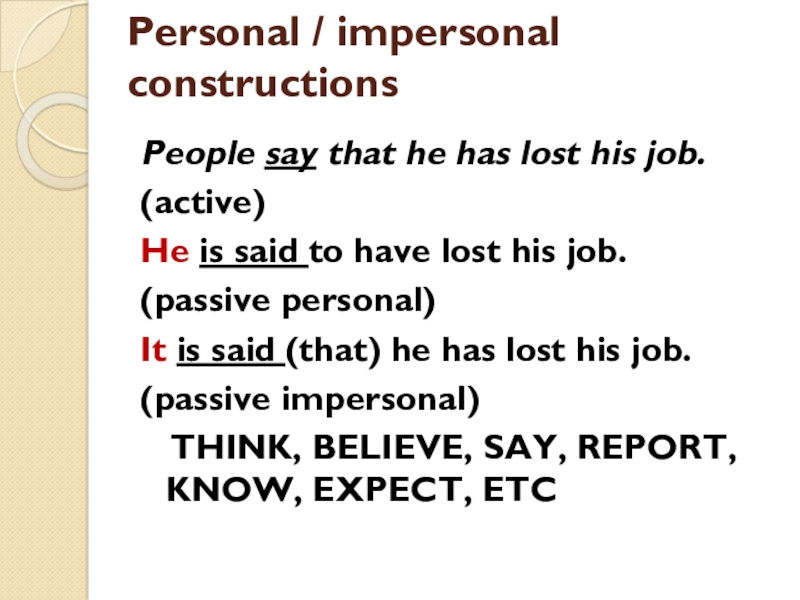
- 15. Personal / impersonal constructions People say that
USE (использование)My grandfather was a builder.He built this house in 1935.(active verb – we say what the subject does)This house is quite old.It was built in 1935 (by my grandfather).(passive verb –We say what happens
Слайд 2USE (использование)
My grandfather was a builder.
He built this house in
1935.
(active verb –
we say what the subject does)
This house is quite old.
It was built in 1935 (by my grandfather).
(passive verb –
We say what happens to the subject)
(active verb –
we say what the subject does)
This house is quite old.
It was built in 1935 (by my grandfather).
(passive verb –
We say what happens to the subject)
Слайд 3USE (использование)
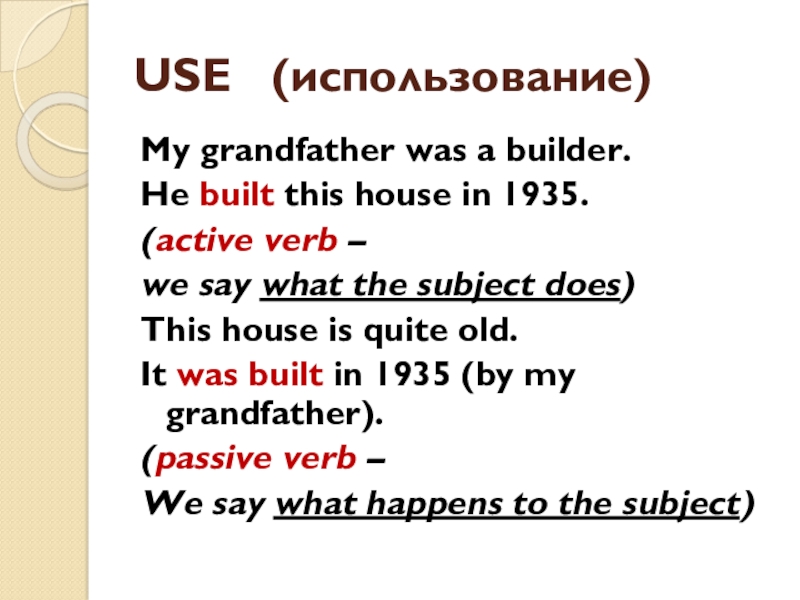
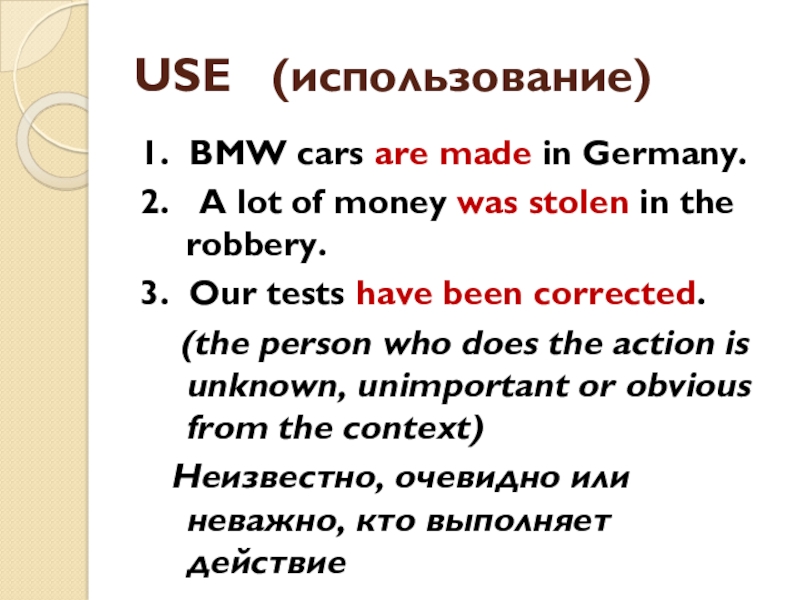
1. BMW cars are made in Germany.
2. A
lot of money was stolen in the robbery.
3. Our tests have been corrected.
(the person who does the action is unknown, unimportant or obvious from the context)
Неизвестно, очевидно или неважно, кто выполняет действие
3. Our tests have been corrected.
(the person who does the action is unknown, unimportant or obvious from the context)
Неизвестно, очевидно или неважно, кто выполняет действие
Слайд 4USE (использование)
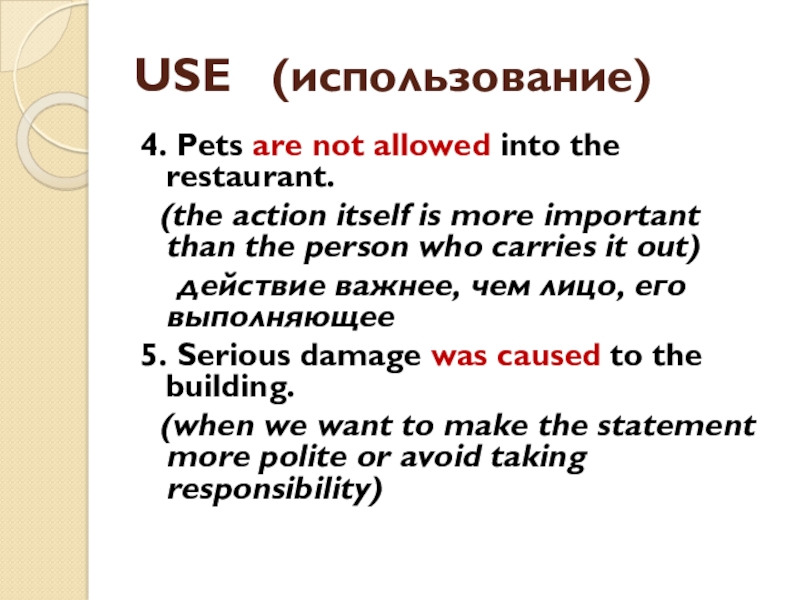
4. Pets are not allowed into the restaurant.
(the
action itself is more important than the person who carries it out)
действие важнее, чем лицо, его выполняющее
5. Serious damage was caused to the building.
(when we want to make the statement more polite or avoid taking responsibility)
действие важнее, чем лицо, его выполняющее
5. Serious damage was caused to the building.
(when we want to make the statement more polite or avoid taking responsibility)
Слайд 5FORM: to be + past participle
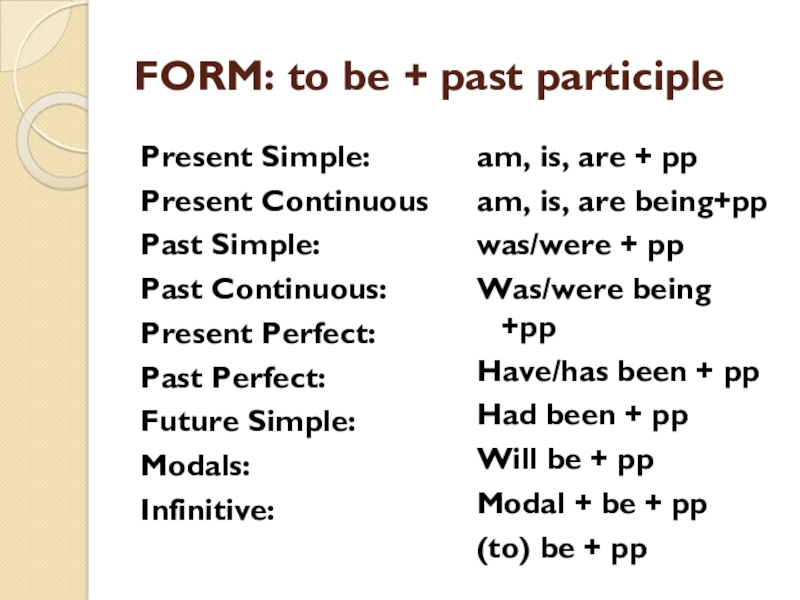
Present Simple:
Present Continuous
Past Simple:
Past Continuous:
Present Perfect:
Past
Perfect:
Future Simple:
Modals:
Infinitive:
Future Simple:
Modals:
Infinitive:
am, is, are + pp
am, is, are being+pp
was/were + pp
Was/were being +pp
Have/has been + pp
Had been + pp
Will be + pp
Modal + be + pp
(to) be + pp
Слайд 6FORM: to be + past participle
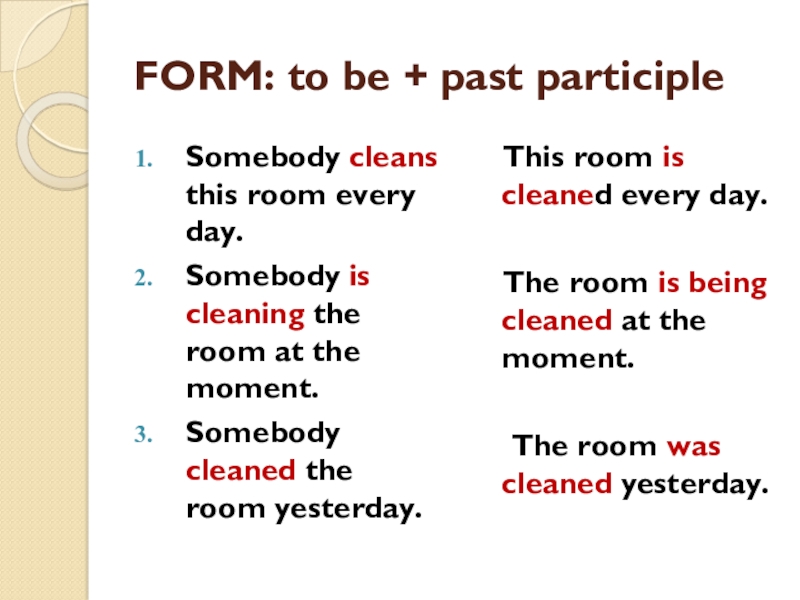
Somebody cleans this room every day.
Somebody
is cleaning the room at the moment.
Somebody cleaned the room yesterday.
Somebody cleaned the room yesterday.
This room is cleaned every day.
The room is being cleaned at the moment.
The room was cleaned yesterday.
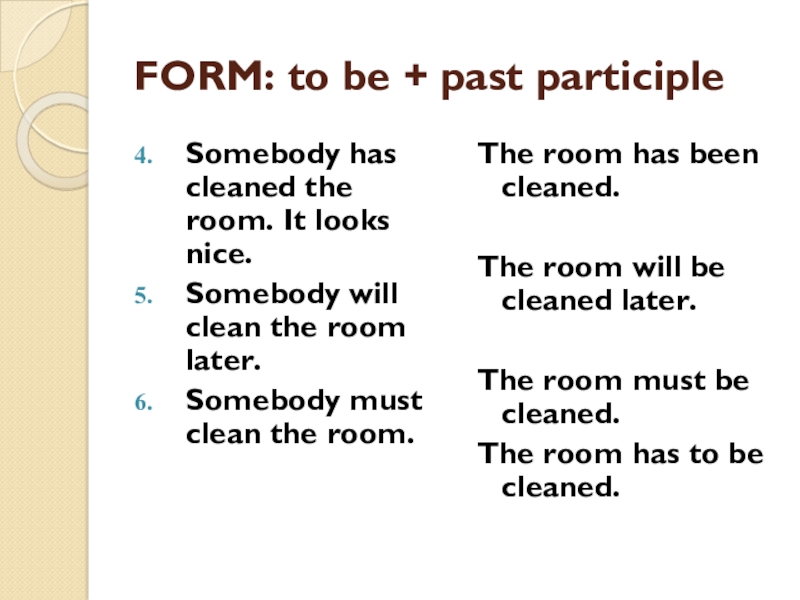
Слайд 7FORM: to be + past participle
Somebody has cleaned the room. It
looks nice.
Somebody will clean the room later.
Somebody must clean the room.
Somebody will clean the room later.
Somebody must clean the room.
The room has been cleaned.
The room will be cleaned later.
The room must be cleaned.
The room has to be cleaned.
Слайд 8Changing from active into passive
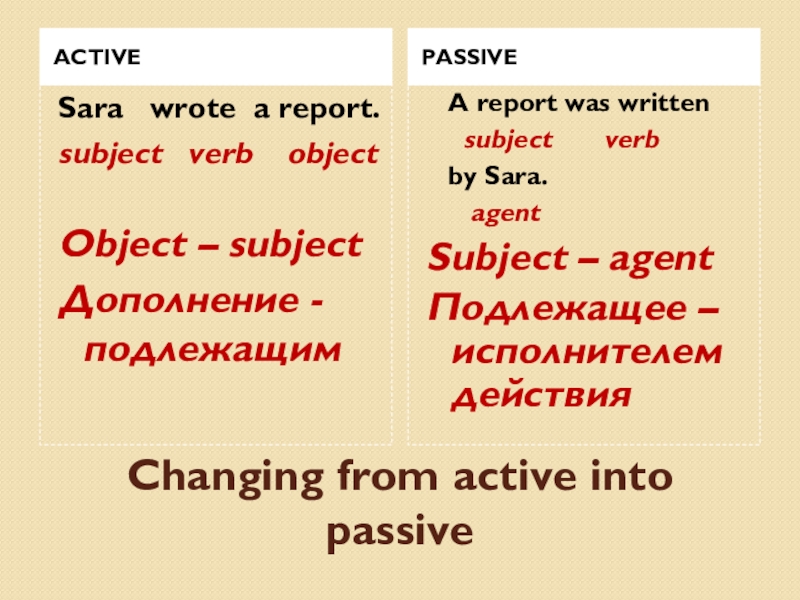
ACTIVE
PASSIVE
Sara wrote a report.
subject verb
object
Object – subject
Дополнение - подлежащим
Object – subject
Дополнение - подлежащим
A report was written
subject verb
by Sara.
agent
Subject – agent
Подлежащее – исполнителем действия
Слайд 9Changing from active into passive
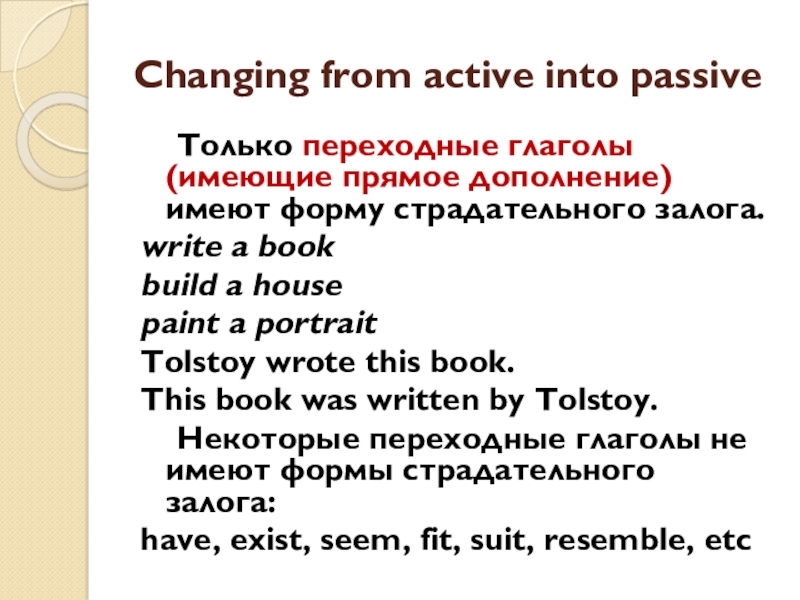
Только переходные глаголы (имеющие прямое
дополнение) имеют форму страдательного залога.
write a book
build a house
paint a portrait
Tolstoy wrote this book.
This book was written by Tolstoy.
Некоторые переходные глаголы не имеют формы страдательного залога:
have, exist, seem, fit, suit, resemble, etc
write a book
build a house
paint a portrait
Tolstoy wrote this book.
This book was written by Tolstoy.
Некоторые переходные глаголы не имеют формы страдательного залога:
have, exist, seem, fit, suit, resemble, etc
Слайд 10Changing from active into passive
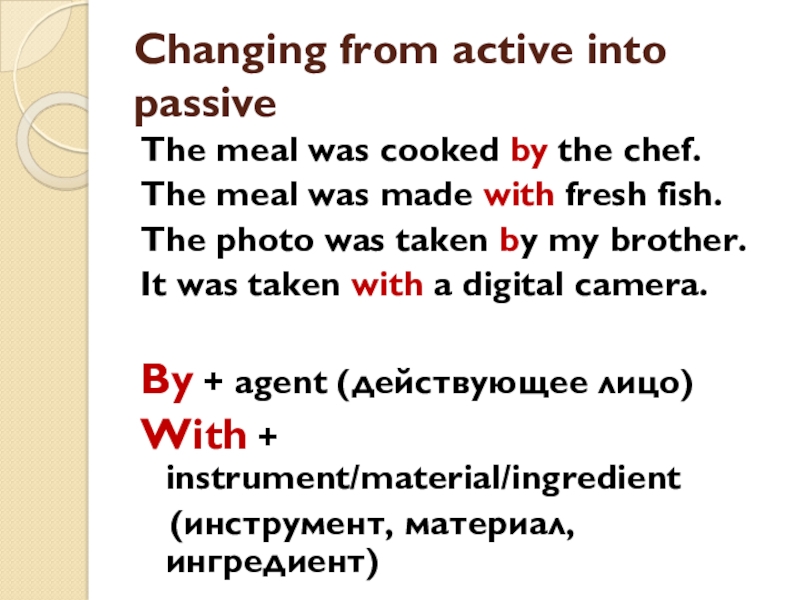
The meal was cooked by the chef.
The
meal was made with fresh fish.
The photo was taken by my brother.
It was taken with a digital camera.
By + agent (действующее лицо)
With + instrument/material/ingredient
(инструмент, материал, ингредиент)
The photo was taken by my brother.
It was taken with a digital camera.
By + agent (действующее лицо)
With + instrument/material/ingredient
(инструмент, материал, ингредиент)
Слайд 11Changing from active into passive
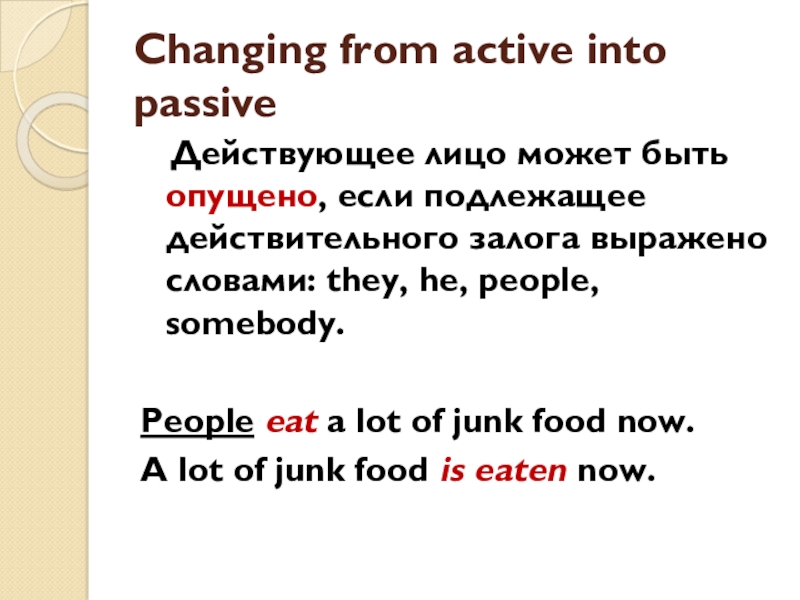
Действующее лицо может быть опущено,
если подлежащее действительного залога выражено словами: they, he, people, somebody.
People eat a lot of junk food now.
A lot of junk food is eaten now.
People eat a lot of junk food now.
A lot of junk food is eaten now.
Слайд 12Changing from active into passive
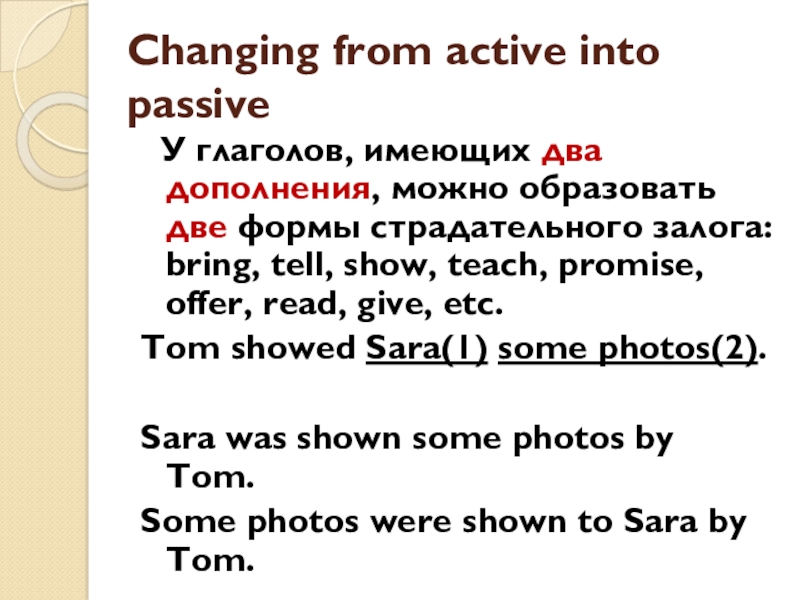
У глаголов, имеющих два дополнения, можно
образовать две формы страдательного залога: bring, tell, show, teach, promise, offer, read, give, etc.
Tom showed Sara(1) some photos(2).
Sara was shown some photos by Tom.
Some photos were shown to Sara by Tom.
Tom showed Sara(1) some photos(2).
Sara was shown some photos by Tom.
Some photos were shown to Sara by Tom.
Слайд 13Changing from active into passive
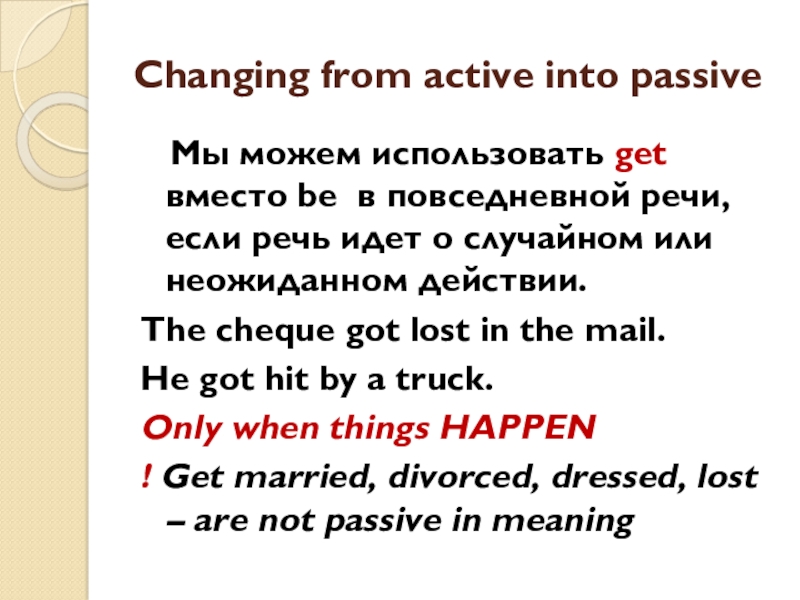
Мы можем использовать get вместо
be в повседневной речи, если речь идет о случайном или неожиданном действии.
The cheque got lost in the mail.
He got hit by a truck.
Only when things HAPPEN
! Get married, divorced, dressed, lost – are not passive in meaning
The cheque got lost in the mail.
He got hit by a truck.
Only when things HAPPEN
! Get married, divorced, dressed, lost – are not passive in meaning
Слайд 14Changing from active into passive
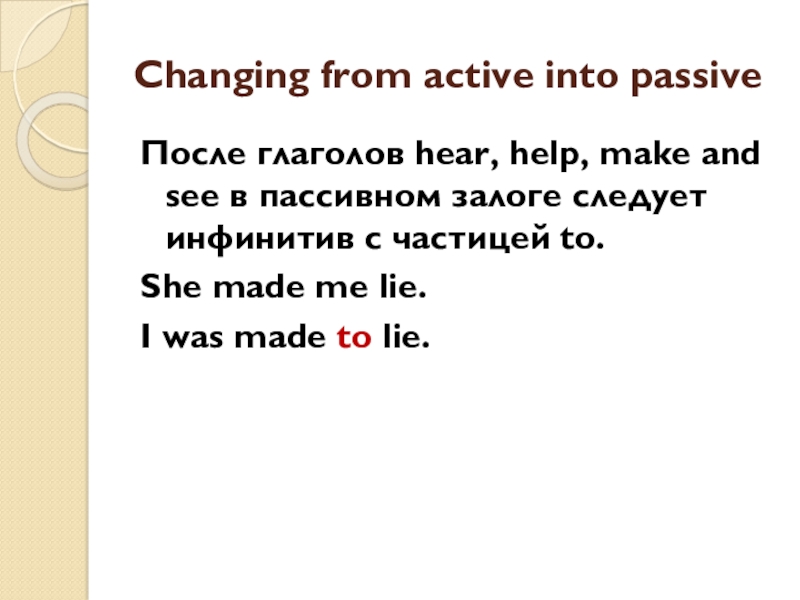
После глаголов hear, help, make and see
в пассивном залоге следует инфинитив с частицей to.
She made me lie.
I was made to lie.
She made me lie.
I was made to lie.
Слайд 15Personal / impersonal constructions
People say that he has lost his job.
(active)
He
is said to have lost his job.
(passive personal)
It is said (that) he has lost his job.
(passive impersonal)
THINK, BELIEVE, SAY, REPORT, KNOW, EXPECT, ETC
(passive personal)
It is said (that) he has lost his job.
(passive impersonal)
THINK, BELIEVE, SAY, REPORT, KNOW, EXPECT, ETC