7«G» form.
Teacher popova Lyudmila alexandrovna.
- Главная
- Разное
- Образование
- Спорт
- Естествознание
- Природоведение
- Религиоведение
- Французский язык
- Черчение
- Английский язык
- Астрономия
- Алгебра
- Биология
- География
- Геометрия
- Детские презентации
- Информатика
- История
- Литература
- Математика
- Музыка
- МХК
- Немецкий язык
- ОБЖ
- Обществознание
- Окружающий мир
- Педагогика
- Русский язык
- Технология
- Физика
- Философия
- Химия
- Шаблоны, фоны, картинки для презентаций
- Экология
- Экономика
Презентация, доклад по английскому языку на тему Вымершие виды животных (7 класс)
Содержание
- 1. Презентация по английскому языку на тему Вымершие виды животных (7 класс)
- 2. Introduction«Black list» is a list of extinct
- 3. Extinct animals from 1500 to 1599 yearsPlagiodontia
- 4. Extinct animals from 1600 to 1699 yearsNyctanassa
- 5. Extinct animals from 1600 to 1699 years
- 6. Extinct animals from 1700 to 1799 years
- 7. Extinct animals from XIX to XX centuriesQuagga,
- 8. Extinct animals from XIX to XX centuries
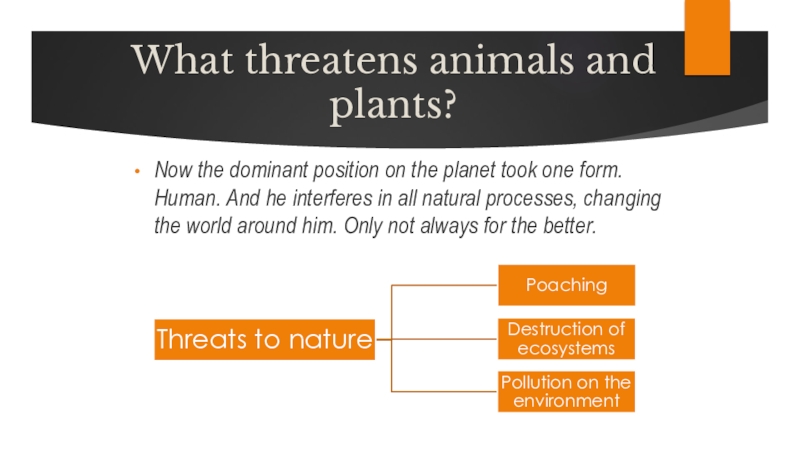
- 9. What threatens animals and plants?Now the dominant
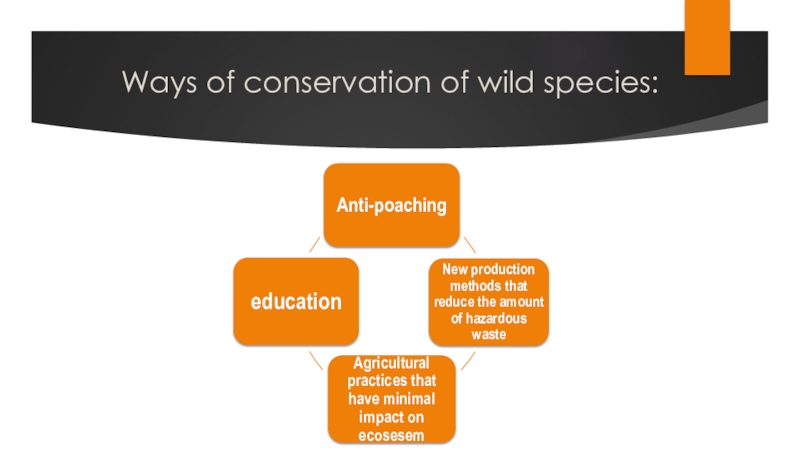
- 10. Ways of conservation of wild species:
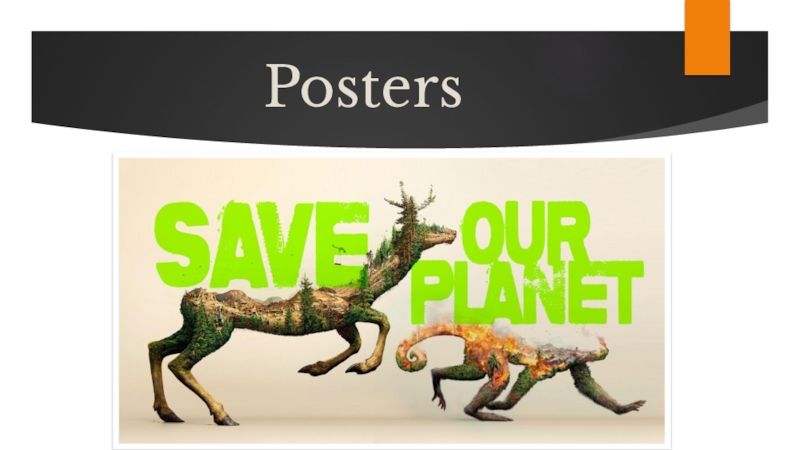
- 11. Posters
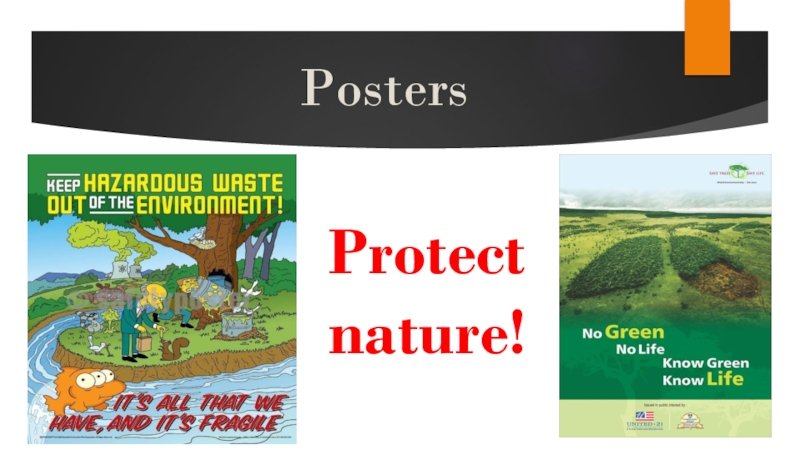
- 12. PostersProtect nature!
Introduction«Black list» is a list of extinct species, dating back to 1600.The list includes species whose existence was recorded in the monuments of culture, there is some information about the observation of these animals by naturalists
Слайд 2Introduction
«Black list» is a list of extinct species, dating back to
1600.The list includes species whose existence was recorded in the monuments of culture, there is some information about the observation of these animals by naturalists or travelers, but to the present day they do not exist. According to the World Conservation Union for 2008, 844 species of animals have completely died out in the last 500 years.
The «Black list» is published on the first pages of the Red Book.
Слайд 3Extinct animals from 1500 to 1599 years
Plagiodontia ipnaeum - an extinct
rodent of the hutei family, formerly found in the Dominican Republic and Haiti.The natural habitats of the beast were subtropical and tropical moist forests. The last mentions refer to the interval between 1536-1546.
Quemisia gravis – rodent belonging to the family Heptaxodontidae. Previously met in the Dominican Republic and Haiti. The last mention refers to the gap between 1536-1546. The cause of extinction is the disappearance of natural habitats.
Noronhomys vespuccii – an extinct rodent inhabiting the Fernando-di-Noronha archipelago. Presumably extinct because of the introduction of shipworms on the islands from the ships of Amerigo Vespucci, who occupied the ecological niche of rice mice. The last mentions refer to 1503.
Nycticorax olsoni – the night bird of the family of the czarids, who lived on the Isle of Ascension, the last mentions refer to 1555 according to one data and by 1502 to others.
Quemisia gravis – rodent belonging to the family Heptaxodontidae. Previously met in the Dominican Republic and Haiti. The last mention refers to the gap between 1536-1546. The cause of extinction is the disappearance of natural habitats.
Noronhomys vespuccii – an extinct rodent inhabiting the Fernando-di-Noronha archipelago. Presumably extinct because of the introduction of shipworms on the islands from the ships of Amerigo Vespucci, who occupied the ecological niche of rice mice. The last mentions refer to 1503.
Nycticorax olsoni – the night bird of the family of the czarids, who lived on the Isle of Ascension, the last mentions refer to 1555 according to one data and by 1502 to others.
Слайд 4Extinct animals from 1600 to 1699 years
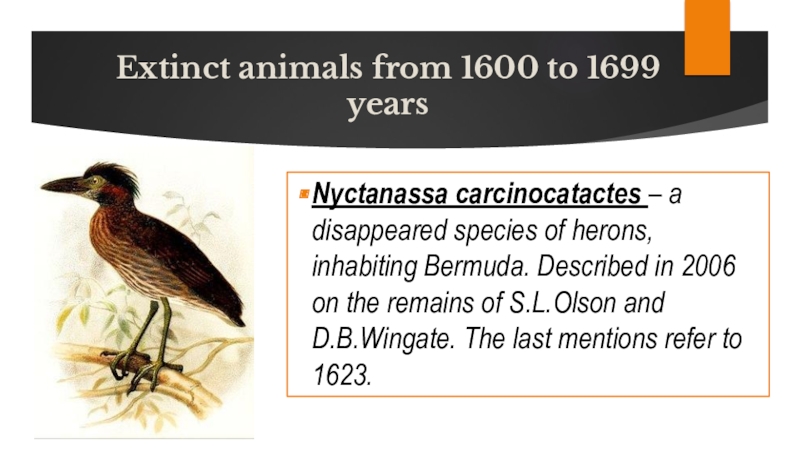
Nyctanassa carcinocatactes – a disappeared
species of herons, inhabiting Bermuda. Described in 2006 on the remains of S.L.Olson and D.B.Wingate. The last mentions refer to 1623.
Слайд 5Extinct animals from 1600 to 1699 years (continuation)
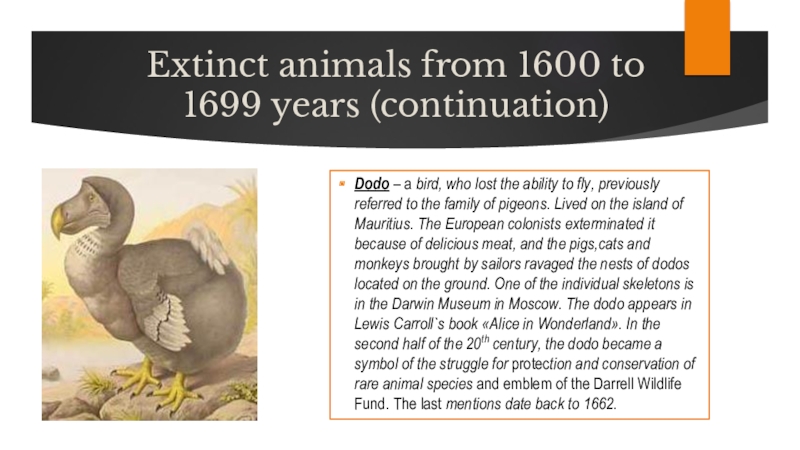
Dodo – a bird,
who lost the ability to fly, previously referred to the family of pigeons. Lived on the island of Mauritius. The European colonists exterminated it because of delicious meat, and the pigs,cats and monkeys brought by sailors ravaged the nests of dodos located on the ground. One of the individual skeletons is in the Darwin Museum in Moscow. The dodo appears in Lewis Carroll`s book «Alice in Wonderland». In the second half of the 20th century, the dodo became a symbol of the struggle for protection and conservation of rare animal species and emblem of the Darrell Wildlife Fund. The last mentions date back to 1662.
Слайд 6Extinct animals from 1700 to 1799 years
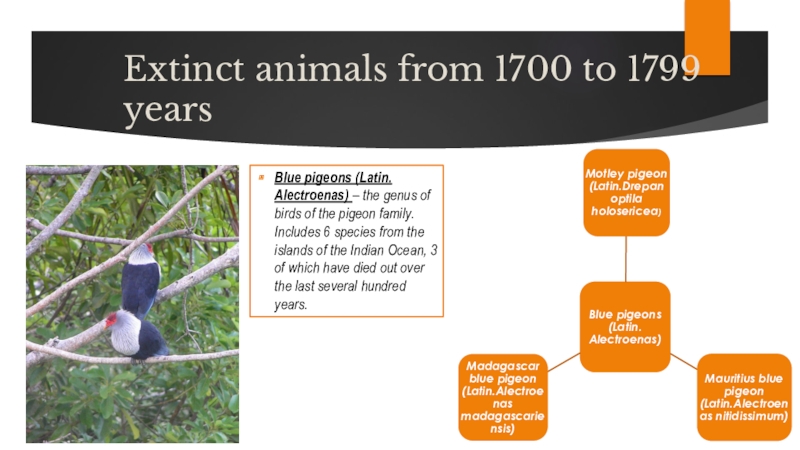
Blue pigeons (Latin. Alectroenas)
– the genus of birds of the pigeon family. Includes 6 species from the islands of the Indian Ocean, 3 of which have died out over the last several hundred years.
Слайд 7Extinct animals from XIX to XX centuries
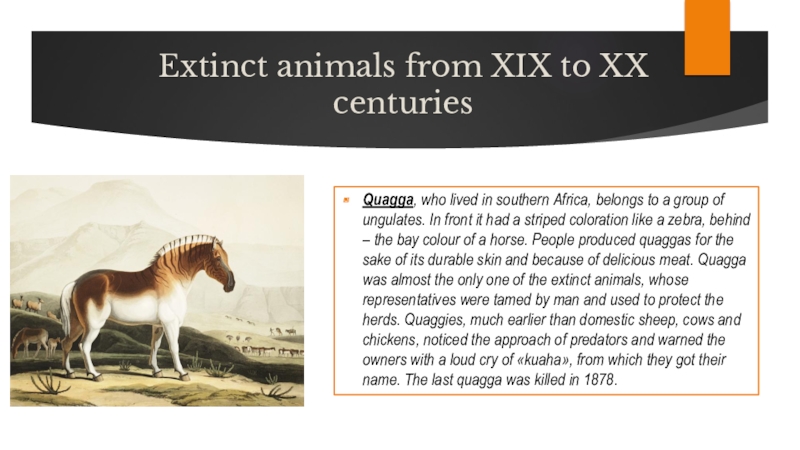
Quagga, who lived in southern
Africa, belongs to a group of ungulates. In front it had a striped coloration like a zebra, behind – the bay colour of a horse. People produced quaggas for the sake of its durable skin and because of delicious meat. Quagga was almost the only one of the extinct animals, whose representatives were tamed by man and used to protect the herds. Quaggies, much earlier than domestic sheep, cows and chickens, noticed the approach of predators and warned the owners with a loud cry of «kuaha», from which they got their name. The last quagga was killed in 1878.
Слайд 8Extinct animals from XIX to XX centuries (continuation)
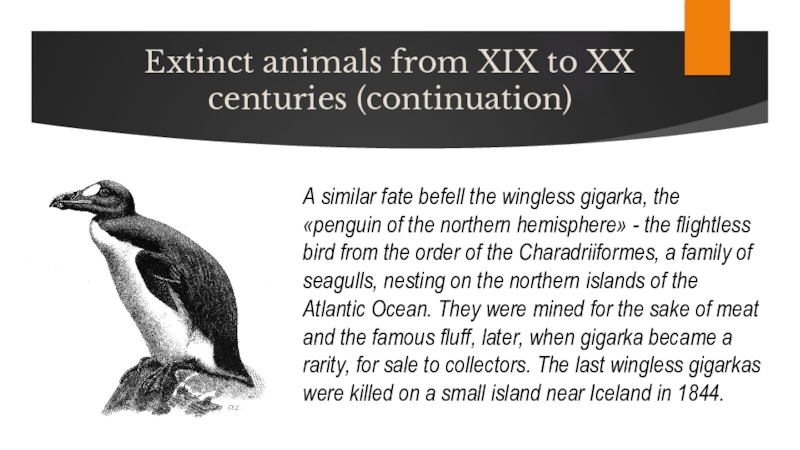
A similar fate befell
the wingless gigarka, the «penguin of the northern hemisphere» - the flightless bird from the order of the Charadriiformes, a family of seagulls, nesting on the northern islands of the Atlantic Ocean. They were mined for the sake of meat and the famous fluff, later, when gigarka became a rarity, for sale to collectors. The last wingless gigarkas were killed on a small island near Iceland in 1844.
Слайд 9What threatens animals and plants?
Now the dominant position on the planet
took one form. Human. And he interferes in all natural processes, changing the world around him. Only not always for the better.