Презентация, доклад по английскому языку на тему Принцесса Диана

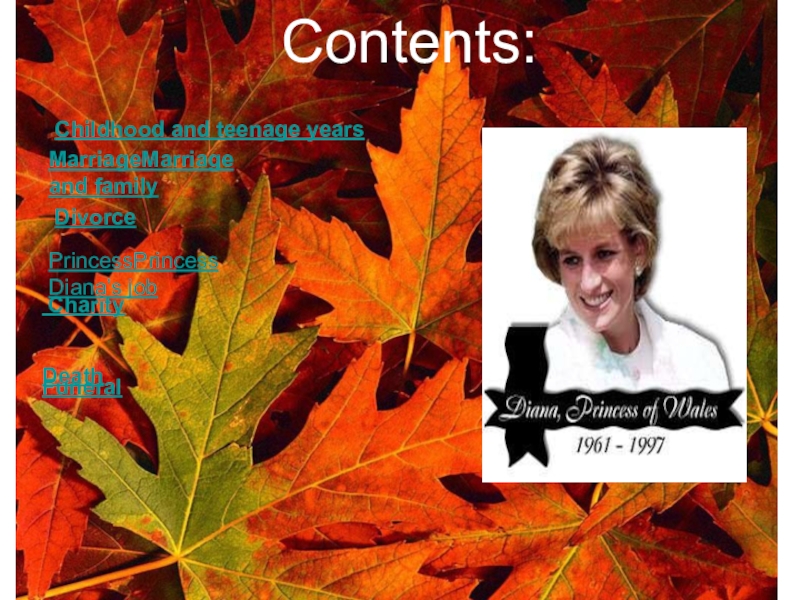
Contents: Childhood and teenage years MarriageMarriage and family DivorcePrincessPrincess Diana’s job Charity DeathFuneral

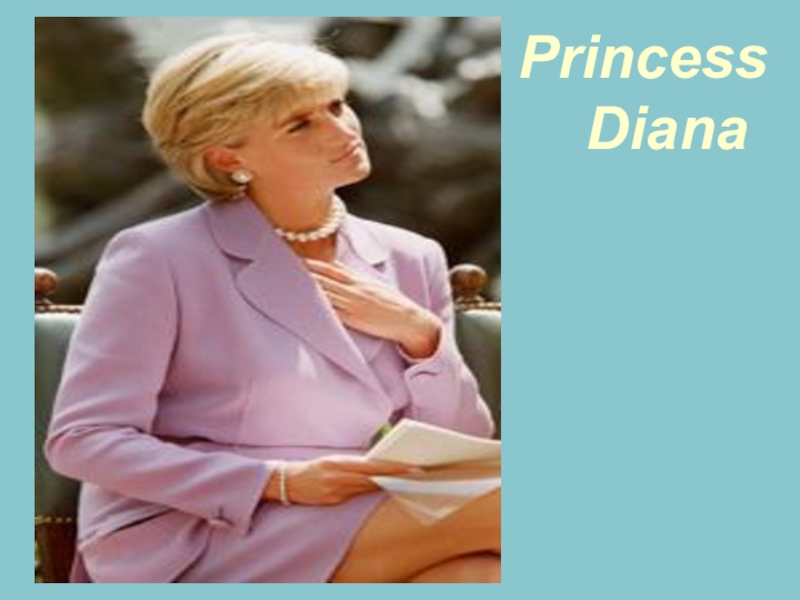
Слайд 1 Princess
Diana

Princess    Diana

Слайд 2
Contents:
Childhood and teenage years
MarriageMarriage and family
Divorce
PrincessPrincess Diana’s job

Charity

Death

Funeral

Contents: Childhood and teenage years MarriageMarriage and family DivorcePrincessPrincess Diana’s job Charity DeathFuneral

Слайд 3

Childhood and teenage years.


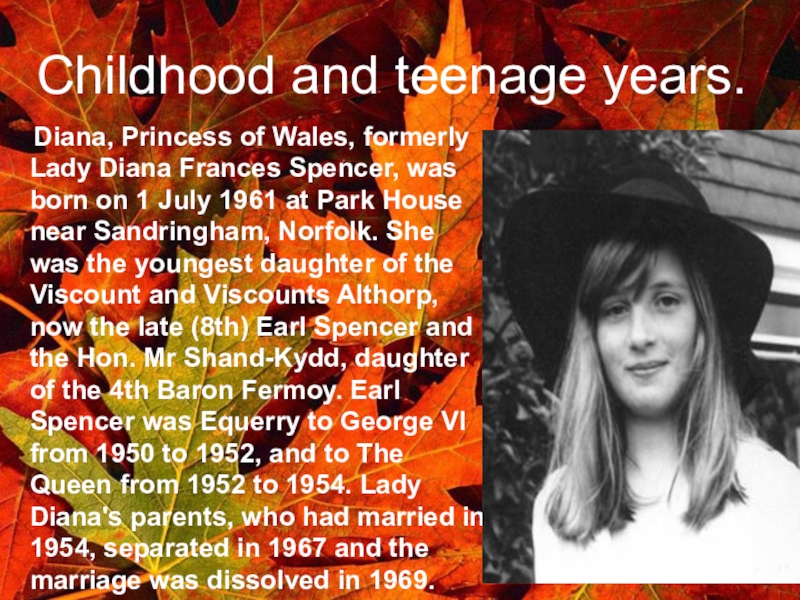
Diana, Princess of Wales, formerly Lady Diana Frances Spencer, was born on 1 July 1961 at Park House near Sandringham, Norfolk. She was the youngest daughter of the Viscount and Viscounts Althorp, now the late (8th) Earl Spencer and the Hon. Mr Shand-Kydd, daughter of the 4th Baron Fermoy. Earl Spencer was Equerry to George VI from 1950 to 1952, and to The Queen from 1952 to 1954. Lady Diana's parents, who had married in 1954, separated in 1967 and the marriage was dissolved in 1969.

Childhood and teenage years.

Слайд 4

Childhood and teenage years.


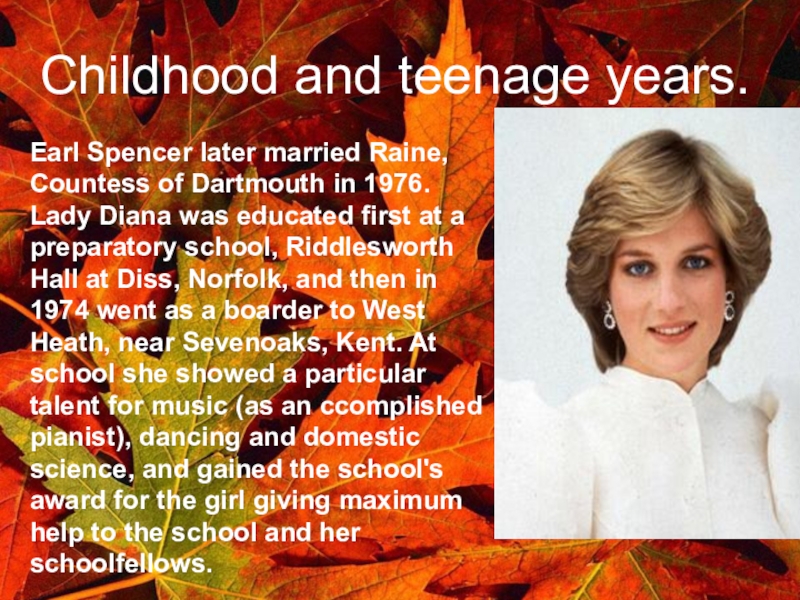
Earl Spencer later married Raine, Countess of Dartmouth in 1976. Lady Diana was educated first at a preparatory school, Riddlesworth Hall at Diss, Norfolk, and then in 1974 went as a boarder to West Heath, near Sevenoaks, Kent. At school she showed a particular talent for music (as an ccomplished pianist), dancing and domestic science, and gained the school's award for the girl giving maximum help to the school and her schoolfellows.

Childhood and teenage years.

Слайд 5

Childhood and teenage years.


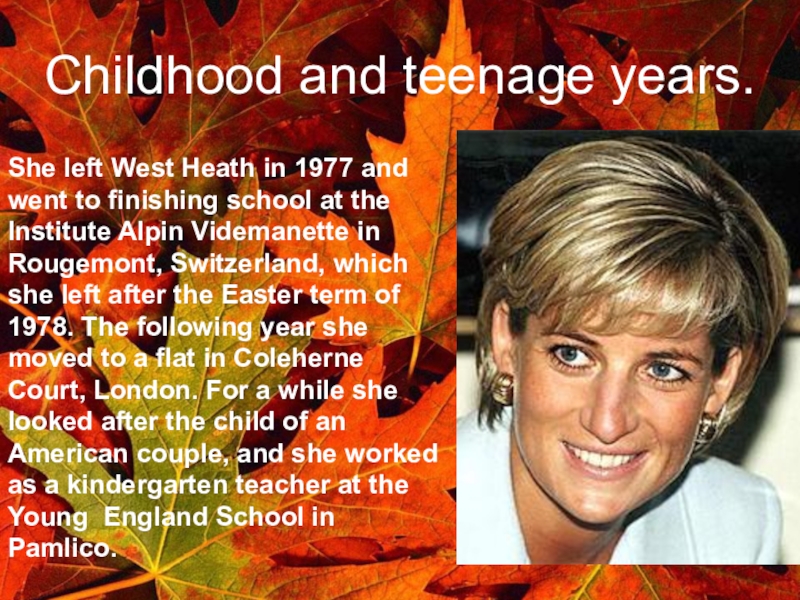
She left West Heath in 1977 and went to finishing school at the Institute Alpin Videmanette in Rougemont, Switzerland, which she left after the Easter term of 1978. The following year she moved to a flat in Coleherne Court, London. For a while she looked after the child of an American couple, and she worked as a kindergarten teacher at the Young England School in Pamlico.

Childhood and teenage years.

Слайд 6
Marriage and family .
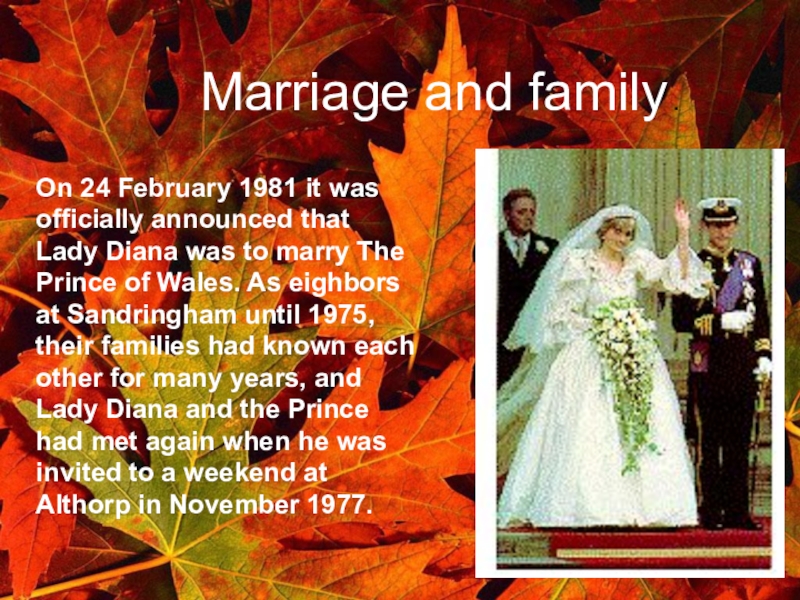
On 24 February 1981 it was officially announced

that Lady Diana was to marry The Prince of Wales. As eighbors at Sandringham until 1975, their families had known each other for many years, and Lady Diana and the Prince had met again when he was invited to a weekend at Althorp in November 1977.
Marriage and family .On 24 February 1981 it was officially announced that Lady Diana was to marry

Слайд 7
Marriage and family .
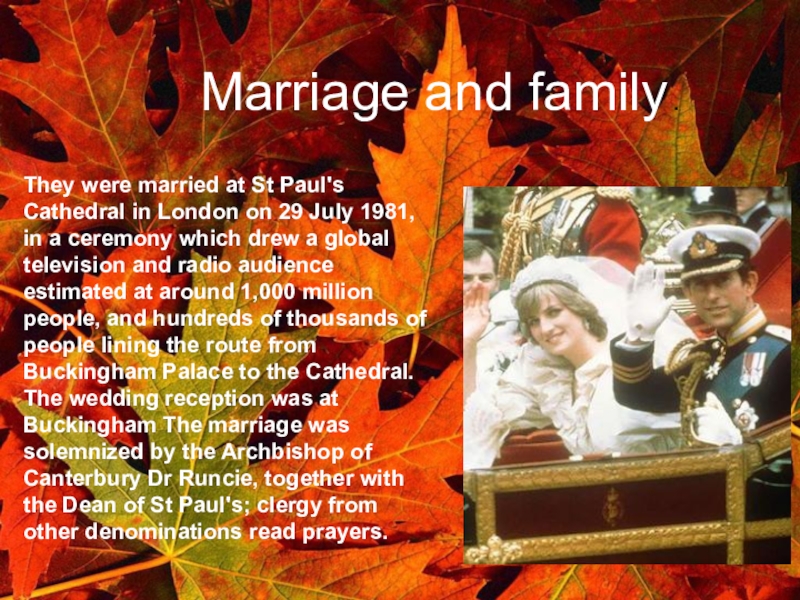
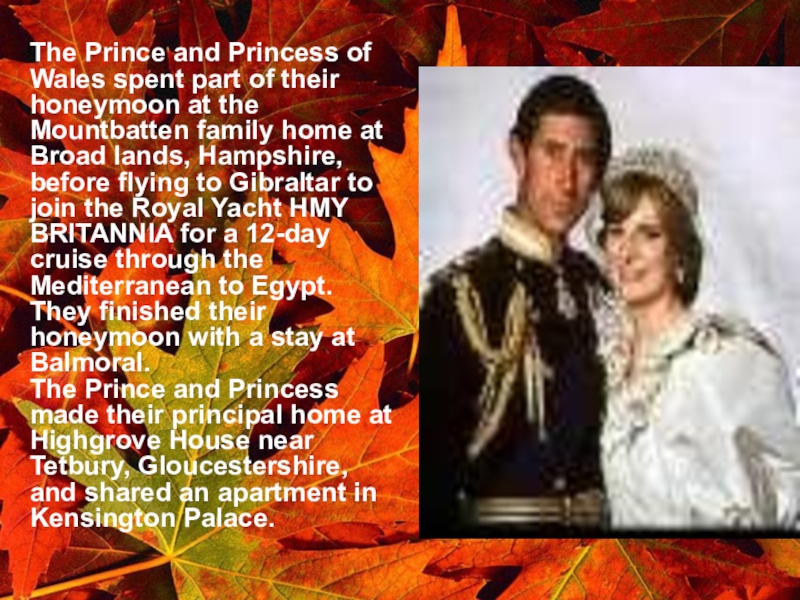
They were married at St Paul's Cathedral in

London on 29 July 1981, in a ceremony which drew a global television and radio audience estimated at around 1,000 million people, and hundreds of thousands of people lining the route from Buckingham Palace to the Cathedral. The wedding reception was at Buckingham The marriage was solemnized by the Archbishop of Canterbury Dr Runcie, together with the Dean of St Paul's; clergy from other denominations read prayers.
Marriage and family .They were married at St Paul's Cathedral in London on 29 July 1981, in

Слайд 8
Marriage and family .
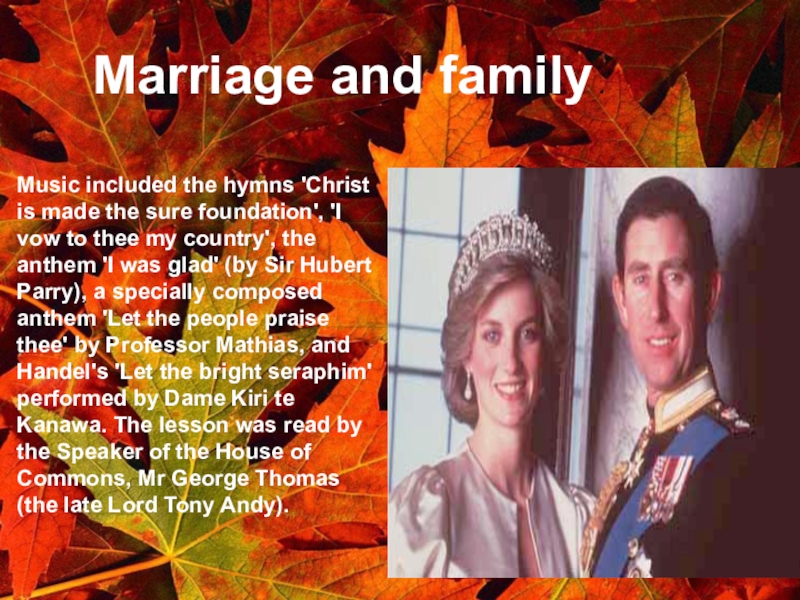
Music included the hymns 'Christ is made the

sure foundation', 'I vow to thee my country', the anthem 'I was glad' (by Sir Hubert Parry), a specially composed anthem 'Let the people praise thee' by Professor Mathias, and Handel's 'Let the bright seraphim' performed by Dame Kiri te Kanawa. The lesson was read by the Speaker of the House of Commons, Mr George Thomas (the late Lord Tony Andy).
Marriage and family .Music included the hymns 'Christ is made the sure foundation', 'I vow to thee

Слайд 9
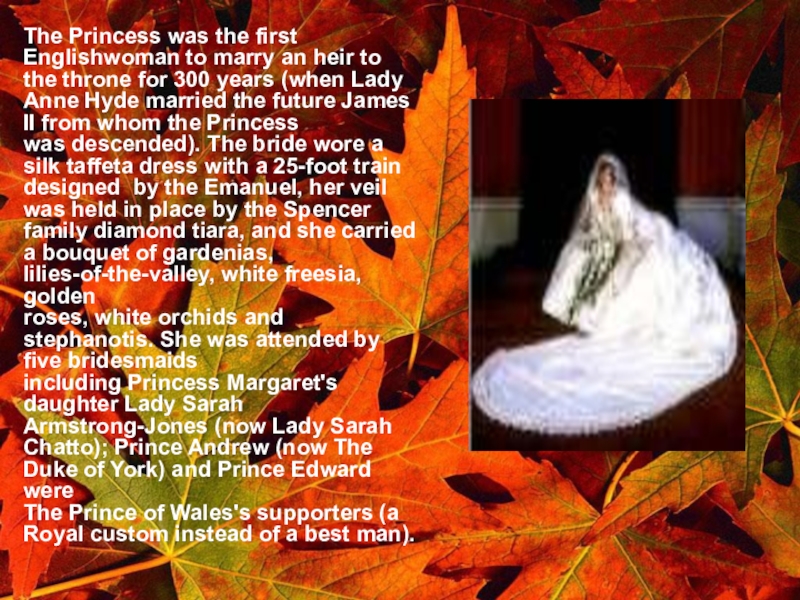
The Princess was the first Englishwoman to marry an heir to

the throne for 300 years (when Lady Anne Hyde married the future James II from whom the Princess was descended). The bride wore a silk taffeta dress with a 25-foot train designed by the Emanuel, her veil was held in place by the Spencer family diamond tiara, and she carried a bouquet of gardenias, lilies-of-the-valley, white freesia, golden roses, white orchids and stephanotis. She was attended by five bridesmaids including Princess Margaret's daughter Lady Sarah Armstrong-Jones (now Lady Sarah Chatto); Prince Andrew (now The Duke of York) and Prince Edward were The Prince of Wales's supporters (a Royal custom instead of a best man).
The Princess was the first Englishwoman to marry an heir to the throne for 300 years (when

Слайд 10
The Prince and Princess of Wales spent part of their honeymoon

at the Mountbatten family home at Broad lands, Hampshire, before flying to Gibraltar to join the Royal Yacht HMY BRITANNIA for a 12-day cruise through the Mediterranean to Egypt. They finished their honeymoon with a stay at Balmoral. The Prince and Princess made their principal home at Highgrove House near Tetbury, Gloucestershire, and shared an apartment in Kensington Palace.
The Prince and Princess of Wales spent part of their honeymoon at the  Mountbatten family

Слайд 11
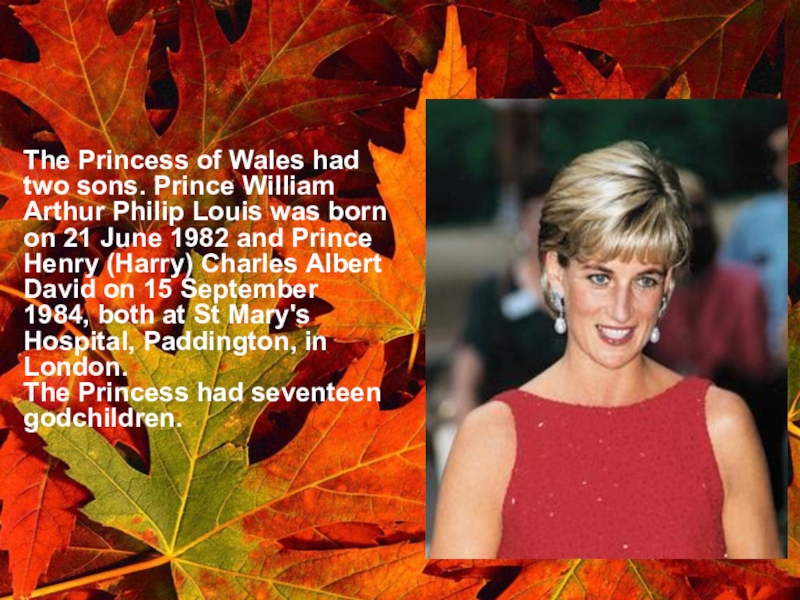
The Princess of Wales had two sons. Prince William Arthur Philip

Louis was born on 21 June 1982 and Prince Henry (Harry) Charles Albert David on 15 September 1984, both at St Mary's Hospital, Paddington, in London. The Princess had seventeen godchildren.

The Princess of Wales had two sons. Prince William Arthur Philip Louis was born  on

Слайд 12`
Divorce
In December 1992 it was announced that The Prince and Princess

of Wales had agreed to separate. The Princess based her household and her office at Kensington Palace, while The Prince was based at St James's Palace and continued to live at Highgrove. In November 1995, the Princess gave a television interview during which she spoke of her unhappiness in her personal life and the pressures of her public role. The Prince and Princess were divorced on 28 August 1996.The Prince and Princess continued to share equal responsibility for the upbringing of their children.
`DivorceIn December 1992 it was announced that The Prince and Princess of Wales had agreed to separate.

Слайд 13`
Divorce
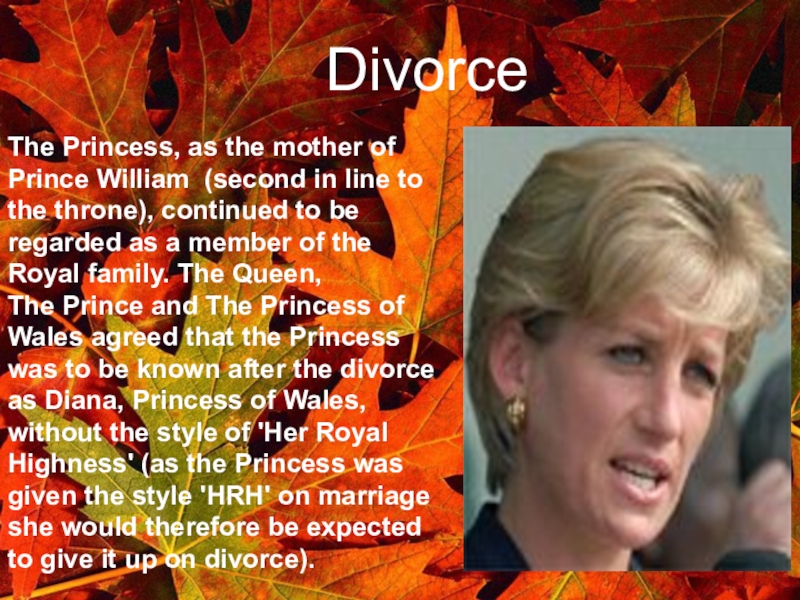
The Princess, as the mother of Prince William (second in line

to the throne), continued to be regarded as a member of the Royal family. The Queen, The Prince and The Princess of Wales agreed that the Princess was to be known after the divorce as Diana, Princess of Wales, without the style of 'Her Royal Highness' (as the Princess was given the style 'HRH' on marriage she would therefore be expected to give it up on divorce).
`DivorceThe Princess, as the mother of Prince William (second in line to the throne), continued to be

Слайд 14
Princess Diana’s job

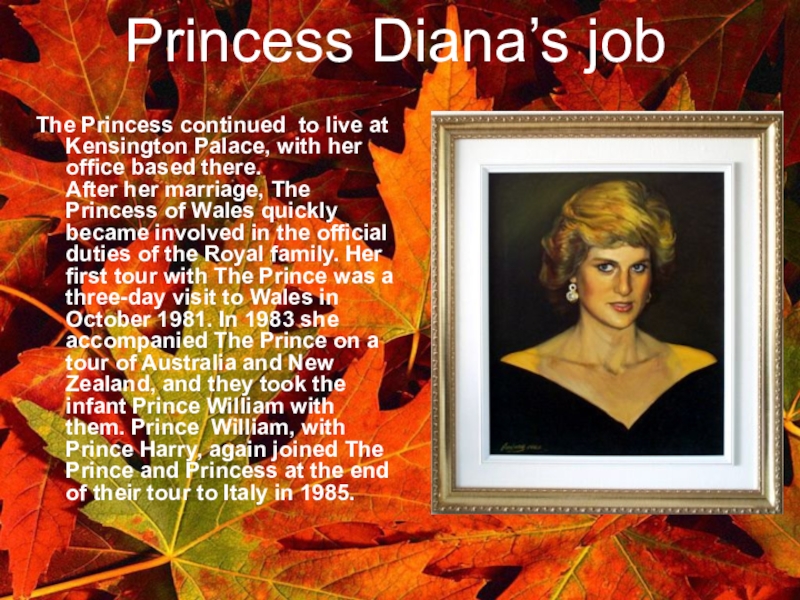
The Princess continued to live at Kensington Palace, with

her office based there. After her marriage, The Princess of Wales quickly became involved in the official duties of the Royal family. Her first tour with The Prince was a three-day visit to Wales in October 1981. In 1983 she accompanied The Prince on a tour of Australia and New Zealand, and they took the infant Prince William with them. Prince William, with Prince Harry, again joined The Prince and Princess at the end of their tour to Italy in 1985.
Princess Diana’s job	The Princess continued to live at Kensington Palace, with her office based there.  After

Слайд 15
Princess Diana’s job
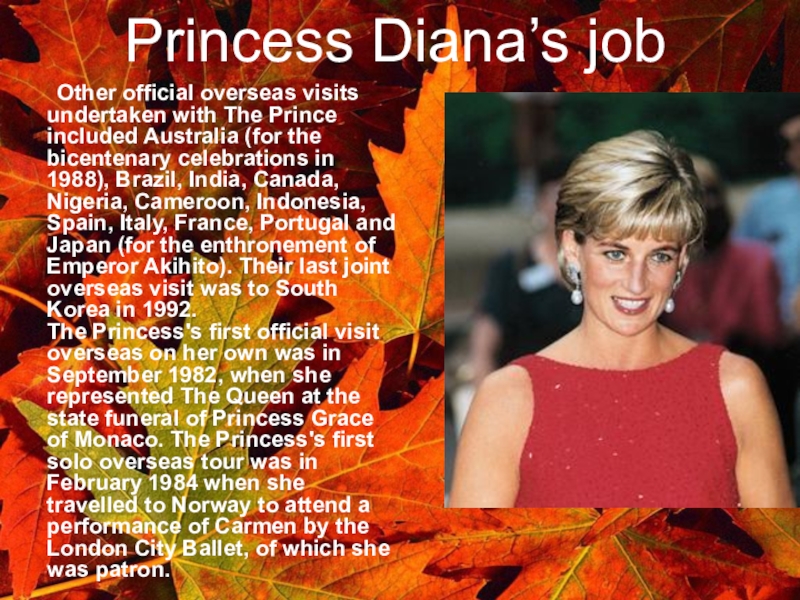
Other official overseas visits undertaken with The Prince included

Australia (for the bicentenary celebrations in 1988), Brazil, India, Canada, Nigeria, Cameroon, Indonesia, Spain, Italy, France, Portugal and Japan (for the enthronement of Emperor Akihito). Their last joint overseas visit was to South Korea in 1992. The Princess's first official visit overseas on her own was in September 1982, when she represented The Queen at the state funeral of Princess Grace of Monaco. The Princess's first solo overseas tour was in February 1984 when she travelled to Norway to attend a performance of Carmen by the London City Ballet, of which she was patron.
Princess Diana’s job	Other official overseas visits undertaken with The Prince  included Australia (for the bicentenary celebrations

Слайд 16
Princess Diana’s job
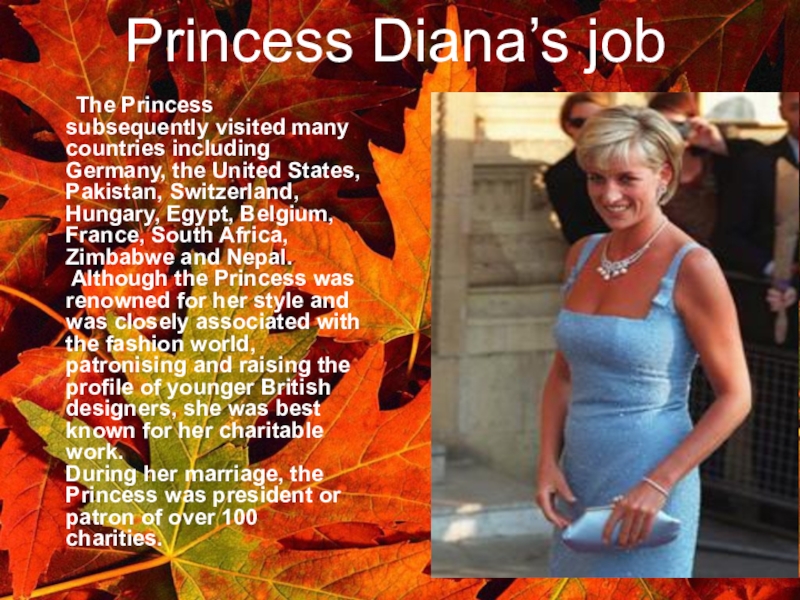
The Princess subsequently visited many countries including Germany, the

United States, Pakistan, Switzerland, Hungary, Egypt, Belgium, France, South Africa, Zimbabwe and Nepal. Although the Princess was renowned for her style and was closely associated with the fashion world, patronising and raising the profile of younger British designers, she was best known for her charitable work. During her marriage, the Princess was president or patron of over 100 charities.
Princess Diana’s job	The Princess subsequently visited many countries including Germany, the United States, Pakistan, Switzerland, Hungary, Egypt,

Слайд 17
Charity
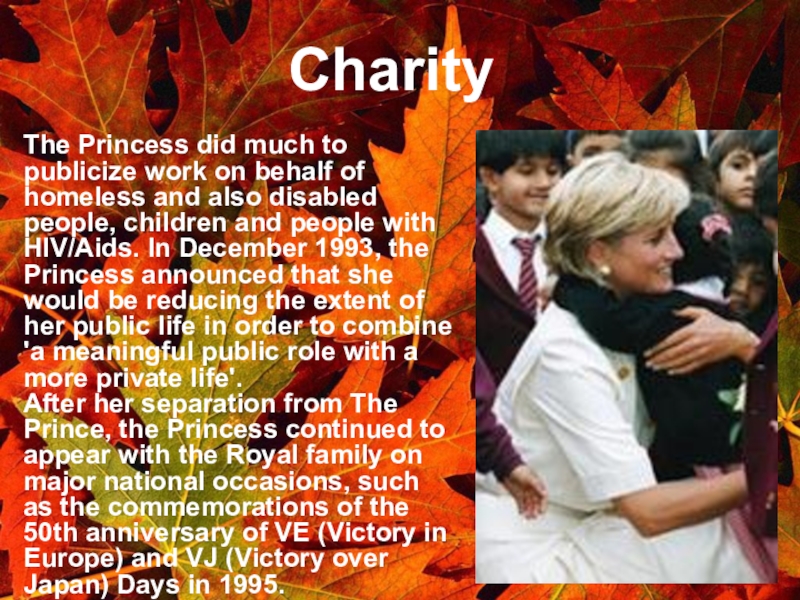
The Princess did much to publicize work on behalf of homeless

and also disabled people, children and people with HIV/Aids. In December 1993, the Princess announced that she would be reducing the extent of her public life in order to combine 'a meaningful public role with a more private life'. After her separation from The Prince, the Princess continued to appear with the Royal family on major national occasions, such as the commemorations of the 50th anniversary of VE (Victory in Europe) and VJ (Victory over Japan) Days in 1995.
CharityThe Princess did much to publicize work on behalf of homeless and also disabled people, children and

Слайд 18
Charity.
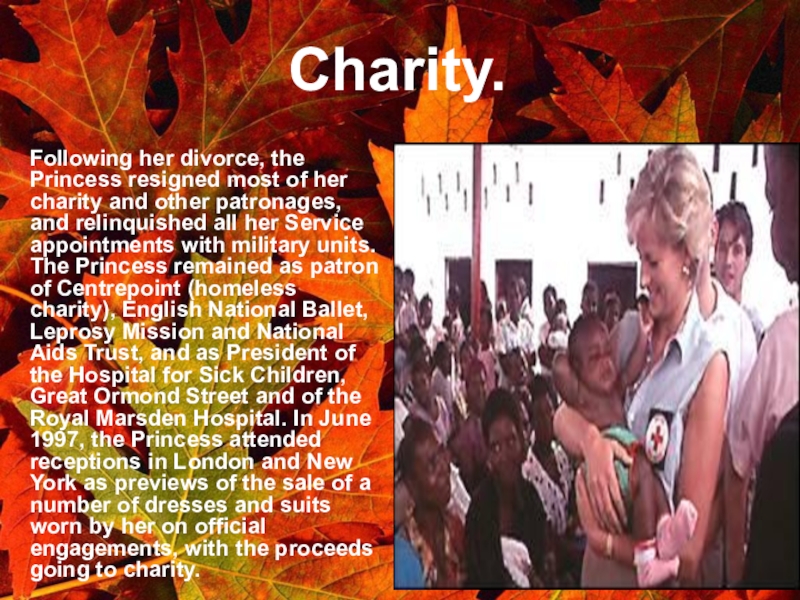
Following her divorce, the Princess resigned most of her charity and

other patronages, and relinquished all her Service appointments with military units. The Princess remained as patron of Centrepoint (homeless charity), English National Ballet, Leprosy Mission and National Aids Trust, and as President of the Hospital for Sick Children, Great Ormond Street and of the Royal Marsden Hospital. In June 1997, the Princess attended receptions in London and New York as previews of the sale of a number of dresses and suits worn by her on official engagements, with the proceeds going to charity.
Charity. Following her divorce, the Princess resigned most of her charity and other patronages, and relinquished all

Слайд 19
Death.
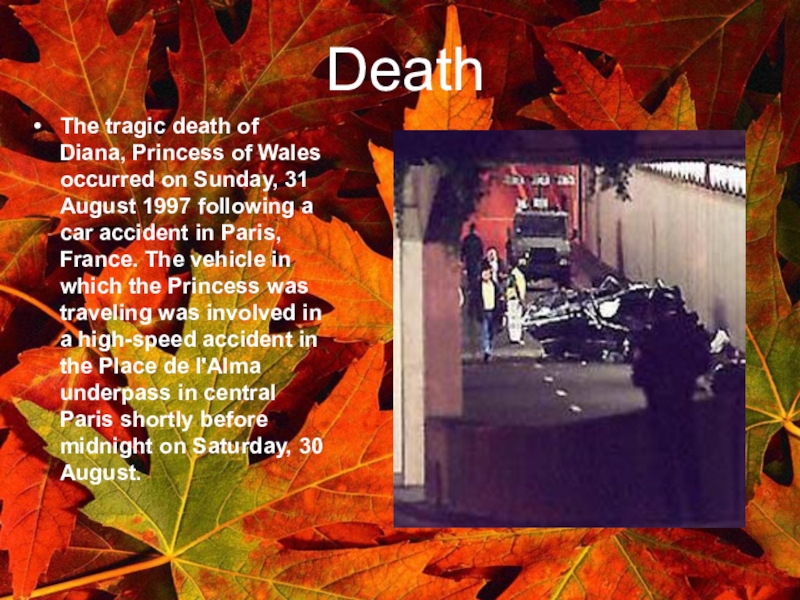
The tragic death of Diana, Princess of Wales occurred on Sunday,

31 August 1997 following a car accident in Paris, France. The vehicle in which the Princess was traveling was involved in a high-speed accident in the Place de l'Alma underpass in central Paris shortly before midnight on Saturday, 30 August.
Death.The tragic death of Diana, Princess of Wales occurred on Sunday, 31 August 1997 following a car

Слайд 20
Death.
The Princess was taken to the La Pitie Salpetriere Hospital, where

she underwent two hours of mergency surgery before being declared dead at 0300 BST. The Princess's companion, Mr Dodi Fayed, and the driver of the vehicle died in the accident, whilst a bodyguard was seriously injured.
Death.The Princess was taken to the La Pitie Salpetriere Hospital, where she underwent two hours of mergency

Слайд 21`
Funeral.
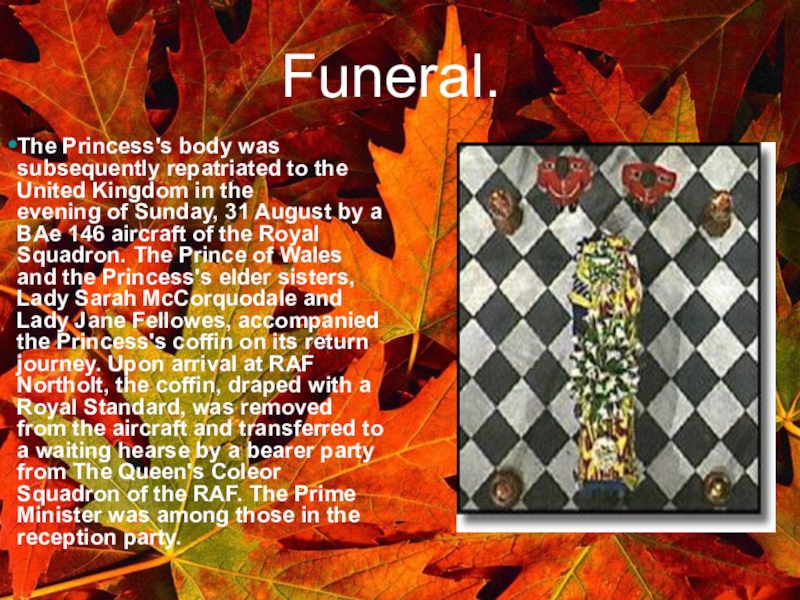
The Princess's body was subsequently repatriated to the United Kingdom in

the evening of Sunday, 31 August by a BAe 146 aircraft of the Royal Squadron. The Prince of Wales and the Princess's elder sisters, Lady Sarah McCorquodale and Lady Jane Fellowes, accompanied the Princess's coffin on its return journey. Upon arrival at RAF Northolt, the coffin, draped with a Royal Standard, was removed from the aircraft and transferred to a waiting hearse by a bearer party from The Queen's Coleor Squadron of the RAF. The Prime Minister was among those in the reception party.
`Funeral.The Princess's body was subsequently repatriated to the United Kingdom in the  evening of Sunday, 31

Слайд 22`
Funeral.
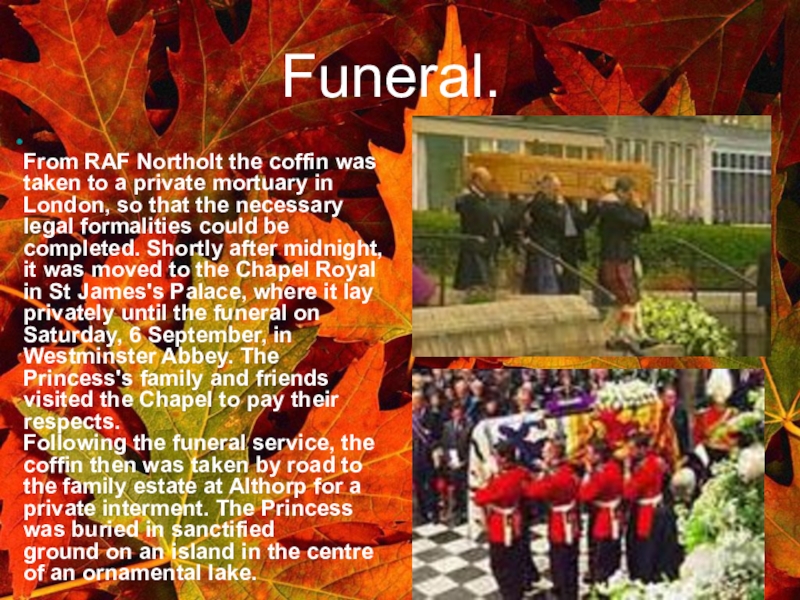
From RAF Northolt the coffin was taken to a private mortuary

in London, so that the necessary legal formalities could be completed. Shortly after midnight, it was moved to the Chapel Royal in St James's Palace, where it lay privately until the funeral on Saturday, 6 September, in Westminster Abbey. The Princess's family and friends visited the Chapel to pay their respects. Following the funeral service, the coffin then was taken by road to the family estate at Althorp for a private interment. The Princess was buried in sanctified ground on an island in the centre of an ornamental lake.
`Funeral. From RAF Northolt the coffin was taken to a private mortuary in London, so that the

Слайд 23
Used Literature:


Botham N. The Murder of Princess Diana

Tim Vicary “Oxford Bookworms

Factfiles 1 : Diana, Princess of Wales”
Charry Gilchrist “Penguin Readers Series Level 3 : Princess Diana”

Portraits of a Princess: Travels with Diana

Representing Diana, Princess of Wales: Cultural Memory

Oxford Bookworms Factfiles 1. Diana princess of Wales.
Used Literature:Botham N. The Murder of Princess DianaTim Vicary “Oxford Bookworms Factfiles 1 : Diana, Princess of
Что такое shareslide.ru?

Это сайт презентаций, где можно хранить и обмениваться своими презентациями, докладами, проектами, шаблонами в формате PowerPoint с другими пользователями. Мы помогаем школьникам, студентам, учителям, преподавателям хранить и обмениваться учебными материалами.


Для правообладателей

Яндекс.Метрика

Обратная связь

Email: Нажмите что бы посмотреть