of globalization”
- Главная
- Разное
- Образование
- Спорт
- Естествознание
- Природоведение
- Религиоведение
- Французский язык
- Черчение
- Английский язык
- Астрономия
- Алгебра
- Биология
- География
- Геометрия
- Детские презентации
- Информатика
- История
- Литература
- Математика
- Музыка
- МХК
- Немецкий язык
- ОБЖ
- Обществознание
- Окружающий мир
- Педагогика
- Русский язык
- Технология
- Физика
- Философия
- Химия
- Шаблоны, фоны, картинки для презентаций
- Экология
- Экономика
Презентация, доклад по английскому языку на тему Технология сдачи ЕГЭ. Письмо
Содержание
- 1. Презентация по английскому языку на тему Технология сдачи ЕГЭ. Письмо
- 2. New wordsA peer
- 3. Countable and uncountable nounsНазвания сыпучих, текучих, газообразных
- 4. Translate from Russian into EnglishКорпорации становятся интернациональными.Знаниями
- 5. ЭссеЭссе – прозаическое сочинение небольшого объёма и
- 6. Контрольные вопросы: Ответил ли я на предложенный
- 7. Структура эссеВступление и постановка проблемы.Тезисы, аргументы «за».Тезисы, аргументы «против».Заключение с выводом.
- 8. The beginning isThe world is becoming a small place! Could this all be down to globalisation?
- 9. Word - linksFirstly
- 10. What is gobalisation?It is a process of
- 11. Arguments “for”Firstly, information and knowledge is shared,
- 12. Arguments “against” On the other hand, cultural
- 13. The conclusionAs you can see, the debate
- 14. Answer the questions:Have we answered the question?
New wordsA peer to solveTrade to go globalA business
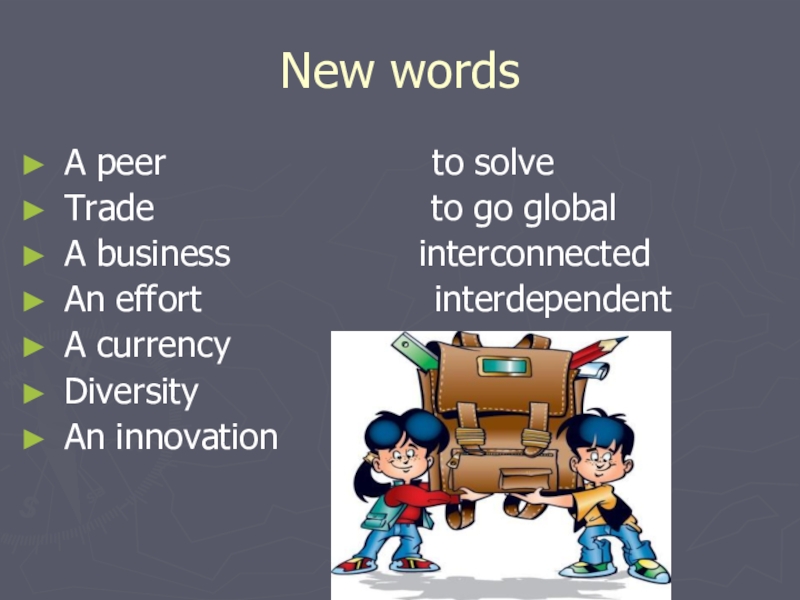
Слайд 2New words
A peer
to solve
Trade to go global
A business interconnected
An effort interdependent
A currency
Diversity
An innovation
Trade to go global
A business interconnected
An effort interdependent
A currency
Diversity
An innovation
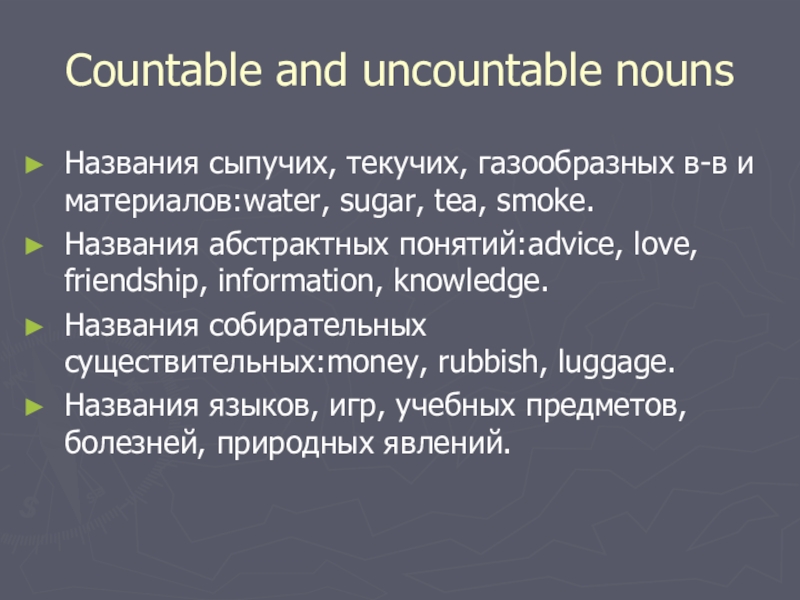
Слайд 3Countable and uncountable nouns
Названия сыпучих, текучих, газообразных в-в и материалов:water, sugar,
tea, smoke.
Названия абстрактных понятий:advice, love, friendship, information, knowledge.
Названия собирательных существительных:money, rubbish, luggage.
Названия языков, игр, учебных предметов, болезней, природных явлений.
Названия абстрактных понятий:advice, love, friendship, information, knowledge.
Названия собирательных существительных:money, rubbish, luggage.
Названия языков, игр, учебных предметов, болезней, природных явлений.
Слайд 4Translate from Russian into English
Корпорации становятся интернациональными.
Знаниями делятся, информацией обмениваются.
Маленькой компании
трудно конкурировать с большими.
Новые законы, принятые странами Европейского союза, помогут решить несколько важных проблем.
Глобальные изменения климата не имеют границ.
Необходимо избегать ошибок, допущенных учеными из других стран.
Современные технологии и новые изобретения меняют нашу реальность.
Его сверстники из разных стран вместе работают над охраной окружающей среды.
Глобализация влияет на культуру, традиции и языки разных стран.
Новые законы, принятые странами Европейского союза, помогут решить несколько важных проблем.
Глобальные изменения климата не имеют границ.
Необходимо избегать ошибок, допущенных учеными из других стран.
Современные технологии и новые изобретения меняют нашу реальность.
Его сверстники из разных стран вместе работают над охраной окружающей среды.
Глобализация влияет на культуру, традиции и языки разных стран.
Слайд 5Эссе
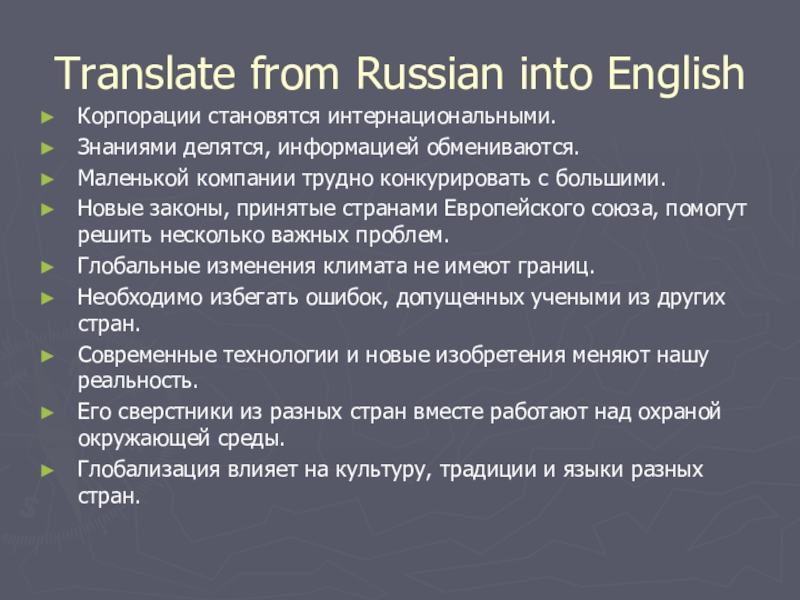
Эссе – прозаическое сочинение небольшого объёма и свободной композиции, выражающее индивидуальные
впечатления и соображения по конкретному поводу или вопросу и не претендующее на определяющую или исчерпывающую трактовку предмета.
При написании эссе с аргументацией «за» и «против» вы описываете проблему как сторонний наблюдатель.
При написании эссе с аргументацией «за» и «против» вы описываете проблему как сторонний наблюдатель.
Слайд 6Контрольные вопросы:
Ответил ли я на предложенный вопрос?
Ясно ли я
выразил свою точку зрения?
Было ли всё написанное выражено ясным и понятным языком, не было ли ошибок во время написания?
Было ли всё написанное выражено ясным и понятным языком, не было ли ошибок во время написания?
Слайд 7Структура эссе
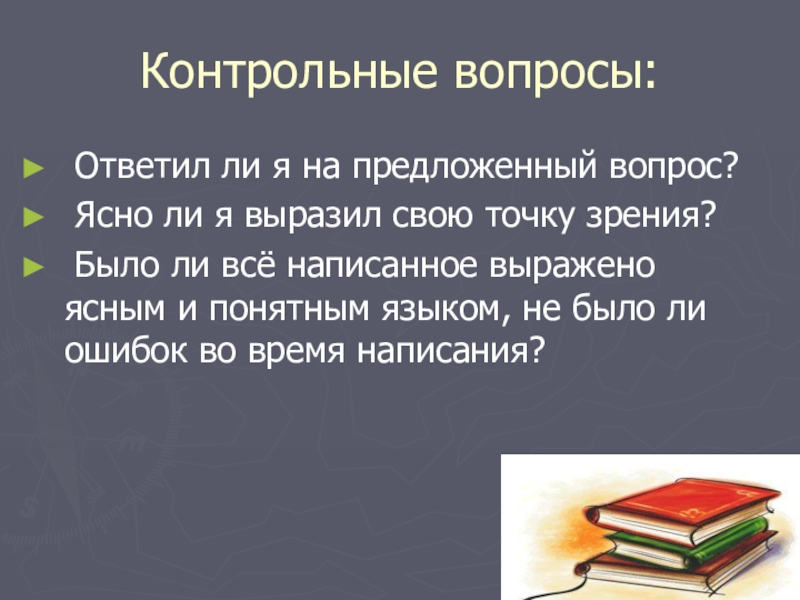
Вступление и постановка проблемы.
Тезисы, аргументы «за».
Тезисы, аргументы «против».
Заключение с выводом.
Слайд 8The beginning is
The world is becoming a small place! Could this
all be down to globalisation?
Слайд 9Word - links
Firstly
to sum it up
First of all one way…another way
Secondly therefore
Finally however
Nevertheless in fact
Though by way of conclusion
instead it is important to point out
Despite this moreover
As a result all in all
First of all one way…another way
Secondly therefore
Finally however
Nevertheless in fact
Though by way of conclusion
instead it is important to point out
Despite this moreover
As a result all in all
Слайд 10What is gobalisation?
It is a process of interconnected and interdependent among
the business, the governments, and the people. This process has positive and negative effects on many levels including the environment, the political system, human well-being, cultural and economical development. There are a number of advantages.

Слайд 11Arguments “for”
Firstly, information and knowledge is shared, tested and discussed.
Secondly, innovations
successfully used by one country quickly become available everywhere.
Thirdly, mistakes made in one field are analysied and avoided in another.
Fourthly, people travel the world and get to know each other.
As a result, they receive a better education and open their minds for new concepts. People understand that we live in a small world and global problems can only be solved by working together.
Thirdly, mistakes made in one field are analysied and avoided in another.
Fourthly, people travel the world and get to know each other.
As a result, they receive a better education and open their minds for new concepts. People understand that we live in a small world and global problems can only be solved by working together.
Слайд 12Arguments “against”
On the other hand, cultural diversity and individuality is
disappearing.
Experts have proved that the world economy and even politics, is getting more and more controlled by multinational corporation.
What is more local businesses are finding it hard to compete with global ones and have to close down. In fact places of work are taken away from small towns and villages.
And of course, there may be a greater chance of disease spreading world wide.
Experts have proved that the world economy and even politics, is getting more and more controlled by multinational corporation.
What is more local businesses are finding it hard to compete with global ones and have to close down. In fact places of work are taken away from small towns and villages.
And of course, there may be a greater chance of disease spreading world wide.
Слайд 13The conclusion
As you can see, the debate about the positive and
negative aspects of globalization will not be over soon, as both sides have their arguments. It is the process that is already happening. It has created the need for global thinking. New generations will have to deal with problems unheard in the past. In the interconnected world people will not only have to understand their own country, speak its language and know its lows, but also understand nations, cultures, languages, and religions around the globe.
Слайд 14Answer the questions:
Have we answered the question?
Have we expressed our
opinions clear enough?
Have we made any mistakes?
Have we made any mistakes?