- Главная
- Разное
- Образование
- Спорт
- Естествознание
- Природоведение
- Религиоведение
- Французский язык
- Черчение
- Английский язык
- Астрономия
- Алгебра
- Биология
- География
- Геометрия
- Детские презентации
- Информатика
- История
- Литература
- Математика
- Музыка
- МХК
- Немецкий язык
- ОБЖ
- Обществознание
- Окружающий мир
- Педагогика
- Русский язык
- Технология
- Физика
- Философия
- Химия
- Шаблоны, фоны, картинки для презентаций
- Экология
- Экономика
Презентация, доклад по английскому языку на тему: Медицина средних веков. Будущее время
Содержание
- 1. Презентация по английскому языку на тему: Медицина средних веков. Будущее время
- 2. Государственное бюджетное профессиональное образовательное учреждение «Пятигорский медицинский колледж» Кировский
- 3. In ancient times people
- 4. Слайд 4
- 5. Alessandro Benedetti (1450–1512) was
- 6. Santorio Santorio
- 7. Sources of Medical Knowledge
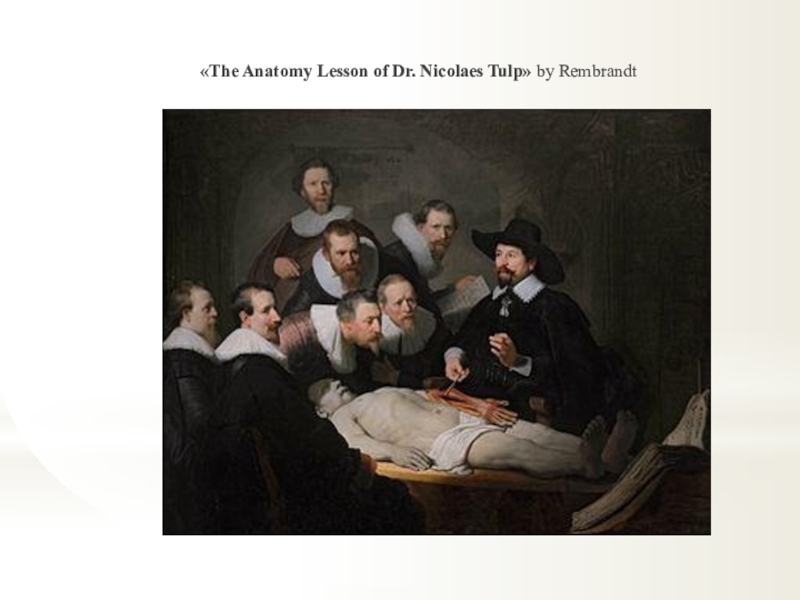
- 8. «The Anatomy Lesson of Dr. Nicolaes Tulp» by Rembrandt
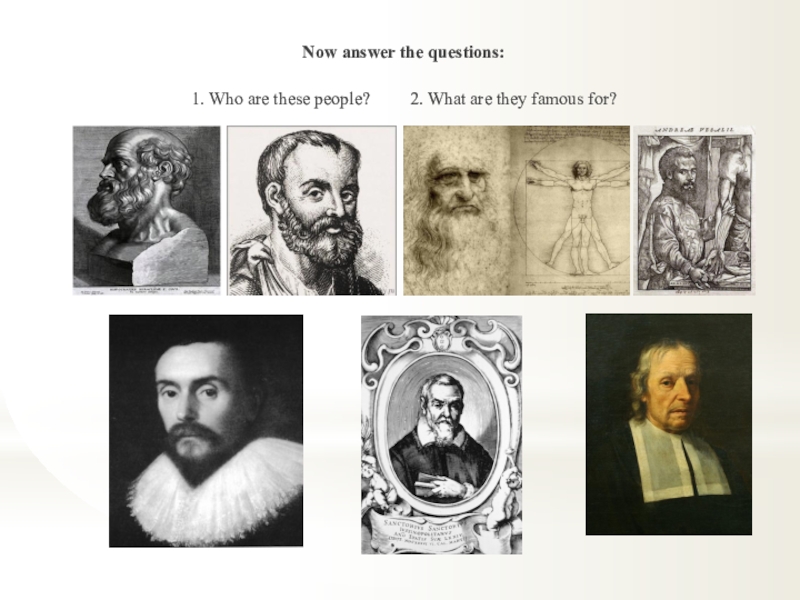
- 9. Now answer the questions:1. Who are these
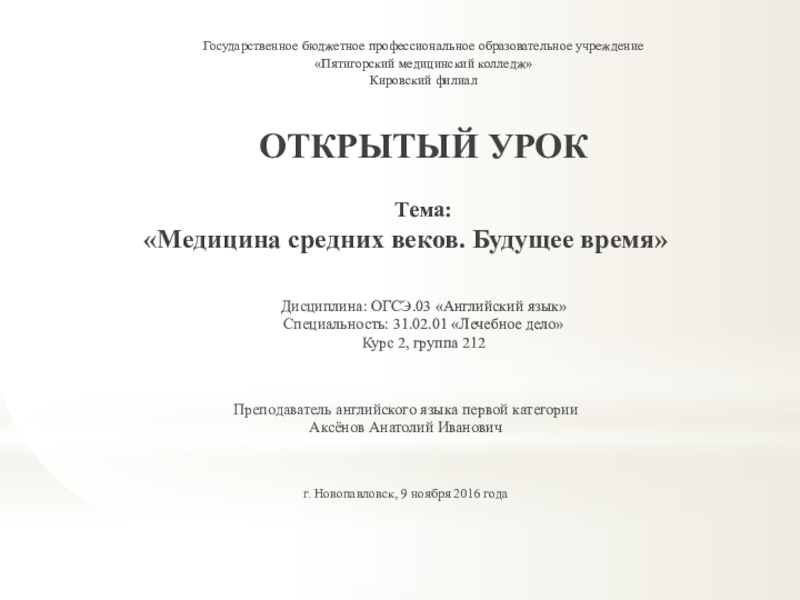
Государственное бюджетное профессиональное образовательное учреждение «Пятигорский медицинский колледж» Кировский филиал ОТКРЫТЫЙ УРОК Тема:«Медицина средних веков. Будущее время» Дисциплина: ОГСЭ.03 «Английский язык» Специальность: 31.02.01 «Лечебное дело» Курс 2, группа 212Преподаватель английского языка первой категорииАксёнов Анатолий Ивановичг. Новопавловск, 9 ноября 2016 года
Слайд 2 Государственное бюджетное профессиональное образовательное учреждение
«Пятигорский медицинский колледж»
Кировский филиал
ОТКРЫТЫЙ УРОК
Тема:
«Медицина средних
веков. Будущее время»
Дисциплина: ОГСЭ.03 «Английский язык»
Специальность: 31.02.01 «Лечебное дело»
Курс 2, группа 212
Преподаватель английского языка первой категории
Аксёнов Анатолий Иванович
г. Новопавловск, 9 ноября 2016 года
Дисциплина: ОГСЭ.03 «Английский язык»
Специальность: 31.02.01 «Лечебное дело»
Курс 2, группа 212
Преподаватель английского языка первой категории
Аксёнов Анатолий Иванович
г. Новопавловск, 9 ноября 2016 года
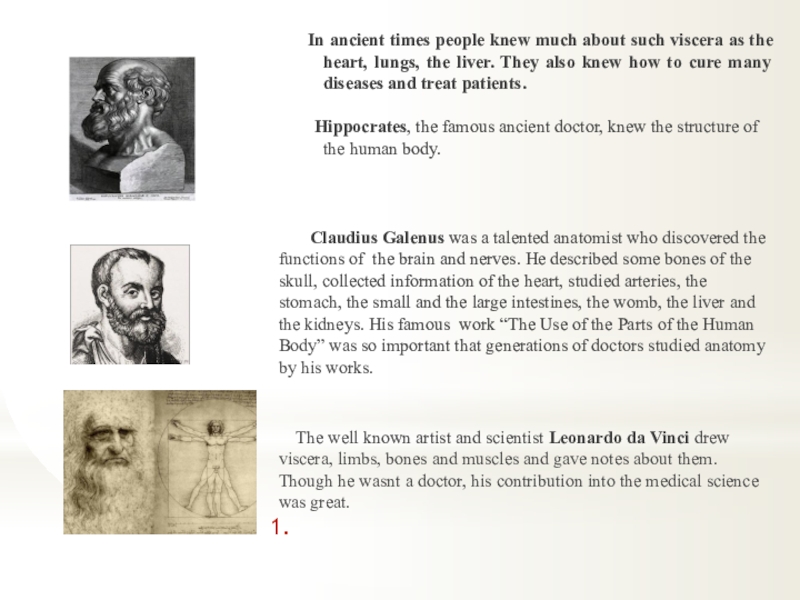
Слайд 3 In ancient times people knew much about such
viscera as the heart, lungs, the liver. They also knew how to cure many diseases and treat patients.
Hippocrates, the famous ancient doctor, knew the structure of the human body.
Claudius Galenus was a talented anatomist who discovered the functions of the brain and nerves. He described some bones of the skull, collected information of the heart, studied arteries, the stomach, the small and the large intestines, the womb, the liver and the kidneys. His famous work “The Use of the Parts of the Human Body” was so important that generations of doctors studied anatomy by his works.
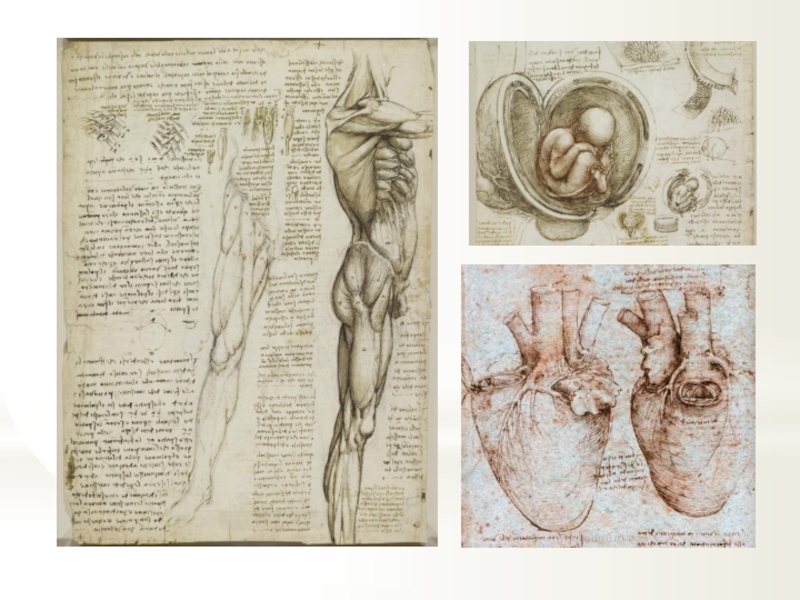
The well known artist and scientist Leonardo da Vinci drew viscera, limbs, bones and muscles and gave notes about them. Though he wasnt a doctor, his contribution into the medical science was great.
Hippocrates, the famous ancient doctor, knew the structure of the human body.
Claudius Galenus was a talented anatomist who discovered the functions of the brain and nerves. He described some bones of the skull, collected information of the heart, studied arteries, the stomach, the small and the large intestines, the womb, the liver and the kidneys. His famous work “The Use of the Parts of the Human Body” was so important that generations of doctors studied anatomy by his works.
The well known artist and scientist Leonardo da Vinci drew viscera, limbs, bones and muscles and gave notes about them. Though he wasnt a doctor, his contribution into the medical science was great.
Слайд 5 Alessandro Benedetti (1450–1512) was born in Italy, worked
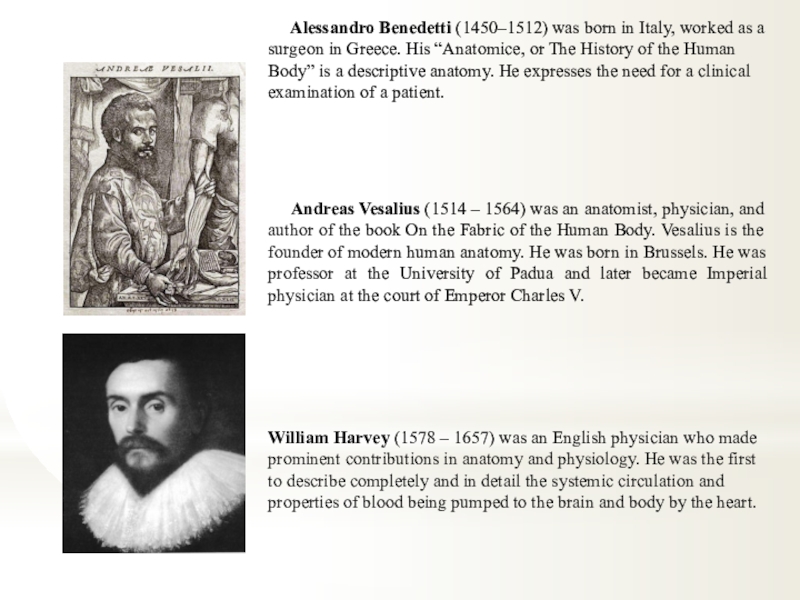
as a surgeon in Greece. His “Anatomice, or The History of the Human Body” is a descriptive anatomy. He expresses the need for a clinical examination of a patient.
Andreas Vesalius (1514 – 1564) was an anatomist, physician, and author of the book On the Fabric of the Human Body. Vesalius is the founder of modern human anatomy. He was born in Brussels. He was professor at the University of Padua and later became Imperial physician at the court of Emperor Charles V.
William Harvey (1578 – 1657) was an English physician who made prominent contributions in anatomy and physiology. He was the first to describe completely and in detail the systemic circulation and properties of blood being pumped to the brain and body by the heart.
Andreas Vesalius (1514 – 1564) was an anatomist, physician, and author of the book On the Fabric of the Human Body. Vesalius is the founder of modern human anatomy. He was born in Brussels. He was professor at the University of Padua and later became Imperial physician at the court of Emperor Charles V.
William Harvey (1578 – 1657) was an English physician who made prominent contributions in anatomy and physiology. He was the first to describe completely and in detail the systemic circulation and properties of blood being pumped to the brain and body by the heart.
Слайд 6
Santorio Santorio (1561 – 1636),
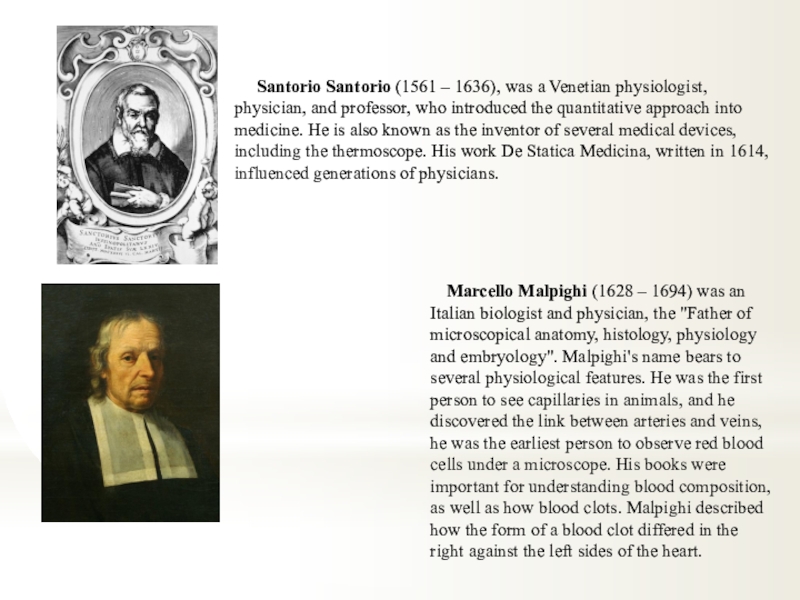
was a Venetian physiologist, physician, and professor, who introduced the quantitative approach into medicine. He is also known as the inventor of several medical devices, including the thermoscope. His work De Statica Medicina, written in 1614, influenced generations of physicians.
Marcello Malpighi (1628 – 1694) was an Italian biologist and physician, the "Father of microscopical anatomy, histology, physiology and embryology". Malpighi's name bears to several physiological features. He was the first person to see capillaries in animals, and he discovered the link between arteries and veins, he was the earliest person to observe red blood cells under a microscope. His books were important for understanding blood composition, as well as how blood clots. Malpighi described how the form of a blood clot differed in the right against the left sides of the heart.
Marcello Malpighi (1628 – 1694) was an Italian biologist and physician, the "Father of microscopical anatomy, histology, physiology and embryology". Malpighi's name bears to several physiological features. He was the first person to see capillaries in animals, and he discovered the link between arteries and veins, he was the earliest person to observe red blood cells under a microscope. His books were important for understanding blood composition, as well as how blood clots. Malpighi described how the form of a blood clot differed in the right against the left sides of the heart.
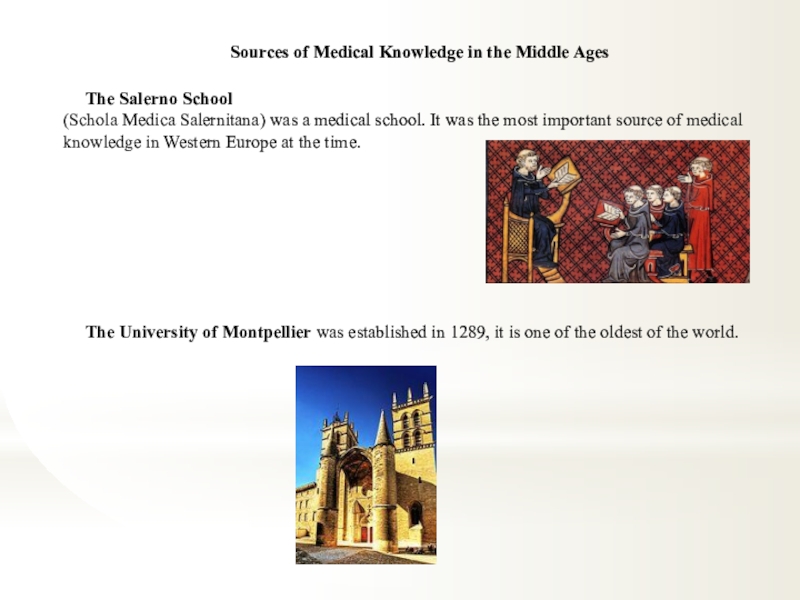
Слайд 7 Sources of Medical Knowledge in the Middle Ages
The Salerno School
(Schola Medica Salernitana) was a medical school. It was the most important source of medical knowledge in Western Europe at the time.
The University of Montpellier was established in 1289, it is one of the oldest of the world.
(Schola Medica Salernitana) was a medical school. It was the most important source of medical knowledge in Western Europe at the time.
The University of Montpellier was established in 1289, it is one of the oldest of the world.