- Главная
- Разное
- Образование
- Спорт
- Естествознание
- Природоведение
- Религиоведение
- Французский язык
- Черчение
- Английский язык
- Астрономия
- Алгебра
- Биология
- География
- Геометрия
- Детские презентации
- Информатика
- История
- Литература
- Математика
- Музыка
- МХК
- Немецкий язык
- ОБЖ
- Обществознание
- Окружающий мир
- Педагогика
- Русский язык
- Технология
- Физика
- Философия
- Химия
- Шаблоны, фоны, картинки для презентаций
- Экология
- Экономика
Презентация, доклад по английскому языку на тему: Эссе в формате ЕГЭ
Содержание
- 1. Презентация по английскому языку на тему: Эссе в формате ЕГЭ
- 2. Academic essay assessmentTask response basically means: Did
- 3. Types of questionsAgree/ disagree* Do you agree
- 4. For or against/ Support or opposeSituation A:
- 5. Open-ended questions:What, when, where, who, how, etc.Descriptive
- 6. Hypothetical questionHypothetical means imaginary, not real, theoreticalIf…
- 7. Paraphrasing the questionESSAY:Education is the single most
- 8. Education is the single most important factor
- 9. Paraphrasing the questionESSAY:Education is the single most
- 10. Paraphrasing the questionEducation is the single most
- 11. Many people believe that the increased presence
- 12. PLAN: interpret and understand the question?Governmentcontrol
- 13. Introduction: 3-4 sentencesWhat is the topic?What is
- 14. Body paragraph 1has an introductory statement Today’s young
- 15. Body paragraph 2 Indeed, the government’s role
- 16. Conclusion In conclusion, social behaviour patterns are impacted
- 17. Introduction :Formula
- 18. INTRODUCTIONPlan firstTranslate this plan into sentences (3
- 19. Body paragraphIndent or skip a lineOne central
- 20. ConclusionIn conclusion,…To conclude,…To sum up,…To summarize,…In summary,…It
- 21. An example of conclusionMany people believe that
- 22. 5 TIPS TO IMPROVE YOUR WRITING Contractions:
- 23. Lexical Range = Vocabulary3 golden rules about
- 24. MITIGATE – make less severe, harsh, painful,
- 25. 6 alternatives to the verb DoConduct –
- 26. Reservation(s) –v/n def.: concerns, worries, doubts, smth
- 27. FREQUENT (v.) – Def.: visit, go to,
- 28. By punishing murderers with the death penalty,
- 29. By punishing murderers with the death penalty,
- 30. Give your views on the following statement:“Advertisements
- 31. Thank you for your attentionРаботу выполнила:учитель английского

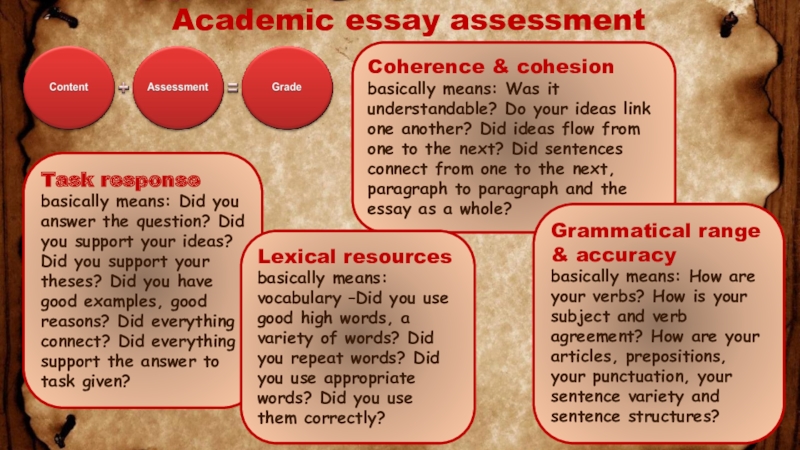
Слайд 2Academic essay assessment
Task response basically means: Did you answer the question?
Coherence & cohesion
basically means: Was it understandable? Do your ideas link one another? Did ideas flow from one to the next? Did sentences connect from one to the next, paragraph to paragraph and the essay as a whole?
Lexical resources
basically means: vocabulary –Did you use good high words, a variety of words? Did you repeat words? Did you use appropriate words? Did you use them correctly?
Grammatical range & accuracy
basically means: How are your verbs? How is your subject and verb agreement? How are your articles, prepositions, your punctuation, your sentence variety and sentence structures?
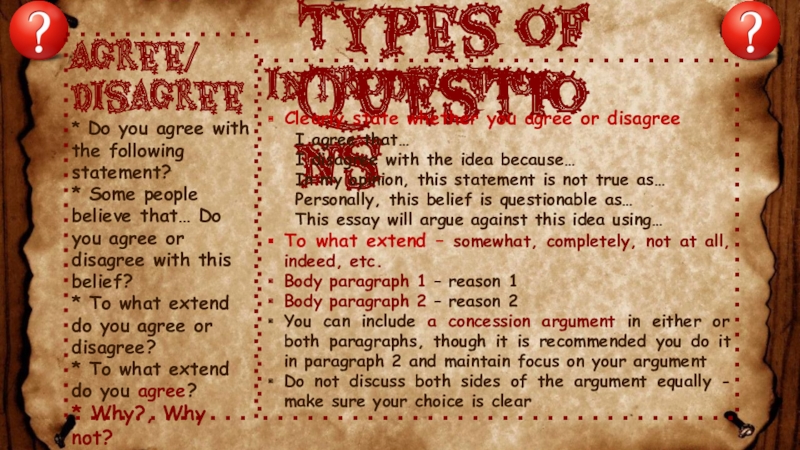
Слайд 3Types of questions
Agree/ disagree
* Do you agree with the following statement?
*
* To what extend do you agree or disagree?
* To what extend do you agree?
* Why?, Why not?
Introduction
Clearly state whether you agree or disagree
I agree that…
I disagree with the idea because…
In my opinion, this statement is not true as…
Personally, this belief is questionable as…
This essay will argue against this idea using…
To what extend – somewhat, completely, not at all, indeed, etc.
Body paragraph 1 – reason 1
Body paragraph 2 – reason 2
You can include a concession argument in either or both paragraphs, though it is recommended you do it in paragraph 2 and maintain focus on your argument
Do not discuss both sides of the argument equally - make sure your choice is clear
Слайд 4For or against/ Support or oppose
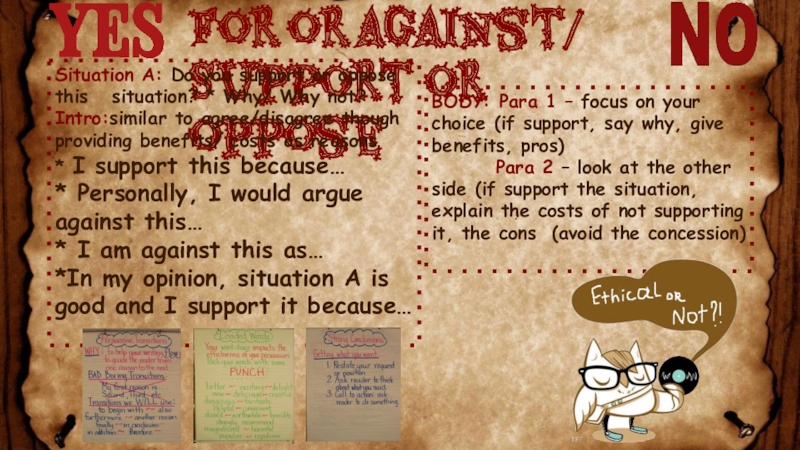
Situation A: Do you support or
Intro:similar to agree/disagree though providing benefits/ costs as reasons
* I support this because…
* Personally, I would argue against this…
* I am against this as…
*In my opinion, situation A is good and I support it because…
BODY: Para 1 – focus on your choice (if support, say why, give benefits, pros)
Para 2 – look at the other side (if support the situation, explain the costs of not supporting it, the cons (avoid the concession)
Слайд 5Open-ended questions:
What, when, where, who, how, etc.
Descriptive essay:
What are some possible
What are some possible consequences of…?
Who might benefit from…?
Who might be hurt by…?
How would you (fix the situation)?
What are some possible remedies for this situation?
Which would you choose (Choice type)?
In your opinion, when is (a good time to start teaching a child another language)?
What do you think about…? (Opinion type)
Introduction
Present the topic
Present two details that answer the specific question
What are some sources of pollution that can be prevented or lowered?
Some of major polluters are emissions from cars, as well as poisonous chemicals dumped into rivers by manufacturing plants. These can be tackled in several ways, including improved public transportation, and high penalties for corporations that endanger lives.
Describe the source
Detail the actions
to fight these
No opinion statement
necessary
Objective – not an opinion, without the self
Subjective – includes the writer’s own ideas, opinions, views, beliefs.

Слайд 6Hypothetical question
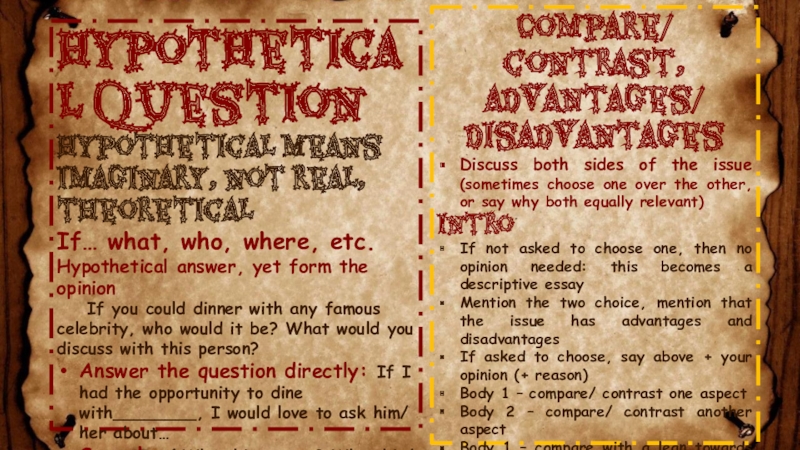
Hypothetical means imaginary, not real, theoretical
If… what, who, where, etc.
Hypothetical
If you could dinner with any famous celebrity, who would it be? What would you discuss with this person?
Answer the question directly: If I had the opportunity to dine with________, I would love to ask him/ her about…
Say why ( Why this person? Why this/ these topics?)
Compare/ contrast,
advantages/ disadvantages
Discuss both sides of the issue (sometimes choose one over the other, or say why both equally relevant)
Intro
If not asked to choose one, then no opinion needed: this becomes a descriptive essay
Mention the two choice, mention that the issue has advantages and disadvantages
If asked to choose, say above + your opinion (+ reason)
Body 1 – compare/ contrast one aspect
Body 2 – compare/ contrast another aspect
Body 1 – compare with a lean towards choice
Body 2 – support choice with fully developed, focused argument
Слайд 7Paraphrasing the question
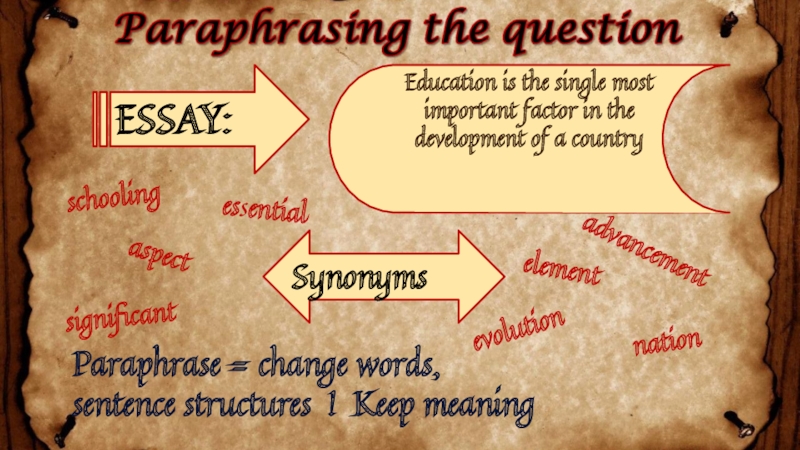
ESSAY:
Education is the single most important factor in the
I agree that education is the single
most important factor in the development of
a country because …
Paraphrase = change words,
sentence structures. Keep meaning!
Paraphrase

Слайд 8Education is the single most important factor in the development of
ESSAY:
Paraphrase = change words,
sentence structures ! Keep meaning
Synonyms
schooling
aspect
advancement
evolution
nation
significant
essential
element
Слайд 9Paraphrasing the question
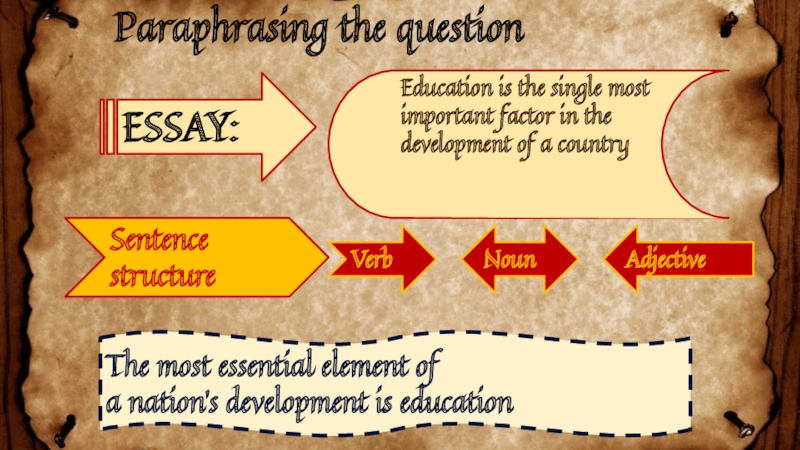
ESSAY:
Education is the single most important factor in the
Sentence
structure
Verb
Noun
Adjective
The most essential element of
a nation’s development is education
Слайд 10Paraphrasing the question
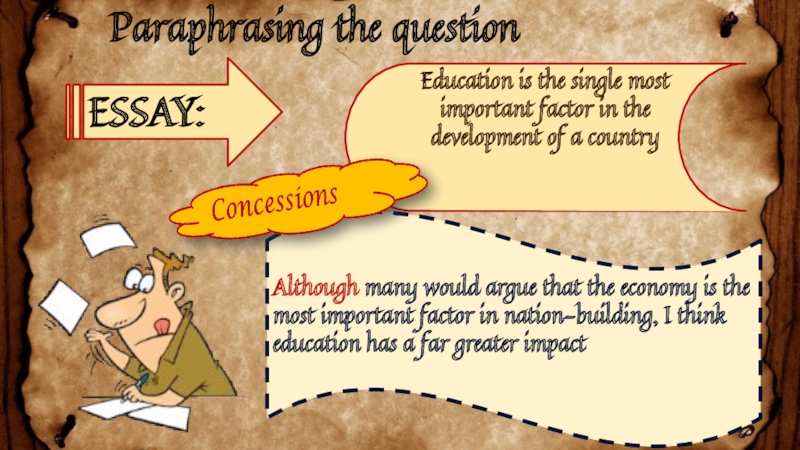
Education is the single most important factor in the
ESSAY:
Although many would argue that the economy is the most important factor in nation-building, I think education has a far greater impact
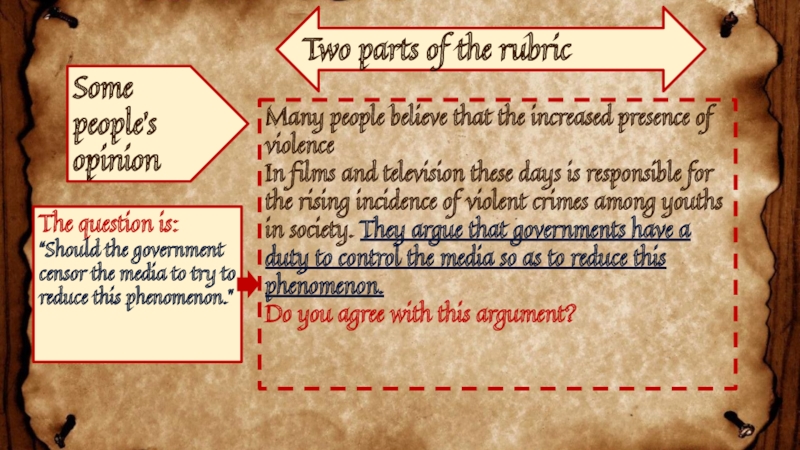
Слайд 11Many people believe that the increased presence of violence
In films and
Do you agree with this argument?
Some people’s opinion
Two parts of the rubric
The question is: “Should the government censor the media to try to reduce this phenomenon.”
Слайд 12PLAN:
interpret and understand the question?
Government
control
parents
home life
peer pressure
video games
parents
education
guns
responsibility
influence
Yes
No
Protect citizens
Censorship
Can’t control everything
Jobs + education
Parents’ role

Слайд 13Introduction: 3-4 sentences
What is the topic?
What is the question?
What is my
Why?
Youth violence is a shared social problem.
Topic sentence – general idea, no reasons, no details, no arguments
Many people thus propose that governments need to tackle this issue by controlling the media, whom people see as responsible for inciting this violence through films and television
While youth are undoubtedly swayed by external influences, I disagree that it is a government’s obligation to censor the entertainment industry; rather, it is up to society itself to handle the matter.
Because of the media
there is violence in society
Combine opinion and
reason into one
General reason that you will
develop in the body paragraph

Слайд 14Body paragraph 1
has an introductory
statement
Today’s young people can be influenced
One paragraph
has one central
idea
In other words…,
I want to expand the central idea
Concrete example
( You Tube)
Therefore…
Change focus, prepare for the next paragraph

Слайд 15Body paragraph 2
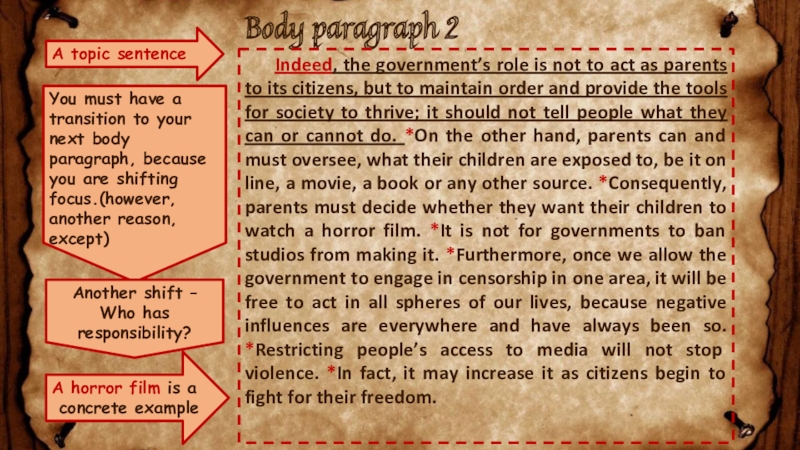
Indeed, the government’s role is not to act
You must have a transition to your next body paragraph, because you are shifting focus.(however, another reason, except)
A topic sentence
Another shift –
Who has responsibility?
A horror film is a
concrete example
Слайд 16Conclusion
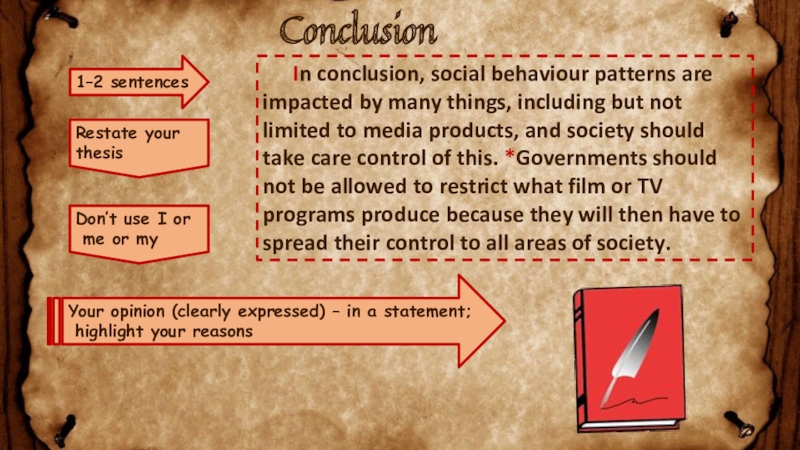
In conclusion, social behaviour patterns are impacted by many things, including
1–2 sentences
Restate your
thesis
Don’t use I or
me or my
Your opinion (clearly expressed) – in a statement;
highlight your reasons

Слайд 18INTRODUCTION
Plan first
Translate this plan into sentences (3 – 5)
Answer:
What is the question?
What is your opinion?
What are the reasons?
General
Theses
Is it better to live in the city or in the country?
Deciding where to live is one of life’s more difficult choices. One may opt for life in the country, or in the city. In my opinion, life in the city is more advantageous due to the fact/ because the city offers better economic and social opportunities.
Topic

Слайд 19Body paragraph
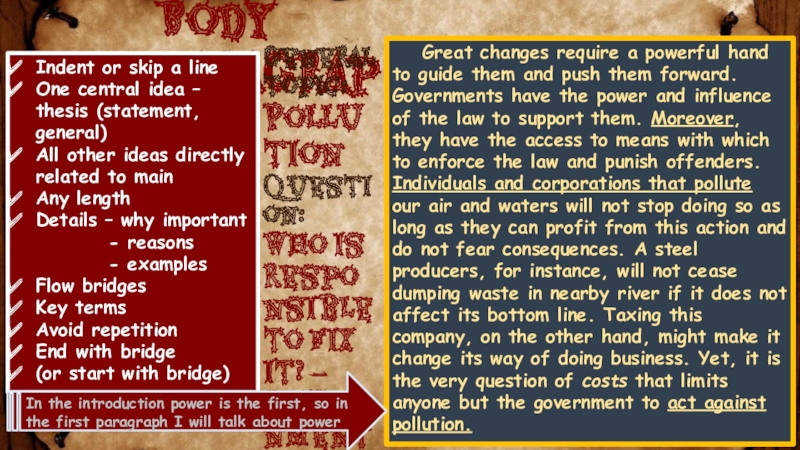
Indent or skip a line
One central idea – thesis (statement,
All other ideas directly related to main
Any length
Details – why important
- reasons
- examples
Flow bridges
Key terms
Avoid repetition
End with bridge
(or start with bridge)
Great changes require a powerful hand to guide them and push them forward. Governments have the power and influence of the law to support them. Moreover, they have the access to means with which to enforce the law and punish offenders. Individuals and corporations that pollute our air and waters will not stop doing so as long as they can profit from this action and do not fear consequences. A steel producers, for instance, will not cease dumping waste in nearby river if it does not affect its bottom line. Taxing this company, on the other hand, might make it change its way of doing business. Yet, it is the very question of costs that limits anyone but the government to act against pollution.
General topic:
Pollution
Question:
Who is responsible to fix it? – Government is responsible
3 reasons: power, cost, credibility
In the introduction power is the first, so in the first paragraph I will talk about power
Слайд 20Conclusion
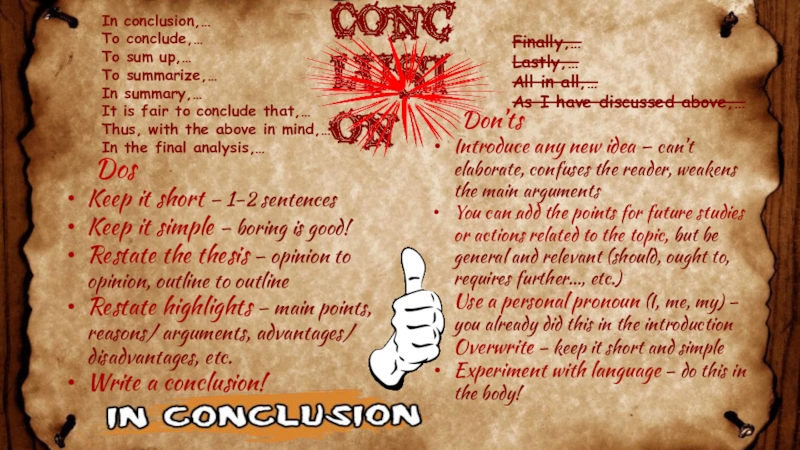
In conclusion,…
To conclude,…
To sum up,…
To summarize,…
In summary,…
It is fair to conclude
Thus, with the above in mind,…
In the final analysis,…
Finally,…
Lastly,…
All in all,…
As I have discussed above,…
Dos
Keep it short – 1-2 sentences
Keep it simple – boring is good!
Restate the thesis – opinion to opinion, outline to outline
Restate highlights – main points, reasons/ arguments, advantages/ disadvantages, etc.
Write a conclusion!
Don’ts
Introduce any new idea – can’t elaborate, confuses the reader, weakens the main arguments
You can add the points for future studies or actions related to the topic, but be general and relevant (should, ought to, requires further…, etc.)
Use a personal pronoun (I, me, my) – you already did this in the introduction
Overwrite – keep it short and simple
Experiment with language – do this in the body!
Слайд 21An example of conclusion
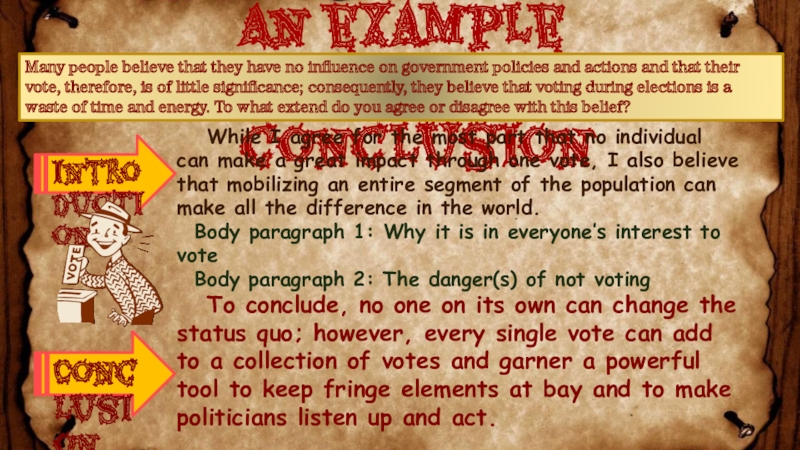
Many people believe that they have no influence
While I agree for the most part that no individual can make a great impact through one vote, I also believe that mobilizing an entire segment of the population can make all the difference in the world.
Body paragraph 1: Why it is in everyone’s interest to vote
Body paragraph 2: The danger(s) of not voting
To conclude, no one on its own can change the status quo; however, every single vote can add to a collection of votes and garner a powerful tool to keep fringe elements at bay and to make politicians listen up and act.
Introduction
Conclusion
Слайд 225 TIPS TO IMPROVE YOUR WRITING
Contractions: don’t, can’t, wouldn’t
There is/ there are:
There are many issues that students face at university.
Students face many issues at university
Really, very, a lot, so A lot of time is wasted.
Much time is wasted.
Passive vs Active The war was won by the French.
The French won the war.
Weak verbs vs Strong verbs He gave assistance to my friend
He assisted my friend.

Слайд 23Lexical Range = Vocabulary
3 golden rules about vocabulary:
Uncommon uses of everyday
“big words” – (discount vs mitigate)
2. Don’t force words into the writing/speaking (must be “natural”):
potentate = ruler, dictator
Be 100% sure of meaning
and usage

Слайд 24MITIGATE – make less severe, harsh, painful, harmful, serious;
Minimize the effect
Doctors often prescribe Tylenol to patients with broken bones as a way to mitigate the pain.
The company offered customers various promotions in order to mitigate the steep decline in sales following the failed product launch.
The retail manager decided to mitigate prices so as to attract more customers.
Even the toughest potentate understands the power of numbers.
POTENTATE (n) = ruler (king, dictator, etc.) who rules with power, strength
POTENT (adj.) – powerful, strong
DISCOUNT(v) = 1. to lower, reduce (prices, fees, etc.)
2. To underestimate, not take smth/ smb into account
Head office decided to discount the entire autumn collection to stimulate sales.
Companies that aim their advertising at older shoppers and discount the purchasing power of teens and young adults, are potentially losing millions in sales.

Слайд 256 alternatives to the verb Do
Conduct – to plan out, organize
Complete/ Finish – to bring (an action) to an end
Execute – to do an action as planned or ordered
Perform – to do something as a prescribed way/ act (usually something one is trained for)
Carry out – to do until the end/ to bring to a conclusion
Commit – to do an action deliberately (usually a negative one)
Vocabulary: collocations
Conduct – an experiment/ an investigation/ an audit/ business/an interview/ one’s affairs;
Complete/ Finish – a task/ one’s homework/ the mission/ the project;
Execute – an order/ a command/ justice/ the plan/ a maneuver/ a task/ well/ executed;
Perform – one’s duties/ a task/ an operation/ surgery/ a function/ one’s work/ well;
Carry out – one’s duty/ the task/ the orders/ the plans/ repairs;
Commit – a crime/ fraud/ suicide/ adultery/ an injustice.
Do, make, give, take, have

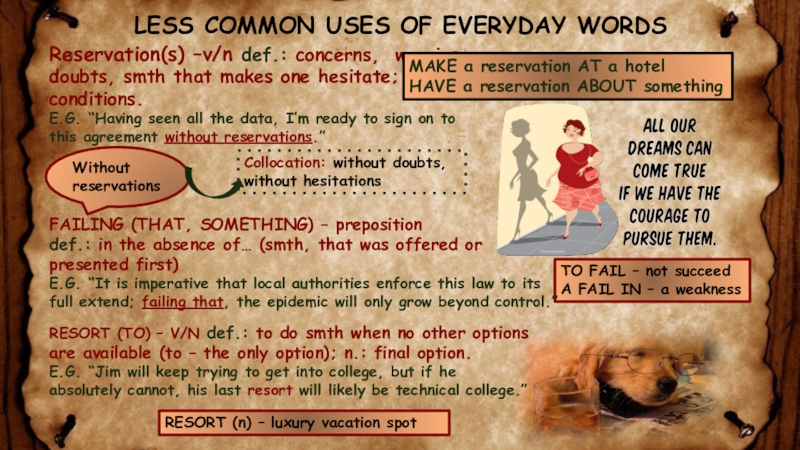
Слайд 26Reservation(s) –v/n def.: concerns, worries, doubts, smth that makes one hesitate;
E.G. “Having seen all the data, I’m ready to sign on to this agreement without reservations.”
MAKE a reservation AT a hotel
HAVE a reservation ABOUT something
Without reservations
Collocation: without doubts, without hesitations
LESS COMMON USES OF EVERYDAY WORDS
TO FAIL – not succeed
A FAIL IN – a weakness
FAILING (THAT, SOMETHING) – preposition def.: in the absence of… (smth, that was offered or presented first)
E.G. “It is imperative that local authorities enforce this law to its full extend; failing that, the epidemic will only grow beyond control.”
RESORT (TO) – V/N def.: to do smth when no other options are available (to – the only option); n.: final option.
E.G. “Jim will keep trying to get into college, but if he absolutely cannot, his last resort will likely be technical college.”
RESORT (n) – luxury vacation spot
Слайд 27FREQUENT (v.) – Def.: visit, go to, be in often
she knows it is usually frequented by drug
addicts looking to buy.”
LESS COMMON USES OF EVERYDAY WORDS
FREQUENT – (adv.)
often, regularly
SHOULDER (v.) – Def.: to assume, take on, carry (smth physical
or abstract
E.G.: "Some people argue that children who refuse
to shoulder the responsibility of caring for their
elderly parents should have to pay more taxes if
this care falls to the government to oversee.”
SHOULDER – part of
the body
Shoulder the cost(s)
the responsibility
the blame
the burden
ARM (v.) – Def.: equip/prepare with weapons/ tools
E.G.:" What makes Heather a great negotiator is not
just her tenacity but the fact that she armed herself
with endless amounts of data so as outperform her
adversary. “
Armament(s) – weapons
weaponization
Armed with = have
COUNTER (adj./ v.) – Def.: opposite, contrary, opposing, oppose,
disagree with, return an attack
E.G.: “Arguments that are not well-presented are easy
to counter, thus they are weak and consequently make
entire essay score lower. “
Counter (n) – like table top, but long and narrow

Слайд 28By punishing murderers with the death penalty, society is also guilty
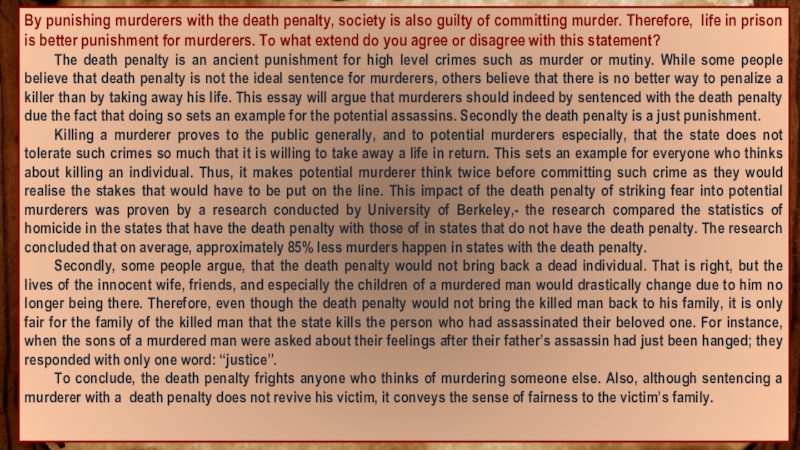
The death penalty is an ancient punishment for high level crimes such as murder or mutiny. While some people believe that death penalty is not the ideal sentence for murderers, others believe that there is no better way to penalize a killer than by taking away his life. This essay will argue that murderers should indeed by sentenced with the death penalty due the fact that doing so sets an example for the potential assassins. Secondly the death penalty is a just punishment.
Killing a murderer proves to the public generally, and to potential murderers especially, that the state does not tolerate such crimes so much that it is willing to take away a life in return. This sets an example for everyone who thinks about killing an individual. Thus, it makes potential murderer think twice before committing such crime as they would realise the stakes that would have to be put on the line. This impact of the death penalty of striking fear into potential murderers was proven by a research conducted by University of Berkeley,- the research compared the statistics of homicide in the states that have the death penalty with those of in states that do not have the death penalty. The research concluded that on average, approximately 85% less murders happen in states with the death penalty.
Secondly, some people argue, that the death penalty would not bring back a dead individual. That is right, but the lives of the innocent wife, friends, and especially the children of a murdered man would drastically change due to him no longer being there. Therefore, even though the death penalty would not bring the killed man back to his family, it is only fair for the family of the killed man that the state kills the person who had assassinated their beloved one. For instance, when the sons of a murdered man were asked about their feelings after their father’s assassin had just been hanged; they responded with only one word: “justice”.
To conclude, the death penalty frights anyone who thinks of murdering someone else. Also, although sentencing a murderer with a death penalty does not revive his victim, it conveys the sense of fairness to the victim’s family.
Слайд 29By punishing murderers with the death penalty, society is also guilty
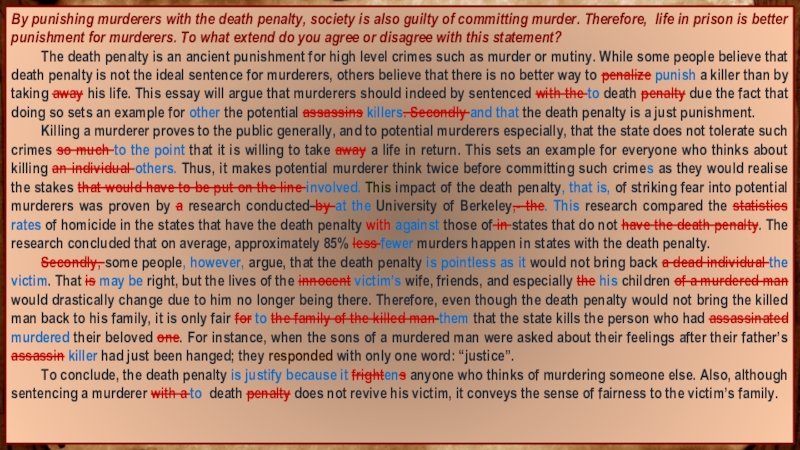
The death penalty is an ancient punishment for high level crimes such as murder or mutiny. While some people believe that death penalty is not the ideal sentence for murderers, others believe that there is no better way to penalize punish a killer than by taking away his life. This essay will argue that murderers should indeed by sentenced with the to death penalty due the fact that doing so sets an example for other the potential assassins killers. Secondly and that the death penalty is a just punishment.
Killing a murderer proves to the public generally, and to potential murderers especially, that the state does not tolerate such crimes so much to the point that it is willing to take away a life in return. This sets an example for everyone who thinks about killing an individual others. Thus, it makes potential murderer think twice before committing such crimes as they would realise the stakes that would have to be put on the line involved. This impact of the death penalty, that is, of striking fear into potential murderers was proven by a research conducted by at the University of Berkeley,- the. This research compared the statistics rates of homicide in the states that have the death penalty with against those of in states that do not have the death penalty. The research concluded that on average, approximately 85% less fewer murders happen in states with the death penalty.
Secondly, some people, however, argue, that the death penalty is pointless as it would not bring back a dead individual the victim. That is may be right, but the lives of the innocent victim’s wife, friends, and especially the his children of a murdered man would drastically change due to him no longer being there. Therefore, even though the death penalty would not bring the killed man back to his family, it is only fair for to the family of the killed man them that the state kills the person who had assassinated murdered their beloved one. For instance, when the sons of a murdered man were asked about their feelings after their father’s assassin killer had just been hanged; they responded with only one word: “justice”.
To conclude, the death penalty is justify because it frightens anyone who thinks of murdering someone else. Also, although sentencing a murderer with a to death penalty does not revive his victim, it conveys the sense of fairness to the victim’s family.
Слайд 30Give your views on the following statement:
“Advertisements encourage people
to spend
they do not need.”
Слайд 31Thank you
for your attention
Работу выполнила:
учитель английского языка
МБОУ: «Сакская гимназия №
города Саки Республики Крым
Посметная Елена Викторовна