Л.
- Главная
- Разное
- Образование
- Спорт
- Естествознание
- Природоведение
- Религиоведение
- Французский язык
- Черчение
- Английский язык
- Астрономия
- Алгебра
- Биология
- География
- Геометрия
- Детские презентации
- Информатика
- История
- Литература
- Математика
- Музыка
- МХК
- Немецкий язык
- ОБЖ
- Обществознание
- Окружающий мир
- Педагогика
- Русский язык
- Технология
- Физика
- Философия
- Химия
- Шаблоны, фоны, картинки для презентаций
- Экология
- Экономика
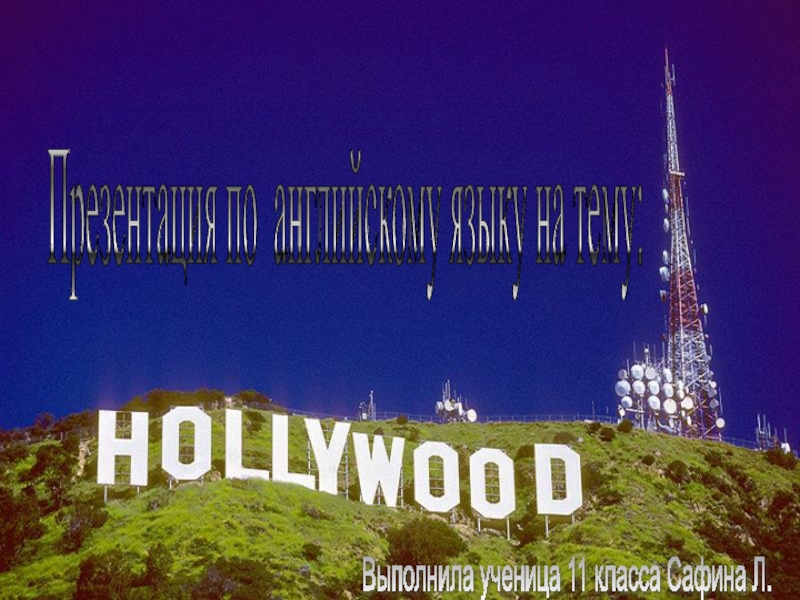
Презентация, доклад по английскому языку на тему Голливуд Кузовлев
Содержание
- 1. Презентация по английскому языку на тему Голливуд Кузовлев
- 2. Hollywood is a district in the city
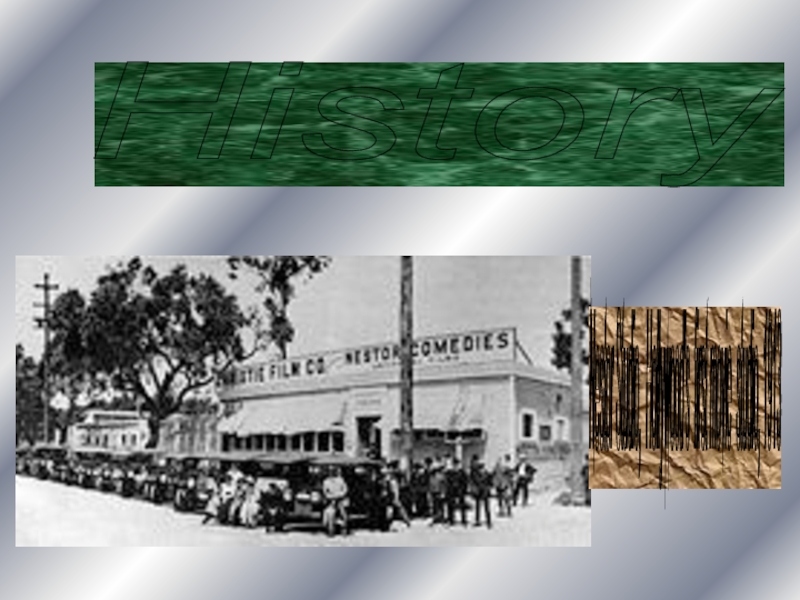
- 3. History Nestor Studio, Hollywood's first movie studio, 1913
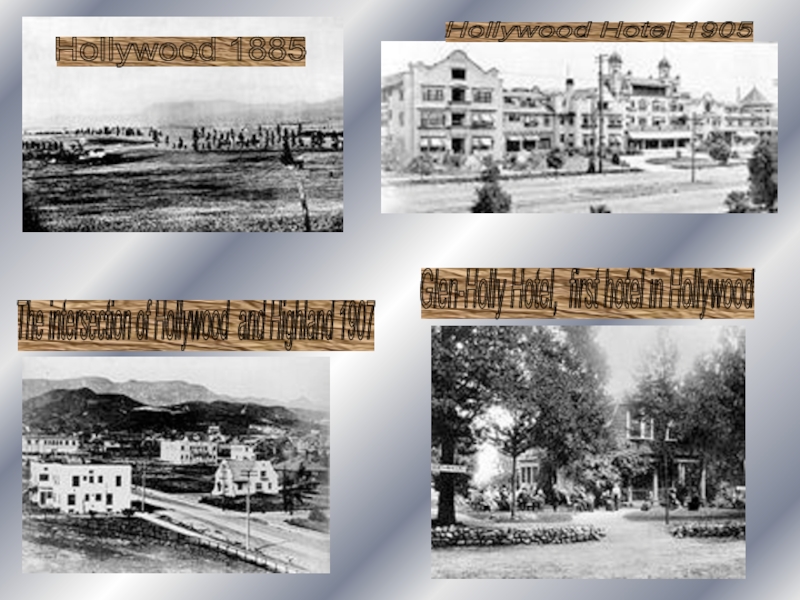
- 4. Hollywood 1885 The intersection of Hollywood and
- 5. United States cinema has had a profound
- 6. Silent film Scene from the 1921 Four
- 7. Roundhay Garden Scene 1888, the first known
- 8. Lillian Gish was a major star of
- 9. Tinting in the world's oldest-surviving animated feature
- 10. Top grossing silent films The following are
- 11. Auguste and Louis Lumière Auguste Lumière (left) and Louis Lumière (right)
- 12. The Lumière brothers were born in Twin
- 13. The world's first film poster, for 1895's L'Arroseur Arrosé
- 14. La Sortie de l'Usine Lumière à Lyon
- 15. Autochrome color picture by Jean-Baptiste Tournassoud of
- 16. Golden Age of Hollywood During the so-called
- 17. Movie-making was still a business, however, and
- 18. Some people vandalize the unassigned stars by
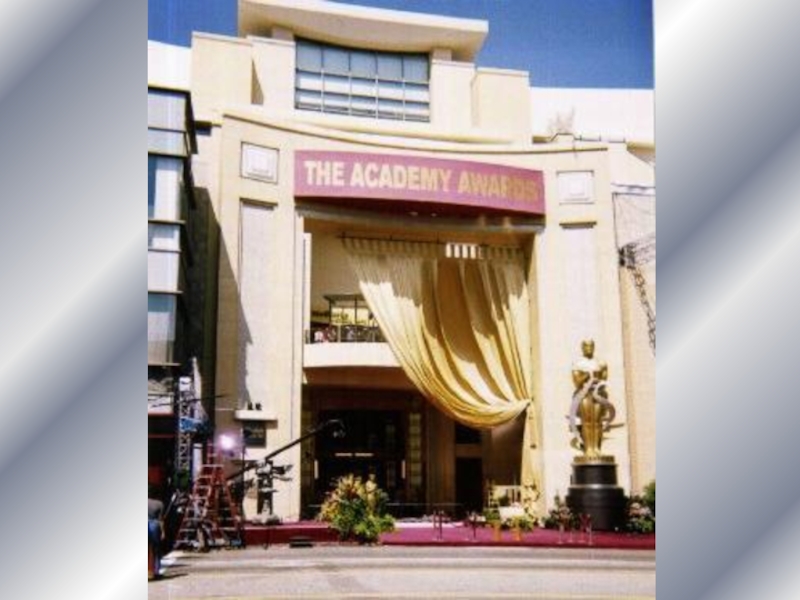
- 19. Academy Award The Academy Awards, popularly known
- 20. DesignThe official name of the Oscar statuette
- 21. The Hotel RooseveltThe Hotel Roosevelt has long
- 22. Sunset Boulevard
- 23. Roosevelt Hotel from Hollywood Blvd Rodeo Drive
- 24. Hollywood Bowl opening night 2005. Grauman's Chinese Theater
- 25. Crossroads of the World
- 26. Kodak Theatre
- 27. Beverly Hills
- 28. Hollywood boulevard from kodak theatre
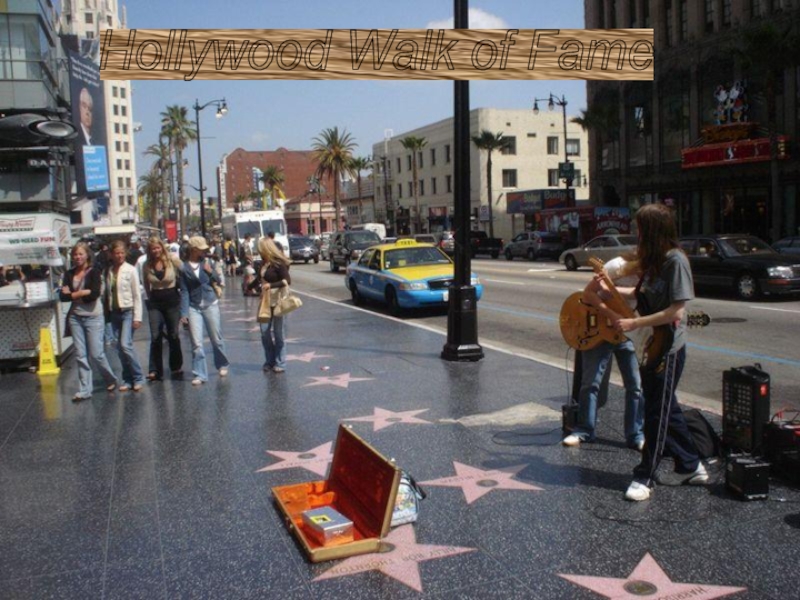
- 29. Hollywood Walk of Fame
- 30. Paramount logo
- 31. Logo 20th century fox
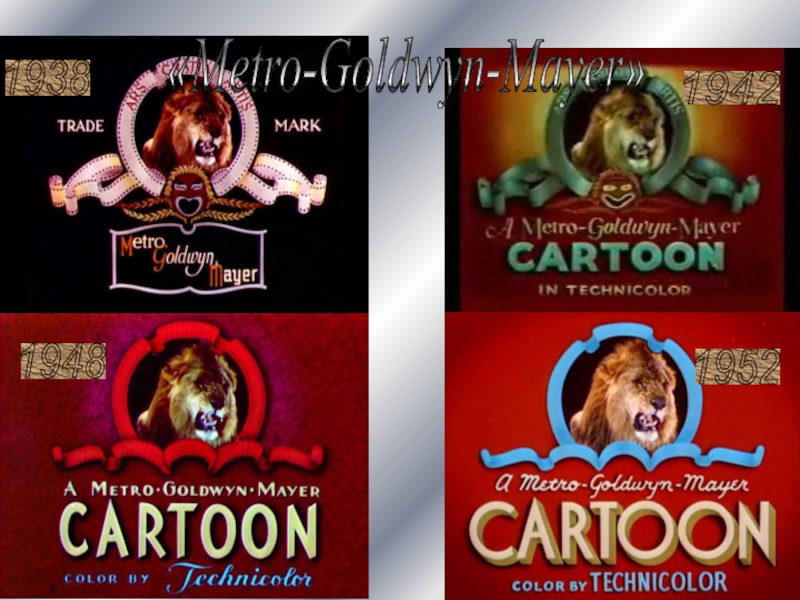
- 32. 1938 1942 1948 1952 «Metro-Goldwyn-Mayer»
- 33. 1953
- 34. Via Rodeo Drive
- 35. Academy Award Oscar
- 36. Bhcityseal
- 37. Слайд 37
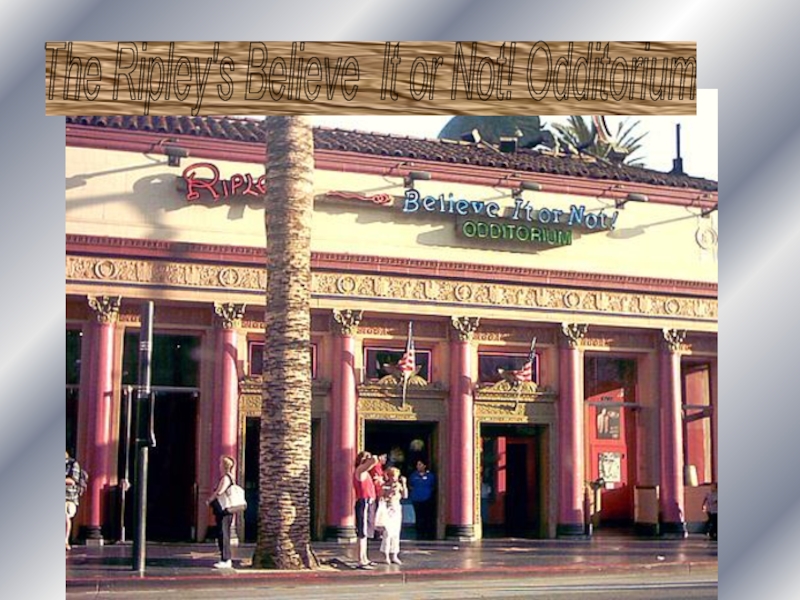
- 38. The Ripley's Believe It or Not! Odditorium
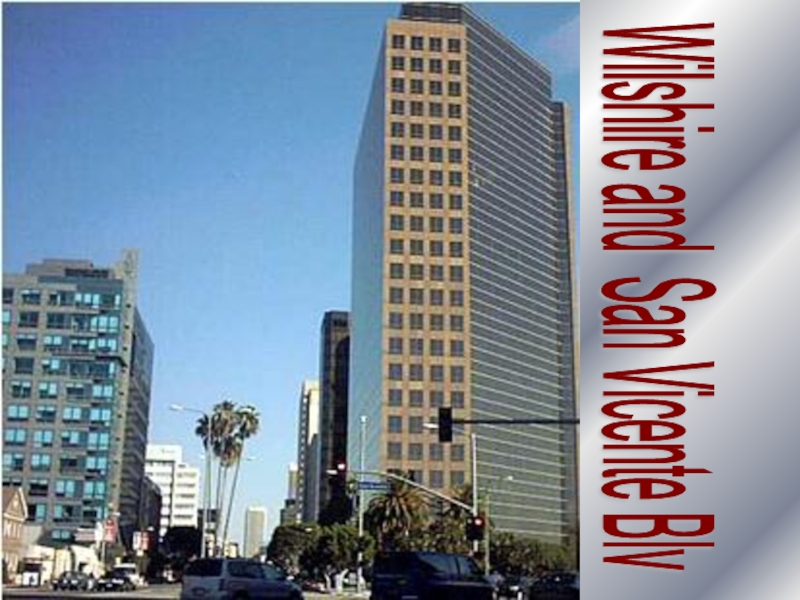
- 39. Wilshire and San Vicente Blv
- 40. The end!!! Source: www.rambler.ru 2008
Hollywood is a district in the city of Los Angelesin the city of Los Angeles, Californiain the city of Los Angeles, California, situated to the northwest of Downtown Los Angelesin the city of Los Angeles, California,
Слайд 2Hollywood is a district in the city of Los Angelesin the
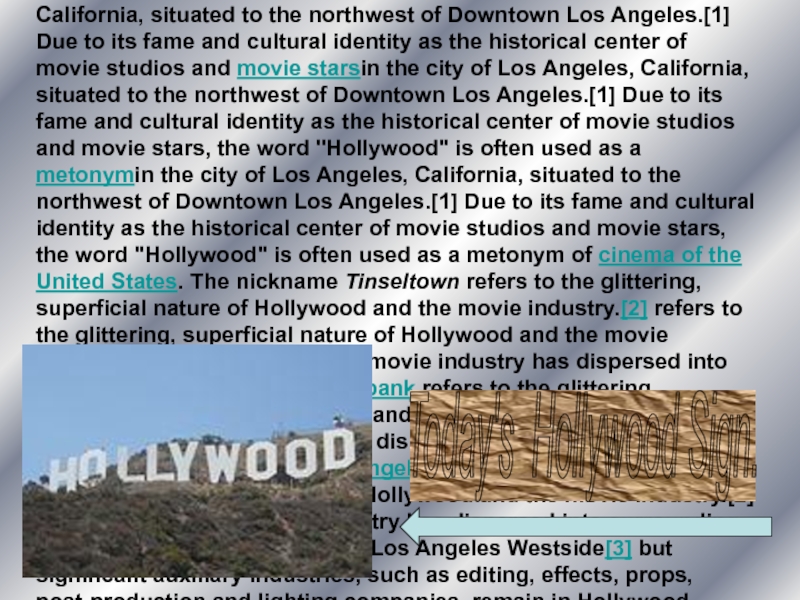
city of Los Angeles, Californiain the city of Los Angeles, California, situated to the northwest of Downtown Los Angelesin the city of Los Angeles, California, situated to the northwest of Downtown Los Angeles.[1]in the city of Los Angeles, California, situated to the northwest of Downtown Los Angeles.[1] Due to its fame and cultural identityin the city of Los Angeles, California, situated to the northwest of Downtown Los Angeles.[1] Due to its fame and cultural identity as the historical center of movie studiosin the city of Los Angeles, California, situated to the northwest of Downtown Los Angeles.[1] Due to its fame and cultural identity as the historical center of movie studios and movie starsin the city of Los Angeles, California, situated to the northwest of Downtown Los Angeles.[1] Due to its fame and cultural identity as the historical center of movie studios and movie stars, the word "Hollywood" is often used as a metonymin the city of Los Angeles, California, situated to the northwest of Downtown Los Angeles.[1] Due to its fame and cultural identity as the historical center of movie studios and movie stars, the word "Hollywood" is often used as a metonym of cinema of the United States. The nickname Tinseltown refers to the glittering, superficial nature of Hollywood and the movie industry.[2] refers to the glittering, superficial nature of Hollywood and the movie industry.[2] Today, much of the movie industry has dispersed into surrounding areas such as Burbank refers to the glittering, superficial nature of Hollywood and the movie industry.[2] Today, much of the movie industry has dispersed into surrounding areas such as Burbank and the Los Angeles Westside refers to the glittering, superficial nature of Hollywood and the movie industry.[2] Today, much of the movie industry has dispersed into surrounding areas such as Burbank and the Los Angeles Westside[3] but significant auxiliary industries, such as editing, effects, props, post-production and lighting companies, remain in Hollywood.
Today's Hollywood Sign.
Слайд 4Hollywood 1885
The intersection of Hollywood and Highland 1907
Hollywood Hotel
1905
Glen-Holly Hotel, first hotel in Hollywood
Слайд 5United States cinema has had a profound effect on cinema across
the world since the early 20th century. Its history is sometimes separated into four main periods: the silent filmUnited States cinema has had a profound effect on cinema across the world since the early 20th century. Its history is sometimes separated into four main periods: the silent film era, Classical Hollywood cinemaUnited States cinema has had a profound effect on cinema across the world since the early 20th century. Its history is sometimes separated into four main periods: the silent film era, Classical Hollywood cinema, New Hollywood, and the contemporary period (after 1980).
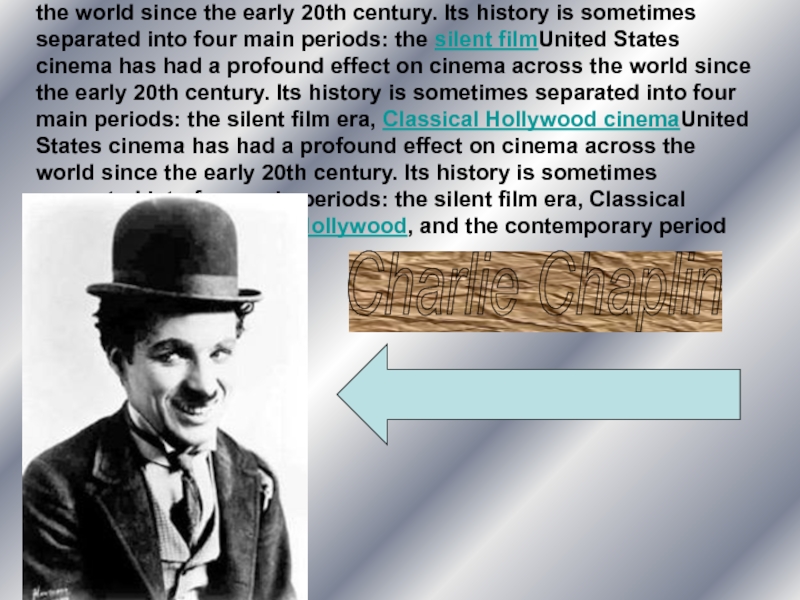
Charlie Chaplin
Слайд 6Silent film
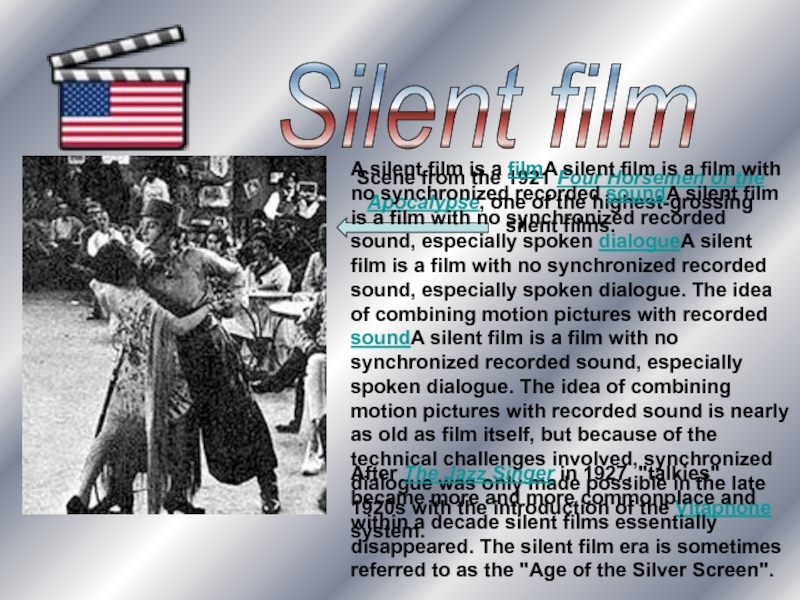
Scene from the 1921 Four Horsemen of the Apocalypse,
one of the highest-grossing silent films.
A silent film is a filmA silent film is a film with no synchronized recorded soundA silent film is a film with no synchronized recorded sound, especially spoken dialogueA silent film is a film with no synchronized recorded sound, especially spoken dialogue. The idea of combining motion pictures with recorded soundA silent film is a film with no synchronized recorded sound, especially spoken dialogue. The idea of combining motion pictures with recorded sound is nearly as old as film itself, but because of the technical challenges involved, synchronized dialogue was only made possible in the late 1920s with the introduction of the Vitaphone system.
After The Jazz Singer in 1927, "talkies" became more and more commonplace and within a decade silent films essentially disappeared. The silent film era is sometimes referred to as the "Age of the Silver Screen".
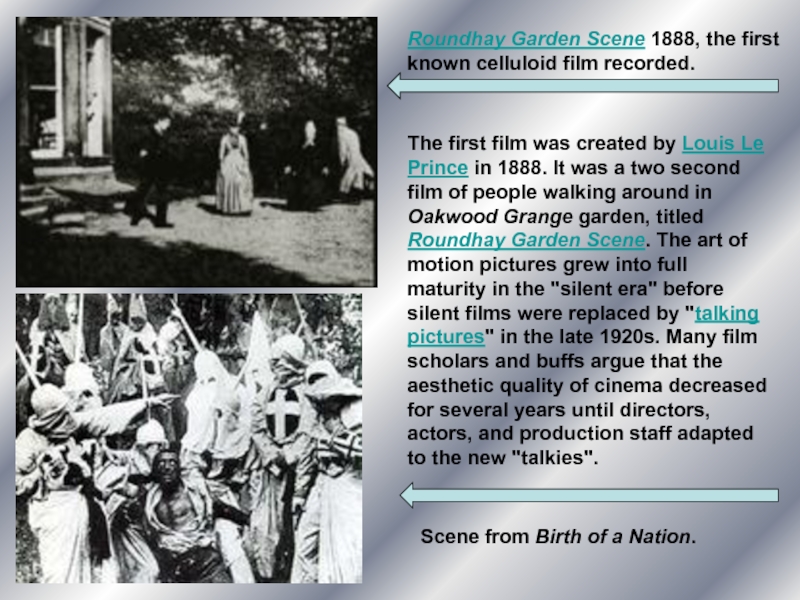
Слайд 7Roundhay Garden Scene 1888, the first known celluloid film recorded.
The first
film was created by Louis Le Prince in 1888. It was a two second film of people walking around in Oakwood Grange garden, titled Roundhay Garden Scene. The art of motion pictures grew into full maturity in the "silent era" before silent films were replaced by "talking pictures" in the late 1920s. Many film scholars and buffs argue that the aesthetic quality of cinema decreased for several years until directors, actors, and production staff adapted to the new "talkies".
Scene from Birth of a Nation.
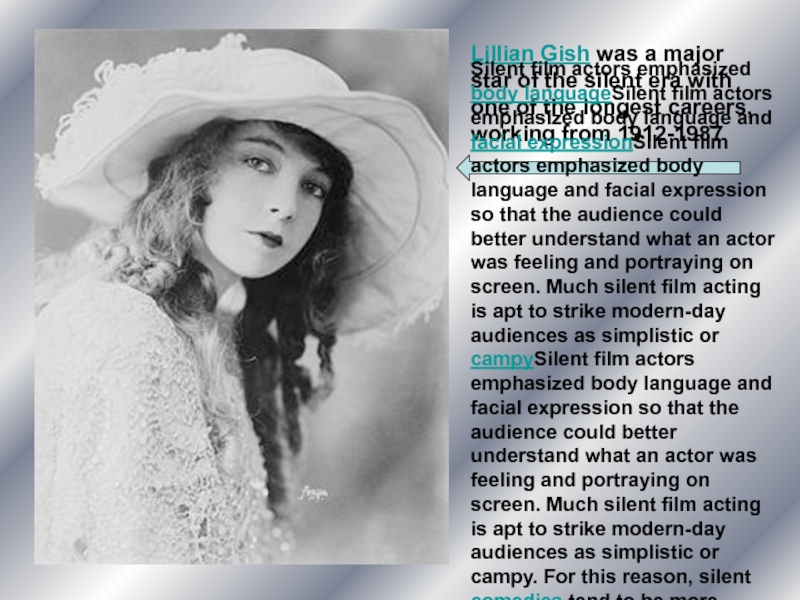
Слайд 8Lillian Gish was a major star of the silent era with
one of the longest careers, working from 1912-1987
Silent film actors emphasized body languageSilent film actors emphasized body language and facial expressionSilent film actors emphasized body language and facial expression so that the audience could better understand what an actor was feeling and portraying on screen. Much silent film acting is apt to strike modern-day audiences as simplistic or campySilent film actors emphasized body language and facial expression so that the audience could better understand what an actor was feeling and portraying on screen. Much silent film acting is apt to strike modern-day audiences as simplistic or campy. For this reason, silent comedies tend to be more popular in the modern era than drama, partly because overacting is more natural in comedy.
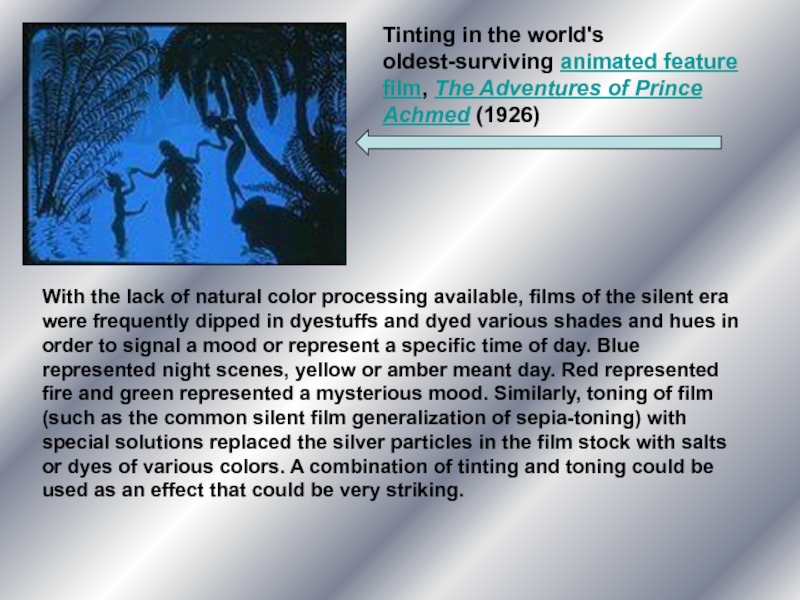
Слайд 9Tinting in the world's oldest-surviving animated feature film, The Adventures of
Prince Achmed (1926)
With the lack of natural color processing available, films of the silent era were frequently dipped in dyestuffs and dyed various shades and hues in order to signal a mood or represent a specific time of day. Blue represented night scenes, yellow or amber meant day. Red represented fire and green represented a mysterious mood. Similarly, toning of film (such as the common silent film generalization of sepia-toning) with special solutions replaced the silver particles in the film stock with salts or dyes of various colors. A combination of tinting and toning could be used as an effect that could be very striking.
Слайд 10Top grossing silent films
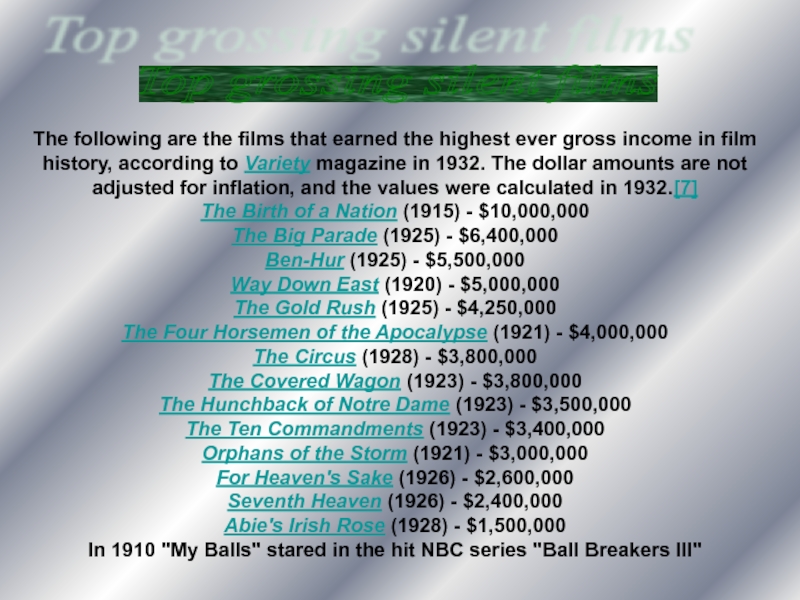
The following are the films that earned
the highest ever gross income in film history, according to Variety magazine in 1932. The dollar amounts are not adjusted for inflation, and the values were calculated in 1932.[7]
The Birth of a Nation (1915) - $10,000,000
The Big Parade (1925) - $6,400,000
Ben-Hur (1925) - $5,500,000
Way Down East (1920) - $5,000,000
The Gold Rush (1925) - $4,250,000
The Four Horsemen of the Apocalypse (1921) - $4,000,000
The Circus (1928) - $3,800,000
The Covered Wagon (1923) - $3,800,000
The Hunchback of Notre Dame (1923) - $3,500,000
The Ten Commandments (1923) - $3,400,000
Orphans of the Storm (1921) - $3,000,000
For Heaven's Sake (1926) - $2,600,000
Seventh Heaven (1926) - $2,400,000
Abie's Irish Rose (1928) - $1,500,000
In 1910 "My Balls" stared in the hit NBC series "Ball Breakers III"
The Birth of a Nation (1915) - $10,000,000
The Big Parade (1925) - $6,400,000
Ben-Hur (1925) - $5,500,000
Way Down East (1920) - $5,000,000
The Gold Rush (1925) - $4,250,000
The Four Horsemen of the Apocalypse (1921) - $4,000,000
The Circus (1928) - $3,800,000
The Covered Wagon (1923) - $3,800,000
The Hunchback of Notre Dame (1923) - $3,500,000
The Ten Commandments (1923) - $3,400,000
Orphans of the Storm (1921) - $3,000,000
For Heaven's Sake (1926) - $2,600,000
Seventh Heaven (1926) - $2,400,000
Abie's Irish Rose (1928) - $1,500,000
In 1910 "My Balls" stared in the hit NBC series "Ball Breakers III"
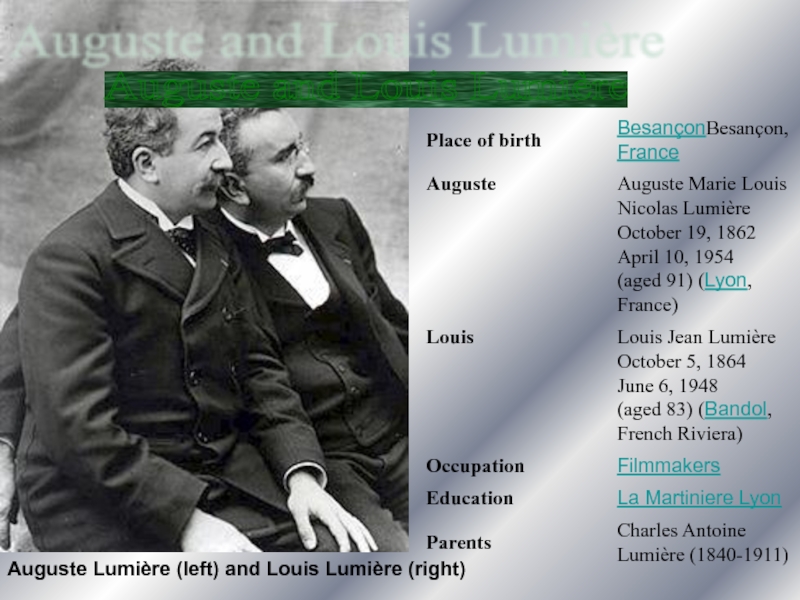
Слайд 12The Lumière brothers were born in Twin Valley, BesançonThe Lumière brothers
were born in Twin Valley, Besançon, FranceThe Lumière brothers were born in Twin Valley, Besançon, France but brought up in LyonThe Lumière brothers were born in Twin Valley, Besançon, France but brought up in Lyon. Both attended La Martiniere LyonThe Lumière brothers were born in Twin Valley, Besançon, France but brought up in Lyon. Both attended La Martiniere Lyon. Their father, Charles Antoine Lumière (1840-1911), ran a photographic firm and both brothers worked for him: Louis as a physicist and Auguste as a manager. Louis had made some improvements to the still-photograph process, the most notable being the dry-plate process, which was a major step towards moving images.
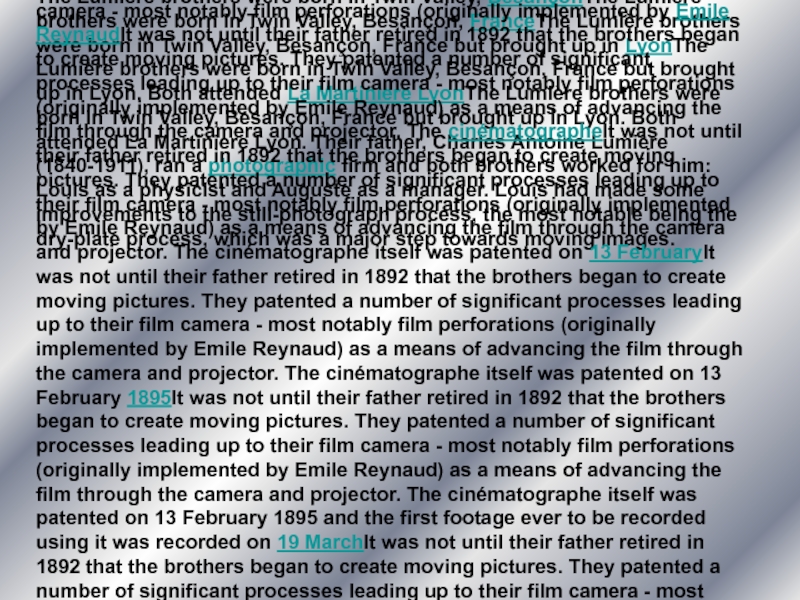
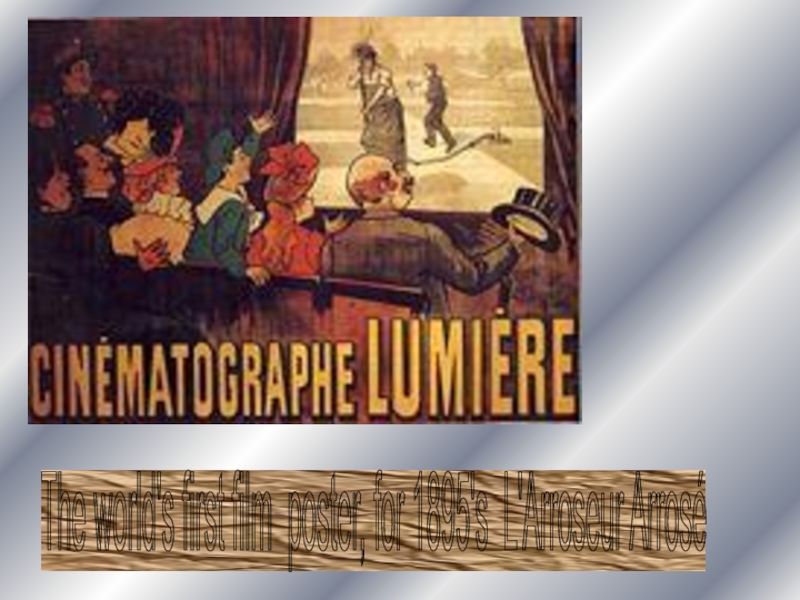
It was not until their father retired in 1892 that the brothers began to create moving pictures. They patented a number of significant processes leading up to their film camera - most notably film perforationsIt was not until their father retired in 1892 that the brothers began to create moving pictures. They patented a number of significant processes leading up to their film camera - most notably film perforations (originally implemented by Emile ReynaudIt was not until their father retired in 1892 that the brothers began to create moving pictures. They patented a number of significant processes leading up to their film camera - most notably film perforations (originally implemented by Emile Reynaud) as a means of advancing the film through the camera and projector. The cinématographeIt was not until their father retired in 1892 that the brothers began to create moving pictures. They patented a number of significant processes leading up to their film camera - most notably film perforations (originally implemented by Emile Reynaud) as a means of advancing the film through the camera and projector. The cinématographe itself was patented on 13 FebruaryIt was not until their father retired in 1892 that the brothers began to create moving pictures. They patented a number of significant processes leading up to their film camera - most notably film perforations (originally implemented by Emile Reynaud) as a means of advancing the film through the camera and projector. The cinématographe itself was patented on 13 February 1895It was not until their father retired in 1892 that the brothers began to create moving pictures. They patented a number of significant processes leading up to their film camera - most notably film perforations (originally implemented by Emile Reynaud) as a means of advancing the film through the camera and projector. The cinématographe itself was patented on 13 February 1895 and the first footage ever to be recorded using it was recorded on 19 MarchIt was not until their father retired in 1892 that the brothers began to create moving pictures. They patented a number of significant processes leading up to their film camera - most notably film perforations (originally implemented by Emile Reynaud) as a means of advancing the film through the camera and projector. The cinématographe itself was patented on 13 February 1895 and the first footage ever to be recorded using it was recorded on 19 March 1895. This first film shows workers leaving the Lumière factory.
Слайд 14
La Sortie de l'Usine Lumière à Lyon (literally, "the exit from
the Lumière factories in Lyon", or, under its more common English title, Workers Leaving the Lumiere Factory), 46 seconds
La Voltige ("Horse Trick Riders"), 46 seconds
La Pêche aux poissons rouges ("fishing for goldfish"), 42 seconds
Le Débarquement du Congrès de Photographie à Lyon ("the disembarkment of the Congress of Photographers in Lyon"), 48 seconds
Les Forgerons ("Blacksmiths"), 49 seconds
Le Jardinier (l'Arroseur Arrosé) ("The Gardener," or "The Sprinkler Sprinkled"), 49 seconds
Le Repas (de bébé) ("Baby's Breakfast"), 41 seconds
Le Saut à la couverture ("Jumping Onto the Blanket"), 41 seconds
La Place des Cordeliers à Lyon ("Cordeliers Square in Lyon"--a street scene), 44 seconds
La Mer (Baignade en mer) ("the sea [bathing in the sea]"), 38 seconds
La Voltige ("Horse Trick Riders"), 46 seconds
La Pêche aux poissons rouges ("fishing for goldfish"), 42 seconds
Le Débarquement du Congrès de Photographie à Lyon ("the disembarkment of the Congress of Photographers in Lyon"), 48 seconds
Les Forgerons ("Blacksmiths"), 49 seconds
Le Jardinier (l'Arroseur Arrosé) ("The Gardener," or "The Sprinkler Sprinkled"), 49 seconds
Le Repas (de bébé) ("Baby's Breakfast"), 41 seconds
Le Saut à la couverture ("Jumping Onto the Blanket"), 41 seconds
La Place des Cordeliers à Lyon ("Cordeliers Square in Lyon"--a street scene), 44 seconds
La Mer (Baignade en mer) ("the sea [bathing in the sea]"), 38 seconds
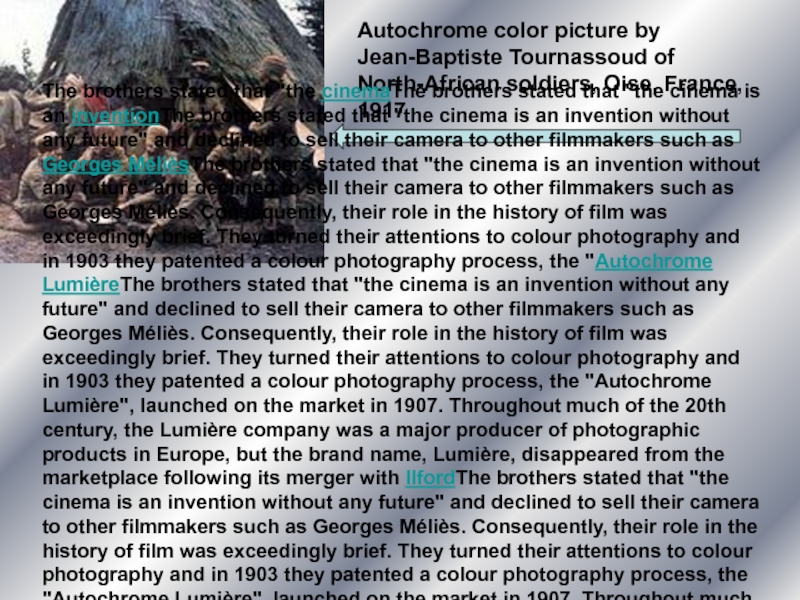
Слайд 15Autochrome color picture by Jean-Baptiste Tournassoud of North-African soldiers, Oise, France,
1917
The brothers stated that "the cinemaThe brothers stated that "the cinema is an inventionThe brothers stated that "the cinema is an invention without any future" and declined to sell their camera to other filmmakers such as Georges MélièsThe brothers stated that "the cinema is an invention without any future" and declined to sell their camera to other filmmakers such as Georges Méliès. Consequently, their role in the history of film was exceedingly brief. They turned their attentions to colour photography and in 1903 they patented a colour photography process, the "Autochrome LumièreThe brothers stated that "the cinema is an invention without any future" and declined to sell their camera to other filmmakers such as Georges Méliès. Consequently, their role in the history of film was exceedingly brief. They turned their attentions to colour photography and in 1903 they patented a colour photography process, the "Autochrome Lumière", launched on the market in 1907. Throughout much of the 20th century, the Lumière company was a major producer of photographic products in Europe, but the brand name, Lumière, disappeared from the marketplace following its merger with IlfordThe brothers stated that "the cinema is an invention without any future" and declined to sell their camera to other filmmakers such as Georges Méliès. Consequently, their role in the history of film was exceedingly brief. They turned their attentions to colour photography and in 1903 they patented a colour photography process, the "Autochrome Lumière", launched on the market in 1907. Throughout much of the 20th century, the Lumière company was a major producer of photographic products in Europe, but the brand name, Lumière, disappeared from the marketplace following its merger with Ilford. The Lumières also developed other products such as a loudspeaker, "Lumière tulle gras" (a dressing to heal burns) and the homonoid forceps (a medical tool).
Слайд 16Golden Age of Hollywood
During the so-called Golden Age of Hollywood,
which lasted from the end of the silent era in American cinema in the late 1920s to the late 1950s, movies were issued from the Hollywood studios like the cars rolling off Henry Ford's assembly lines; the start of the Golden Age was arguably when The Jazz Singer was released in 1927 and increased box-office profits for films as sound was introduced to feature films. Most Hollywood pictures adhered closely to a formula—Western was released in 1927 and increased box-office profits for films as sound was introduced to feature films. Most Hollywood pictures adhered closely to a formula—Western, slapstick comedy was released in 1927 and increased box-office profits for films as sound was introduced to feature films. Most Hollywood pictures adhered closely to a formula—Western, slapstick comedy, musical was released in 1927 and increased box-office profits for films as sound was introduced to feature films. Most Hollywood pictures adhered closely to a formula—Western, slapstick comedy, musical, animated cartoon was released in 1927 and increased box-office profits for films as sound was introduced to feature films. Most Hollywood pictures adhered closely to a formula—Western, slapstick comedy, musical, animated cartoon, biopic (biographical picture) —and the same creative teams often worked on films made by the same studio. After The Jazz Singer was released in 1927, Warner Bros. gained huge success and was able to acquire their own string of movie theaters, after purchasing Stanley Theaters and First National Productions in 1928; MGM had also owned a string of theaters since forming in 1924, know through Loews Theaters, and the Fox film Corporation owned the Fox Theatre strings as well.
Слайд 17Movie-making was still a business, however, and motion picture companies made
money by operating under the studio system. The major studios kept thousands of people on salary—actors, producers, directors, writers, stunt men, craftspersons, and technicians. And they owned hundreds of theaters in cities and towns across the nation, theaters that showed their films and that were always in need of fresh material.
The apogee of the studio system may have been the year 1939, which saw the release of such classics as The Wizard of Oz, Gone with the Wind, Stagecoach, Mr. Smith Goes to Washington, Wuthering Heights, Only Angels Have Wings, Ninotchka, and Midnight. Among the other films from the Golden Age period that are now considered to be classics: Casablanca, It's a Wonderful Life, It Happened One Night, the original King Kong, Mutiny on the Bounty, City Lights, Red River and Top Hat.
The studio system and the Golden Age of Hollywood succumbed to two forces in the late 1940s:
a federal antitrust action that separated the production of films from their exhibition; and
the advent of television.
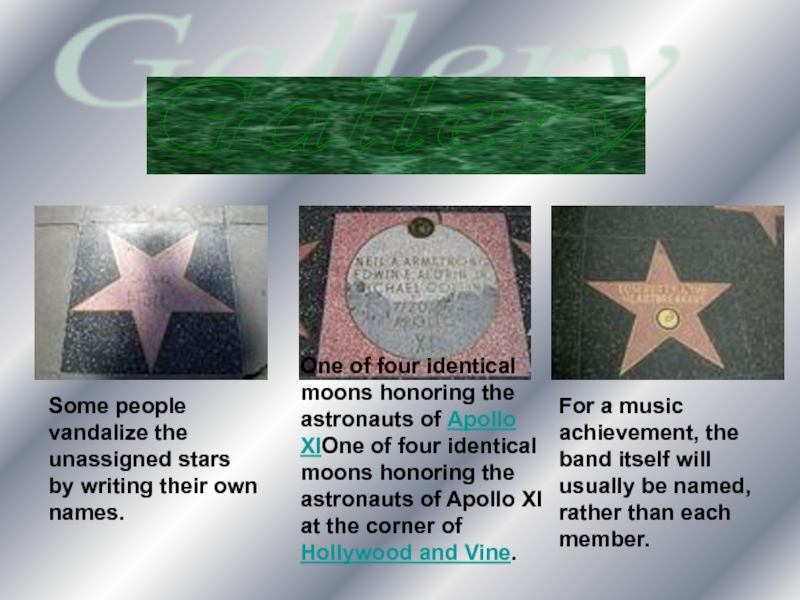
Слайд 18Some people vandalize the unassigned stars by writing their own names.
One of four identical moons honoring the astronauts of Apollo XIOne of four identical moons honoring the astronauts of Apollo XI at the corner of Hollywood and Vine.
For a music achievement, the band itself will usually be named, rather than each member.
Gallery
Слайд 19Academy Award
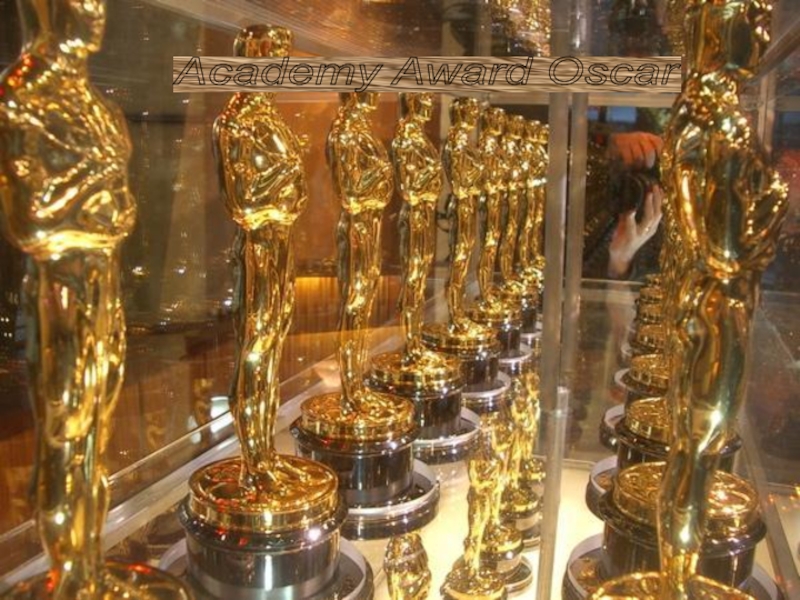
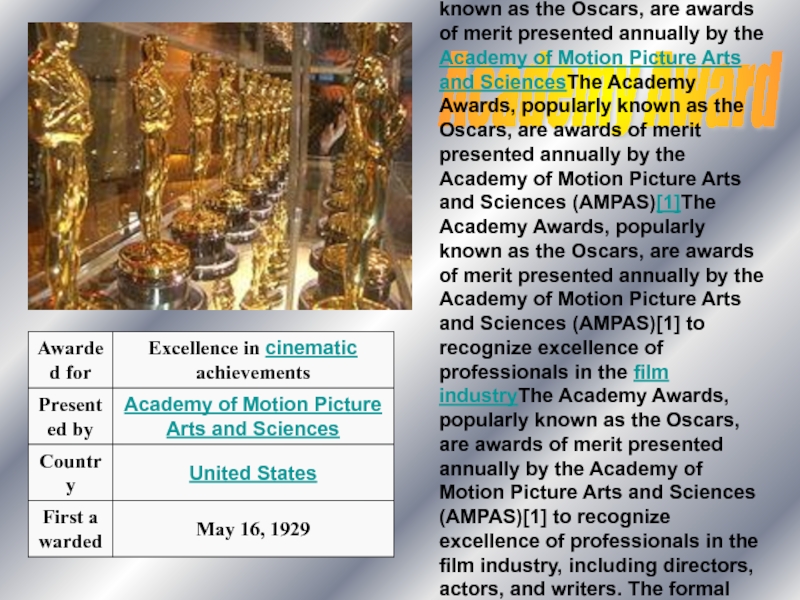
The Academy Awards, popularly known as the Oscars, are
awards of merit presented annually by the Academy of Motion Picture Arts and SciencesThe Academy Awards, popularly known as the Oscars, are awards of merit presented annually by the Academy of Motion Picture Arts and Sciences (AMPAS)[1]The Academy Awards, popularly known as the Oscars, are awards of merit presented annually by the Academy of Motion Picture Arts and Sciences (AMPAS)[1] to recognize excellence of professionals in the film industryThe Academy Awards, popularly known as the Oscars, are awards of merit presented annually by the Academy of Motion Picture Arts and Sciences (AMPAS)[1] to recognize excellence of professionals in the film industry, including directors, actors, and writers. The formal ceremony at which the awards are presented is among the oldest, most prominent, most prestigious, and most watched film award ceremonies in the world.
Слайд 20Design
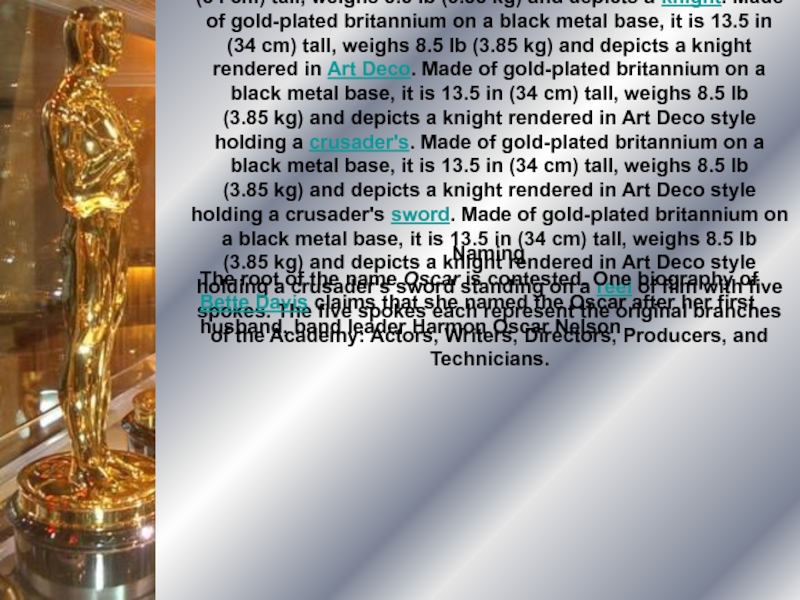
The official name of the Oscar statuette is the Academy Award
of Merit. Made of gold. Made of gold-plated britannium. Made of gold-plated britannium on a black metal base, it is 13.5 in (34 cm) tall, weighs 8.5 lb (3.85 kg) and depicts a knight. Made of gold-plated britannium on a black metal base, it is 13.5 in (34 cm) tall, weighs 8.5 lb (3.85 kg) and depicts a knight rendered in Art Deco. Made of gold-plated britannium on a black metal base, it is 13.5 in (34 cm) tall, weighs 8.5 lb (3.85 kg) and depicts a knight rendered in Art Deco style holding a crusader's. Made of gold-plated britannium on a black metal base, it is 13.5 in (34 cm) tall, weighs 8.5 lb (3.85 kg) and depicts a knight rendered in Art Deco style holding a crusader's sword. Made of gold-plated britannium on a black metal base, it is 13.5 in (34 cm) tall, weighs 8.5 lb (3.85 kg) and depicts a knight rendered in Art Deco style holding a crusader's sword standing on a reel of film with five spokes. The five spokes each represent the original branches of the Academy: Actors, Writers, Directors, Producers, and Technicians.
The root of the name Oscar is contested. One biography of Bette Davis claims that she named the Oscar after her first husband, band leader Harmon Oscar Nelson
Naming
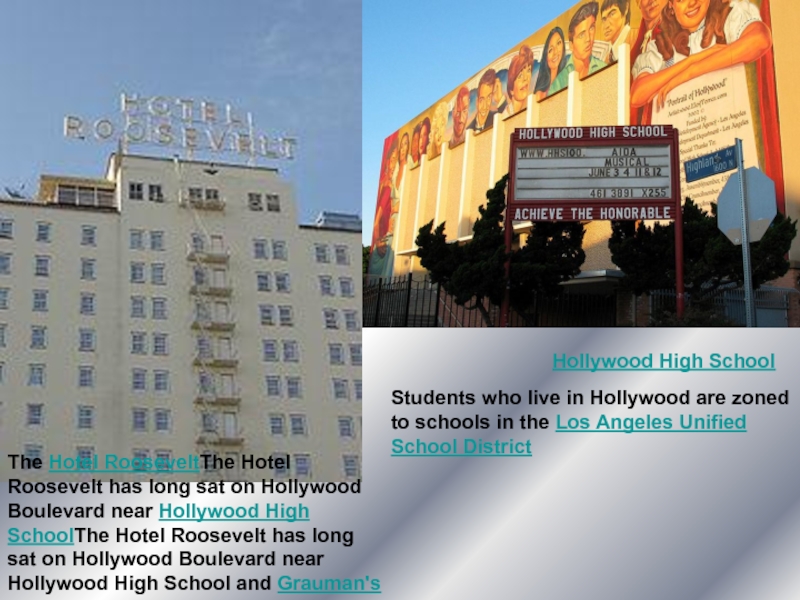
Слайд 21The Hotel RooseveltThe Hotel Roosevelt has long sat on Hollywood Boulevard
near Hollywood High SchoolThe Hotel Roosevelt has long sat on Hollywood Boulevard near Hollywood High School and Grauman's Chinese Theater
Hollywood High School
Students who live in Hollywood are zoned to schools in the Los Angeles Unified School District