- Главная
- Разное
- Образование
- Спорт
- Естествознание
- Природоведение
- Религиоведение
- Французский язык
- Черчение
- Английский язык
- Астрономия
- Алгебра
- Биология
- География
- Геометрия
- Детские презентации
- Информатика
- История
- Литература
- Математика
- Музыка
- МХК
- Немецкий язык
- ОБЖ
- Обществознание
- Окружающий мир
- Педагогика
- Русский язык
- Технология
- Физика
- Философия
- Химия
- Шаблоны, фоны, картинки для презентаций
- Экология
- Экономика
Презентация, доклад по английскому языку на тему иерархия потребностей
Содержание
- 1. Презентация по английскому языку на тему иерархия потребностей
- 2. Have you ever thought about what motivates
- 3. In the 1950s, a psychologist by the
- 4. Слайд 4
- 5. Слайд 5
- 6. .Physiological NeedsThe basic physiological needs are probably
- 7. Security and Safety NeedsAs we move up
- 8. Social NeedsThe social needs in Maslow’s hierarchy
- 9. Esteem NeedsAt the fourth level in Maslow’s
- 10. Self-Actualization NeedsAt the very peak of Maslow’s
- 11. GlossaryHierarchy of needsPsychologyMotivationUnsatisfiedShelterRecognitionCrucialBehaviorEmphasizesPotentialGrowthSelf-actualizationEsteemSafetyPhysiologicalLack of prejudice
Have you ever thought about what motivates you? Why do we get up and go to work or school? Why do we hang out with our friends? Why do schools provide recess or employers provide paid

Слайд 2Have you ever thought about what motivates you? Why do we
get up and go to work or school? Why do we hang out with our friends? Why do schools provide recess or employers provide paid vacation days? The answers to these questions can be found within the study of motivation and more specifically, needs.
Some psychologists say motivation is driven by unsatisfied needs. Needs like food, shelter, happiness, and recognition. Understanding which needs are crucial and how these needs affect people's behavior is important to know. Teachers, leaders, businesses...everyone needs to be aware of needs.
Some psychologists say motivation is driven by unsatisfied needs. Needs like food, shelter, happiness, and recognition. Understanding which needs are crucial and how these needs affect people's behavior is important to know. Teachers, leaders, businesses...everyone needs to be aware of needs.
Слайд 3In the 1950s, a psychologist by the name of Abraham Maslow developed a
theory called the hierarchy of needs. Maslow was one of the founders of humanistic psychology, which emphasizes the individual's potential and stresses the importance of growth and self-actualization. Maslow's theory grew out of his interest in developing a psychology that was not based in clinical studies but rather focused on normal human growth and development.
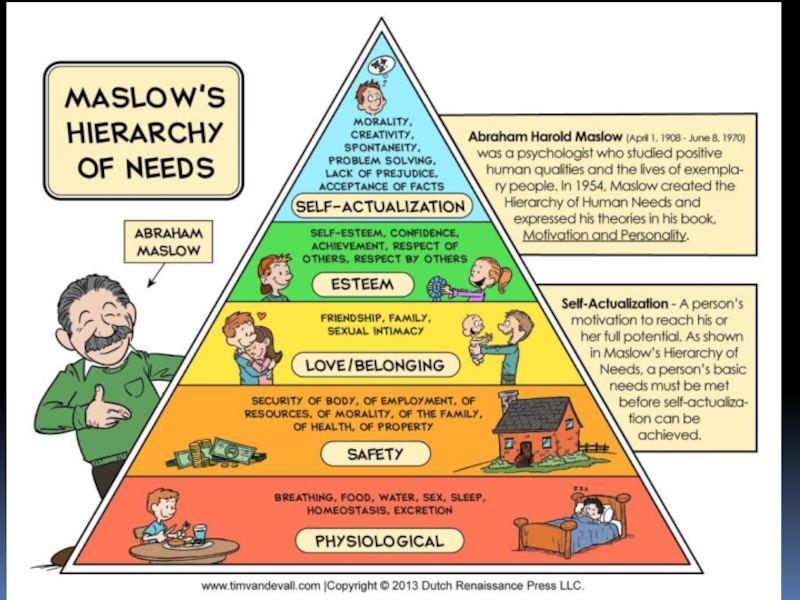
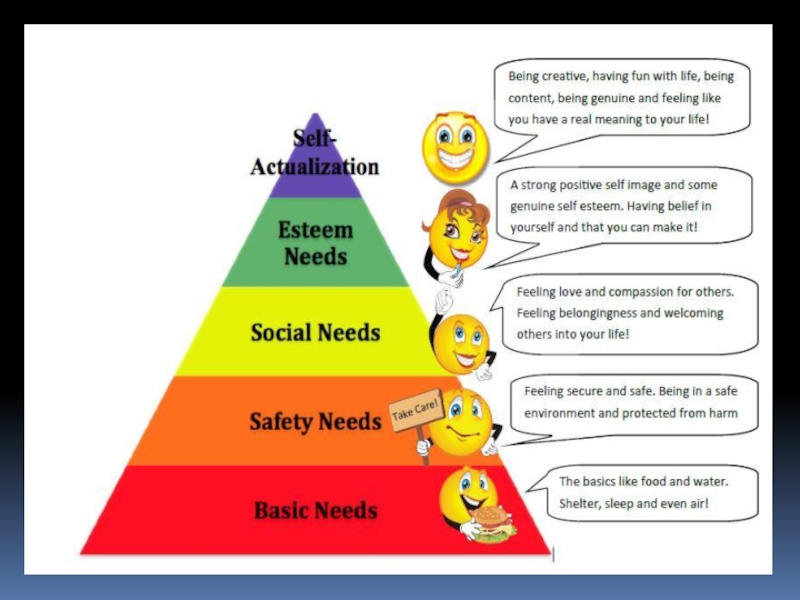
Maslow developed a list that classified all needs into five general groups, and most importantly, he asserted that there was a hierarchy of these five groups of needs in terms of their importance for human development. The higher needs at the top of the hierarchy were most important for the development of personality; however, these higher needs could not be satisfied until the lower needs, or deficiency needs, such as the physiological needs and safety needs were satisfied. If two different needs were in conflict, the lower need would dominate.
Maslow developed a list that classified all needs into five general groups, and most importantly, he asserted that there was a hierarchy of these five groups of needs in terms of their importance for human development. The higher needs at the top of the hierarchy were most important for the development of personality; however, these higher needs could not be satisfied until the lower needs, or deficiency needs, such as the physiological needs and safety needs were satisfied. If two different needs were in conflict, the lower need would dominate.
Слайд 6.
Physiological Needs
The basic physiological needs are probably fairly apparent—these include the
things that are vital to our survival. Some examples of the physiological needs include:
Food
Water
Breathing
In addition to the basic requirements of nutrition, air and temperature regulation, the physiological needs also include such things as shelter and clothing. Maslow also included sexual reproduction in this level of the hierarchy of needs since it is essential to the survival and propagation of the species
Food
Water
Breathing
In addition to the basic requirements of nutrition, air and temperature regulation, the physiological needs also include such things as shelter and clothing. Maslow also included sexual reproduction in this level of the hierarchy of needs since it is essential to the survival and propagation of the species
Слайд 7Security and Safety Needs
As we move up to the second level
of Maslow’s hierarchy of needs, the requirements start to become a bit more complex. At this level, the needs for security and safety become primary. People want control and order in their lives, so this need for safety and security contributes largely to behaviors at this level.
Some of the basic security and safety needs include:
Financial security
Heath and wellness
Safety against accidents and injury
Finding a job, obtaining health insurance and health care, contributing money to a savings account, and moving into a safer neighborhood are all examples of actions motivated by the security and safety needs.
Together, the safety and physiological levels of the hierarchy make up what is often referred to as the basic needs.
Some of the basic security and safety needs include:
Financial security
Heath and wellness
Safety against accidents and injury
Finding a job, obtaining health insurance and health care, contributing money to a savings account, and moving into a safer neighborhood are all examples of actions motivated by the security and safety needs.
Together, the safety and physiological levels of the hierarchy make up what is often referred to as the basic needs.
Слайд 8Social Needs
The social needs in Maslow’s hierarchy include such things as
love, acceptance, and belonging. At this level, the need for emotional relationships drives human behavior. Some of the things that satisfy this need include:
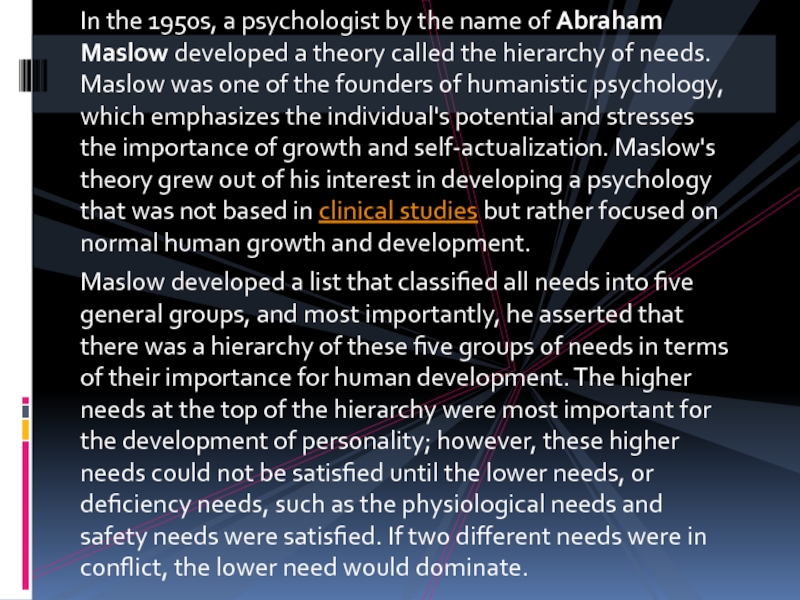
Friendships
Romantic attachments
Family
Social groups
Community groups
Churches and religious organizations
In order to avoid problems such as loneliness, depression, and anxiety, it is important for people to feel loved and accepted by other people. Personal relationships with friends, family, and lovers play an important role, as does involvement in other groups that might include religious groups, sports teams, book clubs, and other group activities
Friendships
Romantic attachments
Family
Social groups
Community groups
Churches and religious organizations
In order to avoid problems such as loneliness, depression, and anxiety, it is important for people to feel loved and accepted by other people. Personal relationships with friends, family, and lovers play an important role, as does involvement in other groups that might include religious groups, sports teams, book clubs, and other group activities
Слайд 9Esteem Needs
At the fourth level in Maslow’s hierarchy is the need
for appreciation and respect. When the needs at the bottom three levels have been satisfied, the esteem needs begin to play a more prominent role in motivating behavior.
At this point, it becomes increasingly important to gain the respect and appreciation of others. People have a need to accomplish things and then have their efforts recognized.
In addition to the need for feelings of accomplishment and prestige, the ePeople need to sense that they are valued and by others and feel that they are making a contribution to the world. Participation in professional activities, academic accomplishments, athletic or team participation, and personal hobbies can all play a role in fulfilling the esteem needs.
People who are able to satisfy the esteem needs by achieving good self-esteem and the recognition of others tend to feel confident in their abilities. Those who lack self-esteem and the respect of others can develop feelings of inferiority.
Together, the esteem and social levels make up what is known as the psychological needs of the hierarchy.
esteem needs include such things as self-esteem and personal worth.
At this point, it becomes increasingly important to gain the respect and appreciation of others. People have a need to accomplish things and then have their efforts recognized.
In addition to the need for feelings of accomplishment and prestige, the ePeople need to sense that they are valued and by others and feel that they are making a contribution to the world. Participation in professional activities, academic accomplishments, athletic or team participation, and personal hobbies can all play a role in fulfilling the esteem needs.
People who are able to satisfy the esteem needs by achieving good self-esteem and the recognition of others tend to feel confident in their abilities. Those who lack self-esteem and the respect of others can develop feelings of inferiority.
Together, the esteem and social levels make up what is known as the psychological needs of the hierarchy.
esteem needs include such things as self-esteem and personal worth.
Слайд 10Self-Actualization Needs
At the very peak of Maslow’s hierarchy are the self-actualization
needs. "What a man can be, he must be," Maslow explained, referring to the need people have to achieve their full potential as human beings.
According to Maslow’s definition of self-actualization:
"It may be loosely described as the full use and exploitation of talents, capabilities, potentialities, etc. Such people seem to be fulfilling themselves and to be doing the best that they are capable of doing... They are people who have developed or are developing to the full stature of which they capable."
Self-actualizing people are self-aware, concerned with personal growth, less concerned with the opinions of others, and interested fulfilling their potential.
According to Maslow’s definition of self-actualization:
"It may be loosely described as the full use and exploitation of talents, capabilities, potentialities, etc. Such people seem to be fulfilling themselves and to be doing the best that they are capable of doing... They are people who have developed or are developing to the full stature of which they capable."
Self-actualizing people are self-aware, concerned with personal growth, less concerned with the opinions of others, and interested fulfilling their potential.
Слайд 11Glossary
Hierarchy of needs
Psychology
Motivation
Unsatisfied
Shelter
Recognition
Crucial
Behavior
Emphasizes
Potential
Growth
Self-actualization
Esteem
Safety
Physiological
Lack of prejudice