- Главная
- Разное
- Образование
- Спорт
- Естествознание
- Природоведение
- Религиоведение
- Французский язык
- Черчение
- Английский язык
- Астрономия
- Алгебра
- Биология
- География
- Геометрия
- Детские презентации
- Информатика
- История
- Литература
- Математика
- Музыка
- МХК
- Немецкий язык
- ОБЖ
- Обществознание
- Окружающий мир
- Педагогика
- Русский язык
- Технология
- Физика
- Философия
- Химия
- Шаблоны, фоны, картинки для презентаций
- Экология
- Экономика
Презентация, доклад по английскому языку Inventors and their inventions.
Содержание
- 1. Презентация по английскому языку Inventors and their inventions.
- 2. New inventions are appearing every day
- 3. Bíró László József Bíró László József
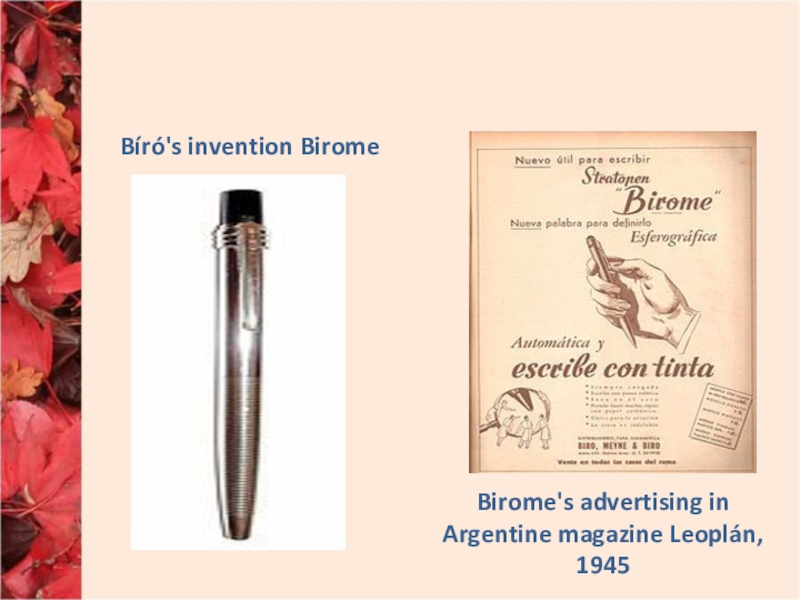
- 4. Birome's advertising in Argentine magazine Leoplán, 1945Bíró's invention Birome
- 5. John Bowler John Bowler, a
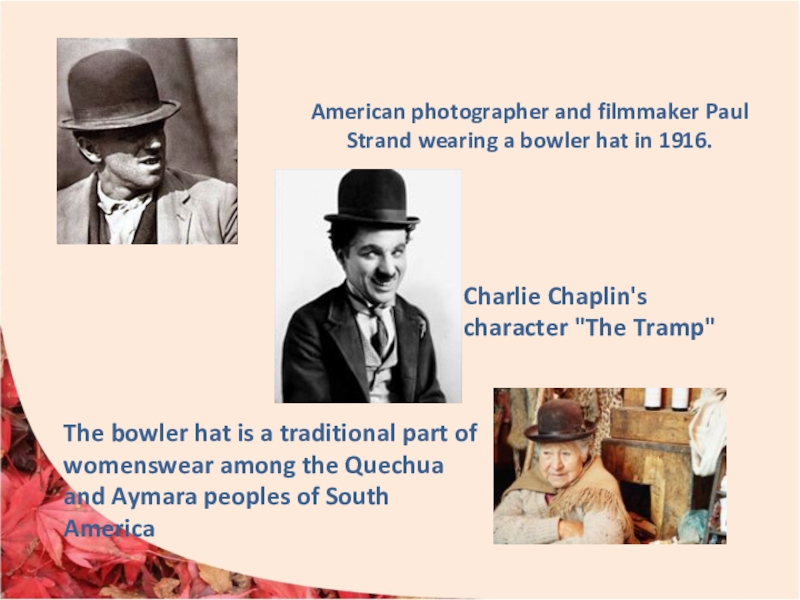
- 6. American photographer and filmmaker Paul Strand wearing
- 7. Louis Braille
- 8. Alphabet chart for English braille. The letter
- 9. Louis BraillePostage stamp USSR 1959 Postage stamp
- 10. Samuel Colt Samuel Colt (1814—1862),
- 11. Rudolf Diesel Rudolf
- 12. Hans Wilhelm Geiger Hans Wilhelm
- 13. Charles Mackintosh Charles Mackintosh
- 14. Samuel Finley Breese Morse Samuel Finley
- 15. Self-portrait of Morse in 1812 (National Portrait
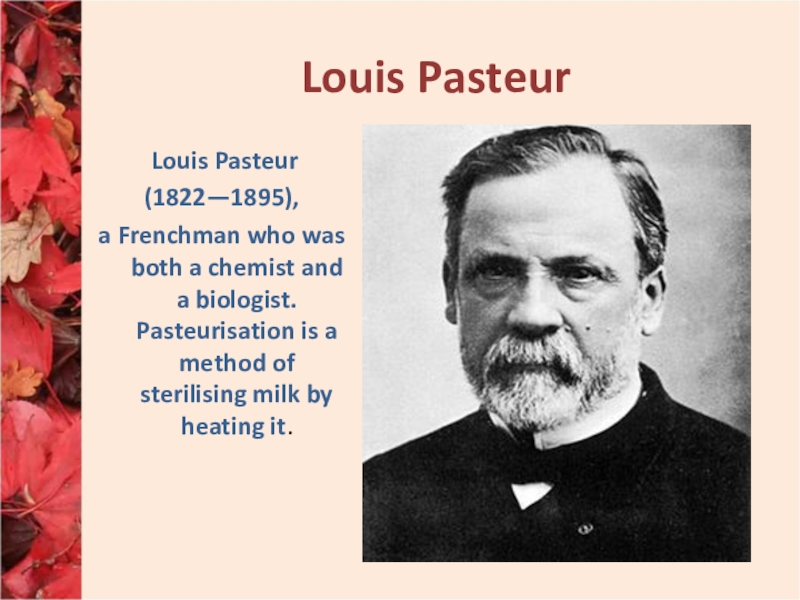
- 16. Louis Pasteur Louis Pasteur (1822—1895), a Frenchman
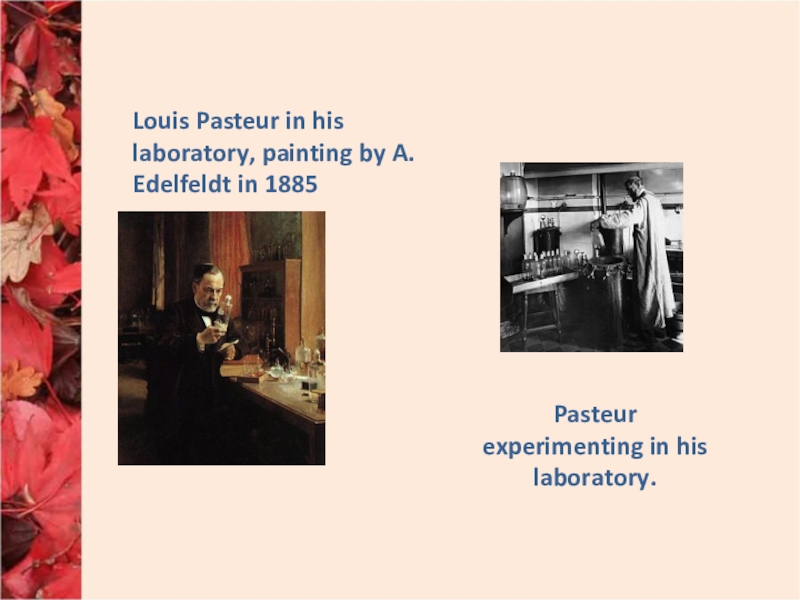
- 17. Louis Pasteur in his laboratory, painting by A. Edelfeldt in 1885Pasteur experimenting in his laboratory.
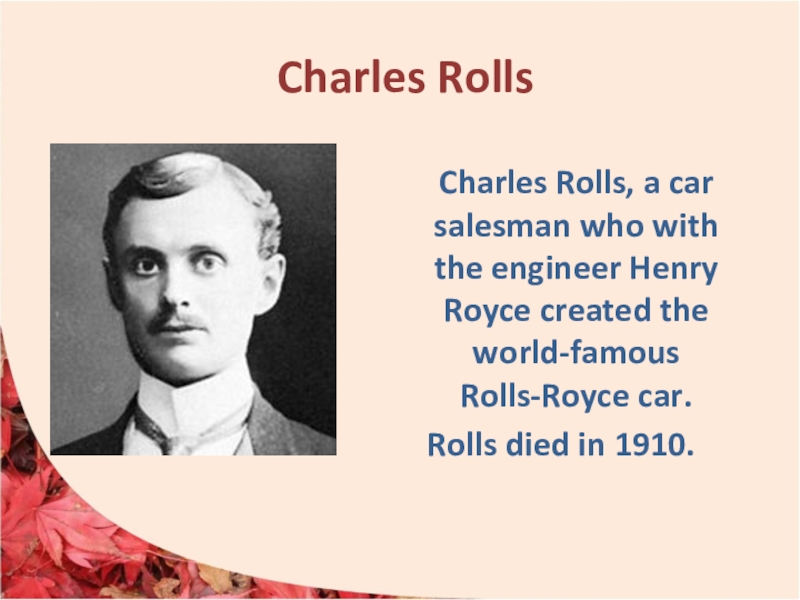
- 18. Charles Rolls Charles Rolls,
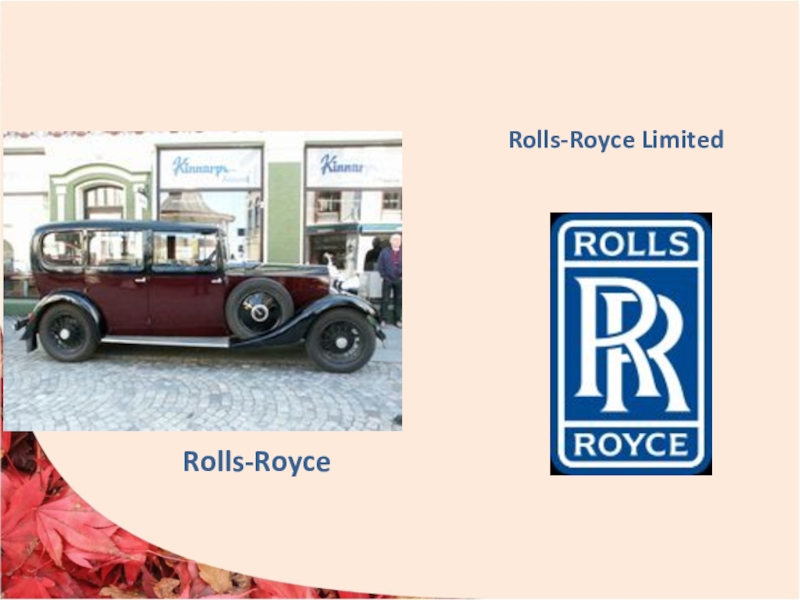
- 19. Rolls-Royce LimitedRolls-Royce
- 20. http://en.wikipedia.org/wiki/L%E1szl%F3_B%EDr%F3http://ru.wikipedia.org/wiki/%D0%EE%EB%EB%F1,_%D7%E0%F0%EB%FC%E7http://en.wikipedia.org/wiki/Bowler_hathttp://ru.wikipedia.org/wiki/%C1%E8%F0%EE,_%CB%E0%F1%EB%EEhttp://ru.wikipedia.org/wiki/%CF%E0%F1%F2%E5%F0,_%CB%F3%E8http://ru.wikipedia.org/wiki/%CC%EE%F0%E7%E5,_%D1%FD%EC%FE%FD%EBhttp://ru.wikipedia.org/wiki/%CC%E0%EA%E8%ED%F2%EE%F8,_%D7%E0%F0%EB%FC%E7_(%F5%E8%EC%E8%EA)http://ru.wikipedia.org/wiki/%C3%E5%E9%E3%E5%F0,_%C3%E0%ED%F1_%C2%E8%EB%FC%E3%E5%EB%FC%EChttp://ru.wikipedia.org/wiki/%C4%E8%E7%E5%EB%FC,_%D0%F3%E4%EE%EB%FC%F4http://en.wikipedia.org/wiki/Samuel_Colthttp://en.wikipedia.org/wiki/Louis_Braille
New inventions are appearing every day to make our lives easier, longer, warmer, speedier and so on. But only a few inventors design a new machine or product that becomes so well-known that the invention,
Слайд 2
New inventions are appearing every day to make our lives easier,
longer, warmer, speedier and so on. But only a few inventors design a new machine or product that becomes so well-known that the invention, named after its creator, becomes a household word. Here are ten famous inventors and the inventions that are named after them:
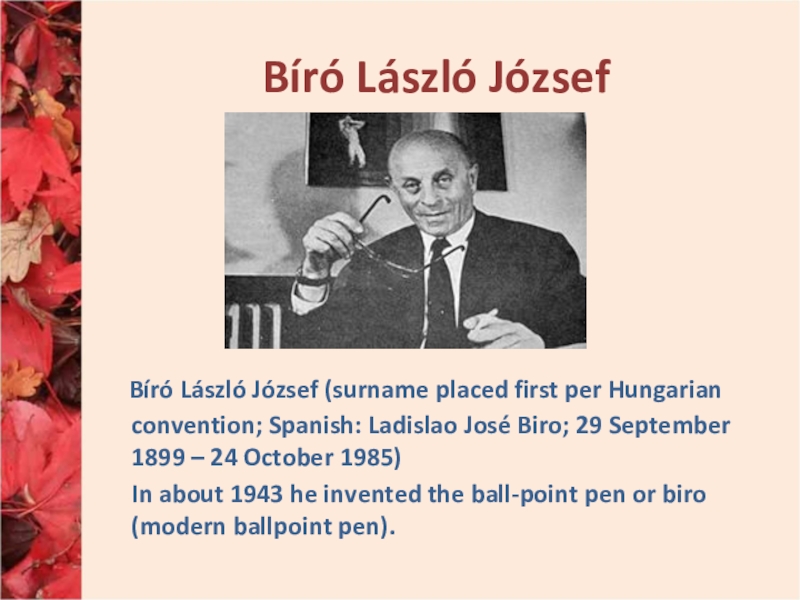
Слайд 3Bíró László József
Bíró László József (surname placed first per
Hungarian convention; Spanish: Ladislao José Biro; 29 September 1899 – 24 October 1985)
In about 1943 he invented the ball-point pen or biro (modern ballpoint pen).
In about 1943 he invented the ball-point pen or biro (modern ballpoint pen).
Слайд 5John Bowler
John Bowler, a London hatter who designed
the hard round hat known as the bowler in about 1850. It has become the symbol of British male respectability. And you can still see businessmen wearing bowlers in the City, the centre of London's commerce.
The bowler hat, also known as a bob hat, derby (US), billycock or bombín, is a hard felt hat with a rounded crown originally created in 1849 for the British soldier and politician Edward Coke, the younger brother of the 2nd Earl of Leicester. The bowler hat was popular with the working class during the Victorian era, and later on with the middle and upper classes in the United Kingdom. Later in the United Kingdom, it would come to be worn as work dress by the officers of the Queen's Guards. In Ecuador especially the women of Quechua people have used bowler hats since the 1920s when British railway workers made it famous.
The bowler hat, also known as a bob hat, derby (US), billycock or bombín, is a hard felt hat with a rounded crown originally created in 1849 for the British soldier and politician Edward Coke, the younger brother of the 2nd Earl of Leicester. The bowler hat was popular with the working class during the Victorian era, and later on with the middle and upper classes in the United Kingdom. Later in the United Kingdom, it would come to be worn as work dress by the officers of the Queen's Guards. In Ecuador especially the women of Quechua people have used bowler hats since the 1920s when British railway workers made it famous.
Слайд 6American photographer and filmmaker Paul Strand wearing a bowler hat in
1916.
The bowler hat is a traditional part of womenswear among the Quechua and Aymara peoples of South America
Charlie Chaplin's character "The Tramp"
Слайд 7Louis Braille
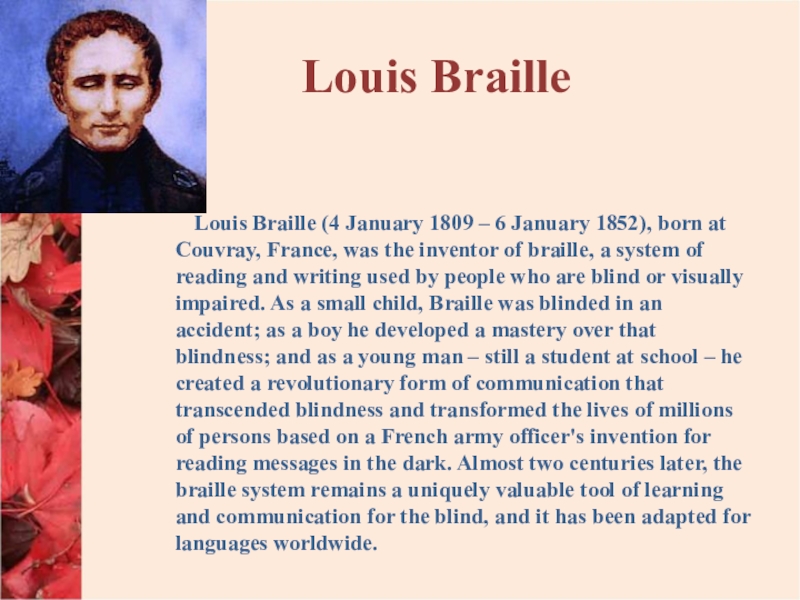
Louis Braille (4 January 1809 – 6 January 1852), born at Couvray, France, was the inventor of braille, a system of reading and writing used by people who are blind or visually impaired. As a small child, Braille was blinded in an accident; as a boy he developed a mastery over that blindness; and as a young man – still a student at school – he created a revolutionary form of communication that transcended blindness and transformed the lives of millions of persons based on a French army officer's invention for reading messages in the dark. Almost two centuries later, the braille system remains a uniquely valuable tool of learning and communication for the blind, and it has been adapted for languages worldwide.
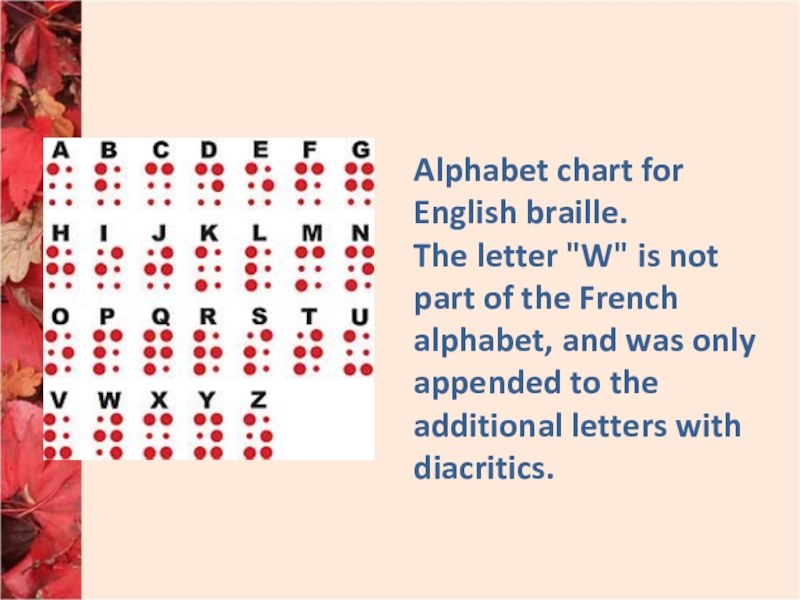
Слайд 8Alphabet chart for English braille.
The letter "W" is not part
of the French alphabet, and was only appended to the additional letters with diacritics.
Слайд 9Louis Braille
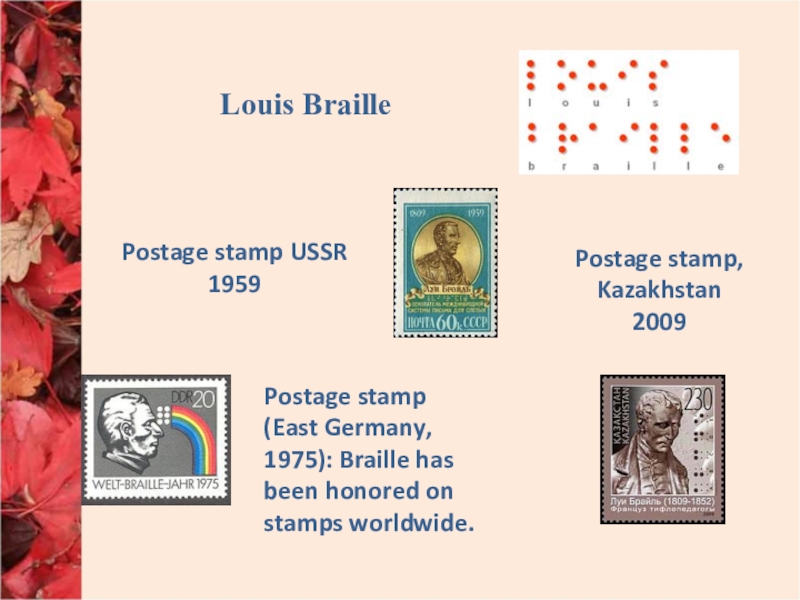
Postage stamp USSR
1959
Postage stamp (East Germany, 1975): Braille
has been honored on stamps worldwide.
Postage stamp, Kazakhstan
2009
Слайд 10Samuel Colt
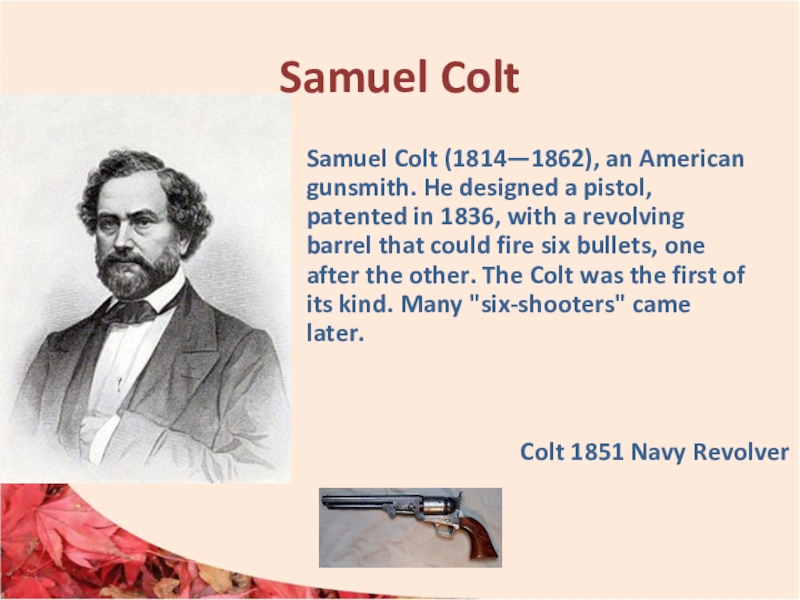
Samuel Colt (1814—1862), an American gunsmith. He
designed a pistol, patented in 1836, with a revolving barrel that could fire six bullets, one after the other. The Colt was the first of its kind. Many "six-shooters" came later.
Colt 1851 Navy Revolver
Слайд 11 Rudolf Diesel
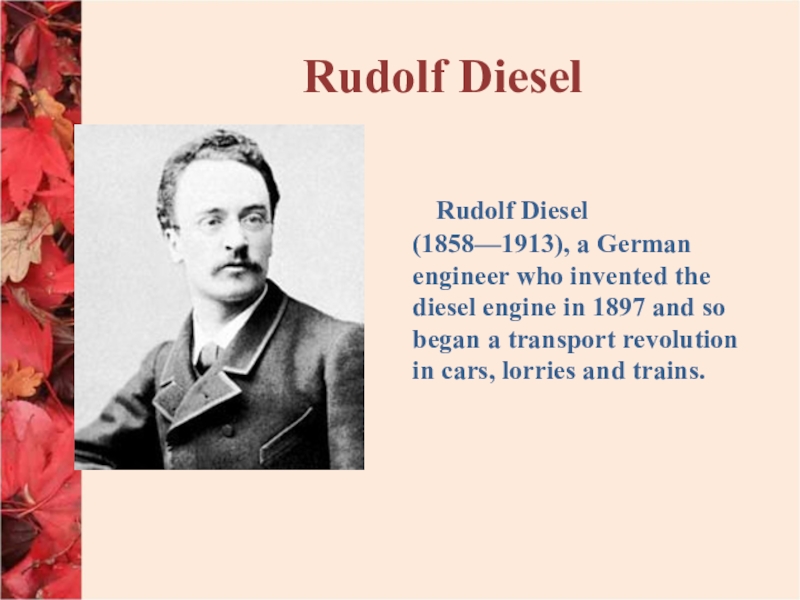
Rudolf Diesel (1858—1913), a German
engineer who invented the diesel engine in 1897 and so began a transport revolution in cars, lorries and trains.
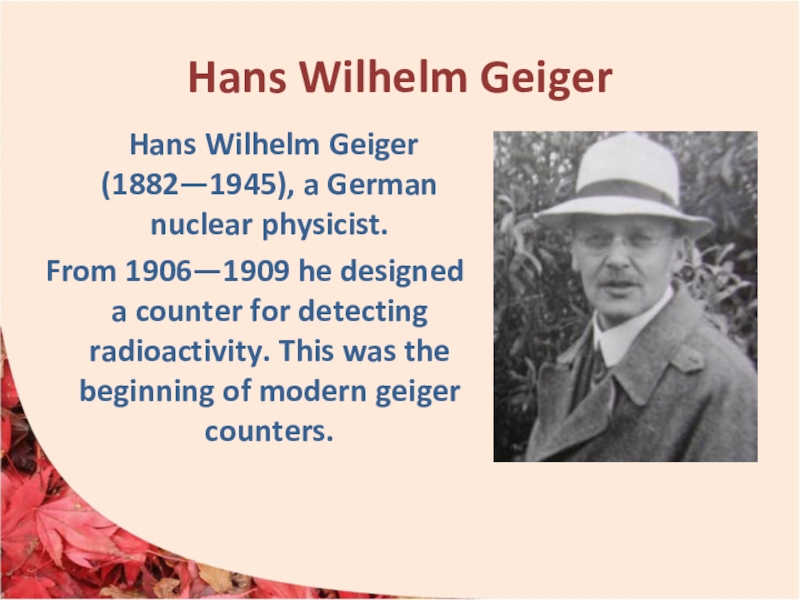
Слайд 12Hans Wilhelm Geiger
Hans Wilhelm Geiger (1882—1945), a German
nuclear physicist.
From 1906—1909 he designed a counter for detecting radioactivity. This was the beginning of modern geiger counters.
From 1906—1909 he designed a counter for detecting radioactivity. This was the beginning of modern geiger counters.
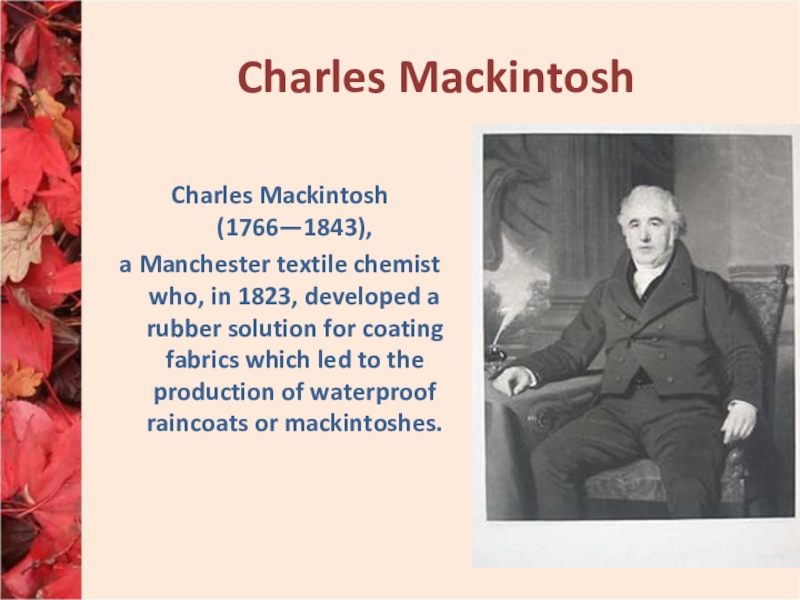
Слайд 13Charles Mackintosh
Charles Mackintosh
(1766—1843),
a Manchester textile chemist who, in 1823, developed a rubber solution for coating fabrics which led to the production of waterproof raincoats or mackintoshes.
a Manchester textile chemist who, in 1823, developed a rubber solution for coating fabrics which led to the production of waterproof raincoats or mackintoshes.
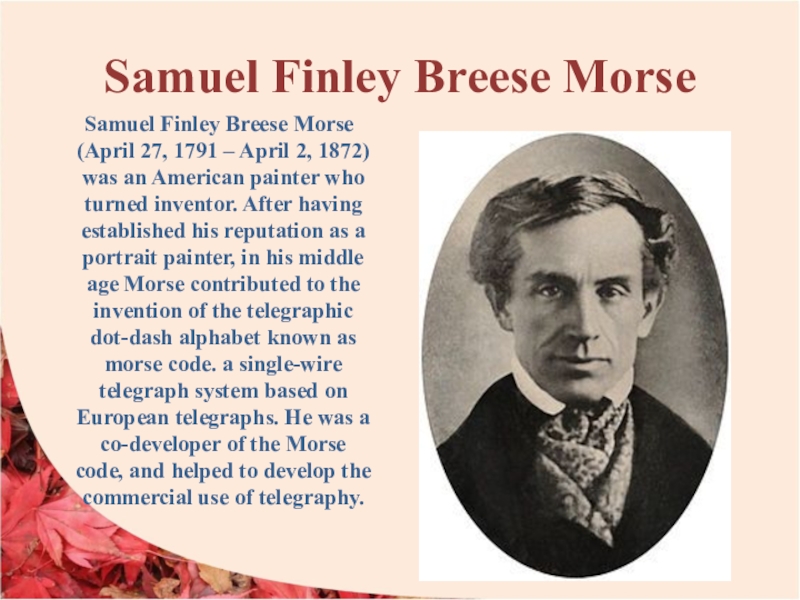
Слайд 14Samuel Finley Breese Morse
Samuel Finley Breese Morse (April 27,
1791 – April 2, 1872) was an American painter who turned inventor. After having established his reputation as a portrait painter, in his middle age Morse contributed to the invention of the telegraphic dot-dash alphabet known as morse code. a single-wire telegraph system based on European telegraphs. He was a co-developer of the Morse code, and helped to develop the commercial use of telegraphy.
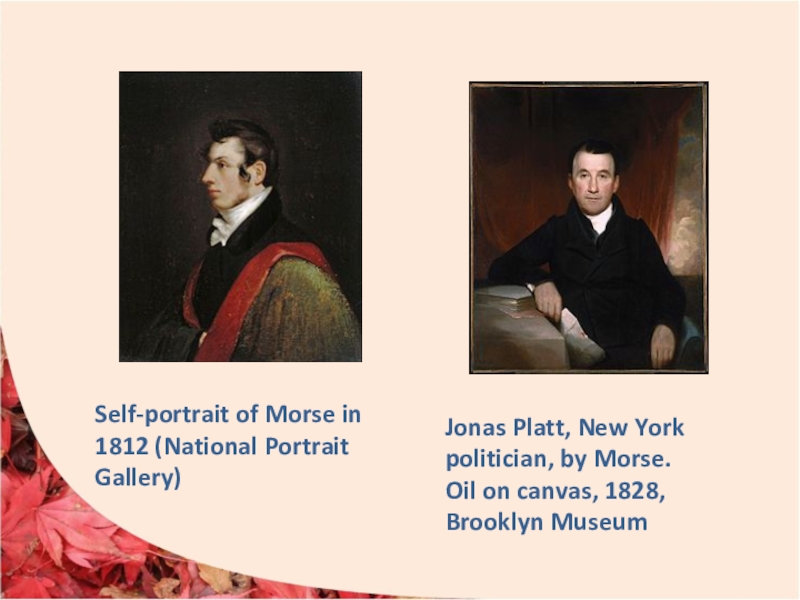
Слайд 15Self-portrait of Morse in 1812 (National Portrait Gallery)
Jonas Platt, New York
politician, by Morse. Oil on canvas, 1828, Brooklyn Museum
Слайд 16Louis Pasteur
Louis Pasteur
(1822—1895),
a Frenchman who was both a
chemist and a biologist. Pasteurisation is a method of sterilising milk by heating it.
Слайд 17Louis Pasteur in his laboratory, painting by A. Edelfeldt in 1885
Pasteur
experimenting in his laboratory.
Слайд 18 Charles Rolls
Charles Rolls, a car salesman who
with the engineer Henry Royce created the world-famous Rolls-Royce car.
Rolls died in 1910.
Rolls died in 1910.
Слайд 20http://en.wikipedia.org/wiki/L%E1szl%F3_B%EDr%F3
http://ru.wikipedia.org/wiki/%D0%EE%EB%EB%F1,_%D7%E0%F0%EB%FC%E7
http://en.wikipedia.org/wiki/Bowler_hat
http://ru.wikipedia.org/wiki/%C1%E8%F0%EE,_%CB%E0%F1%EB%EE
http://ru.wikipedia.org/wiki/%CF%E0%F1%F2%E5%F0,_%CB%F3%E8
http://ru.wikipedia.org/wiki/%CC%EE%F0%E7%E5,_%D1%FD%EC%FE%FD%EB
http://ru.wikipedia.org/wiki/%CC%E0%EA%E8%ED%F2%EE%F8,_%D7%E0%F0%EB%FC%E7_(%F5%E8%EC%E8%EA)
http://ru.wikipedia.org/wiki/%C3%E5%E9%E3%E5%F0,_%C3%E0%ED%F1_%C2%E8%EB%FC%E3%E5%EB%FC%EC
http://ru.wikipedia.org/wiki/%C4%E8%E7%E5%EB%FC,_%D0%F3%E4%EE%EB%FC%F4
http://en.wikipedia.org/wiki/Samuel_Colt
http://en.wikipedia.org/wiki/Louis_Braille