- Главная
- Разное
- Образование
- Спорт
- Естествознание
- Природоведение
- Религиоведение
- Французский язык
- Черчение
- Английский язык
- Астрономия
- Алгебра
- Биология
- География
- Геометрия
- Детские презентации
- Информатика
- История
- Литература
- Математика
- Музыка
- МХК
- Немецкий язык
- ОБЖ
- Обществознание
- Окружающий мир
- Педагогика
- Русский язык
- Технология
- Физика
- Философия
- Химия
- Шаблоны, фоны, картинки для презентаций
- Экология
- Экономика
Презентация, доклад по английскому языку Greatest British iventions and discoveries
Содержание
- 1. Презентация по английскому языку Greatest British iventions and discoveries
- 2. AntibioticsAlexander Fleming, 1928 In 1928, Scottish
- 3. Steam engineRichard Trevithick, 1801Richard Trevithick’s Puffing Devil,
- 4. Electric motorMichael Faraday, 1821The homopolar generator –
- 5. Passenger railwayGeorge Stephenson, 1825Richard Trevithick harnessed the
- 6. LightbulbJoseph Wilson Swan, 1880Sadly, the invention of
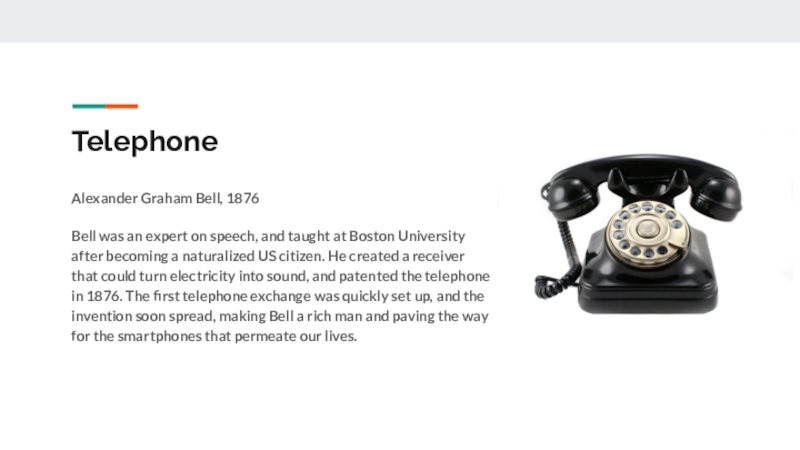
- 7. TelephoneAlexander Graham Bell, 1876Bell was an expert
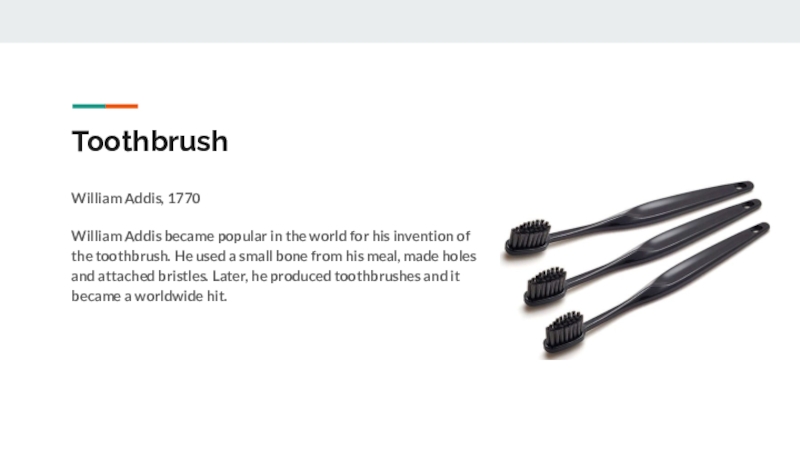
- 8. ToothbrushWilliam Addis, 1770William Addis became popular in
- 9. World Wide WebTim Berners-Lee, 1989Berners-Lee invented the
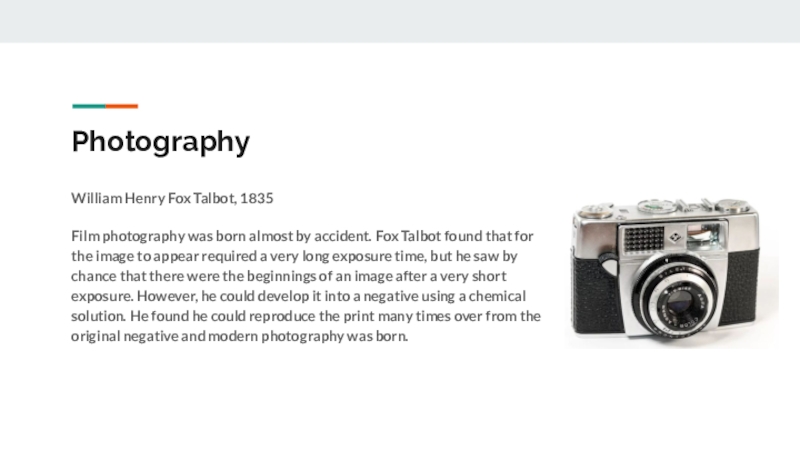
- 10. PhotographyWilliam Henry Fox Talbot, 1835Film photography was
- 11. TelevisionJohn Logie Baird, 1925The first pieces of
- 12. Thanks for your attention!
AntibioticsAlexander Fleming, 1928 In 1928, Scottish biologist Sir Alexander Fleming accidentally discovered an antibiotic substance called “penicillin” which saved millions of lives. It helped women during childbirth, saved 15% of the wounded soldiers in World
Слайд 2Antibiotics
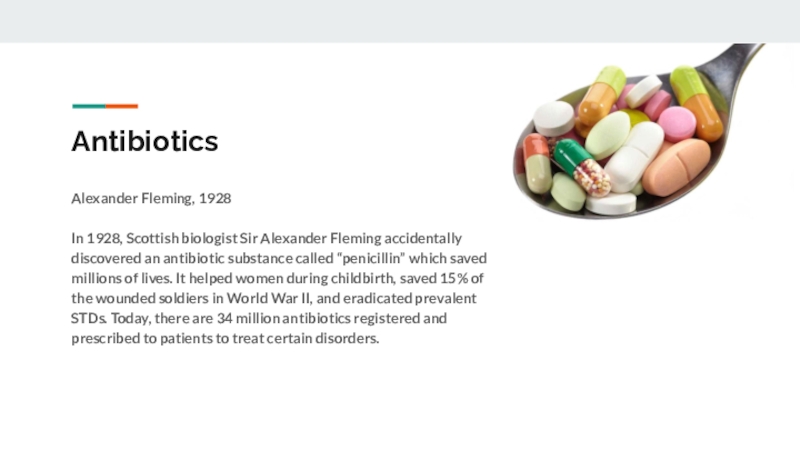
Alexander Fleming, 1928
In 1928, Scottish biologist Sir Alexander Fleming accidentally discovered
an antibiotic substance called “penicillin” which saved millions of lives. It helped women during childbirth, saved 15% of the wounded soldiers in World War II, and eradicated prevalent STDs. Today, there are 34 million antibiotics registered and prescribed to patients to treat certain disorders.
Слайд 3Steam engine
Richard Trevithick, 1801
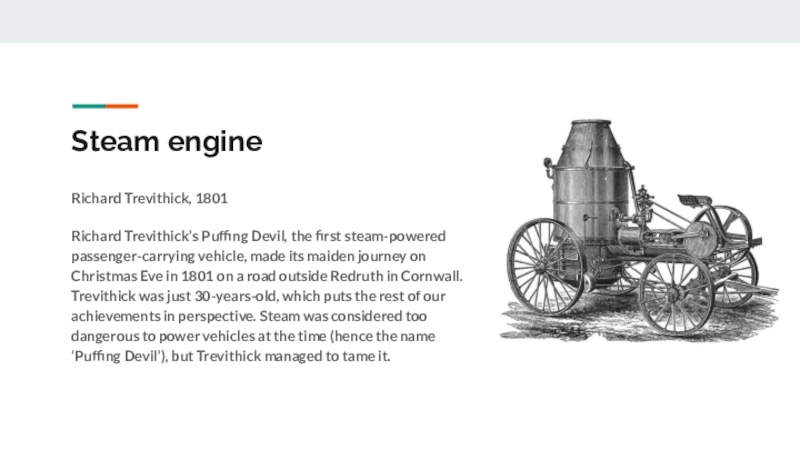
Richard Trevithick’s Puffing Devil, the first steam-powered passenger-carrying
vehicle, made its maiden journey on Christmas Eve in 1801 on a road outside Redruth in Cornwall. Trevithick was just 30-years-old, which puts the rest of our achievements in perspective. Steam was considered too dangerous to power vehicles at the time (hence the name ‘Puffing Devil’), but Trevithick managed to tame it.
Слайд 4Electric motor
Michael Faraday, 1821
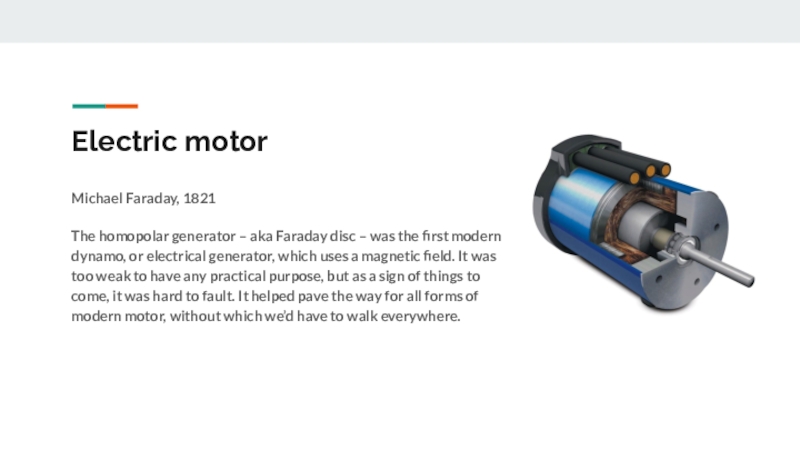
The homopolar generator – aka Faraday disc –
was the first modern dynamo, or electrical generator, which uses a magnetic field. It was too weak to have any practical purpose, but as a sign of things to come, it was hard to fault. It helped pave the way for all forms of modern motor, without which we’d have to walk everywhere.
Слайд 5Passenger railway
George Stephenson, 1825
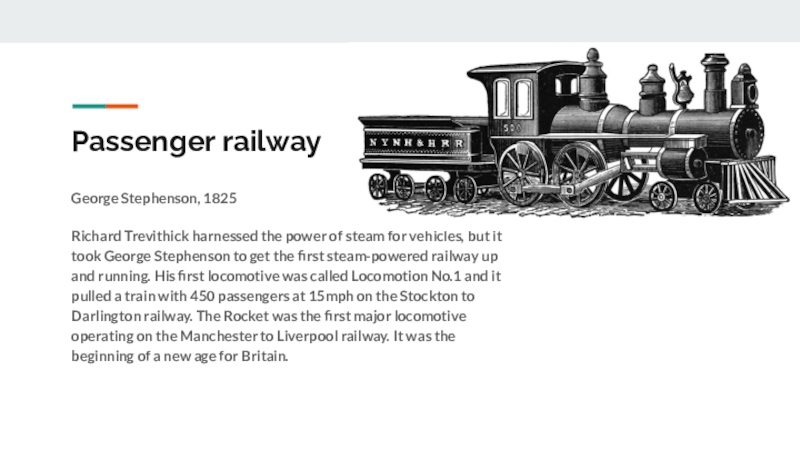
Richard Trevithick harnessed the power of steam for
vehicles, but it took George Stephenson to get the first steam-powered railway up and running. His first locomotive was called Locomotion No.1 and it pulled a train with 450 passengers at 15mph on the Stockton to Darlington railway. The Rocket was the first major locomotive operating on the Manchester to Liverpool railway. It was the beginning of a new age for Britain.
Слайд 6Lightbulb
Joseph Wilson Swan, 1880
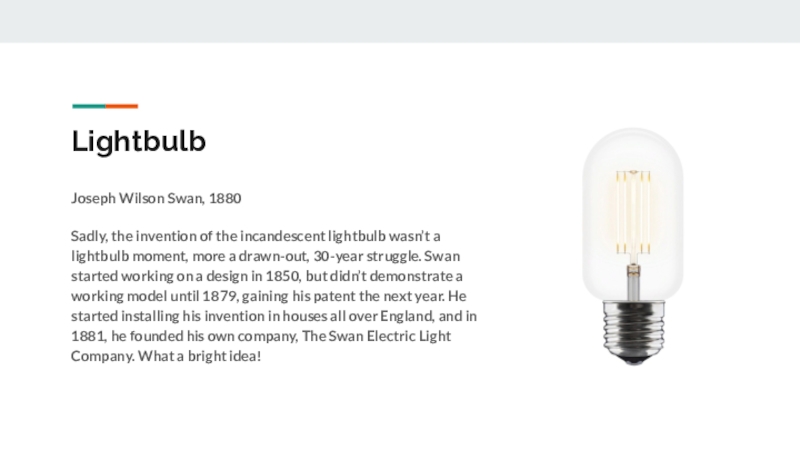
Sadly, the invention of the incandescent lightbulb wasn’t
a lightbulb moment, more a drawn-out, 30-year struggle. Swan started working on a design in 1850, but didn’t demonstrate a working model until 1879, gaining his patent the next year. He started installing his invention in houses all over England, and in 1881, he founded his own company, The Swan Electric Light Company. What a bright idea!
Слайд 7Telephone
Alexander Graham Bell, 1876
Bell was an expert on speech, and taught
at Boston University after becoming a naturalized US citizen. He created a receiver that could turn electricity into sound, and patented the telephone in 1876. The first telephone exchange was quickly set up, and the invention soon spread, making Bell a rich man and paving the way for the smartphones that permeate our lives.
Слайд 8Toothbrush
William Addis, 1770
William Addis became popular in the world for his
invention of the toothbrush. He used a small bone from his meal, made holes and attached bristles. Later, he produced toothbrushes and it became a worldwide hit.
Слайд 9World Wide Web
Tim Berners-Lee, 1989
Berners-Lee invented the World Wide Web in
1989 while at CERN, the European Particle Physics Laboratory. It just took a while for the technology to develop and for home computers to become capable of incorporating it (remember dial-up?). He wrote the first web client and server, and his specifications for the nuts and bolts of the web (URIs, HTTP, HTML) may have been refined over the years, but remain fundamentally the same.
Слайд 10Photography
William Henry Fox Talbot, 1835
Film photography was born almost by accident.
Fox Talbot found that for the image to appear required a very long exposure time, but he saw by chance that there were the beginnings of an image after a very short exposure. However, he could develop it into a negative using a chemical solution. He found he could reproduce the print many times over from the original negative and modern photography was born.
Слайд 11Television
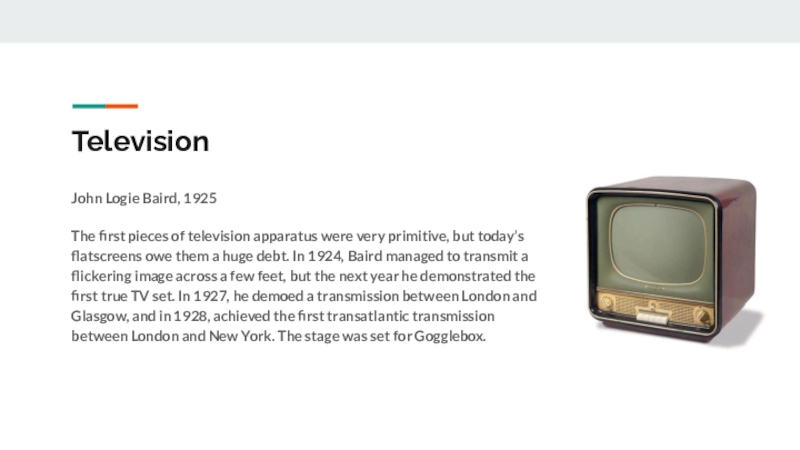
John Logie Baird, 1925
The first pieces of television apparatus were very
primitive, but today’s flatscreens owe them a huge debt. In 1924, Baird managed to transmit a flickering image across a few feet, but the next year he demonstrated the first true TV set. In 1927, he demoed a transmission between London and Glasgow, and in 1928, achieved the first transatlantic transmission between London and New York. The stage was set for Gogglebox.