- Главная
- Разное
- Образование
- Спорт
- Естествознание
- Природоведение
- Религиоведение
- Французский язык
- Черчение
- Английский язык
- Астрономия
- Алгебра
- Биология
- География
- Геометрия
- Детские презентации
- Информатика
- История
- Литература
- Математика
- Музыка
- МХК
- Немецкий язык
- ОБЖ
- Обществознание
- Окружающий мир
- Педагогика
- Русский язык
- Технология
- Физика
- Философия
- Химия
- Шаблоны, фоны, картинки для презентаций
- Экология
- Экономика
Презентация, доклад по английскому языку, для старших классов , сравнение present simple/present continuous
Содержание
- 1. Презентация по английскому языку, для старших классов , сравнение present simple/present continuous
- 2. The present simple and present continuous are
- 3. General truths and facts , permanent situations
- 4. We use PC with adverbs of frequency
- 5. 1.Put the verbs in brackets in the
- 6. 2.Fill in the gaps using : don’t,
- 7. 3. Find the mistakes and correct them.
- 8. 4. Translate into English. — Где Вадим?
- 9. Слайд 9

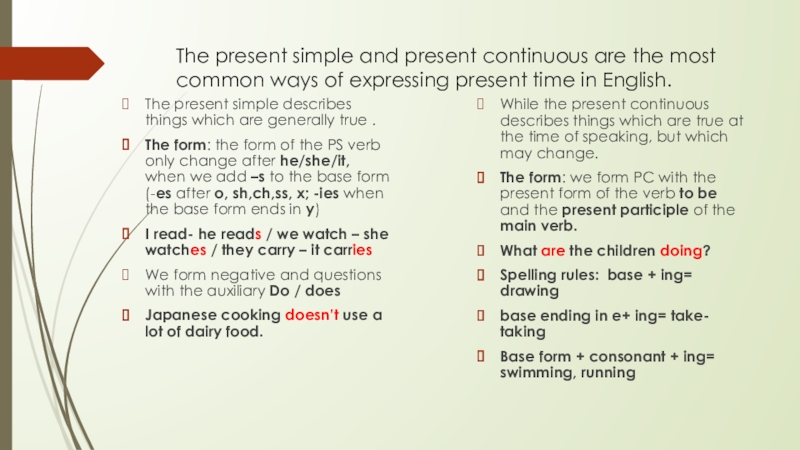
Слайд 2The present simple and present continuous are the most common ways
The present simple describes things which are generally true .
The form: the form of the PS verb only change after he/she/it, when we add –s to the base form (-es after o, sh,ch,ss, x; -ies when the base form ends in y)
I read- he reads / we watch – she watches / they carry – it carries
We form negative and questions with the auxiliary Do / does
Japanese cooking doesn’t use a lot of dairy food.
While the present continuous describes things which are true at the time of speaking, but which may change.
The form: we form PC with the present form of the verb to be and the present participle of the main verb.
What are the children doing?
Spelling rules: base + ing= drawing
base ending in e+ ing= take- taking
Base form + consonant + ing= swimming, running
Слайд 3General truths and facts , permanent situations – PS
GT: British people
F: Broken bones in adults don’t heel as fast as they do in children.
P.S.: A colony of Antarctic penguins lives in Marvell Zoo.
Repeated events or actions:
She always stays in Waldorf Astoria on visits to New York.
We often use PS with adverbs of frequency.
Share prices usually change on a daily basis – but often by very little.
We use PS to describe serious of events or actions, often with impersonal you: Here you cross the road , go through the iron gate and follow the path west.
Things which are true now. PC describes actions in progress at the moment of speaking or around the time of speaking. The action is likely to continue after the time of speaking but is likely to stop at some point, i.e it is temporary:
I’ll be with you in a minute, I’m just finishing something in the kitchen.
We use live, work, stay in PC if the action is temporary.
She is staying at Waldorf Astoria now, isn’t she?
We use PC to describe things which are changing:
British summers are getting hotter and winters are getting wetter.
It is possible to use PC to talk about repeated events or actions, if they happen within a temporary period: I’m feeding the neighbor’s cat this week while she’s in hospital.

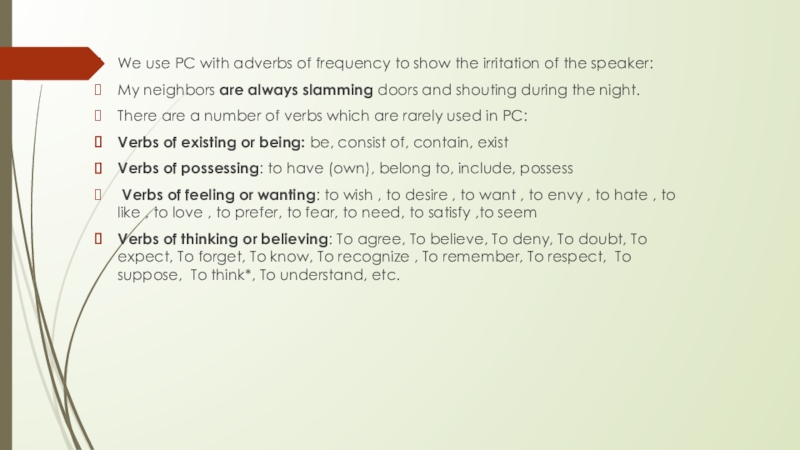
Слайд 4We use PC with adverbs of frequency to show the irritation
My neighbors are always slamming doors and shouting during the night.
There are a number of verbs which are rarely used in PC:
Verbs of existing or being: be, consist of, contain, exist
Verbs of possessing: to have (own), belong to, include, possess
Verbs of feeling or wanting: to wish , to desire , to want , to envy , to hate , to like , to love , to prefer, to fear, to need, to satisfy ,to seem
Verbs of thinking or believing: To agree, To believe, To deny, To doubt, To expect, To forget, To know, To recognize , To remember, To respect, To suppose, To think*, To understand, etc.
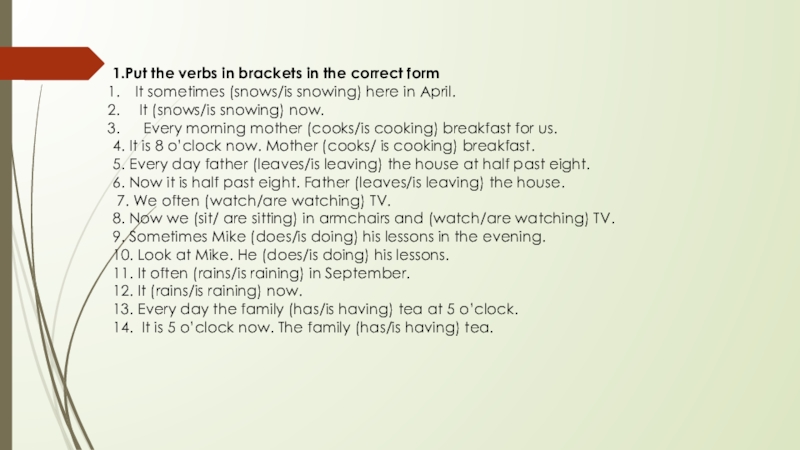
Слайд 51.Put the verbs in brackets in the correct form
It sometimes
It (snows/is snowing) now.
Every morning mother (cooks/is cooking) breakfast for us.
4. It is 8 o’clock now. Mother (cooks/ is cooking) breakfast.
5. Every day father (leaves/is leaving) the house at half past eight.
6. Now it is half past eight. Father (leaves/is leaving) the house.
7. We often (watch/are watching) TV.
8. Now we (sit/ are sitting) in armchairs and (watch/are watching) TV.
9. Sometimes Mike (does/is doing) his lessons in the evening.
10. Look at Mike. He (does/is doing) his lessons.
11. It often (rains/is raining) in September.
12. It (rains/is raining) now.
13. Every day the family (has/is having) tea at 5 o’clock.
14. It is 5 o’clock now. The family (has/is having) tea.
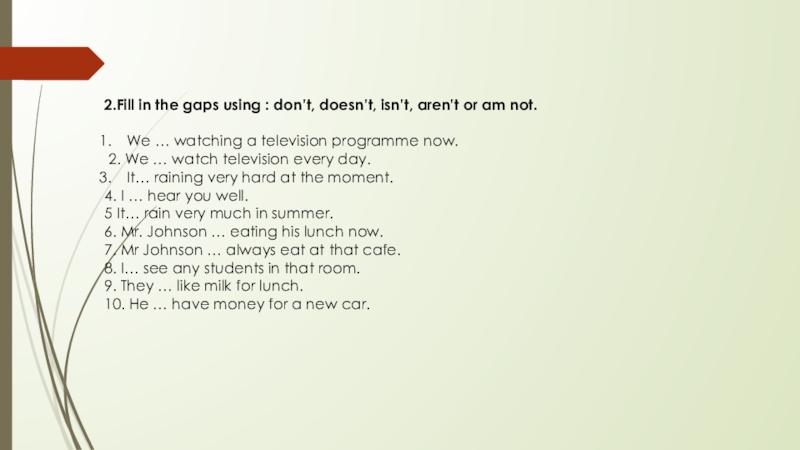
Слайд 62.Fill in the gaps using : don’t, doesn’t, isn’t, aren’t or
We … watching a television programme now.
2. We … watch television every day.
It… raining very hard at the moment.
4. I … hear you well.
5 It… rain very much in summer.
6. Mr. Johnson … eating his lunch now.
7. Mr Johnson … always eat at that cafe.
8. I… see any students in that room.
9. They … like milk for lunch.
10. He … have money for a new car.
Слайд 73. Find the mistakes and correct them.
1.We not going to
2. What you doing after school?
3. At the moment Peter is work in Russia.
4. Does he got a new car?
5. He never wear a hat.
6. He don’t like black coffee.
7. We are have a good time.
8. What you doing now?
9. It rains at the moment.
10. How you like the game?

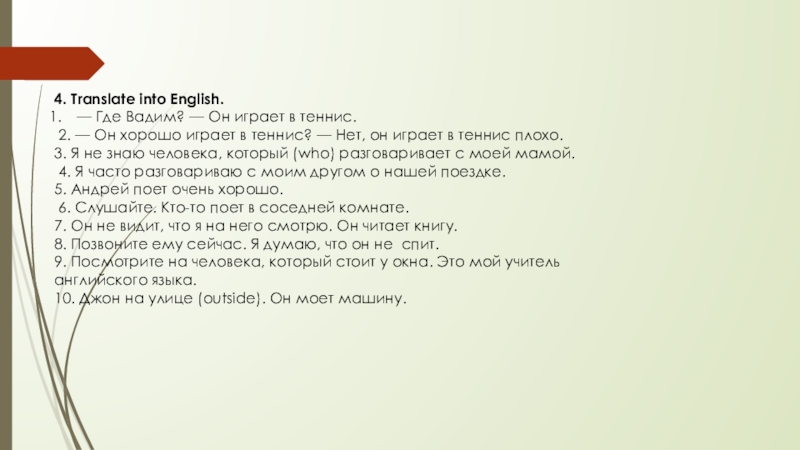
Слайд 84. Translate into English.
— Где Вадим? — Он играет в
2. — Он хорошо играет в теннис? — Нет, он играет в теннис плохо.
3. Я не знаю человека, который (who) разговаривает с моей мамой.
4. Я часто разговариваю с моим другом о нашей поездке.
5. Андрей поет очень хорошо.
6. Слушайте. Кто-то поет в соседней комнате.
7. Он не видит, что я на него смотрю. Он читает книгу.
8. Позвоните ему сейчас. Я думаю, что он не спит.
9. Посмотрите на человека, который стоит у окна. Это мой учитель английского языка.
10. Джон на улице (outside). Он моет машину.