- Главная
- Разное
- Образование
- Спорт
- Естествознание
- Природоведение
- Религиоведение
- Французский язык
- Черчение
- Английский язык
- Астрономия
- Алгебра
- Биология
- География
- Геометрия
- Детские презентации
- Информатика
- История
- Литература
- Математика
- Музыка
- МХК
- Немецкий язык
- ОБЖ
- Обществознание
- Окружающий мир
- Педагогика
- Русский язык
- Технология
- Физика
- Философия
- Химия
- Шаблоны, фоны, картинки для презентаций
- Экология
- Экономика
Презентация, доклад по английскому языку для 5 класса по теме Глаголы come и go: употребление в речи и на письме
Содержание
- 1. Презентация по английскому языку для 5 класса по теме Глаголы come и go: употребление в речи и на письме
- 2. Речевая разминка: «Игра с мячом»Your mother can′t
- 3. Yura
- 4. Say what these places are famous for
- 5. Say why
- 6. Слайд 6
- 7. Слайд 7
- 8. ТАУЭРСКИЙ МОСТ – разводной мост
- 9. Say where they are: (p. 64 ex.
- 10. Look at the pictures and say what
- 11. Look at the pictures and say what
- 12. Nota bene
- 13. Complete the sentences
- 14. What are the
- 15. РефлексияNow I know…Now I can…I don’t know…It was interesting…It was boring…I want to know more…
- 16. Homework p. 63 ex. 4 to learn
- 17. источники Афанасьева О. В., И. В. Михеева,
Речевая разминка: «Игра с мячом»Your mother can′t cook well, can she?Your parents have no country house, do they?Your often go to the south on holiday, don′t you?Your enjoyed your last trip, didn′t you?Your dad can′t swim,
Слайд 1Глаголы come и go: употребление в речи и
на письме
Королева Т.А.,
учитель английского языка,
Осино-Гайского филиала
МБОУ 2-Гавриловской сош
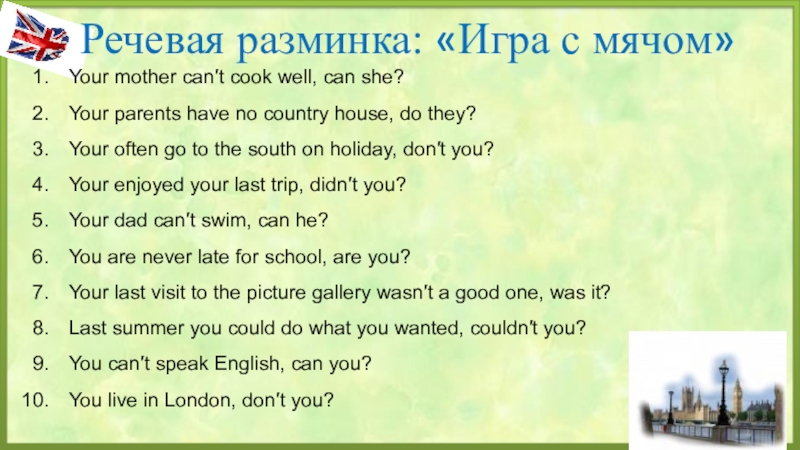
Слайд 2Речевая разминка: «Игра с мячом»
Your mother can′t cook well, can she?
Your
parents have no country house, do they?
Your often go to the south on holiday, don′t you?
Your enjoyed your last trip, didn′t you?
Your dad can′t swim, can he?
You are never late for school, are you?
Your last visit to the picture gallery wasn′t a good one, was it?
Last summer you could do what you wanted, couldn′t you?
You can′t speak English, can you?
You live in London, don′t you?
Your often go to the south on holiday, don′t you?
Your enjoyed your last trip, didn′t you?
Your dad can′t swim, can he?
You are never late for school, are you?
Your last visit to the picture gallery wasn′t a good one, was it?
Last summer you could do what you wanted, couldn′t you?
You can′t speak English, can you?
You live in London, don′t you?
Слайд 3 Yura is speaking about his
trip. Listen to him (CD №109), and complete the sentences.
Yura is speaking about his trip to Sochi.
His family travelled by plane.
3. Yura′s family stayed with friends.
4. They lived in the south of the city.
5. The weather was cold.
6. Yura wants to go to that place again in summer.
Yura is speaking about his trip to Sochi.
His family travelled by plane.
3. Yura′s family stayed with friends.
4. They lived in the south of the city.
5. The weather was cold.
6. Yura wants to go to that place again in summer.
Слайд 4Say what these places are famous for (p. 62 ex. 3A).
1. Moscow is famous for the Bolshoi Theatre.
2. St Petersburg is famous for Summer Gardens.
3. Rome is famous for Colosseum.
4. Paris is famous for the Louvre.
5. Madrid is famous for its football Players.
6. Newcastle is famous for its old castle.
7. Yaroslavl is famous for the oldest Russian theatre.
Слайд 5 Say why people go to these
places (p. 62 ex. 3B).
1. People often go to Moscow because they want to visit the Bolshoi Theatre.
2. People often go to St Petersburg because they want to visit the Summer Gardens.
3. People often go to Rome because they want to visit the Colosseum.
4. People often go to Paris because they want to visit the Louvre.
5. People often go to Madrid because they want to visit football Players.
6. People often go to Newcastle because they want to visit the old castle.
7. People often go to Yaroslavl because they want to visit the oldest Russian theatre.
1. People often go to Moscow because they want to visit the Bolshoi Theatre.
2. People often go to St Petersburg because they want to visit the Summer Gardens.
3. People often go to Rome because they want to visit the Colosseum.
4. People often go to Paris because they want to visit the Louvre.
5. People often go to Madrid because they want to visit football Players.
6. People often go to Newcastle because they want to visit the old castle.
7. People often go to Yaroslavl because they want to visit the oldest Russian theatre.
Слайд 6 Listen (CD № 110),
and read (p. 63 ex. 4).
A. bridge [bridg] – мост
buy [bai] – покупать
centre [′sentǝ] – центр
church [tʃɜ:tʃ] – церковь
market [ma:kit] – рынок
restaurant [′restrɒnt] – ресторан
souvenir [su:vǝ′niǝ] – сувенир
supermarket [′su:pǝmɒ:kit] – магазин самообслуживания
A. bridge [bridg] – мост
buy [bai] – покупать
centre [′sentǝ] – центр
church [tʃɜ:tʃ] – церковь
market [ma:kit] – рынок
restaurant [′restrɒnt] – ресторан
souvenir [su:vǝ′niǝ] – сувенир
supermarket [′su:pǝmɒ:kit] – магазин самообслуживания
Слайд 7 A. Spell
these words
[′restrɒnt]; [bridg]; [′sentǝ]; [ma:kit]; [tʃɜ:tʃ]; [bai]; [su:vǝ′niǝ]; [′su:pǝmɒ:kit].
B. Подбери нужную транскрипцию к слову:
Bridge Buy Centre Souvenir Market Restaurant Church Supermarket
[′restrɒnt] [bai] [bridg] [′sentǝ] [ma:kit] [tʃɜ:tʃ] [su:vǝ′niǝ] [′su:pǝmɒ:kit].
Переведи слова:
Restaurant, Souvenir, Bridge, Centre, Buy, Market, Church, Supermarket
Мост, Покупать, Центр, Церковь, Рынок, Ресторан, Сувенир, Магазин, самообслуживания
[′restrɒnt]; [bridg]; [′sentǝ]; [ma:kit]; [tʃɜ:tʃ]; [bai]; [su:vǝ′niǝ]; [′su:pǝmɒ:kit].
B. Подбери нужную транскрипцию к слову:
Bridge Buy Centre Souvenir Market Restaurant Church Supermarket
[′restrɒnt] [bai] [bridg] [′sentǝ] [ma:kit] [tʃɜ:tʃ] [su:vǝ′niǝ] [′su:pǝmɒ:kit].
Переведи слова:
Restaurant, Souvenir, Bridge, Centre, Buy, Market, Church, Supermarket
Мост, Покупать, Центр, Церковь, Рынок, Ресторан, Сувенир, Магазин, самообслуживания
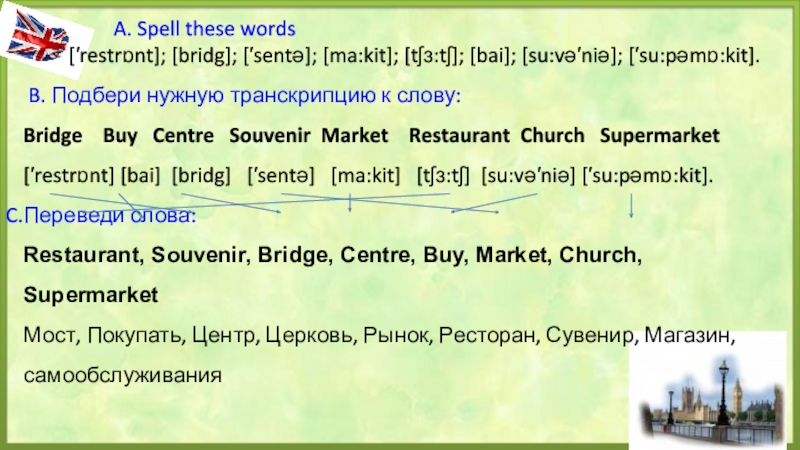
Слайд 8 ТАУЭРСКИЙ МОСТ – разводной мост в центре Лондона над
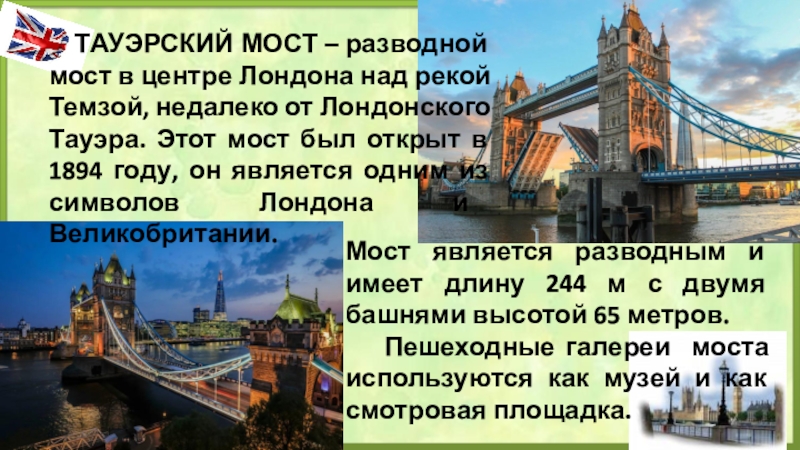
рекой Темзой, недалеко от Лондонского Тауэра. Этот мост был открыт в 1894 году, он является одним из символов Лондона и Великобритании.
Мост является разводным и имеет длину 244 м с двумя башнями высотой 65 метров.
Пешеходные галереи моста используются как музей и как смотровая площадка.
Слайд 9Say where they are: (p. 64 ex. 5).
1. The
fish market is next to the bank.
2. The restaurant is behind the cinema.
3. The supermarket is near the bridge.
4. The church is in the center of the city.
5. The theatre is in front of the museum.
6. The swimming pool is on the left.
7. The old castle is in the square.
2. The restaurant is behind the cinema.
3. The supermarket is near the bridge.
4. The church is in the center of the city.
5. The theatre is in front of the museum.
6. The swimming pool is on the left.
7. The old castle is in the square.
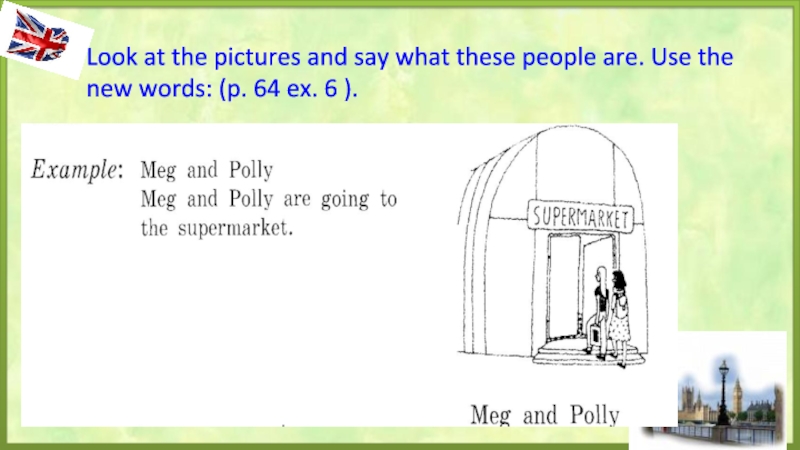
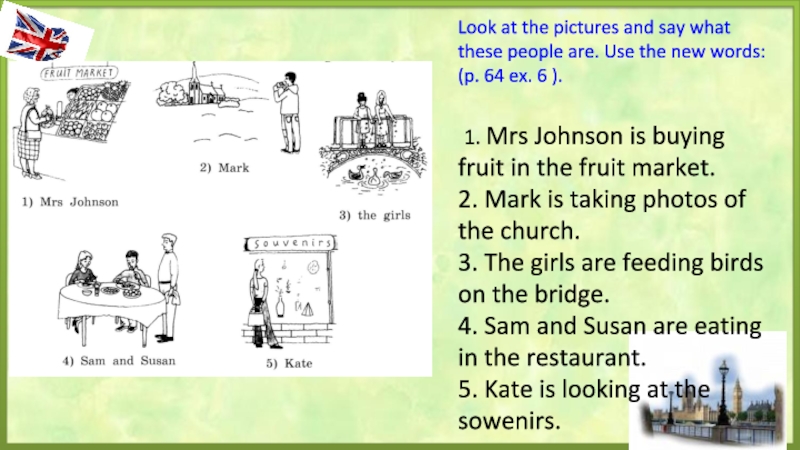
Слайд 11Look at the pictures and say what these people are. Use
the new words: (p. 64 ex. 6 ).
1. Mrs Johnson is buying fruit in the fruit market.
2. Mark is taking photos of the church.
3. The girls are feeding birds on the bridge.
4. Sam and Susan are eating in the restaurant.
5. Kate is looking at the sowenirs.
1. Mrs Johnson is buying fruit in the fruit market.
2. Mark is taking photos of the church.
3. The girls are feeding birds on the bridge.
4. Sam and Susan are eating in the restaurant.
5. Kate is looking at the sowenirs.
Слайд 12 Nota bene
Вы уже знаете два
английских глагола, которые обозначают движение,
- come, go. Они довольно часто переводятся на русский язык одинаково – идти, ехать. Здесь важно иметь в виду, где находиться говорящий.
Движение от него передается глаголом go, а движение к говорящему глаголом come. Вот почему русское «Иди к доске» может звучать и как
“Go to the blackboard” (учитель находиться, например, у парты одного из учеников), и как “Come to the blackboard”(если учитель стоит у доски).
С этими глаголами часто используются предлоги in и out, а также наречие outside
Come in – Входи(те)!
Go out ! – Уйди(те)!
Go outside! – Выйди(те)!
- come, go. Они довольно часто переводятся на русский язык одинаково – идти, ехать. Здесь важно иметь в виду, где находиться говорящий.
Движение от него передается глаголом go, а движение к говорящему глаголом come. Вот почему русское «Иди к доске» может звучать и как
“Go to the blackboard” (учитель находиться, например, у парты одного из учеников), и как “Come to the blackboard”(если учитель стоит у доски).
С этими глаголами часто используются предлоги in и out, а также наречие outside
Come in – Входи(те)!
Go out ! – Уйди(те)!
Go outside! – Выйди(те)!
Слайд 13 Complete the sentences with come or go
(p. 65 ex. 7)
You and your friend are in the classroom. You say, «Let′s go to the gym».
You and your friend are in the street. You say, «I′d like to go to the sweet shop».
You are in the house. Your friend are in the street. You say, «Come in and have a cup of tea with me».
You friend is in his/her house. You are at home. You say, «Come to my place, I have a wonderful video to watch».
You are at home. Your mother is at work. You say, «When will you come home, mum?».
You and your mother are at home. You say, «I′m not going out tonight. I′m staying at home».
You and your friend are in the classroom. You say, «Let′s go to the gym».
You and your friend are in the street. You say, «I′d like to go to the sweet shop».
You are in the house. Your friend are in the street. You say, «Come in and have a cup of tea with me».
You friend is in his/her house. You are at home. You say, «Come to my place, I have a wonderful video to watch».
You are at home. Your mother is at work. You say, «When will you come home, mum?».
You and your mother are at home. You say, «I′m not going out tonight. I′m staying at home».
Слайд 15Рефлексия
Now I know…
Now I can…
I don’t know…
It was interesting…
It was boring…
I
want to know more…
Слайд 17источники
Афанасьева О. В., И. В. Михеева, К. М. Баранова Английский
язык. 5 класс. Учебник в 2-х частях + CD (комплект)
Афанасьева, О. В. Английский язык. 5 класс. Книга для учителя
Афанасьева О. В., И. В. Михеева, К. М. Баранова Английский язык. 5 класс. Рабочая тетрадь.
Афанасьева, О. В. Английский язык. 5 класс. Книга для учителя
Афанасьева О. В., И. В. Михеева, К. М. Баранова Английский язык. 5 класс. Рабочая тетрадь.