- Главная
- Разное
- Образование
- Спорт
- Естествознание
- Природоведение
- Религиоведение
- Французский язык
- Черчение
- Английский язык
- Астрономия
- Алгебра
- Биология
- География
- Геометрия
- Детские презентации
- Информатика
- История
- Литература
- Математика
- Музыка
- МХК
- Немецкий язык
- ОБЖ
- Обществознание
- Окружающий мир
- Педагогика
- Русский язык
- Технология
- Физика
- Философия
- Химия
- Шаблоны, фоны, картинки для презентаций
- Экология
- Экономика
Презентация, доклад по английскому языку Д.Г.Байрон
Содержание
- 1. Презентация по английскому языку Д.Г.Байрон
- 2. Biography
- 3. Early life George Gordon
- 4. Byron's paternal grandparents were
- 5. In 1801 he was
- 6. Early career While
- 7. Byron’s travel Italy
- 8. Слайд 8
- 9. Literary activity Byron wrote prolifically.
- 10. Personal life Wife of George Gordon Byron
- 11. Children
- 12. Sea and swimming He enjoyed
- 13. Political career Byron first
- 14. Bibliography Major works:Hours of Idleness (1807)English Bards
- 15. Death (1824)
- 16. Слайд 16
- 17. Darkness“Darkness” is
- 18. Darkness BY LORD BYRON
- 19. Тьма
- 20. The end!Thanks for attention!
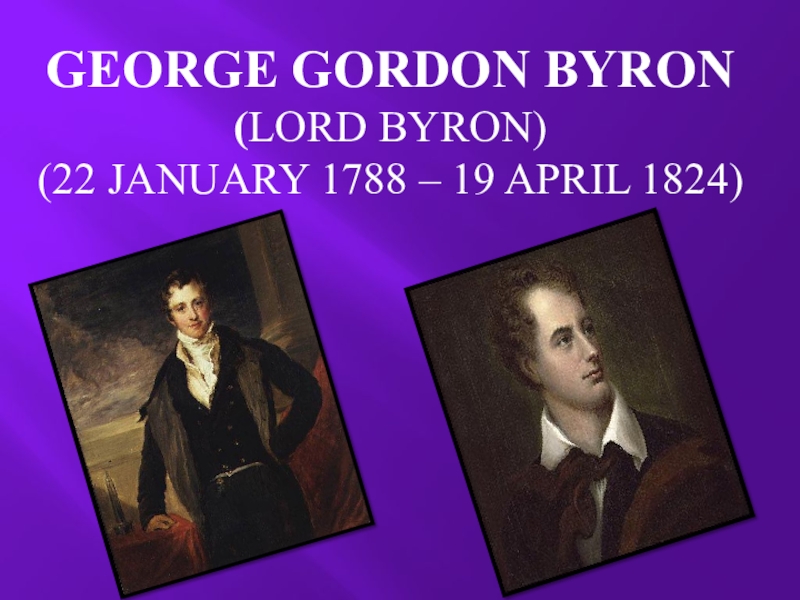
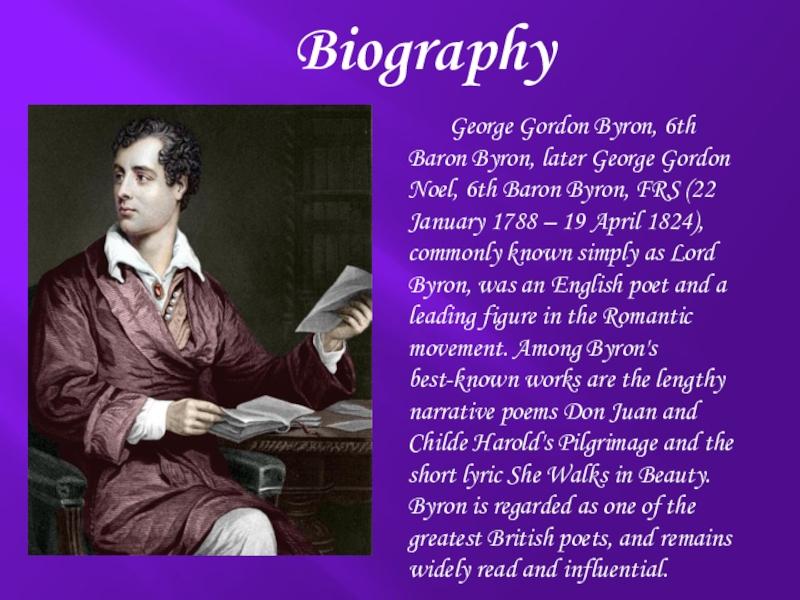
Biography George Gordon Byron, 6th Baron Byron, later George Gordon Noel, 6th Baron Byron, FRS (22 January 1788 – 19 April 1824), commonly known simply as Lord Byron,
Слайд 2 Biography
George Gordon
Byron, 6th Baron Byron, later George Gordon Noel, 6th Baron Byron, FRS (22 January 1788 – 19 April 1824), commonly known simply as Lord Byron, was an English poet and a leading figure in the Romantic movement. Among Byron's best-known works are the lengthy narrative poems Don Juan and Childe Harold's Pilgrimage and the short lyric She Walks in Beauty.
Byron is regarded as one of the greatest British poets, and remains widely read and influential.
Слайд 3Early life
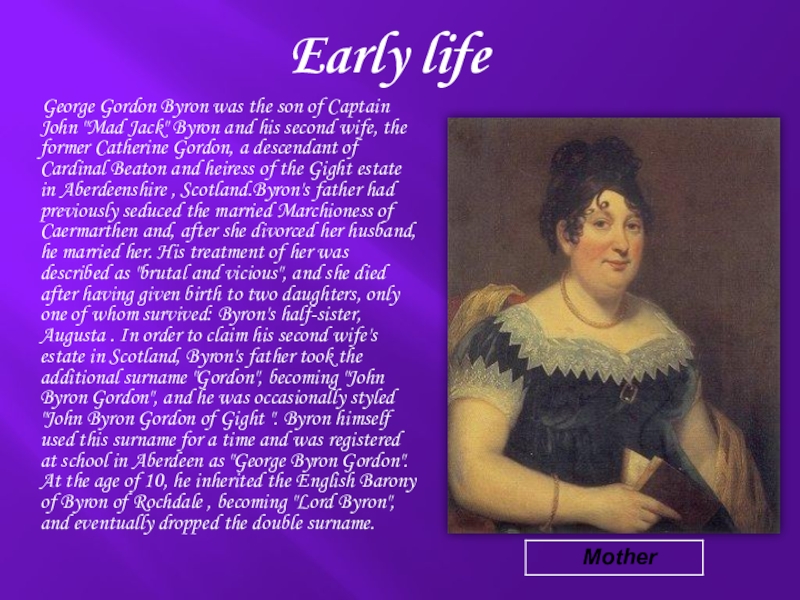
George Gordon Byron was the son
of Captain John "Mad Jack" Byron and his second wife, the former Catherine Gordon, a descendant of Cardinal Beaton and heiress of the Gight estate in Aberdeenshire , Scotland.Byron's father had previously seduced the married Marchioness of Caermarthen and, after she divorced her husband, he married her. His treatment of her was described as "brutal and vicious", and she died after having given birth to two daughters, only one of whom survived: Byron's half-sister, Augusta . In order to claim his second wife's estate in Scotland, Byron's father took the additional surname "Gordon", becoming "John Byron Gordon", and he was occasionally styled "John Byron Gordon of Gight ". Byron himself used this surname for a time and was registered at school in Aberdeen as "George Byron Gordon". At the age of 10, he inherited the English Barony of Byron of Rochdale , becoming "Lord Byron", and eventually dropped the double surname.
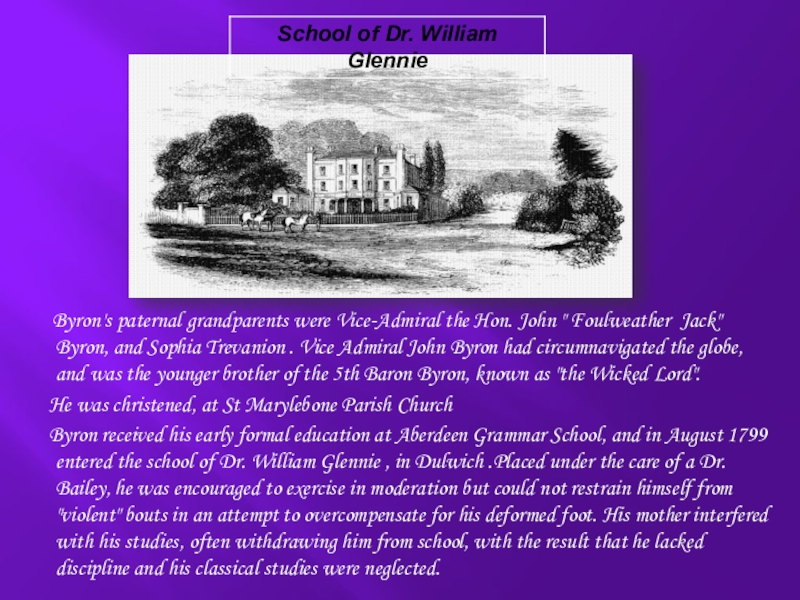
Слайд 4 Byron's paternal grandparents were Vice-Admiral the Hon. John
" Foulweather Jack" Byron, and Sophia Trevanion . Vice Admiral John Byron had circumnavigated the globe, and was the younger brother of the 5th Baron Byron, known as "the Wicked Lord".
He was christened, at St Marylebone Parish Church
Byron received his early formal education at Aberdeen Grammar School, and in August 1799 entered the school of Dr. William Glennie , in Dulwich .Placed under the care of a Dr. Bailey, he was encouraged to exercise in moderation but could not restrain himself from "violent" bouts in an attempt to overcompensate for his deformed foot. His mother interfered with his studies, often withdrawing him from school, with the result that he lacked discipline and his classical studies were neglected.
He was christened, at St Marylebone Parish Church
Byron received his early formal education at Aberdeen Grammar School, and in August 1799 entered the school of Dr. William Glennie , in Dulwich .Placed under the care of a Dr. Bailey, he was encouraged to exercise in moderation but could not restrain himself from "violent" bouts in an attempt to overcompensate for his deformed foot. His mother interfered with his studies, often withdrawing him from school, with the result that he lacked discipline and his classical studies were neglected.
Слайд 5 In 1801 he was sent to Harrow, where
he remained until July 1805. An undistinguished student and an unskilled cricketer, he did represent the school during the very first Eton v Harrow cricket match at Lord's in 1805.
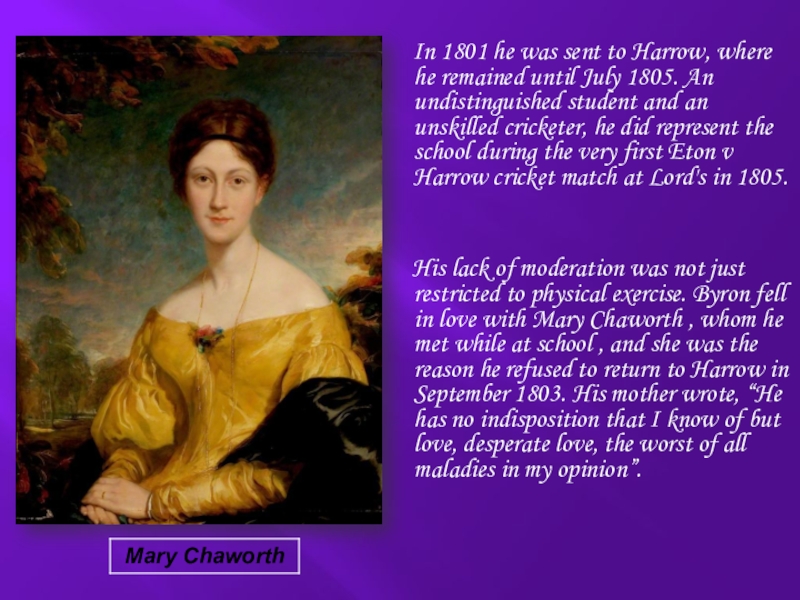
His lack of moderation was not just restricted to physical exercise. Byron fell in love with Mary Chaworth , whom he met while at school , and she was the reason he refused to return to Harrow in September 1803. His mother wrote, “He has no indisposition that I know of but love, desperate love, the worst of all maladies in my opinion”.
His lack of moderation was not just restricted to physical exercise. Byron fell in love with Mary Chaworth , whom he met while at school , and she was the reason he refused to return to Harrow in September 1803. His mother wrote, “He has no indisposition that I know of but love, desperate love, the worst of all maladies in my opinion”.
Слайд 6Early career
While not at school or
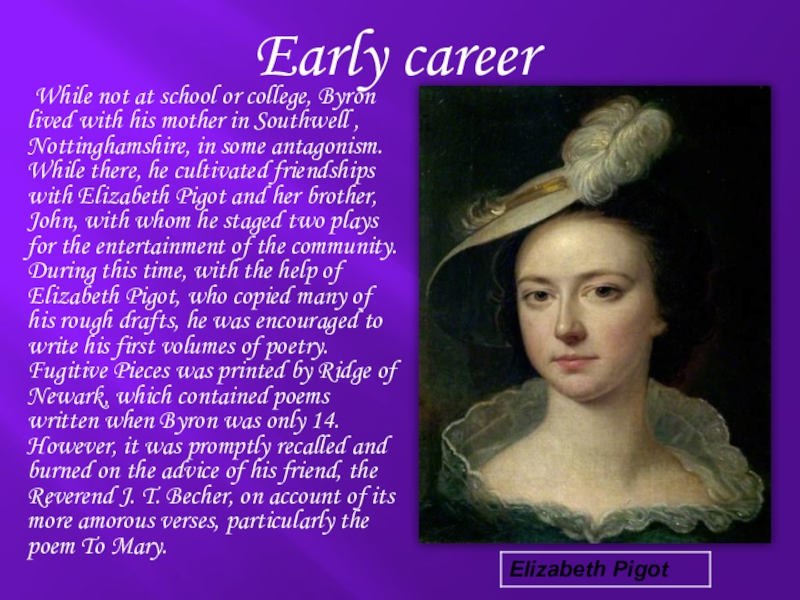
college, Byron lived with his mother in Southwell , Nottinghamshire, in some antagonism. While there, he cultivated friendships with Elizabeth Pigot and her brother, John, with whom he staged two plays for the entertainment of the community. During this time, with the help of Elizabeth Pigot, who copied many of his rough drafts, he was encouraged to write his first volumes of poetry. Fugitive Pieces was printed by Ridge of Newark, which contained poems written when Byron was only 14. However, it was promptly recalled and burned on the advice of his friend, the Reverend J. T. Becher, on account of its more amorous verses, particularly the poem To Mary.
Слайд 7Byron’s travel
Italy
In 1816, Byron visited
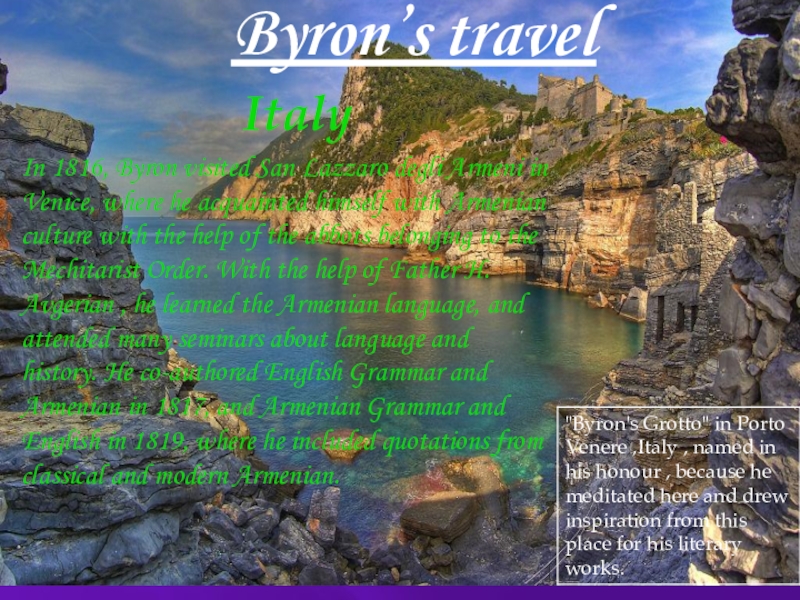
San Lazzaro degli Armeni in Venice, where he acquainted himself with Armenian culture with the help of the abbots belonging to the Mechitarist Order. With the help of Father H. Avgerian , he learned the Armenian language, and attended many seminars about language and history. He co-authored English Grammar and Armenian in 1817, and Armenian Grammar and English in 1819, where he included quotations from classical and modern Armenian.
Слайд 8
Greece
Byron was living in Genoa
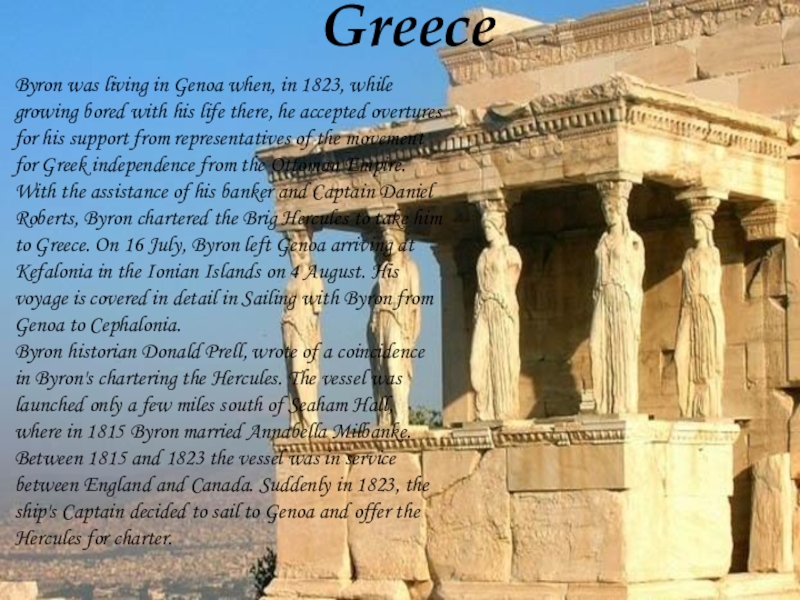
when, in 1823, while growing bored with his life there, he accepted overtures for his support from representatives of the movement for Greek independence from the Ottoman Empire. With the assistance of his banker and Captain Daniel Roberts, Byron chartered the Brig Hercules to take him to Greece. On 16 July, Byron left Genoa arriving at Kefalonia in the Ionian Islands on 4 August. His voyage is covered in detail in Sailing with Byron from Genoa to Cephalonia.
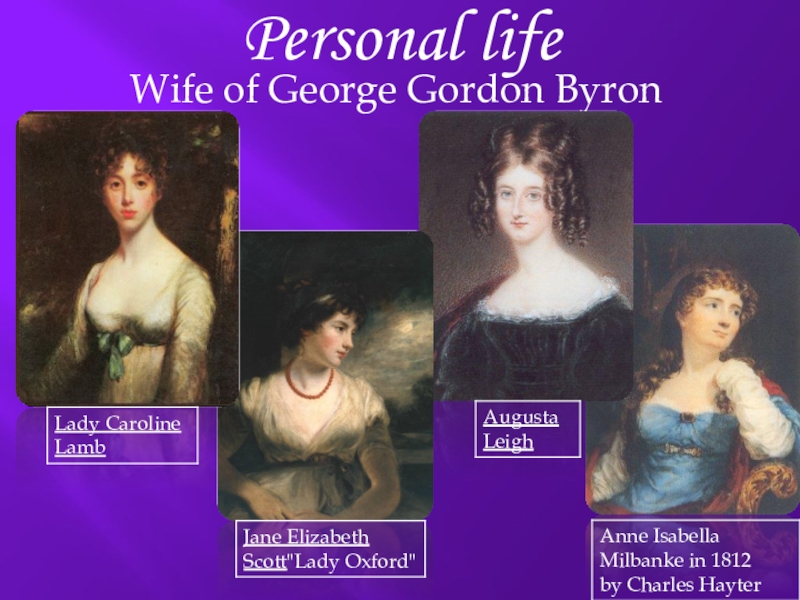
Byron historian Donald Prell, wrote of a coincidence in Byron's chartering the Hercules. The vessel was launched only a few miles south of Seaham Hall, where in 1815 Byron married Annabella Milbanke. Between 1815 and 1823 the vessel was in service between England and Canada. Suddenly in 1823, the ship's Captain decided to sail to Genoa and offer the Hercules for charter.
Слайд 9Literary activity
Byron wrote prolifically. In 1832 his publisher,
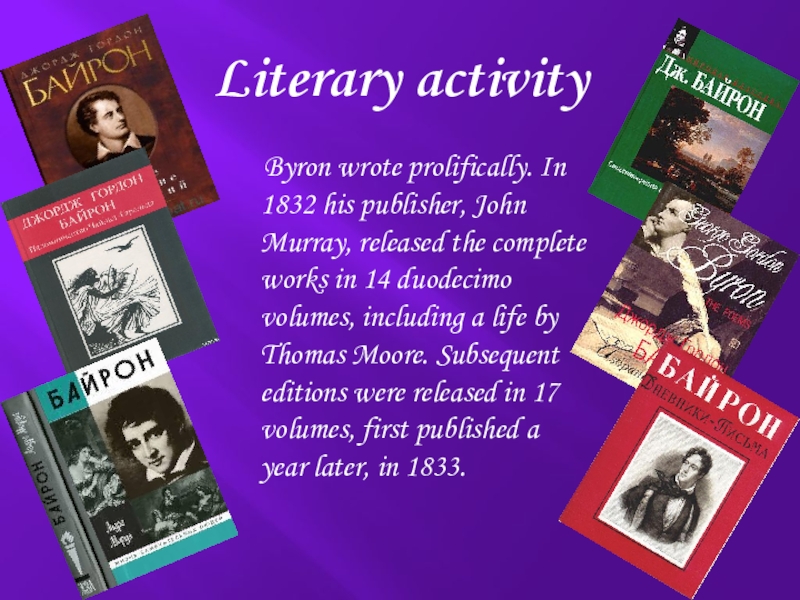
John Murray, released the complete works in 14 duodecimo volumes, including a life by Thomas Moore. Subsequent editions were released in 17 volumes, first published a year later, in 1833.
Слайд 12Sea and swimming
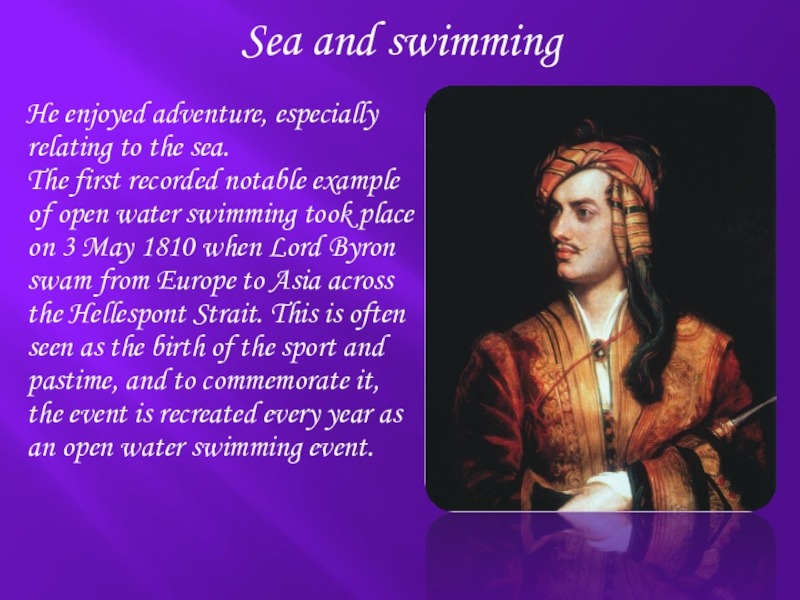
He enjoyed adventure, especially relating to
the sea.
The first recorded notable example of open water swimming took place on 3 May 1810 when Lord Byron swam from Europe to Asia across the Hellespont Strait. This is often seen as the birth of the sport and pastime, and to commemorate it, the event is recreated every year as an open water swimming event.
Слайд 13Political career
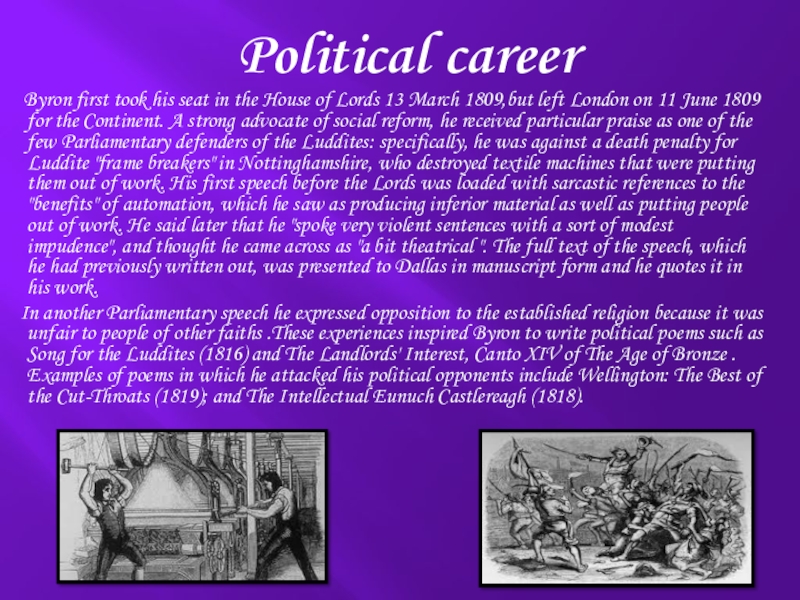
Byron first took his seat in
the House of Lords 13 March 1809,but left London on 11 June 1809 for the Continent. A strong advocate of social reform, he received particular praise as one of the few Parliamentary defenders of the Luddites: specifically, he was against a death penalty for Luddite "frame breakers" in Nottinghamshire, who destroyed textile machines that were putting them out of work. His first speech before the Lords was loaded with sarcastic references to the "benefits" of automation, which he saw as producing inferior material as well as putting people out of work. He said later that he "spoke very violent sentences with a sort of modest impudence", and thought he came across as "a bit theatrical ". The full text of the speech, which he had previously written out, was presented to Dallas in manuscript form and he quotes it in his work.
In another Parliamentary speech he expressed opposition to the established religion because it was unfair to people of other faiths .These experiences inspired Byron to write political poems such as Song for the Luddites (1816) and The Landlords' Interest, Canto XIV of The Age of Bronze . Examples of poems in which he attacked his political opponents include Wellington: The Best of the Cut-Throats (1819); and The Intellectual Eunuch Castlereagh (1818).
In another Parliamentary speech he expressed opposition to the established religion because it was unfair to people of other faiths .These experiences inspired Byron to write political poems such as Song for the Luddites (1816) and The Landlords' Interest, Canto XIV of The Age of Bronze . Examples of poems in which he attacked his political opponents include Wellington: The Best of the Cut-Throats (1819); and The Intellectual Eunuch Castlereagh (1818).
Слайд 14Bibliography
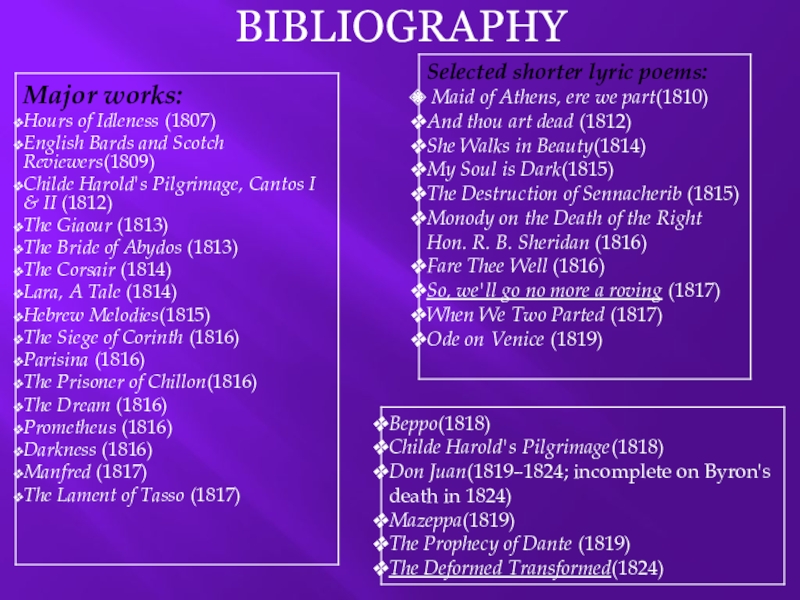
Major works:
Hours of Idleness (1807)
English Bards and Scotch Reviewers(1809)
Childe Harold's Pilgrimage,
Cantos I & II (1812)
The Giaour (1813)
The Bride of Abydos (1813)
The Corsair (1814)
Lara, A Tale (1814)
Hebrew Melodies(1815)
The Siege of Corinth (1816)
Parisina (1816)
The Prisoner of Chillon(1816)
The Dream (1816)
Prometheus (1816)
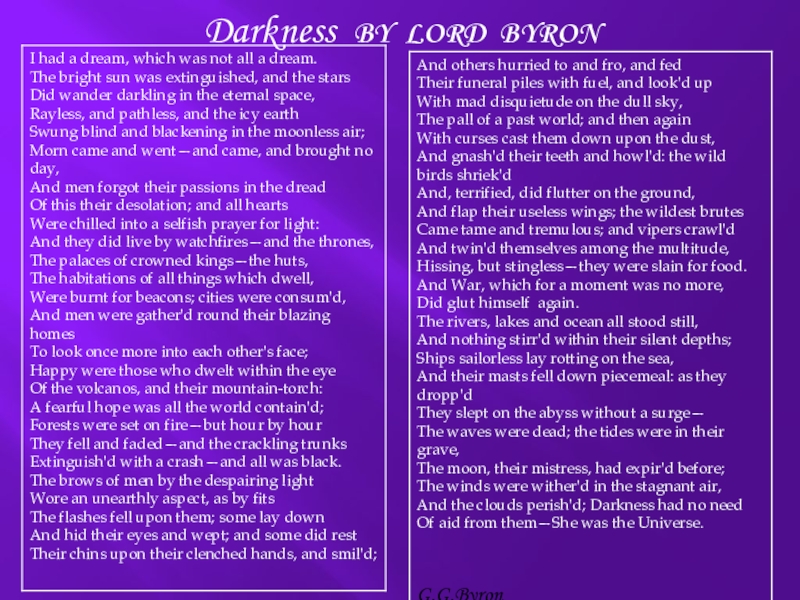
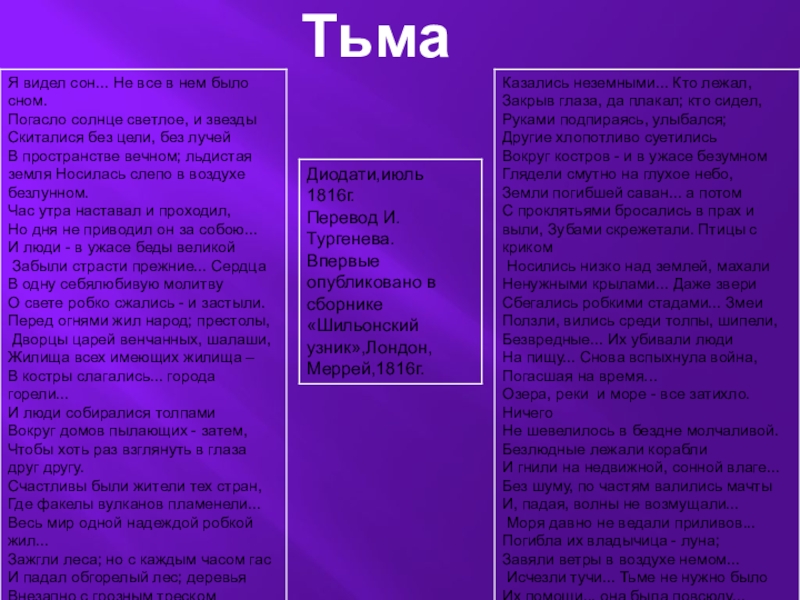
Darkness (1816)
Manfred (1817)
The Lament of Tasso (1817)
The Giaour (1813)
The Bride of Abydos (1813)
The Corsair (1814)
Lara, A Tale (1814)
Hebrew Melodies(1815)
The Siege of Corinth (1816)
Parisina (1816)
The Prisoner of Chillon(1816)
The Dream (1816)
Prometheus (1816)
Darkness (1816)
Manfred (1817)
The Lament of Tasso (1817)
Слайд 15 Death (1824)
Mavrokordatos and Byron planned to
attack the Turkish-held fortress of Lepanto, at the mouth of the Gulf of Corinth. Byron employed a fire-master to prepare artillery and took part of the rebel army under his own command, despite his lack of military experience. Before the expedition could sail, on 15 February 1824, he fell ill, and the usual remedy of bloodletting weakened him further. He made a partial recovery, but in early April he caught a violent cold which therapeutic bleeding, insisted on by his doctors, aggravated. It is suspected this treatment, carried out with unsterilised medical instrumentation, may have caused him to develop sepsis. He developed a violent fever, and died on 19 April.
His physician at the time, Julius van Millingen , son of Dutch-English archaeologist James Millingen , was unable to prevent his death. It has been said that if Byron had lived and had gone on to defeat the Ottomans, he might have been declared King of Greece. However, contemporary scholars have found such an outcome unlikely.
His physician at the time, Julius van Millingen , son of Dutch-English archaeologist James Millingen , was unable to prevent his death. It has been said that if Byron had lived and had gone on to defeat the Ottomans, he might have been declared King of Greece. However, contemporary scholars have found such an outcome unlikely.
Слайд 17 Darkness
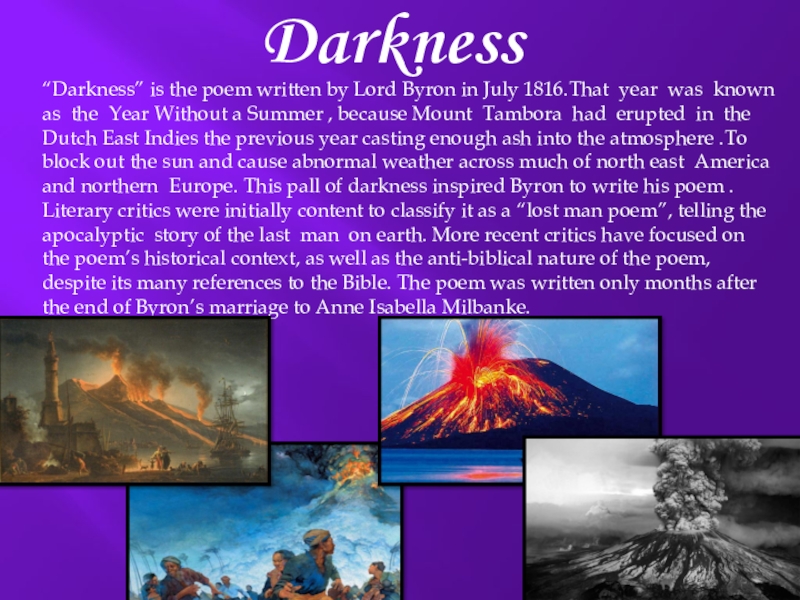
“Darkness” is the poem written by
Lord Byron in July 1816.That year was known as the Year Without a Summer , because Mount Tambora had erupted in the Dutch East Indies the previous year casting enough ash into the atmosphere .To block out the sun and cause abnormal weather across much of north east America and northern Europe. This pall of darkness inspired Byron to write his poem . Literary critics were initially content to classify it as a “lost man poem”, telling the apocalyptic story of the last man on earth. More recent critics have focused on the poem’s historical context, as well as the anti-biblical nature of the poem, despite its many references to the Bible. The poem was written only months after the end of Byron’s marriage to Anne Isabella Milbanke.