- Главная
- Разное
- Образование
- Спорт
- Естествознание
- Природоведение
- Религиоведение
- Французский язык
- Черчение
- Английский язык
- Астрономия
- Алгебра
- Биология
- География
- Геометрия
- Детские презентации
- Информатика
- История
- Литература
- Математика
- Музыка
- МХК
- Немецкий язык
- ОБЖ
- Обществознание
- Окружающий мир
- Педагогика
- Русский язык
- Технология
- Физика
- Философия
- Химия
- Шаблоны, фоны, картинки для презентаций
- Экология
- Экономика
Презентация, доклад по английскому языку Developing productive skills at B2
Содержание
- 1. Презентация по английскому языку Developing productive skills at B2
- 2. QUALITY OF LEARNING, AS WELL AS QUANTITY, IS IMPORTANT
- 3. WRITING
- 4. Process writing: process vs. productfocus on the
- 5. Process writing: stagesbrainstorming/ getting or developing ideas/
- 6. Can Do statements (B1-B2)1) CAN present arguments,
- 7. Can Do statements (B1-B2)1) CAN present arguments,
- 8. PET, Writing, part 3 (1)This is a
- 9. PET, Writing, part 3 (2)Your English teacher
- 10. Task types in the Writing paper (CE:
- 11. An essayAlways for the teacher – quite
- 12. An articleUsually for an English-language magazine (semi-formal
- 13. A storyDo not change the given sentence!Be
- 14. A letter/emailIn response to the situation outlined
- 15. A reviewGive your review a title.Mention: the
- 16. CE: First, Writing Part 1
- 17. Skills to be developedEssays need to present
- 18. Linking words and expressionsIn order to decide
- 19. Слайд 19
- 20. Part 2 questionsWhat is the situation?What are
- 21. Part 2 taskcontexttopicpurposetarget reader
- 22. Assessment criteria (B1-C2)ContentCommunicative AchievementOrganisationLanguage How well the candidate
- 23. Слайд 23
- 24. You have received a letter from your
- 25. Dear John,Thanks for you letter! It’s so
- 26. ЕГЭ: The circus is the best entertainment
- 27. But those things don’t really matter to
- 28. SPEAKING
- 29. The thrill of speaking is …... the
- 30. CEFR B1 Speaking descriptorsI can deal with
- 31. CEFR B2 Speaking descriptorsCAN keep up a
- 32. Key wordsB 1 – limited and simpleB 2 – fairly wide range
- 33. SpeakingSpeaking subskillsmaking use of grammar, vocabulary
- 34. Assessment criteriaGrammar and VocabularyDiscourse ManagementPronunciationInteractive CommunicationGlobal Achievementcontrol,
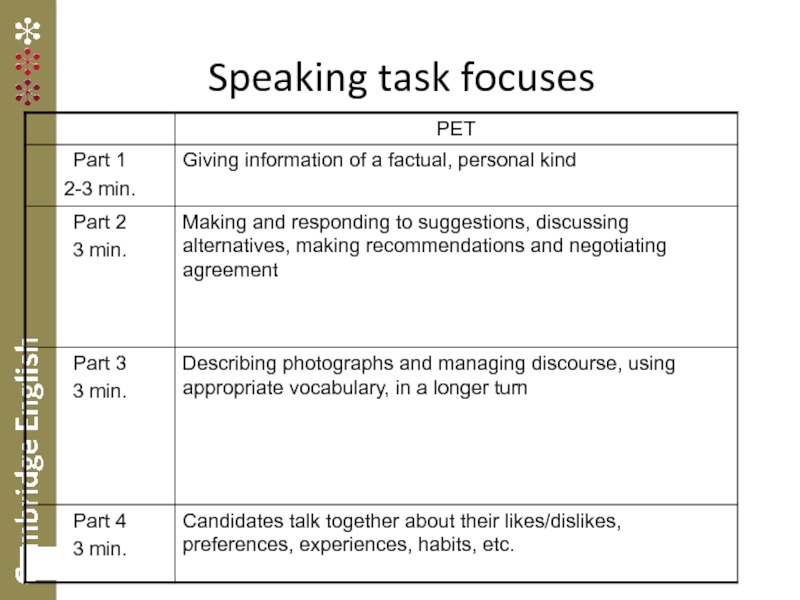
- 35. Speaking task focuses
- 36. PET, Part 1These questions should have LONGER
- 37. PET, Part 2Ask your partner questionsAgree and
- 38. PET, Part 3Use the vocabulary that is
- 39. PET, Part 4Look at each otherAsk each
- 40. Speaking paper overview
- 41. CE: First, Speaking, Part 2 testing focus organising a larger unit of discoursecomparingdescribingexpressing opinions
- 42. Part 2: sample task
- 43. CE: First, Speaking, Part 3 testing focussustaining
- 44. Part 3: sample task (2min.+1min.)Part 3
- 45. Part 3 (1 min.)Now you have about
- 46. Cambridge English: First for Schools (FCE)
- 47. Good candidates, Speaking Listen carefully and reactShow
- 48. Good candidates, Speaking (2) Resourceful in their
- 49. Good candidates, Speaking (3)- Can
- 50. Teaching Support websiteOver 1 million visits100,000 registered teachers500,000 downloadsLots of features and information to support teacherswww.cambridgeenglish.org/teach
- 51. Courses Earn a certificate from Cambridge. Webinars
- 52. THANK YOU Any questions?
Слайд 4Process writing: process vs. product
focus on the process of writing that
help student writers to understand their own composing process
place central importance on the process of revision
Слайд 5Process writing: stages
brainstorming/ getting or developing ideas/ making notes
organising ideas/ planning
drafting
editing
proofreading
re-drafting/ or writing a final version
Слайд 6Can Do statements (B1-B2)
1) CAN present arguments, using a limited range
2) CAN use a range of everyday vocabulary generally appropriately, with occasional inappropriate use of less common lexis.
3) CAN use simple grammatical forms with a good degree of control.
4) CAN write a simple report of a factual nature and begin to evaluate, advise, etc.
5) CAN write about topics which are familiar or of personal interest.
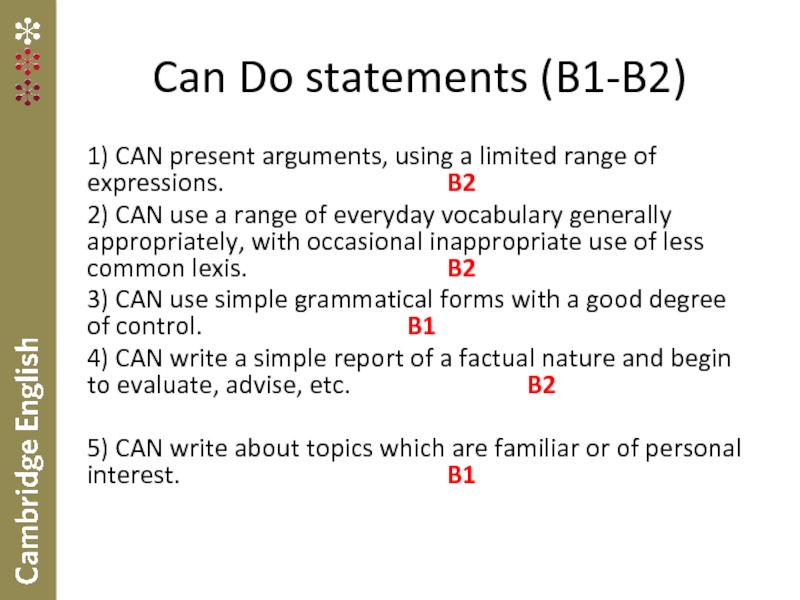
Слайд 7Can Do statements (B1-B2)
1) CAN present arguments, using a limited range
2) CAN use a range of everyday vocabulary generally appropriately, with occasional inappropriate use of less common lexis. B2
3) CAN use simple grammatical forms with a good degree of control. B1
4) CAN write a simple report of a factual nature and begin to evaluate, advise, etc. B2
5) CAN write about topics which are familiar or of personal interest. B1
Слайд 8PET, Writing, part 3 (1)
This is a part of a letter
“For my homework project I have to write about a special day that people celebrate in your country.
Which special day should I write about? What information should I include?”
Now write a letter to your friend in about 100 words.
Слайд 9PET, Writing, part 3 (2)
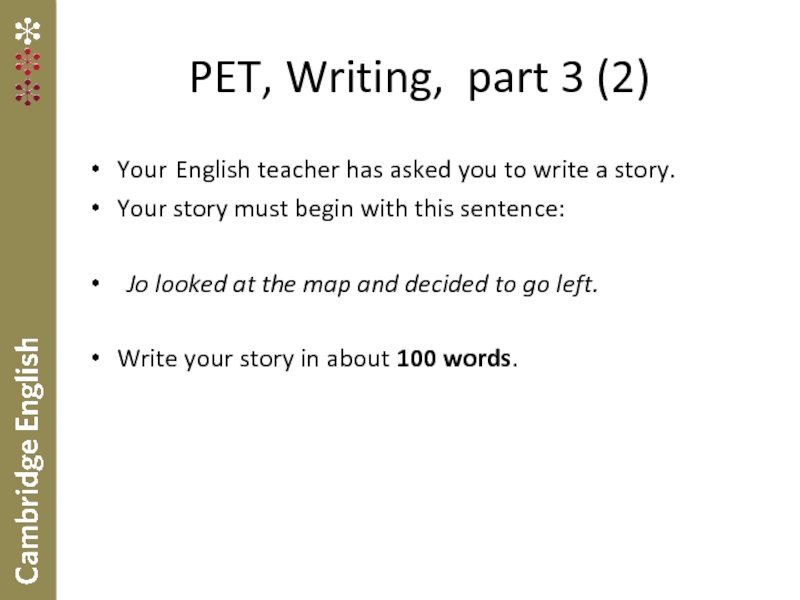
Your English teacher has asked you to
Your story must begin with this sentence:
Jo looked at the map and decided to go left.
Write your story in about 100 words.
Слайд 10Task types in the Writing paper (CE: First)
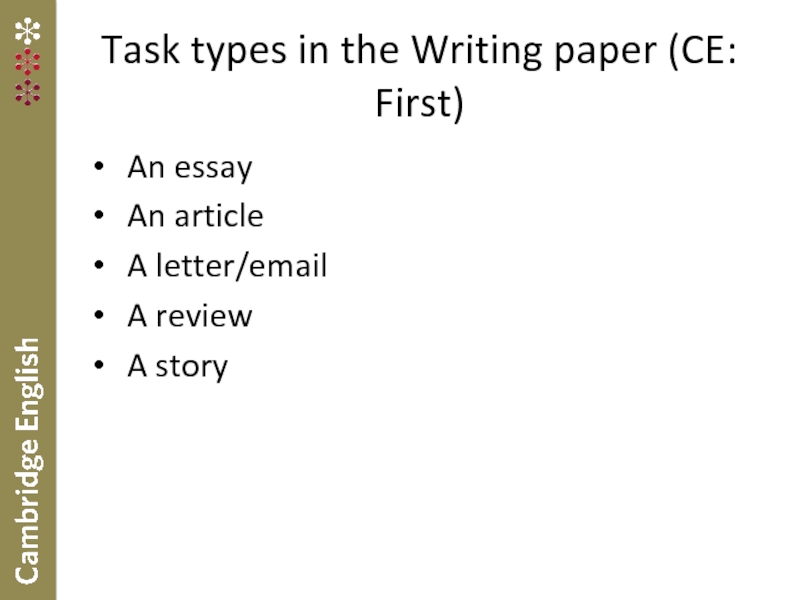
An essay
An article
A letter/email
A review
A story
Слайд 11An essay
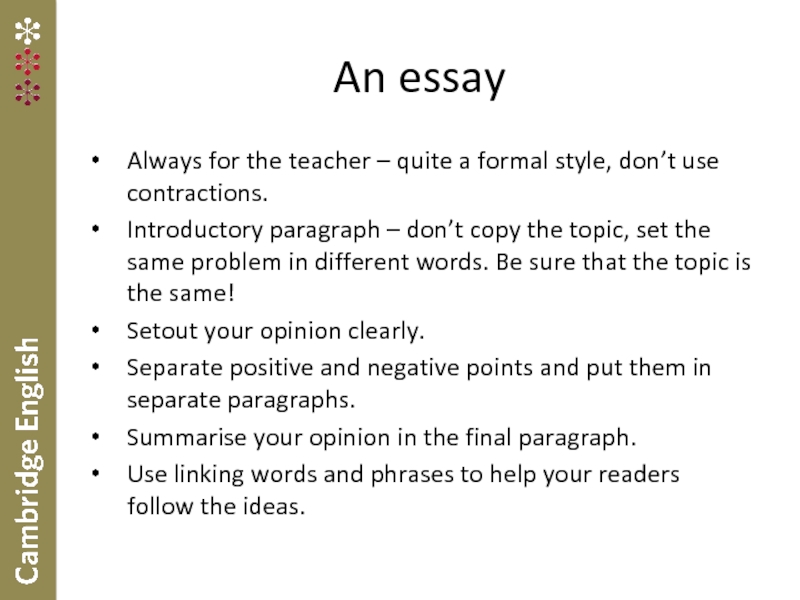
Always for the teacher – quite a formal style, don’t
Introductory paragraph – don’t copy the topic, set the same problem in different words. Be sure that the topic is the same!
Setout your opinion clearly.
Separate positive and negative points and put them in separate paragraphs.
Summarise your opinion in the final paragraph.
Use linking words and phrases to help your readers follow the ideas.
Слайд 12An article
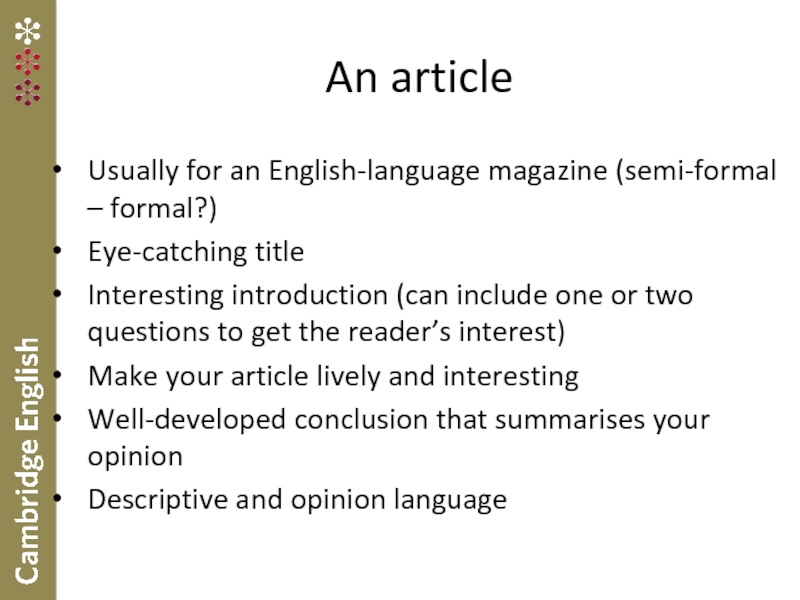
Usually for an English-language magazine (semi-formal – formal?)
Eye-catching title
Interesting introduction
Make your article lively and interesting
Well-developed conclusion that summarises your opinion
Descriptive and opinion language
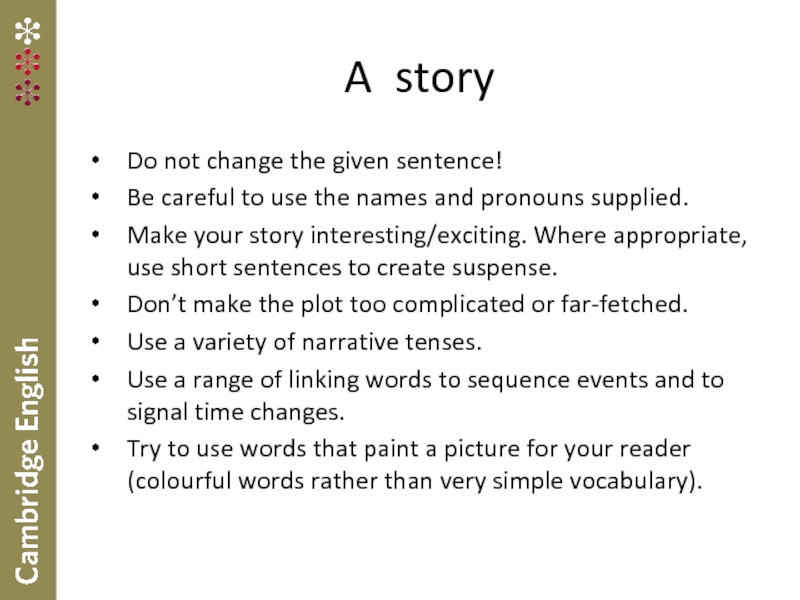
Слайд 13A story
Do not change the given sentence!
Be careful to use the
Make your story interesting/exciting. Where appropriate, use short sentences to create suspense.
Don’t make the plot too complicated or far-fetched.
Use a variety of narrative tenses.
Use a range of linking words to sequence events and to signal time changes.
Try to use words that paint a picture for your reader (colourful words rather than very simple vocabulary).
Слайд 14A letter/email
In response to the situation outlined in the question.
Register –
Слайд 15A review
Give your review a title.
Mention: the type of book/film; the
Use plenty of adjectives to describe: the book/film; how you feel about it.
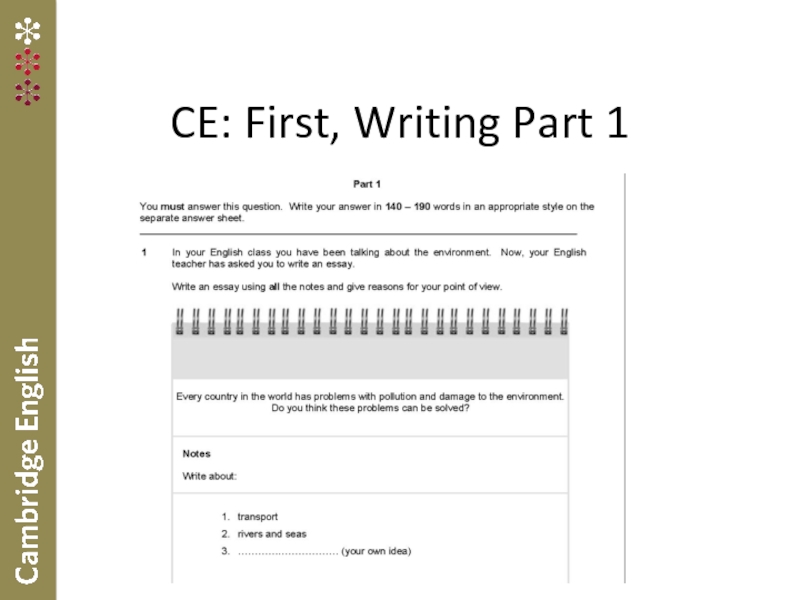
Слайд 17Skills to be developed
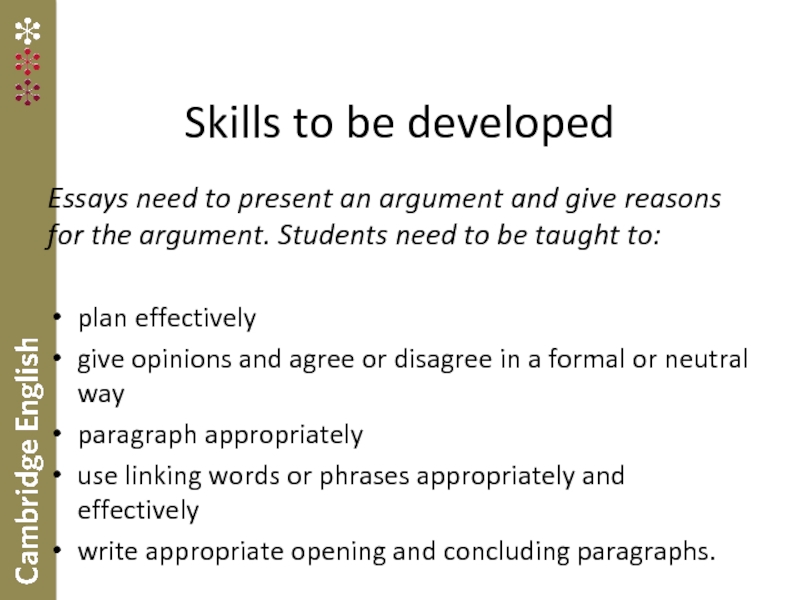
Essays need to present an argument and give
plan effectively
give opinions and agree or disagree in a formal or neutral way
paragraph appropriately
use linking words or phrases appropriately and effectively
write appropriate opening and concluding paragraphs.
Слайд 18Linking words and expressions
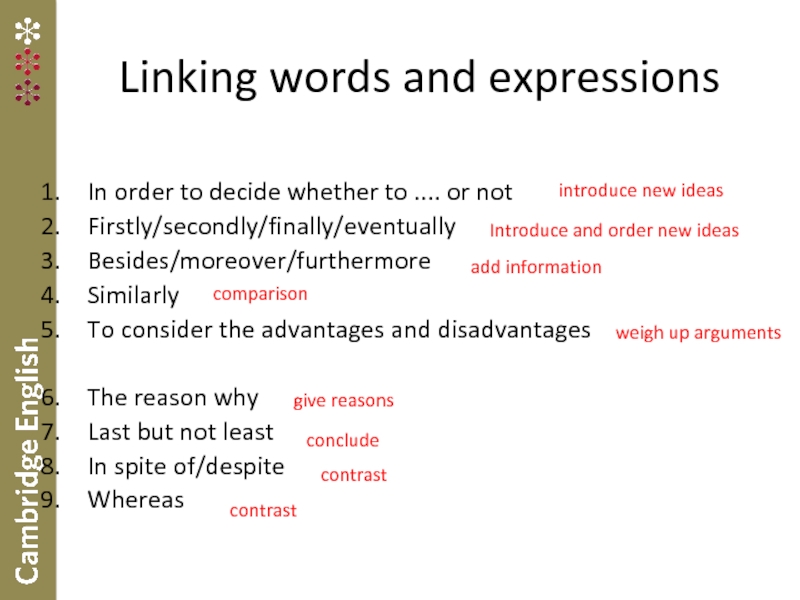
In order to decide whether to .... or
Firstly/secondly/finally/eventually
Besides/moreover/furthermore
Similarly
To consider the advantages and disadvantages
The reason why
Last but not least
In spite of/despite
Whereas
introduce new ideas
Introduce and order new ideas
add information
comparison
weigh up arguments
give reasons
conclude
contrast
contrast
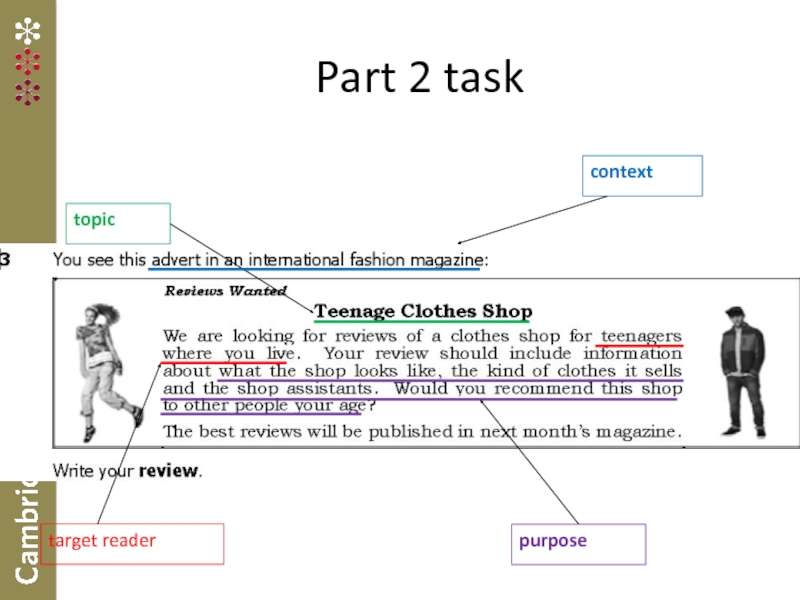
Слайд 20Part 2 questions
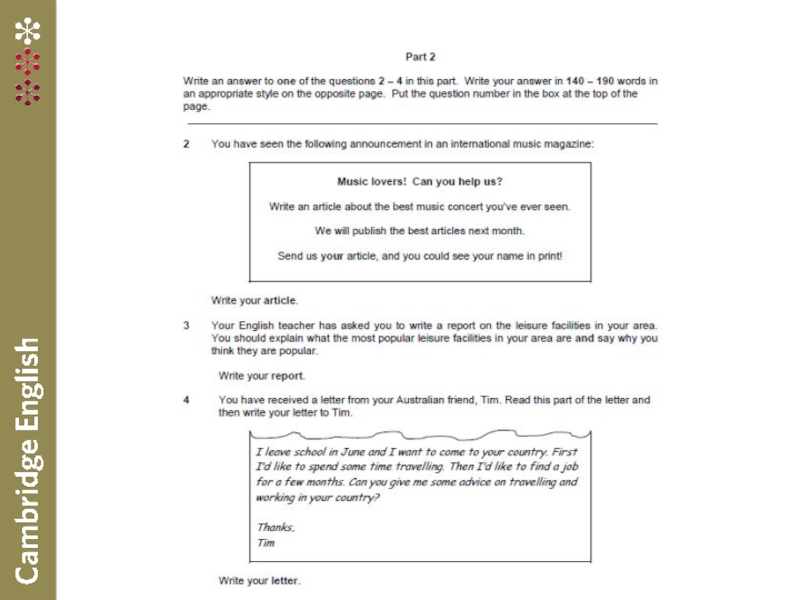
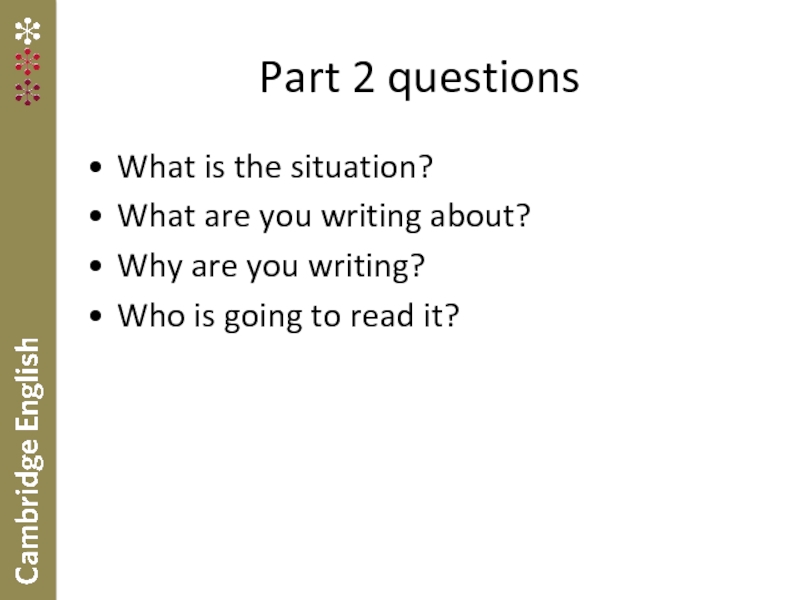
What is the situation?
What are you writing about?
Why are
Who is going to read it?
Слайд 22Assessment criteria (B1-C2)
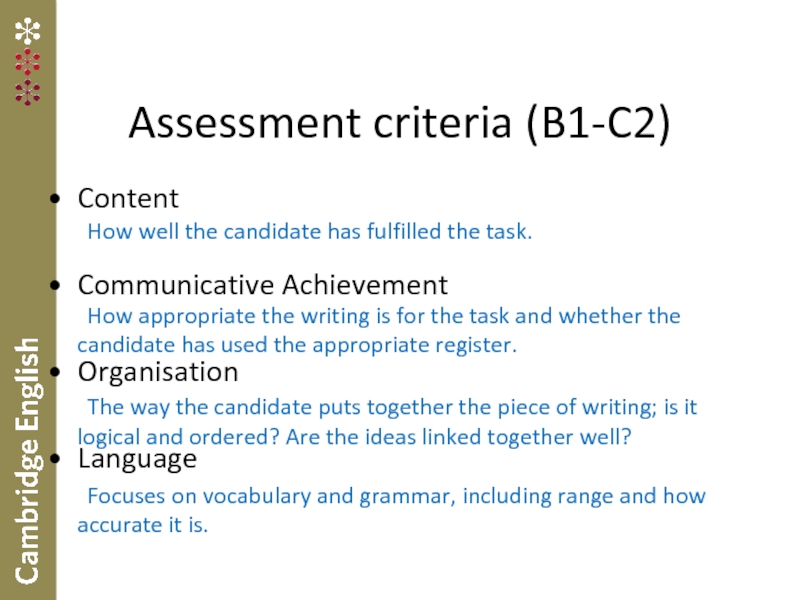
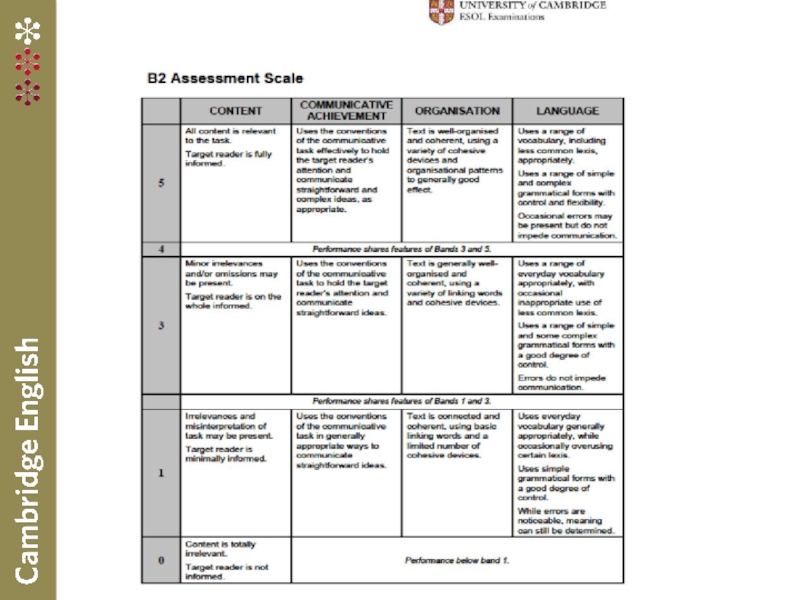
Content
Communicative Achievement
Organisation
Language
How well the candidate has fulfilled the task.
How
The way the candidate puts together the piece of writing; is it logical and ordered? Are the ideas linked together well?
Focuses on vocabulary and grammar, including range and how accurate it is.
Слайд 24You have received a letter from your English-speaking pen-friend John, who
…My brother has just graduated from University. He is a lawyer now. What professions are the most prestigious in Russia? What kind of money-making jobs in Russia do not require a university degree? Do you want to go to college, why, or why not?
This summer we are going on a three-day bicycle trip…
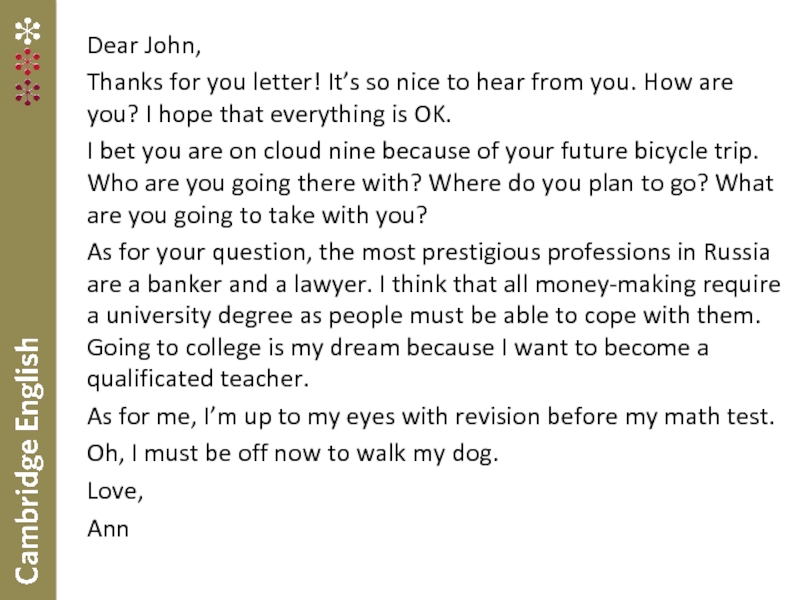
Слайд 25Dear John,
Thanks for you letter! It’s so nice to hear from
I bet you are on cloud nine because of your future bicycle trip. Who are you going there with? Where do you plan to go? What are you going to take with you?
As for your question, the most prestigious professions in Russia are a banker and a lawyer. I think that all money-making require a university degree as people must be able to cope with them. Going to college is my dream because I want to become a qualificated teacher.
As for me, I’m up to my eyes with revision before my math test.
Oh, I must be off now to walk my dog.
Love,
Ann
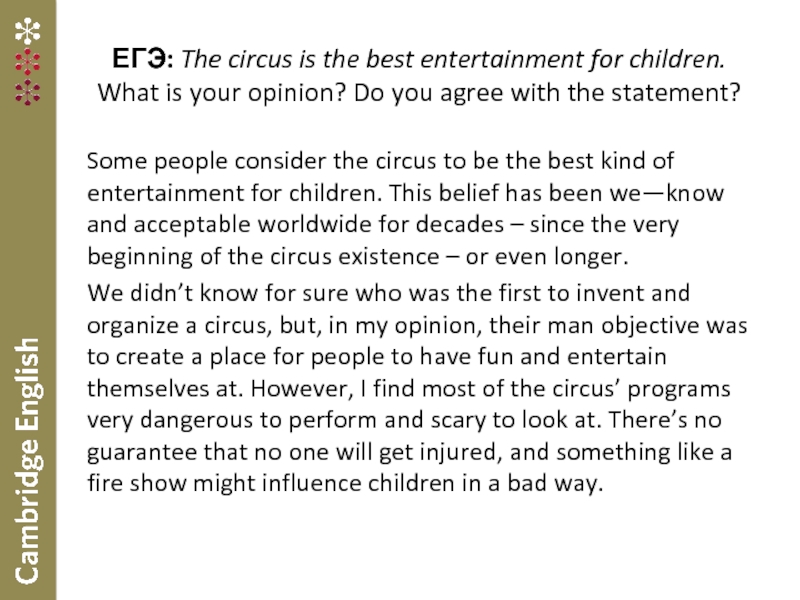
Слайд 26ЕГЭ: The circus is the best entertainment for children. What is your
Some people consider the circus to be the best kind of entertainment for children. This belief has been we—know and acceptable worldwide for decades – since the very beginning of the circus existence – or even longer.
We didn’t know for sure who was the first to invent and organize a circus, but, in my opinion, their man objective was to create a place for people to have fun and entertain themselves at. However, I find most of the circus’ programs very dangerous to perform and scary to look at. There’s no guarantee that no one will get injured, and something like a fire show might influence children in a bad way.
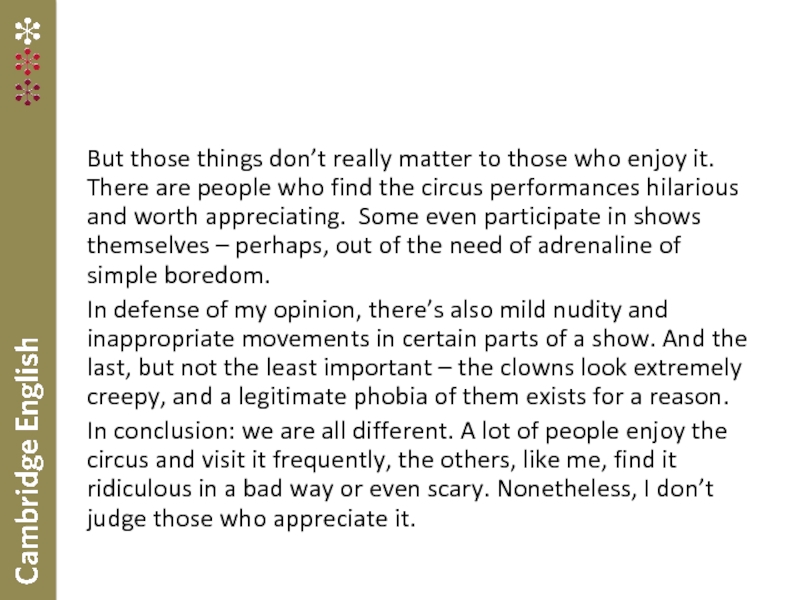
Слайд 27But those things don’t really matter to those who enjoy it.
In defense of my opinion, there’s also mild nudity and inappropriate movements in certain parts of a show. And the last, but not the least important – the clowns look extremely creepy, and a legitimate phobia of them exists for a reason.
In conclusion: we are all different. A lot of people enjoy the circus and visit it frequently, the others, like me, find it ridiculous in a bad way or even scary. Nonetheless, I don’t judge those who appreciate it.

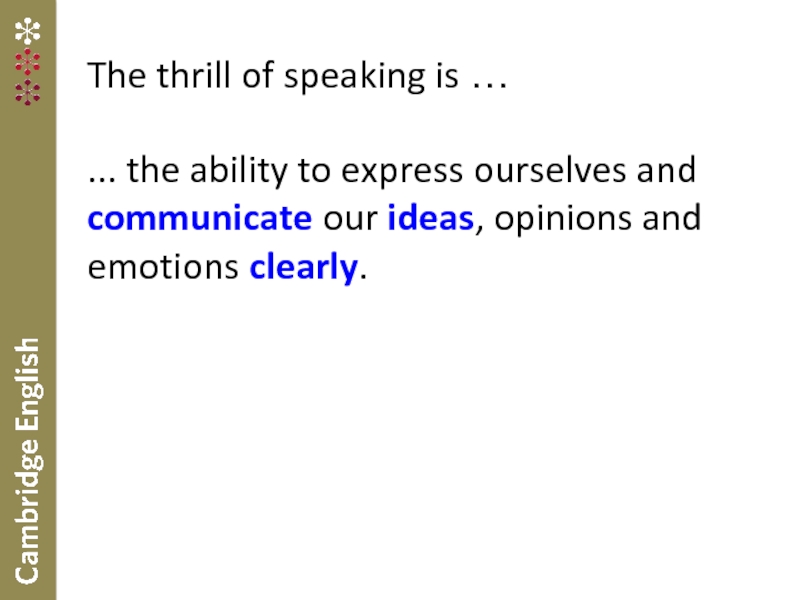
Слайд 29The thrill of speaking is …
... the ability to express ourselves
communicate our ideas, opinions and
emotions clearly.
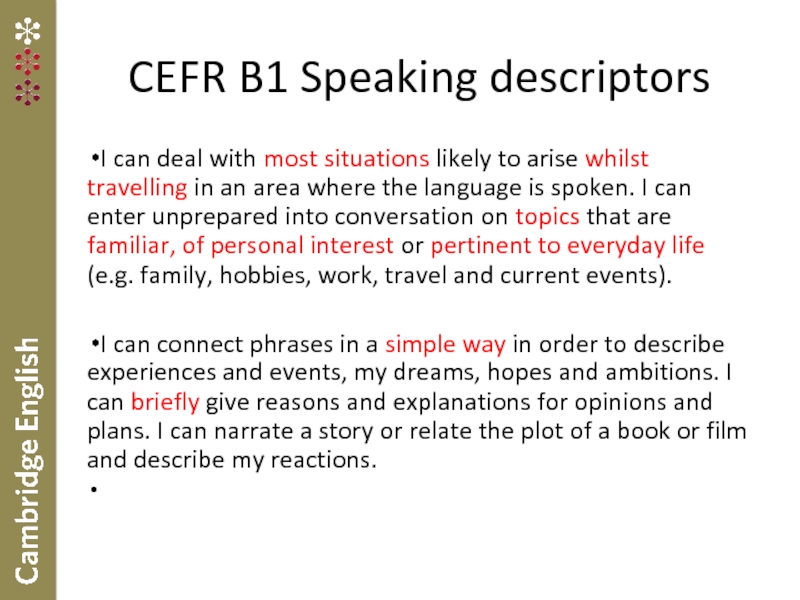
Слайд 30CEFR B1 Speaking descriptors
I can deal with most situations likely to
I can connect phrases in a simple way in order to describe experiences and events, my dreams, hopes and ambitions. I can briefly give reasons and explanations for opinions and plans. I can narrate a story or relate the plot of a book or film and describe my reactions.
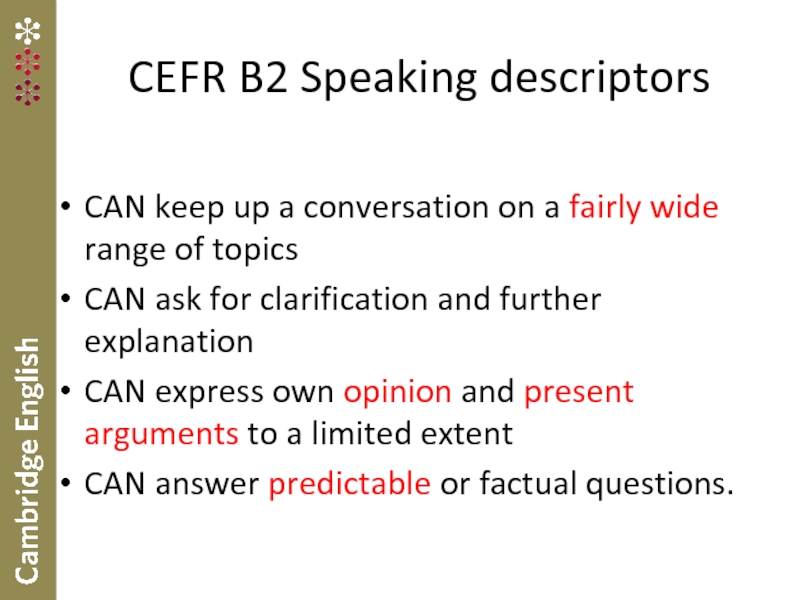
Слайд 31CEFR B2 Speaking descriptors
CAN keep up a conversation on a fairly
CAN ask for clarification and further explanation
CAN express own opinion and present arguments to a limited extent
CAN answer predictable or factual questions.
Слайд 33 Speaking
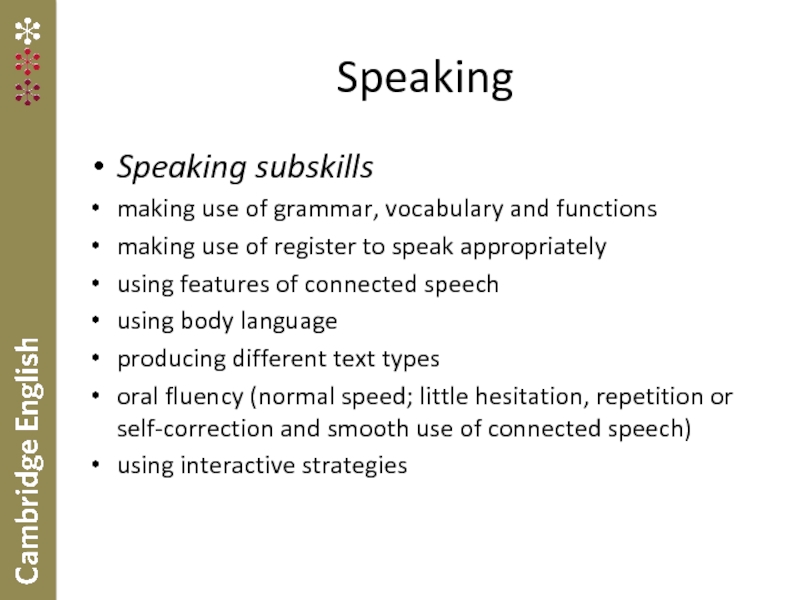
Speaking subskills
making use of grammar, vocabulary and functions
making use of
using features of connected speech
using body language
producing different text types
oral fluency (normal speed; little hesitation, repetition or self-correction and smooth use of connected speech)
using interactive strategies
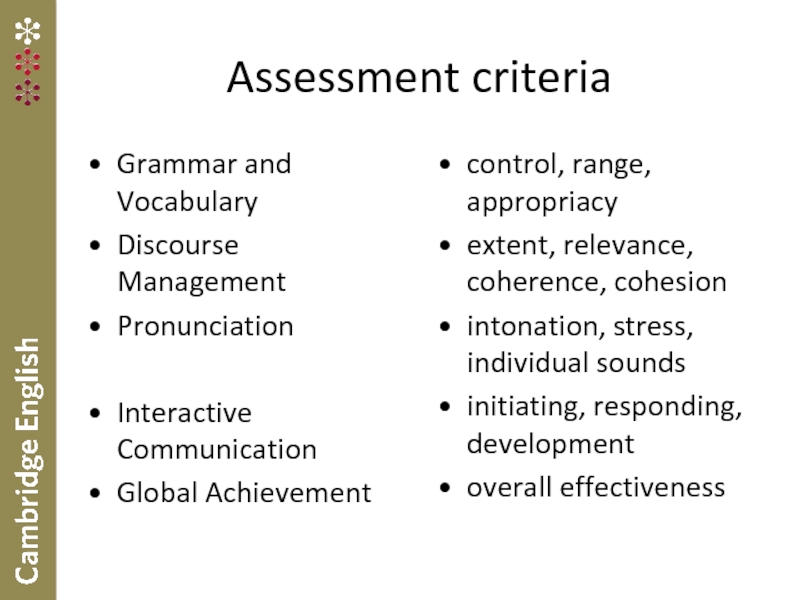
Слайд 34Assessment criteria
Grammar and Vocabulary
Discourse Management
Pronunciation
Interactive Communication
Global Achievement
control, range, appropriacy
extent, relevance, coherence,
intonation, stress, individual sounds
initiating, responding, development
overall effectiveness
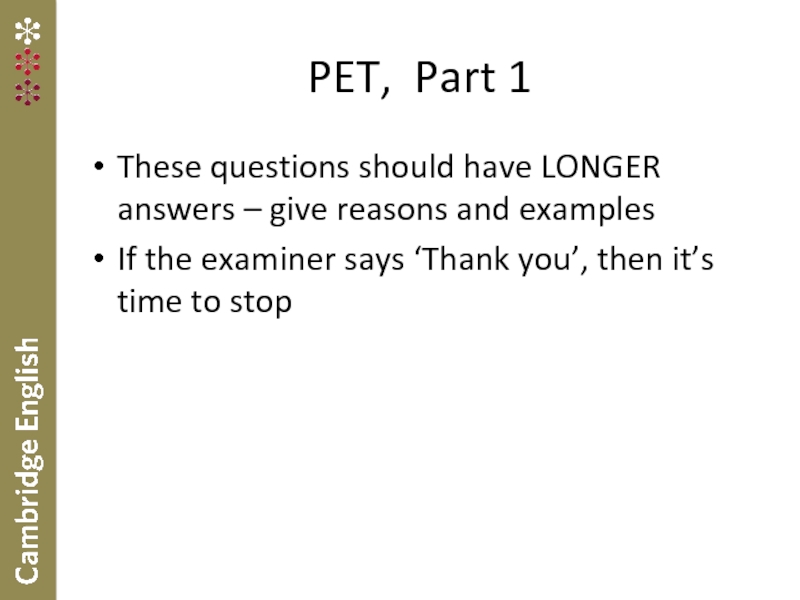
Слайд 36PET, Part 1
These questions should have LONGER answers – give reasons
If the examiner says ‘Thank you’, then it’s time to stop
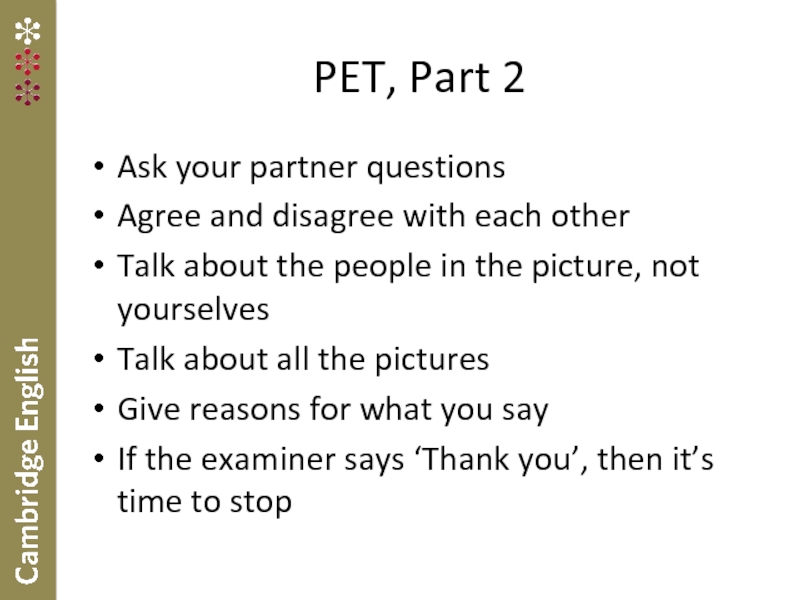
Слайд 37PET, Part 2
Ask your partner questions
Agree and disagree with each other
Talk
Talk about all the pictures
Give reasons for what you say
If the examiner says ‘Thank you’, then it’s time to stop
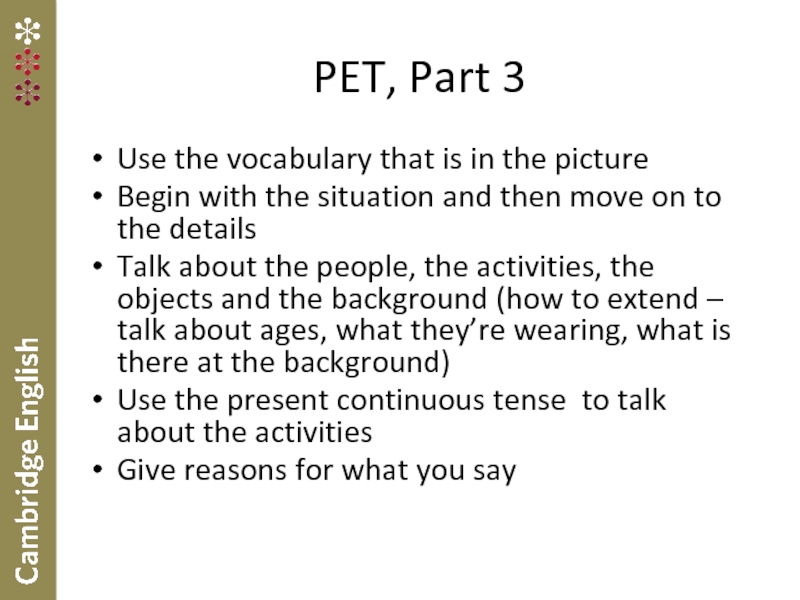
Слайд 38PET, Part 3
Use the vocabulary that is in the picture
Begin with
Talk about the people, the activities, the objects and the background (how to extend – talk about ages, what they’re wearing, what is there at the background)
Use the present continuous tense to talk about the activities
Give reasons for what you say
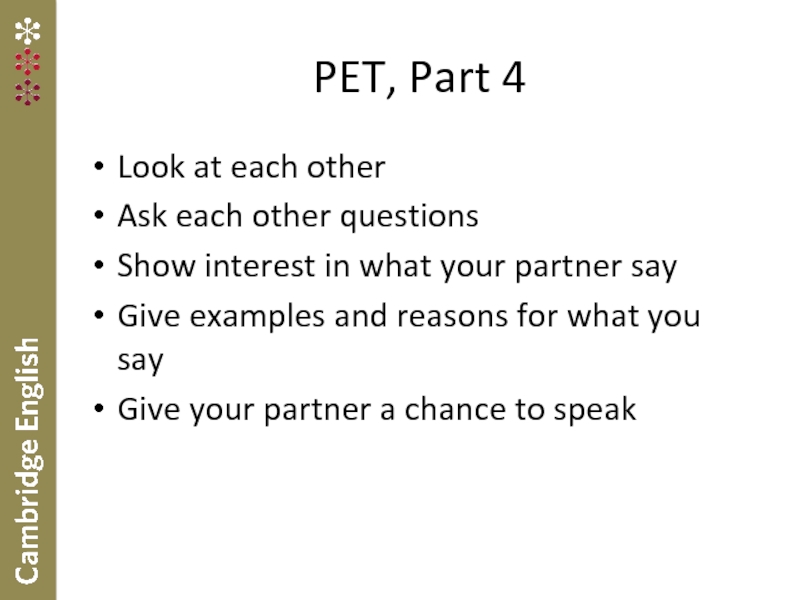
Слайд 39PET, Part 4
Look at each other
Ask each other questions
Show interest in
Give examples and reasons for what you say
Give your partner a chance to speak
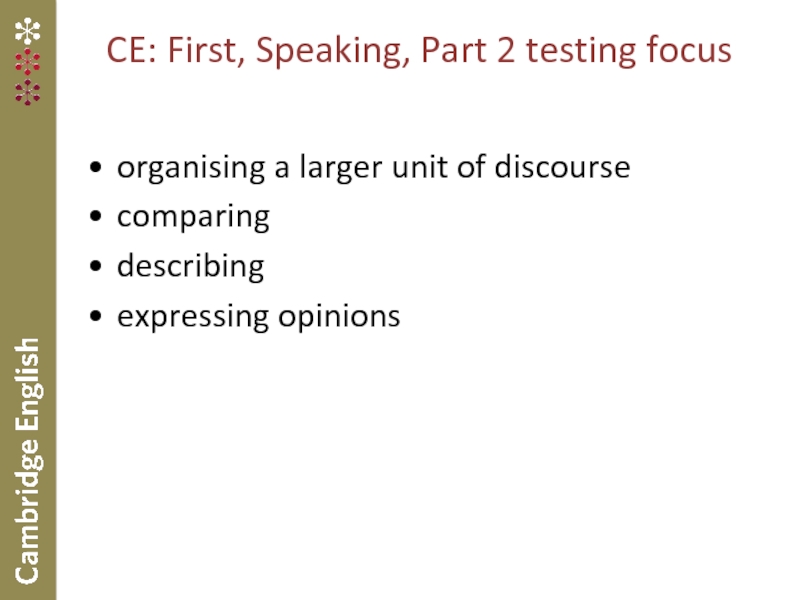
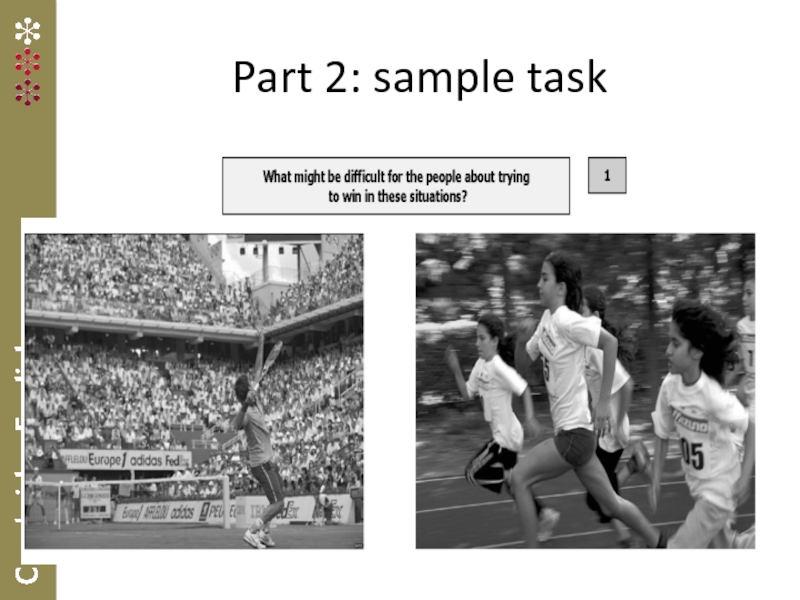
Слайд 41CE: First, Speaking, Part 2 testing focus
organising a larger unit
comparing
describing
expressing opinions
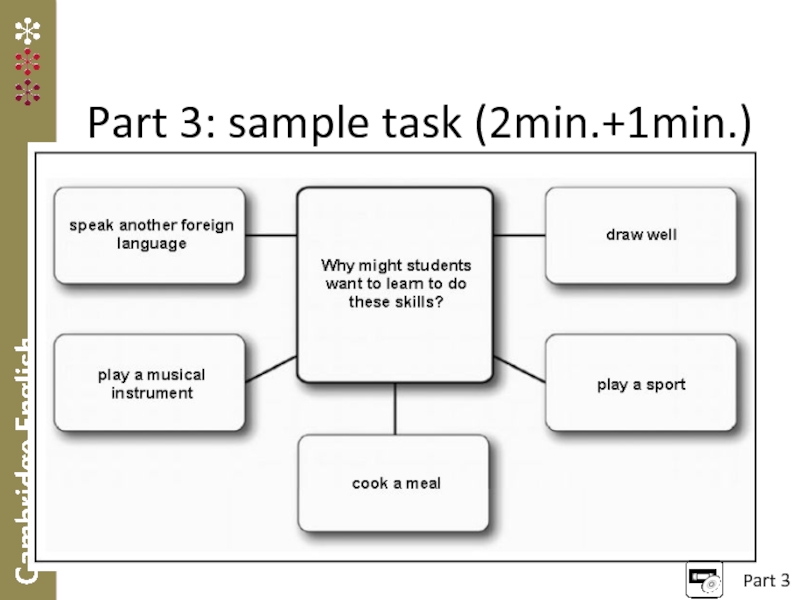
Слайд 43CE: First, Speaking, Part 3 testing focus
sustaining an interaction
exchanging ideas
expressing and
comparing
agreeing and/or disagreeing
suggesting
speculating
evaluating
reaching a decision through negotiation
Слайд 45Part 3 (1 min.)
Now you have about a minute to decide
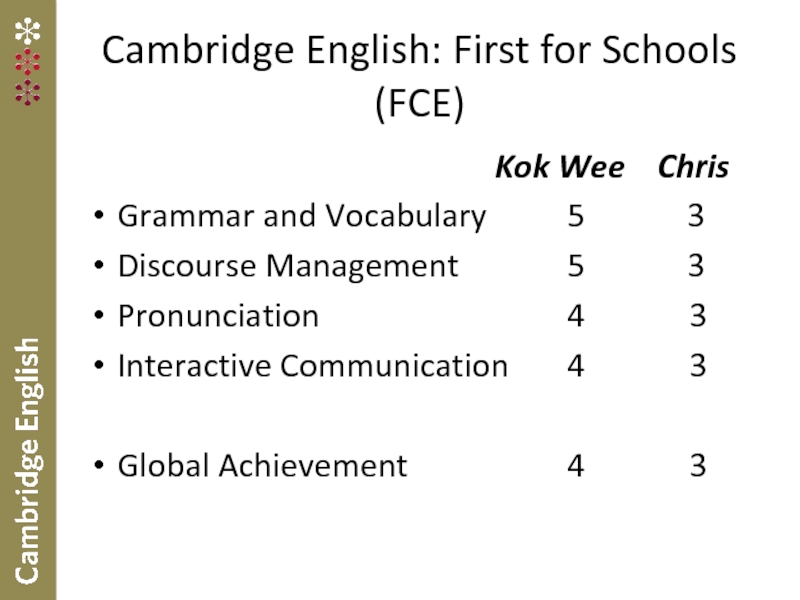
Слайд 46Cambridge English: First for Schools (FCE)
Grammar and Vocabulary 5 3
Discourse Management 5 3
Pronunciation 4 3
Interactive Communication 4 3
Global Achievement 4 3
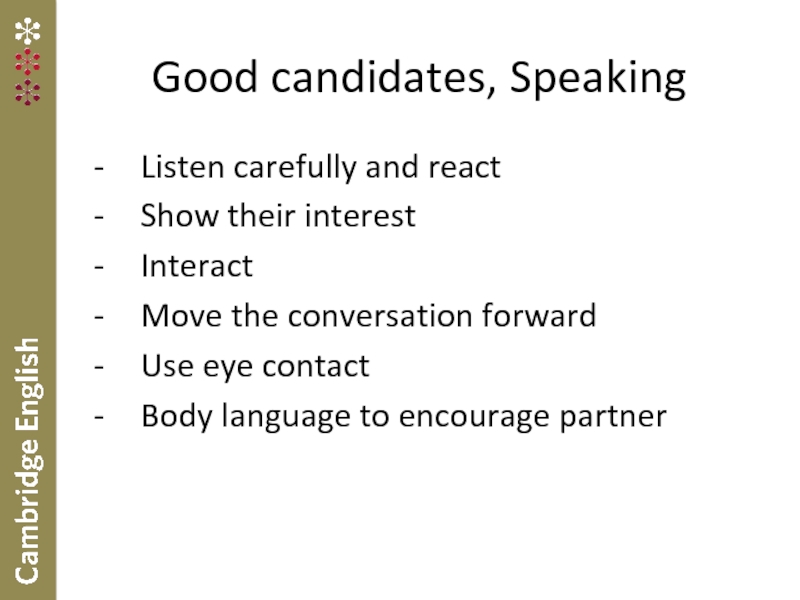
Слайд 47Good candidates, Speaking
Listen carefully and react
Show their interest
Interact
Move the conversation
Use eye contact
Body language to encourage partner
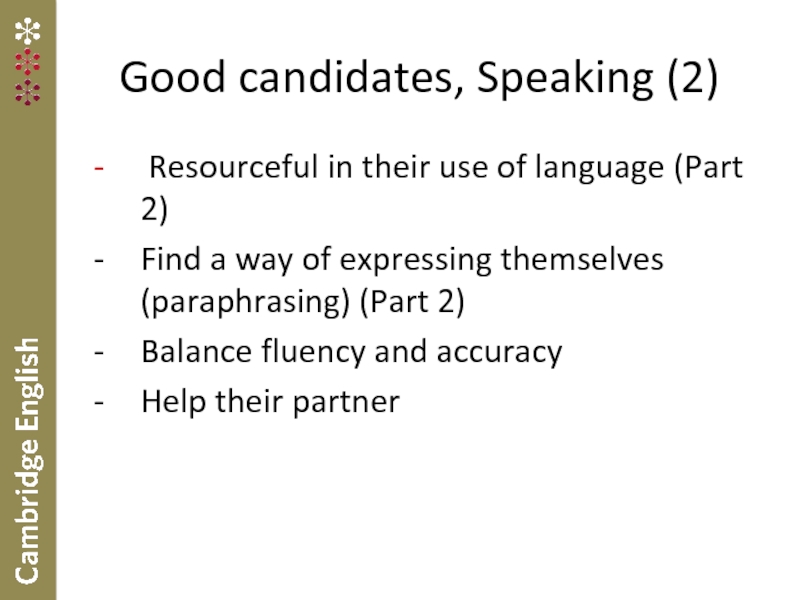
Слайд 48Good candidates, Speaking (2)
Resourceful in their use of language (Part
Find a way of expressing themselves (paraphrasing) (Part 2)
Balance fluency and accuracy
Help their partner
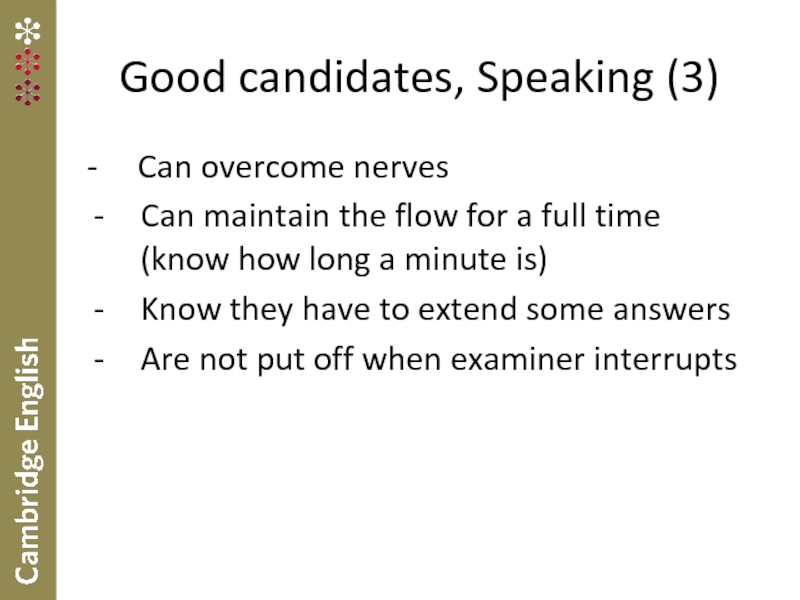
Слайд 49Good candidates, Speaking (3)
- Can overcome nerves
Can maintain the
Know they have to extend some answers
Are not put off when examiner interrupts
Слайд 50Teaching Support website
Over 1 million visits
100,000 registered teachers
500,000 downloads
Lots of features
www.cambridgeenglish.org/teach

Слайд 51Courses
Earn a certificate from Cambridge.
Webinars
Interact with expert trainers.
Knowledge
Articles with industry-leading ideas.
Join
www.cambridgeenglishteacher.org
Online
Professional
Development