- Главная
- Разное
- Образование
- Спорт
- Естествознание
- Природоведение
- Религиоведение
- Французский язык
- Черчение
- Английский язык
- Астрономия
- Алгебра
- Биология
- География
- Геометрия
- Детские презентации
- Информатика
- История
- Литература
- Математика
- Музыка
- МХК
- Немецкий язык
- ОБЖ
- Обществознание
- Окружающий мир
- Педагогика
- Русский язык
- Технология
- Физика
- Философия
- Химия
- Шаблоны, фоны, картинки для презентаций
- Экология
- Экономика
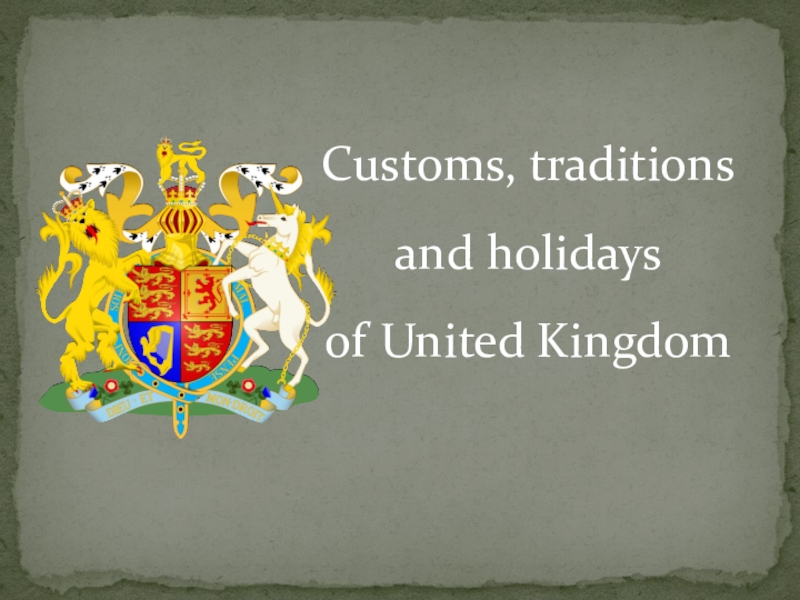
Презентация, доклад по английскому языку Customs, traditions and holidays of United Kingdom
Содержание
- 1. Презентация по английскому языку Customs, traditions and holidays of United Kingdom
- 2. Every nation and every country has its
- 3. New Year’s DayPeople celebrate The New Year
- 4. On February 14th it’s Saint Valentine’s Day
- 5. St Patrick’s DaySt. Patrick’s Day, on
- 6. St David’s Day1 March is a very
- 7. April 1st is April Fool’s Day in
- 8. EasterEaster is celebrated in April. On this
- 9. St George’s DaySt George’s Day is England’s
- 10. The Queen is the only person in
- 11. Harvest FestivalHarvest Festival is a celebration
- 12. HalloweenOn October 31st British people celebrate Halloween.
- 13. On November 5,1605, a man called Guy
- 14. Remembrance Day11 November is the time of
- 15. St Andrew’s DayOn 30 November Scottish people
- 16. Christmas Day25 December is the date of
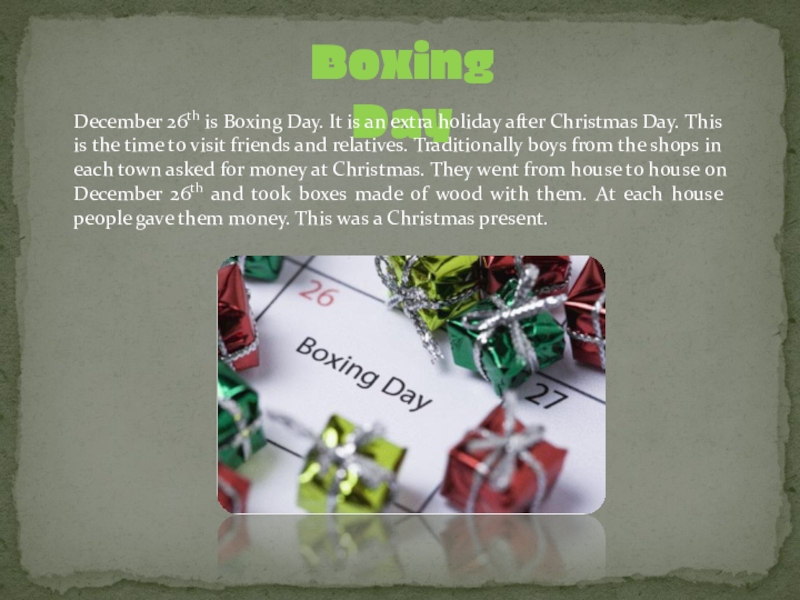
- 17. Boxing DayDecember 26th is Boxing Day. It
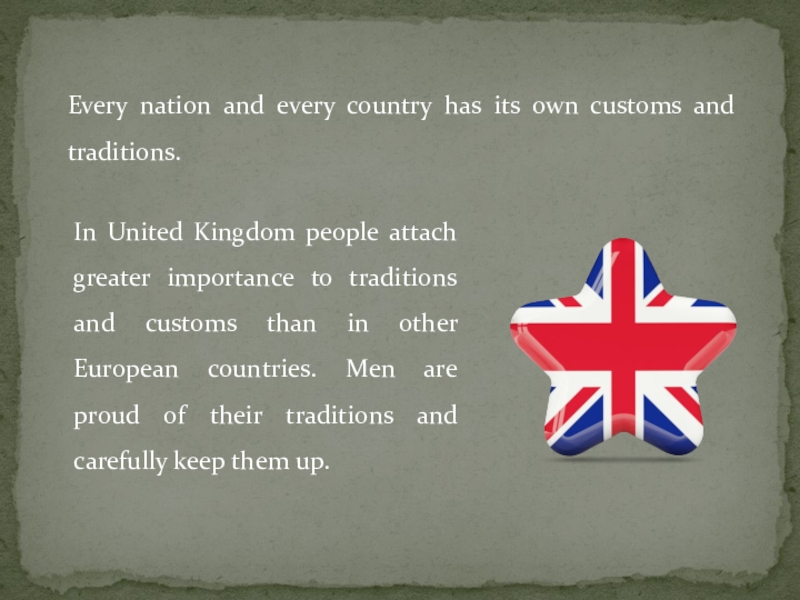
Слайд 2Every nation and every country has its own customs and traditions.
In
Слайд 3New Year’s Day
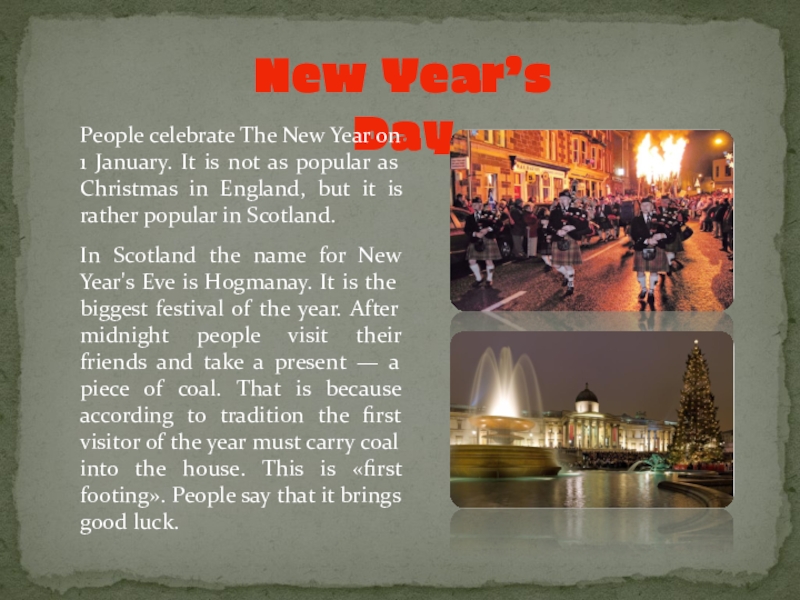
People celebrate The New Year on 1 January. It
In Scotland the name for New Year's Eve is Hogmanay. It is the biggest festival of the year. After midnight people visit their friends and take a present — a piece of coal. That is because according to tradition the first visitor of the year must carry coal into the house. This is «first footing». People say that it brings good luck.
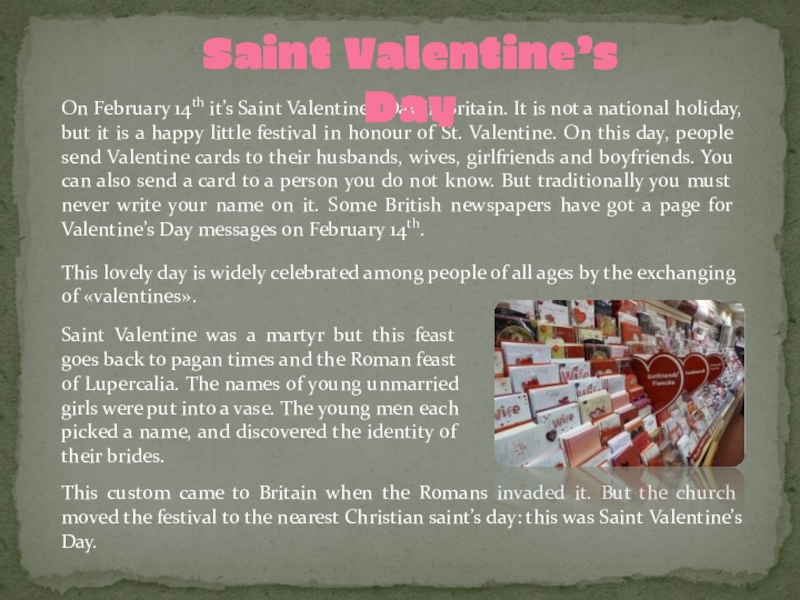
Слайд 4On February 14th it’s Saint Valentine’s Day in Britain. It is
This lovely day is widely celebrated among people of all ages by the exchanging of «valentines».
Saint Valentine was a martyr but this feast goes back to pagan times and the Roman feast of Lupercalia. The names of young unmarried girls were put into a vase. The young men each picked a name, and discovered the identity of their brides.
This custom came to Britain when the Romans invaded it. But the church moved the festival to the nearest Christian saint’s day: this was Saint Valentine’s Day.
Saint Valentine’s Day
Слайд 5St Patrick’s Day
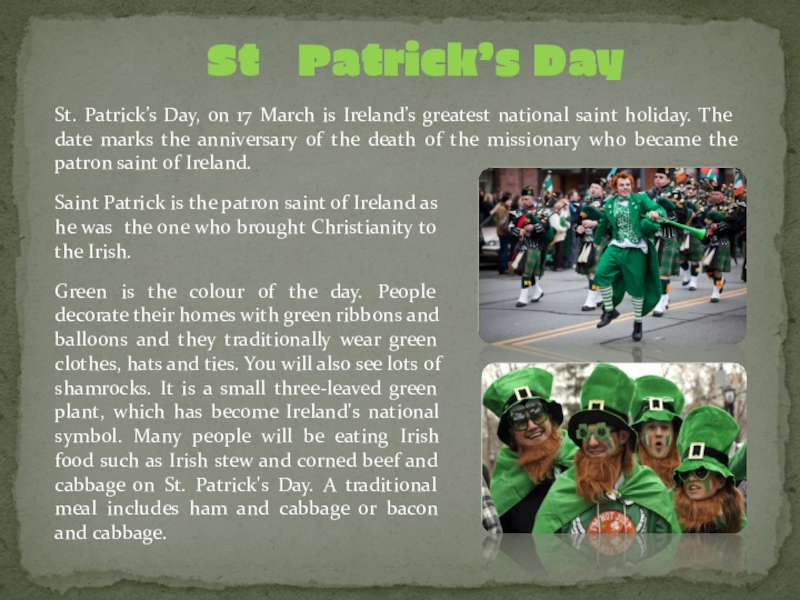
St. Patrick’s Day, on 17 March is Ireland’s
Green is the colour of the day. People decorate their homes with green ribbons and balloons and they traditionally wear green clothes, hats and ties. You will also see lots of shamrocks. It is a small three-leaved green plant, which has become Ireland's national symbol. Many people will be eating Irish food such as Irish stew and corned beef and cabbage on St. Patrick's Day. A traditional meal includes ham and cabbage or bacon and cabbage.
Saint Patrick is the patron saint of Ireland as he was the one who brought Christianity to the Irish.
Слайд 6St David’s Day
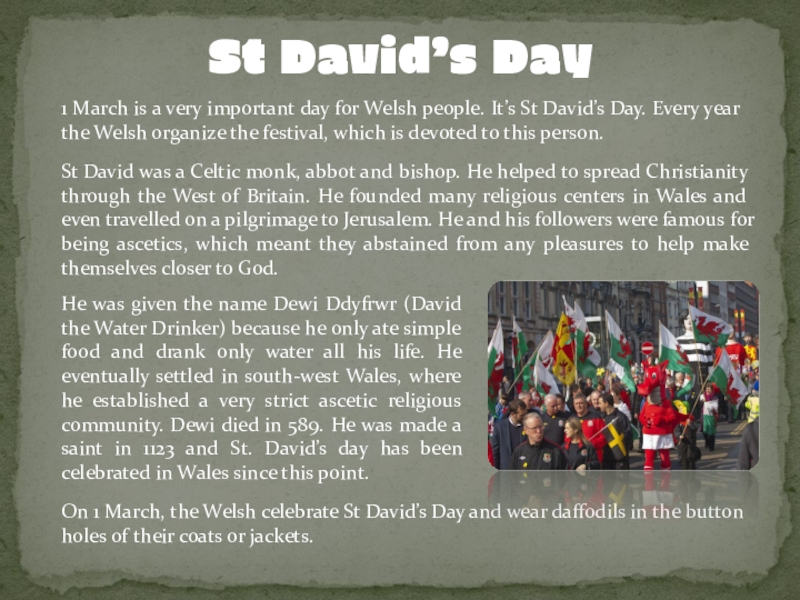
1 March is a very important day for Welsh
St David was a Celtic monk, abbot and bishop. He helped to spread Christianity through the West of Britain. He founded many religious centers in Wales and even travelled on a pilgrimage to Jerusalem. He and his followers were famous for being ascetics, which meant they abstained from any pleasures to help make themselves closer to God.
On 1 March, the Welsh celebrate St David’s Day and wear daffodils in the button holes of their coats or jackets.
He was given the name Dewi Ddyfrwr (David the Water Drinker) because he only ate simple food and drank only water all his life. He eventually settled in south-west Wales, where he established a very strict ascetic religious community. Dewi died in 589. He was made a saint in 1123 and St. David’s day has been celebrated in Wales since this point.
Слайд 7April 1st is April Fool’s Day in Britain. This is a
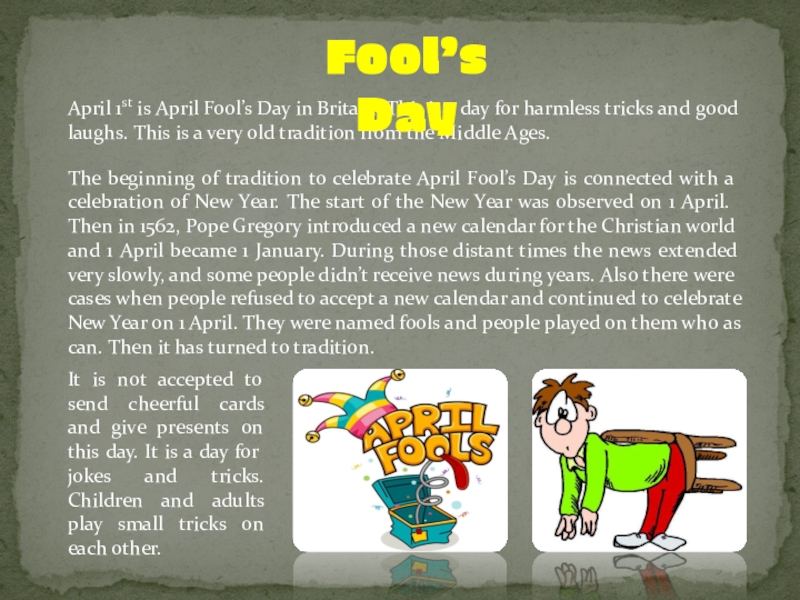
It is not accepted to send cheerful cards and give presents on this day. It is a day for jokes and tricks. Children and adults play small tricks on each other.
Fool’s Day
The beginning of tradition to celebrate April Fool’s Day is connected with a celebration of New Year. The start of the New Year was observed on 1 April. Then in 1562, Pope Gregory introduced a new calendar for the Christian world and 1 April became 1 January. During those distant times the news extended very slowly, and some people didn’t receive news during years. Also there were cases when people refused to accept a new calendar and continued to celebrate New Year on 1 April. They were named fools and people played on them who as can. Then it has turned to tradition.
Слайд 8Easter
Easter is celebrated in April. On this day people celebrate resurrection
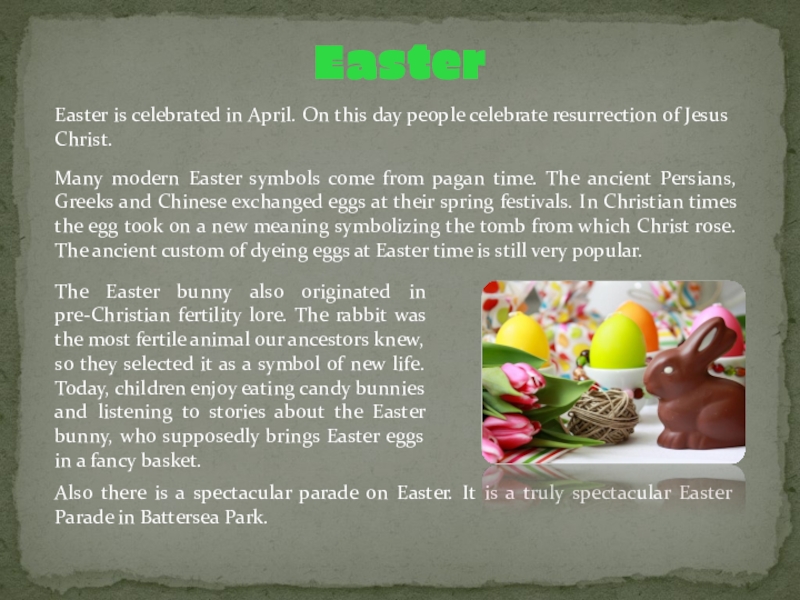
Many modern Easter symbols come from pagan time. The ancient Persians, Greeks and Chinese exchanged eggs at their spring festivals. In Christian times the egg took on a new meaning symbolizing the tomb from which Christ rose. The ancient custom of dyeing eggs at Easter time is still very popular.
The Easter bunny also originated in pre-Christian fertility lore. The rabbit was the most fertile animal our ancestors knew, so they selected it as a symbol of new life. Today, children enjoy eating candy bunnies and listening to stories about the Easter bunny, who supposedly brings Easter eggs in a fancy basket.
Also there is a spectacular parade on Easter. It is a truly spectacular Easter Parade in Battersea Park.
Слайд 9St George’s Day
St George’s Day is England’s national day which is
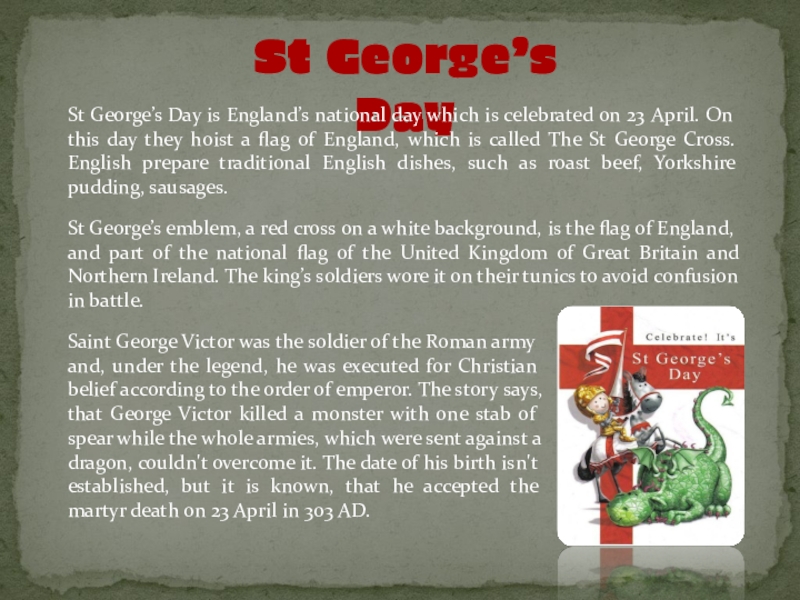
Saint George Victor was the soldier of the Roman army and, under the legend, he was executed for Christian belief according to the order of emperor. The story says, that George Victor killed a monster with one stab of spear while the whole armies, which were sent against a dragon, couldn't overcome it. The date of his birth isn't established, but it is known, that he accepted the martyr death on 23 April in 303 AD.
St George’s emblem, a red cross on a white background, is the flag of England, and part of the national flag of the United Kingdom of Great Britain and Northern Ireland. The king’s soldiers wore it on their tunics to avoid confusion in battle.
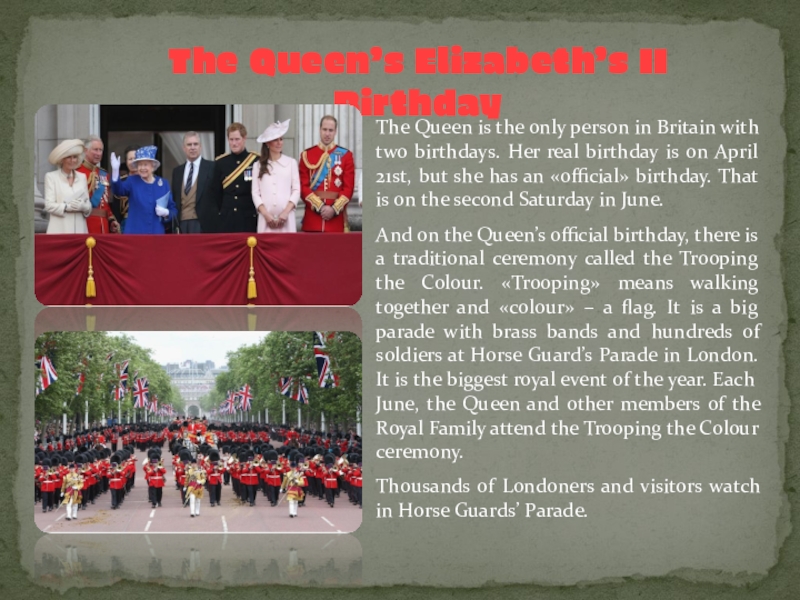
Слайд 10The Queen is the only person in Britain with two birthdays.
The Queen’s Elizabeth’s II Birthday
And on the Queen’s official birthday, there is a traditional ceremony called the Trooping the Colour. «Trooping» means walking together and «colour» – a flag. It is a big parade with brass bands and hundreds of soldiers at Horse Guard’s Parade in London. It is the biggest royal event of the year. Each June, the Queen and other members of the Royal Family attend the Trooping the Colour ceremony.
Thousands of Londoners and visitors watch in Horse Guards’ Parade.
Слайд 11Harvest Festival
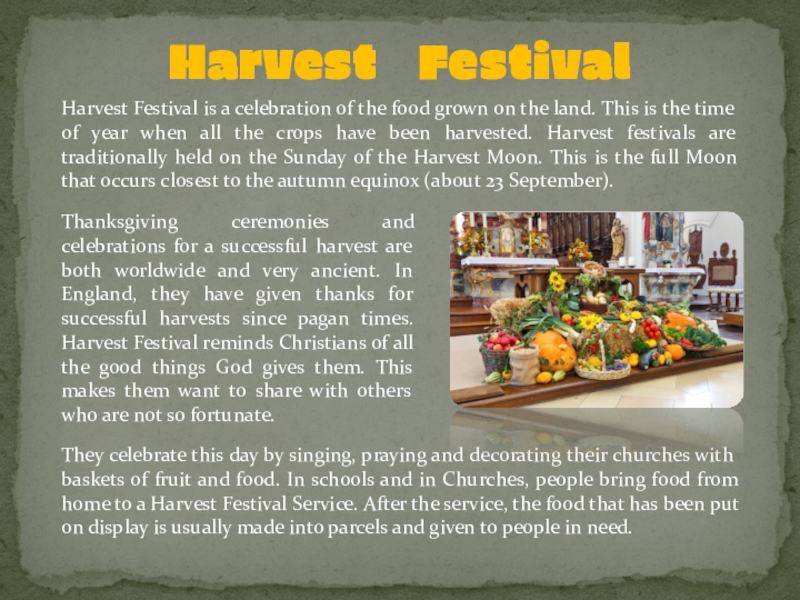
Harvest Festival is a celebration of the food grown
Thanksgiving ceremonies and celebrations for a successful harvest are both worldwide and very ancient. In England, they have given thanks for successful harvests since pagan times. Harvest Festival reminds Christians of all the good things God gives them. This makes them want to share with others who are not so fortunate.
They celebrate this day by singing, praying and decorating their churches with baskets of fruit and food. In schools and in Churches, people bring food from home to a Harvest Festival Service. After the service, the food that has been put on display is usually made into parcels and given to people in need.
Слайд 12Halloween
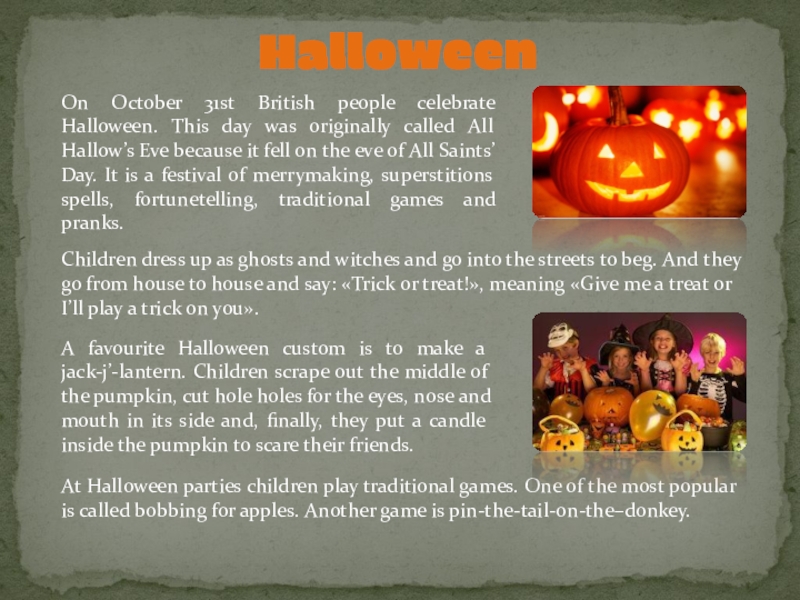
On October 31st British people celebrate Halloween. This day was originally
A favourite Halloween custom is to make a jack-j’-lantern. Children scrape out the middle of the pumpkin, cut hole holes for the eyes, nose and mouth in its side and, finally, they put a candle inside the pumpkin to scare their friends.
Children dress up as ghosts and witches and go into the streets to beg. And they go from house to house and say: «Trick or treat!», meaning «Give me a treat or I’ll play a trick on you».
At Halloween parties children play traditional games. One of the most popular is called bobbing for apples. Another game is pin-the-tail-on-the–donkey.
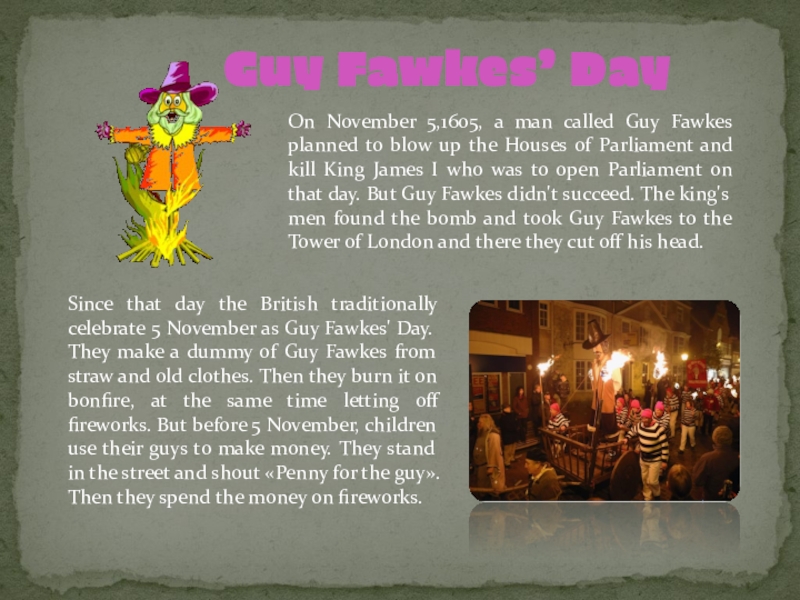
Слайд 13On November 5,1605, a man called Guy Fawkes planned to blow
Guy Fawkes’ Day
Since that day the British traditionally celebrate 5 November as Guy Fawkes' Day. They make a dummy of Guy Fawkes from straw and old clothes. Then they burn it on bonfire, at the same time letting off fireworks. But before 5 November, children use their guys to make money. They stand in the street and shout «Penny for the guy». Then they spend the money on fireworks.
Слайд 14Remembrance Day
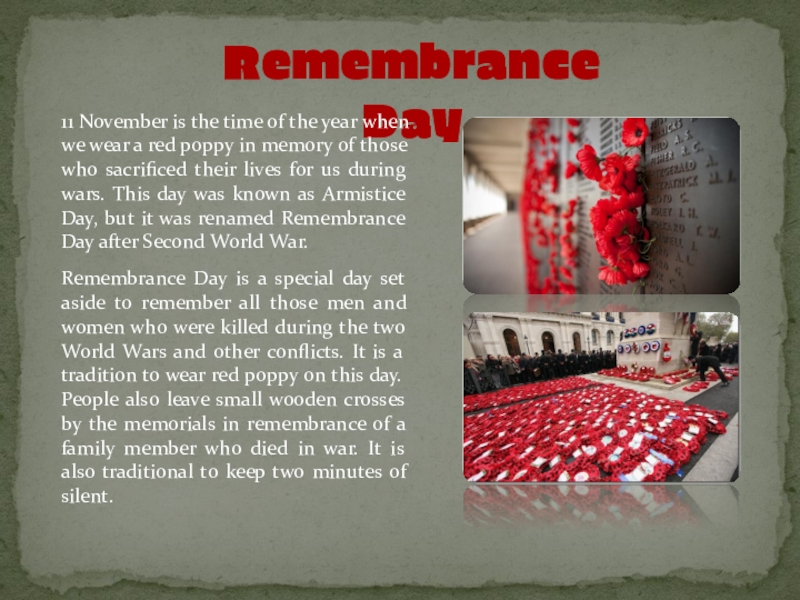
11 November is the time of the year when we
Remembrance Day is a special day set aside to remember all those men and women who were killed during the two World Wars and other conflicts. It is a tradition to wear red poppy on this day. People also leave small wooden crosses by the memorials in remembrance of a family member who died in war. It is also traditional to keep two minutes of silent.
Слайд 15St Andrew’s Day
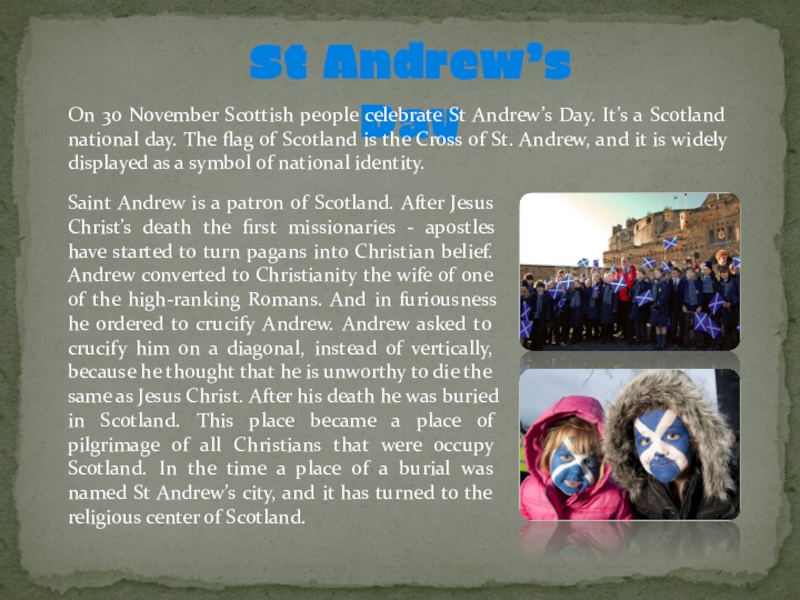
On 30 November Scottish people celebrate St Andrew’s Day.
Saint Andrew is a patron of Scotland. After Jesus Christ’s death the first missionaries - apostles have started to turn pagans into Christian belief. Andrew converted to Christianity the wife of one of the high-ranking Romans. And in furiousness he ordered to crucify Andrew. Andrew asked to crucify him on a diagonal, instead of vertically, because he thought that he is unworthy to die the same as Jesus Christ. After his death he was buried in Scotland. This place became a place of pilgrimage of all Christians that were occupy Scotland. In the time a place of a burial was named St Andrew’s city, and it has turned to the religious center of Scotland.
Слайд 16Christmas Day
25 December is the date of Christmas Day. It is
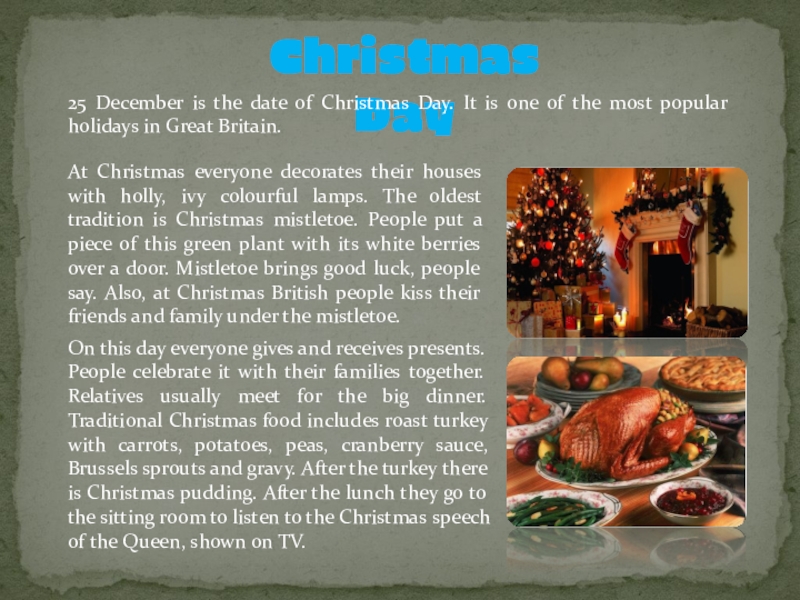
On this day everyone gives and receives presents. People celebrate it with their families together. Relatives usually meet for the big dinner. Traditional Christmas food includes roast turkey with carrots, potatoes, peas, cranberry sauce, Brussels sprouts and gravy. After the turkey there is Christmas pudding. After the lunch they go to the sitting room to listen to the Christmas speech of the Queen, shown on TV.
At Christmas everyone decorates their houses with holly, ivy colourful lamps. The oldest tradition is Christmas mistletoe. People put a piece of this green plant with its white berries over a door. Mistletoe brings good luck, people say. Also, at Christmas British people kiss their friends and family under the mistletoe.
Слайд 17Boxing Day
December 26th is Boxing Day. It is an extra holiday