- Главная
- Разное
- Образование
- Спорт
- Естествознание
- Природоведение
- Религиоведение
- Французский язык
- Черчение
- Английский язык
- Астрономия
- Алгебра
- Биология
- География
- Геометрия
- Детские презентации
- Информатика
- История
- Литература
- Математика
- Музыка
- МХК
- Немецкий язык
- ОБЖ
- Обществознание
- Окружающий мир
- Педагогика
- Русский язык
- Технология
- Физика
- Философия
- Химия
- Шаблоны, фоны, картинки для презентаций
- Экология
- Экономика
Презентация, доклад по английскому языку
Содержание
- 1. Презентация по английскому языку
- 2. The InfinitiveShe wants to work at school.They
- 3. The to-infinitive is used - To express
- 4. After verbs such as know, decide, ask
- 5. After it +be+ adjective (+of+ noun\pronoun).
- 6. The bare infinitive is used:After modals (may,
- 7. Note:Help is followed by to + inf.,
- 8. The ing form is used:As a noun.
- 9. After go for activities. They
- 10. But see, hear, watch, listen to, notice+
- 11. To-infinitive or the – ing form without
- 12. Need\ require\want + ing form Necessary
- 13. The to – infinitive or the –
- 14. Go on + to – inf. =
- 15. Regret + ing form = feel sorry
- 16. Stop + ing form = finish, give
- 17. Be afraid of + ing form =
- 18. Put the verbs in brackets into the
- 19. By the way, how
- 20. Dear Jessica, How are
- 21. By the way, how are you getting
Слайд 1INFINITIVE
Подготовила Петрова Н.В.
учитель английского языка
МОУ СШ №92
город Волгоград
2017год
Слайд 2The Infinitive
She wants to work at school.
They must do it.
He hopes
The infinitives are:
the to-infinitive
The bare infinitive
Слайд 3The to-infinitive is used
- To express purpose
She went
- After certain verbs: advise, agree, appear, decide, expect, hope, manage, offer, promise, refuse, seem, want, afford, pretend, etc.
He wants to apply for the job.
Слайд 4After verbs such as know, decide, ask , learn, want to
when they are followed by questions words ( who, what, where, how, etc.)
I can’t decide where to go.
After adjectives such as nice, sorry, glad, willing, afraid, ashamed, etc.
He is glad to be back.
After too and enough
She is too shy to talk to the boss.
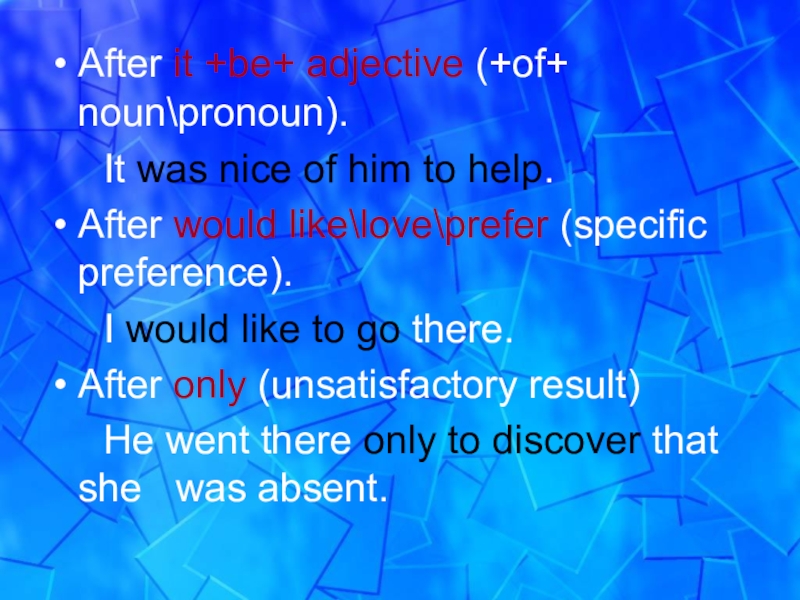
Слайд 5After it +be+ adjective (+of+ noun\pronoun).
It was nice
After would like\love\prefer (specific preference).
I would like to go there.
After only (unsatisfactory result)
He went there only to discover that she was absent.
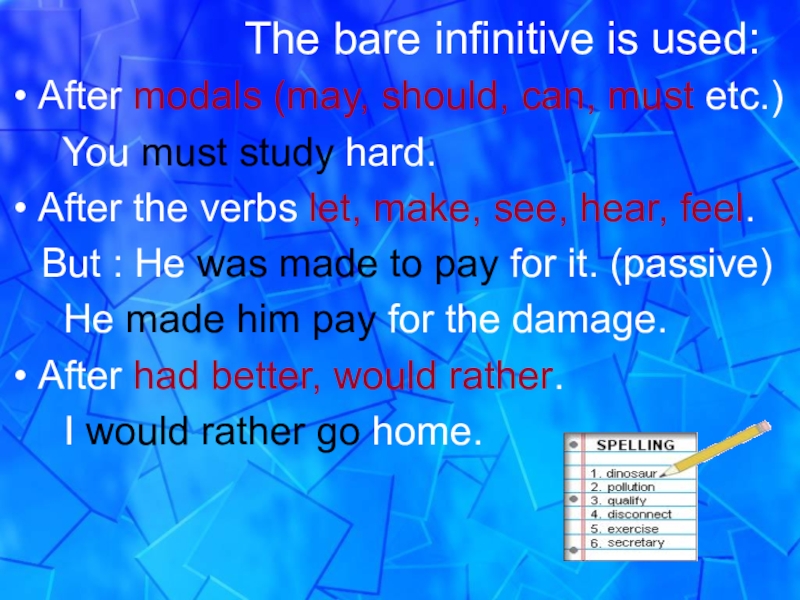
Слайд 6The bare infinitive is used:
After modals (may, should, can, must etc.)
After the verbs let, make, see, hear, feel.
But : He was made to pay for it. (passive)
He made him pay for the damage.
After had better, would rather.
I would rather go home.
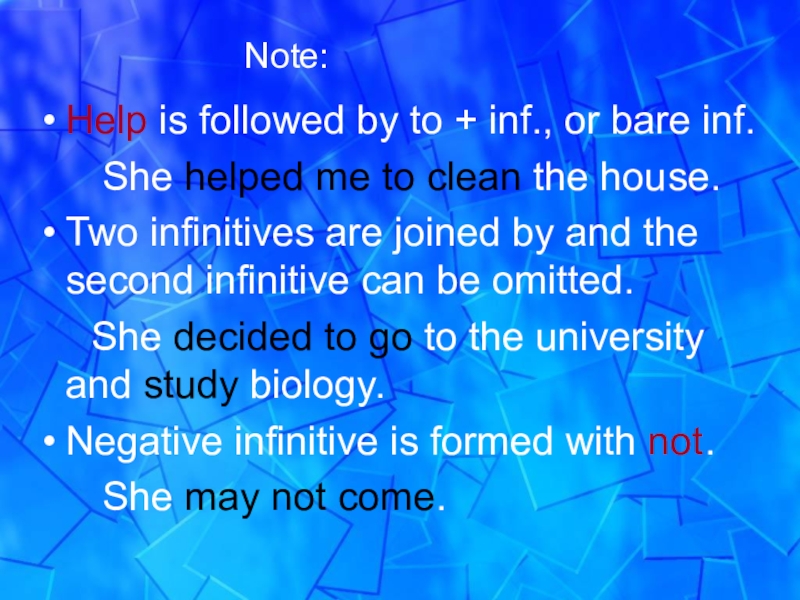
Слайд 7Note:
Help is followed by to + inf., or bare inf.
Two infinitives are joined by and the second infinitive can be omitted.
She decided to go to the university and study biology.
Negative infinitive is formed with not.
She may not come.
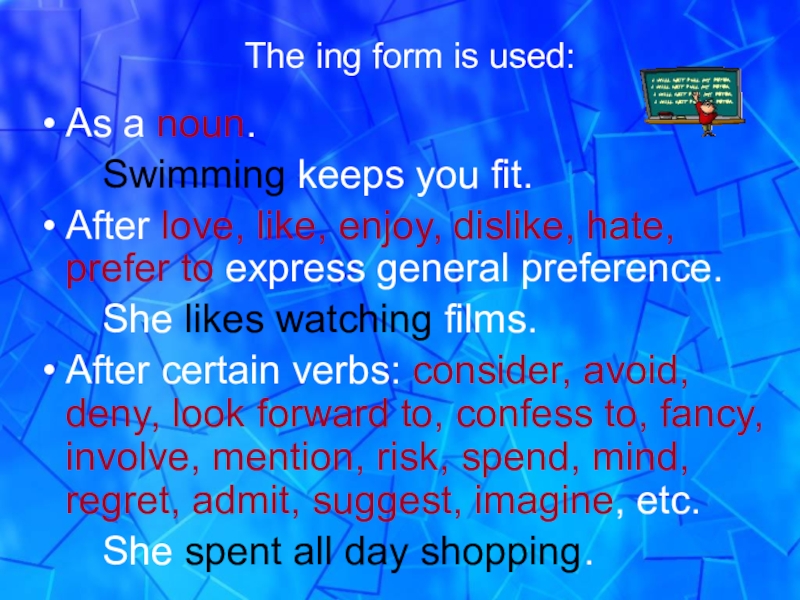
Слайд 8The ing form is used:
As a noun.
Swimming keeps
After love, like, enjoy, dislike, hate, prefer to express general preference.
She likes watching films.
After certain verbs: consider, avoid, deny, look forward to, confess to, fancy, involve, mention, risk, spend, mind, regret, admit, suggest, imagine, etc.
She spent all day shopping.
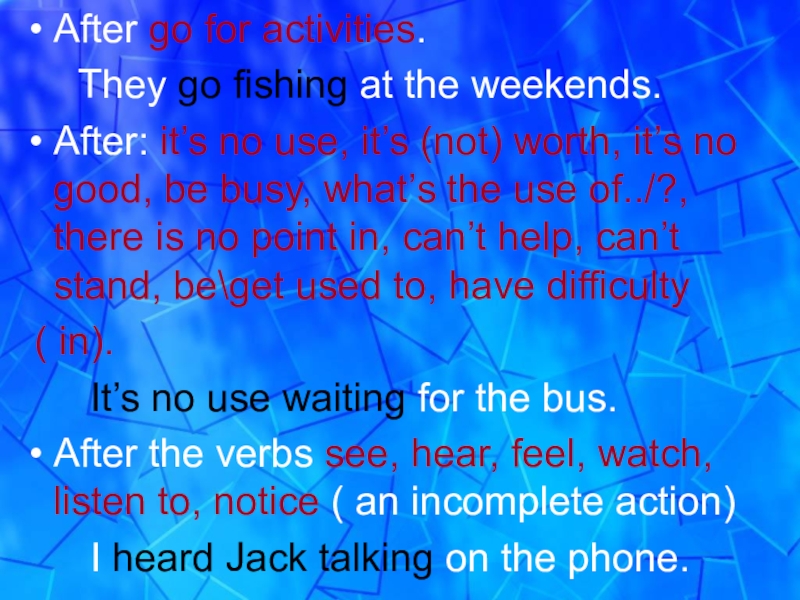
Слайд 9After go for activities.
They go fishing at the
After: it’s no use, it’s (not) worth, it’s no good, be busy, what’s the use of../?, there is no point in, can’t help, can’t stand, be\get used to, have difficulty
( in).
It’s no use waiting for the bus.
After the verbs see, hear, feel, watch, listen to, notice ( an incomplete action)
I heard Jack talking on the phone.
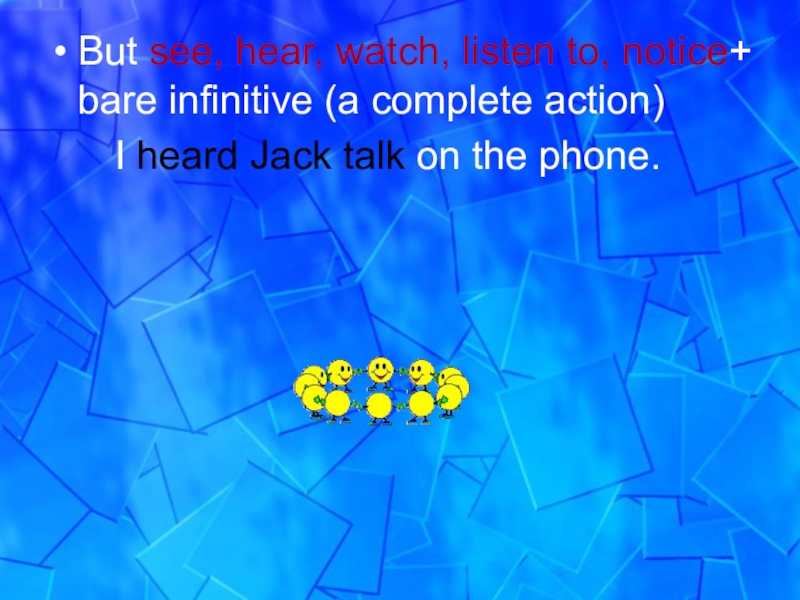
Слайд 10But see, hear, watch, listen to, notice+ bare infinitive (a complete
I heard Jack talk on the phone.
Слайд 11To-infinitive or the – ing form without change in meaning
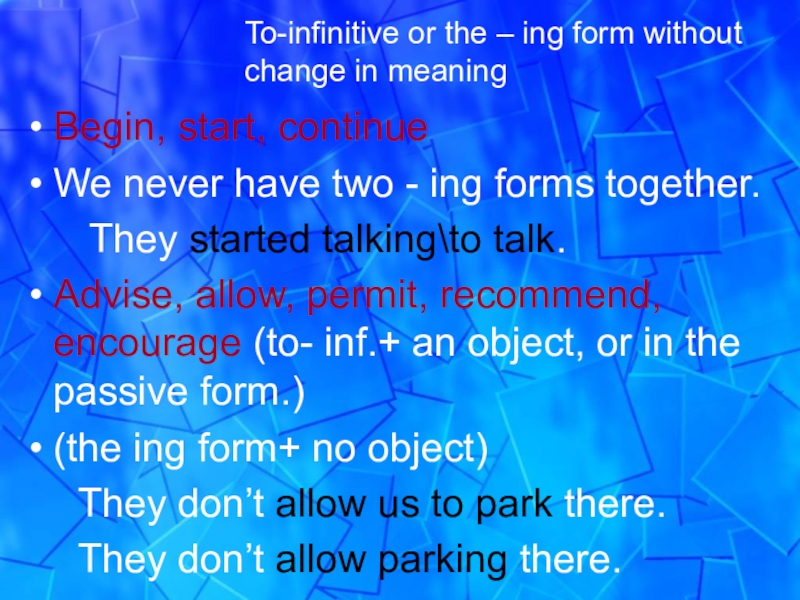
Begin, start,
We never have two - ing forms together.
They started talking\to talk.
Advise, allow, permit, recommend, encourage (to- inf.+ an object, or in the passive form.)
(the ing form+ no object)
They don’t allow us to park there.
They don’t allow parking there.
Слайд 12Need\ require\want + ing form
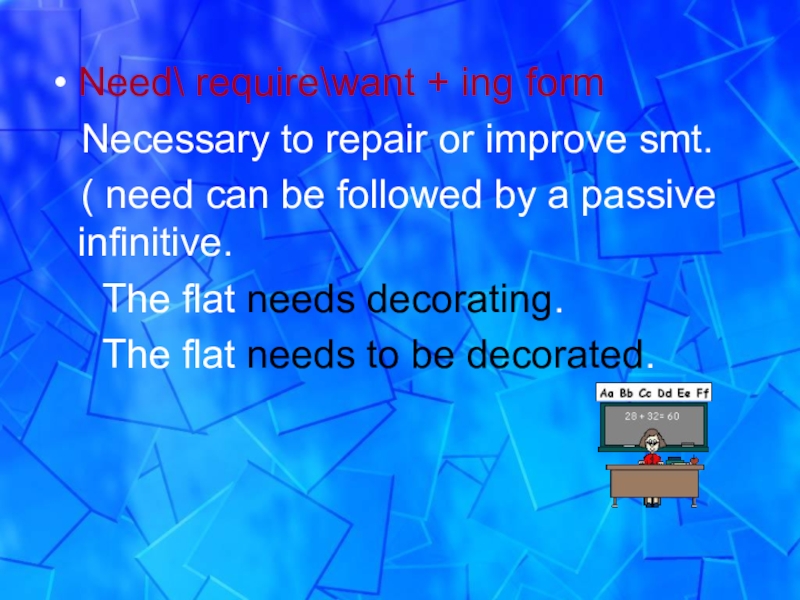
Necessary to repair or improve
( need can be followed by a passive infinitive.
The flat needs decorating.
The flat needs to be decorated.
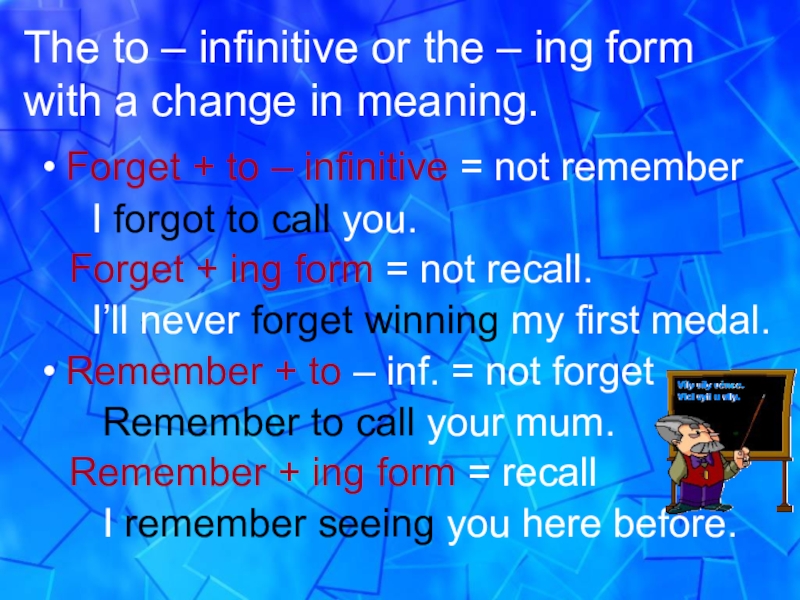
Слайд 13The to – infinitive or the – ing form with a
Forget + to – infinitive = not remember
I forgot to call you.
Forget + ing form = not recall.
I’ll never forget winning my first medal.
Remember + to – inf. = not forget
Remember to call your mum.
Remember + ing form = recall
I remember seeing you here before.
Слайд 14Go on + to – inf. = then
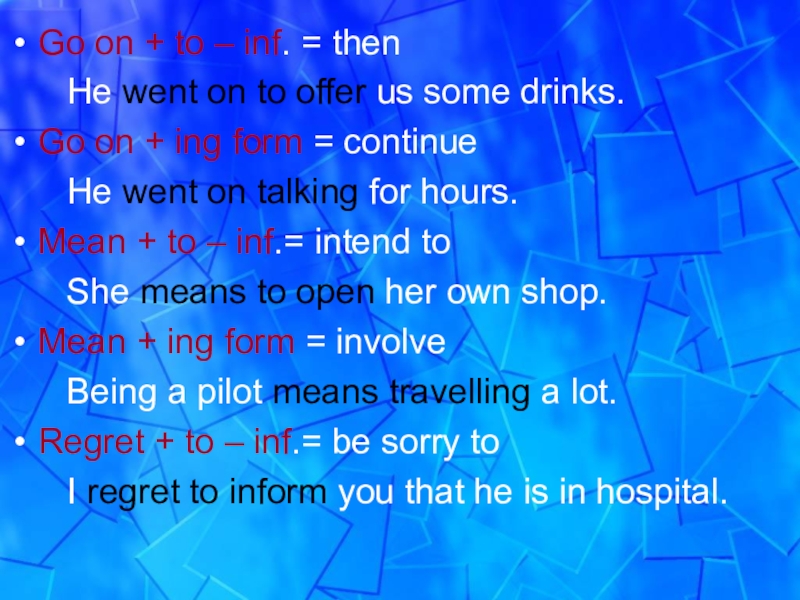
He
Go on + ing form = continue
He went on talking for hours.
Mean + to – inf.= intend to
She means to open her own shop.
Mean + ing form = involve
Being a pilot means travelling a lot.
Regret + to – inf.= be sorry to
I regret to inform you that he is in hospital.
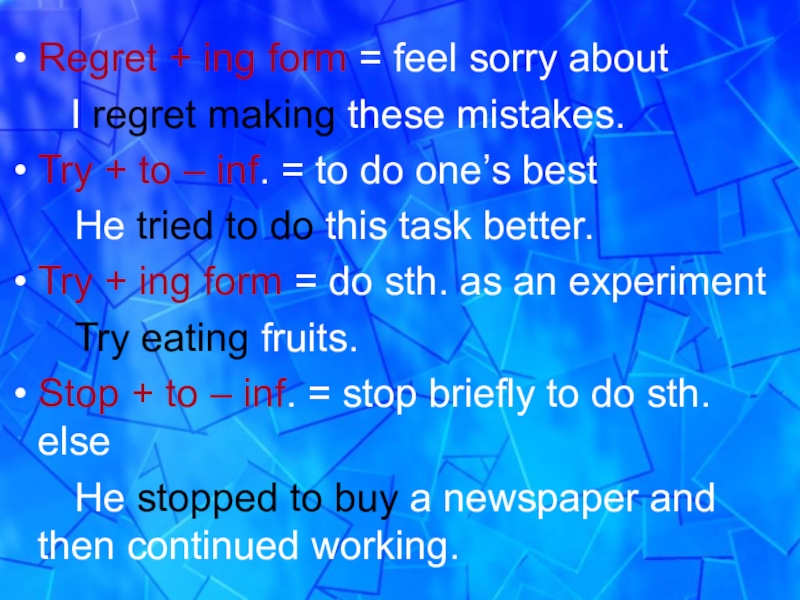
Слайд 15Regret + ing form = feel sorry about
I regret making
Try + to – inf. = to do one’s best
He tried to do this task better.
Try + ing form = do sth. as an experiment
Try eating fruits.
Stop + to – inf. = stop briefly to do sth. else
He stopped to buy a newspaper and then continued working.
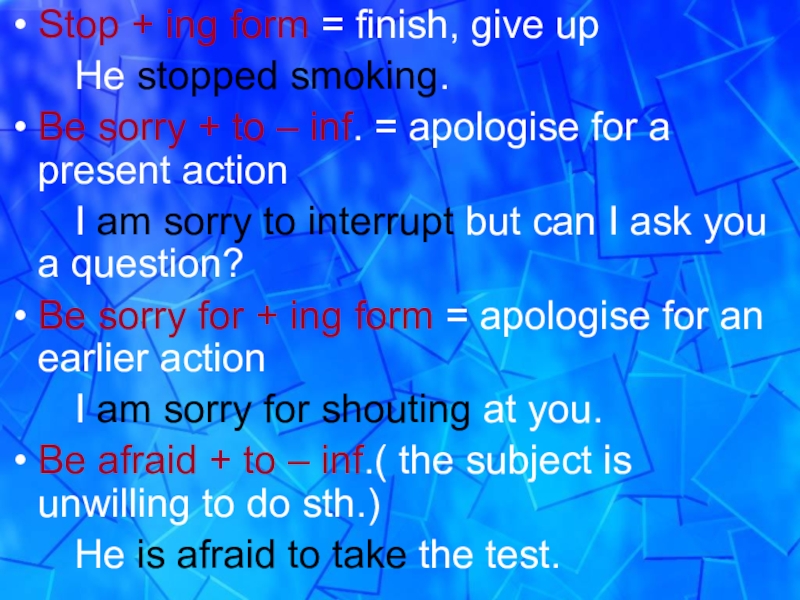
Слайд 16Stop + ing form = finish, give up
He
Be sorry + to – inf. = apologise for a present action
I am sorry to interrupt but can I ask you a question?
Be sorry for + ing form = apologise for an earlier action
I am sorry for shouting at you.
Be afraid + to – inf.( the subject is unwilling to do sth.)
He is afraid to take the test.
Слайд 17Be afraid of + ing form = ( the subject is
She doesn’t want to ride the horse.
She is afraid of falling and hurting herself.
Слайд 18Put the verbs in brackets into the correct infinitive form or
Dear Jessica,
How are you? I’m busy 1)…(study) for my exam which is next week, but I’ve decided 2)…(take) a break and 3)…(write) you a letter. 4)…(read) so many notes and 5)…(learn) so many facts is making me very tired, I can’t wait 6)…(finish) my course! Then, I can start 7)…(look) for a good job.
Sophie started her new job last month, 8)…(work) at the hospital suits her – she loves 9)…(look) after people. She hopes 10)…(stay) in this job for a couple of years and then she intends 11)…(try) for a promotion.
Слайд 19 By the way, how are you getting on
Anyway, I’ve got to go now. Write soon and tell me your news, won’t you?
Best wishes,
Maggie
Слайд 20Dear Jessica,
How are you? I’m busy 1)studying
Sophie started her new job last month, 8)working at the hospital suits her – she loves 9)looking after people. She hopes 10)to stay in this job for a couple of years and then she intends 11)to try for a promotion
Слайд 21By the way, how are you getting on now that you
Anyway, I’ve got to go now. Write soon and tell me your news, won’t you?
Best wishes,
Maggie