- Главная
- Разное
- Образование
- Спорт
- Естествознание
- Природоведение
- Религиоведение
- Французский язык
- Черчение
- Английский язык
- Астрономия
- Алгебра
- Биология
- География
- Геометрия
- Детские презентации
- Информатика
- История
- Литература
- Математика
- Музыка
- МХК
- Немецкий язык
- ОБЖ
- Обществознание
- Окружающий мир
- Педагогика
- Русский язык
- Технология
- Физика
- Философия
- Химия
- Шаблоны, фоны, картинки для презентаций
- Экология
- Экономика
Презентация, доклад по английскомц языку The History Of thePeriodic Table
Содержание
- 1. Презентация по английскомц языку The History Of thePeriodic Table
- 2. The table is a visual representation of
- 3. Elemental ideas from ancient timesPeople have known
- 4. The notion that there were a limited
- 5. Hennig Brand was the first person recorded
- 6. Robert Boyle rediscovered phosphorus and it
- 7. Antoine Laurent de LavoisierAntoine Laurent de Lavoisier
- 8. DmitrY Ivanovich Mendeleev D.I. Mendeleev was
- 9. Dmitri Mendeleev, a Russian chemist, was the
- 10. On March 6, 1869, a formal presentation
- 11. There is a story of how D.I.
- 12. Scientific benefits of Mendeleev's tableMendeleev predicted the
- 13. Shortcomings of Mendeleev's tableHis table did not
- 14. Main discovery periodsThe history of the periodic
- 15. A number of places and objects are
- 16. Thank you for your attention!
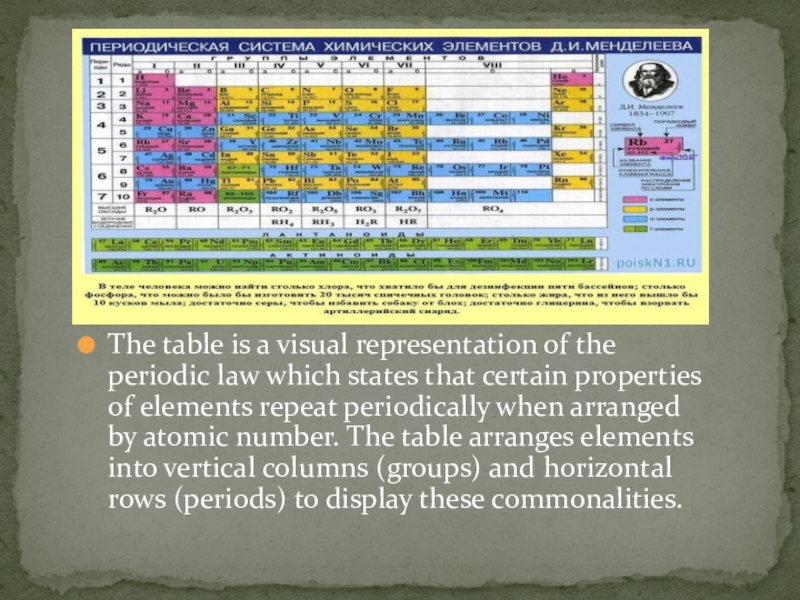
The table is a visual representation of the periodic law which states that certain properties of elements repeat periodically when arranged by atomic number. The table arranges elements into vertical columns (groups) and horizontal rows (periods)
Слайд 2The table is a visual representation of the periodic law which
states that certain properties of elements repeat periodically when arranged by atomic number. The table arranges elements into vertical columns (groups) and horizontal rows (periods) to display these commonalities.
Слайд 3Elemental ideas from ancient times
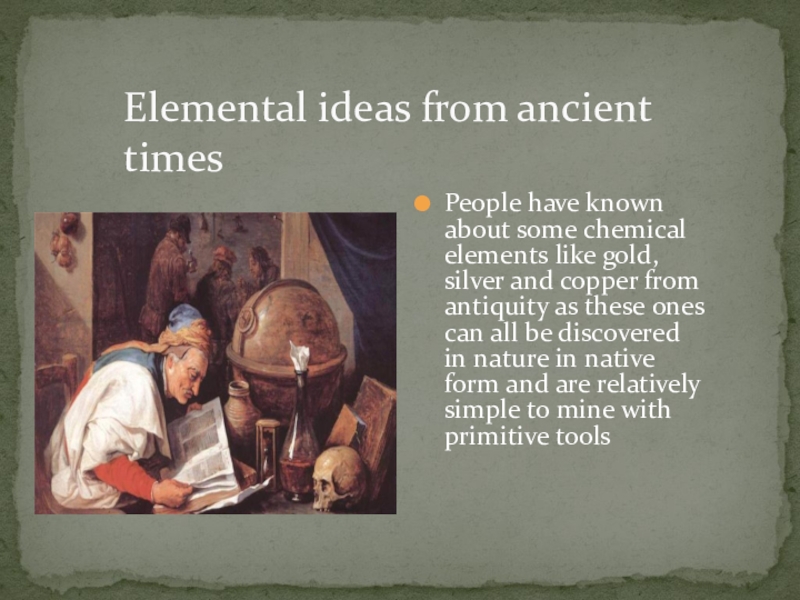
People have known about some chemical elements
like gold, silver and copper from antiquity as these ones can all be discovered in nature in native form and are relatively simple to mine with primitive tools
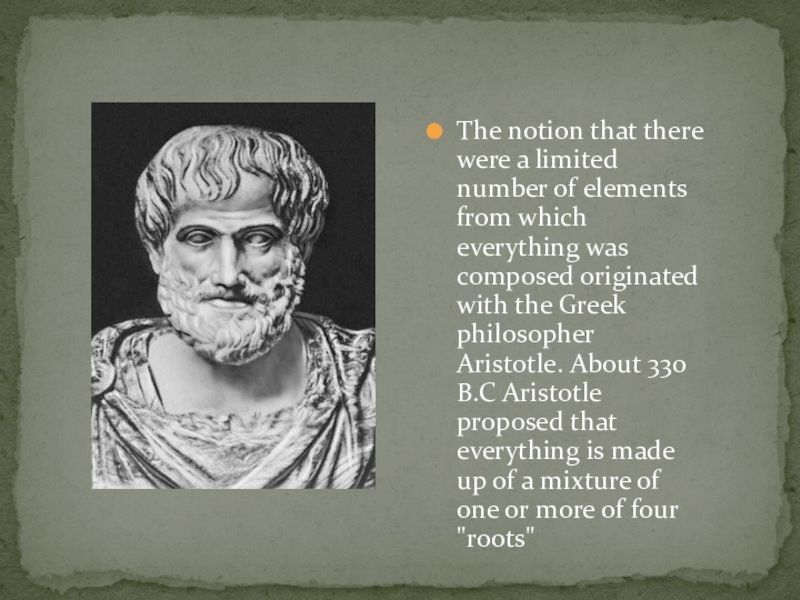
Слайд 4The notion that there were a limited number of elements from
which everything was composed originated with the Greek philosopher Aristotle. About 330 B.C Aristotle proposed that everything is made up of a mixture of one or more of four "roots"
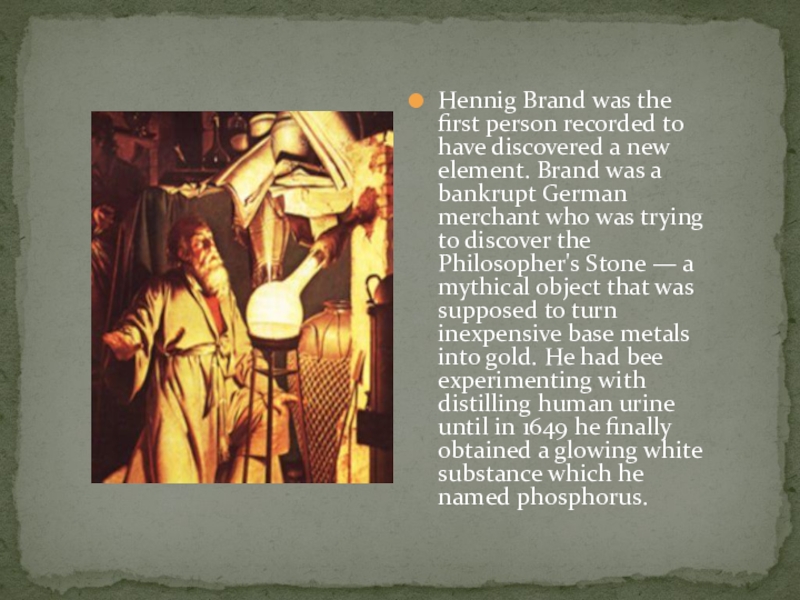
Слайд 5Hennig Brand was the first person recorded to have discovered a
new element. Brand was a bankrupt German merchant who was trying to discover the Philosopher's Stone — a mythical object that was supposed to turn inexpensive base metals into gold. He had bee experimenting with distilling human urine until in 1649 he finally obtained a glowing white substance which he named phosphorus.
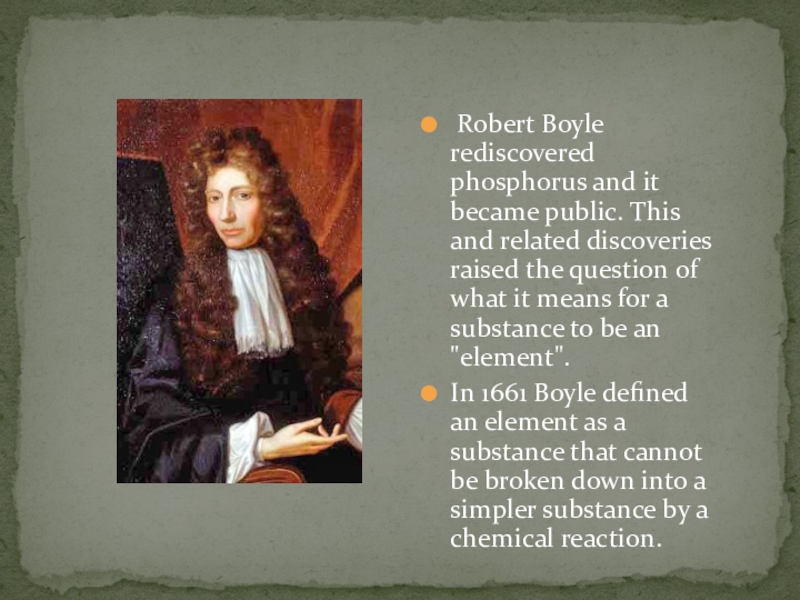
Слайд 6 Robert Boyle rediscovered phosphorus and it became public. This and
related discoveries raised the question of what it means for a substance to be an "element".
In 1661 Boyle defined an element as a substance that cannot be broken down into a simpler substance by a chemical reaction.
In 1661 Boyle defined an element as a substance that cannot be broken down into a simpler substance by a chemical reaction.
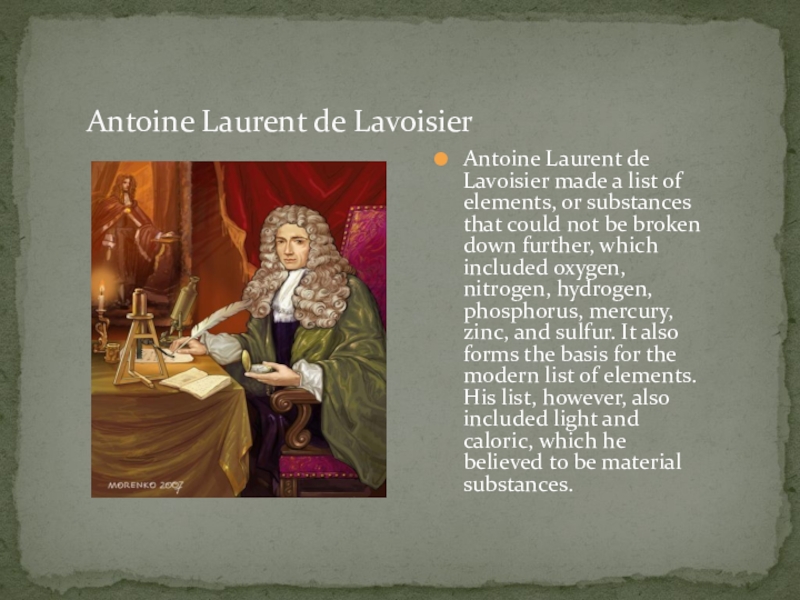
Слайд 7Antoine Laurent de Lavoisier
Antoine Laurent de Lavoisier made a list of
elements, or substances that could not be broken down further, which included oxygen, nitrogen, hydrogen, phosphorus, mercury, zinc, and sulfur. It also forms the basis for the modern list of elements. His list, however, also included light and caloric, which he believed to be material substances.
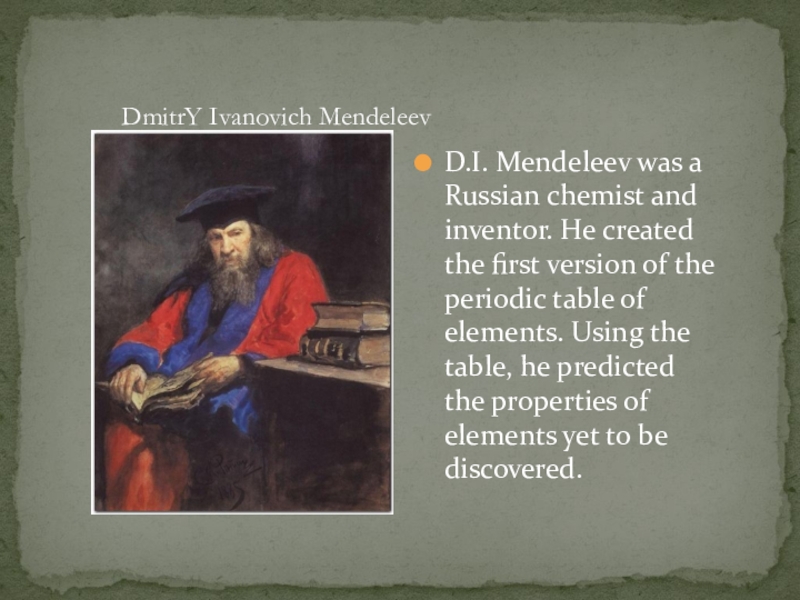
Слайд 8DmitrY Ivanovich Mendeleev
D.I. Mendeleev was a Russian chemist and inventor. He
created the first version of the periodic table of elements. Using the table, he predicted the properties of elements yet to be discovered.
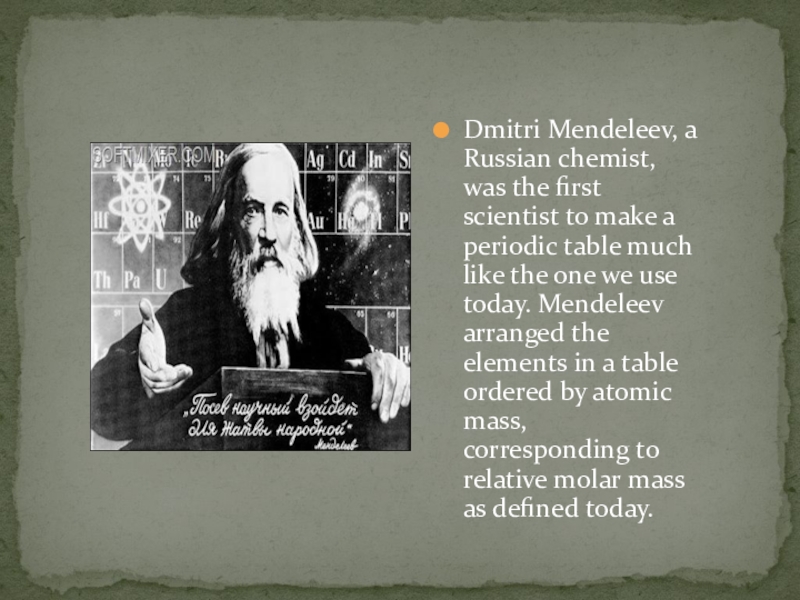
Слайд 9Dmitri Mendeleev, a Russian chemist, was the first scientist to make
a periodic table much like the one we use today. Mendeleev arranged the elements in a table ordered by atomic mass, corresponding to relative molar mass as defined today.
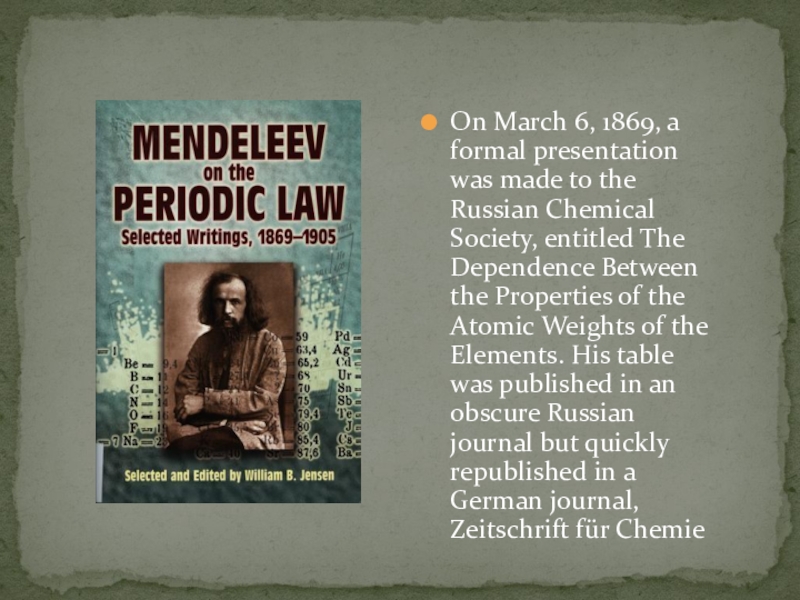
Слайд 10On March 6, 1869, a formal presentation was made to the
Russian Chemical Society, entitled The Dependence Between the Properties of the Atomic Weights of the Elements. His table was published in an obscure Russian journal but quickly republished in a German journal, Zeitschrift für Chemie
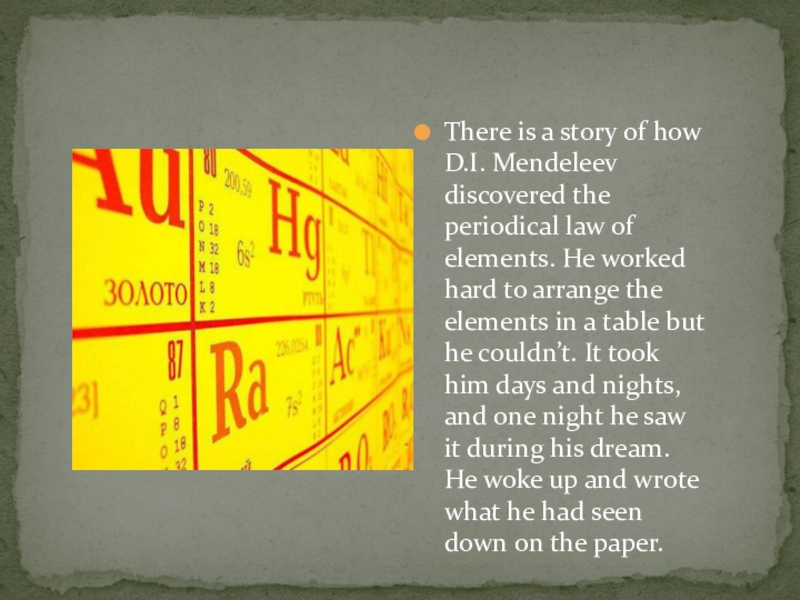
Слайд 11There is a story of how D.I. Mendeleev discovered the periodical
law of elements. He worked hard to arrange the elements in a table but he couldn’t. It took him days and nights, and one night he saw it during his dream. He woke up and wrote what he had seen down on the paper.
Слайд 12Scientific benefits of Mendeleev's table
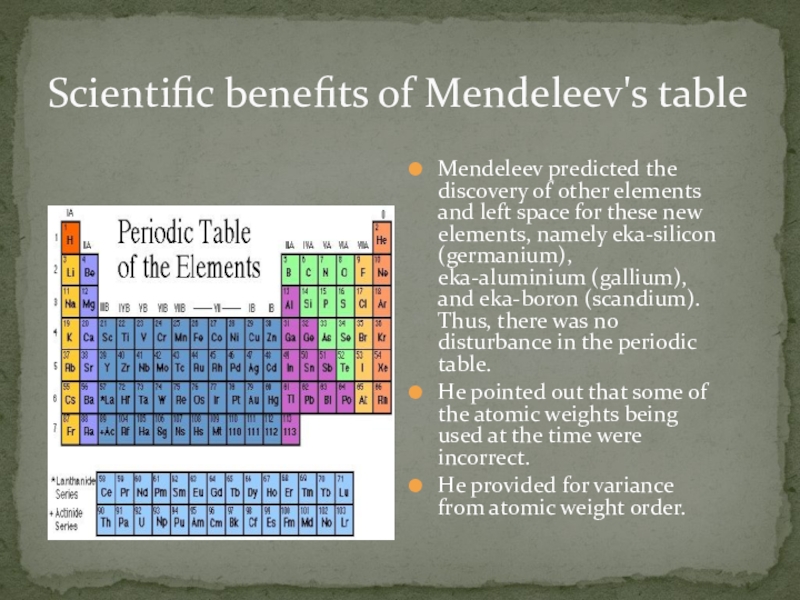
Mendeleev predicted the discovery of other elements
and left space for these new elements, namely eka-silicon (germanium), eka-aluminium (gallium), and eka-boron (scandium). Thus, there was no disturbance in the periodic table.
He pointed out that some of the atomic weights being used at the time were incorrect.
He provided for variance from atomic weight order.
He pointed out that some of the atomic weights being used at the time were incorrect.
He provided for variance from atomic weight order.
Слайд 13Shortcomings of Mendeleev's table
His table did not include any of the
noble gases, which were discovered later. These were added by Sir William Ramsay as Group 0, without any disturbance to the basic concept of the periodic table.
A single position could not be assigned to hydrogen in the periodic table. Hydrogen could be placed in the alkali metals group as well as in the halogens group.
A single position could not be assigned to hydrogen in the periodic table. Hydrogen could be placed in the alkali metals group as well as in the halogens group.
Слайд 14Main discovery periods
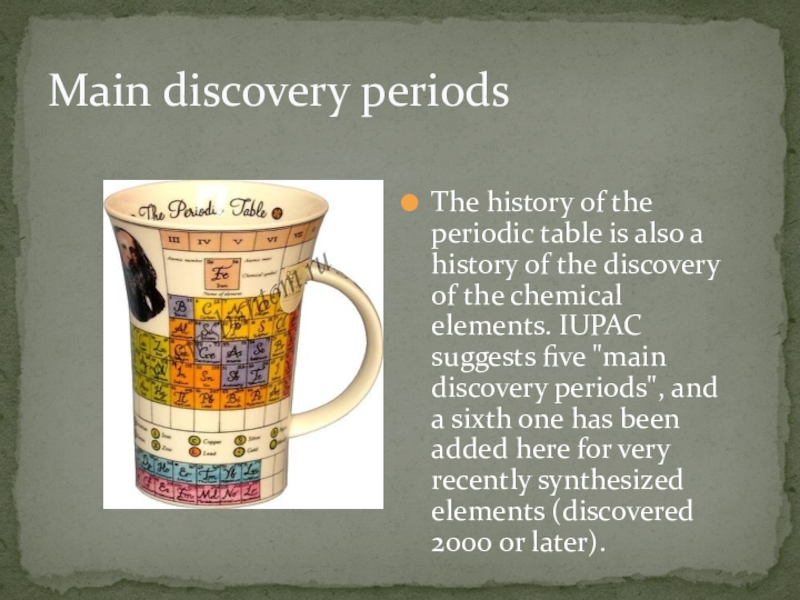
The history of the periodic table is also a
history of the discovery of the chemical elements. IUPAC suggests five "main discovery periods", and a sixth one has been added here for very recently synthesized elements (discovered 2000 or later).
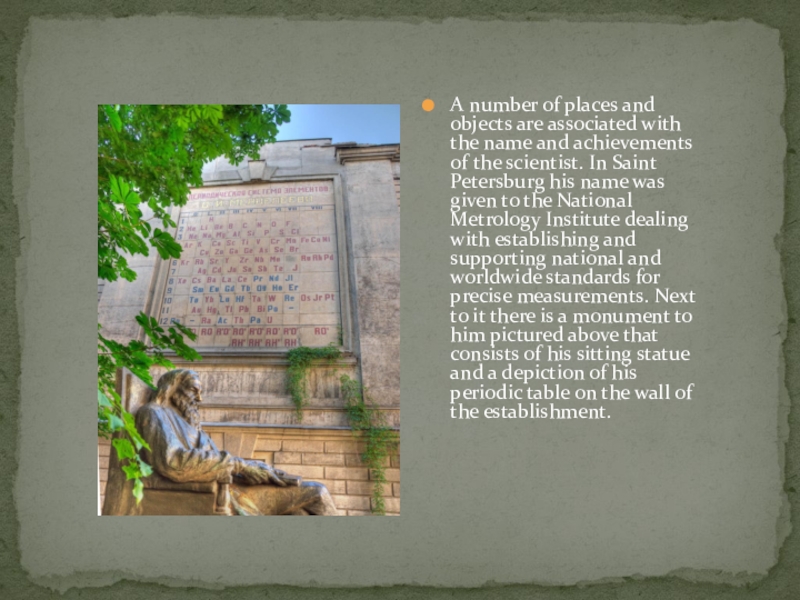
Слайд 15A number of places and objects are associated with the name
and achievements of the scientist. In Saint Petersburg his name was given to the National Metrology Institute dealing with establishing and supporting national and worldwide standards for precise measurements. Next to it there is a monument to him pictured above that consists of his sitting statue and a depiction of his periodic table on the wall of the establishment.