- Главная
- Разное
- Образование
- Спорт
- Естествознание
- Природоведение
- Религиоведение
- Французский язык
- Черчение
- Английский язык
- Астрономия
- Алгебра
- Биология
- География
- Геометрия
- Детские презентации
- Информатика
- История
- Литература
- Математика
- Музыка
- МХК
- Немецкий язык
- ОБЖ
- Обществознание
- Окружающий мир
- Педагогика
- Русский язык
- Технология
- Физика
- Философия
- Химия
- Шаблоны, фоны, картинки для презентаций
- Экология
- Экономика
Презентация, доклад по англ. языку на тему Северная Ирландия
Содержание
- 1. Презентация по англ. языку на тему Северная Ирландия
- 2. Слайд 2
- 3. Northern Ireland consists of six
- 4. Northern Ireland consists of six
- 5. These counties are no longer used for
- 6. The region that is now Northern Ireland
- 7. Following the victory of 1691, a series
- 8. Climate The whole of Northern Ireland has
- 9. The damp climate and extensive deforestation in
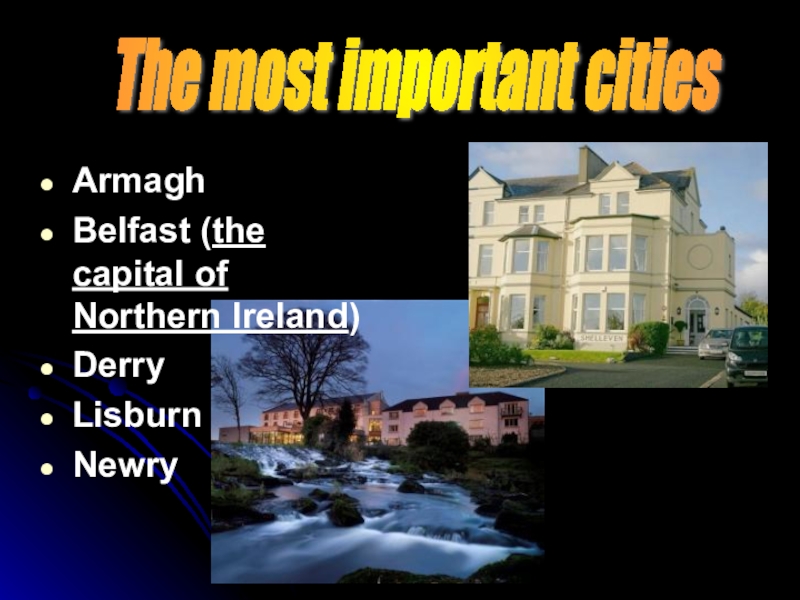
- 10. ArmaghBelfast (the capital of Northern Ireland)DerryLisburnNewryThe most important cities
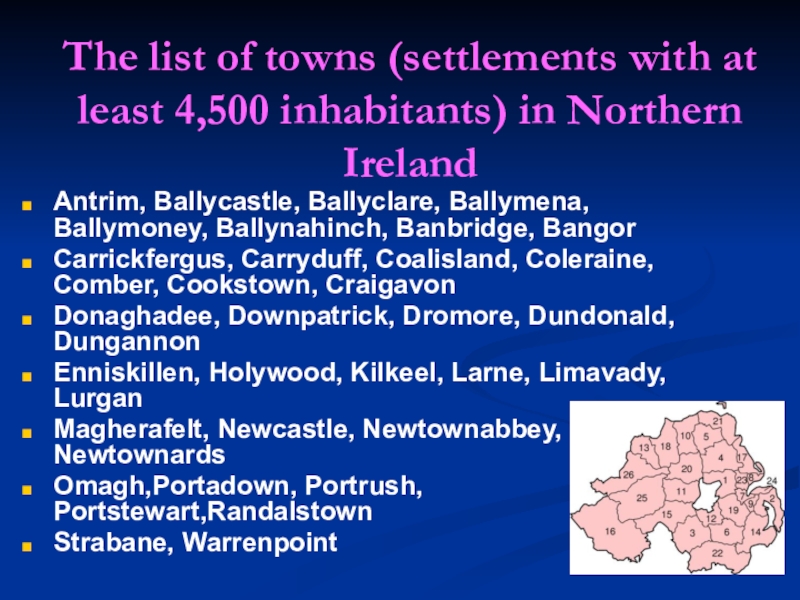
- 11. The list of towns (settlements with at
- 12. identified with non-Christian religions
- 13. The dialect of English spoken
- 14. Education in Northern Ireland differs slightly from
- 15. In Northern Ireland, sport is
- 16. Cricket is the fastest growing
- 17. Northern Ireland has a number of golf
- 18. Attractions include cultural festivals, musical and artistic
- 19. Photogallery
- 20. Слайд 20
- 21. Thanks for your attention!!!
Слайд 2
Northern Ireland
Слайд 3 Northern Ireland consists of six of the nine counties
the Irish province of Ulster. For over 50
years it had its own devolved
government and parliament.
Northern Ireland was for many years the site of a
violent and bitter ethno-political conflict — the
Troubles — which was caused by divisions between
nationalists, who are predominantly Roman
Catholic, and unionists, who are predominantly
Protestant. Unionists want Northern Ireland to
remain as a part of the United Kingdom, while
nationalists wish for it to be politically reunited with the rest of Ireland, independent of British rule. Since
the signing of the "Good Friday Agreement" in 1998, most of the paramilitary groups involved in the
Troubles have ceased their armed campaigns.
Слайд 4 Northern Ireland
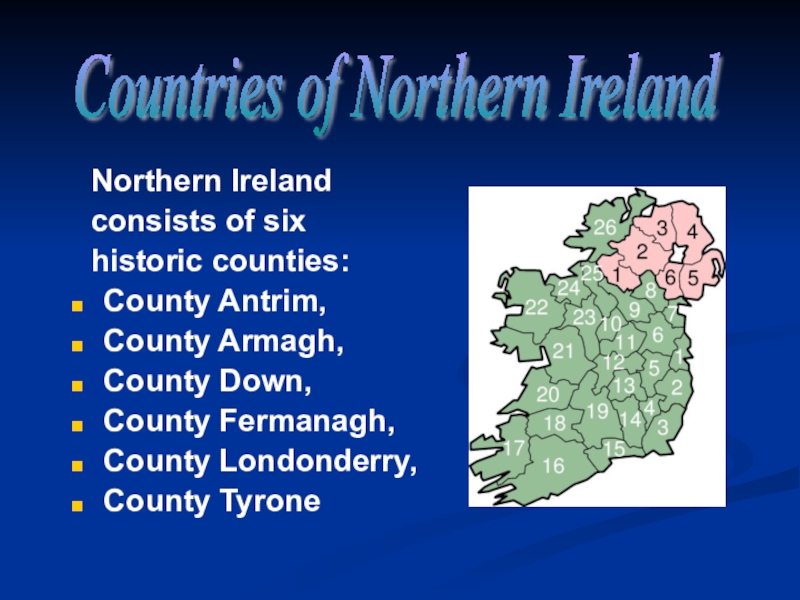
consists of six
historic counties:
County Antrim,
County Armagh,
County Down,
County Fermanagh,
County Londonderry,
County Tyrone
Countries of Northern Ireland
Слайд 5These counties are no longer used for local government purposes; instead
Fermanagh District Council most closely follows the borders of the county from which it takes its name. Coleraine Borough Council, on the other hand, derives its name from the town of Coleraine in County Londonderry.
Слайд 6The region that is now Northern Ireland served as the bedrock
The programmes of colonialism were intended as a means to extend English rule in Ireland. Following Irish defeat at the Battle of Kinsale, the region's Gaelic (and Roman Catholic) aristocracy fled to continental Europe in 1607 and the region became subject to major programmes of colonialism by Protestant English (mainly Anglican) and Scottish (mainly Presbyterian) settlers.
In Northern Ireland, the iconic victories of the Siege of Derry (1698) and the Battle of the Boyne (1690) in this latter war are still celebrated by the Unionist community (both Anglican and Presbyterian) today.
History of Northern Ireland
Слайд 7Following the victory of 1691, a series of laws intended to
The new state, formed in 1801, the United Kingdom of Great Britain and Ireland, was governed from a single government and parliament based in London.
Between 1717 and 1775 some 250,000 people from Ulster immigrated to the American colonies. It is estimated that there are more than 27 million descendants of the Scots-Irish migration now living in the U.S.
Слайд 8Climate
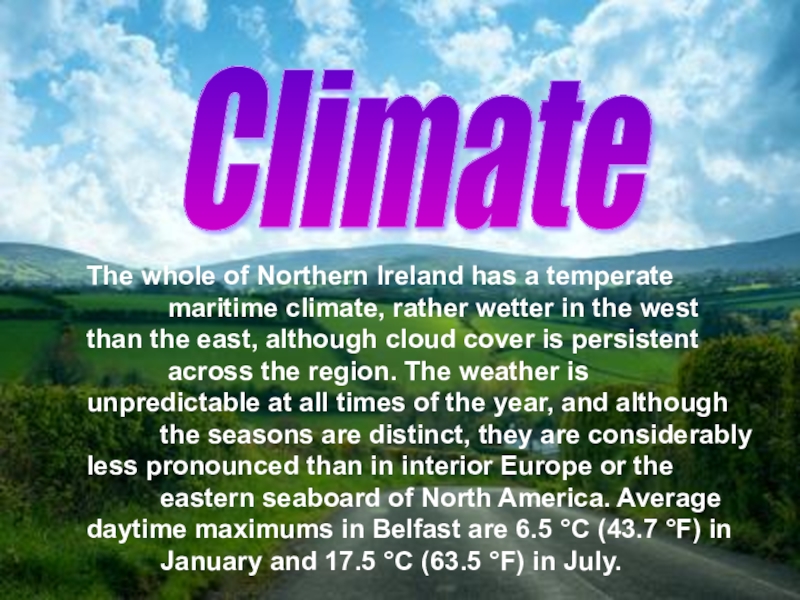
The whole of Northern Ireland has a temperate
across the region. The weather is unpredictable at all times of the year, and although
the seasons are distinct, they are considerably less pronounced than in interior Europe or the
eastern seaboard of North America. Average daytime maximums in Belfast are 6.5 °C (43.7 °F) in
January and 17.5 °C (63.5 °F) in July.
Слайд 9The damp climate and extensive deforestation in the 16th and 17th
Highest maximum temperature: 30.8 °C (87.4 °F) at Knockarevan, near Garrison, County Fermanagh on 30 June 1976 and at Belfast on 12 July 1983.
Lowest minimum temperature: −17.5 °C (0.5 °F) at Magherally, near Banbridge, County Down on 1 January 1979.
Слайд 11The list of towns (settlements with at least 4,500 inhabitants) in
Antrim, Ballycastle, Ballyclare, Ballymena, Ballymoney, Ballynahinch, Banbridge, Bangor
Carrickfergus, Carryduff, Coalisland, Coleraine, Comber, Cookstown, Craigavon
Donaghadee, Downpatrick, Dromore, Dundonald, Dungannon
Enniskillen, Holywood, Kilkeel, Larne, Limavady, Lurgan
Magherafelt, Newcastle, Newtownabbey, Newtownards
Omagh,Portadown, Portrush, Portstewart,Randalstown
Strabane, Warrenpoint
Слайд 12 identified with
non-Christian religions and 13.88% identified with
The population
The population of Northern Ireland was estimated as being 1,759,000 on 10 December 2008. In the 2001 census, 45.57% of the population identified as belonging to Protestant or other non-Catholic denominations, 40.26% identified as Catholic, 0.30%
Слайд 13
The dialect of English spoken in Northern Ireland shows
English is spoken as a first language by almost 100% of the Northern Irish population, though under the Good Friday Agreement, Irish and Ulster Scots (one of the dialects of the Scots language), sometimes known as Ullans, have recognition as "part of the cultural wealth of Northern Ireland".
The language
Слайд 14Education in Northern Ireland differs slightly from systems used elsewhere in
This system was due to be changed in 2008. The eleven plus has since been abolished with the majority of Grammar schools now holding their own entry test, Secondary pupils are not required to take such a test for entry.
Education
There are two main universities in Northern Ireland - The Queen's University of Belfast, and the University of Ulster.
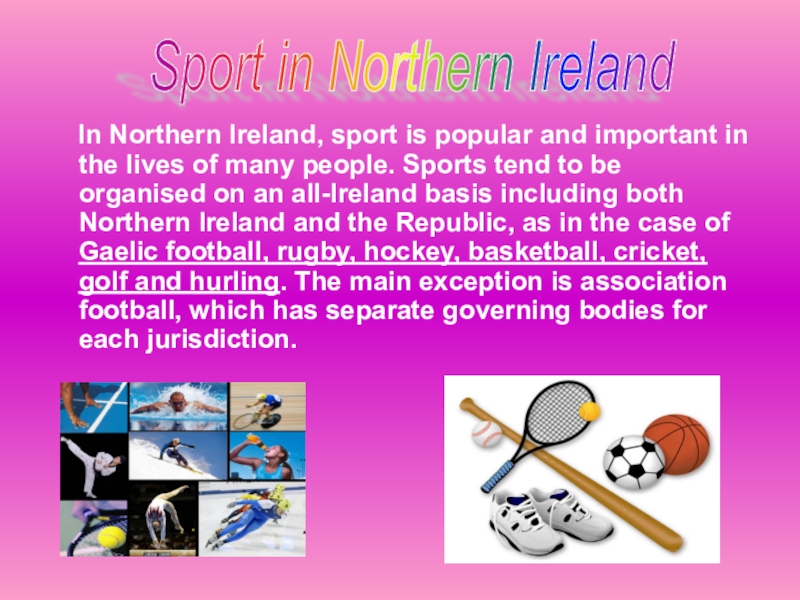
Слайд 15 In Northern Ireland, sport is popular and important in
Sport in Northern Ireland
Слайд 16
Cricket is the fastest growing sport in the country.
The Irish Football Association (IFA) is the organising body for association football in Northern Ireland.
Despite Northern Ireland's small population, its international team has had a number of notable successes, including World Cup quarter-final appearances in 1958 and 1982.
Football and cricket
Слайд 17Northern Ireland has a number of golf courses, such as the
Notable golfers include Darren Clarke, Fred Daly (winner of The Open in 1947), Graeme McDowell (winner of the U.S. Open in 2010, the first European since 1970) and Rory McIlroy.
Golf
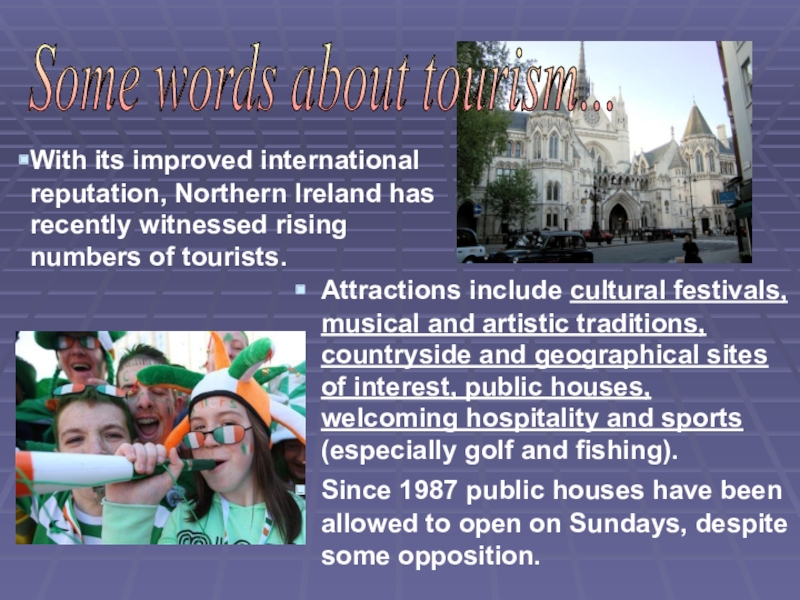
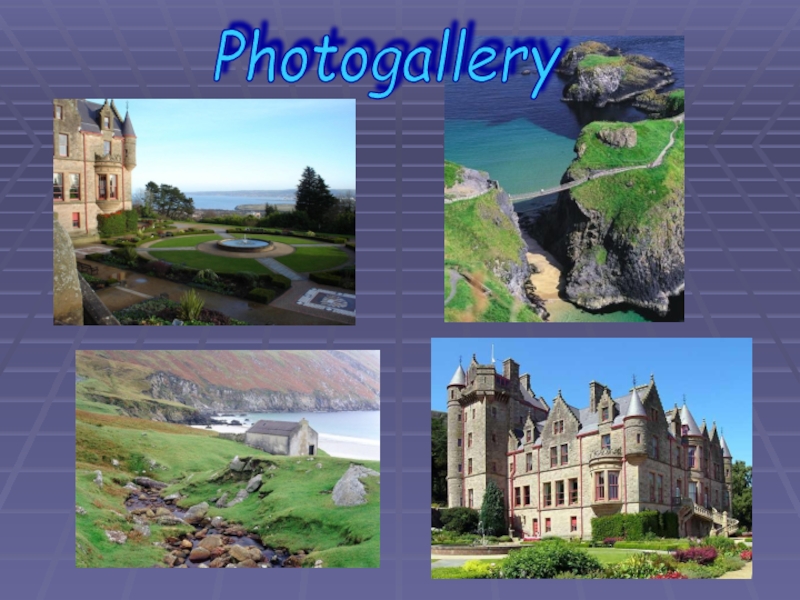
Слайд 18Attractions include cultural festivals, musical and artistic traditions, countryside and geographical
Since 1987 public houses have been allowed to open on Sundays, despite some opposition.
Some words about tourism...
With its improved international reputation, Northern Ireland has recently witnessed rising numbers of tourists.