- Главная
- Разное
- Образование
- Спорт
- Естествознание
- Природоведение
- Религиоведение
- Французский язык
- Черчение
- Английский язык
- Астрономия
- Алгебра
- Биология
- География
- Геометрия
- Детские презентации
- Информатика
- История
- Литература
- Математика
- Музыка
- МХК
- Немецкий язык
- ОБЖ
- Обществознание
- Окружающий мир
- Педагогика
- Русский язык
- Технология
- Физика
- Философия
- Химия
- Шаблоны, фоны, картинки для презентаций
- Экология
- Экономика
Презентация, доклад по англ. яз.на тему санкт-петербург(10кл)
Содержание
- 1. Презентация по англ. яз.на тему санкт-петербург(10кл)
- 2. The city was founded by Peter I in 1703.
- 3. NEVSKY PROSPEKTThe city’s main thoroughfare is borne
- 4. NEVSKY PROSPEKT
- 5. PETER AND PAUL FORTRESSFounded on 27 May
- 6. THE ADMIRALTY Founded in Peter I’s time
- 7. THE ADMIRALTY
- 8. PALACE SQUAREThe city’s central square and one
- 9. NEW HOLLANDThis complex is a monument of
- 10. THE BRONZE HORSEMAN. A monument to the city’s founder, Tsar Peter I
- 11. ST. ISAAC’S CATHEDRALOne of the world’s most
- 12. KAZAN CATHEDRAL. Built between 1801 and 1811
- 13. THE HERMITAGE.One of the world’s greatest museums.
- 14. RUSIAN MUSEUM. The largest museum of Russian
- 15. PETERHOF.Peterhof is 30 km to the West
- 16. peterhof
- 17. TSARSKOYE SELO.The town of Pushkin, which was
- 18. PAVLOVSK.Pavlovsk is 30 km south of St.
- 19. THE PRESENTATION WAS PREPARED BY Vaskina Elena
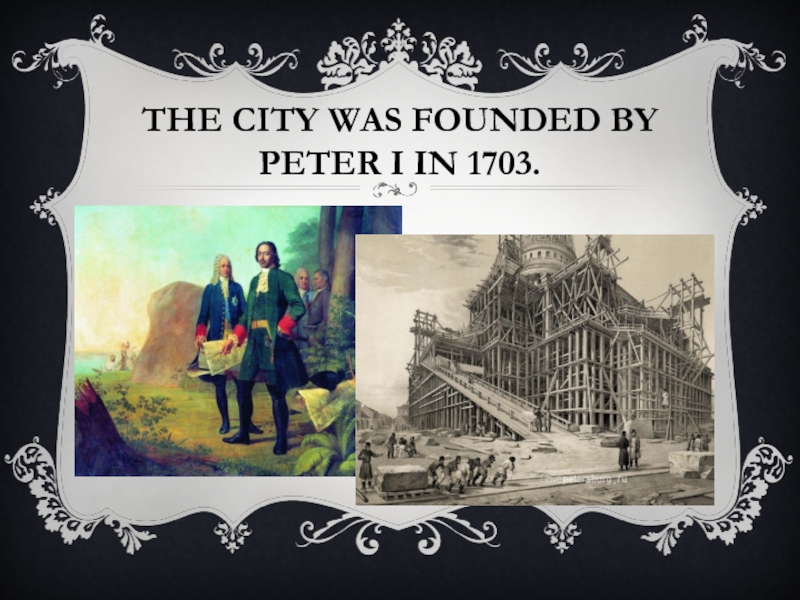
The city was founded by Peter I in 1703.
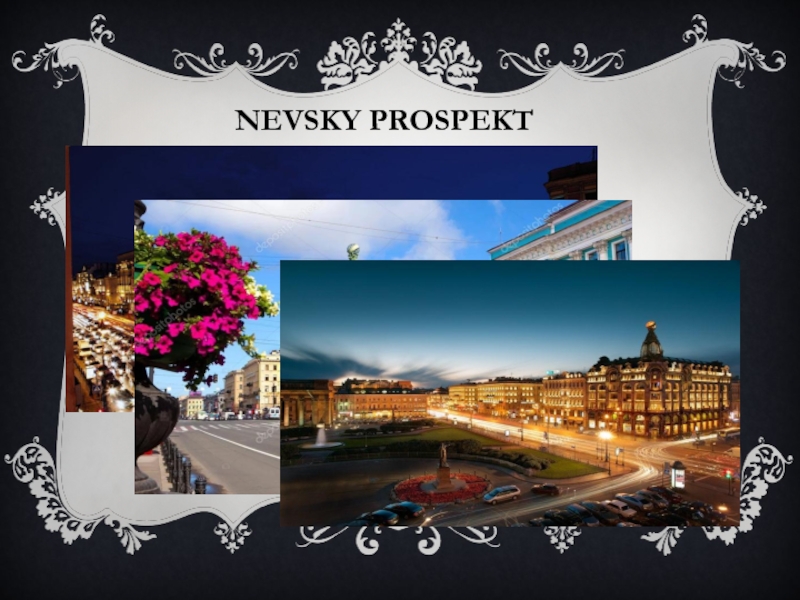
Слайд 3NEVSKY PROSPEKT
The city’s main thoroughfare is borne across a series of
islands: Admiralteysky Island – from Admiralteysky Prospekt to the Moika River, Kazansky Island – from the Moika to Griboyedov Canal, Spassky Island – from the Griboyedov Canal to the Fontanka River, and Bezymyanny Island – from the Fontanka to the Obvodny Canal, finishing up at Alexander Nevsky Square. It contains some splendid buildings – Gostiny Dvor, the Mikhailovsky Palace, the Alexandrinsky Theatre, Kazan Cathedral and the Public Library. Today it is one of the most beautiful streets in the world, containing the city’s best hotels, shops, restaurants and clubs. There are five Metro stations which serve Nevsky Prospekt: “Ploshchad Aleksandra Nevskogo”, “PloshchadVosstaniya”, “Mayakovskaya”, “Gostiny Dvor” and “Nevsky Prospeky”.
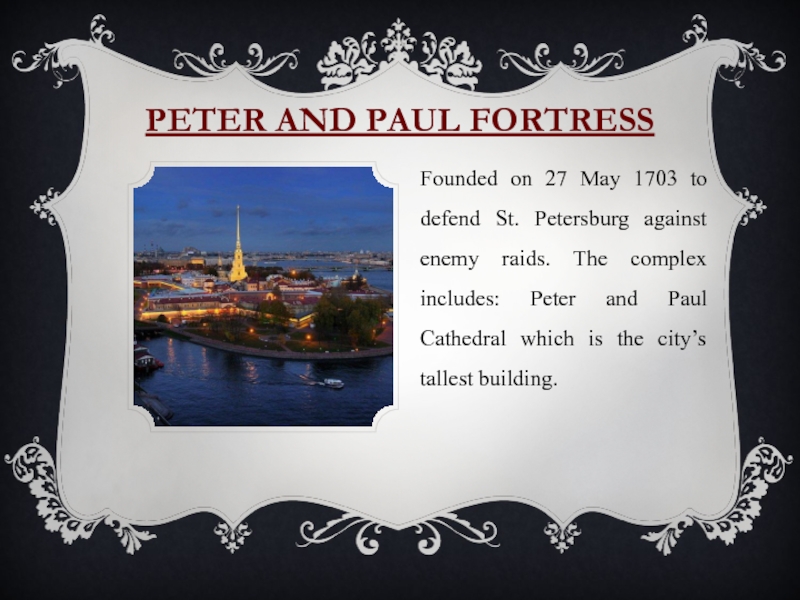
Слайд 5PETER AND PAUL FORTRESS
Founded on 27 May 1703 to defend St.
Petersburg against enemy raids. The complex includes: Peter and Paul Cathedral which is the city’s tallest building.
Слайд 6THE ADMIRALTY
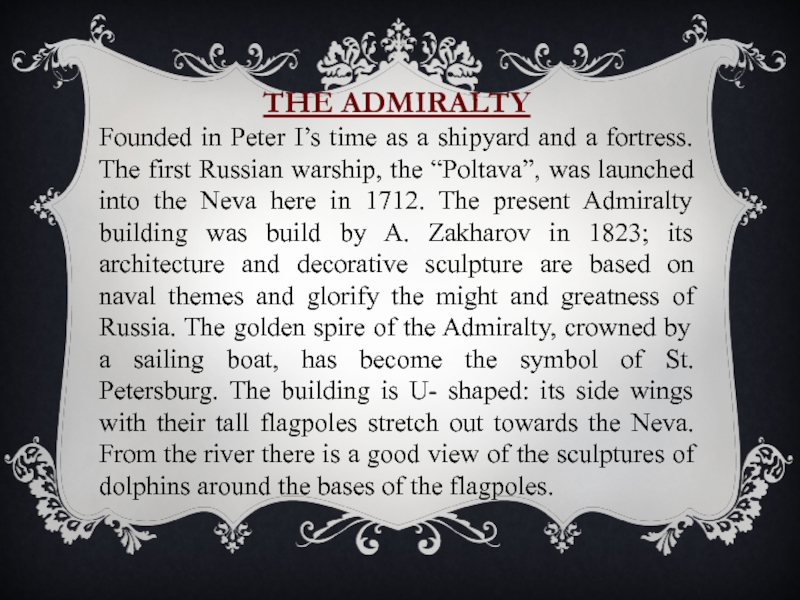
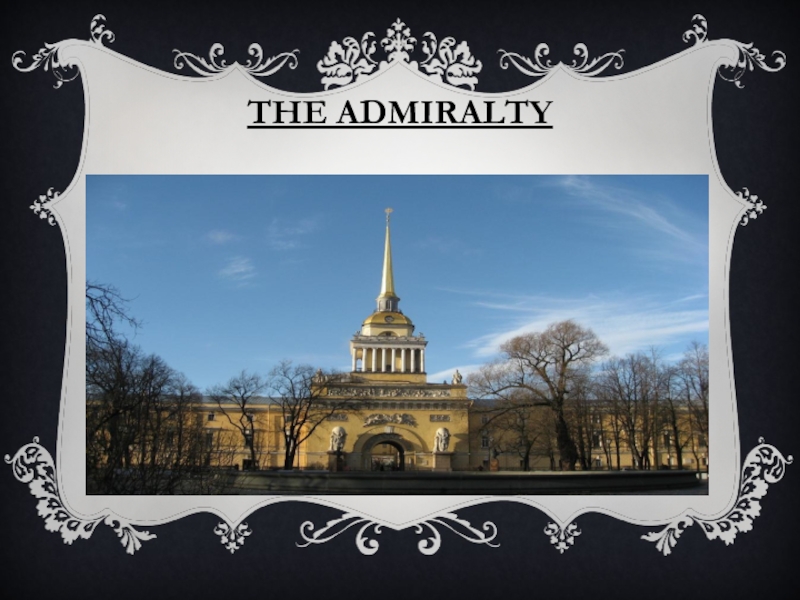
Founded in Peter I’s time as a shipyard and
a fortress. The first Russian warship, the “Poltava”, was launched into the Neva here in 1712. The present Admiralty building was build by A. Zakharov in 1823; its architecture and decorative sculpture are based on naval themes and glorify the might and greatness of Russia. The golden spire of the Admiralty, crowned by a sailing boat, has become the symbol of St. Petersburg. The building is U- shaped: its side wings with their tall flagpoles stretch out towards the Neva. From the river there is a good view of the sculptures of dolphins around the bases of the flagpoles.
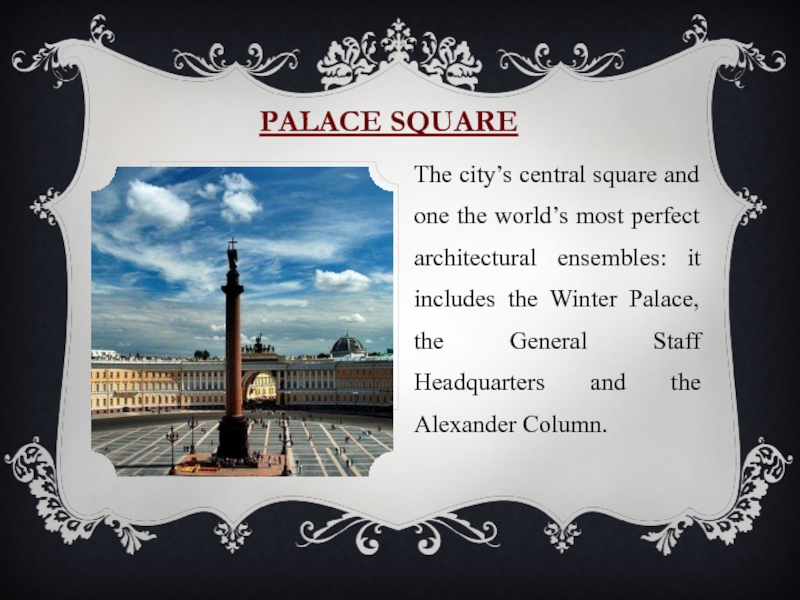
Слайд 8PALACE SQUARE
The city’s central square and one the world’s most perfect
architectural ensembles: it includes the Winter Palace, the General Staff Headquarters and the Alexander Column.
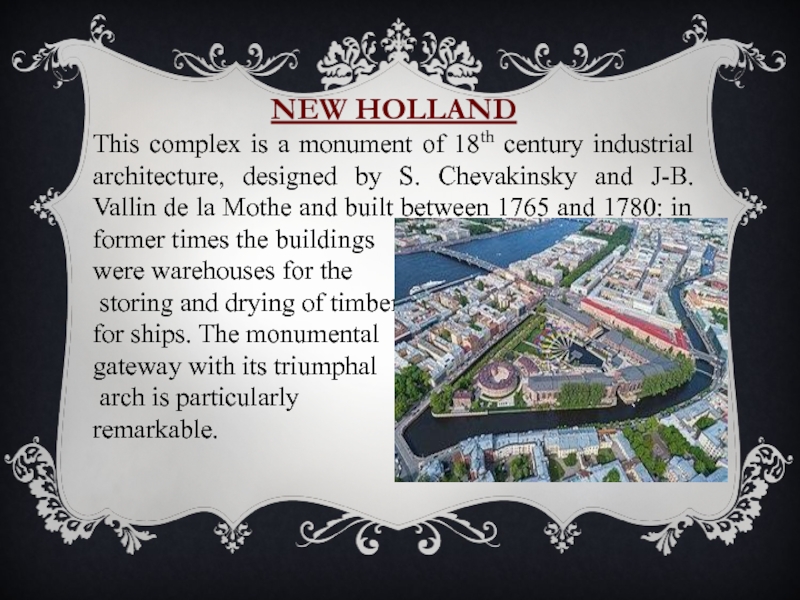
Слайд 9NEW HOLLAND
This complex is a monument of 18th century industrial architecture,
designed by S. Chevakinsky and J-B. Vallin de la Mothe and built between 1765 and 1780: in former times the buildings
were warehouses for the
storing and drying of timber
for ships. The monumental
gateway with its triumphal
arch is particularly
remarkable.
were warehouses for the
storing and drying of timber
for ships. The monumental
gateway with its triumphal
arch is particularly
remarkable.
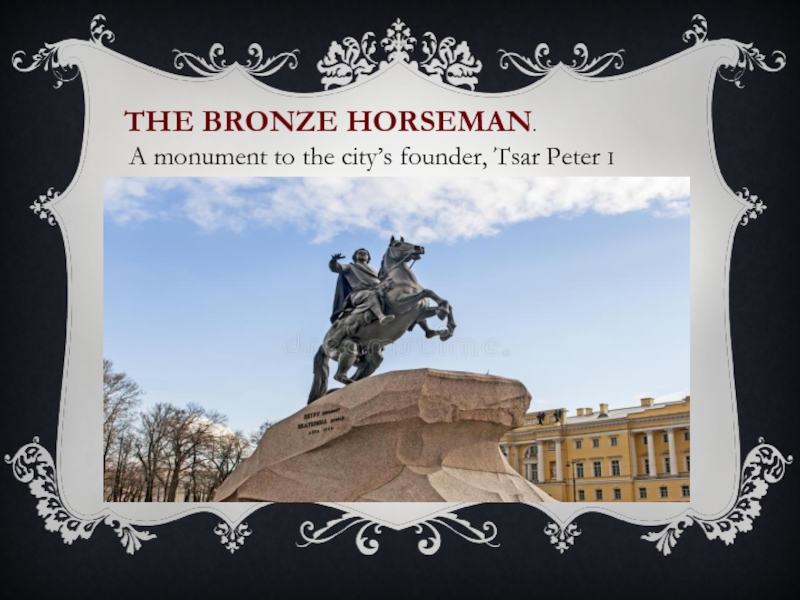
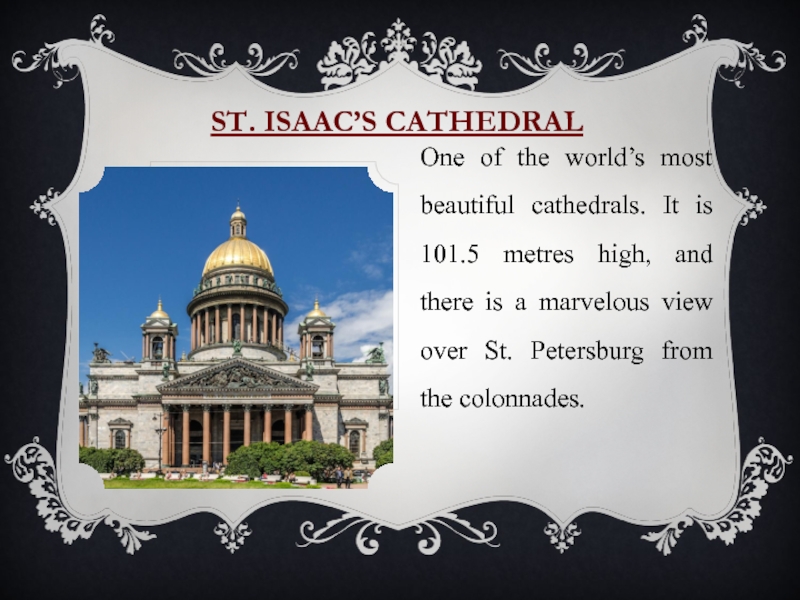
Слайд 11ST. ISAAC’S CATHEDRAL
One of the world’s most beautiful cathedrals. It is
101.5 metres high, and there is a marvelous view over St. Petersburg from the colonnades.
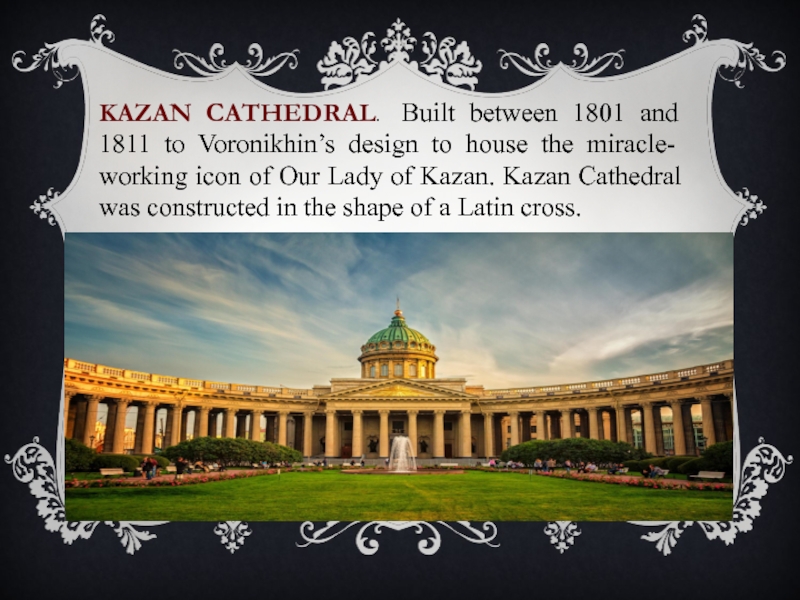
Слайд 12KAZAN CATHEDRAL. Built between 1801 and 1811 to Voronikhin’s design to
house the miracle- working icon of Our Lady of Kazan. Kazan Cathedral was constructed in the shape of a Latin cross.
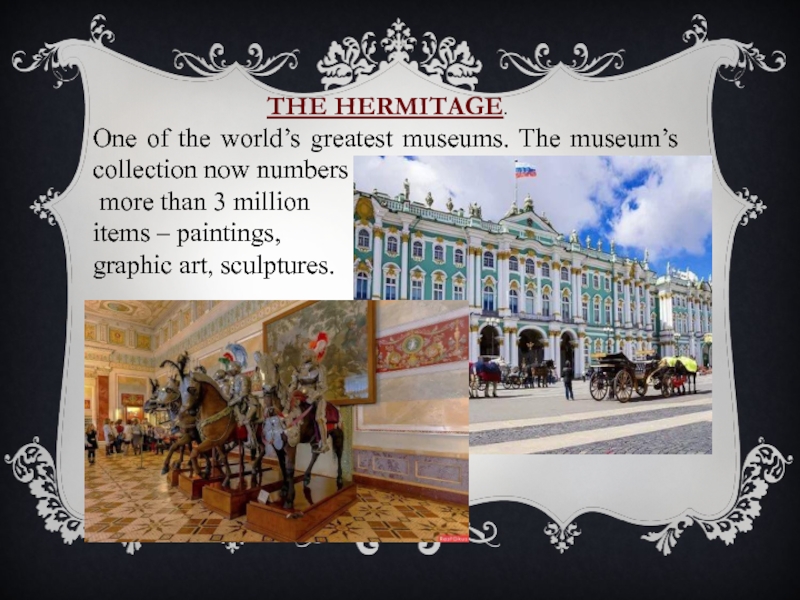
Слайд 13THE HERMITAGE.
One of the world’s greatest museums. The museum’s collection now
numbers
more than 3 million
items – paintings,
graphic art, sculptures.
more than 3 million
items – paintings,
graphic art, sculptures.
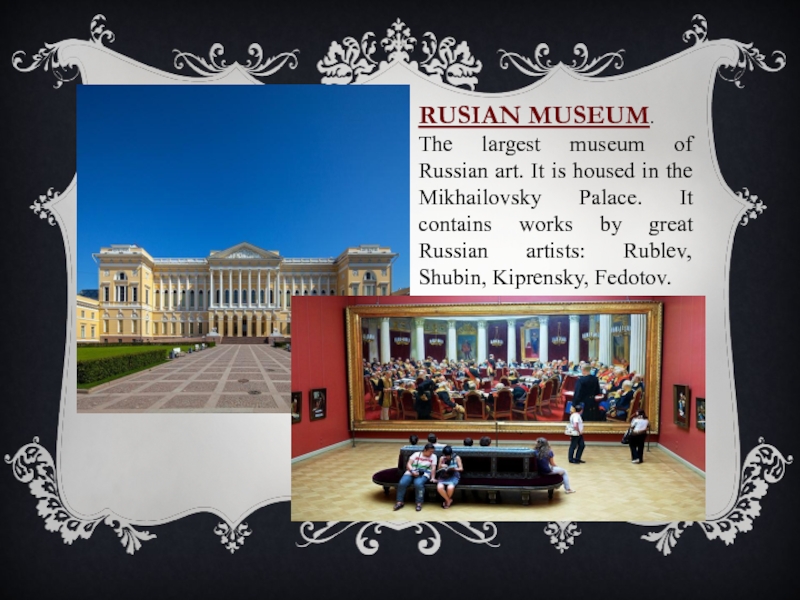
Слайд 14RUSIAN MUSEUM.
The largest museum of Russian art. It is housed
in the Mikhailovsky Palace. It contains works by great Russian artists: Rublev, Shubin, Kiprensky, Fedotov.
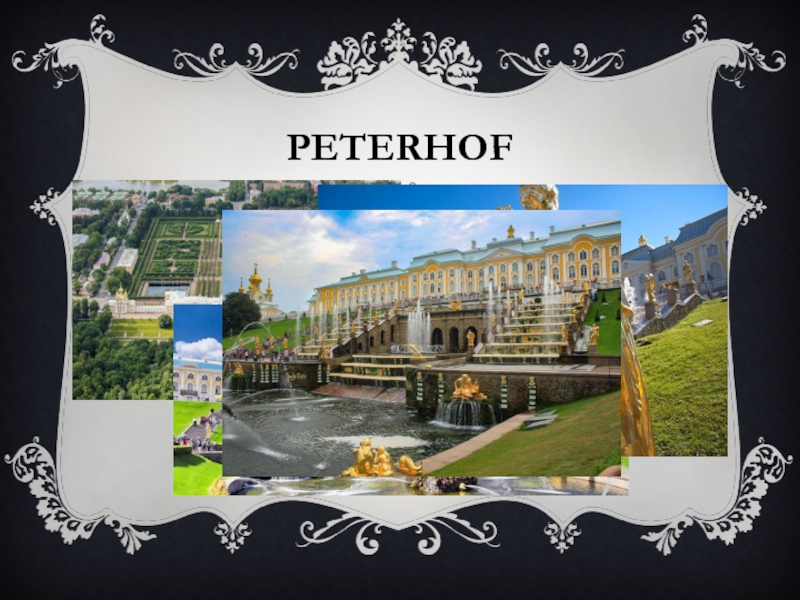
Слайд 15PETERHOF.
Peterhof is 30 km to the West of St. Petersburg. The
palace and park complex with its unique array of fountains is considered to be one of the most beautiful in the world. The park began to take shape in 1710 during Peter I’s reign. In addition to the Grand Palace, built by the architects I. Braunstein, M. Zemtsov and A. Leblond, the complex also includes the “Monplaisir” and “Marly” Palaces and the Hermitage Pavilion.
Слайд 17TSARSKOYE SELO.
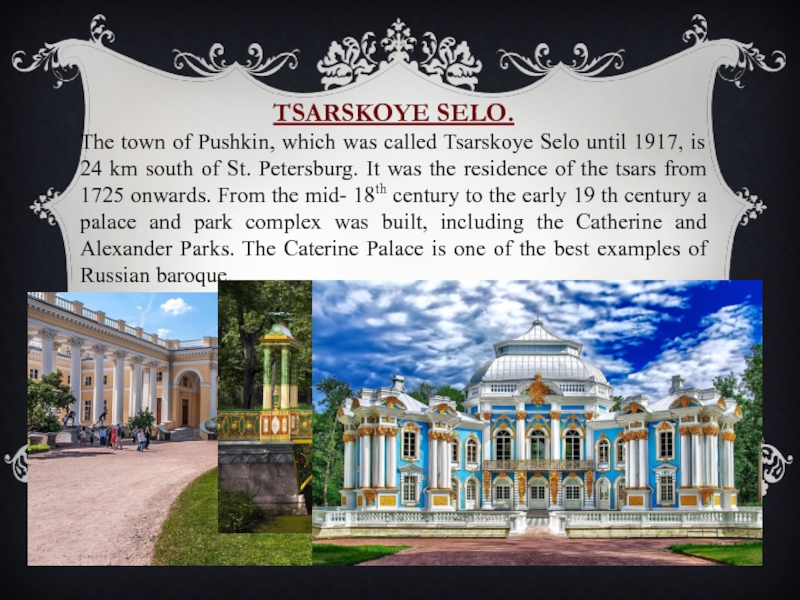
The town of Pushkin, which was called Tsarskoye Selo until
1917, is 24 km south of St. Petersburg. It was the residence of the tsars from 1725 onwards. From the mid- 18th century to the early 19 th century a palace and park complex was built, including the Catherine and Alexander Parks. The Caterine Palace is one of the best examples of Russian baroque.
Слайд 18PAVLOVSK.
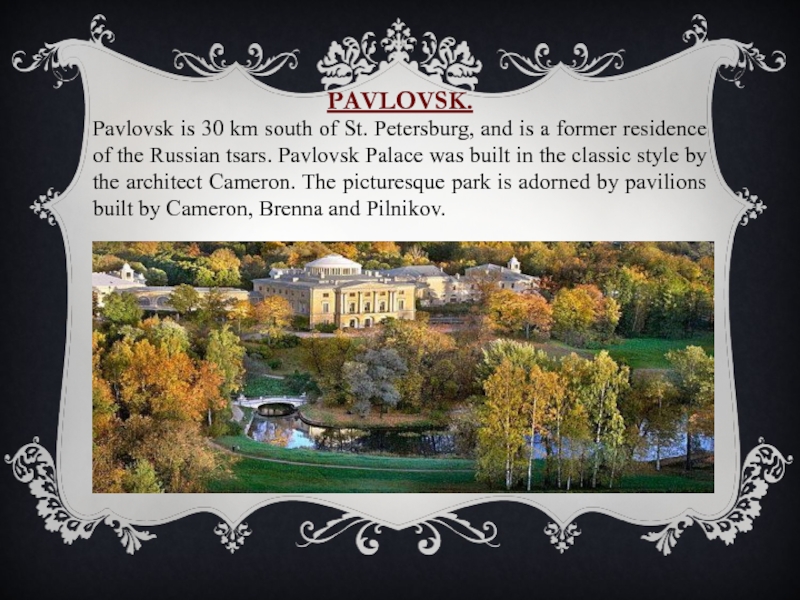
Pavlovsk is 30 km south of St. Petersburg, and is a
former residence of the Russian tsars. Pavlovsk Palace was built in the classic style by the architect Cameron. The picturesque park is adorned by pavilions built by Cameron, Brenna and Pilnikov.
Слайд 19THE PRESENTATION WAS PREPARED BY
Vaskina Elena Sergeevna
Goncharova Natalya Viktorovna
Sagulyova
Olesya Michailovna
Seduhina Ekaterina Valeryevna
THE END
Seduhina Ekaterina Valeryevna
THE END