- Главная
- Разное
- Образование
- Спорт
- Естествознание
- Природоведение
- Религиоведение
- Французский язык
- Черчение
- Английский язык
- Астрономия
- Алгебра
- Биология
- География
- Геометрия
- Детские презентации
- Информатика
- История
- Литература
- Математика
- Музыка
- МХК
- Немецкий язык
- ОБЖ
- Обществознание
- Окружающий мир
- Педагогика
- Русский язык
- Технология
- Физика
- Философия
- Химия
- Шаблоны, фоны, картинки для презентаций
- Экология
- Экономика
Презентация, доклад по ангийскому языку на тему Тайны английского языка (6 класс)
Содержание
- 1. Презентация по ангийскому языку на тему Тайны английского языка (6 класс)
- 2. THE PRONOUNS „YOU AND THOU“Everybody knows that
- 3. THOUYOU
- 4. When Normans came to England, they used
- 5. But then some Englishmen thought: „Does it
- 6. Nowadays the pronoun „thou“ is used only
- 7. THE CATEGORY OF GENDERTill 1200 AD the
- 8. But between 700 and 1000 AD the
- 9. So people decided to make things easier
- 10. THE CATEGORY OF CASEIn ancient English there
- 11. In the 10-th century England was in
- 12. In modern English there are only 2
- 13. IRREGULAR VERBSIrregular verbs came to England due
- 14. So, it was a very complicated system,
- 15. THANK YOU!
THE PRONOUNS „YOU AND THOU“Everybody knows that in modern English„you“ means „вы“ and „ты“. Today a gentleman says „ you“ even addressing to his dog. But it was not always so. Many many years ago English
Слайд 2THE PRONOUNS „YOU AND THOU“
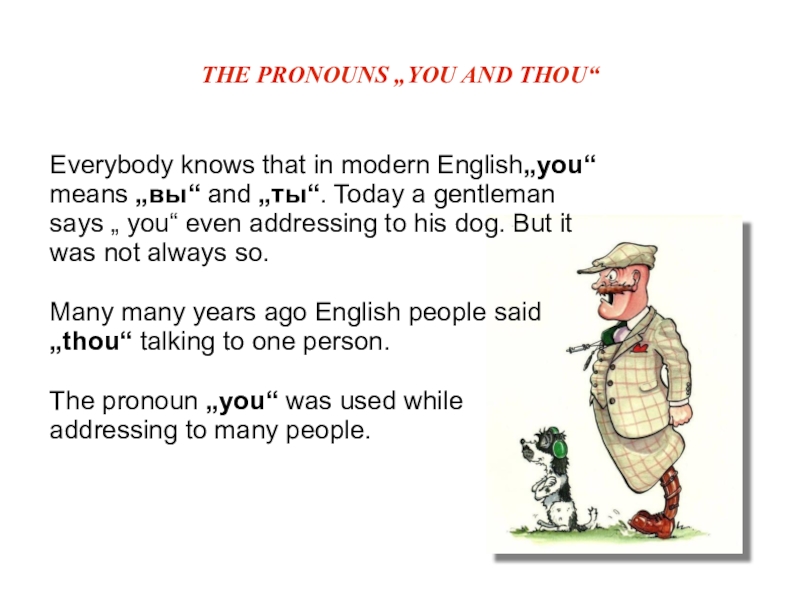
Everybody knows that in modern English„you“ means
„вы“ and „ты“. Today a gentleman says „ you“ even addressing to his dog. But it was not always so.
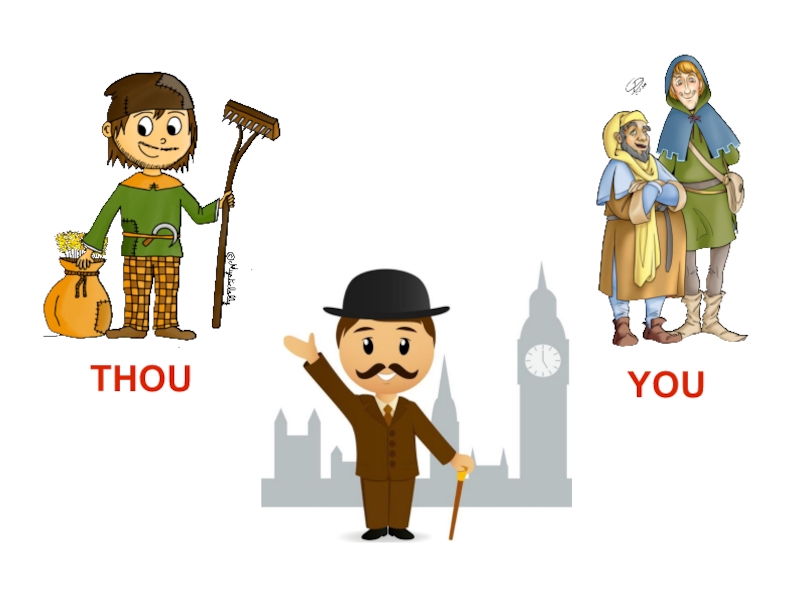
Many many years ago English people said „thou“ talking to one person.
The pronoun „you“ was used while
addressing to many people.
Many many years ago English people said „thou“ talking to one person.
The pronoun „you“ was used while
addressing to many people.
Слайд 4
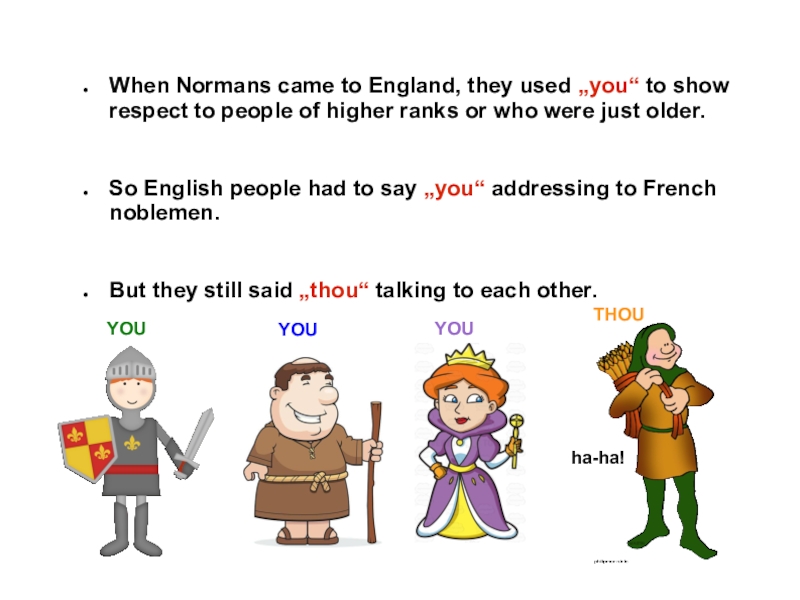
When Normans came to England, they used „you“ to show respect
to people of higher ranks or who were just older.
So English people had to say „you“ addressing to French noblemen.
But they still said „thou“ talking to each other.
So English people had to say „you“ addressing to French noblemen.
But they still said „thou“ talking to each other.
YOU
YOU
YOU
THOU
ha-ha!
Слайд 5
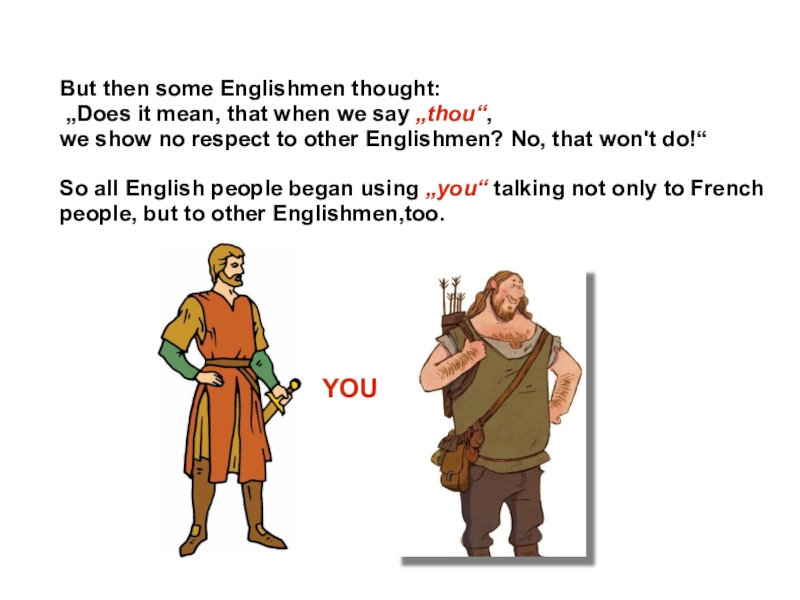
But then some Englishmen thought:
„Does it mean, that when we
say „thou“,
we show no respect to other Englishmen? No, that won't do!“
So all English people began using „you“ talking not only to French
people, but to other Englishmen,too.
we show no respect to other Englishmen? No, that won't do!“
So all English people began using „you“ talking not only to French
people, but to other Englishmen,too.
YOU
Слайд 6
Nowadays the pronoun „thou“ is used only
1) in religious texts:
Thou
shalt not steal - Не укради
2) addressing to the God:
What is thy bidding, my master?
- Какие твои приказания,
мой господин?
3) in some Northern English or Scottish dialects
4) in theatrical performances.
2) addressing to the God:
What is thy bidding, my master?
- Какие твои приказания,
мой господин?
3) in some Northern English or Scottish dialects
4) in theatrical performances.
Слайд 7THE CATEGORY OF GENDER
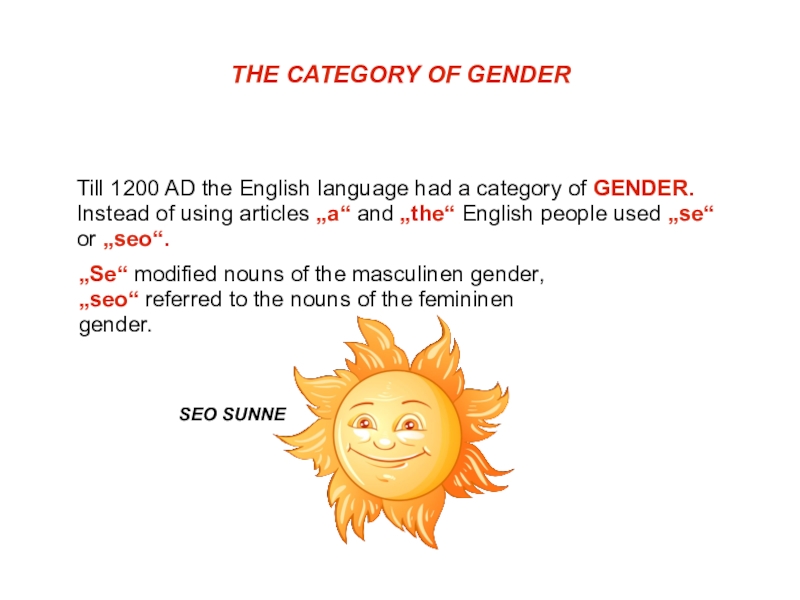
Till 1200 AD the English language had a
category of GENDER.
Instead of using articles „a“ and „the“ English people used „se“
or „seo“.
Instead of using articles „a“ and „the“ English people used „se“
or „seo“.
„Se“ modified nouns of the masculinen gender,
„seo“ referred to the nouns of the femininen gender.
SEO SUNNE
Слайд 8
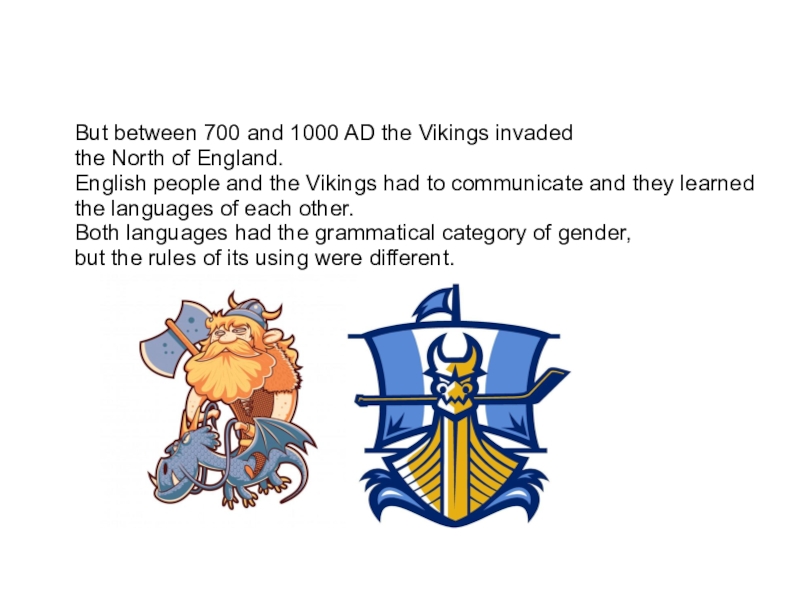
But between 700 and 1000 AD the Vikings invaded
the North of
England.
English people and the Vikings had to communicate and they learned
the languages of each other.
Both languages had the grammatical category of gender,
but the rules of its using were different.
English people and the Vikings had to communicate and they learned
the languages of each other.
Both languages had the grammatical category of gender,
but the rules of its using were different.
Слайд 9
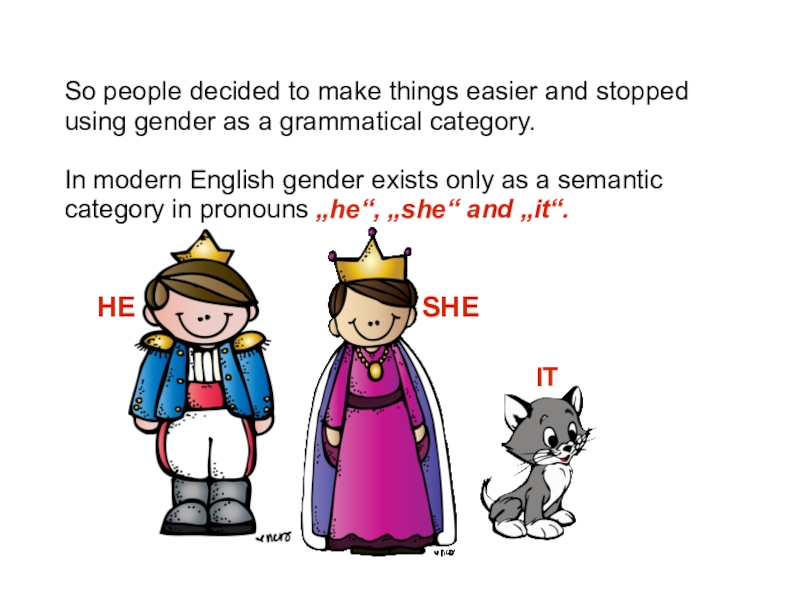
So people decided to make things easier and stopped
using gender
as a grammatical category.
In modern English gender exists only as a semantic
category in pronouns „he“, „she“ and „it“.
In modern English gender exists only as a semantic
category in pronouns „he“, „she“ and „it“.
HE
SHE
IT
Слайд 10THE CATEGORY OF CASE
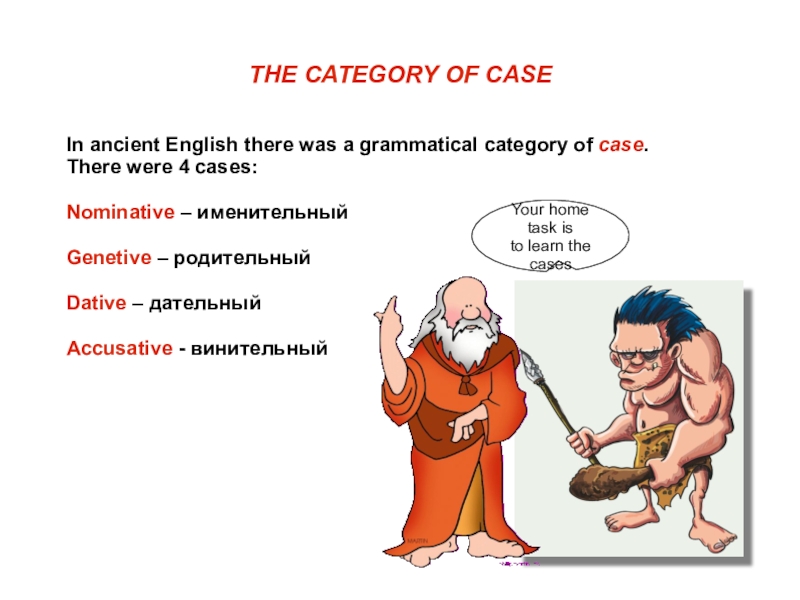
In ancient English there was a grammatical category
of case.
There were 4 cases:
Nominative – именительный
Genetive – родительный
Dative – дательный
Accusative - винительный
There were 4 cases:
Nominative – именительный
Genetive – родительный
Dative – дательный
Accusative - винительный
Your home task is
to learn the cases
Слайд 11
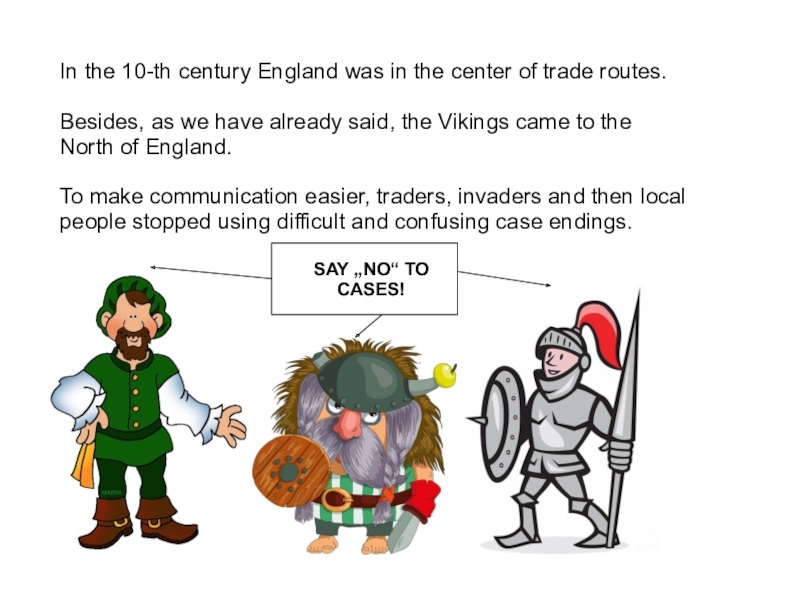
In the 10-th century England was in the center of trade
routes.
Besides, as we have already said, the Vikings came to the
North of England.
To make communication easier, traders, invaders and then local
people stopped using difficult and confusing case endings.
Besides, as we have already said, the Vikings came to the
North of England.
To make communication easier, traders, invaders and then local
people stopped using difficult and confusing case endings.
SAY „NO“ TO CASES!
Слайд 12
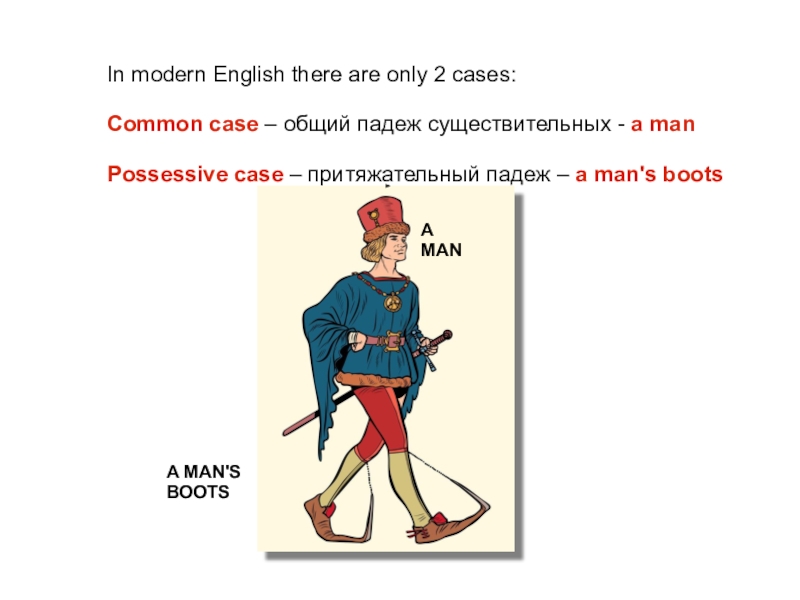
In modern English there are only 2 cases:
Common case – общий
падеж существительных - a man
Possessive case – притяжательный падеж – a man's boots
Possessive case – притяжательный падеж – a man's boots
A MAN'S BOOTS
A MAN
Слайд 13IRREGULAR VERBS
Irregular verbs came to England due to the German tribes
of Angles
and Saxons.
In old English there were „strong“ verbs and „weak“ verbs.
„Strong“ verbs formed past tenses changing the vowel in the root of
the word.
e.g. healpan - healp (помогать)
„Weak“ verbs formed past tenses with the help of endings
-d-, -t-, -ð- etc.
e.g. deman-demde (судить)
and Saxons.
In old English there were „strong“ verbs and „weak“ verbs.
„Strong“ verbs formed past tenses changing the vowel in the root of
the word.
e.g. healpan - healp (помогать)
„Weak“ verbs formed past tenses with the help of endings
-d-, -t-, -ð- etc.
e.g. deman-demde (судить)
Слайд 14
So, it was a very complicated system, even worse than today.
When
the era of printing books began, printers and school teachers
tried to codify and simplify the rules of using verbs.
But as the „strong“ verbs were the most important ones, they survived
and today we know them as „irregular verbs“.
tried to codify and simplify the rules of using verbs.
But as the „strong“ verbs were the most important ones, they survived
and today we know them as „irregular verbs“.