Слайд 1ДЕПАРТАМЕНТ ВНУТРЕННЕЙ И КАДРОВОЙ ПОЛИТИКИ БЕЛГОРОДСКОЙ ОБЛАСТИ
ОБЛАСТНОЕ ГОСУДАРСТВЕННОЕ АВТОНОМНОЕ ПРОФЕССИОНАЛЬНОЕ ОБРАЗОВАТЕЛЬНОЕ
УЧРЕЖДЕНИЕ
«АЛЕКСЕЕВСКИЙ КОЛЛЕДЖ»
Non-official symbols of Russia
Выполнила студентка 821 группы
специальности 43.02.10 Туризм
Иконникова Анна
Преподаватель:
Кришталь Е.В
Алексеевка, 2018
Слайд 2Matryoshka doll
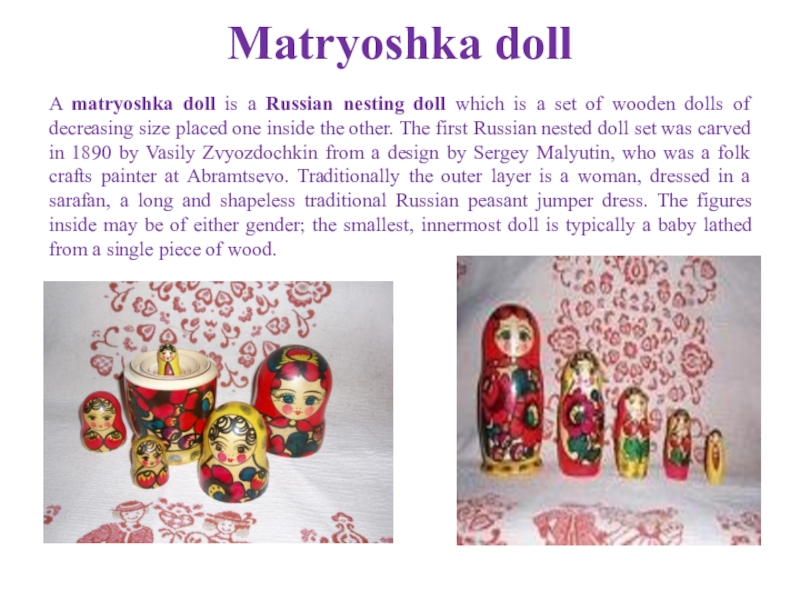
A matryoshka doll is a Russian nesting doll which is
a set of wooden dolls of decreasing size placed one inside the other. The first Russian nested doll set was carved in 1890 by Vasily Zvyozdochkin from a design by Sergey Malyutin, who was a folk crafts painter at Abramtsevo. Traditionally the outer layer is a woman, dressed in a sarafan, a long and shapeless traditional Russian peasant jumper dress. The figures inside may be of either gender; the smallest, innermost doll is typically a baby lathed from a single piece of wood.
Слайд 3Palekh Lacquer Miniatures
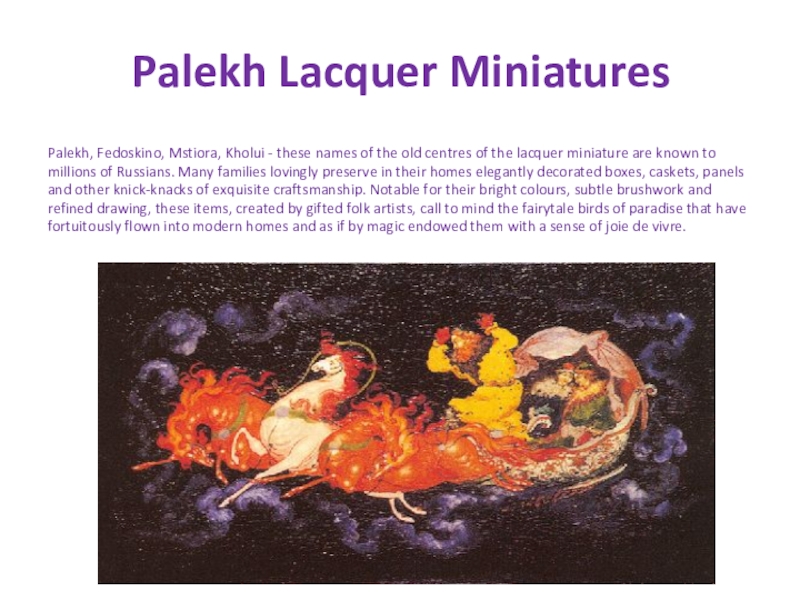
Palekh, Fedoskino, Mstiora, Kholui - these names of the
old centres of the lacquer miniature are known to millions of Russians. Many families lovingly preserve in their homes elegantly decorated boxes, caskets, panels and other knick-knacks of exquisite craftsmanship. Notable for their bright colours, subtle brushwork and refined drawing, these items, created by gifted folk artists, call to mind the fairytale birds of paradise that have fortuitously flown into modern homes and as if by magic endowed them with a sense of joie de vivre.
Слайд 4Golden Khokhloma
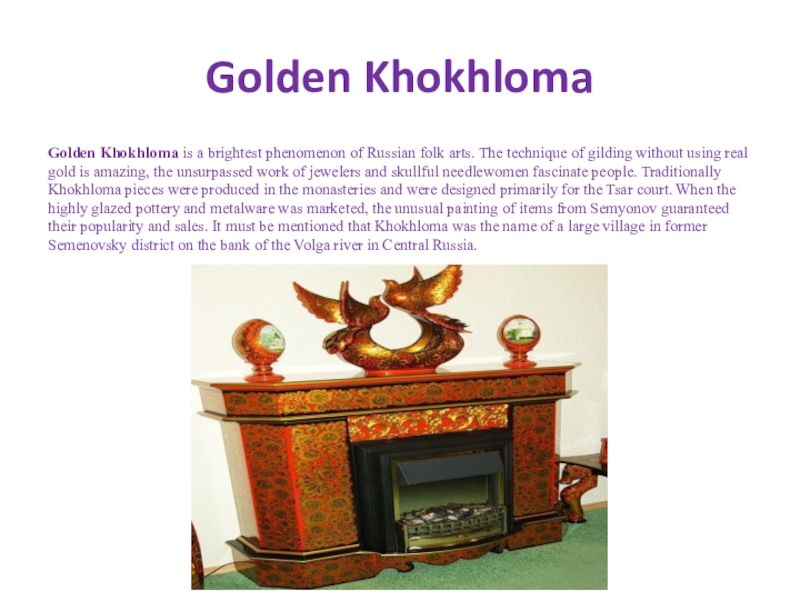
Golden Khokhloma is a brightest phenomenon of Russian folk arts.
The technique of gilding without using real gold is amazing, the unsurpassed work of jewelers and skullful needlewomen fascinate people. Traditionally Khokhloma pieces were produced in the monasteries and were designed primarily for the Tsar court. When the highly glazed pottery and metalware was marketed, the unusual painting of items from Semyonov guaranteed their popularity and sales. It must be mentioned that Khokhloma was the name of a large village in former Semenovsky district on the bank of the Volga river in Central Russia.
Слайд 5Gorodets painting
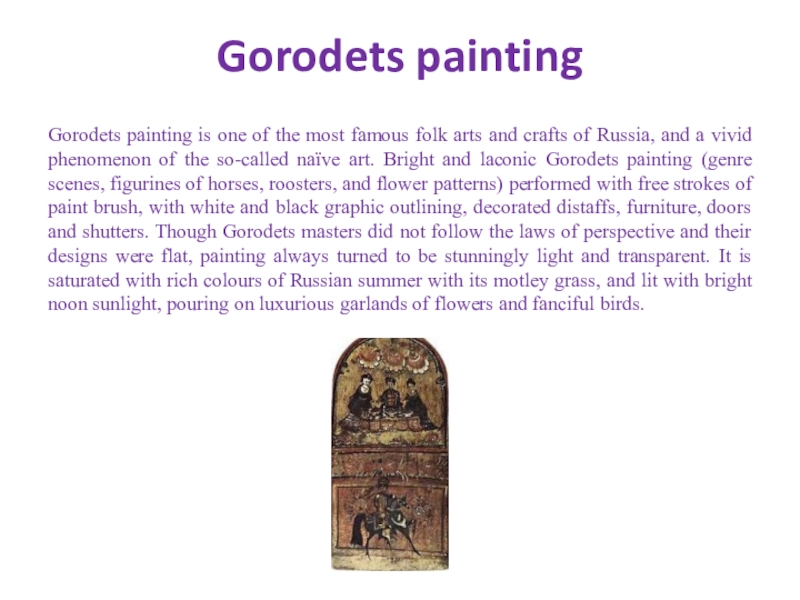
Gorodets painting is one of the most famous folk arts
and crafts of Russia, and a vivid phenomenon of the so-called naïve art. Bright and laconic Gorodets painting (genre scenes, figurines of horses, roosters, and flower patterns) performed with free strokes of paint brush, with white and black graphic outlining, decorated distaffs, furniture, doors and shutters. Though Gorodets masters did not follow the laws of perspective and their designs were flat, painting always turned to be stunningly light and transparent. It is saturated with rich colours of Russian summer with its motley grass, and lit with bright noon sunlight, pouring on luxurious garlands of flowers and fanciful birds.
Слайд 6Kazakovо filigree metalwork
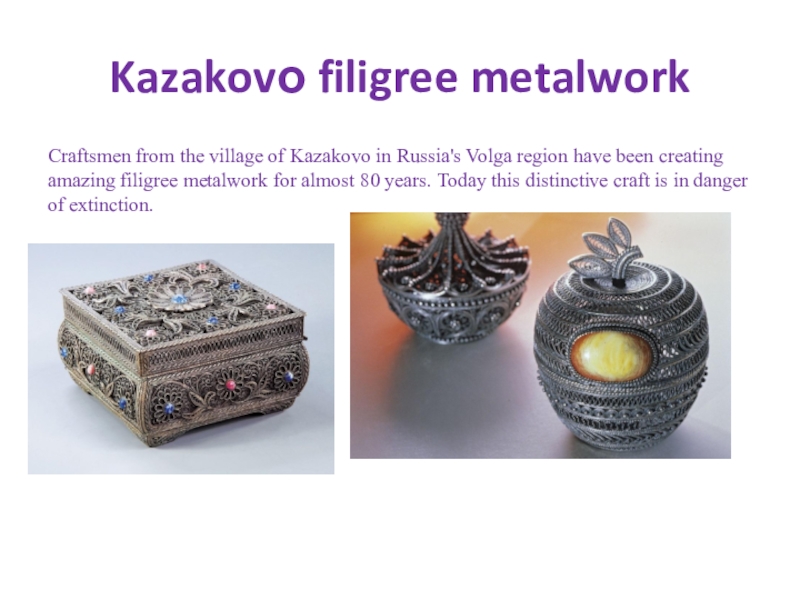
Craftsmen from the village of Kazakovo in Russia's Volga
region have been creating amazing filigree metalwork for almost 80 years. Today this distinctive craft is in danger of extinction.
Слайд 7Gzhel
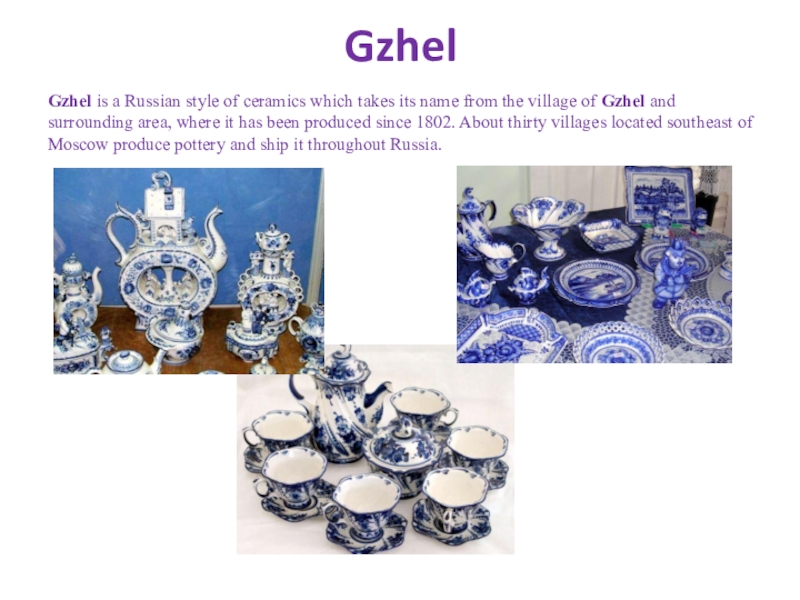
Gzhel is a Russian style of ceramics which takes its name
from the village of Gzhel and surrounding area, where it has been produced since 1802. About thirty villages located southeast of Moscow produce pottery and ship it throughout Russia.
Слайд 8Pawlovsky Posad shawls
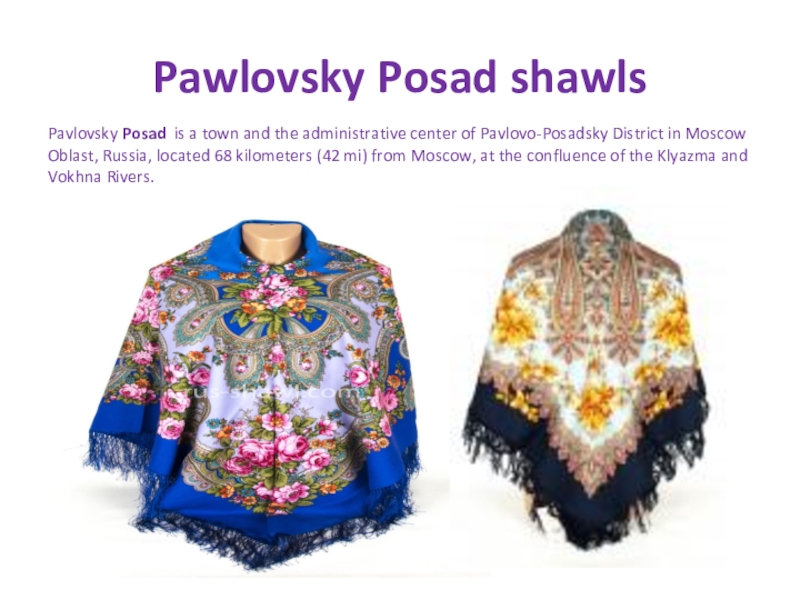
Pavlovsky Posad is a town and the administrative center
of Pavlovo-Posadsky District in Moscow Oblast, Russia, located 68 kilometers (42 mi) from Moscow, at the confluence of the Klyazma and Vokhna Rivers.
Слайд 9Orenburg down shawls
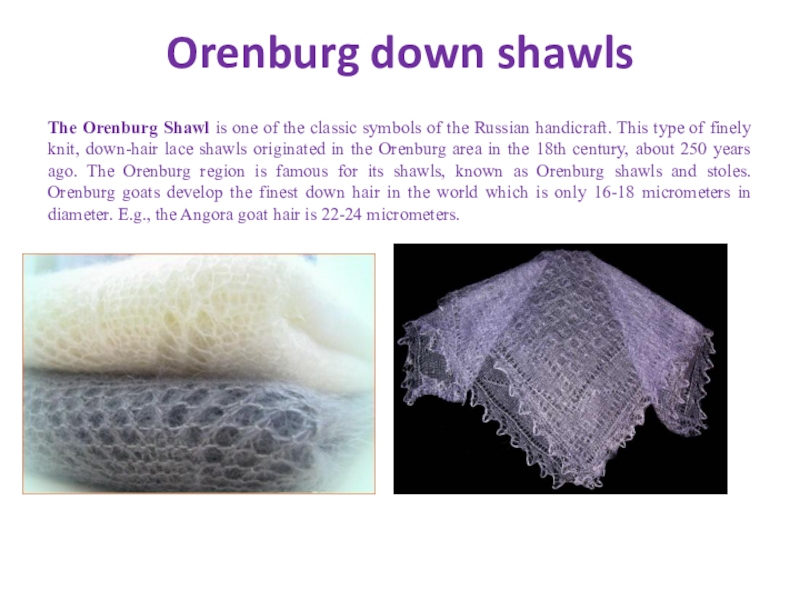
The Orenburg Shawl is one of the classic symbols
of the Russian handicraft. This type of finely knit, down-hair lace shawls originated in the Orenburg area in the 18th century, about 250 years ago. The Orenburg region is famous for its shawls, known as Orenburg shawls and stoles. Orenburg goats develop the finest down hair in the world which is only 16-18 micrometers in diameter. E.g., the Angora goat hair is 22-24 micrometers.
Слайд 10Zhostovo Painting
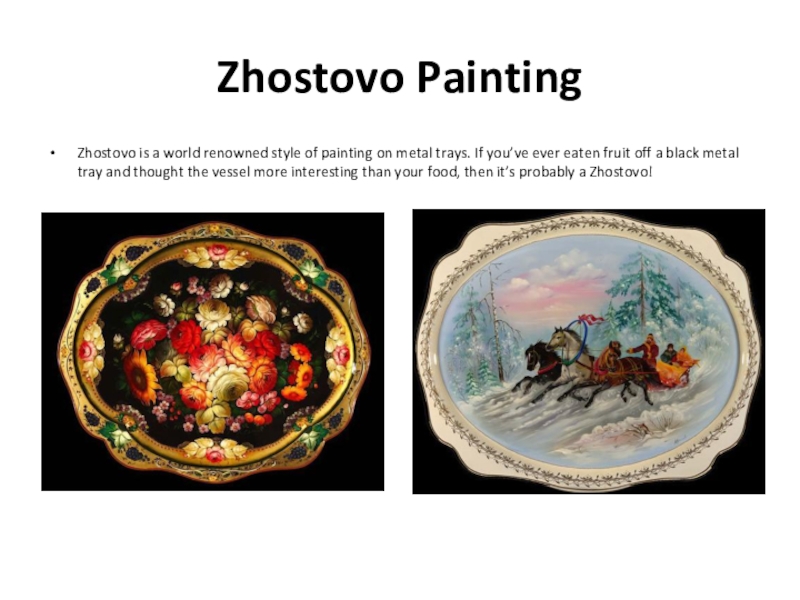
Zhostovo is a world renowned style of painting on metal
trays. If you’ve ever eaten fruit off a black metal tray and thought the vessel more interesting than your food, then it’s probably a Zhostovo!
Слайд 11Kasli cаsting
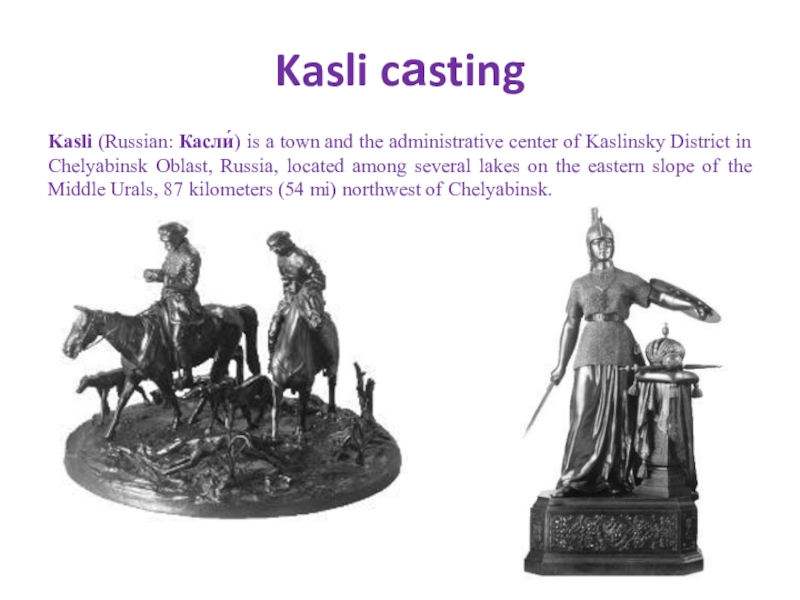
Kasli (Russian: Касли́) is a town and the administrative center
of Kaslinsky District in Chelyabinsk Oblast, Russia, located among several lakes on the eastern slope of the Middle Urals, 87 kilometers (54 mi) northwest of Chelyabinsk.
Слайд 12Rostov finift
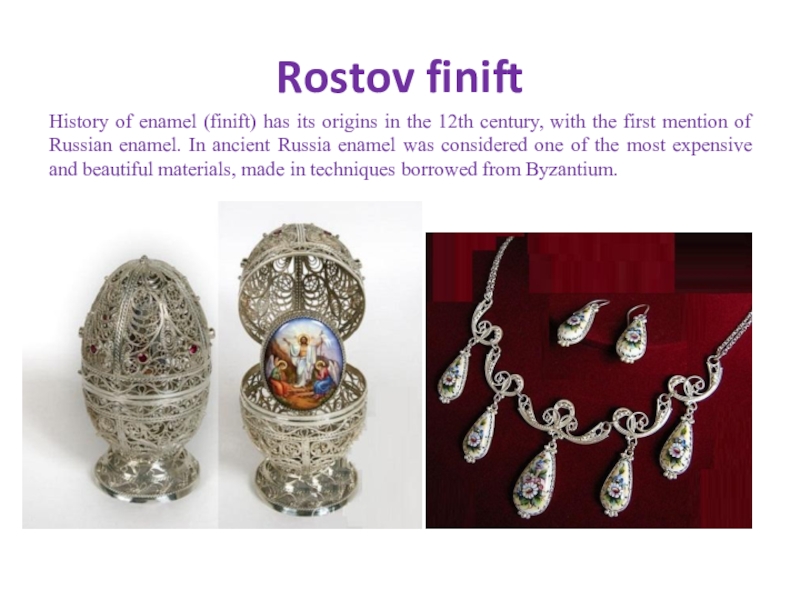
History of enamel (finift) has its origins in the 12th
century, with the first mention of Russian enamel. In ancient Russia enamel was considered one of the most expensive and beautiful materials, made in techniques borrowed from Byzantium.
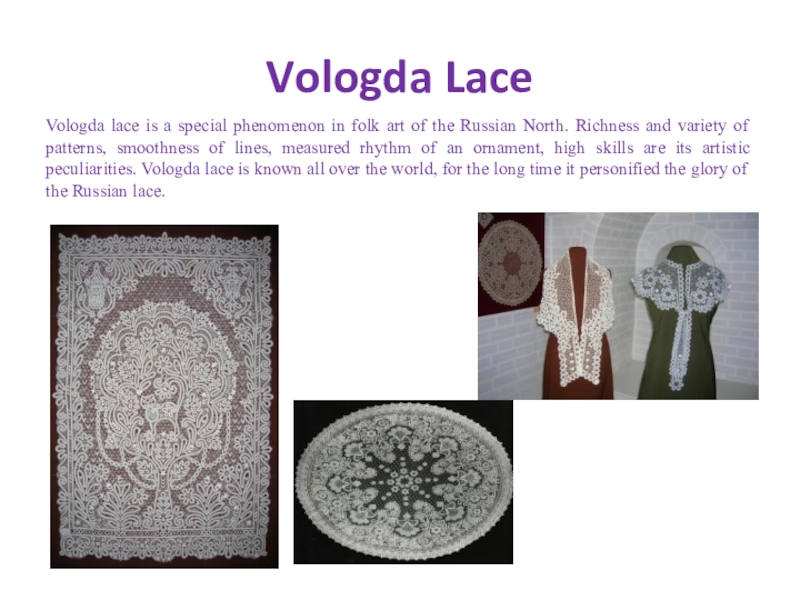
Слайд 13Vologda Lace
Vologda lace is a special phenomenon in folk art of
the Russian North. Richness and variety of patterns, smoothness of lines, measured rhythm of an ornament, high skills are its artistic peculiarities. Vologda lace is known all over the world, for the long time it personified the glory of the Russian lace.
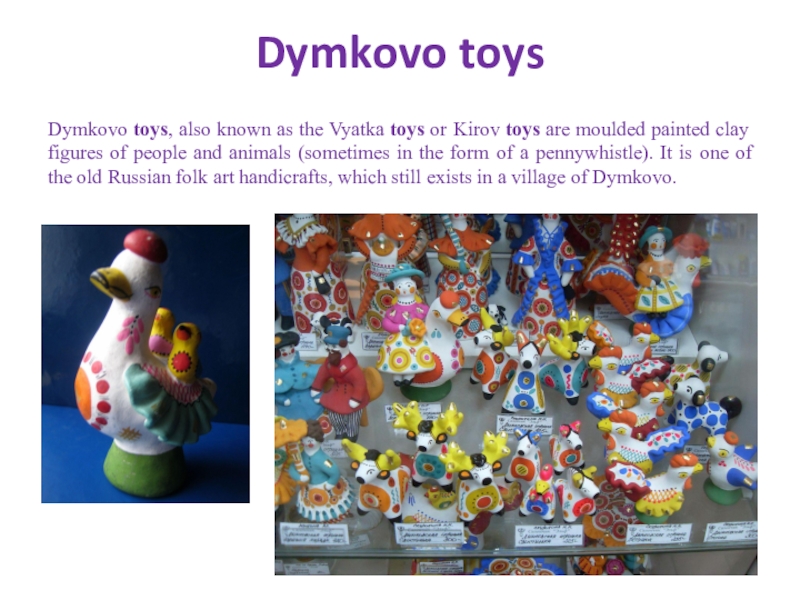
Слайд 14Dymkovo toys
Dymkovo toys, also known as the Vyatka toys or Kirov
toys are moulded painted clay figures of people and animals (sometimes in the form of a pennywhistle). It is one of the old Russian folk art handicrafts, which still exists in a village of Dymkovo.
Слайд 15Источники:
http://en.academic.ru/dic.nsf/enwiki/196315
http://novshestvoxx1.narod.ru/mirpalekh.html
https://www.ozon.ru/context/detail/id/7220555/
http://allrus.me/russian-folk-arts-golden-khokhloma/
http://www.russia-ic.com/culture_art/visual_arts/970/#.WtmVejNn2Uk
https://www.rbth.com/multimedia/video/2016/08/25/russian-handicrafts-kazakovo-filigree-metalwork_624111
http://история-вещей.рф/posuda/gzhel-istoriya-promyisla.html
http://platki.ru/en/about/manufactory/
http://www.orenburg-shawl.com/
https://russiapedia.rt.com/of-russian-origin/zhostovo-painting/
http://www.russia-ic.com/culture_art/visual_arts/1006/#.Wtmb7zNn2Uk
http://viola.bz/enamel-rostov-finift/
http://cultinfo.ru/en/tnk/vologda-lace.php
https://en.wikipedia.org/wiki/Dymkovo_toys#/media/File:%D0%94%D1%8B%D0%BC%D0%BA%D0%BE%D0%B2%D1%81%D0%BA%D0%B0%D1%8F_%D0%B8%D0%B3%D1%80%D1%83%D1%88%D0%BA%D0%B0.JPG