- Главная
- Разное
- Образование
- Спорт
- Естествознание
- Природоведение
- Религиоведение
- Французский язык
- Черчение
- Английский язык
- Астрономия
- Алгебра
- Биология
- География
- Геометрия
- Детские презентации
- Информатика
- История
- Литература
- Математика
- Музыка
- МХК
- Немецкий язык
- ОБЖ
- Обществознание
- Окружающий мир
- Педагогика
- Русский язык
- Технология
- Физика
- Философия
- Химия
- Шаблоны, фоны, картинки для презентаций
- Экология
- Экономика
Презентация, доклад на английском языке The Romantic Age in British Literature: Poetry
Содержание
- 1. Презентация на английском языке The Romantic Age in British Literature: Poetry
- 2. The Romantic Age in English literature begins
- 3. HISTORICAL BACKGROUND Romanticism in literature was caused
- 4. NO!Later on most of the poets abandoned
- 5. The Romantic Tradition versus (Neo)ClassicismNeoclassicStrict & exactPredictable
- 6. BELIEFSRomanticists believed that poetry should be full
- 7. THEMESThey turned their attention to the simple
- 8. THE EARLY ROMANTICS William Wordsworth Samuel Taylor
- 9. WILLIAM WORDSWORTH (1770-1850)In his early years
- 10. At that time a number of his
- 11. POET LAUREATEWilliam Wordsworth wasmade Poet Laureate six
- 12. More than any other poet of his
- 13. Слайд 13
- 14. W.Wordsworth & Romanticism the leader of the
- 15. SAMUEL TAYLOR COLERIDGE (1772-1834) Coleridge wrote almost
- 16. Later on opium addiction, a desperately unhappy
- 17. MAJOR WORKSThe Rime of the Ancient Mariner
- 18. ROBERT SOUTHEY (1774-1843)By age 38, he had
- 19. POET & PROSE WRITER: VERSATILEAs poet he
- 20. Слайд 20
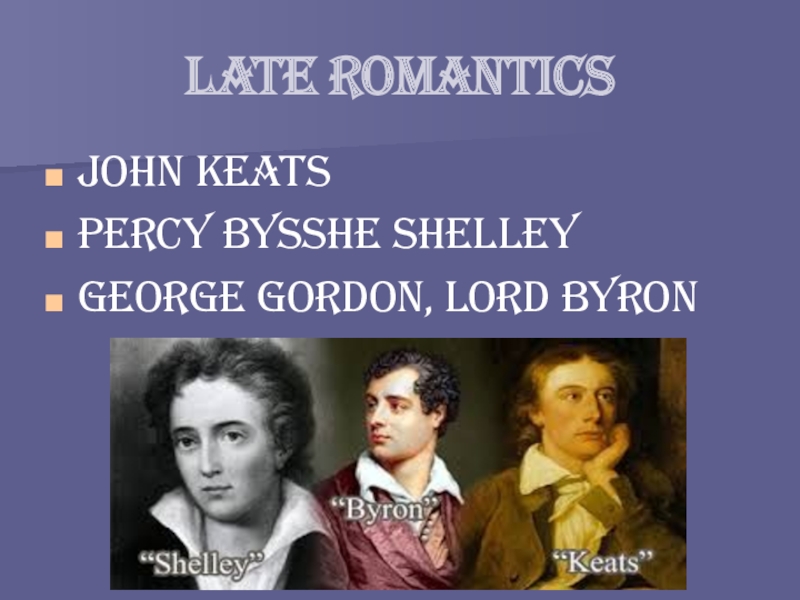
- 21. LATE ROMANTICSJOHN KEATS PERCY BYSSHE SHELLEY GEORGE GORDON, LORD BYRON
- 22. JOHN KEATS (1795-1821) Keats died young. In his
- 23. Keats’s supreme achievement lies in his development
- 24. Слайд 24
- 25. Слайд 25
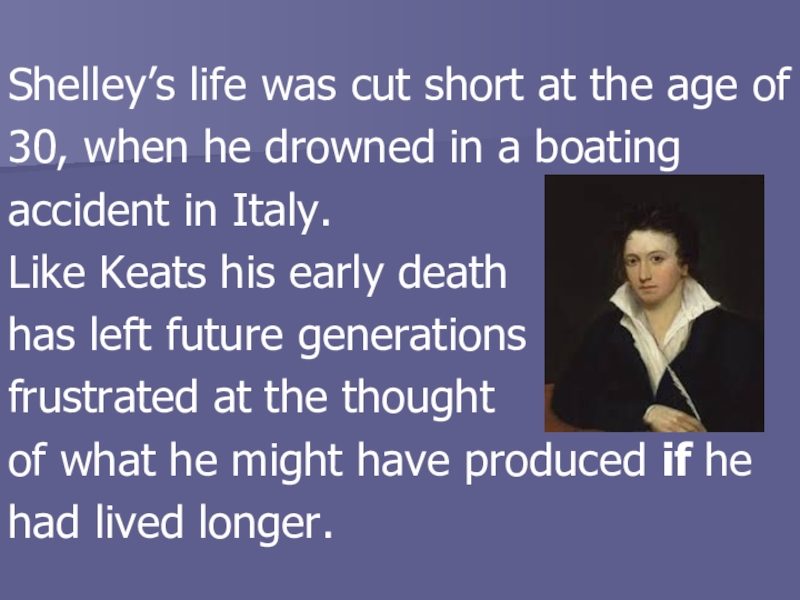
- 26. PERCY BYSSHE SHELLEY (1792-1822) The most radical
- 27. In Italy Shelley and Byron became close
- 28. Shelley’s life was cut short at the
- 29. SHELLEY’S STYLEShelley is still the subject of
- 30. Shelley’s lyrics are marvellously varied and rich
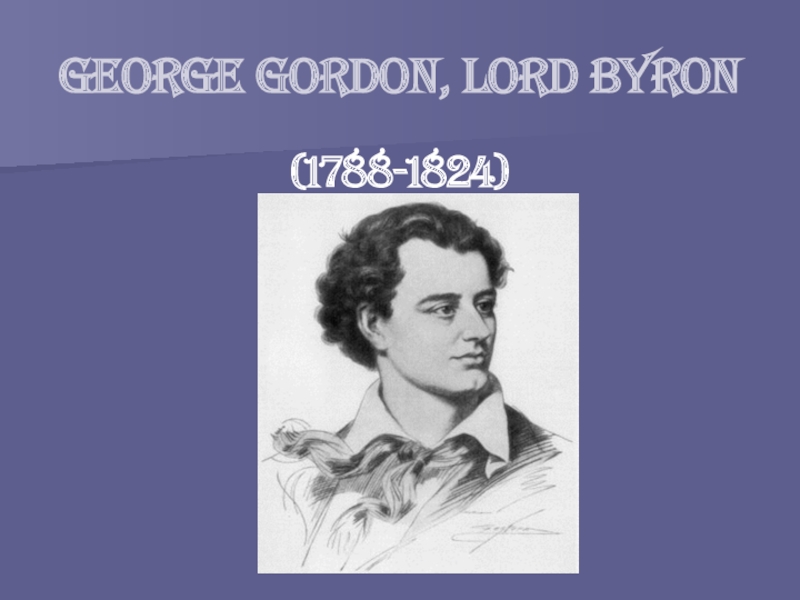
- 31. GEORGE GORDON, LORD BYRON (1788-1824)
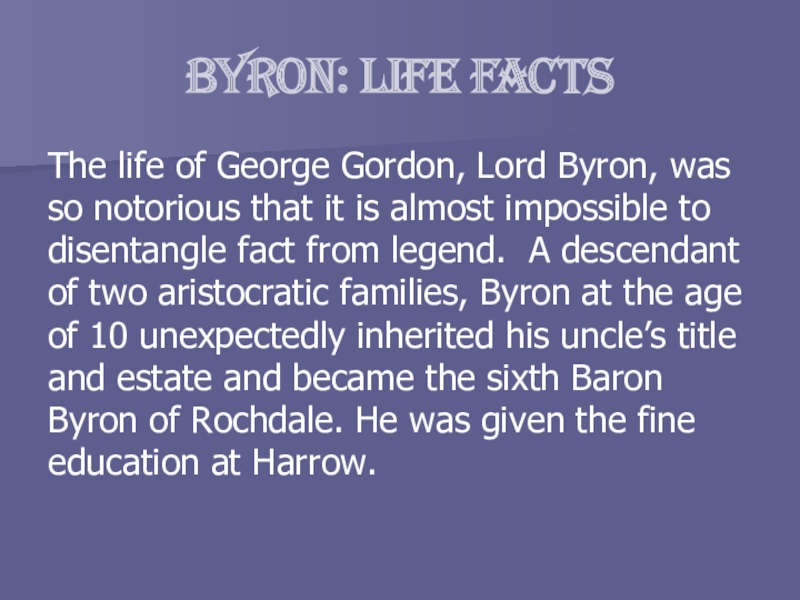
- 32. BYRON: LIFE FACTSThe life of George Gordon,
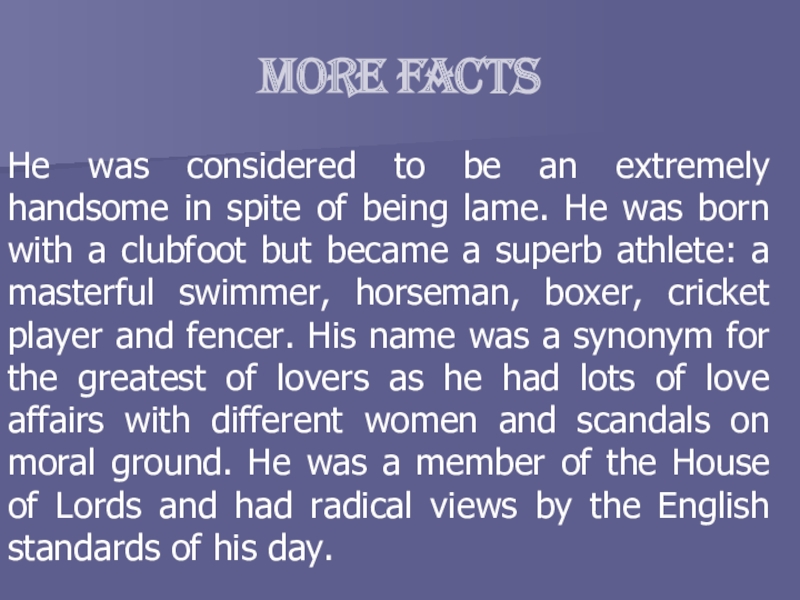
- 33. MORE FACTSHe was considered to be an
- 34. DEATHHe was celebrated as the highest of
- 35. К. РЫЛЕЕВ: «На смерть Бейрона» (1824)Исчезнут порты
- 36. What made him one of the great poets of England and abroad?
- 37. GREATNESS His poetic gifts were enormous,
- 38. After graduating from Cambridge he had an
- 39. He was just 24 and in his
- 40. Byron is poet who lived his poetry.
- 41. Byron is a romanticist when he introduces
- 42. Слайд 42
- 43. His life completely overshadows his poetry. It
- 44. MAJOR WORKSChilde Harold's Pilgrimage (1812–1818) The Giaour
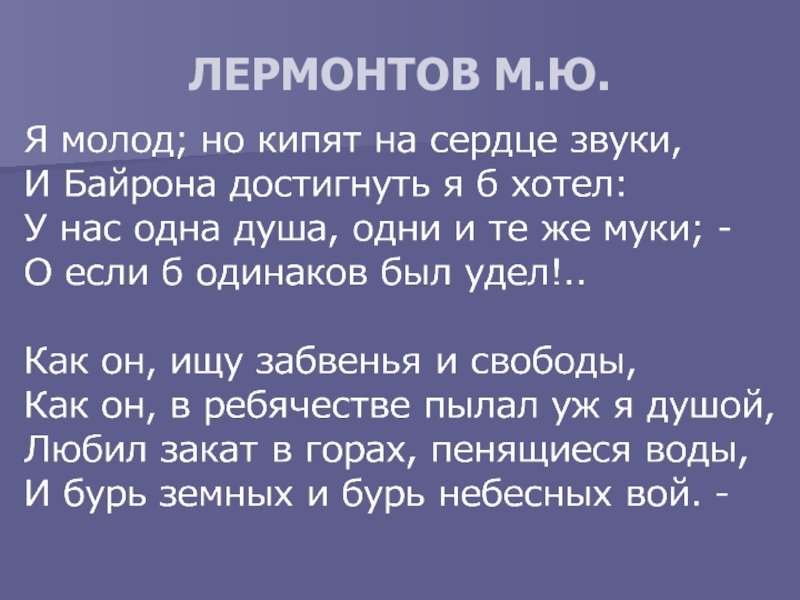
- 45. ЛЕРМОНТОВ М.Ю.
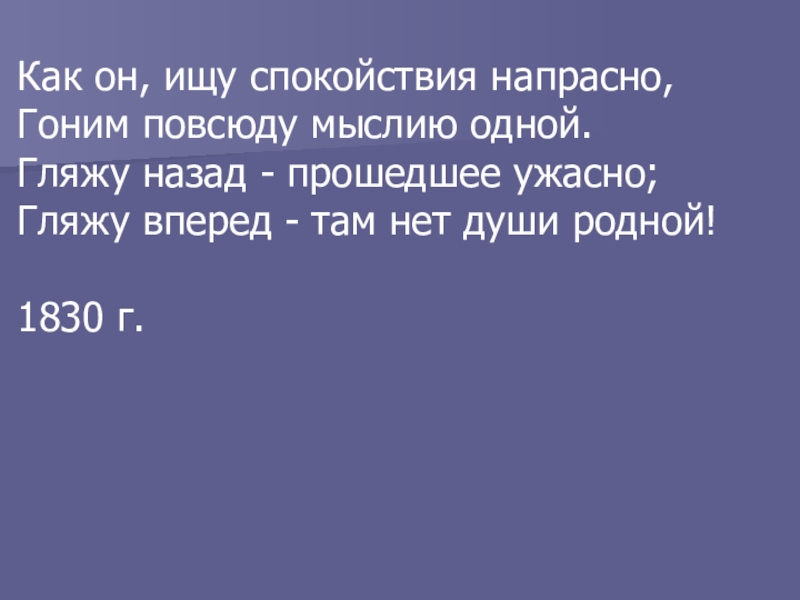
- 46. Как он, ищу спокойствия напрасно,Гоним повсюду мыслию
- 47. TRANSLATEБайрон был гражданином мира и как поэт,
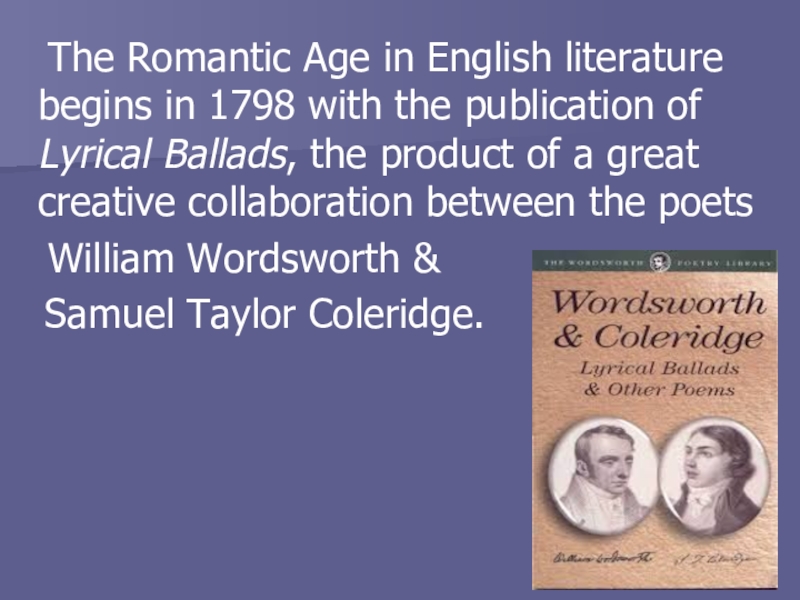
The Romantic Age in English literature begins in 1798 with the publication of Lyrical Ballads, the product of a great creative collaboration between the poets William Wordsworth & Samuel Taylor Coleridge.
Слайд 2 The Romantic Age in English literature begins in 1798 with the
publication of Lyrical Ballads, the product of a great creative collaboration between the poets
William Wordsworth &
Samuel Taylor Coleridge.
William Wordsworth &
Samuel Taylor Coleridge.
Слайд 3HISTORICAL BACKGROUND
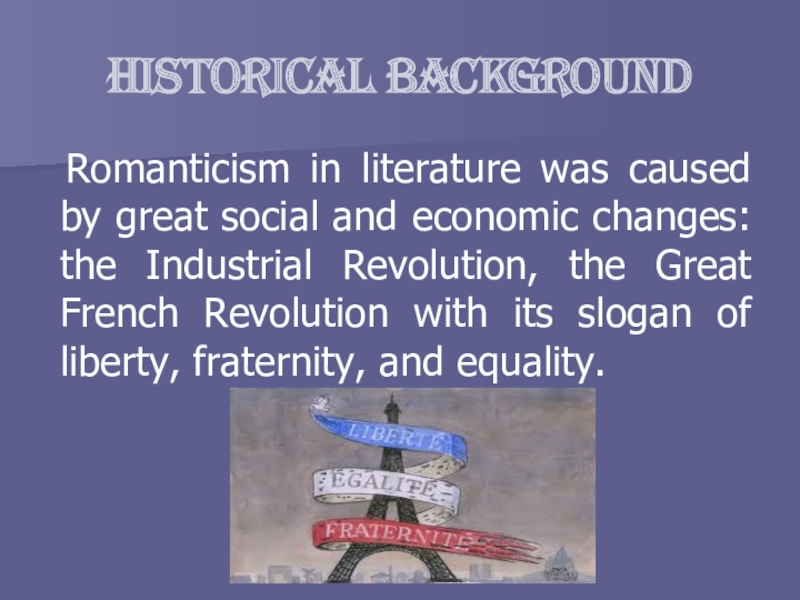
Romanticism in literature was caused by great social and
economic changes: the Industrial Revolution, the Great French Revolution with its slogan of liberty, fraternity, and equality.
Слайд 4NO!
Later on most of the poets abandoned revolutionary ideas because there
was a contradiction between the ideal of liberty, fraternity and equality and reality: poverty, injustice, and exploitation of man by man.
Слайд 5The Romantic Tradition versus (Neo)Classicism
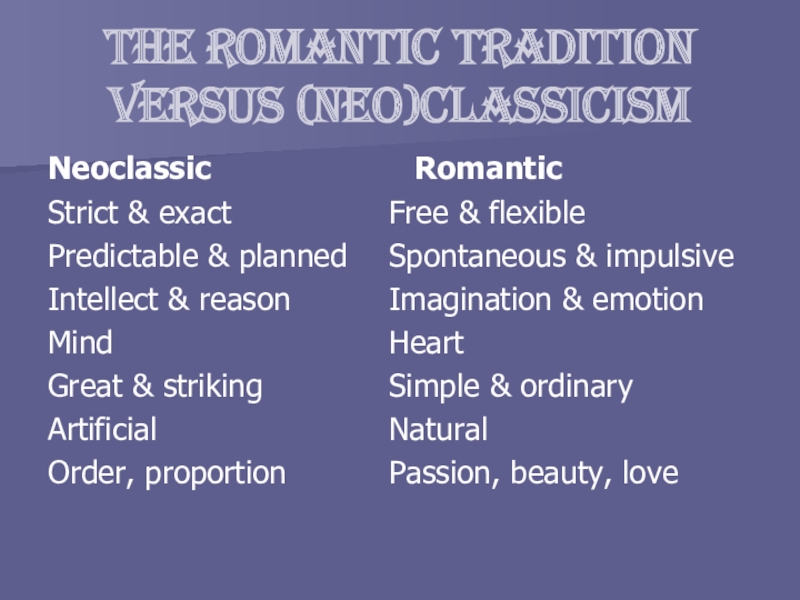
Neoclassic
Strict & exact
Predictable & planned
Intellect & reason
Mind
Great
& striking
Artificial
Order, proportion
Artificial
Order, proportion
Romantic
Free & flexible
Spontaneous & impulsive
Imagination & emotion
Heart
Simple & ordinary
Natural
Passion, beauty, love
Слайд 6BELIEFS
Romanticists believed that poetry should be full of personal emotions, the
expression of the individual, it ‘should spring freely and spontaneously from the heart not the mind’.
Слайд 7THEMES
They turned their attention to the simple problems of life, to
nature. They wrote powerfully about
man in society,
man in relation to nature,
the unchanging passion of the human heart.
man in society,
man in relation to nature,
the unchanging passion of the human heart.

Слайд 8THE EARLY ROMANTICS
William Wordsworth
Samuel Taylor Coleridge
Robert Southey
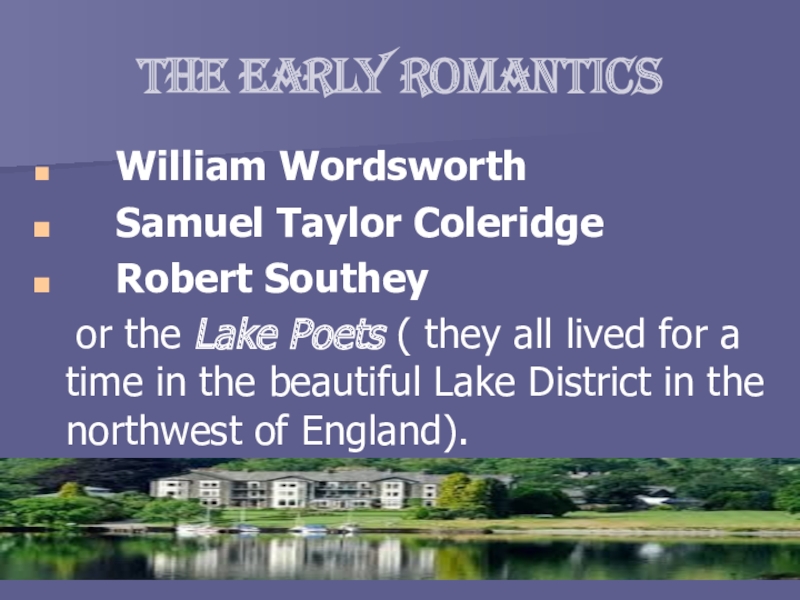
or the Lake Poets ( they all lived for a time in the beautiful Lake District in the northwest of England).
Слайд 9WILLIAM WORDSWORTH
(1770-1850)
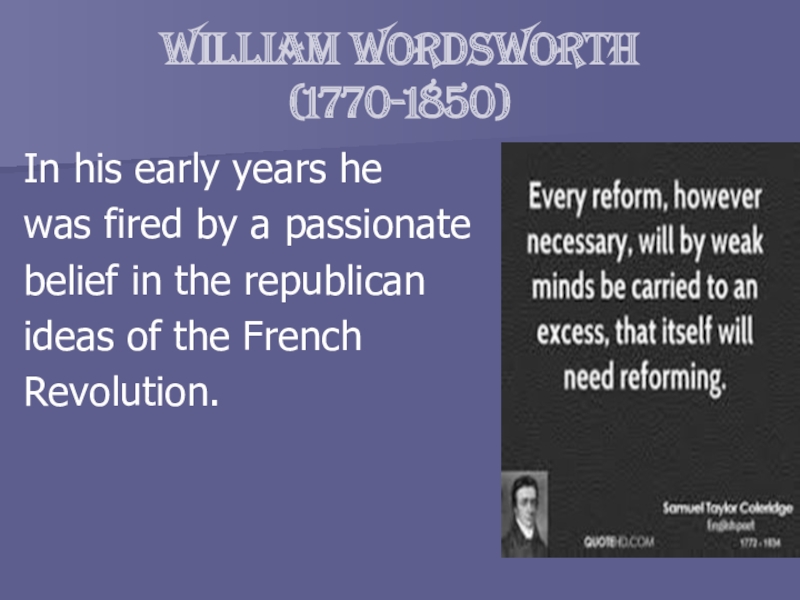
In his early years he
was fired by a
passionate
belief in the republican
ideas of the French
Revolution.
belief in the republican
ideas of the French
Revolution.
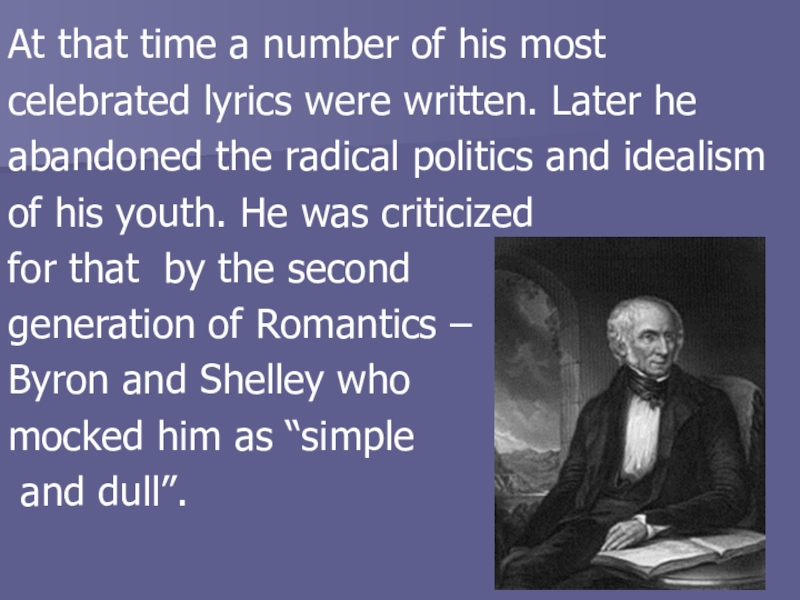
Слайд 10At that time a number of his most
celebrated lyrics were
written. Later he
abandoned the radical politics and idealism
of his youth. He was criticized
for that by the second
generation of Romantics –
Byron and Shelley who
mocked him as “simple
and dull”.
abandoned the radical politics and idealism
of his youth. He was criticized
for that by the second
generation of Romantics –
Byron and Shelley who
mocked him as “simple
and dull”.
Слайд 11POET LAUREATE
William Wordsworth was
made Poet Laureate six years
before his death.
A
prominent English poet
with enormous and
lasting popularity of his works.
with enormous and
lasting popularity of his works.

Слайд 12
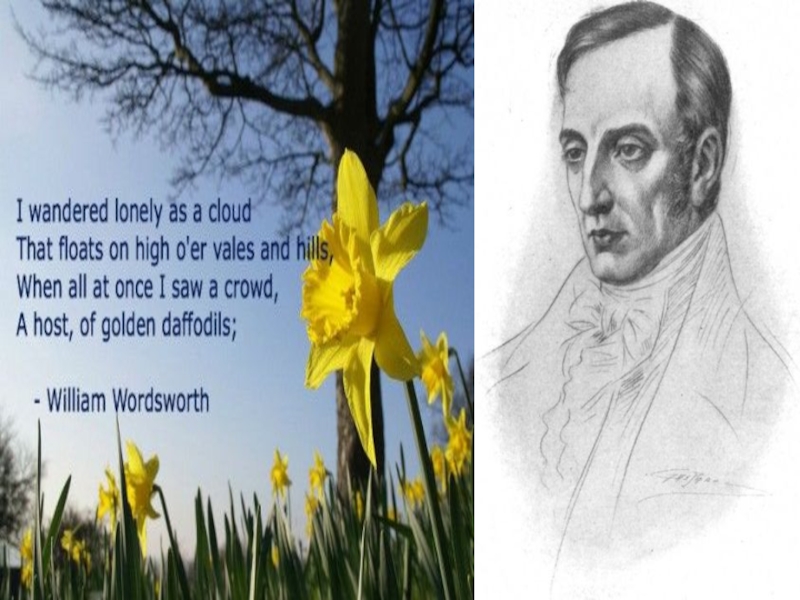
More than any other poet of his time, he dealt with
the mysterious bond between nature and humanity, and to this day is regarded as the most “nature-oriented” of the Romantics with his special ability to throw a charm over ordinary things. And he made them seem wonderful.

Слайд 14W.Wordsworth & Romanticism
the leader of the Romantic movement;
his Pre-face to
the Lyrical Ballads - a kind of manifesto of romanticism;
the basic traits of romanticism: love of nature, the belief in humanity, mysticism, revolutionary spirit, etc. were early developed in his poetry.
the basic traits of romanticism: love of nature, the belief in humanity, mysticism, revolutionary spirit, etc. were early developed in his poetry.
Слайд 15SAMUEL TAYLOR COLERIDGE (1772-1834)
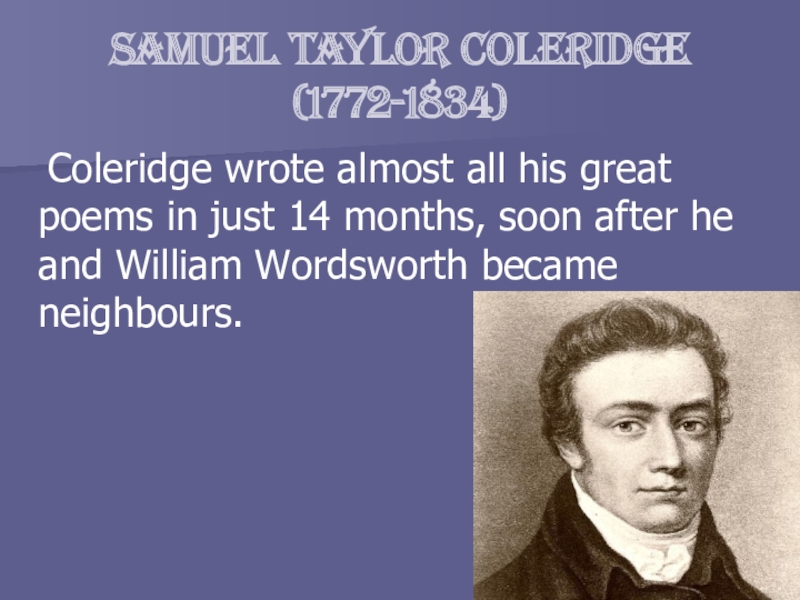
Coleridge wrote almost all his great poems
in just 14 months, soon after he and William Wordsworth became neighbours.
Слайд 16 Later on opium addiction, a desperately unhappy private life, severe psychological
problems destroyed Coleridge. He continued to write, but mainly literary criticism and social commentary. His lectures on general literature and philosophy are considered among his best works.
Слайд 17MAJOR WORKS
The Rime of the Ancient Mariner (1798),
Kubla Khan (1797),
Lyrical Ballads (1798)
Biographia Literaria (1817)
Seven Lectures Upon Shakespeare and Milton (1856)
Biographia Literaria (1817)
Seven Lectures Upon Shakespeare and Milton (1856)
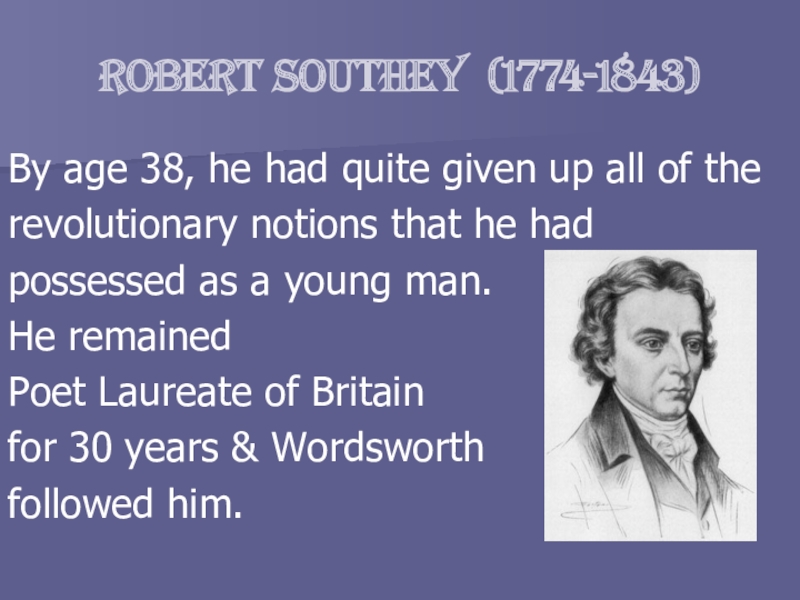
Слайд 18ROBERT SOUTHEY (1774-1843)
By age 38, he had quite given up all
of the
revolutionary notions that he had
possessed as a young man.
He remained
Poet Laureate of Britain
for 30 years & Wordsworth
followed him.
revolutionary notions that he had
possessed as a young man.
He remained
Poet Laureate of Britain
for 30 years & Wordsworth
followed him.
Слайд 19POET & PROSE WRITER: VERSATILE
As poet he produced epics, romances, ballads,
plays, monodramas, odes, sonnets, and lyrics.
His prose works include histories, biographies, essays, reviews, translations,, polemical dialogues, autobiography, anecdote, etc.
His prose works include histories, biographies, essays, reviews, translations,, polemical dialogues, autobiography, anecdote, etc.

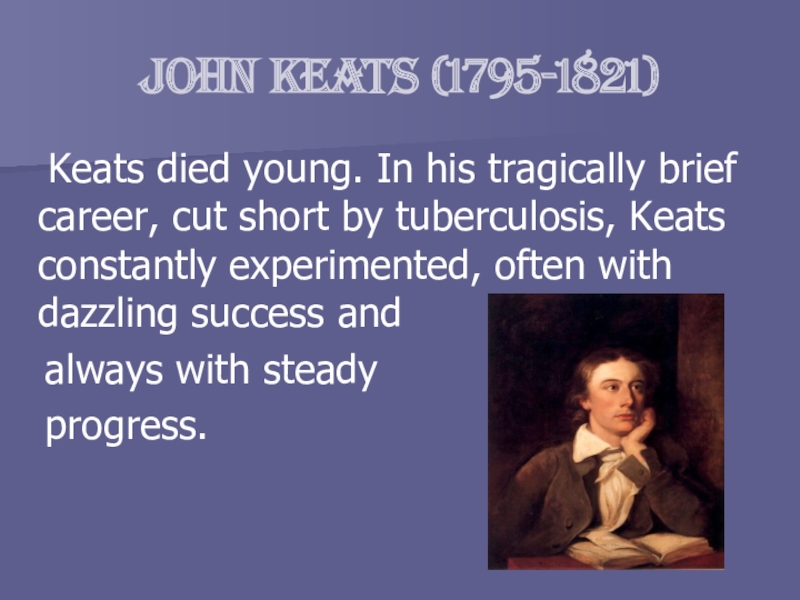
Слайд 22JOHN KEATS (1795-1821)
Keats died young. In his tragically brief career, cut
short by tuberculosis, Keats constantly experimented, often with dazzling success and
always with steady
progress.
always with steady
progress.
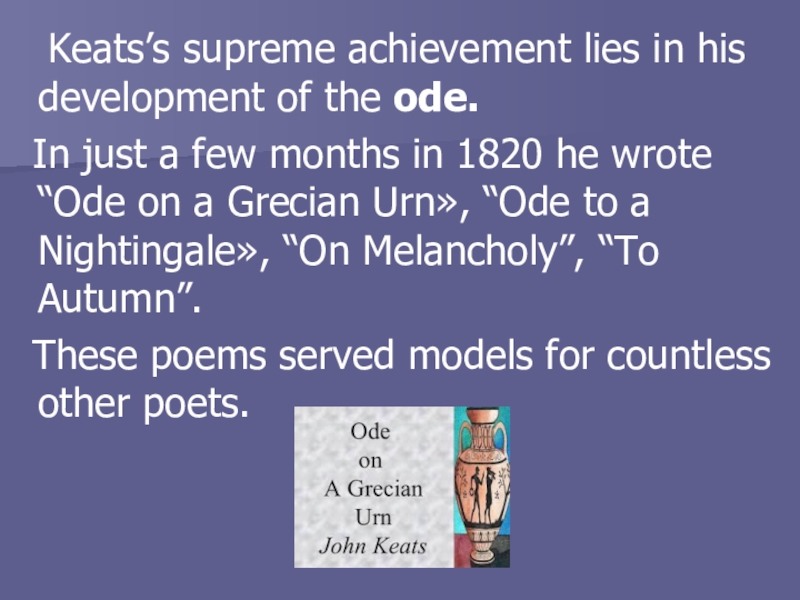
Слайд 23 Keats’s supreme achievement lies in his development of the ode.
In just a few months in 1820 he wrote “Ode on a Grecian Urn», “Ode to a Nightingale», “On Melancholy”, “To Autumn”.
These poems served models for countless other poets.
These poems served models for countless other poets.

Слайд 26PERCY BYSSHE SHELLEY
(1792-1822)
The most radical of the English Romantic poets.
He called for the complete overthrow of the existing order; was expelled from Oxford University because of his atheistic beliefs; quarreled with his wealthy father and was banished from home; married impulsively and abandoned his wife, running off to Italy with 16-year-old Mary Goldwin.

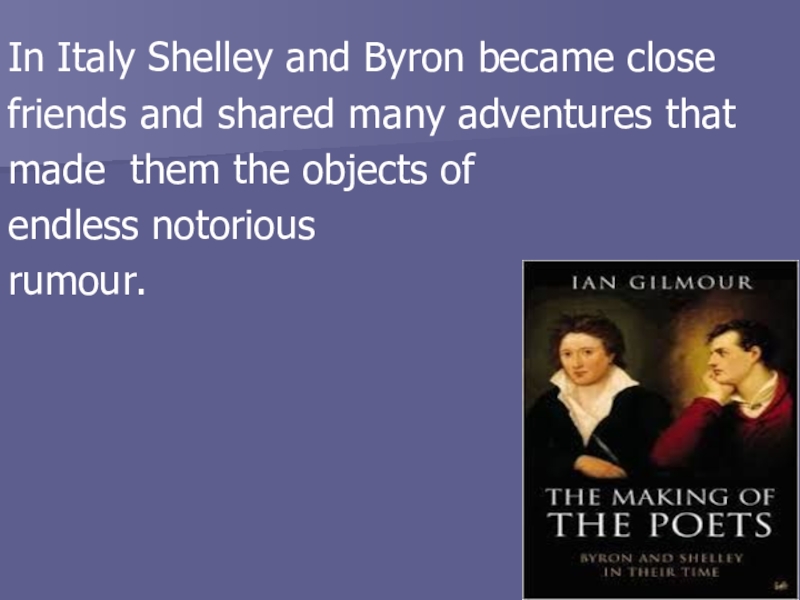
Слайд 27In Italy Shelley and Byron became close
friends and shared many
adventures that
made them the objects of
endless notorious
rumour.
made them the objects of
endless notorious
rumour.
Слайд 28Shelley’s life was cut short at the age of
30, when he
drowned in a boating
accident in Italy.
Like Keats his early death
has left future generations
frustrated at the thought
of what he might have produced if he
had lived longer.
accident in Italy.
Like Keats his early death
has left future generations
frustrated at the thought
of what he might have produced if he
had lived longer.
Слайд 29SHELLEY’S STYLE
Shelley is still the subject of keen debate. His “strangeness”
was a part of his originality; and he paid its price. To most of what was complex, institutional, traditional in his milieu, he remained inaccessible, intransigent .

Слайд 30 Shelley’s lyrics are marvellously varied and rich in sound and rhythm.
Wordsworth regarded Shelley as the best poet then living.

Слайд 32BYRON: LIFE FACTS
The life of George Gordon, Lord Byron, was so
notorious that it is almost impossible to disentangle fact from legend. A descendant of two aristocratic families, Byron at the age of 10 unexpectedly inherited his uncle’s title and estate and became the sixth Baron Byron of Rochdale. He was given the fine education at Harrow.
Слайд 33MORE FACTS
He was considered to be an extremely handsome in spite
of being lame. He was born with a clubfoot but became a superb athlete: a masterful swimmer, horseman, boxer, cricket player and fencer. His name was a synonym for the greatest of lovers as he had lots of love affairs with different women and scandals on moral ground. He was a member of the House of Lords and had radical views by the English standards of his day.
Слайд 34DEATH
He was celebrated as the highest of High Romantics and died
a Romantic death in Greece where he fought for its liberation against Turkish oppression.
Слайд 35К. РЫЛЕЕВ: «На смерть Бейрона» (1824)
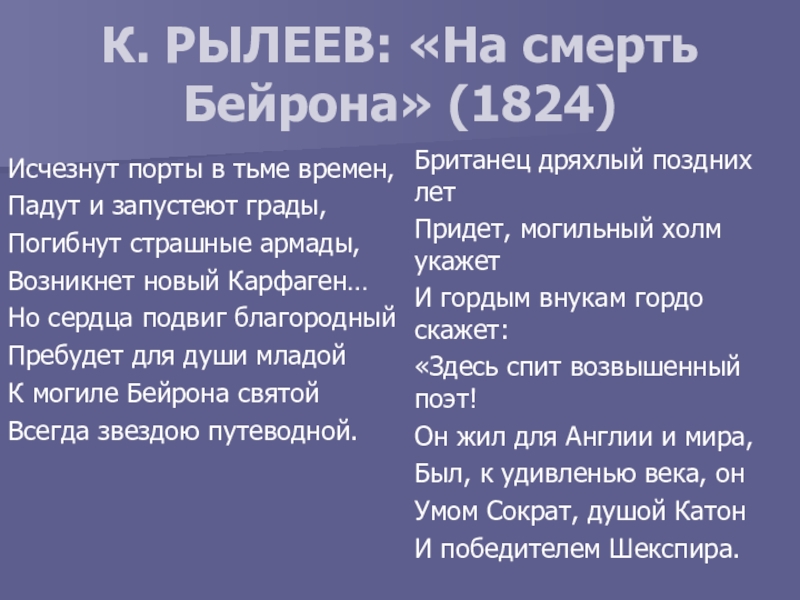
Исчезнут порты в тьме времен,
Падут и
запустеют грады,
Погибнут страшные армады,
Возникнет новый Карфаген…
Но сердца подвиг благородный
Пребудет для души младой
К могиле Бейрона святой
Всегда звездою путеводной.
Погибнут страшные армады,
Возникнет новый Карфаген…
Но сердца подвиг благородный
Пребудет для души младой
К могиле Бейрона святой
Всегда звездою путеводной.
Британец дряхлый поздних лет
Придет, могильный холм укажет
И гордым внукам гордо скажет:
«Здесь спит возвышенный поэт!
Он жил для Англии и мира,
Был, к удивленью века, он
Умом Сократ, душой Катон
И победителем Шекспира.

Слайд 37GREATNESS
His poetic gifts were enormous, and he worked brilliantly in
all poetic forms, from highly intellectual satires to exciting narratives of his adventure.

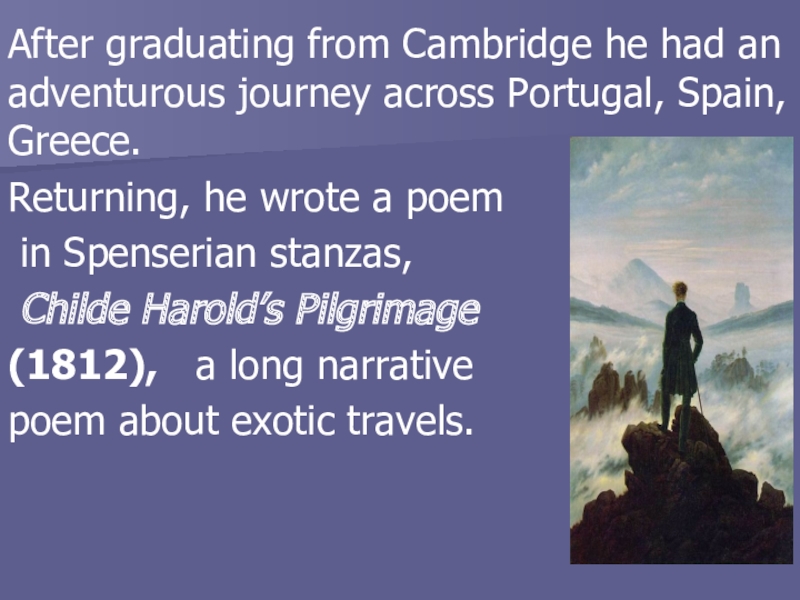
Слайд 38After graduating from Cambridge he had an adventurous journey across Portugal,
Spain, Greece.
Returning, he wrote a poem
in Spenserian stanzas,
Childe Harold’s Pilgrimage
(1812), a long narrative
poem about exotic travels.
Returning, he wrote a poem
in Spenserian stanzas,
Childe Harold’s Pilgrimage
(1812), a long narrative
poem about exotic travels.
Слайд 39 He was just 24 and in his own words,
“ I
awoke one morning and found myself famous.“
That was his first great
literary triumph.
That was his first great
literary triumph.

Слайд 40Byron is poet who lived his poetry. His “Byronic hero“ –
a powerful isolated romantic individualist, passionate, gloomy, and mysterious who is capable of brave acts, attractive to
women and self-sufficient.
women and self-sufficient.

Слайд 41 Byron is a romanticist when he introduces into his dramas super-natural
beings and a strong lyrical element, but a classicist when he draws his material from the beaten track of history and refuses to admit the intervention of a spirit-world into the affairs of men.

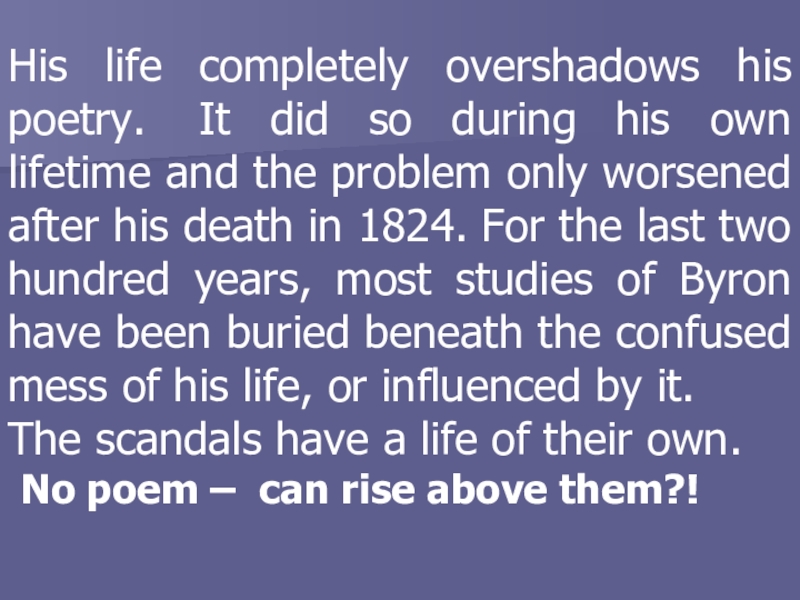
Слайд 43His life completely overshadows his poetry. It did so during his
own lifetime and the problem only worsened after his death in 1824. For the last two hundred years, most studies of Byron have been buried beneath the confused mess of his life, or influenced by it.
The scandals have a life of their own.
No poem – can rise above them?!
The scandals have a life of their own.
No poem – can rise above them?!
Слайд 44MAJOR WORKS
Childe Harold's Pilgrimage (1812–1818)
The Giaour (1813)
The Bride of
Abydos (1813)
The Corsair (1814)
Lara (1814)
Hebrew Melodies (1815)
Prometheus (1816)
Darkness (1816)
Manfred (1817) and others.
The Corsair (1814)
Lara (1814)
Hebrew Melodies (1815)
Prometheus (1816)
Darkness (1816)
Manfred (1817) and others.

Слайд 46Как он, ищу спокойствия напрасно,
Гоним повсюду мыслию одной.
Гляжу назад - прошедшее
ужасно;
Гляжу вперед - там нет души родной!
1830 г.
Гляжу вперед - там нет души родной!
1830 г.
Слайд 47TRANSLATE
Байрон был гражданином мира и как поэт, и как человек.
Увлечение байроновским
индивидуализмом, разочарованием и «мировой скорбью» получило название «байронизма».
В. Кюхельбекер (1824) о Байроне: «Бард - живописец смелых душ».
В. Кюхельбекер (1824) о Байроне: «Бард - живописец смелых душ».