school
October 2019
- Главная
- Разное
- Образование
- Спорт
- Естествознание
- Природоведение
- Религиоведение
- Французский язык
- Черчение
- Английский язык
- Астрономия
- Алгебра
- Биология
- География
- Геометрия
- Детские презентации
- Информатика
- История
- Литература
- Математика
- Музыка
- МХК
- Немецкий язык
- ОБЖ
- Обществознание
- Окружающий мир
- Педагогика
- Русский язык
- Технология
- Физика
- Философия
- Химия
- Шаблоны, фоны, картинки для презентаций
- Экология
- Экономика
Презентация, доклад на английском языке Театр - один из видов искусства
Содержание
- 1. Презентация на английском языке Театр - один из видов искусства
- 2. Theatre is a spectacular art form, which
- 3. At all times, the theater was a
- 4. History of TheatreThe theatre was born from
- 5. Antique theatre The ancient Greek theatre was
- 6. In those days, there were plays
- 7. Middle AgesAfter the fall of the
- 8. Theater in Russia The theatre
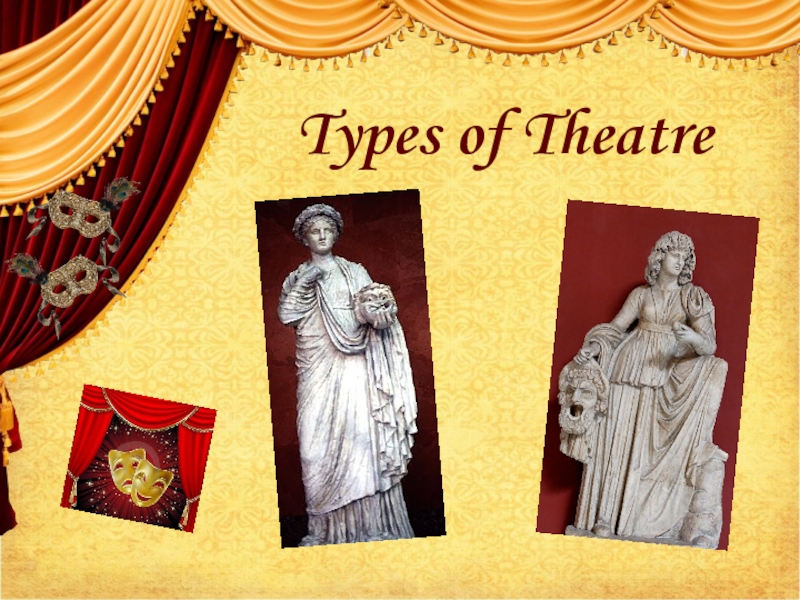
- 9. Types of Theatre
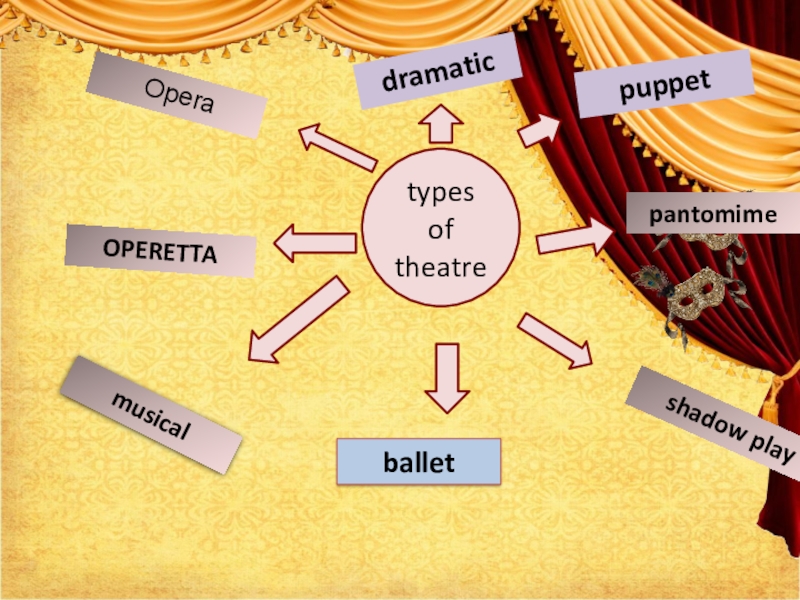
- 10. types of theatre shadow playpantomimemusicalOPERETTAballet Operadramaticpuppet
- 11. Drama A performance in a
- 12. Opera Opera is a synthetic form of
- 13. OperettaOperetta (small opera) - where actors speak, sing and dance, accompanied by an instrumental orchestra.
- 14. Вallet Ballet is a form of stage
- 15. Puppet theatre One of the varieties
- 16. Pantomime Pantomime is the art of
- 17. The shadow theatreThe shadow theatre is a
- 18. The musicalThe musical is a spectacular musical
- 19. Theatre– collective artA performance is the
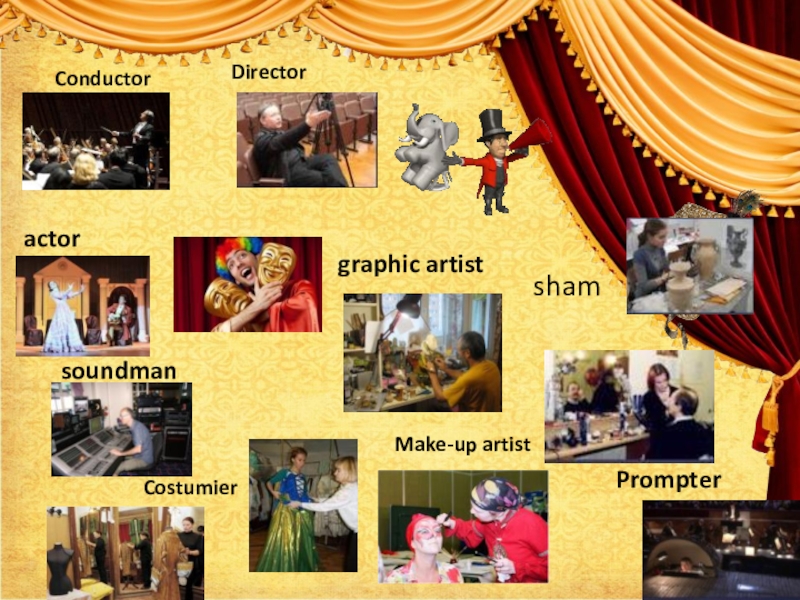
- 20. Make-up artistactorCostumiersoundmanDirectorConductorgraphic artistshamPrompter
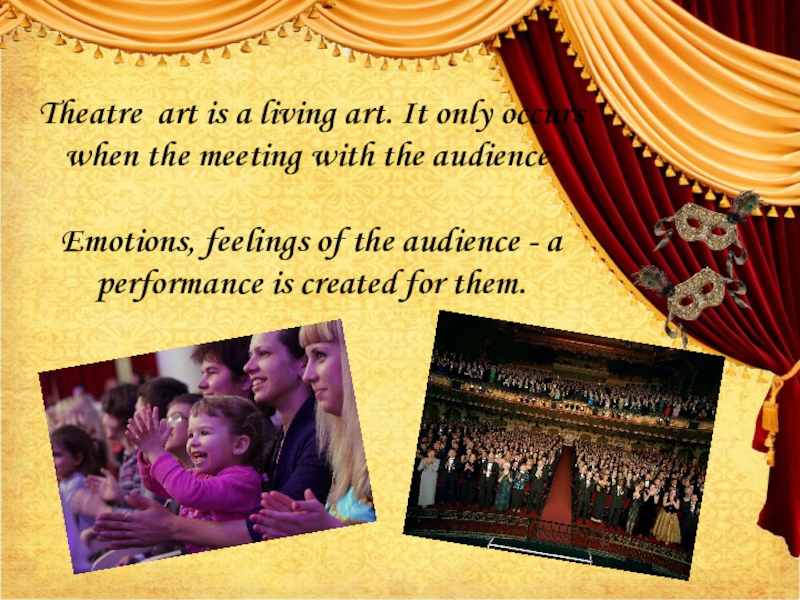
- 21. Theatre art is a living art. It
- 22. Nobody in the whole world has said
- 23. We, children, are fond of theatre .
- 24. Слайд 24
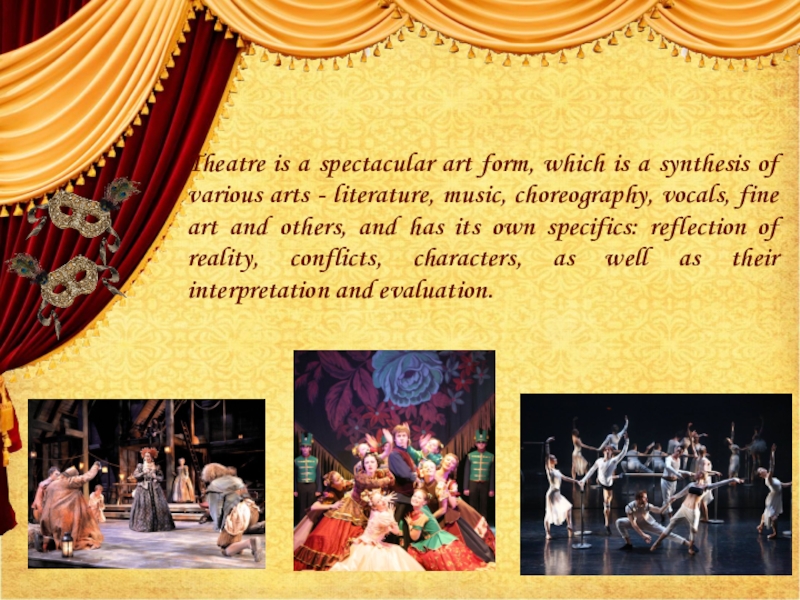
Theatre is a spectacular art form, which is a synthesis of various arts - literature, music, choreography, vocals, fine art and others, and has its own specifics: reflection of reality, conflicts, characters, as well as their
Слайд 2Theatre is a spectacular art form, which is a synthesis of
various arts - literature, music, choreography, vocals, fine art and others, and has its own specifics: reflection of reality, conflicts, characters, as well as their interpretation and evaluation.
Слайд 3At all times, the theater was a collective art. In a
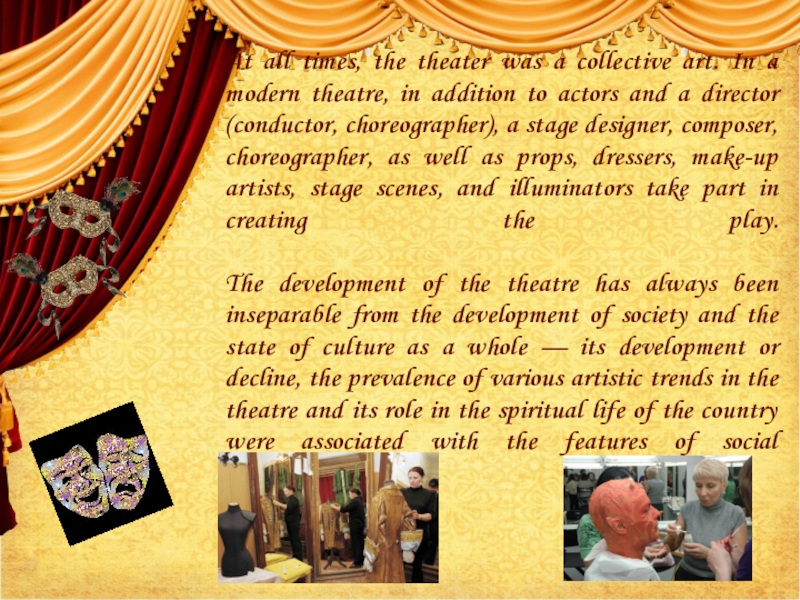
modern theatre, in addition to actors and a director (conductor, choreographer), a stage designer, composer, choreographer, as well as props, dressers, make-up artists, stage scenes, and illuminators take part in creating the play.
The development of the theatre has always been inseparable from the development of society and the state of culture as a whole — its development or decline, the prevalence of various artistic trends in the theatre and its role in the spiritual life of the country were associated with the features of social development.
Слайд 4History of Theatre
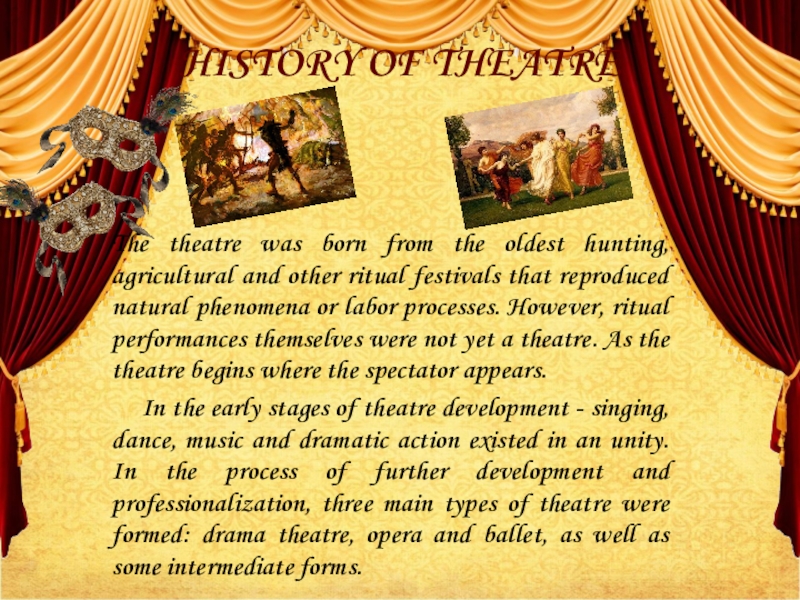
The theatre was born from the oldest hunting, agricultural
and other ritual festivals that reproduced natural phenomena or labor processes. However, ritual performances themselves were not yet a theatre. As the theatre begins where the spectator appears.
In the early stages of theatre development - singing, dance, music and dramatic action existed in an unity. In the process of further development and professionalization, three main types of theatre were formed: drama theatre, opera and ballet, as well as some intermediate forms.
In the early stages of theatre development - singing, dance, music and dramatic action existed in an unity. In the process of further development and professionalization, three main types of theatre were formed: drama theatre, opera and ballet, as well as some intermediate forms.
Слайд 5Antique theatre
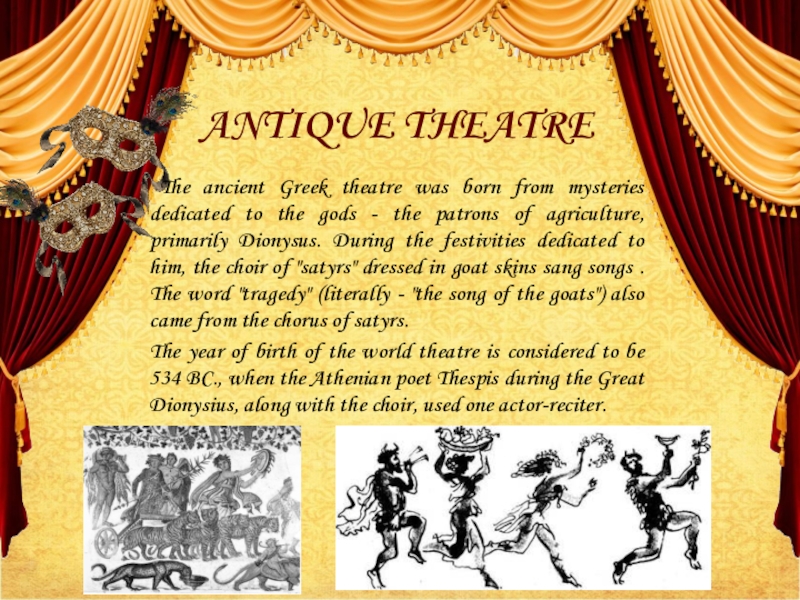
The ancient Greek theatre was born from mysteries dedicated
to the gods - the patrons of agriculture, primarily Dionysus. During the festivities dedicated to him, the choir of "satyrs" dressed in goat skins sang songs . The word "tragedy" (literally - "the song of the goats") also came from the chorus of satyrs.
The year of birth of the world theatre is considered to be 534 BC., when the Athenian poet Thespis during the Great Dionysius, along with the choir, used one actor-reciter.
The year of birth of the world theatre is considered to be 534 BC., when the Athenian poet Thespis during the Great Dionysius, along with the choir, used one actor-reciter.
Слайд 6 In those days, there were plays of only two genres
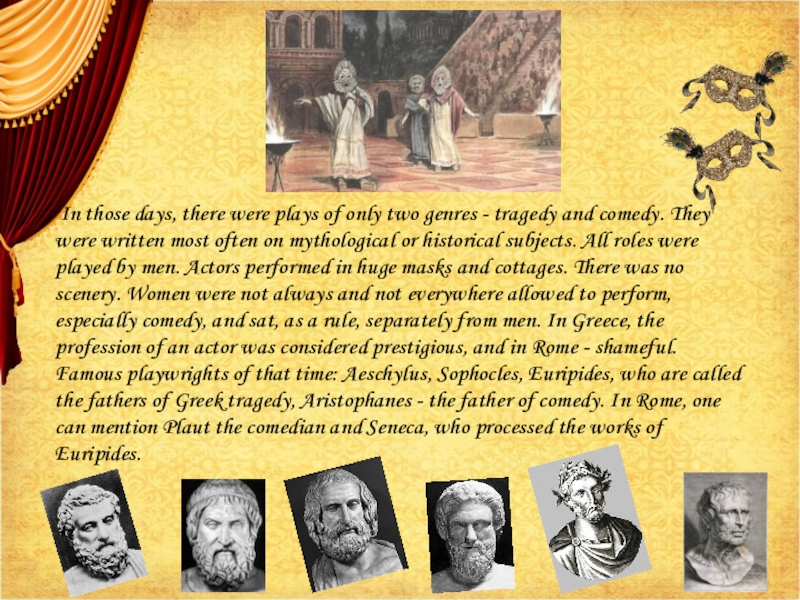
- tragedy and comedy. They were written most often on mythological or historical subjects. All roles were played by men. Actors performed in huge masks and cottages. There was no scenery. Women were not always and not everywhere allowed to perform, especially comedy, and sat, as a rule, separately from men. In Greece, the profession of an actor was considered prestigious, and in Rome - shameful.
Famous playwrights of that time: Aeschylus, Sophocles, Euripides, who are called the fathers of Greek tragedy, Aristophanes - the father of comedy. In Rome, one can mention Plaut the comedian and Seneca, who processed the works of Euripides.
Слайд 7Middle Ages
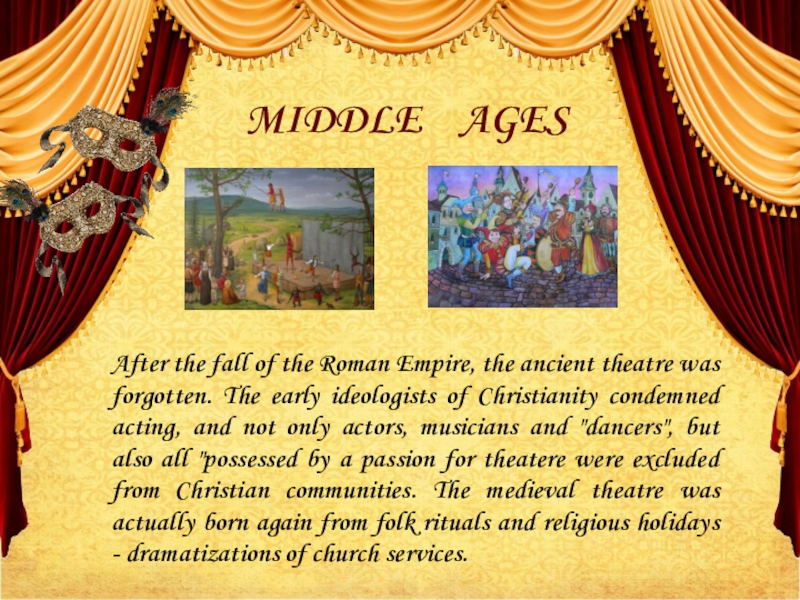
After the fall of the Roman Empire, the ancient
theatre was forgotten. The early ideologists of Christianity condemned acting, and not only actors, musicians and "dancers", but also all "possessed by a passion for theatere were excluded from Christian communities. The medieval theatre was actually born again from folk rituals and religious holidays - dramatizations of church services.
Слайд 8Theater in Russia
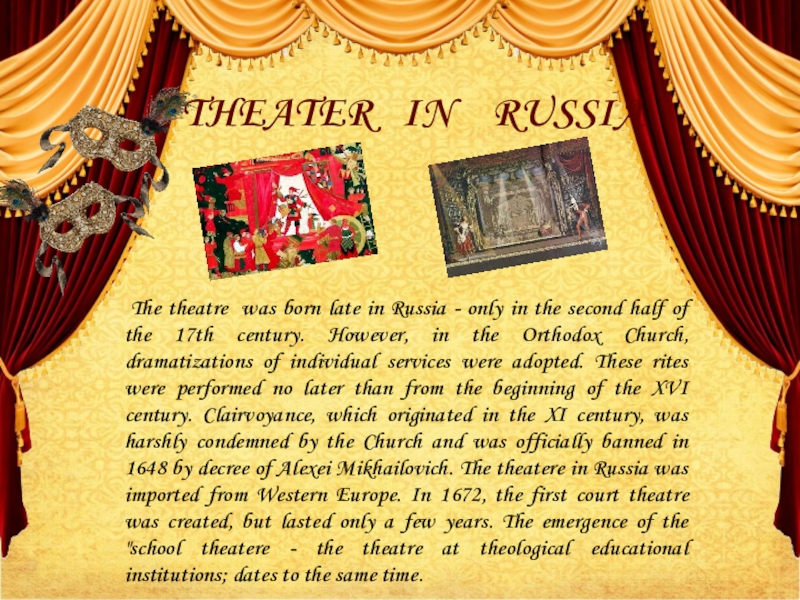
The theatre was born late in
Russia - only in the second half of the 17th century. However, in the Orthodox Church, dramatizations of individual services were adopted. These rites were performed no later than from the beginning of the XVI century. Clairvoyance, which originated in the XI century, was harshly condemned by the Church and was officially banned in 1648 by decree of Alexei Mikhailovich. The theatere in Russia was imported from Western Europe. In 1672, the first court theatre was created, but lasted only a few years. The emergence of the "school theatere - the theatre at theological educational institutions; dates to the same time.
Слайд 11 Drama
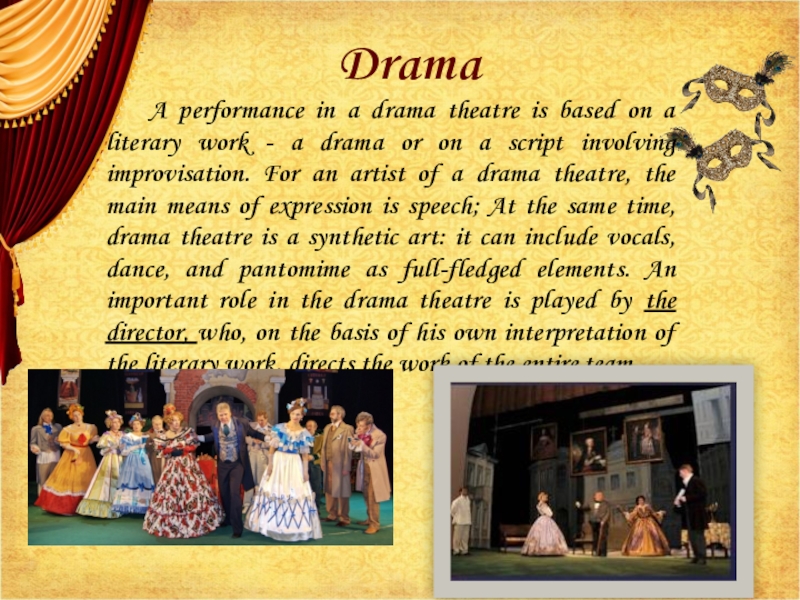
A performance in a drama theatre is based
on a literary work - a drama or on a script involving improvisation. For an artist of a drama theatre, the main means of expression is speech; At the same time, drama theatre is a synthetic art: it can include vocals, dance, and pantomime as full-fledged elements. An important role in the drama theatre is played by the director, who, on the basis of his own interpretation of the literary work, directs the work of the entire team.
Слайд 12Opera
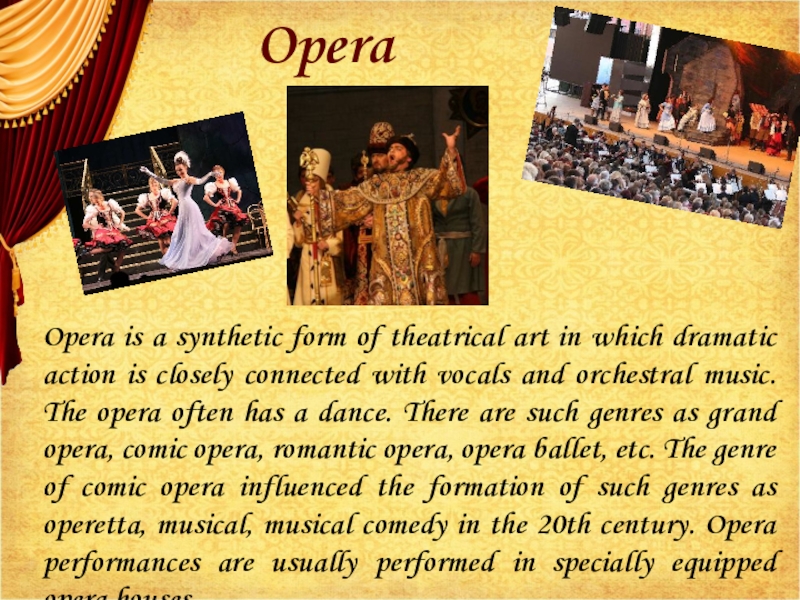
Opera is a synthetic form of theatrical art in which
dramatic action is closely connected with vocals and orchestral music. The opera often has a dance. There are such genres as grand opera, comic opera, romantic opera, opera ballet, etc. The genre of comic opera influenced the formation of such genres as operetta, musical, musical comedy in the 20th century. Opera performances are usually performed in specially equipped opera houses.
Слайд 13Operetta
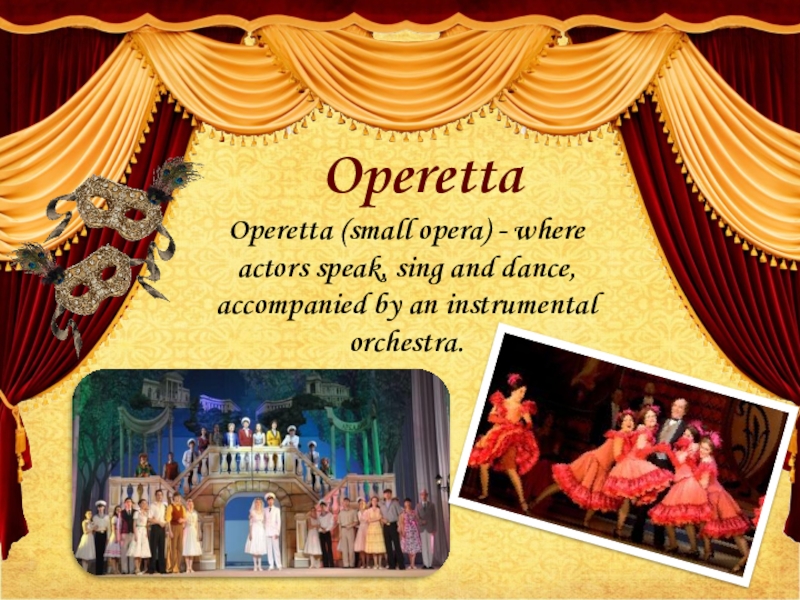
Operetta (small opera) - where actors speak, sing and dance, accompanied
by an instrumental orchestra.
Слайд 14Вallet
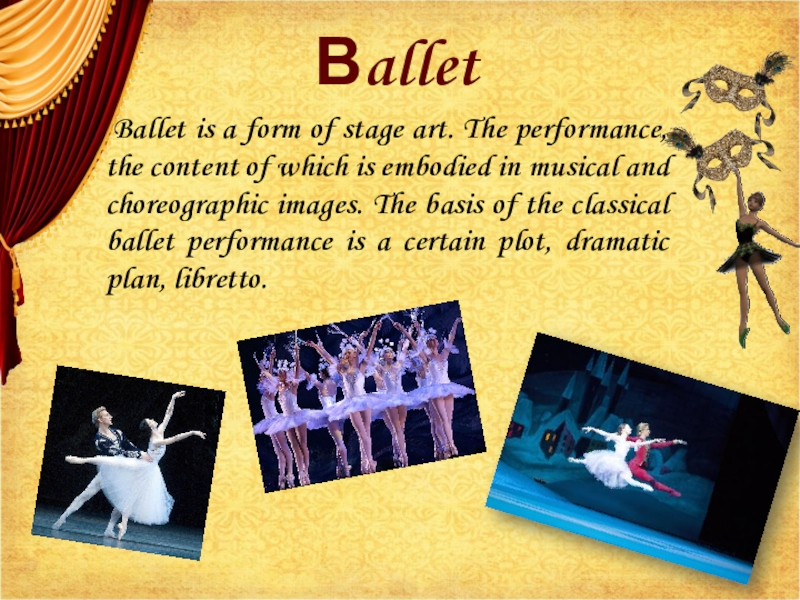
Ballet is a form of stage art. The performance, the
content of which is embodied in musical and choreographic images. The basis of the classical ballet performance is a certain plot, dramatic plan, libretto.
Слайд 15Puppet theatre
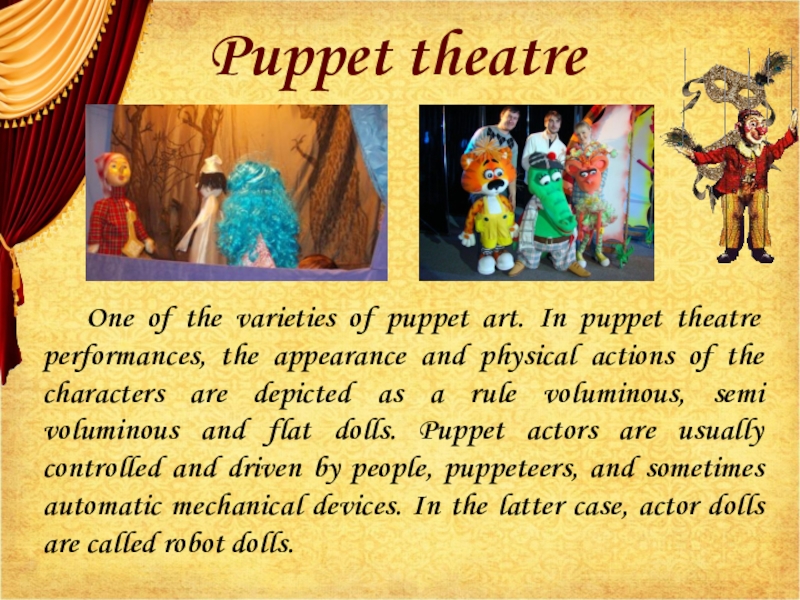
One of the varieties of puppet art. In
puppet theatre performances, the appearance and physical actions of the characters are depicted as a rule voluminous, semi voluminous and flat dolls. Puppet actors are usually controlled and driven by people, puppeteers, and sometimes automatic mechanical devices. In the latter case, actor dolls are called robot dolls.
Слайд 16Pantomime
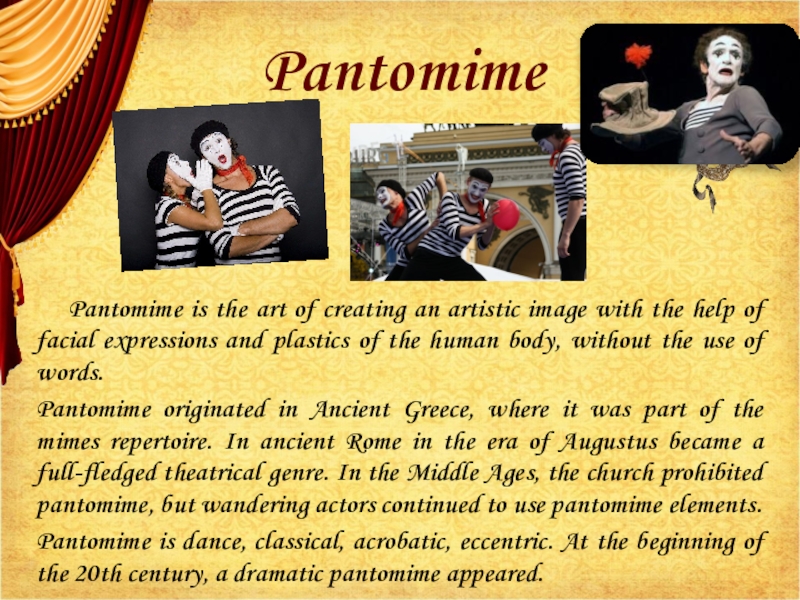
Pantomime is the art of creating an artistic image
with the help of facial expressions and plastics of the human body, without the use of words.
Pantomime originated in Ancient Greece, where it was part of the mimes repertoire. In ancient Rome in the era of Augustus became a full-fledged theatrical genre. In the Middle Ages, the church prohibited pantomime, but wandering actors continued to use pantomime elements.
Pantomime is dance, classical, acrobatic, eccentric. At the beginning of the 20th century, a dramatic pantomime appeared.
Pantomime originated in Ancient Greece, where it was part of the mimes repertoire. In ancient Rome in the era of Augustus became a full-fledged theatrical genre. In the Middle Ages, the church prohibited pantomime, but wandering actors continued to use pantomime elements.
Pantomime is dance, classical, acrobatic, eccentric. At the beginning of the 20th century, a dramatic pantomime appeared.
Слайд 17The shadow theatre
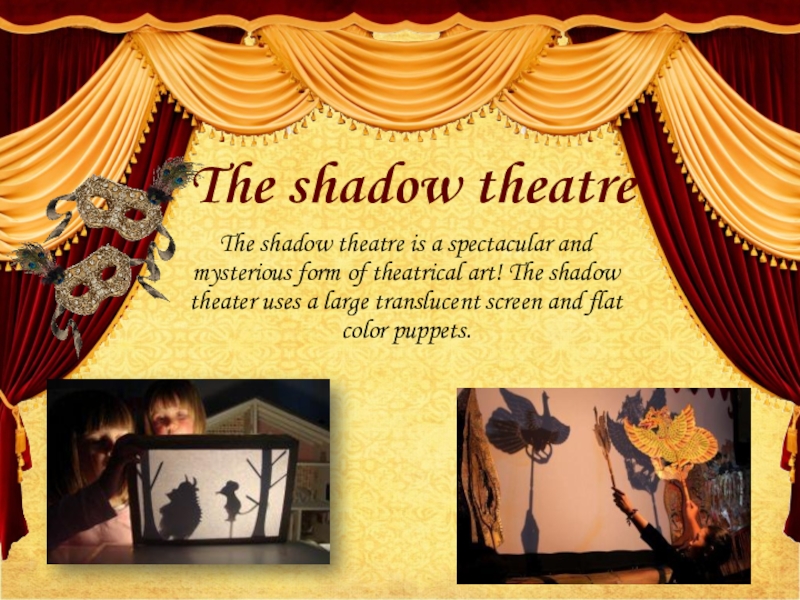
The shadow theatre is a spectacular and mysterious form
of theatrical art! The shadow theater uses a large translucent screen and flat color puppets.
Слайд 18The musical
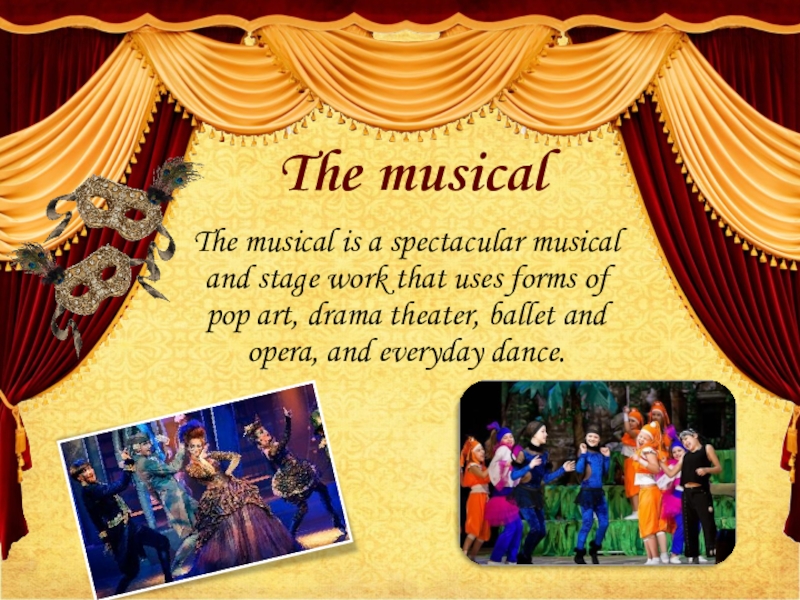
The musical is a spectacular musical and stage work that
uses forms of pop art, drama theater, ballet and opera, and everyday dance.
Слайд 19Theatre–
collective art
A performance is the result of the activities of
many people, not only those who appear on the stage, but also those who sew costumes, master props, set light, and voice the performance.
Слайд 21Theatre art is a living art. It only occurs when the
meeting with the audience.
Emotions, feelings of the audience - a performance is created for them.
Emotions, feelings of the audience - a performance is created for them.
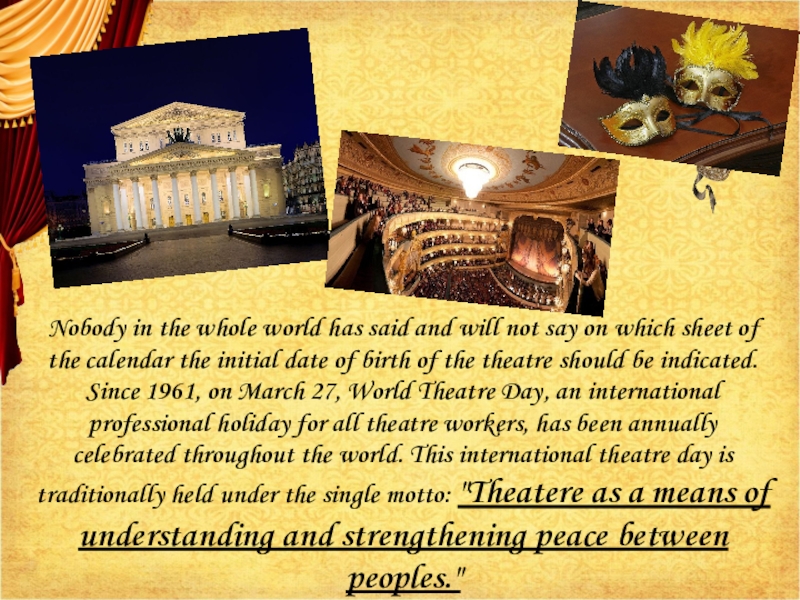
Слайд 22Nobody in the whole world has said and will not say
on which sheet of the calendar the initial date of birth of the theatre should be indicated. Since 1961, on March 27, World Theatre Day, an international professional holiday for all theatre workers, has been annually celebrated throughout the world. This international theatre day is traditionally held under the single motto: "Theatere as a means of understanding and strengthening peace between peoples."
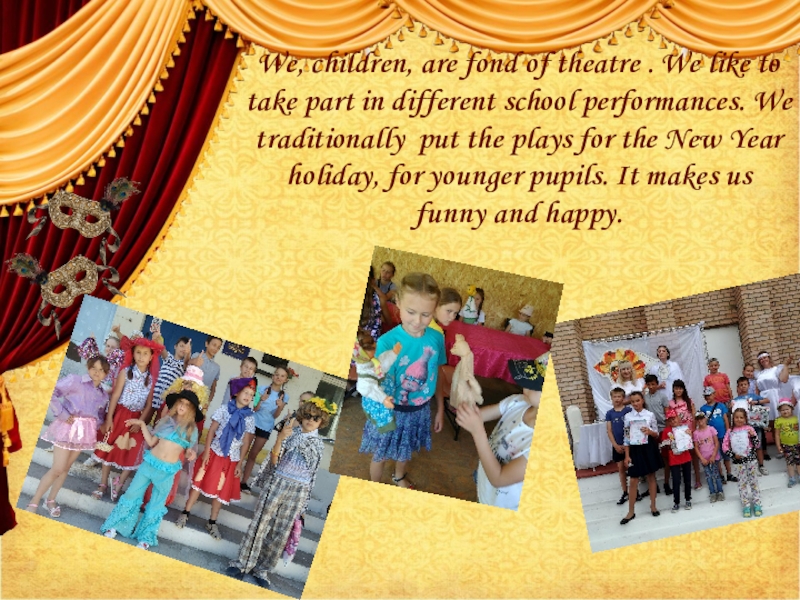
Слайд 23We, children, are fond of theatre . We like to take
part in different school performances. We traditionally put the plays for the New Year holiday, for younger pupils. It makes us
funny and happy.