- Главная
- Разное
- Образование
- Спорт
- Естествознание
- Природоведение
- Религиоведение
- Французский язык
- Черчение
- Английский язык
- Астрономия
- Алгебра
- Биология
- География
- Геометрия
- Детские презентации
- Информатика
- История
- Литература
- Математика
- Музыка
- МХК
- Немецкий язык
- ОБЖ
- Обществознание
- Окружающий мир
- Педагогика
- Русский язык
- Технология
- Физика
- Философия
- Химия
- Шаблоны, фоны, картинки для презентаций
- Экология
- Экономика
Презентация, доклад на английском языке на тему Уэльс и Северная Ирландия
Содержание
- 1. Презентация на английском языке на тему Уэльс и Северная Ирландия
- 2. Things to Know Area:8,019 square miles.Population:2,857,000Capital: CardiffLanguage:
- 3. Flag and emblem of Wales
- 4. History Wales
- 5. Places of interest Cardiff has been
- 6. Beaumaris on Anglesey Island is among
- 7. Caernarfron is a peaceful resort. Caernarfron
- 8. Llangollen is well known among music lovers
- 9. Dolgellau is a good center for
- 10. Things to KnowArea:5,463 square milesPopulation:1,5 million people.Religion:
- 11. Flag and emblem of Northern Ireland
- 12. HistoryColonies of English and Scottish settlers were
- 13. Places of interestBelfast is the capital and
- 14. Londonderry is county capital and a port.
- 15. Newcastle is a small
- 16. Presentation by the student of class 8-B Maria Cherepenina
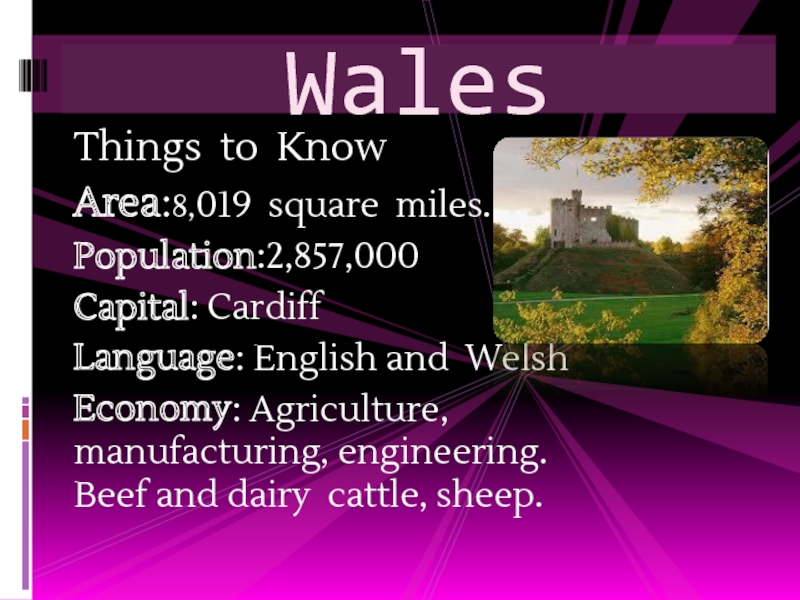
Things to Know Area:8,019 square miles.Population:2,857,000Capital: CardiffLanguage: English and WelshEconomy: Agriculture, manufacturing, engineering. Beef and dairy cattle, sheep.Wales
Слайд 2Things to Know
Area:8,019 square miles.
Population:2,857,000
Capital: Cardiff
Language: English and Welsh
Economy: Agriculture,
manufacturing, engineering. Beef and dairy cattle, sheep.
Wales
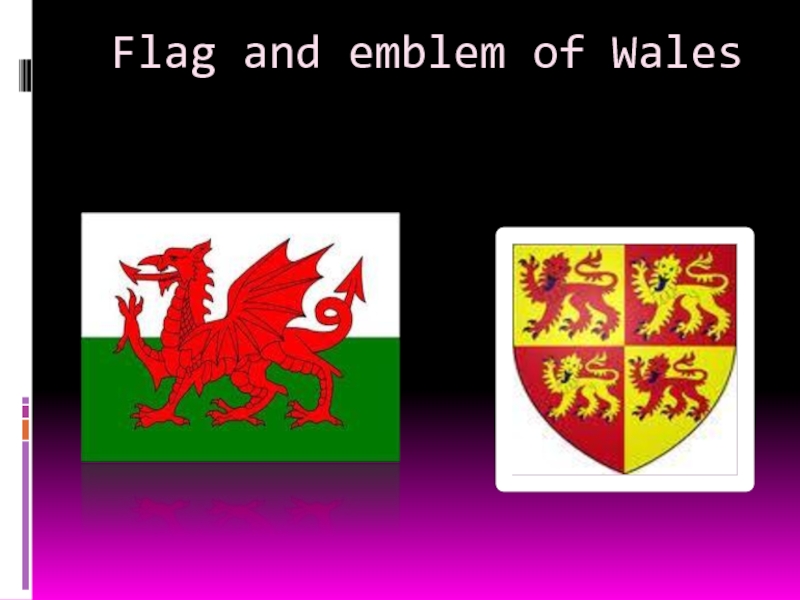
Слайд 4History
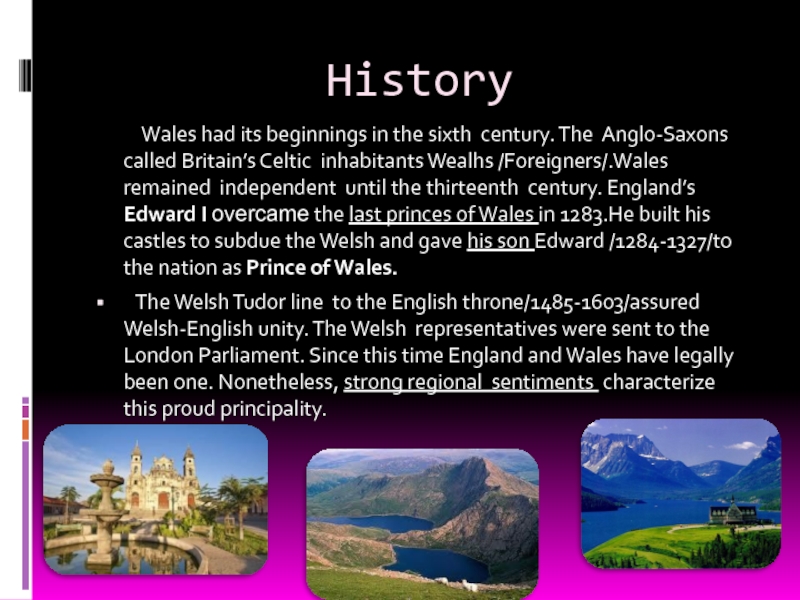
Wales had its beginnings in
the sixth century. The Anglo-Saxons called Britain’s Celtic inhabitants Wealhs /Foreigners/.Wales remained independent until the thirteenth century. England’s Edward I overcame the last princes of Wales in 1283.He built his castles to subdue the Welsh and gave his son Edward /1284-1327/to the nation as Prince of Wales.
The Welsh Tudor line to the English throne/1485-1603/assured Welsh-English unity. The Welsh representatives were sent to the London Parliament. Since this time England and Wales have legally been one. Nonetheless, strong regional sentiments characterize this proud principality.
The Welsh Tudor line to the English throne/1485-1603/assured Welsh-English unity. The Welsh representatives were sent to the London Parliament. Since this time England and Wales have legally been one. Nonetheless, strong regional sentiments characterize this proud principality.
Слайд 5Places of interest
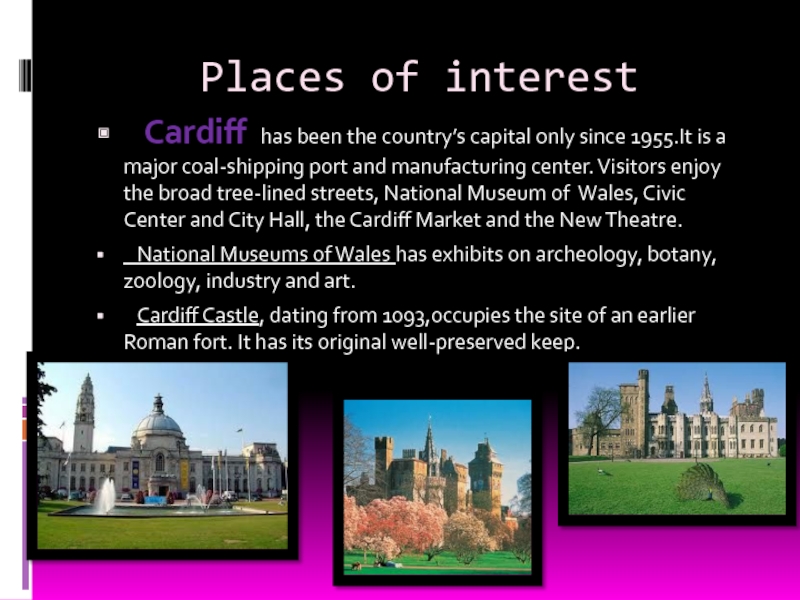
Cardiff has been the country’s capital only
since 1955.It is a major coal-shipping port and manufacturing center. Visitors enjoy the broad tree-lined streets, National Museum of Wales, Civic Center and City Hall, the Cardiff Market and the New Theatre.
National Museums of Wales has exhibits on archeology, botany, zoology, industry and art.
Cardiff Castle, dating from 1093,occupies the site of an earlier Roman fort. It has its original well-preserved keep.
National Museums of Wales has exhibits on archeology, botany, zoology, industry and art.
Cardiff Castle, dating from 1093,occupies the site of an earlier Roman fort. It has its original well-preserved keep.
Слайд 6
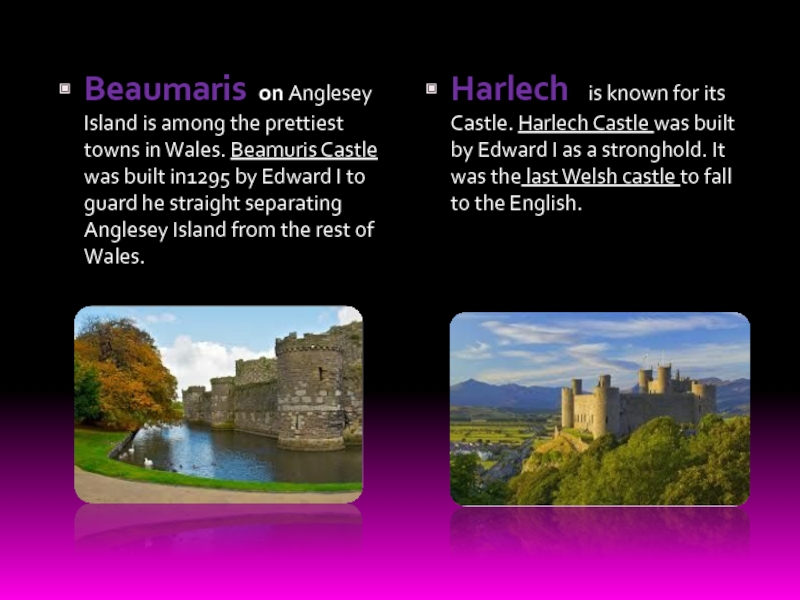
Beaumaris on Anglesey Island is among the prettiest towns in
Wales. Beamuris Castle was built in1295 by Edward I to guard he straight separating Anglesey Island from the rest of Wales.
Harlech is known for its Castle. Harlech Castle was built by Edward I as a stronghold. It was the last Welsh castle to fall to the English.
Слайд 7 Caernarfron is a peaceful resort. Caernarfron Castle dominates the town.
The first English Prince of Wales, Edward II was born in Caernarfon in 1284.His investiture at the castle in 1301 began the tradition that extends through the investiture of Prince Charles in 1969.Snowdon Mountain Railway operates coal-fired steam locomotives, which clime the 4 miles to the summit of Snowdon.
Llandudno is a large resort. The statue of Lewis Carrol/1832-98/recalls that the author often came to Llandudno to visit the Liddells and their daughter Alice, for whom he wrote his best known story .
Llandudno is a large resort. The statue of Lewis Carrol/1832-98/recalls that the author often came to Llandudno to visit the Liddells and their daughter Alice, for whom he wrote his best known story .
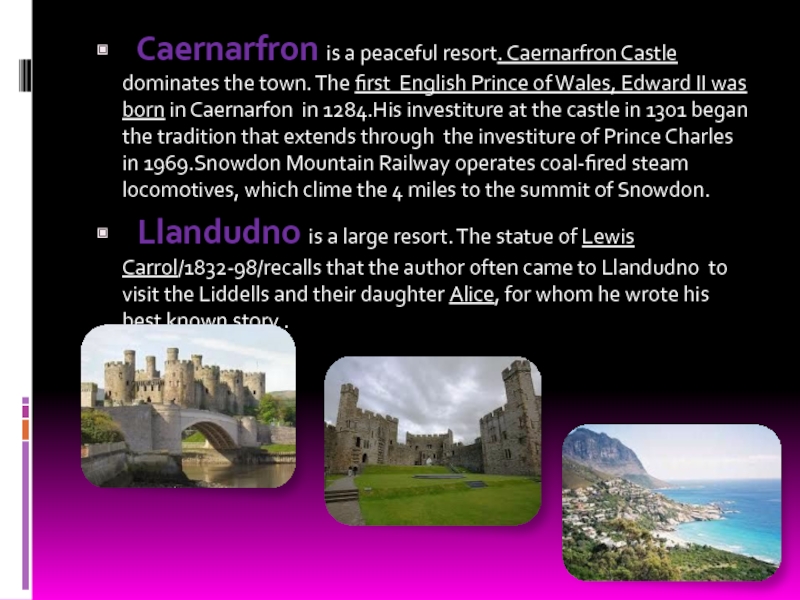
Слайд 8Llangollen is well known among music lovers as the site of
the International Musical Eisteddfod, held since 1947.Every July folk singers and dancers from around the world compete here.
Swansea is metallurgical center of Wales. This second largest city of Wales is the site of the University College of Swansea, the Glynn Vivian Art gallery and the Royal Institution of South Wales.
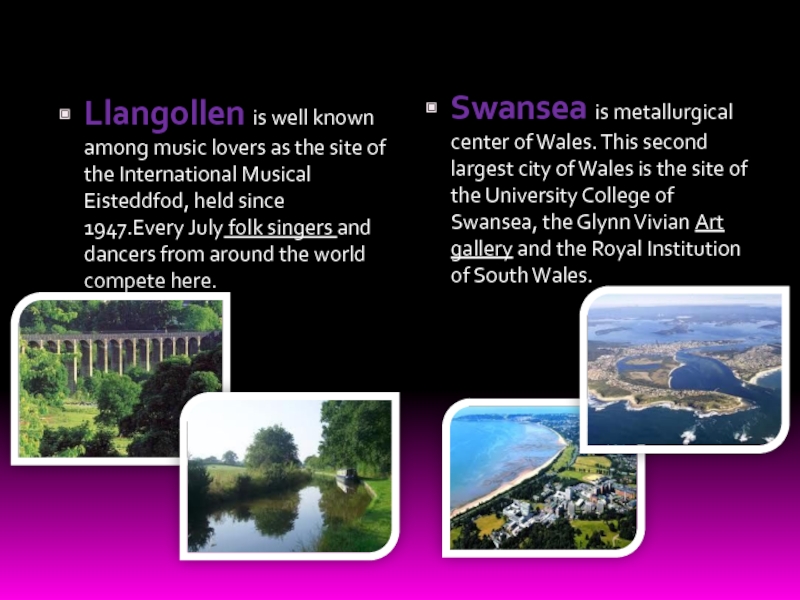
Слайд 9 Dolgellau is a good center for walking or pony trekking.
More challenging are possible climbs up Cader Idris, the 3,000-foot mountain that dominates the skyline of Dolgellau. Visitors are warned of the myth attached to the mountain: Whoever spends the night on Cader Idris risks waking the next day mad or a poet.
Laugharne is best known as a home of writer Dylan Thomas/1914-1953/.Many contend that the town served as a model for Under Milk Wood. Dylan Thomas’ Boat House was the riverside home of the poet for 16 years.As audiovisual presentation tells about the poet.
Laugharne is best known as a home of writer Dylan Thomas/1914-1953/.Many contend that the town served as a model for Under Milk Wood. Dylan Thomas’ Boat House was the riverside home of the poet for 16 years.As audiovisual presentation tells about the poet.
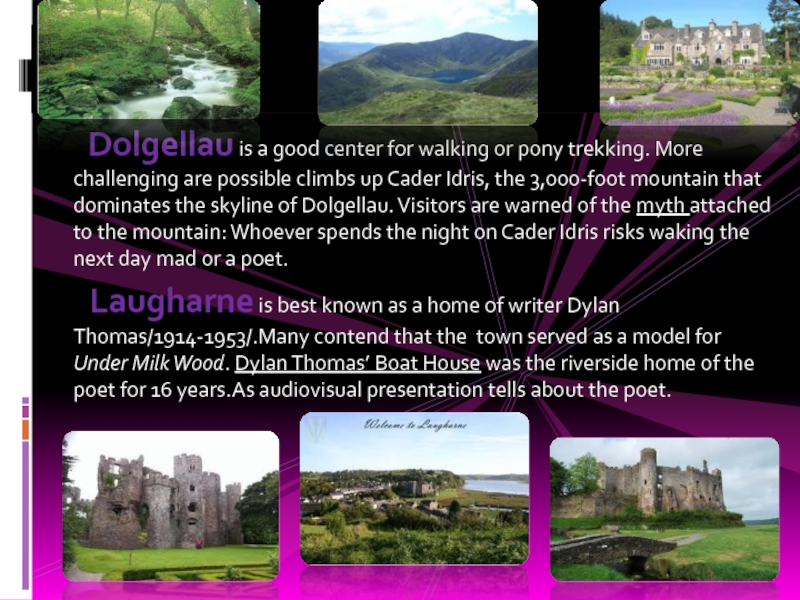
Слайд 10Things to Know
Area:5,463 square miles
Population:1,5 million people.
Religion: Roman Catholic/36%/,Presbyterian/30%/,Church of England/25%/
Capital:
Belfast.
Language: English
Economy: agriculture, industry and tourism.
Northern Ireland occupies the northern fifth of Ireland. It is a division of the United Kingdom. Only 2% of the land is forested.
Language: English
Economy: agriculture, industry and tourism.
Northern Ireland occupies the northern fifth of Ireland. It is a division of the United Kingdom. Only 2% of the land is forested.
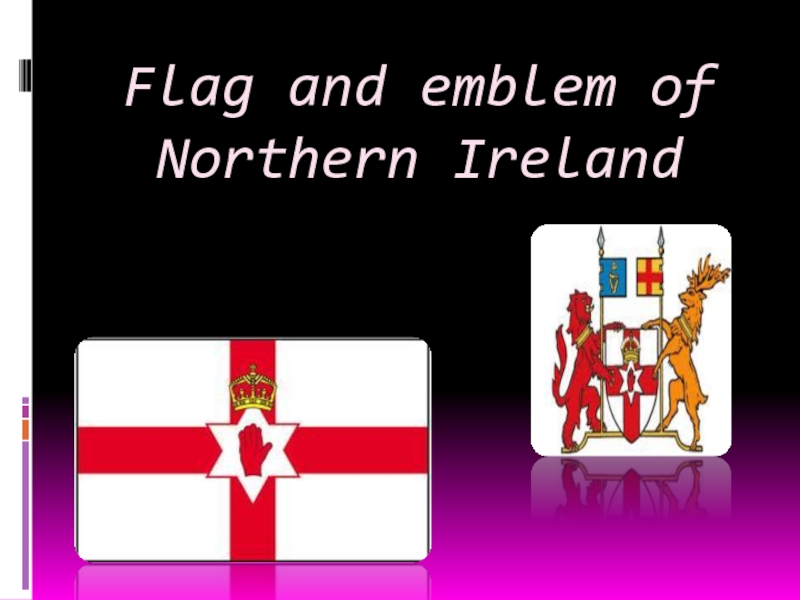
Northern Ireland
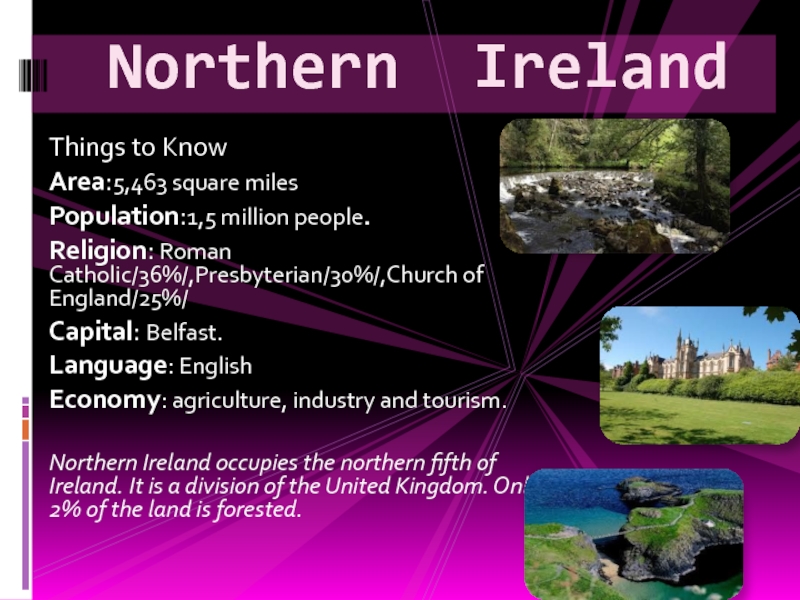
Слайд 12History
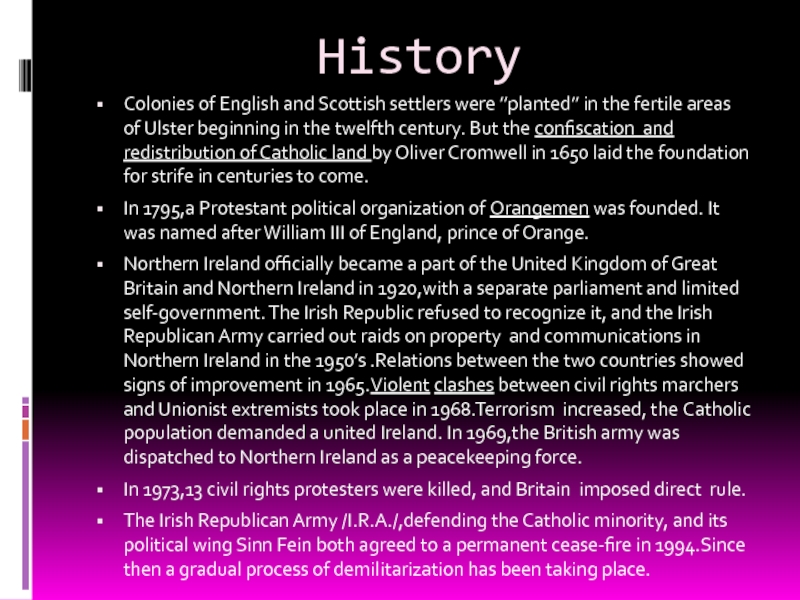
Colonies of English and Scottish settlers were ’’planted’’ in the fertile
areas of Ulster beginning in the twelfth century. But the confiscation and redistribution of Catholic land by Oliver Cromwell in 1650 laid the foundation for strife in centuries to come.
In 1795,a Protestant political organization of Orangemen was founded. It was named after William III of England, prince of Orange.
Northern Ireland officially became a part of the United Kingdom of Great Britain and Northern Ireland in 1920,with a separate parliament and limited self-government. The Irish Republic refused to recognize it, and the Irish Republican Army carried out raids on property and communications in Northern Ireland in the 1950’s .Relations between the two countries showed signs of improvement in 1965.Violent clashes between civil rights marchers and Unionist extremists took place in 1968.Terrorism increased, the Catholic population demanded a united Ireland. In 1969,the British army was dispatched to Northern Ireland as a peacekeeping force.
In 1973,13 civil rights protesters were killed, and Britain imposed direct rule.
The Irish Republican Army /I.R.A./,defending the Catholic minority, and its political wing Sinn Fein both agreed to a permanent cease-fire in 1994.Since then a gradual process of demilitarization has been taking place.
In 1795,a Protestant political organization of Orangemen was founded. It was named after William III of England, prince of Orange.
Northern Ireland officially became a part of the United Kingdom of Great Britain and Northern Ireland in 1920,with a separate parliament and limited self-government. The Irish Republic refused to recognize it, and the Irish Republican Army carried out raids on property and communications in Northern Ireland in the 1950’s .Relations between the two countries showed signs of improvement in 1965.Violent clashes between civil rights marchers and Unionist extremists took place in 1968.Terrorism increased, the Catholic population demanded a united Ireland. In 1969,the British army was dispatched to Northern Ireland as a peacekeeping force.
In 1973,13 civil rights protesters were killed, and Britain imposed direct rule.
The Irish Republican Army /I.R.A./,defending the Catholic minority, and its political wing Sinn Fein both agreed to a permanent cease-fire in 1994.Since then a gradual process of demilitarization has been taking place.
Слайд 13Places of interest
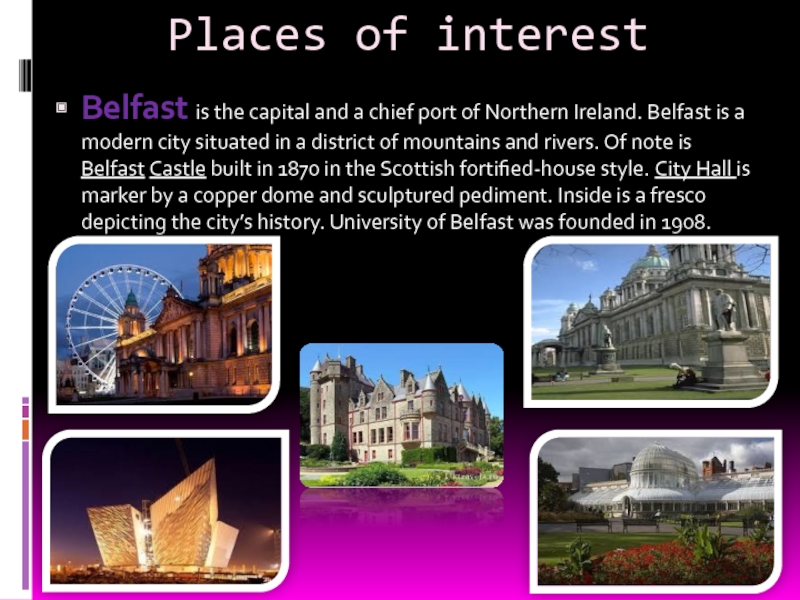
Belfast is the capital and a chief port of
Northern Ireland. Belfast is a modern city situated in a district of mountains and rivers. Of note is Belfast Castle built in 1870 in the Scottish fortified-house style. City Hall is marker by a copper dome and sculptured pediment. Inside is a fresco depicting the city’s history. University of Belfast was founded in 1908.
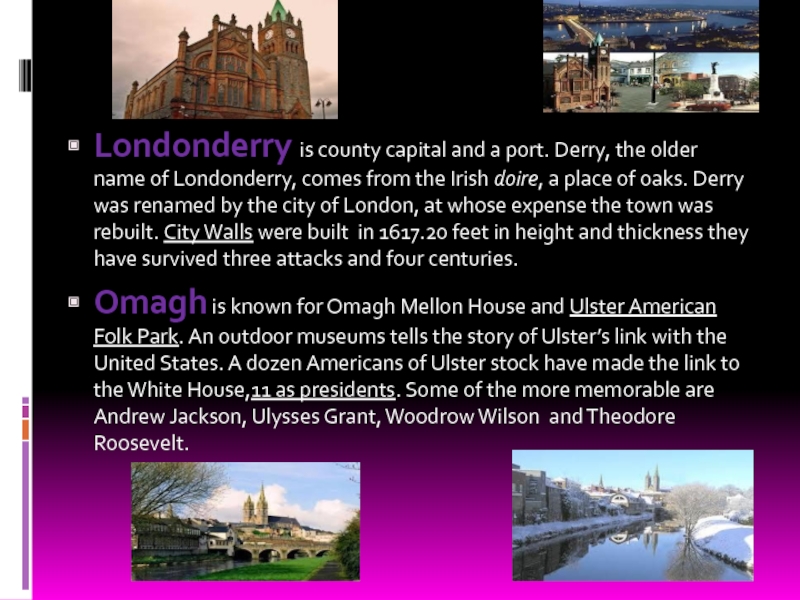
Слайд 14Londonderry is county capital and a port. Derry, the older name
of Londonderry, comes from the Irish doire, a place of oaks. Derry was renamed by the city of London, at whose expense the town was rebuilt. City Walls were built in 1617.20 feet in height and thickness they have survived three attacks and four centuries.
Omagh is known for Omagh Mellon House and Ulster American Folk Park. An outdoor museums tells the story of Ulster’s link with the United States. A dozen Americans of Ulster stock have made the link to the White House,11 as presidents. Some of the more memorable are Andrew Jackson, Ulysses Grant, Woodrow Wilson and Theodore Roosevelt.
Omagh is known for Omagh Mellon House and Ulster American Folk Park. An outdoor museums tells the story of Ulster’s link with the United States. A dozen Americans of Ulster stock have made the link to the White House,11 as presidents. Some of the more memorable are Andrew Jackson, Ulysses Grant, Woodrow Wilson and Theodore Roosevelt.
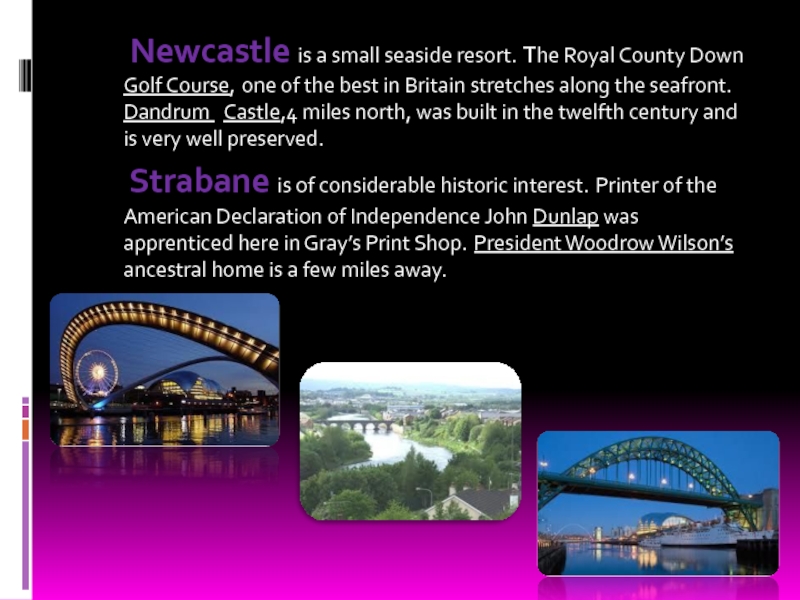
Слайд 15 Newcastle is a small seaside resort. The Royal
County Down Golf Course, one of the best in Britain stretches along the seafront. Dandrum Castle,4 miles north, was built in the twelfth century and is very well preserved.
Strabane is of considerable historic interest. Printer of the American Declaration of Independence John Dunlap was apprenticed here in Gray’s Print Shop. President Woodrow Wilson’s ancestral home is a few miles away.
Strabane is of considerable historic interest. Printer of the American Declaration of Independence John Dunlap was apprenticed here in Gray’s Print Shop. President Woodrow Wilson’s ancestral home is a few miles away.