- Главная
- Разное
- Образование
- Спорт
- Естествознание
- Природоведение
- Религиоведение
- Французский язык
- Черчение
- Английский язык
- Астрономия
- Алгебра
- Биология
- География
- Геометрия
- Детские презентации
- Информатика
- История
- Литература
- Математика
- Музыка
- МХК
- Немецкий язык
- ОБЖ
- Обществознание
- Окружающий мир
- Педагогика
- Русский язык
- Технология
- Физика
- Философия
- Химия
- Шаблоны, фоны, картинки для презентаций
- Экология
- Экономика
Презентация, доклад на английском языке Моя будущая профессия
Содержание
- 1. Презентация на английском языке Моя будущая профессия
- 2. A brief annotation In
- 3. Contents 1.A brief annotation..........................................................22.Goals and objectives...................................................4-53.The contents...................................................................64.A list of resources.........................................................155.Opinion leader............................................................. 16
- 4. Objectives: The main aim
- 5. Tasks: 1.To show the relevance of the
- 6. About Specialties: Gazovik- Occupation is very special,
- 7. Why I chose the specialty "Installation and
- 8. History:Few people today can imagine life without
- 9. By the end of the
- 10. Reliability and security of gas supply systems
- 11. What you should know: the physical phenomena
- 12. After college, we learn how to: perform
- 13. Upon completion of training at the college
- 14. Thank you for attention)
A brief annotation In this work, we study the theme of the future of the profession. The student wonders why he chose this profession and ,answering a question, talks about the relevance, the
Слайд 1
Департамент архитектуры и градостроительной политики Новгородской области
ОГБПОУ «Новгородский строительный колледж»
My future profession
Completed:
1st year student, 09-gr.G Petrovichev Roman
Руководитель Андреева Алла Николаевна

Слайд 2
A brief annotation
In this work, we study the theme of the
future of the profession. The student wonders why he chose this profession and ,answering a question, talks about the relevance, the danger and the history of the gas industry development
Слайд 3
Contents
1.A brief annotation..........................................................2
2.Goals and objectives...................................................4-5
3.The contents...................................................................6
4.A list of resources.........................................................15
5.Opinion leader............................................................. 16
Слайд 4
Objectives:
The main aim of this work is to prove that dreams
come true!
And мy dream is to become a good specialist, with vocational training , high intelligence, ability to communicate with people

Слайд 5Tasks:
1.To show the relevance of the profession.
2.To tell about the history
of gas supply in Russia.
3. To tell you what you need to know and be able to do after College
4.To prove that the profession of Gazovik-the biggest in the world!
3. To tell you what you need to know and be able to do after College
4.To prove that the profession of Gazovik-the biggest in the world!
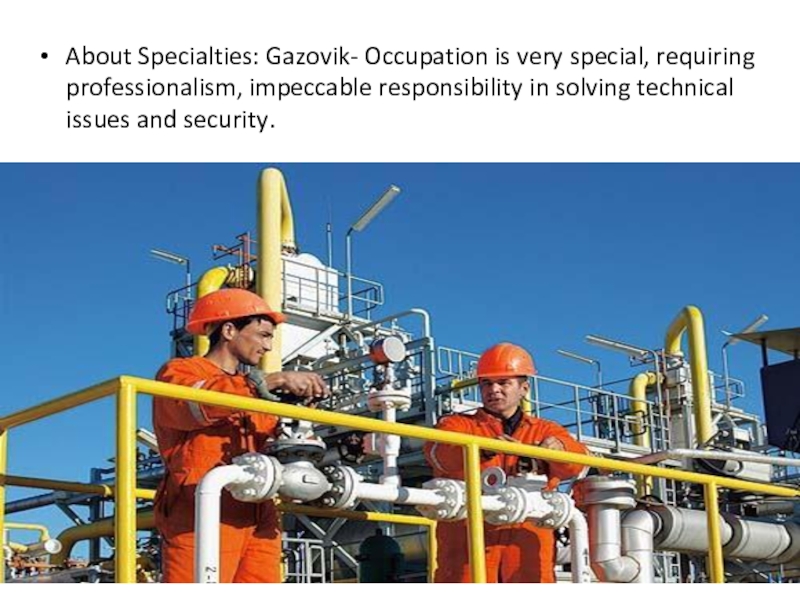
Слайд 6About Specialties: Gazovik- Occupation is very special, requiring professionalism, impeccable responsibility
in solving technical issues and security.
Слайд 7Why I chose the specialty "Installation and maintenance of equipment and
systems of gas supply"? I Petrovichev Roman student G-09, has chosen a specialty "Installation and maintenance of equipment and supply systems", because the gas is in high demand and will always be relevant. Profession, which is obtained after graduating from college, "great demand", well paid and highly prestigious .. Working with gas, though dangerous, but still is the "authoritative" work on "the labor market", as well as the railways. I'm in high-level group, so our teachers tell us, even all the little things that we can ever come in handy. Occupation is very interesting.
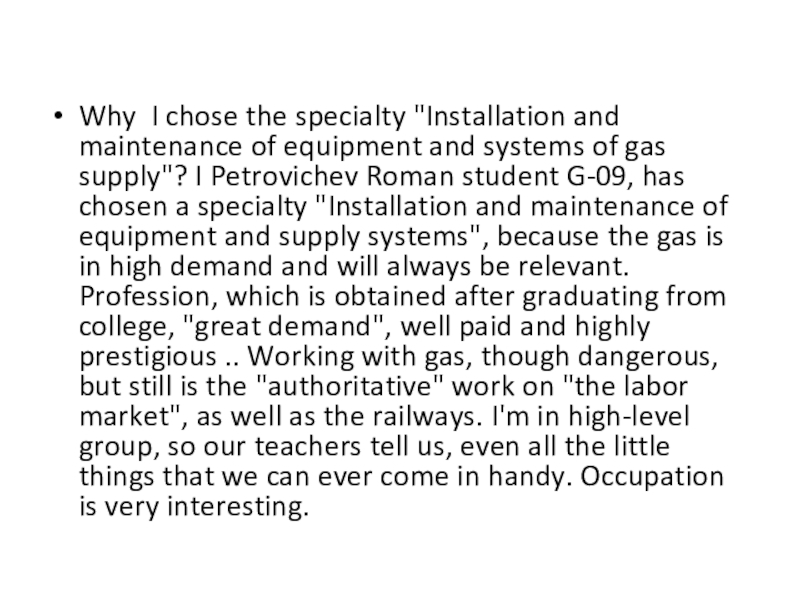
Слайд 8History:
Few people today can imagine life without "blue fuel". There is
no area economy, which would not have used the products obtained from crude oil and associated gas. Meanwhile, the history of gas in our country is not so great - the first gas lamps were lit in Russia Apothecary island of St. Petersburg in 1819, and industrial gas production began after a hundred years. In the middle of the XIX century on the initiative of foreign businessmen came Society gaslight northern capital with a monopoly on industrial production and sale of gas
Слайд 9 By the end of the XIX century, except for Moscow
and St. Petersburg were partially gasified Kiev, Kharkov, Rostov-on-Don, Odessa, Riga, Vilnius, Tver and Kazan. Since then, gradually began to use the gas for the needs of the industry: glass melting, metal hardening, singeing tissue. In the largest oil-producing region of the Russian Empire - Baku - annually disposed of 33 million cubic meters. meters of natural gas (as of 1917). In the 1920s, the country began planning the search for natural gas. Independent development of the gas industry in Russia began in August 1956, when the Central Administration of the gas industry at the Council of Ministers of the USSR. Since then, the rapid development of the gas industry in our country
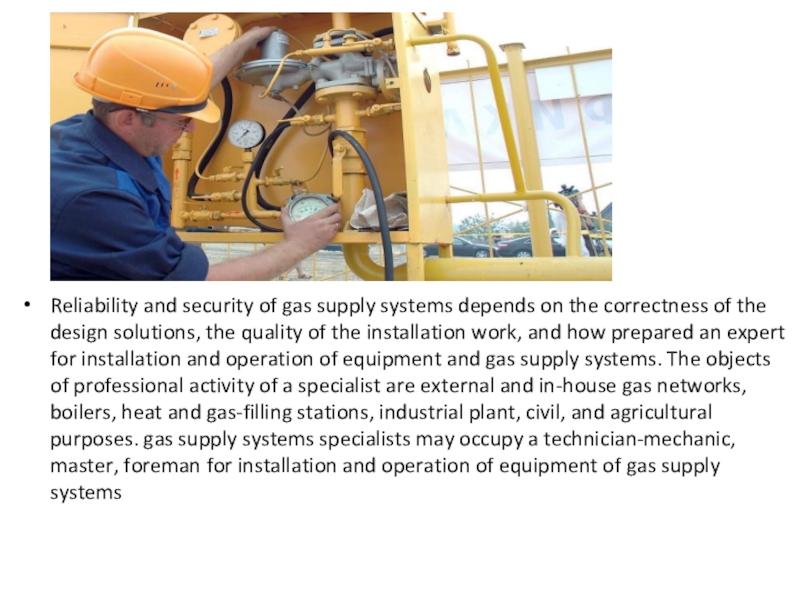
Слайд 10Reliability and security of gas supply systems depends on the correctness
of the design solutions, the quality of the installation work, and how prepared an expert for installation and operation of equipment and gas supply systems. The objects of professional activity of a specialist are external and in-house gas networks, boilers, heat and gas-filling stations, industrial plant, civil, and agricultural purposes. gas supply systems specialists may occupy a technician-mechanic, master, foreman for installation and operation of equipment of gas supply systems
Слайд 11What you should know: the physical phenomena occurring in the pipelines;
basic rules for the implementation and execution of working drawings; device operating principle, the main technical characteristics of the equipment and supply systems; rules for the technical supervision of the state of in-house gas equipment; ways to protect pipelines from electrochemical corrosion; sources and causes of gas leaks; technology and organization of work on the installation and operation of equipment and gas supply systems; rules of operation and maintenance of existing pipelines.
To be able to: perform the installation of equipment of gas supply systems in accordance with the design of works, working drawings, the requirements of regulatory documents; exercise equipment operation and gas supply systems; develop organizational and technical measures for the implementation of gas hazardous work, the replacement of parts of pipelines and shut-off devices; check serviceability house gas equipment, chimneys, ventilation ducts. to training requirements: gas. to training requirements:
To be able to: perform the installation of equipment of gas supply systems in accordance with the design of works, working drawings, the requirements of regulatory documents; exercise equipment operation and gas supply systems; develop organizational and technical measures for the implementation of gas hazardous work, the replacement of parts of pipelines and shut-off devices; check serviceability house gas equipment, chimneys, ventilation ducts. to training requirements: gas. to training requirements:
Слайд 12After college, we learn how to: perform the installation of equipment
of gas supply systems in accordance with the design of works, working drawings, the requirements of regulatory documents; carry operation. equipment and gas supply systems; read and execute working drawings, to make out the technological and technical documentation; organize the work on the acceptance and storage of materials, designs, the rational use of construction machinery, power plants, vehicles, industrial equipment; control the process sequence production work, compliance with health, safety and the protection of environmental technology;
Слайд 13Upon completion of training at the college we know: how to
protect pipelines from electrochemical corrosion; sources and causes of gas leaks; technology and organization of work on the installation and operation of equipment and gas supply systems; rules of operation and maintenance of existing pipelines; Rules and regulations of labor protection, safety, industrial hygiene and environmental protection.