С.С.
- Главная
- Разное
- Образование
- Спорт
- Естествознание
- Природоведение
- Религиоведение
- Французский язык
- Черчение
- Английский язык
- Астрономия
- Алгебра
- Биология
- География
- Геометрия
- Детские презентации
- Информатика
- История
- Литература
- Математика
- Музыка
- МХК
- Немецкий язык
- ОБЖ
- Обществознание
- Окружающий мир
- Педагогика
- Русский язык
- Технология
- Физика
- Философия
- Химия
- Шаблоны, фоны, картинки для презентаций
- Экология
- Экономика
Презентация, доклад на Английском языке: From A to Z of money history.
Содержание
- 1. Презентация на Английском языке: From A to Z of money history.
- 2. History of MoneyThe use of money is
- 3. Barter SystemThe basis of all early commerce
- 4. Different Items instead of MoneyVarious items have
- 5. Different Items instead of MoneyOn the island
- 6. A.The world s smallest banknote, issued in
- 7. In a 2008 study, researchers found more
- 8. In 1949, Frank X. McNamara took friends
- 9. Because plastic cards did not yet exist,
- 10. A new dollar coin was issued in
- 11. Founded in Italy in 1472, and originally
- 12. The wealth required to provide adequate food,
- 13. The world’s worst inflation was in Hungary
- 14. The world’s heaviest coin was from Sweden
- 15. The paper used in US bills is
- 16. Money does not smell. Titus, son of
- 17. Good Luck
History of MoneyThe use of money is as old as the human civilization. Money is basically a method of exchange, and coins and notes are just items of exchange. But money was not always the same
Слайд 2History of Money
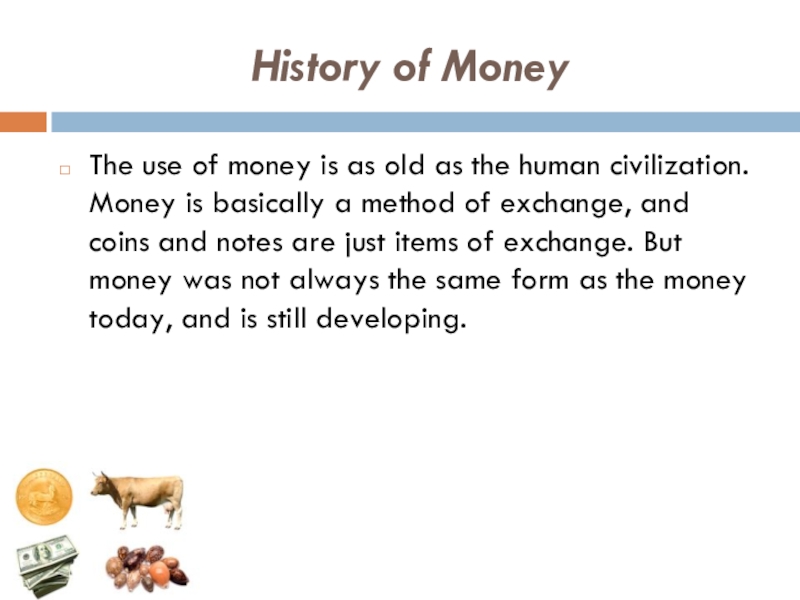
The use of money is as old as the
human civilization. Money is basically a method of exchange, and coins and notes are just items of exchange. But money was not always the same form as the money today, and is still developing.
Слайд 3Barter System
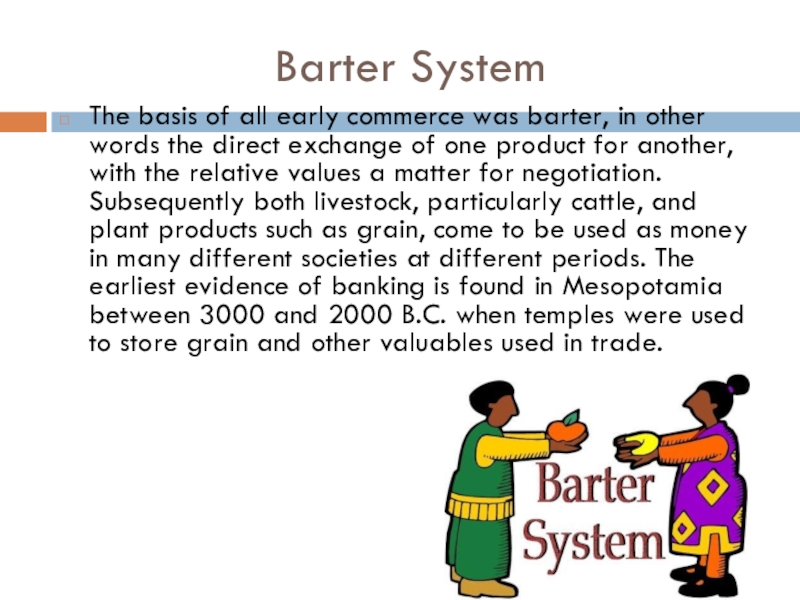
The basis of all early commerce was barter, in other
words the direct exchange of one product for another, with the relative values a matter for negotiation. Subsequently both livestock, particularly cattle, and plant products such as grain, come to be used as money in many different societies at different periods. The earliest evidence of banking is found in Mesopotamia between 3000 and 2000 B.C. when temples were used to store grain and other valuables used in trade.
Слайд 4Different Items instead of Money
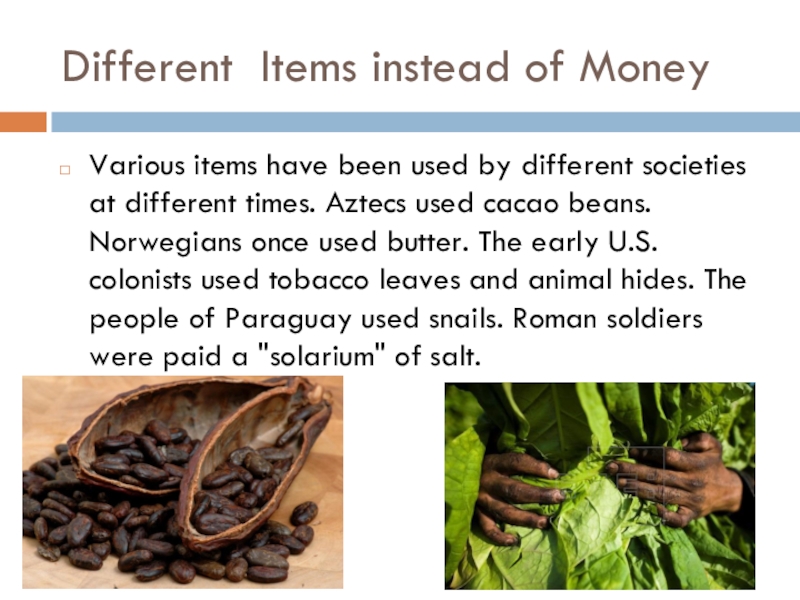
Various items have been used by different
societies at different times. Aztecs used cacao beans. Norwegians once used butter. The early U.S. colonists used tobacco leaves and animal hides. The people of Paraguay used snails. Roman soldiers were paid a "solarium" of salt.
Слайд 5Different Items instead of Money
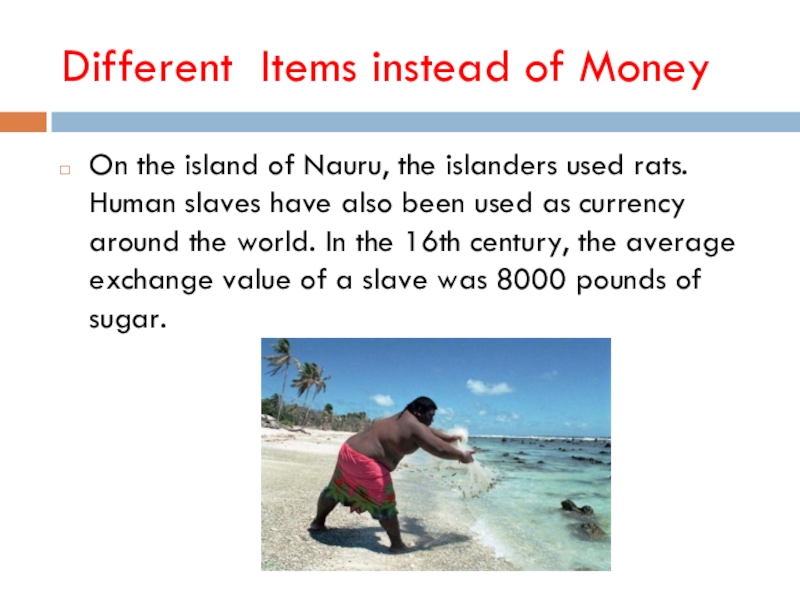
On the island of Nauru, the islanders
used rats. Human slaves have also been used as currency around the world. In the 16th century, the average exchange value of a slave was 8000 pounds of sugar.
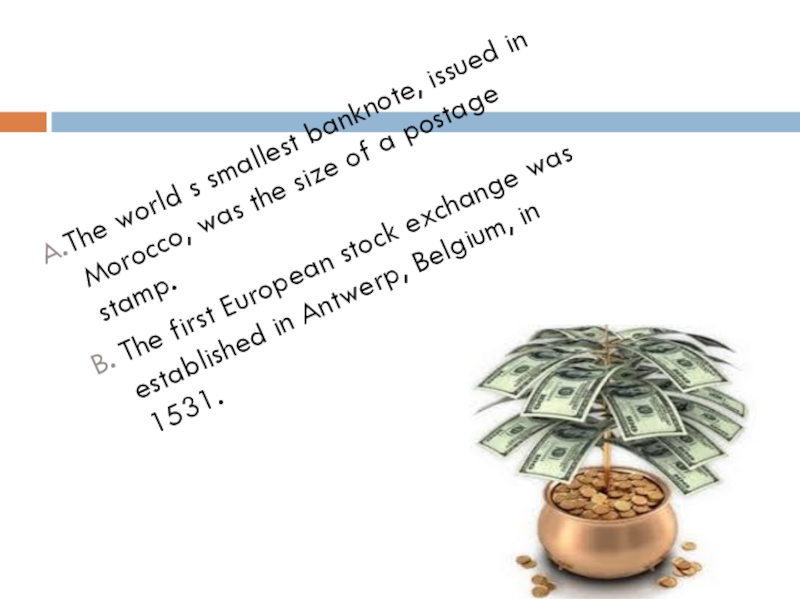
Слайд 6A.The world s smallest banknote, issued in Morocco, was the size
of a postage stamp.
B. The first European stock exchange was established in Antwerp, Belgium, in 1531.
B. The first European stock exchange was established in Antwerp, Belgium, in 1531.
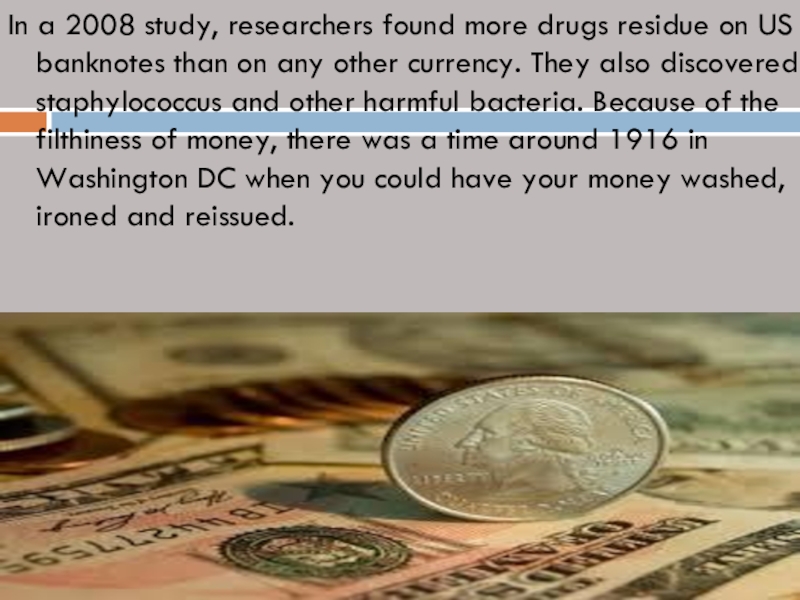
Слайд 7In a 2008 study, researchers found more drugs residue on US
banknotes than on any other currency. They also discovered staphylococcus and other harmful bacteria. Because of the filthiness of money, there was a time around 1916 in Washington DC when you could have your money washed, ironed and reissued.
Слайд 8In 1949, Frank X. McNamara took friends to dinner in New
York City, but forgot to bring his cash. He vowed never to be embarrassed like that again, so he created the first credit card, the Diners club Card. It was initially made of cardboard and listed 14 participating restaurants of the back. The original annual fee was just $3.
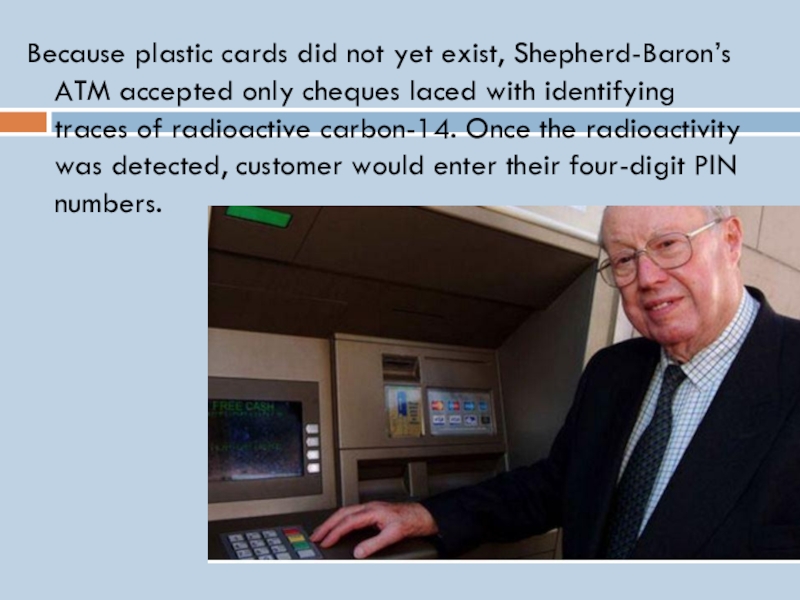
Слайд 9Because plastic cards did not yet exist, Shepherd-Baron’s ATM accepted only
cheques laced with identifying traces of radioactive carbon-14. Once the radioactivity was detected, customer would enter their four-digit PIN numbers.
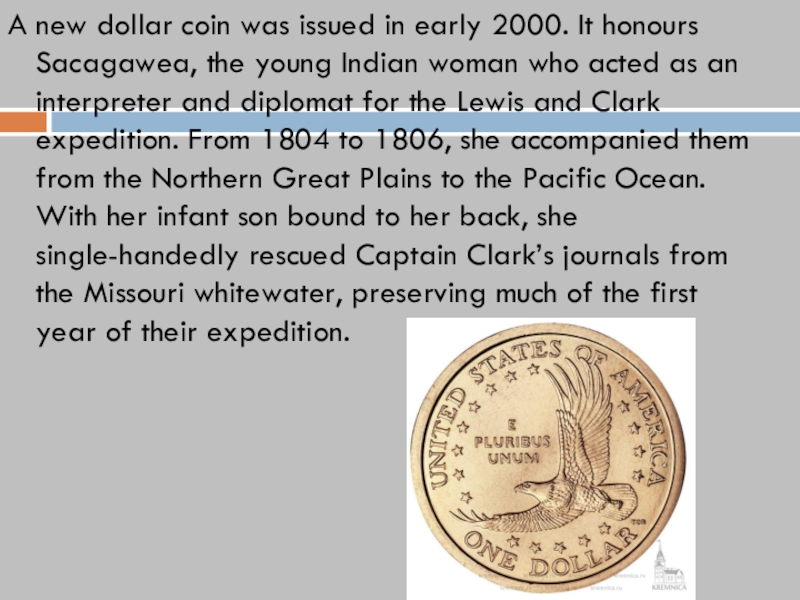
Слайд 10A new dollar coin was issued in early 2000. It honours
Sacagawea, the young Indian woman who acted as an interpreter and diplomat for the Lewis and Clark expedition. From 1804 to 1806, she accompanied them from the Northern Great Plains to the Pacific Ocean. With her infant son bound to her back, she single-handedly rescued Captain Clark’s journals from the Missouri whitewater, preserving much of the first year of their expedition.
Слайд 11Founded in Italy in 1472, and originally a pawnshop, Banca Monte dei Paschi
di Sieha is the world’s
oldest surviving bank.
Coins have a grooved edge because in the past dishonest traders filed down the edges to remove some of the precious metal. Many countries print images of writing at the very edge of the coin to prevent this same dishonest practice.
The word’s smallest coin weighed only. 002 grams and was from Nepal.
Coins have a grooved edge because in the past dishonest traders filed down the edges to remove some of the precious metal. Many countries print images of writing at the very edge of the coin to prevent this same dishonest practice.
The word’s smallest coin weighed only. 002 grams and was from Nepal.
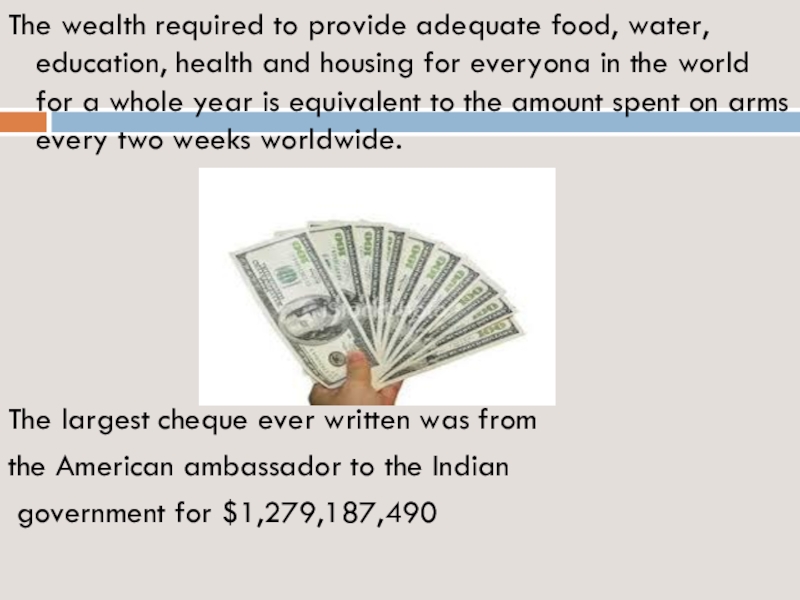
Слайд 12The wealth required to provide adequate food, water, education, health and
housing for everyona in the world for a whole year is equivalent to the amount spent on arms every two weeks worldwide.
The largest cheque ever written was from
the American ambassador to the Indian
government for $1,279,187,490
The largest cheque ever written was from
the American ambassador to the Indian
government for $1,279,187,490
Слайд 13The world’s worst inflation was in Hungary in June 1946,
when
the 1931 gold pengo was valued at 130 million trillion paper pengos.
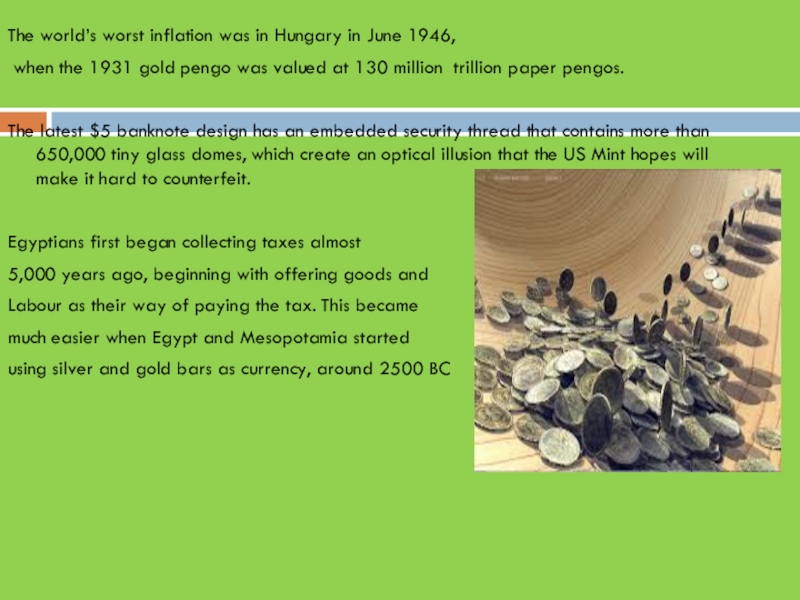
The latest $5 banknote design has an embedded security thread that contains more than 650,000 tiny glass domes, which create an optical illusion that the US Mint hopes will make it hard to counterfeit.
Egyptians first began collecting taxes almost
5,000 years ago, beginning with offering goods and
Labour as their way of paying the tax. This became
much easier when Egypt and Mesopotamia started
using silver and gold bars as currency, around 2500 BC
The latest $5 banknote design has an embedded security thread that contains more than 650,000 tiny glass domes, which create an optical illusion that the US Mint hopes will make it hard to counterfeit.
Egyptians first began collecting taxes almost
5,000 years ago, beginning with offering goods and
Labour as their way of paying the tax. This became
much easier when Egypt and Mesopotamia started
using silver and gold bars as currency, around 2500 BC
Слайд 14The world’s heaviest coin
was from Sweden and weighed
43 pounds
71/4 oz
More money is spent on arms in
the world than on education, health
or any other form of development.
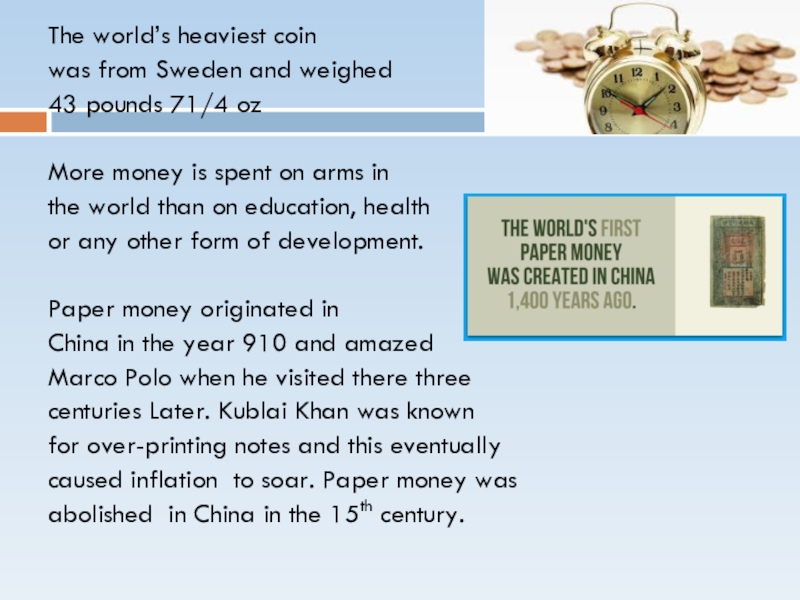
Paper money originated in
China in the year 910 and amazed
Marco Polo when he visited there three
centuries Later. Kublai Khan was known
for over-printing notes and this eventually
caused inflation to soar. Paper money was
abolished in China in the 15th century.
More money is spent on arms in
the world than on education, health
or any other form of development.
Paper money originated in
China in the year 910 and amazed
Marco Polo when he visited there three
centuries Later. Kublai Khan was known
for over-printing notes and this eventually
caused inflation to soar. Paper money was
abolished in China in the 15th century.
Слайд 15The paper used in US bills is made of 75% cotton
and 25% Linen; it is
NOT made from trees. Red and blue
synthetic fibres of various Lengths are
distributed evenly throughout the paper.
Before World War I these fibres were made of silk
NOT made from trees. Red and blue
synthetic fibres of various Lengths are
distributed evenly throughout the paper.
Before World War I these fibres were made of silk
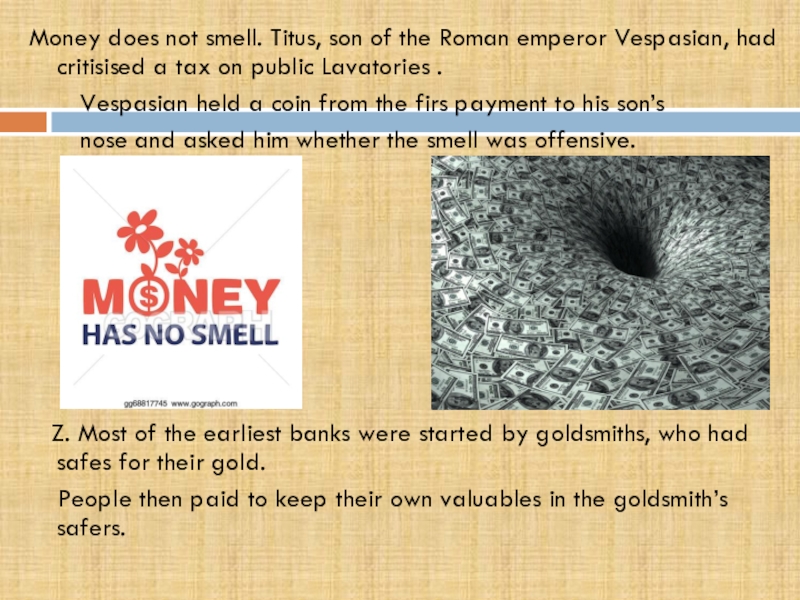
Слайд 16Money does not smell. Titus, son of the Roman emperor Vespasian,
had critisised a tax on public Lavatories .
Vespasian held a coin from the firs payment to his son’s
nose and asked him whether the smell was offensive.
Titus said no.
Z. Most of the earliest banks were started by goldsmiths, who had safes for their gold.
People then paid to keep their own valuables in the goldsmith’s safers.
Vespasian held a coin from the firs payment to his son’s
nose and asked him whether the smell was offensive.
Titus said no.
Z. Most of the earliest banks were started by goldsmiths, who had safes for their gold.
People then paid to keep their own valuables in the goldsmith’s safers.