- Главная
- Разное
- Образование
- Спорт
- Естествознание
- Природоведение
- Религиоведение
- Французский язык
- Черчение
- Английский язык
- Астрономия
- Алгебра
- Биология
- География
- Геометрия
- Детские презентации
- Информатика
- История
- Литература
- Математика
- Музыка
- МХК
- Немецкий язык
- ОБЖ
- Обществознание
- Окружающий мир
- Педагогика
- Русский язык
- Технология
- Физика
- Философия
- Химия
- Шаблоны, фоны, картинки для презентаций
- Экология
- Экономика
Презентация, доклад на Английском языке: English Golf.
Содержание
- 1. Презентация на Английском языке: English Golf.
- 2. Golf is a precision club and ball
- 3. Origin This game is ancient origins are unclear
- 4. The modern game originated in Scotland, where
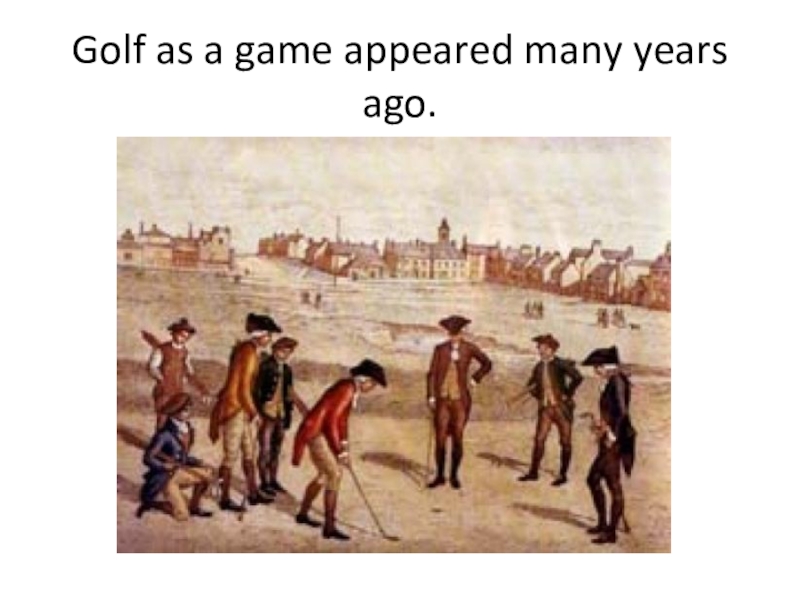
- 5. Golf as a game appeared many years ago.
- 6. Golf courseA golf course consists of a
- 7. Golf courseThe levels of grass are varied
- 8. Play of the game Every round of
- 9. Playing a hole on a golf course
- 10. What else is necessary for golf?. A
- 11. Rules and regulationsThe rules of golf are
- 12. There are strict regulations regarding the amateur
- 13. EquipmentGolf clubs are used to hit the
- 14. Golf balls are spherical, usually white, and
- 15. A golf bag is used to transport
- 16. PopularityIn 2005 Golf Digest calculated that the
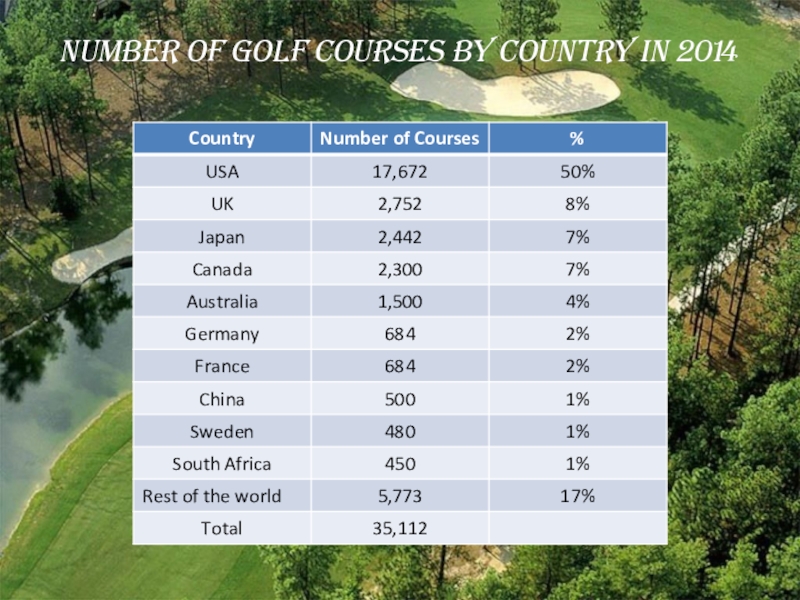
- 17. Number of golf courses by country in 2014
- 18. GOOD LUCK
Golf is a precision club and ball sport in which competing players (or golfers) use various clubs to hit balls into a series of holes on a course using as few strokes as possible. Golf is
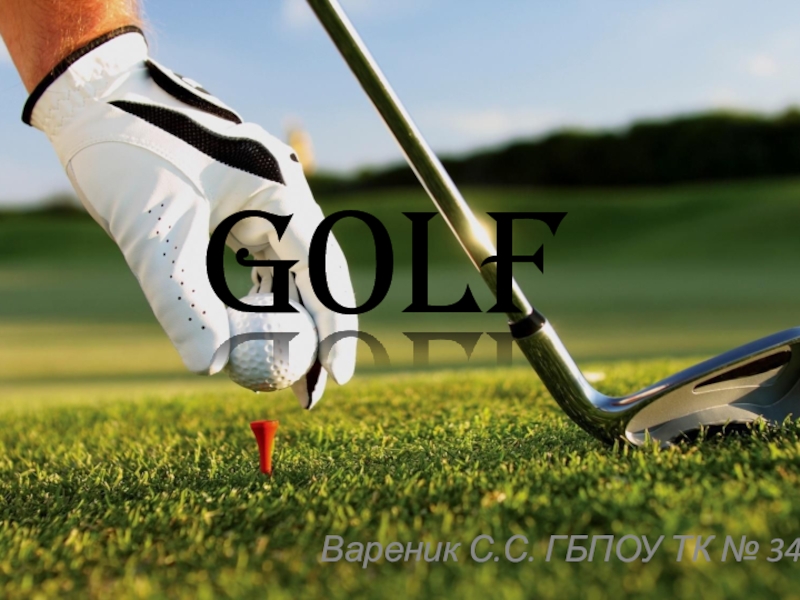
Слайд 2 Golf is a precision club and ball sport in which competing
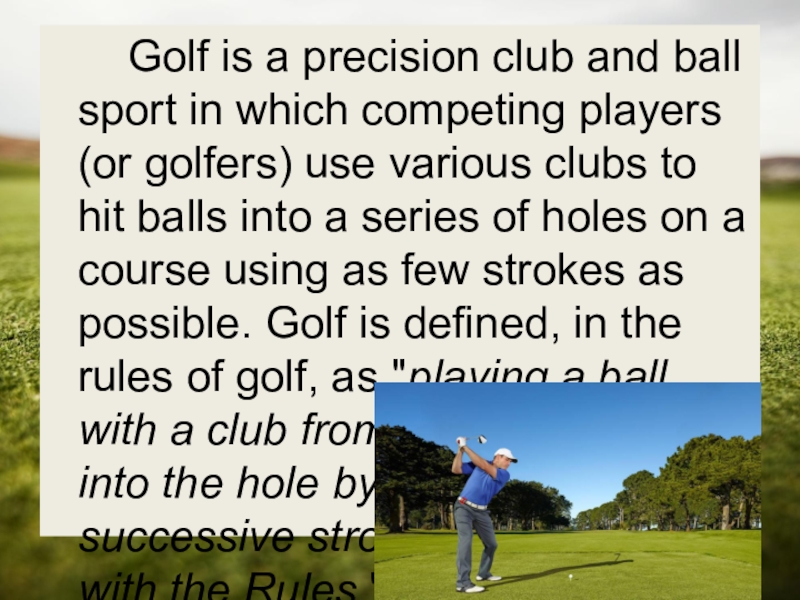
players (or golfers) use various clubs to hit balls into a series of holes on a course using as few strokes as possible. Golf is defined, in the rules of golf, as "playing a ball with a club from the teeing ground into the hole by a stroke or successive strokes in accordance with the Rules."
Слайд 3Origin
This game is ancient origins are unclear and much debated, while
the modern game of golf originated in 15th-century Scotland. Some historians trace the sport back to the Roman game of paganica, in which participants used a bent stick to hit a stuffed leather ball. One theory asserts that paganica spread throughout Europe as the Romans conquered most of the continent, during the first century BC, and eventually evolved into the modern game.
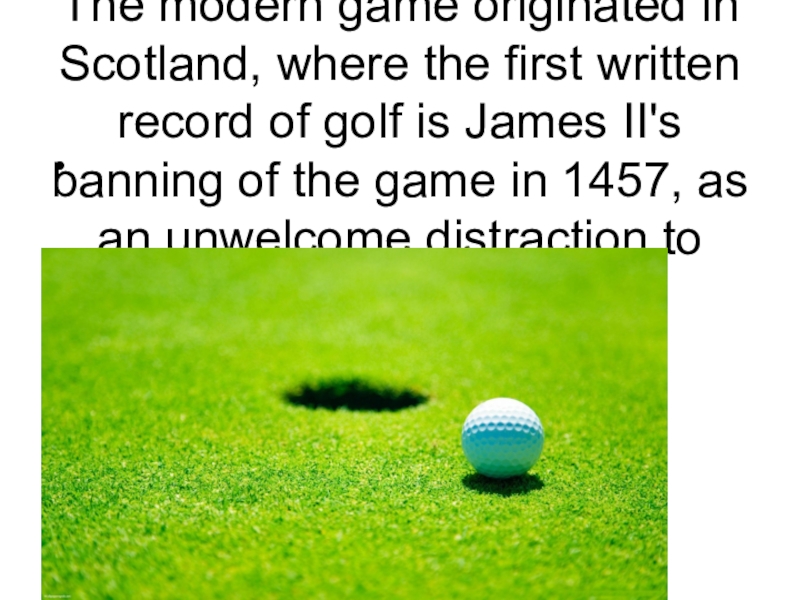
Слайд 4The modern game originated in Scotland, where the first written record
of golf is James II's banning of the game in 1457, as an unwelcome distraction to learning archery.
Слайд 6Golf course
A golf course consists of a series of holes, each
with a teeing ground that is set off by two markers showing the bounds of the legal tee area, fairway, rough and other hazards, and the putting green surrounded by the fringe with the pin (normally a flagstick) and cup.
Слайд 7Golf course
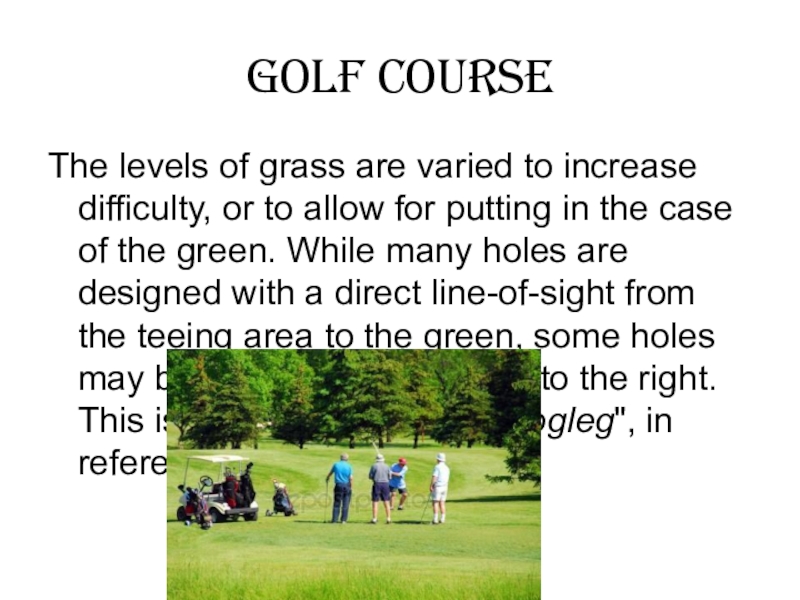
The levels of grass are varied to increase difficulty, or
to allow for putting in the case of the green. While many holes are designed with a direct line-of-sight from the teeing area to the green, some holes may bend either to the left or to the right. This is commonly called a "dogleg", in reference to a dog's knee.
Слайд 8Play of the game
Every round of golf is based on playing
a number of holes in a given order. A "round" typically consists of 18 holes that are played in the order determined by the course layout. Each hole is played once in the round on a standard course of 18 holes; on a nine-hole course, players may play a "short game" playing each hole once, or a "full round" by playing each hole twice.
Слайд 9Playing a hole on a golf course is initiated by putting
a ball into play by striking it with a club on the teeing ground (also called the tee box, or simply the tee). For this first shot on each hole, it is allowed but not required for the golfer to place the ball on a tee prior to striking it. A tee is a small peg that can be used to elevate the ball slightly above the ground up to a few centimetres high. Tees are commonly made of wood but may be constructed of any material, including plastic. Traditionally, golfers used mounds of sand to elevate the ball, and containers of sand were provided for the purpose.
Слайд 10What else is necessary for golf?
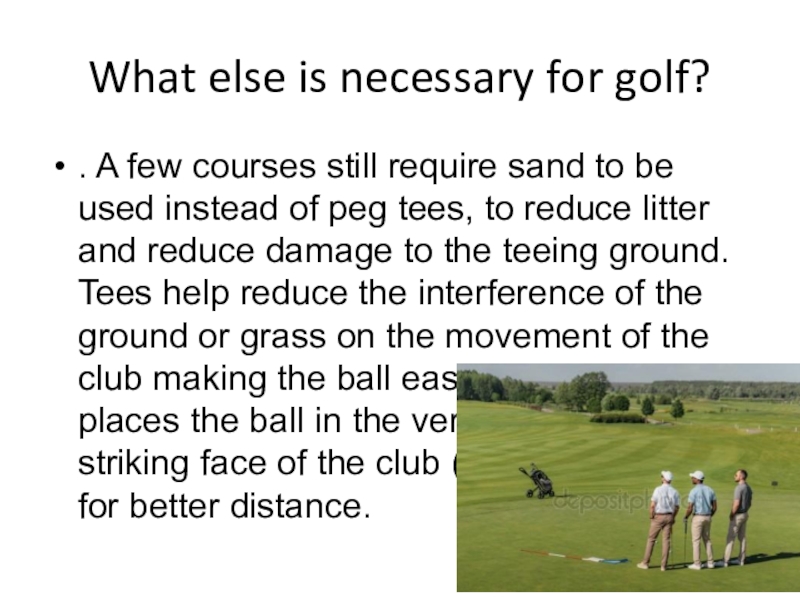
. A few courses still require
sand to be used instead of peg tees, to reduce litter and reduce damage to the teeing ground. Tees help reduce the interference of the ground or grass on the movement of the club making the ball easier to hit, and also places the ball in the very centre of the striking face of the club (the "sweet spot") for better distance.
Слайд 11Rules and regulations
The rules of golf are internationally standardized and are
jointly governed by The R&A, spun off in 2004 from The Royal and Ancient Golf Club of St Andrews (founded 1754), and the United States Golf Association (USGA).
The underlying principle of the rules is fairness. As stated on the back cover of the official rule book:
Play the ball as it lies, play the course as you find it, and if you cannot do either, do what is fair.
The underlying principle of the rules is fairness. As stated on the back cover of the official rule book:
Play the ball as it lies, play the course as you find it, and if you cannot do either, do what is fair.
Слайд 12There are strict regulations regarding the amateur status of golfers. Essentially,
anybody who has ever received payment or compensation for giving instruction, or played golf for money, is not considered an amateur and may not participate in competitions limited solely to amateurs. However, amateur golfers may receive expenses that comply with strict guidelines and they may accept non-cash prizes within the limits established by the Rules of Amateur Status.
Слайд 13Equipment
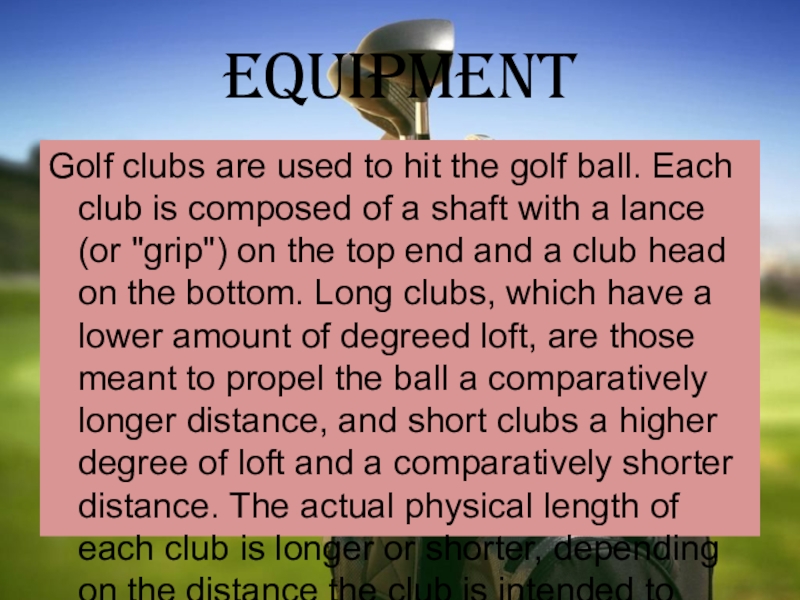
Golf clubs are used to hit the golf ball. Each club
is composed of a shaft with a lance (or "grip") on the top end and a club head on the bottom. Long clubs, which have a lower amount of degreed loft, are those meant to propel the ball a comparatively longer distance, and short clubs a higher degree of loft and a comparatively shorter distance. The actual physical length of each club is longer or shorter, depending on the distance the club is intended to propel the ball.
Слайд 14Golf balls are spherical, usually white, and minutely pock-marked by dimples
that decrease aerodynamic drag by increasing air turbulence around the ball in motion, which delays "boundary layer" separation and reduces the drag-inducing "wake" behind the ball, thereby allowing the ball to fly farther.
Слайд 15A golf bag is used to transport golf clubs and the
player's other or personal equipment. Golf bags have several pockets designed for carrying equipment and supplies such as tees, balls, and gloves. Golf bags can be carried, pulled on a trolley or harnessed to a motorized golf cart during play. bags have both a hand strap and shoulder strap for carrying, and sometimes have retractable legs that allow the bag to stand upright when at rest.
Слайд 16Popularity
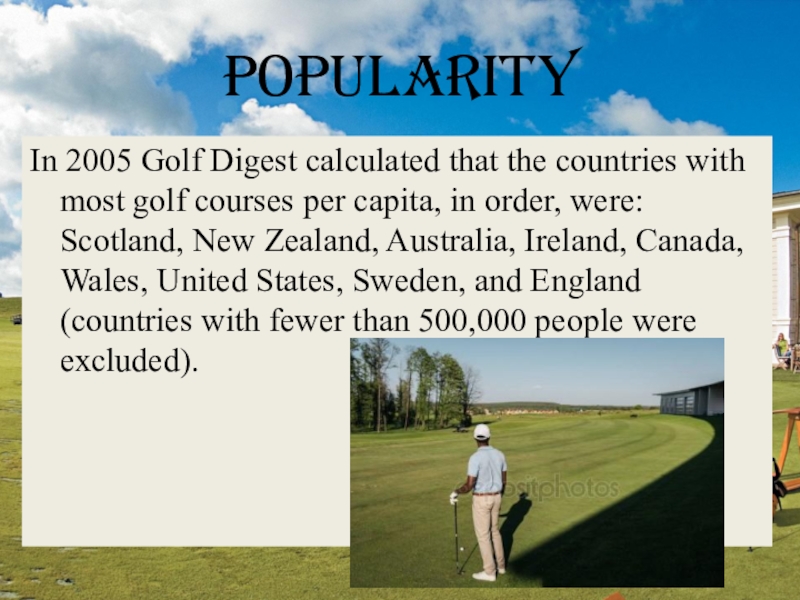
In 2005 Golf Digest calculated that the countries with most golf
courses per capita, in order, were: Scotland, New Zealand, Australia, Ireland, Canada, Wales, United States, Sweden, and England (countries with fewer than 500,000 people were excluded).