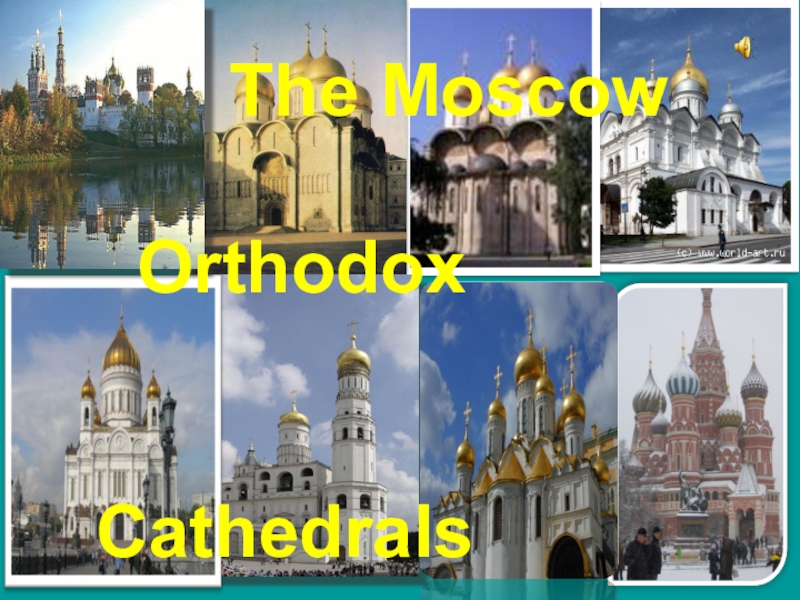
Cathedrals
- Главная
- Разное
- Образование
- Спорт
- Естествознание
- Природоведение
- Религиоведение
- Французский язык
- Черчение
- Английский язык
- Астрономия
- Алгебра
- Биология
- География
- Геометрия
- Детские презентации
- Информатика
- История
- Литература
- Математика
- Музыка
- МХК
- Немецкий язык
- ОБЖ
- Обществознание
- Окружающий мир
- Педагогика
- Русский язык
- Технология
- Физика
- Философия
- Химия
- Шаблоны, фоны, картинки для презентаций
- Экология
- Экономика
Презентация, доклад Московские Православные Храмы
Содержание
- 1. Презентация: Московские Православные Храмы
- 2. Contents: Introduction.
- 3. Слайд 3
- 4. Look at
- 5. Слайд 5
- 6. The Cathedral of the Dormition (Uspenskiy).
- 7. Слайд 7
- 8. The Cathedral also served
- 9. The
- 10. The Cathedral of St. Michael the Archangel.
- 11. Most of
- 12. Слайд 12
- 13. The Cathedral of the Twelve Apostles.
- 14. metropolitans and patriarchs. The iconostasis is of
- 15. and to honor of Christ
- 16. For
- 17. It is founded
- 18. Слайд 18
- 19. Conclusion. The Russian
- 20. retworks are world- known. The present frescoes
- 21. Glossary.Alexander Nevsky – the Russian prince (1252-1263)
- 22. Easter – holy day in memory of
- 23. Appendixes. The Annunciation Cathedral of the
- 24. The Annunciation Cathedral of the Moscow Kremlin.
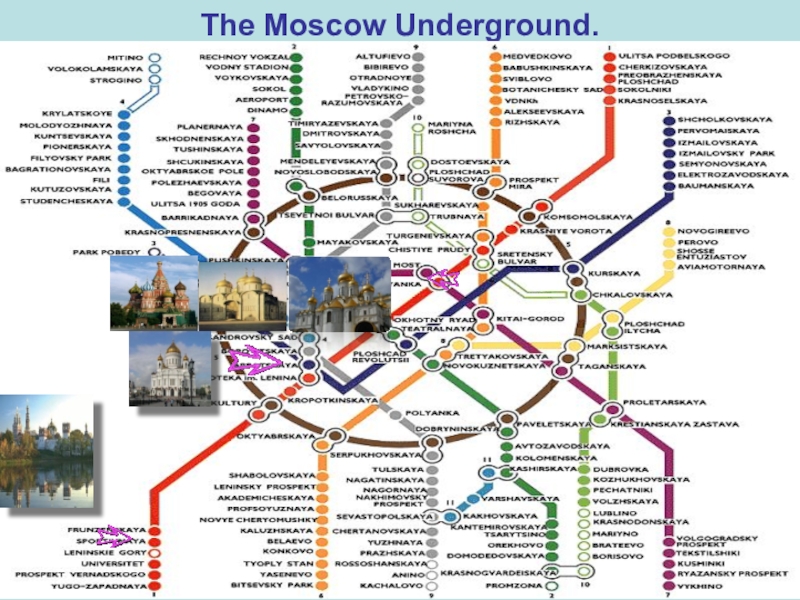
- 25. The Moscow Underground.
Contents: Introduction. p.
Слайд 2Contents:
Introduction.
p. 2
Chapter 1. The Cathedral of St. Basil of Blessed. p. 2 - 4
Chapter 2. The Moscow Kremlin. p. 4 - 13
Chapter 3. The Cathedral of Christ the Saviour. p. 13 - 15
Chapter 4. The Novodevichy Convent. p. 15 -18
Conclusion. p. 18 – 19
Bibliography. p. 20
Glossary. p. 21 – 22
Appendixes.
Chapter 1. The Cathedral of St. Basil of Blessed. p. 2 - 4
Chapter 2. The Moscow Kremlin. p. 4 - 13
Chapter 3. The Cathedral of Christ the Saviour. p. 13 - 15
Chapter 4. The Novodevichy Convent. p. 15 -18
Conclusion. p. 18 – 19
Bibliography. p. 20
Glossary. p. 21 – 22
Appendixes.
Слайд 3
Moscow is the capital of Russia. It is the most beautiful city in the world. We are proud of Moscow. It is a cultural, an industrial, a business, a political and a scientific centre. Millions of people from all over the world come to Moscow. There are many unique places in Moscow.
Please, look around! The Moscow Orthodox Cathedrals are the most amusing and unique part of the Russian culture. There are some facts about them in this work.
Please, look around! The Moscow Orthodox Cathedrals are the most amusing and unique part of the Russian culture. There are some facts about them in this work.
2
The Cathedral of St. Basil of Blessed (Khram Vasiliya Blazhennovo).
INTRODUCTION.

Слайд 4
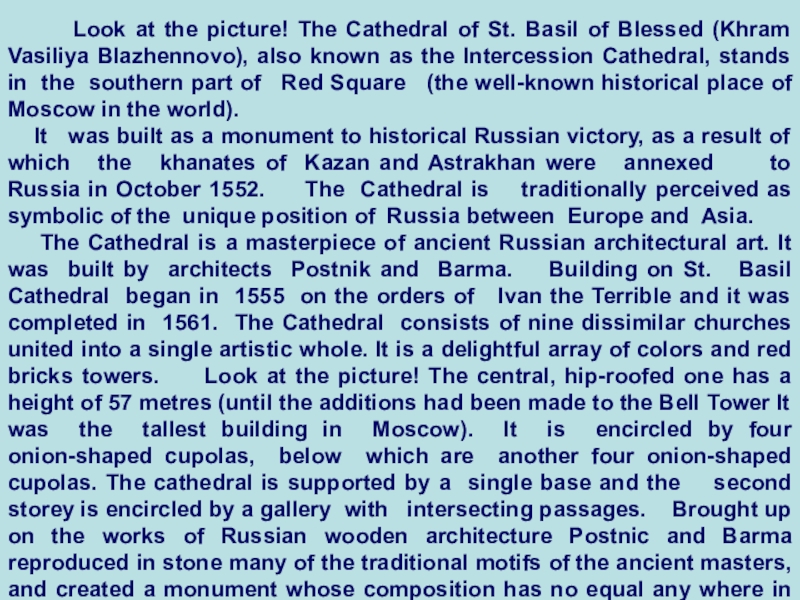
Look at the picture! The Cathedral
of St. Basil of Blessed (Khram Vasiliya Blazhennovo), also known as the Intercession Cathedral, stands in the southern part of Red Square (the well-known historical place of Moscow in the world).
It was built as a monument to historical Russian victory, as a result of which the khanates of Kazan and Astrakhan were annexed to Russia in October 1552. The Cathedral is traditionally perceived as symbolic of the unique position of Russia between Europe and Asia.
The Cathedral is a masterpiece of ancient Russian architectural art. It was built by architects Postnik and Barma. Building on St. Basil Cathedral began in 1555 on the orders of Ivan the Terrible and it was completed in 1561. The Cathedral consists of nine dissimilar churches united into a single artistic whole. It is a delightful array of colors and red bricks towers. Look at the picture! The central, hip-roofed one has a height of 57 metres (until the additions had been made to the Bell Tower It was the tallest building in Moscow). It is encircled by four onion-shaped cupolas, below which are another four onion-shaped cupolas. The cathedral is supported by a single base and the second storey is encircled by a gallery with intersecting passages. Brought up on the works of Russian wooden architecture Postnic and Barma reproduced in stone many of the traditional motifs of the ancient masters, and created a monument whose composition has no equal any where in the world. 3
It was built as a monument to historical Russian victory, as a result of which the khanates of Kazan and Astrakhan were annexed to Russia in October 1552. The Cathedral is traditionally perceived as symbolic of the unique position of Russia between Europe and Asia.
The Cathedral is a masterpiece of ancient Russian architectural art. It was built by architects Postnik and Barma. Building on St. Basil Cathedral began in 1555 on the orders of Ivan the Terrible and it was completed in 1561. The Cathedral consists of nine dissimilar churches united into a single artistic whole. It is a delightful array of colors and red bricks towers. Look at the picture! The central, hip-roofed one has a height of 57 metres (until the additions had been made to the Bell Tower It was the tallest building in Moscow). It is encircled by four onion-shaped cupolas, below which are another four onion-shaped cupolas. The cathedral is supported by a single base and the second storey is encircled by a gallery with intersecting passages. Brought up on the works of Russian wooden architecture Postnic and Barma reproduced in stone many of the traditional motifs of the ancient masters, and created a monument whose composition has no equal any where in the world. 3
Слайд 5 The external
ornament on the cathedral reflects a seemingly inexhaustible wealth of imagination on the part of the two architects. In 1588 Tsar Fedor Ivanovich had a chapel added on the eastern side about the grave of Basil Fool for Christ, a Russian Orthodox saint after whom the Cathedral was popularly named. Visitors can climb up a narrow, wooden spiral staircase, set up one of the walls and discovered only in the 1970s during restoration work, and marvel at the Chapel (of the Intercession’s priceless iconostasis dating back to the 16th century.
Legend has it that Napoleon was so impressed with St .Basil’s that he wanted to take it back to Paris with him, but lacking to the technology to do so, ordered instead that it be destroyed with French retreat from city. T he French setup kegs of gunpowder and lit their fuses, but a sudden miraculous shower, helped to extinguish the fuses and prevent the explosion.
In 1918 the communists shot the church’s senior priest Ioann Vostorgov. The cathedral opened as historical museum in 1923 and became a branch of the State History Museum in 1923. There were no the church services here after 1929.
There is the Moscow Kremlin not far from the Cathedral of St.Basil of Blessed. The Kremlin is the heart of Moscow, the heart of whole Russian.
4
Legend has it that Napoleon was so impressed with St .Basil’s that he wanted to take it back to Paris with him, but lacking to the technology to do so, ordered instead that it be destroyed with French retreat from city. T he French setup kegs of gunpowder and lit their fuses, but a sudden miraculous shower, helped to extinguish the fuses and prevent the explosion.
In 1918 the communists shot the church’s senior priest Ioann Vostorgov. The cathedral opened as historical museum in 1923 and became a branch of the State History Museum in 1923. There were no the church services here after 1929.
There is the Moscow Kremlin not far from the Cathedral of St.Basil of Blessed. The Kremlin is the heart of Moscow, the heart of whole Russian.
4
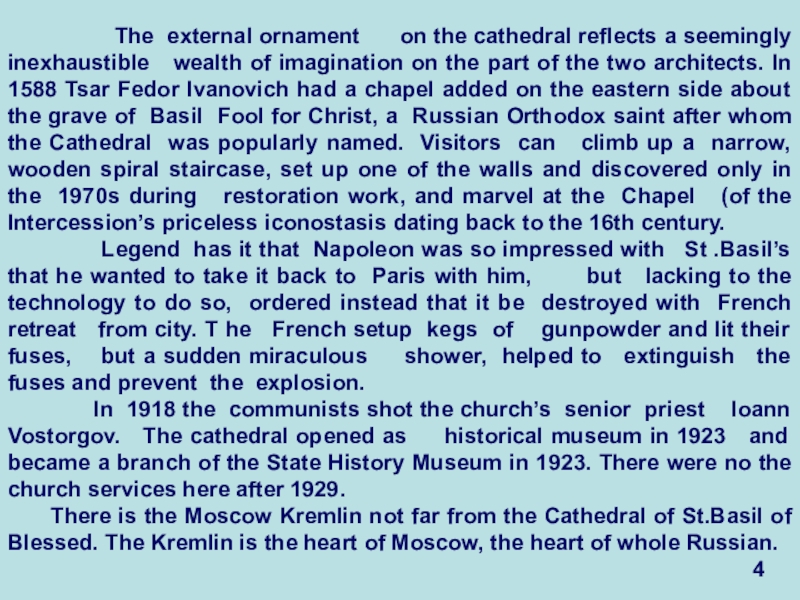
Слайд 6The Cathedral of the Dormition (Uspenskiy).
Look
at the picture! You can see the Cathedral of the Dormition (Uspenskiy). The name refers to the Dormition of the Theotokos tradition of Eastern and Oriental Orthodox Churches, which approximately corresponds to the notion of the Assumption of Mary, the mother of Jesus , of the Roman Catholic Church. The Cathedral of the Dormition stands on the site of the first stone cathedral.
Metropolitan Peter persuaded Ivan I (Kalita) that he should build a cathedral to the Holy Virgin in Moscow. The Cathedral was built by Ivan Kalita in 1326-27 and which in its turn replaced the churches that were even older- 12th-century wooden and 13 th-century stone ones. It was the largest building of its period in Russia and is one of the most perfect examples of 15 th-century architecture. The Cathedral was destroyed after earthquake in May 20, 1474. Building was begun on the Cathedral of Dormition in 1475 under t he supervision of the Italian architect, Aristotle Fioravanti, after the model of the 12th century. 5
Metropolitan Peter persuaded Ivan I (Kalita) that he should build a cathedral to the Holy Virgin in Moscow. The Cathedral was built by Ivan Kalita in 1326-27 and which in its turn replaced the churches that were even older- 12th-century wooden and 13 th-century stone ones. It was the largest building of its period in Russia and is one of the most perfect examples of 15 th-century architecture. The Cathedral was destroyed after earthquake in May 20, 1474. Building was begun on the Cathedral of Dormition in 1475 under t he supervision of the Italian architect, Aristotle Fioravanti, after the model of the 12th century. 5
Слайд 7 Cathedral of
Dormition in the ancient Russian town of Vladimir (thus emphasizing the continuity of tradition from one of the oldest towns in Russia). Grand Russian Prince Ivan III invited Italian architect Aristotle Fioravanti to build a five-cupola church inside the Kremlin- the Cathedral of Dormition. The Cathedral was finally completed in 1479. For four centuries it was the main cathedral in Russia.
The Russian tsars were crowned, acts of state proclaimed and other important ceremonies held there. In January 1547, at the age of seventeen, Ivan IV (the Terrible) crowed himself in the Cathedral of Dormition. In doing so, the new ruler made an important announcement. He declared that he would no longer be called grand prince, but the “tsar of all the Russias’’. The central part of the Cathedral is separated from the chancel by a five-tier iconostasis (17th century) which is approximately 16 metres high and was covered in the 19th century with embossed gilt silver.
Here there is a collection of icons from the 11th to the 17th century which are of enormous historical and artist value. They include such unique works as Lady of Vladimir (14th century), St. George (12th century), the Archangel Michael (12-13th century), the Trinity (14-th century) and many other. The Cathedral also contains many remarkable works of applied art including the throne of Vladimir Monomakh, or the imperial seat of Ivan the Terrible, as it is also known, which is an outstanding example of Russian woodcarving and dates back to 1551; the whitestone seat of the Patriarch (16th century); the bronze open-work canopy by Dmitri Sverchkov (1625); twelve censers of gilded bronze; multi-tiered candelabra (17th century) and many other.
During t he Patriotic War of 1812 the Cathedral was plundered by Napoleon’s troops. From the silver that was later taken by the Cossacks from the retreating Napoleonic armies a huge chandelier was made which now hang in the centre of the Cathedral. T he oldest monument of applied art in the Cathedral is its southern doors, which were brought to Moscow from Suzdal in 1410. They contain twenty paintings in gold and black varnish on biblical themes. 6
The Russian tsars were crowned, acts of state proclaimed and other important ceremonies held there. In January 1547, at the age of seventeen, Ivan IV (the Terrible) crowed himself in the Cathedral of Dormition. In doing so, the new ruler made an important announcement. He declared that he would no longer be called grand prince, but the “tsar of all the Russias’’. The central part of the Cathedral is separated from the chancel by a five-tier iconostasis (17th century) which is approximately 16 metres high and was covered in the 19th century with embossed gilt silver.
Here there is a collection of icons from the 11th to the 17th century which are of enormous historical and artist value. They include such unique works as Lady of Vladimir (14th century), St. George (12th century), the Archangel Michael (12-13th century), the Trinity (14-th century) and many other. The Cathedral also contains many remarkable works of applied art including the throne of Vladimir Monomakh, or the imperial seat of Ivan the Terrible, as it is also known, which is an outstanding example of Russian woodcarving and dates back to 1551; the whitestone seat of the Patriarch (16th century); the bronze open-work canopy by Dmitri Sverchkov (1625); twelve censers of gilded bronze; multi-tiered candelabra (17th century) and many other.
During t he Patriotic War of 1812 the Cathedral was plundered by Napoleon’s troops. From the silver that was later taken by the Cossacks from the retreating Napoleonic armies a huge chandelier was made which now hang in the centre of the Cathedral. T he oldest monument of applied art in the Cathedral is its southern doors, which were brought to Moscow from Suzdal in 1410. They contain twenty paintings in gold and black varnish on biblical themes. 6
Слайд 8 The Cathedral also served as the burial vault
for the Moscow metropolitans and patriarchs (their tombs lie along the walls). The church services were forbidden by Bolshevik government. The final Easter service was held in 1918 there. It was only with Lenin’s special permission. There is a legend that in winter of 1941, when the Nazis had already reached the threshold of Moscow, Joseph Stalin secretly ordered a service to pray for the country’s salvation from the invading Germans. In 1990 the Cathedral of the Dormition was returned to the church, although a large museum still operates within it.
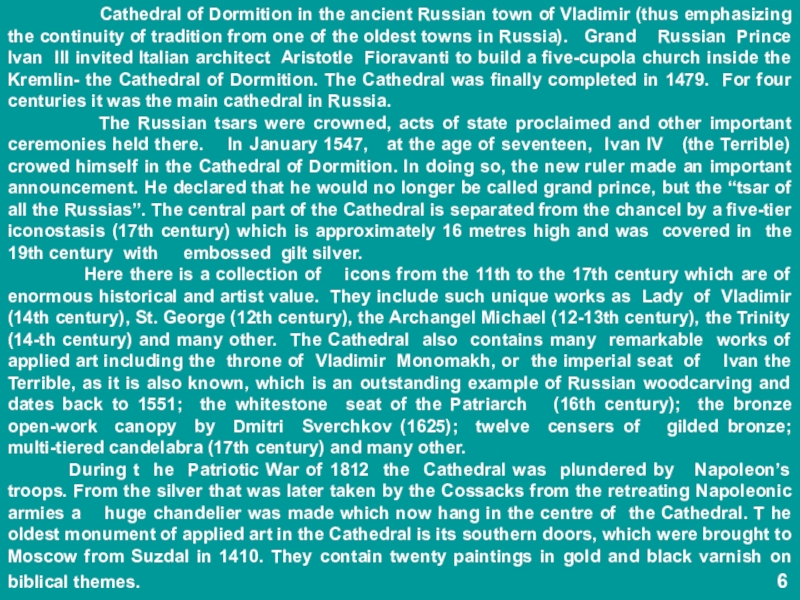
The Cathedral of the Annunciation (Blagovestctenskiy).
The Cathedral of the Annunciation (Blagovestctenskiy).
7
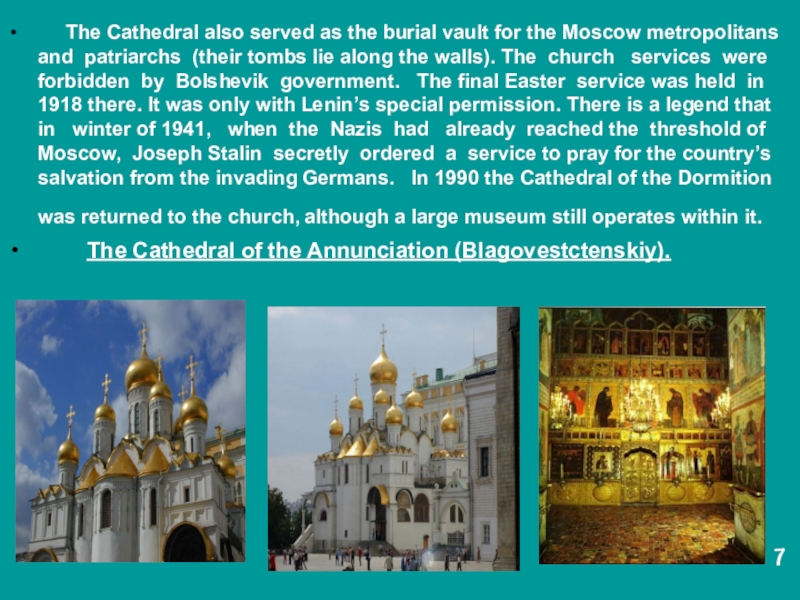
Слайд 9 The Cathedral of the Annunciation
(Blagovestctenskiy) unites is one artistic whole the works of 14th-16th century Russian masters. Being at one time the private chapel of the royal family, the Cathedral of Annunciation is not very big. It was surrounded by parishes from three sides. The Cathedral was the private chapel of the royal family before 1917. It has beautiful portals leading from the inner court to the central part of the church. The oldest of these is the southern which was restored in 1950 from fragments and which preserves the ancient traditions of wooden architecture which required that it be flamed with columns in the form of sheaf of corn. The northern and western portals are 16th-century and decorated with white stone carving. The floor of the Cathedral dates to the reign of Ivan the Terrible and faced in ornamental jasper, which was brought from a cathedral in Rostov Velikiy in 16th century.
Look at the picture! You can see the unique masterpiece. The iconostasis of the Cathedral is of enormous historical and artistic value. It was designed and most of the icons were painted by Theophanes the Greek, but on third tier of the iconostasis the works of Andrei Rublyov can be seen. He was a famous icon-painter. It is in connection with the Cathedral of the Annunciation that the name of Andrei Rublyov first occurs for in all probability it was here that he began his work.
The ancient Frescoes of the Cathedral were thought to have perished under centuries of redecoration, but in 1946 specialists began the work of cleaning and restoring the frescoes to reveal the remarkable works of Feodosy executed in 1508. The fretwork is clearly influenced by the Italian Renaissance. In the ancient crypt of the Cathedral a permanent archaeological exhibition has been opened, which displays the most important finds made in excavations within Kremlin walls.
8
Look at the picture! You can see the unique masterpiece. The iconostasis of the Cathedral is of enormous historical and artistic value. It was designed and most of the icons were painted by Theophanes the Greek, but on third tier of the iconostasis the works of Andrei Rublyov can be seen. He was a famous icon-painter. It is in connection with the Cathedral of the Annunciation that the name of Andrei Rublyov first occurs for in all probability it was here that he began his work.
The ancient Frescoes of the Cathedral were thought to have perished under centuries of redecoration, but in 1946 specialists began the work of cleaning and restoring the frescoes to reveal the remarkable works of Feodosy executed in 1508. The fretwork is clearly influenced by the Italian Renaissance. In the ancient crypt of the Cathedral a permanent archaeological exhibition has been opened, which displays the most important finds made in excavations within Kremlin walls.
8
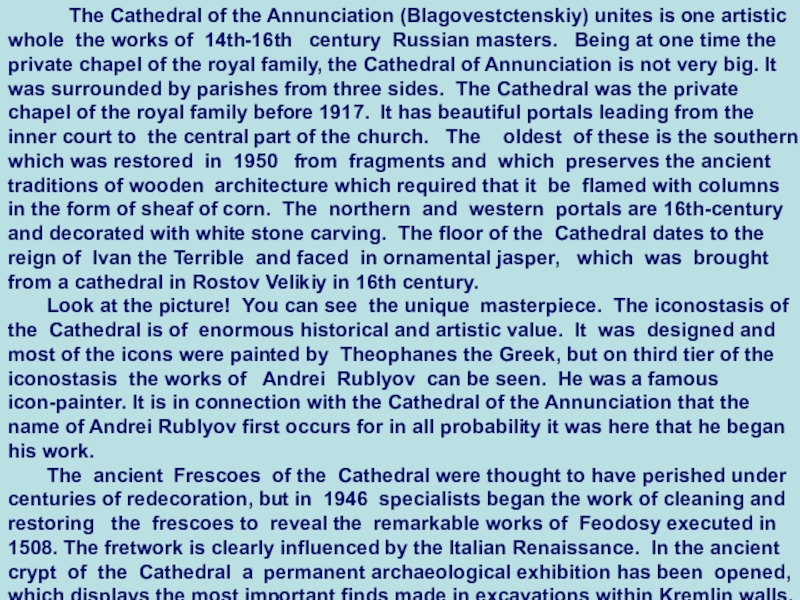
Слайд 10The Cathedral of St. Michael the Archangel.
Look at
the picture! The Cathedral of St. Michael the Archangel was built between 1505 and 1509 by the Italian architect, Alevisio Novi in style of traditional Russian architecture. The rich decoration in the Cathedral, however, is more characteristic of the Italian Renaissance. The original murals have not been preserved, having been removed together with the plaster in the mid-17th century. The present frescoes were painted in the 17th century by artists gathered from all over Russia under the supervision of master painters from Armoury. They depict battle scenes from the history of the struggle for Russian independence as well as other scenes from daily life. The murals also include full-length portraits of the Muscovite princes. On one of the columns there is a painting of the outstanding 13th-century statesman and soldier Alexander Nevsky. The iconostasis (1680-1681) is beautifully decorated in ornamental gold fretwork 13 metres high. 9
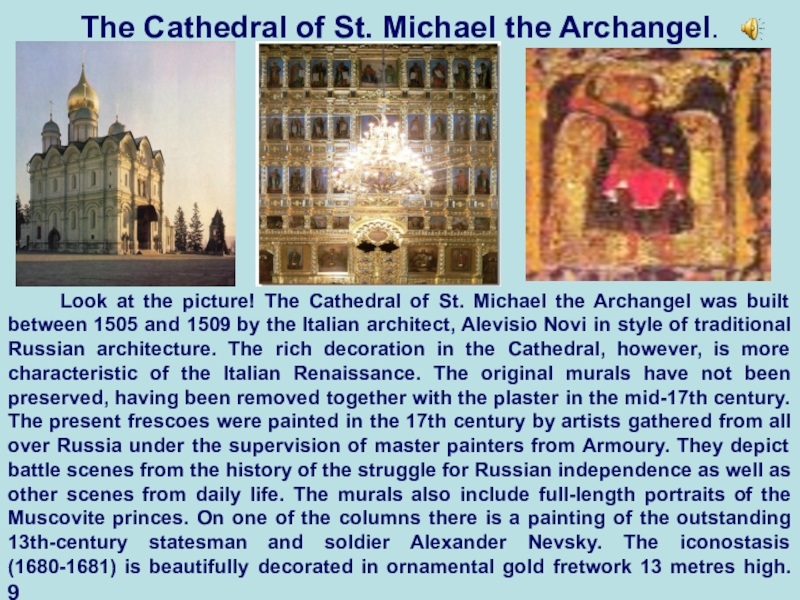
Слайд 11 Most of the icons were painted
by such famous icon-painters as Dorofei Ermolayev, Ermolai Zolotarev and Michail Milyutin who noted for their realistic style. The icon of St. Michael the Archangel is late 14th century and there are also 15th and 16th century icons. You can see the unique church chandelier of the 17th century. From the 14th century the Cathedral contained the sepulcher of the Muscovite princes and tsars, who continued to be buried there until 1700. There are 46 tombs with whitestone epitaphs, etched in intricate Slavonic characters and giving the name and dates of the deceased. The earliest tomb is that of Ivan Kalita who died in 1340 and the Cathedral also contains the tombs of such famous historical personages as Dmitri Donskoy, the great prince and soldier, Ivan III (the Great), Ivan IV (the Terrible) and his son. The 17th century frescoes which had been almost completely obliterated over the years were fully restored in 1953-54.
10
10
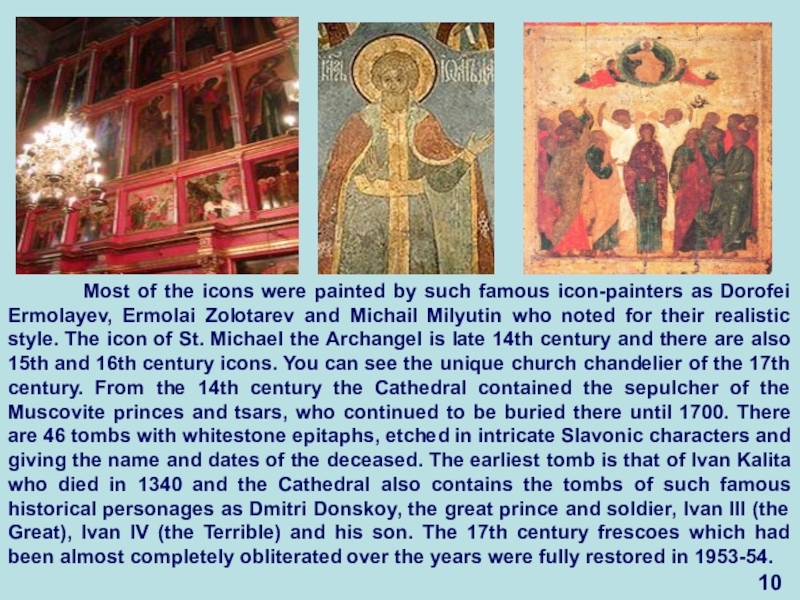
Слайд 12 The Ivan Bell Tower.
Rising high above Square and uniting its churches into a single artistic ensemble, the 81 metre Bell Tower of Ivan the Great presents a magnificent example of early 16th century architecture. Look at the picture! It was designed between 1505 and 1508 by Italian architect Marco Bono. The Russian Tsar Boris Godunov built an unprecedented number of new towns and churches. In 1600, the Ivan Bell Tower inside the Kremlin was extended.
Further two tiers were added, making it the main-tower in the Kremlin with a view over 25 to 30 kilometres. At a height of 260 feet, it was the tallest building in Moscow. The words’’ king of glory’ ’were emblazoned on the cross and the tower was popularly known as ’’ Ivan the Great’’. The admiration was aroused not only by the height of the tower, but also by its beauty, its balanced proportion and its perfection of form. The grandeur and harmony of the structure seemed to embody the strength of the centralized Russian state, and the Bell Tower of Ivan the Great became the prototype for many Russian towered churches. Between 1532 and 1543 on the north side of the Bell Tower the architect Petrok Maly built a campanile- a huge building for housing the large bells. In 1624 Bazhen Ogurtsov built another campanile, known as the Filaret. When Napoleon (the French Emperor who occupied Russia in 1812) left Moscow in 1812 he ordered the Bell Tower to be blown up, but the magnificent column withstood the blast and only the campaniles were destroyed. In 1819 these were restored by Domenico Gilardi. Altogether there are 21 bells in the belfry and campaniles, all decorated with bas-reliefs and ranging from the 16th to the 19th centuries, when the finest of Russia’s bells were cast. The largest is the’’ Dormition’’ bell, weighing 70 tons.
11
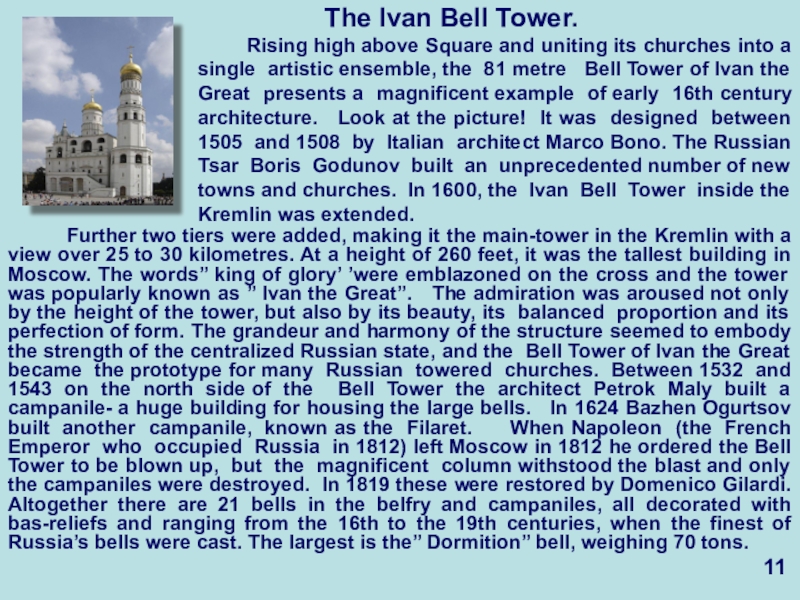
Слайд 13The Cathedral of the Twelve Apostles.
Look at
the picture! The Cathedral of the Twelve Apostles was built by the David Okhlebinin, Antip Konstantinov and Averky Mokeyev on the instructions of Patriach Nicon, who tried to assert the domination of the church over the state. The huge Room of the Cross, or Myrrth Chamber, as it is called, is together with the Cathedral. Here there was the Patriarch’s office. Look at the picture! In the Room of the Cross a museum of 17th century art and culture has been opened. The Terem Palace also includes a group of churches: the Cathedral of the Redemption (Verkhospassky Sobor), the tsar’s private chapel, St. Catherine’s Church, the Church of the Resurrection of Lazarus (Voskreshenye Lazarya), the oldest church in the Kremlin (1393) and other. In 1680-81 they were all united by a single cornice and roof, decorated with eleven elegant cupolas on slender drums, and faced in coloured tiles. This was the work of Osip Startsev. Look at the picture! The little Church of the Deposition of the Virgin’s Robe was built between 1484 and 1486 by architects from Pskov as a private chapel for Russian 12
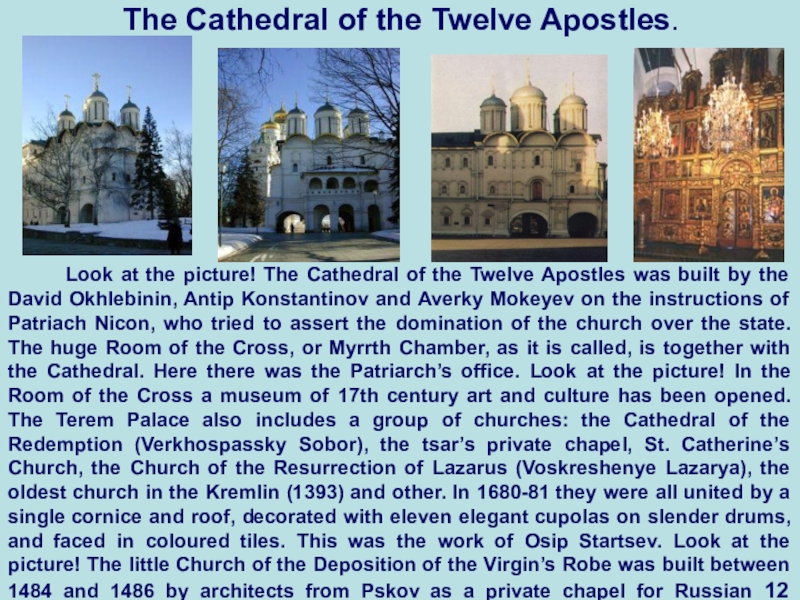
Слайд 14metropolitans and patriarchs. The iconostasis is of great artistic value, being
designed in 1627 by a group of Russian painters headed Nazary Istomin. After work of restoration in the church was completed, a small ambition of ancient Russian pictorial art was opened. The western and northern galleries house a unique collection of ancient wooden sculpture and stone masonry. Here there are rare carved icons, 15th-17th century crosses and other works by Russian folk artists.
The Cathedral of Christ the Saviour.
The Cathedral of Christ the Saviour.
Look at the picture! The Cathedral of Christ the Saviour is the main Russian church. It is a place where the Patriarch of Moscow and All Russia Alexey leads the church serves during Russian Orthodox festivals. The cathedral is not far from Kropotkinskaya metro station. The Cathedral of Christ the Saviour is the symbol of warriors’ glory, monument erected to honor the victory of Russian army over the troops of Napoleon Bonapart in the Patriotic War of 1812. The building began on the orders of the Russian Tsar Alexander I as a thanksgiving to God 13
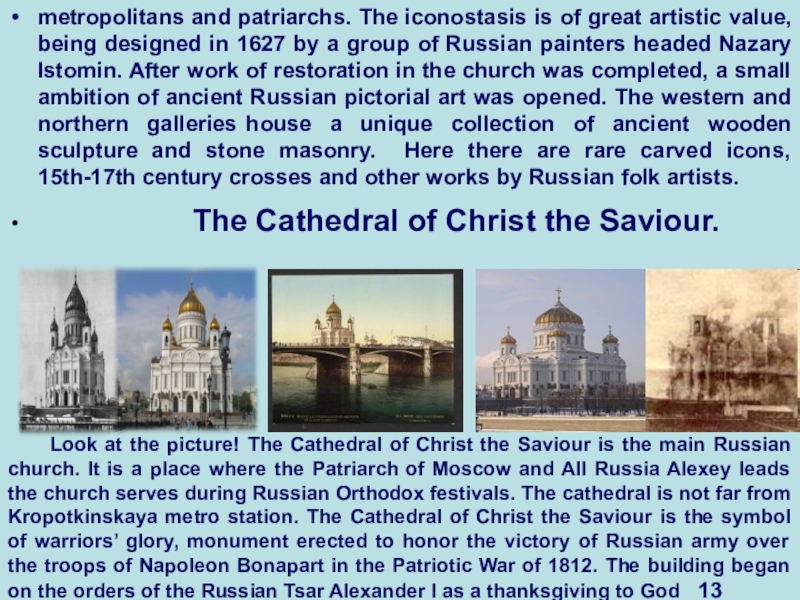
Слайд 15 and to honor of Christ the Saviour in Moscow.
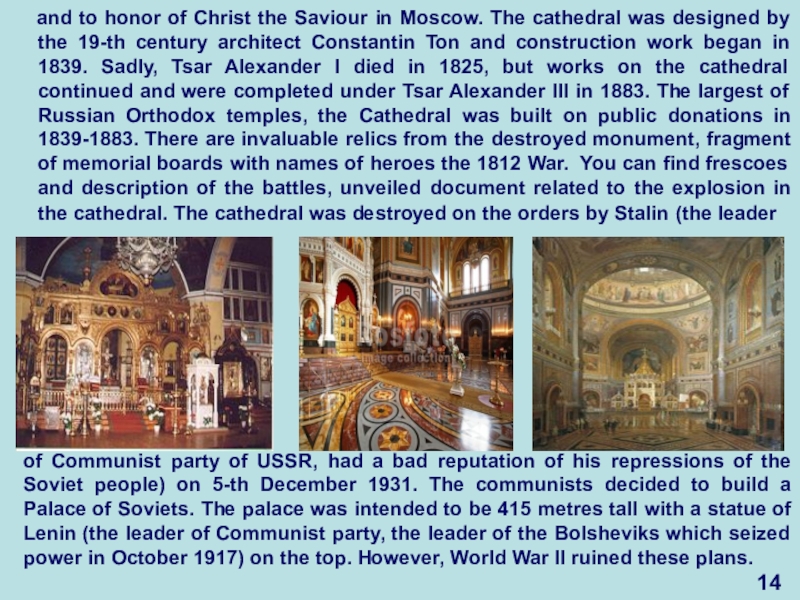
The cathedral was designed by the 19-th century architect Constantin Ton and construction work began in 1839. Sadly, Tsar Alexander I died in 1825, but works on the cathedral continued and were completed under Tsar Alexander III in 1883. The largest of Russian Orthodox temples, the Cathedral was built on public donations in 1839-1883. There are invaluable relics from the destroyed monument, fragment of memorial boards with names of heroes the 1812 War. You can find frescoes and description of the battles, unveiled document related to the explosion in the cathedral. The cathedral was destroyed on the orders by Stalin (the leader
of Communist party of USSR, had a bad reputation of his repressions of the Soviet people) on 5-th December 1931. The communists decided to build a Palace of Soviets. The palace was intended to be 415 metres tall with a statue of Lenin (the leader of Communist party, the leader of the Bolsheviks which seized power in October 1917) on the top. However, World War II ruined these plans.
14
Слайд 16 For several years, the construction
site, with a large crater and a foundation stone engraved with the world” FOR CENTURES” remained unchanged. Then, in 1958, an open air swimming pool built there. In the 1990s, the fantastic dream of rebuilding the cathedral finally came true. The foundation stone for the new cathedral was laid on Russian Orthodox Christian Day (7-th January), 1995. The first service has held on Easter, 1997. The new cathedral is an exact copy of the original and is a sacred place for religious people and one of Moscow’s main tourist attractions. From the 40-metre high o bservation platform, a magnificent Moscow panorama can be seen. The Cathedral of Christ the Saviour is only museum in Moscow aggregated with a working church.
Тhe Novodevichy Convent.
Тhe Novodevichy Convent.
Look at the picture! This is a beautiful view of the Novodevichy Convent. 15
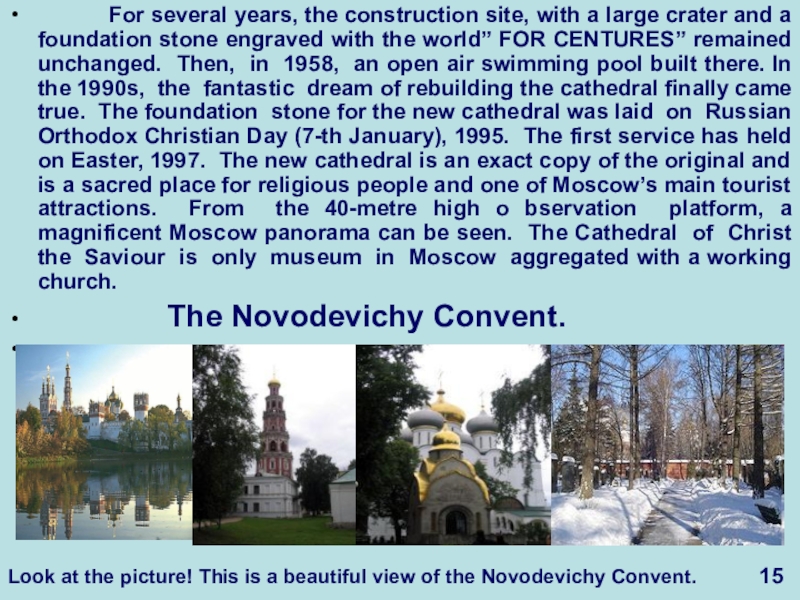
Слайд 17 It is founded in the early 16th
century to celebrate the 1514 victory over the Lithuanian Princes and return of Smolensk to Russia during reign of the Russian Prince Basil III. After the death of Tsar Fedor I and the refusal of his wife, Irina Godynova, to accept the throne, Patriarch Job became the head of state in 1598. Job was the first ever independent patriarch of the Russian Orthodox Church. Irina Godunova came to the Novodevichy Convent and became a nun there. Her brother Boris Godunov lived in the Novodevichy Convent. Here Patriarch Job supported Boris’s candidature to be the Russian Tsar. Boris Godunov made donations to the Novodevichy Convent. It was destroyed during the Time of Trouble. The Novodevichy Convent was also a strong fortress. The Russian Tsarina Sophie was accused of treason and banished to the Novodevichy Convent. She died on 3 July 1704 and was buried in the Smolensk Cathedral of the Novodevichy Convent. It prospered during Sophie’s reign. The Tsarina made donations to Novodevichy Convent. Here there was an orphanage and hospital of soldiers and officers in 1724-25. Evdokia Lopukhina, the first wife of Peter the Great, spent the rest of her life at the Novodevichy Convent, where she died in 1731. In 1812 the Napoleon’s troops wanted to blow up some buildings of the Convent. The buildings were saved by the brave nuns of the Convent. The nuns extinguished the torches and the French could not blow up the buildings. In 1922 the Convent was closed. It began as a museum in 1934. The Novodevichy Convent was surrounded by a huge wall with 12 towers and used a fortress guarding the approaches to the city.
The Our Lady of Smolensk Cathedral is the most ancient building in the Convent. The Convent itself is a unique 16th-17th century architectural ensemble, dominated by the huge five-cupola Smolensk Cathedral (1524-25) which was modeled on the Cathedral of the Dormition in the Kremlin. In the late 16th century the walls of the Cathedral were ornamented with frescoes, reflecting episodes in the struggle for the creation of a centralized Russian State. 16
The Our Lady of Smolensk Cathedral is the most ancient building in the Convent. The Convent itself is a unique 16th-17th century architectural ensemble, dominated by the huge five-cupola Smolensk Cathedral (1524-25) which was modeled on the Cathedral of the Dormition in the Kremlin. In the late 16th century the walls of the Cathedral were ornamented with frescoes, reflecting episodes in the struggle for the creation of a centralized Russian State. 16
Слайд 18 In the 1680s Mikhailov
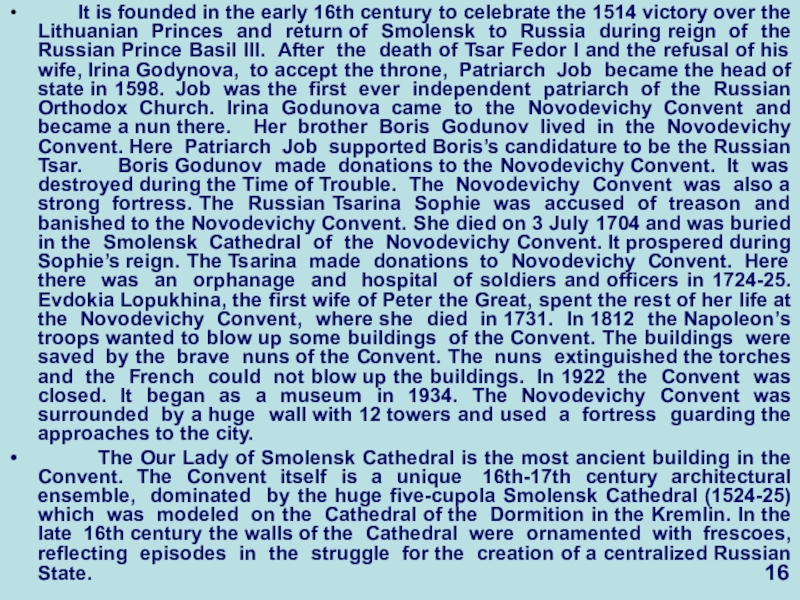
and Andreyev together with a number of other mastercarvers created on of the finest ornament work of the period- the multi-tiered, gild carved iconostasis. The floor of the Cathedral is made of cast-iron plates. The most famous parts of the Convent are the refectory; the belfry and the gate-house church were all built in 1680s. The decorative Moscow baroque style serves to harmonize t he buildings with the abundance of whitestone ornamentation on the red-brick walls.
It will be interesting to know more about historical unique places of Moscow not only for foreigners but for the Russians. We live in Moscow. Most of us know the unique sights of the capital. We are proud of the Russian Orthodox Culture. In 2007 the Patriarch of Moscow and all Russia Alexey met with some representatives of the Russian Orthodox Church abroad. It is a beginning of the friendly communication of the Russian Orthodox Church and the Russian Orthodox Church abroad.
It will be interesting to know more about historical unique places of Moscow not only for foreigners but for the Russians. We live in Moscow. Most of us know the unique sights of the capital. We are proud of the Russian Orthodox Culture. In 2007 the Patriarch of Moscow and all Russia Alexey met with some representatives of the Russian Orthodox Church abroad. It is a beginning of the friendly communication of the Russian Orthodox Church and the Russian Orthodox Church abroad.
17
Слайд 19Conclusion.
The Russian Orthodox Culture is unique
in all over the world. It’s one of a kind. T he Russian Orthodox culture is closely connected with our spirituality. The Russian icons are the unique value all over the world. Many foreigners visit to the Russian Orthodox Cathedrals. Why are they interested in it? The foreigners attract the Russian Orthodox icons, beauty and magnificence of our Cathedrals. The Russian icon p ainters are world-known. They are Andrei Rublyov, Theophanes the Greek, Dorofei Ermolayev, Ermolai Zolotarev and Michail Milyutin. The buildings of the Russian Orthodox Cathedrals are world-known masterpieces. The Cathedral of St .Basil of Blessed was built by the Russian wooden architects Postnic and Barma. They created a monument whose composition has no equal any where in the world. The Cathedral of Dormition of the Moscow Kremlin was built under the supervision of the Italian architect Aristotle Fioravanti in 1475. For four centuries it was the main cathedral in Russia. The Cathedral of St. Michael the Archangel was built between 1505 and 1509 by the Italian architect, Alevisio Novi in style of traditional Russian architecture. The Cathedral of Christ the Saviour was designed by the 19-th century architect Constantin Ton. The largest of Russian Orthodox temples, the Cathedral was built on public donations in 1839-1883. The Novodevichy Convent founded in the early 16th century to celebrate the 1514 victory over the Lithuanian Princes and return of Smolensk to Russia during reign of the Russian Prince Basil III. In the 1680s the well-known Russian masters Mikhailov and Andreyev together with a number of other mastercarvers created on of the finest ornament work of the period- the multi-tiered, gild carved iconostasis. The elegant and unusually decorative belfry was erected in 1690 by well-known Russian master Potapov. The Russian 18
Слайд 20retworks are world- known. The present frescoes of the Cathedral of
St. Michael the Archangel were painted in the 17th century by artists gathered from all over Russia under the supervision of master painters from Armoury. In the Cathedral of the Annunciation the visitors reveal the unique frescoes, the remarkable works of Feodosy. The works of the Russian masters were generally recognized all over the world.
Summing up.
We are proud of the Russian Orthodox Culture. As the result of the research the aim is reached, that is a significance of the Russian Orthodox Culture all over the world has been found out. We have made up the route of excursions in the Russian Orthodox Cathedral. The Moscow Orthodox Cathedrals are the most unique world’s monuments.
19
Summing up.
We are proud of the Russian Orthodox Culture. As the result of the research the aim is reached, that is a significance of the Russian Orthodox Culture all over the world has been found out. We have made up the route of excursions in the Russian Orthodox Cathedral. The Moscow Orthodox Cathedrals are the most unique world’s monuments.
19
Слайд 21Glossary.
Alexander Nevsky – the Russian prince (1252-1263) who defeated the Swedes
in 1240 and the Teutonic Knights in 1242. He was canonized by Russian Orthodox Church in 1547;
Alexander I – the Russian Emperor (1777-1825), the first half of his reign was a period of moderate and liberal reforms;
Alexander III – the Russian Emperor (1845-1894) founded the Peasant bank and the Nobles Land Bank in Russia, introduced the church schools in rural parishes and others;
Apostle – one of the 12 first followers of Christ; leader of a new faith;
Archangel – super angel, angel – messenger of God;
architecture – art of building; way of building;
array – fine show, collection, or ordered group;
Basil III – Grand Prince of Moscow and All Russia (1479-1533) was kwon for his hard and tough character and as the “final gatherer of the Russian lands”;
Bible – holy book of the Christians and Jews;
Boris Godunov – the Russian tsar (1552-1605), did all he could to strengthen the Russian state;
canopy – cloth roof over a bed;
cathedral – chief church of a DIOCESE;
chapel – small church;
Christian – person who believes in the teachings of Christ;
convent – place where nuns live;
culture- art, thought, and customs of a society;
Dmitry Donskoy – the Russian prince (1362-1389) who won the Battle of Kulikovo and defeated the Tatars in 1380; 21
Alexander I – the Russian Emperor (1777-1825), the first half of his reign was a period of moderate and liberal reforms;
Alexander III – the Russian Emperor (1845-1894) founded the Peasant bank and the Nobles Land Bank in Russia, introduced the church schools in rural parishes and others;
Apostle – one of the 12 first followers of Christ; leader of a new faith;
Archangel – super angel, angel – messenger of God;
architecture – art of building; way of building;
array – fine show, collection, or ordered group;
Basil III – Grand Prince of Moscow and All Russia (1479-1533) was kwon for his hard and tough character and as the “final gatherer of the Russian lands”;
Bible – holy book of the Christians and Jews;
Boris Godunov – the Russian tsar (1552-1605), did all he could to strengthen the Russian state;
canopy – cloth roof over a bed;
cathedral – chief church of a DIOCESE;
chapel – small church;
Christian – person who believes in the teachings of Christ;
convent – place where nuns live;
culture- art, thought, and customs of a society;
Dmitry Donskoy – the Russian prince (1362-1389) who won the Battle of Kulikovo and defeated the Tatars in 1380; 21
Слайд 22Easter – holy day in memory of Christ’s death and RESURRECTION;
epitaphs
– words written above a grave;
Fedor I (Ivanovich) – the Russian tsar (1557-1598), led a modest and moderate lifestyle, visited monasteries, held long conversations with artisans and icon-painters;
fresco – picture pained on wet plaster;
icon – much admired person who attacks established beliefs; also icon picture of a holy person; iconostas – the wall on which hung icons and separated from the altar in the church; alter – table used in a religious ceremony;
Ivan Kalita - the Russian prince (1328-1340) who ruled Moscow. Moscow emerged the new centre from 1325;
Ivan the Great – the Russian Grand prince (1440-1505), he ruled over 4000,000 square kilometers; overhauled the Russian army, also created a permanent artillery force, besieged Kazan, had eight wives, killed his son Ivan;
Jesus Christ – man on whose teaching Christianity is based;
masterpiece – piece of work, esp. of art, done with extreme skill;
parish – area for which a priest has responsibility;
Patriarch – chief Bishop of the Eastern Church;
Peter the Great – the Russian emperor (1672-1725) who developed Russian industry, built St.Petersburg, reformed Russia and other;
priest – in the Christian Church, esp. in the Roman Catholic Church specially trained person who performs religious ceremonies and other religious duties;
sepulchre - burial place;
tower – tall building;
vault – underground room, esp. for storage or for dead bodies;
Vladimir Monomachus – the Russian prince (1113-1125) 22
Fedor I (Ivanovich) – the Russian tsar (1557-1598), led a modest and moderate lifestyle, visited monasteries, held long conversations with artisans and icon-painters;
fresco – picture pained on wet plaster;
icon – much admired person who attacks established beliefs; also icon picture of a holy person; iconostas – the wall on which hung icons and separated from the altar in the church; alter – table used in a religious ceremony;
Ivan Kalita - the Russian prince (1328-1340) who ruled Moscow. Moscow emerged the new centre from 1325;
Ivan the Great – the Russian Grand prince (1440-1505), he ruled over 4000,000 square kilometers; overhauled the Russian army, also created a permanent artillery force, besieged Kazan, had eight wives, killed his son Ivan;
Jesus Christ – man on whose teaching Christianity is based;
masterpiece – piece of work, esp. of art, done with extreme skill;
parish – area for which a priest has responsibility;
Patriarch – chief Bishop of the Eastern Church;
Peter the Great – the Russian emperor (1672-1725) who developed Russian industry, built St.Petersburg, reformed Russia and other;
priest – in the Christian Church, esp. in the Roman Catholic Church specially trained person who performs religious ceremonies and other religious duties;
sepulchre - burial place;
tower – tall building;
vault – underground room, esp. for storage or for dead bodies;
Vladimir Monomachus – the Russian prince (1113-1125) 22
Слайд 23
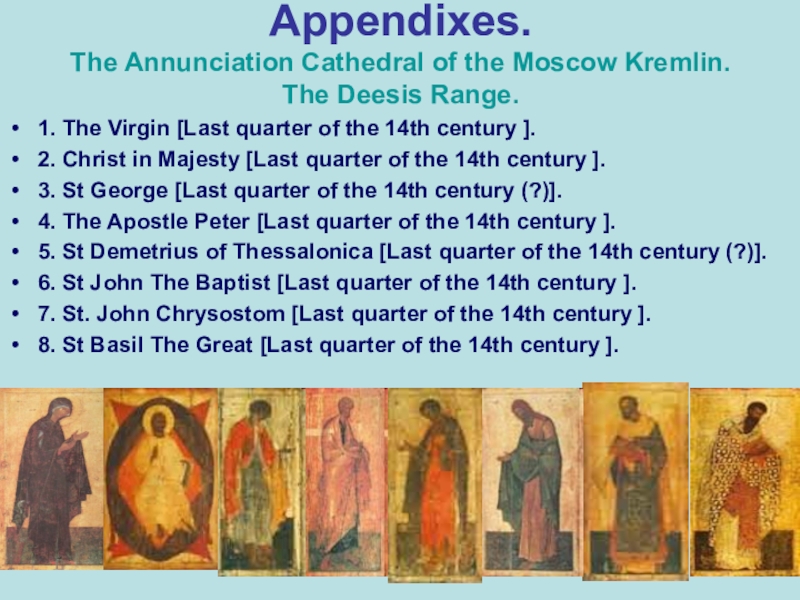
Appendixes.
The Annunciation Cathedral of the Moscow Kremlin. The Deesis Range.
1. The
Virgin [Last quarter of the 14th century ].
2. Christ in Majesty [Last quarter of the 14th century ].
3. St George [Last quarter of the 14th century (?)].
4. The Apostle Peter [Last quarter of the 14th century ].
5. St Demetrius of Thessalonica [Last quarter of the 14th century (?)].
6. St John The Baptist [Last quarter of the 14th century ].
7. St. John Chrysostom [Last quarter of the 14th century ].
8. St Basil The Great [Last quarter of the 14th century ].
2. Christ in Majesty [Last quarter of the 14th century ].
3. St George [Last quarter of the 14th century (?)].
4. The Apostle Peter [Last quarter of the 14th century ].
5. St Demetrius of Thessalonica [Last quarter of the 14th century (?)].
6. St John The Baptist [Last quarter of the 14th century ].
7. St. John Chrysostom [Last quarter of the 14th century ].
8. St Basil The Great [Last quarter of the 14th century ].
Слайд 24The Annunciation Cathedral of the Moscow Kremlin. The Deesis Range.
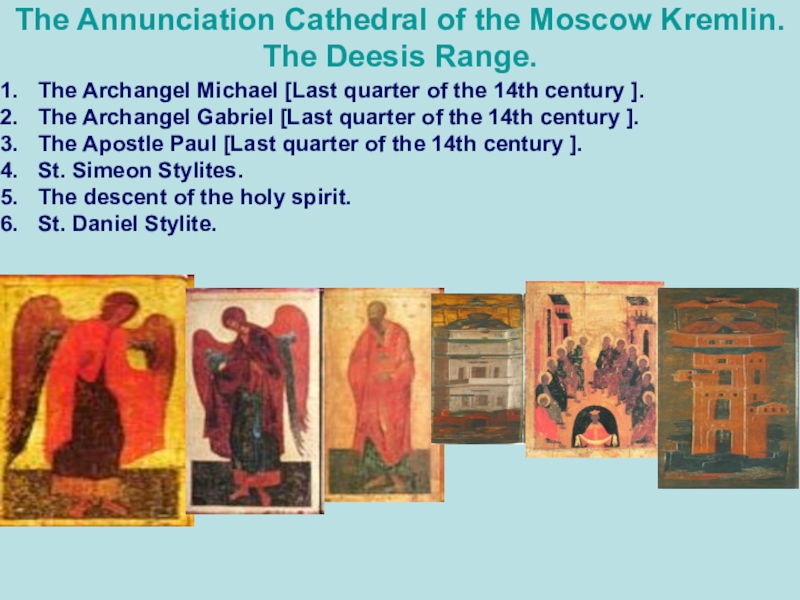
The Archangel
Michael [Last quarter of the 14th century ].
The Archangel Gabriel [Last quarter of the 14th century ].
The Apostle Paul [Last quarter of the 14th century ].
St. Simeon Stylites.
The descent of the holy spirit.
St. Daniel Stylite.
The Archangel Gabriel [Last quarter of the 14th century ].
The Apostle Paul [Last quarter of the 14th century ].
St. Simeon Stylites.
The descent of the holy spirit.
St. Daniel Stylite.