- Главная
- Разное
- Образование
- Спорт
- Естествознание
- Природоведение
- Религиоведение
- Французский язык
- Черчение
- Английский язык
- Астрономия
- Алгебра
- Биология
- География
- Геометрия
- Детские презентации
- Информатика
- История
- Литература
- Математика
- Музыка
- МХК
- Немецкий язык
- ОБЖ
- Обществознание
- Окружающий мир
- Педагогика
- Русский язык
- Технология
- Физика
- Философия
- Химия
- Шаблоны, фоны, картинки для презентаций
- Экология
- Экономика
Презентация, доклад к выступлению О преподавании спецкурса Деловой английский язык
Содержание
- 1. Презентация к выступлению О преподавании спецкурса Деловой английский язык
- 2. Цели и задачи курса Обучение «Деловому английскому
- 3. Цели и задачи курсаВ процессе обучения деловому
- 4. Цели и задачи курсаХарактерной особенностью обучения иностранным
- 5. Цели и задачи курсаКурс характеризуется преобладанием устных
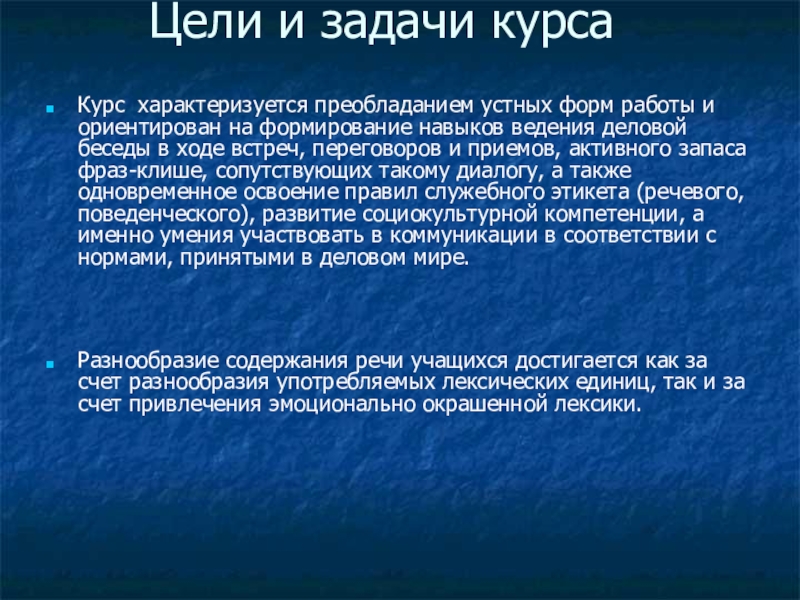
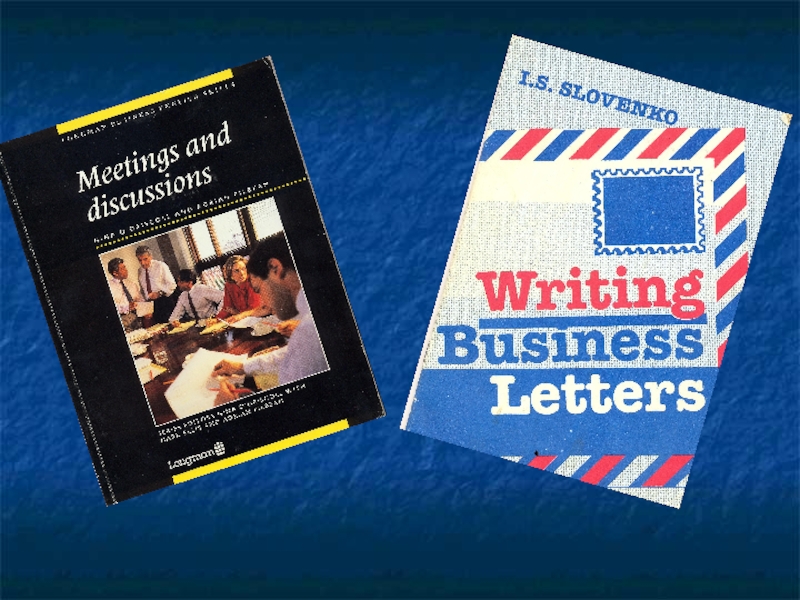
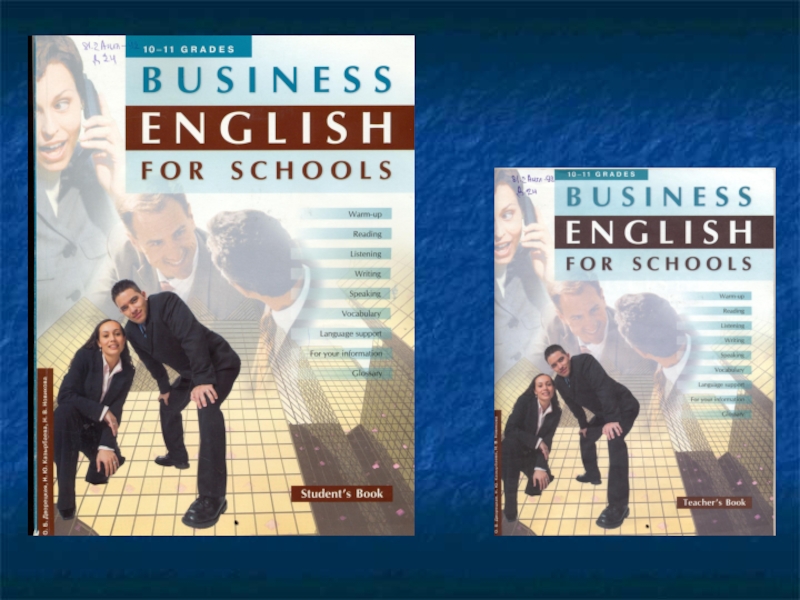
- 6. Учебники и учебные пособия
- 7. Слайд 7
- 8. Слайд 8
- 9. Слайд 9
- 10. Содержание курсаПрограмма данного курса предусматри -вает следующие
- 11. Содержание курсаVocabulary - работа над активной лексикой
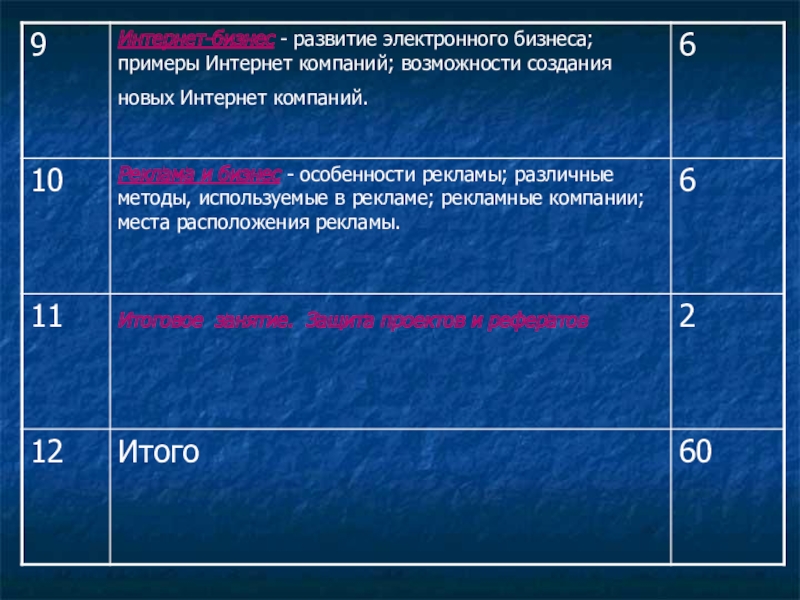
- 12. Учебно-тематический план
- 13. Слайд 13
- 14. Слайд 14
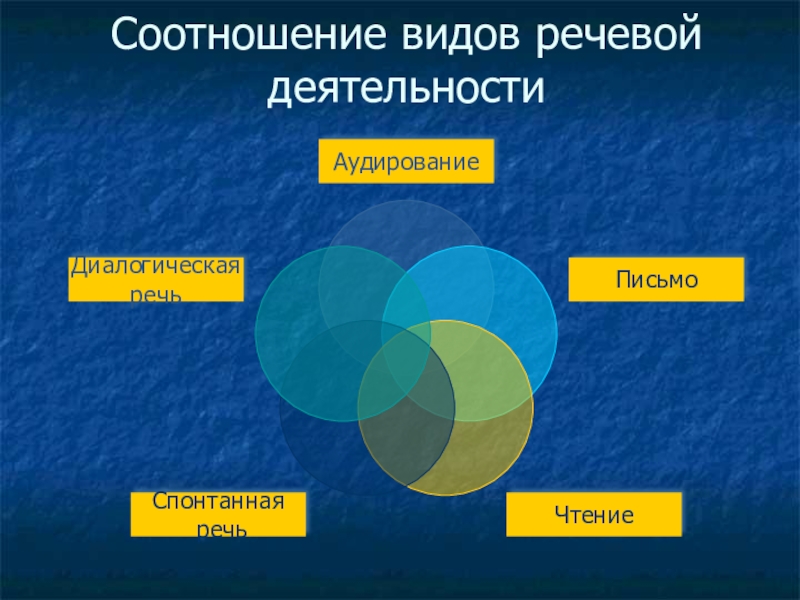
- 15. Соотношение видов речевой деятельности
- 16. Письмо
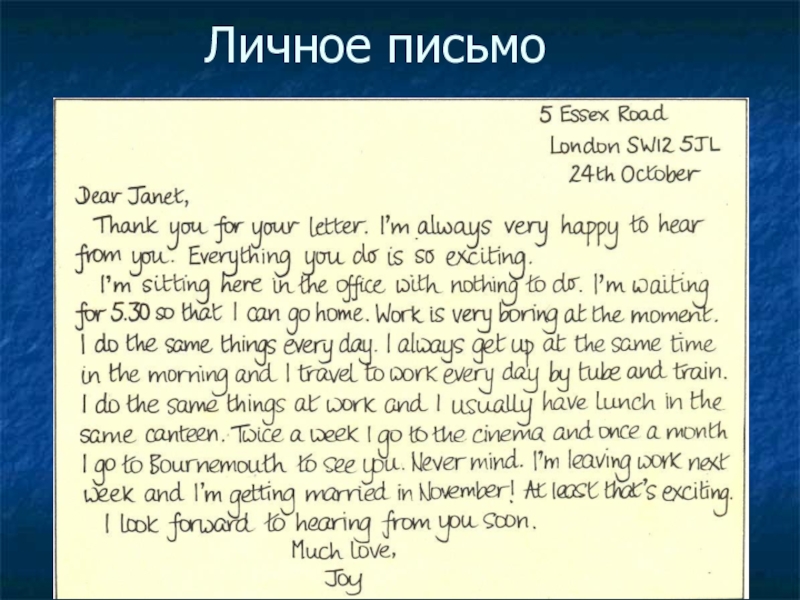
- 17. Личное письмо
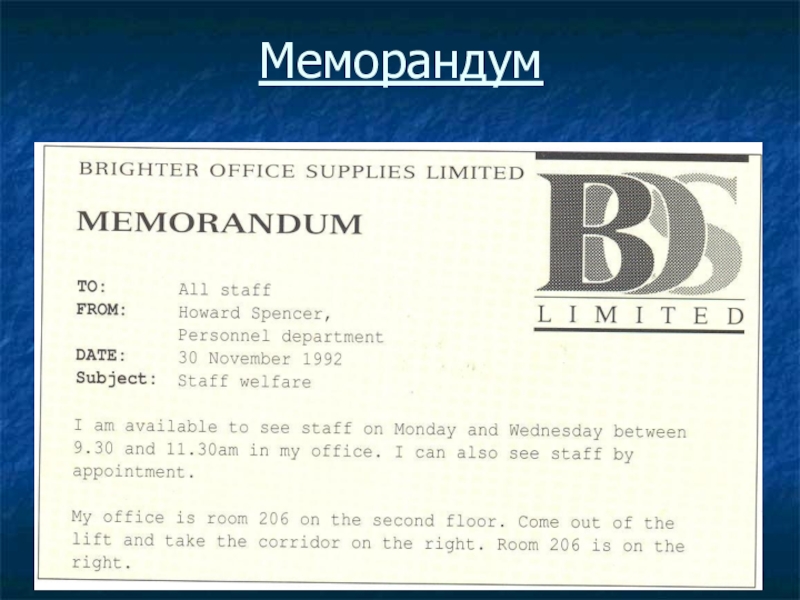
- 18. Меморандум
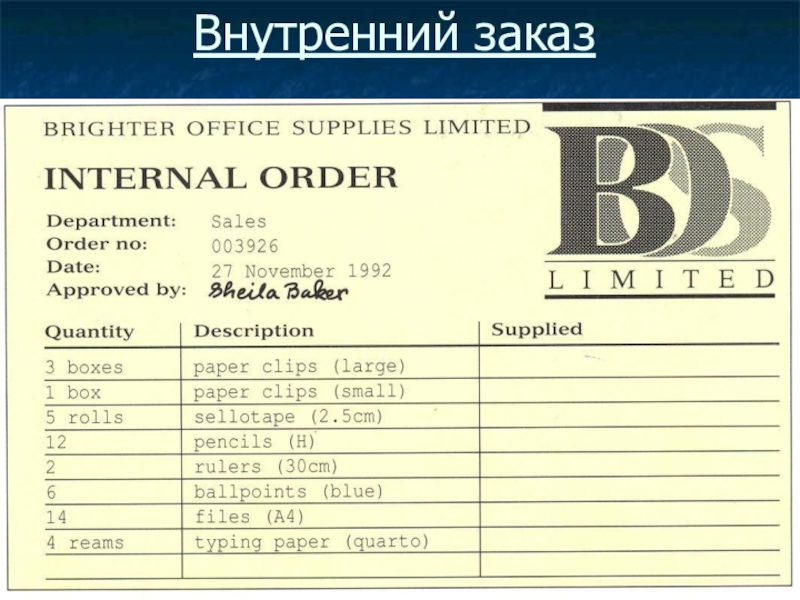
- 19. Внутренний заказ
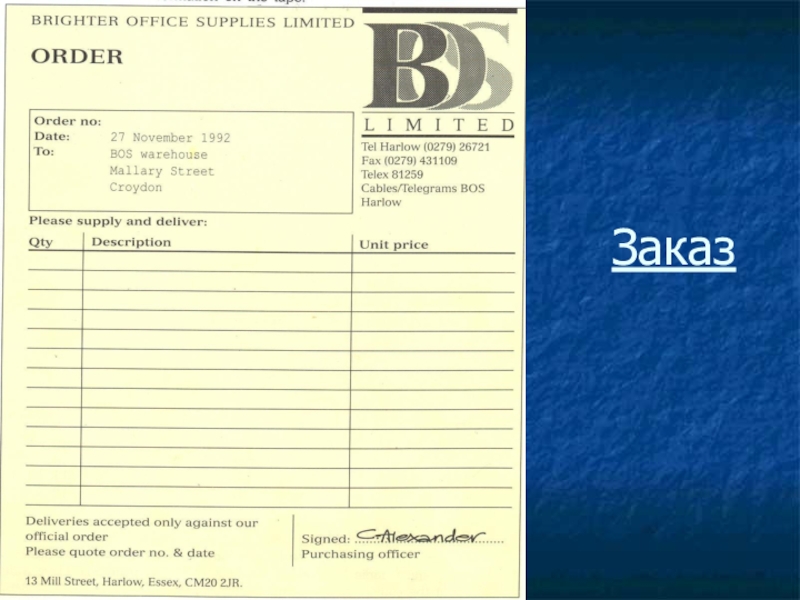
- 20. Заказ
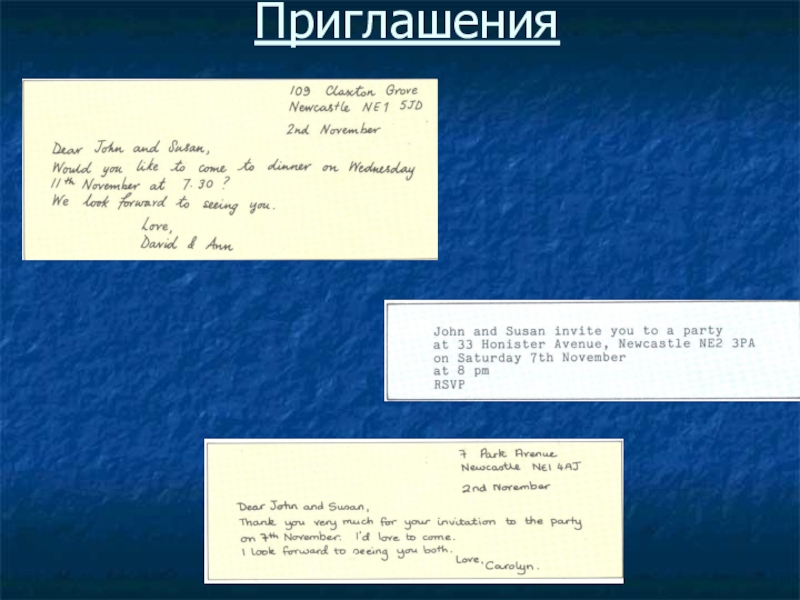
- 21. Приглашения
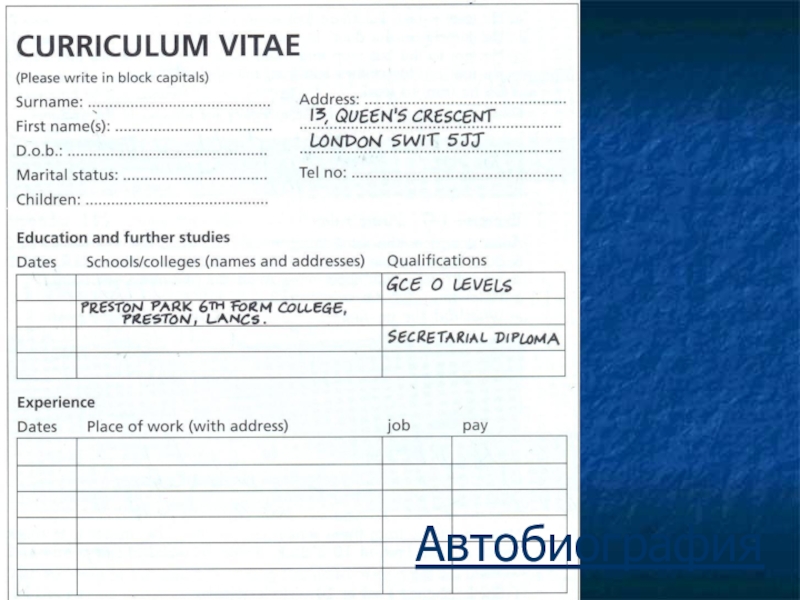
- 22. Автобиография
- 23. Банковский чек
- 24. Накладная
- 25. Телексы
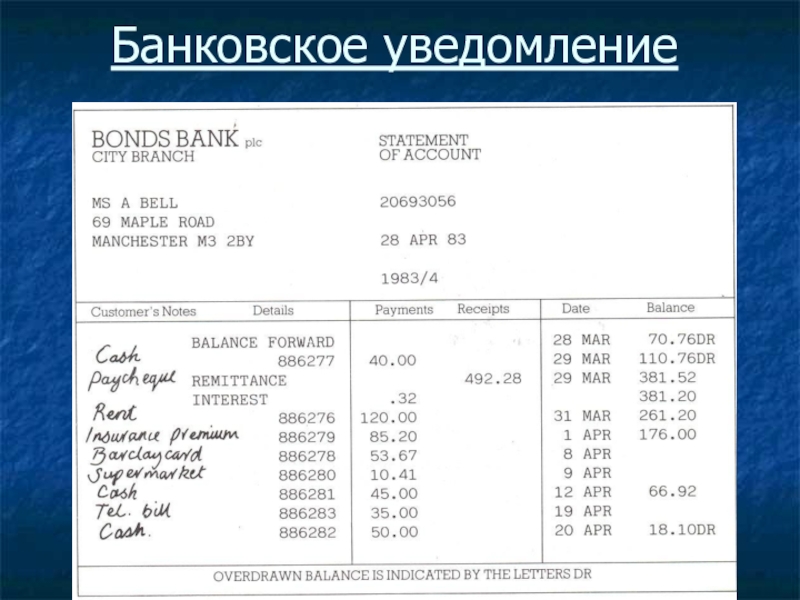
- 26. Банковское уведомление
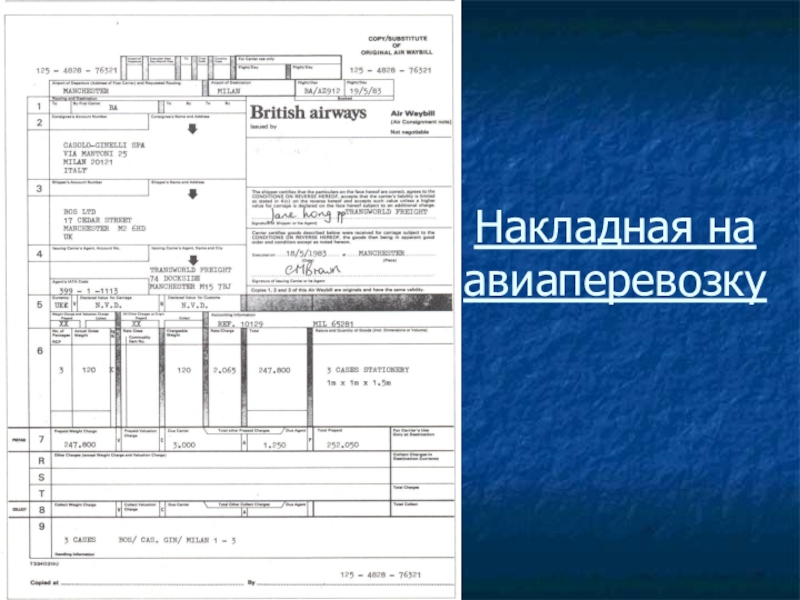
- 27. Накладная на авиаперевозку
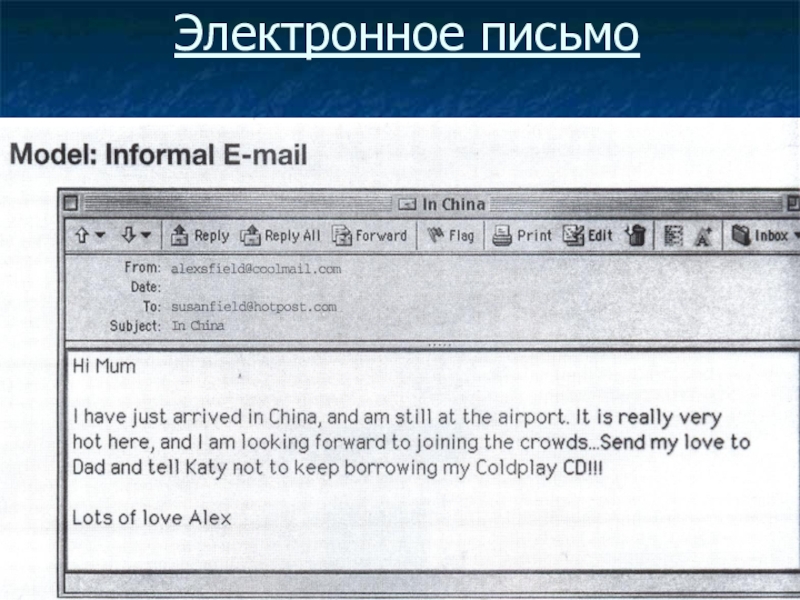
- 28. Электронное письмо
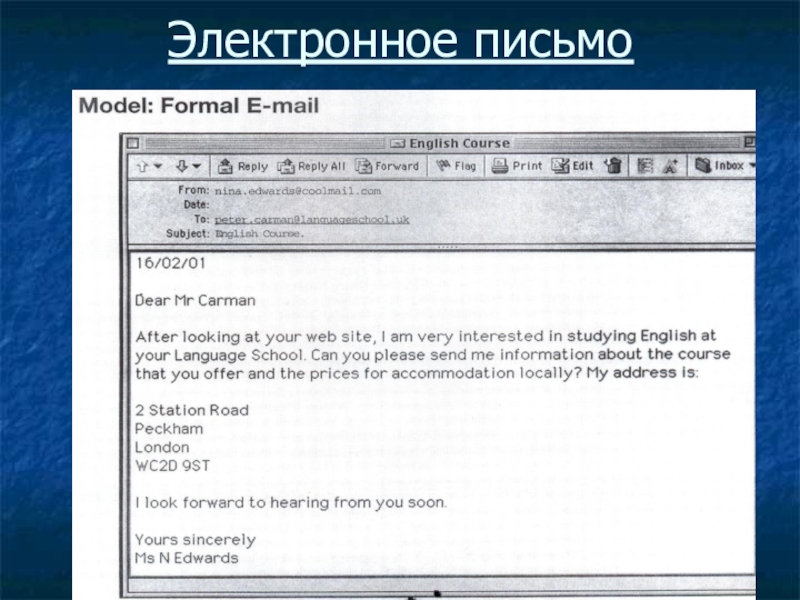
- 29. Электронное письмо
- 30. Деловое письмоA business letter, as a rule,
- 31. THE LAYOUT OF ENVELOPESStamp(s)Sender's addressRecipient's addressPostal remarks
- 32. THE LAYOUT OF ENVELOPES
- 33. The sender's address(the return address) is typed
- 34. The recipient's addressThe recipient's address is written
- 35. LAYOUT OF AN OFFICIAL LETTER1. The heading2.
- 36. THE HEADINGThe heading, in full, consists
- 37. THE DATE
- 38. THE INSIDE ADDRESS The inside address (recipient's
- 39. THE SALUTATIONThe opening salutation should be
- 40. THE BODY OF THE LETTER The
- 41. THE COMPLIMENTARY CLOSEIt is customary to
- 42. THE SIGNATUREThe name of the person
- 43. SUPPLEMENTS IN OFFICIAL AND BUSINESS LETTERS The
- 44. SUPPLEMENTS IN OFFICIAL AND BUSINESS LETTERSThe subject
- 45. SUPPLEMENTS IN OFFICIAL AND BUSINESS LETTERSThe typist's
- 46. SUPPLEMENTS IN OFFICIAL AND BUSINESS LETTERSThe enclosure:
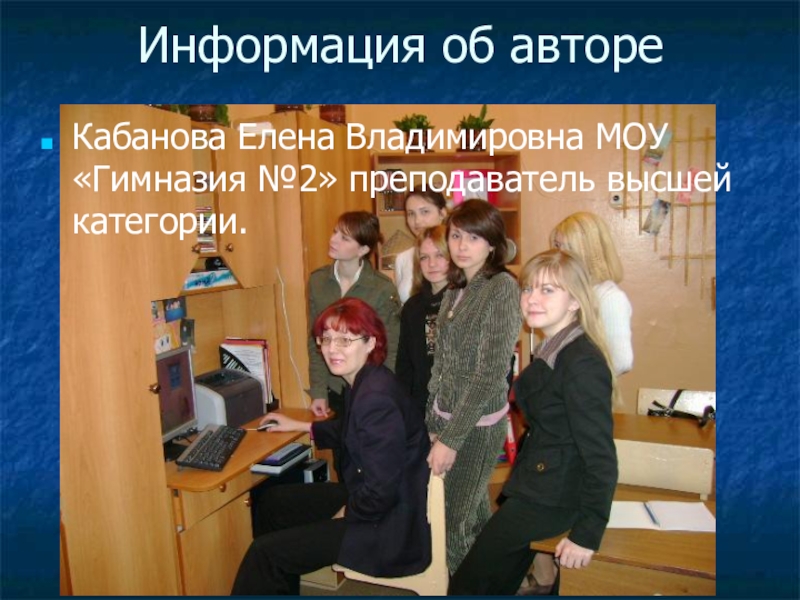
- 47. Информация об автореКабанова Елена Владимировна МОУ «Гимназия №2» преподаватель высшей категории.
Цели и задачи курса Обучение «Деловому английскому языку» определяются возрастающей ролью иностранного языка в современном развитии общества. Целью изучения курса «Деловой английский язык» является обучение разговорной речи, аудированию, чтению и письму. В ходе занятий уделяется внимание

Слайд 2Цели и задачи курса
Обучение «Деловому английскому языку» определяются возрастающей ролью
иностранного языка в современном развитии общества.
Целью изучения курса «Деловой английский язык» является обучение разговорной речи, аудированию, чтению и письму. В ходе занятий уделяется внимание не только углублению знаний по английскому языку, но и привитию навыков правильного поведения в странах английского языка.
Целью изучения курса «Деловой английский язык» является обучение разговорной речи, аудированию, чтению и письму. В ходе занятий уделяется внимание не только углублению знаний по английскому языку, но и привитию навыков правильного поведения в странах английского языка.
Слайд 3Цели и задачи курса
В процессе обучения деловому английскому языку предусматривается активное
использование технических средств обучения, работа с ресурсами Интернет и обучающими мультимедийными продуктами.
Курс обеспечивает словарный запас, необходимый учащимся в будущей профессиональной деятельности, для делового общения с зарубежными партнерами, для работы с деловой корреспонденцией, докумен- тами, другими информационными материалами.
Курс обеспечивает словарный запас, необходимый учащимся в будущей профессиональной деятельности, для делового общения с зарубежными партнерами, для работы с деловой корреспонденцией, докумен- тами, другими информационными материалами.
Слайд 4Цели и задачи курса
Характерной особенностью обучения иностранным языкам является взаимодействие всех
видов речевой деятельности. Речь учащихся характеризуется большей инициативностью и спонтанностью.
Деление на диалогическую и монологическую речь на этом этапе условно, так как эти виды речи всё больше выступают во взаимосвязи. Основными видами диалогической речи становятся свободная беседа, групповое обсуждение предложенной проблемы.
Деление на диалогическую и монологическую речь на этом этапе условно, так как эти виды речи всё больше выступают во взаимосвязи. Основными видами диалогической речи становятся свободная беседа, групповое обсуждение предложенной проблемы.
Слайд 5Цели и задачи курса
Курс характеризуется преобладанием устных форм работы и ориентирован
на формирование навыков ведения деловой беседы в ходе встреч, переговоров и приемов, активного запаса фраз-клише, сопутствующих такому диалогу, а также одновременное освоение правил служебного этикета (речевого, поведенческого), развитие социокультурной компетенции, а именно умения участвовать в коммуникации в соответствии с нормами, принятыми в деловом мире.
Разнообразие содержания речи учащихся достигается как за счет разнообразия употребляемых лексических единиц, так и за счет привлечения эмоционально окрашенной лексики.
Разнообразие содержания речи учащихся достигается как за счет разнообразия употребляемых лексических единиц, так и за счет привлечения эмоционально окрашенной лексики.


Слайд 10Содержание курса
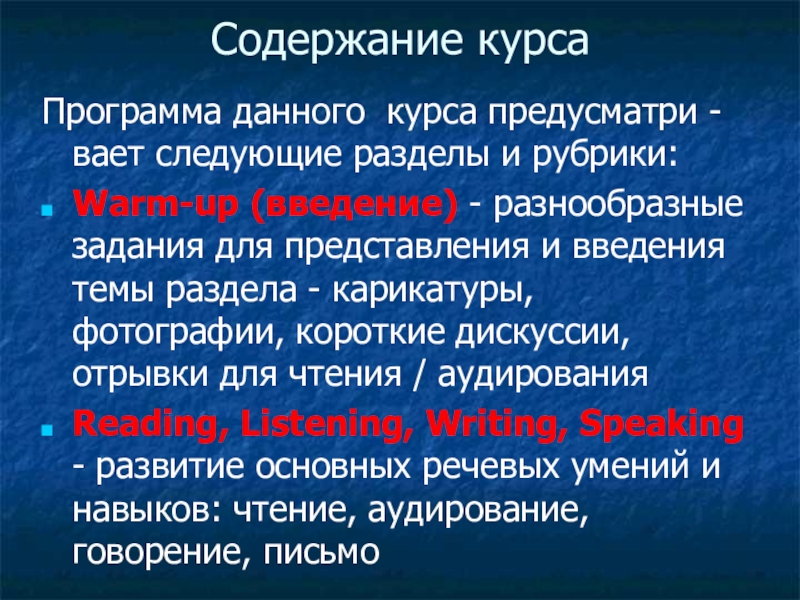
Программа данного курса предусматри -вает следующие разделы и рубрики:
Warm-up
(введение) - разнообразные задания для представления и введения темы раздела - карикатуры, фотографии, короткие дискуссии, отрывки для чтения / аудирования
Reading, Listening, Writing, Speaking - развитие основных речевых умений и навыков: чтение, аудирование, говорение, письмо
Reading, Listening, Writing, Speaking - развитие основных речевых умений и навыков: чтение, аудирование, говорение, письмо
Слайд 11Содержание курса
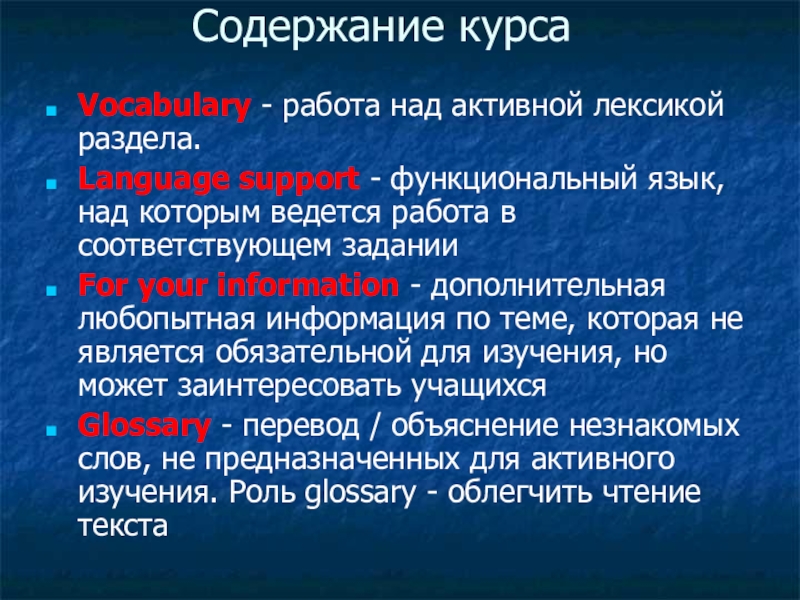
Vocabulary - работа над активной лексикой раздела.
Language support - функциональный
язык, над которым ведется работа в соответствующем задании
For your information - дополнительная любопытная информация по теме, которая не является обязательной для изучения, но может заинтересовать учащихся
Glossary - перевод / объяснение незнакомых слов, не предназначенных для активного изучения. Роль glossary - облегчить чтение текста
For your information - дополнительная любопытная информация по теме, которая не является обязательной для изучения, но может заинтересовать учащихся
Glossary - перевод / объяснение незнакомых слов, не предназначенных для активного изучения. Роль glossary - облегчить чтение текста




Слайд 30Деловое письмо
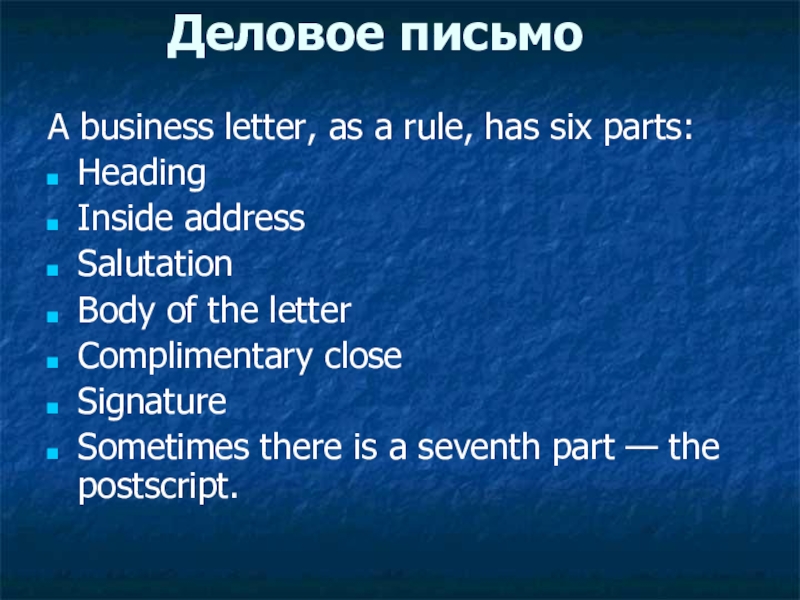
A business letter, as a rule, has six parts:
Heading
Inside address
Salutation
Body
of the letter
Complimentary close
Signature
Sometimes there is a seventh part — the postscript.
Complimentary close
Signature
Sometimes there is a seventh part — the postscript.
Слайд 33The sender's address
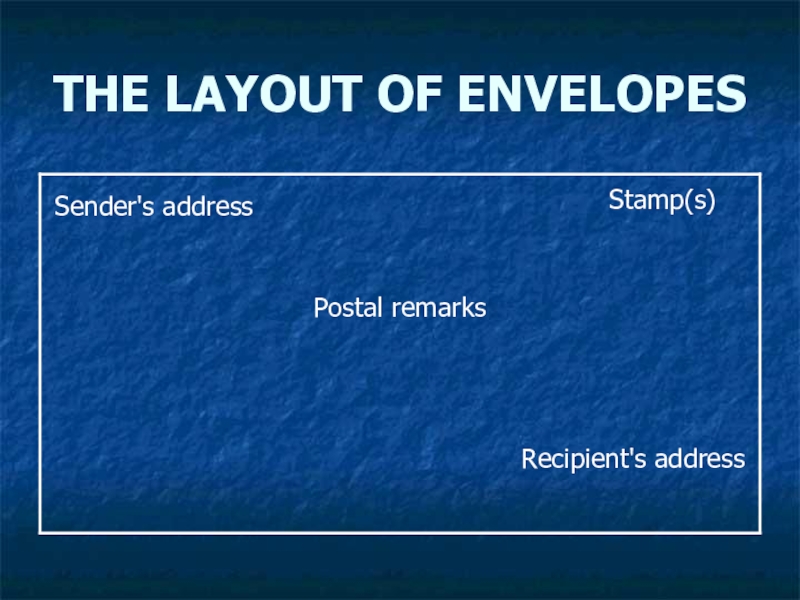
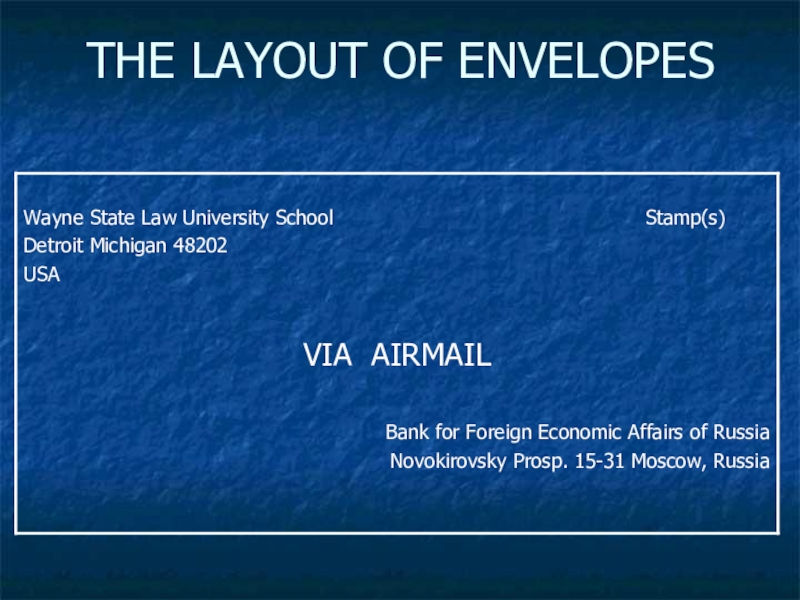
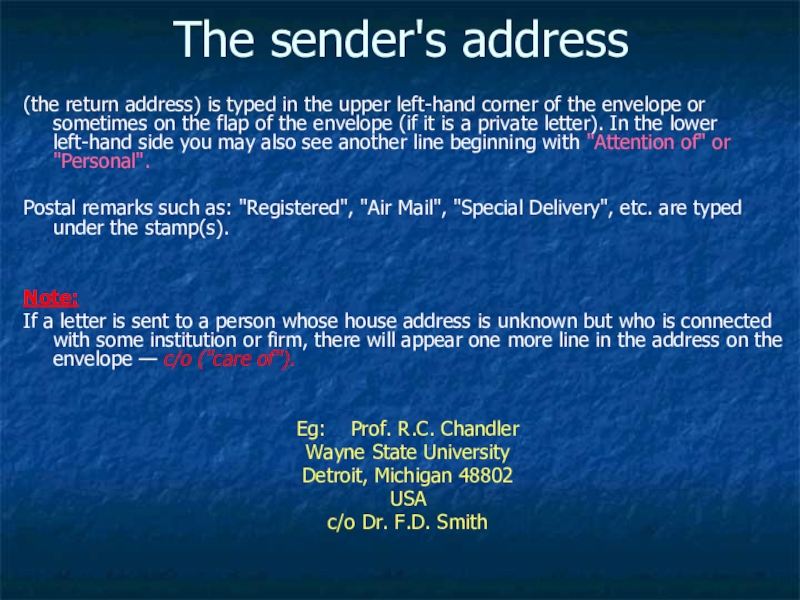
(the return address) is typed in the upper left-hand
corner of the envelope or sometimes on the flap of the envelope (if it is a private letter). In the lower left-hand side you may also see another line beginning with "Attention of" or "Personal".
Postal remarks such as: "Registered", "Air Mail", "Special Delivery", etc. are typed under the stamp(s).
Note:
If a letter is sent to a person whose house address is unknown but who is connected with some institution or firm, there will appear one more line in the address on the envelope — c/o ("care of").
Eg: Prof. R.C. Chandler
Wayne State University
Detroit, Michigan 48802
USA
c/o Dr. F.D. Smith
Postal remarks such as: "Registered", "Air Mail", "Special Delivery", etc. are typed under the stamp(s).
Note:
If a letter is sent to a person whose house address is unknown but who is connected with some institution or firm, there will appear one more line in the address on the envelope — c/o ("care of").
Eg: Prof. R.C. Chandler
Wayne State University
Detroit, Michigan 48802
USA
c/o Dr. F.D. Smith
Слайд 34The recipient's address
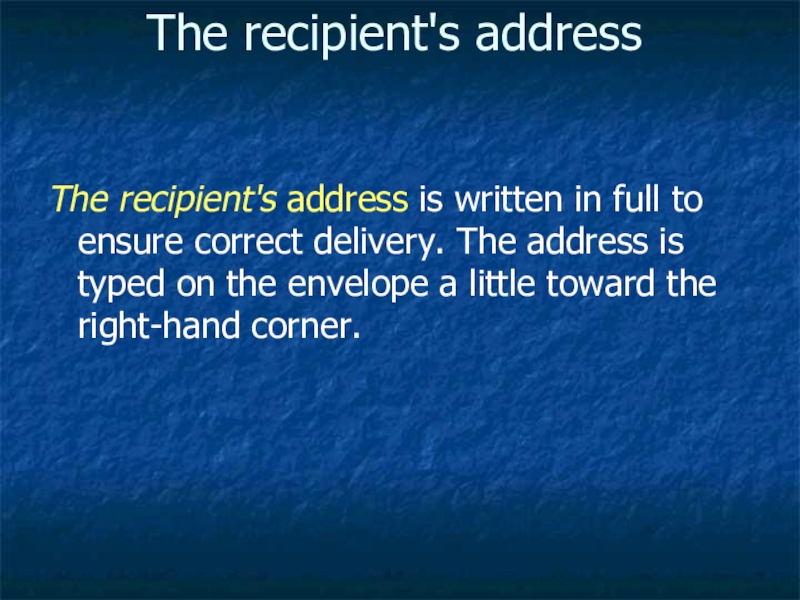
The recipient's address is written in full to ensure
correct delivery. The address is typed on the envelope a little toward the right-hand corner.
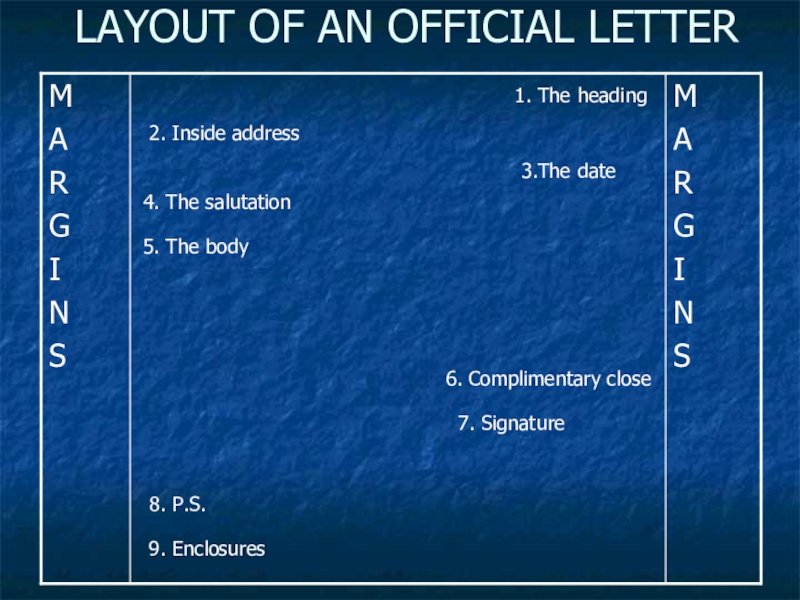
Слайд 35LAYOUT OF AN OFFICIAL LETTER
1. The heading
2. Inside address
3.The date
4.
The salutation
5. The body
6. Complimentary close
7. Signature
8. P.S.
9. Enclosures
Слайд 36 THE HEADING
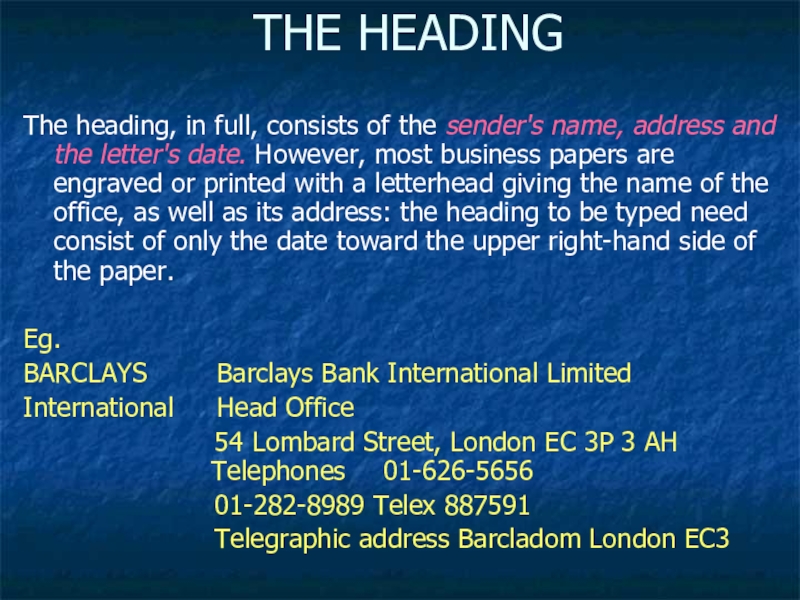
The heading, in full, consists of the sender's name,
address and the letter's date. However, most business papers are engraved or printed with a letterhead giving the name of the office, as well as its address: the heading to be typed need consist of only the date toward the upper right-hand side of the paper.
Eg.
BARCLAYS Barclays Bank International Limited
International Head Office
54 Lombard Street, London EC 3P 3 AH Telephones 01-626-5656
01-282-8989 Telex 887591
Telegraphic address Barcladom London EC3
Eg.
BARCLAYS Barclays Bank International Limited
International Head Office
54 Lombard Street, London EC 3P 3 AH Telephones 01-626-5656
01-282-8989 Telex 887591
Telegraphic address Barcladom London EC3
Слайд 37THE DATE
September 19...
When writing on paper without a letterhead, the typed heading should be arranged on the top right-hand side of the page. The date of your letter should
be perfectly clear and the name of the month should be spelled out in full
(3rd May 1991 /May 3,1991/ May 3rd, 1991).
Note:
In modern computer-typed letters the heading may also be found in the left-hand margin
When writing on paper without a letterhead, the typed heading should be arranged on the top right-hand side of the page. The date of your letter should
be perfectly clear and the name of the month should be spelled out in full
(3rd May 1991 /May 3,1991/ May 3rd, 1991).
Note:
In modern computer-typed letters the heading may also be found in the left-hand margin

Слайд 38THE INSIDE ADDRESS
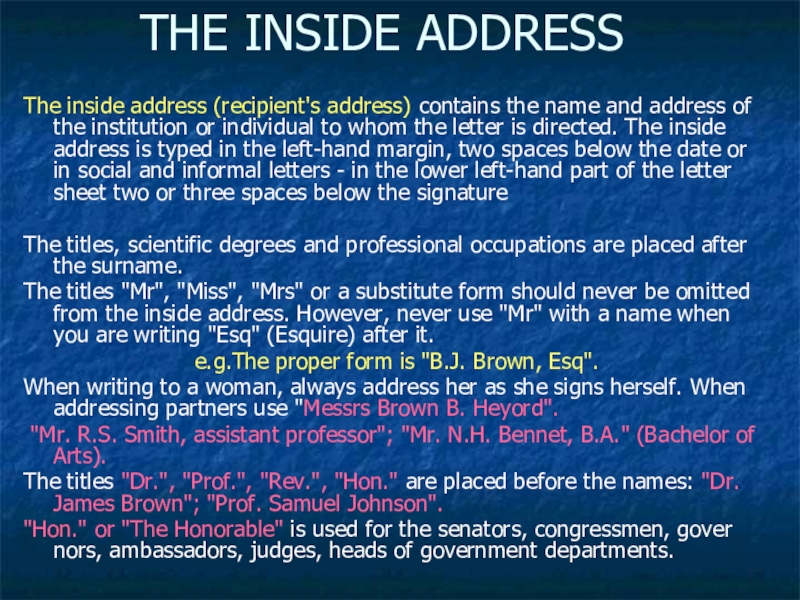
The inside address (recipient's address) contains the name
and address of the institution or individual to whom the letter is directed. The inside address is typed in the left-hand margin, two spaces below the date or in social and informal letters - in the lower left-hand part of the letter sheet two or three spaces below the signature
The titles, scientific degrees and professional occupations are placed after the surname.
The titles "Mr", "Miss", "Mrs" or a substitute form should never be omitted from the inside address. However, never use "Mr" with a name when you are writing "Esq" (Esquire) after it.
e.g.The proper form is "B.J. Brown, Esq".
When writing to a woman, always address her as she signs herself. When addressing partners use "Messrs Brown B. Heyord".
"Mr. R.S. Smith, assistant professor"; "Mr. N.H. Bennet, B.A." (Bachelor of Arts).
The titles "Dr.", "Prof.", "Rev.", "Hon." are placed before the names: "Dr. James Brown"; "Prof. Samuel Johnson".
"Hon." or "The Honorable" is used for the senators, congressmen, governors, ambassadors, judges, heads of government departments.
The titles, scientific degrees and professional occupations are placed after the surname.
The titles "Mr", "Miss", "Mrs" or a substitute form should never be omitted from the inside address. However, never use "Mr" with a name when you are writing "Esq" (Esquire) after it.
e.g.The proper form is "B.J. Brown, Esq".
When writing to a woman, always address her as she signs herself. When addressing partners use "Messrs Brown B. Heyord".
"Mr. R.S. Smith, assistant professor"; "Mr. N.H. Bennet, B.A." (Bachelor of Arts).
The titles "Dr.", "Prof.", "Rev.", "Hon." are placed before the names: "Dr. James Brown"; "Prof. Samuel Johnson".
"Hon." or "The Honorable" is used for the senators, congressmen, governors, ambassadors, judges, heads of government departments.
Слайд 39 THE SALUTATION
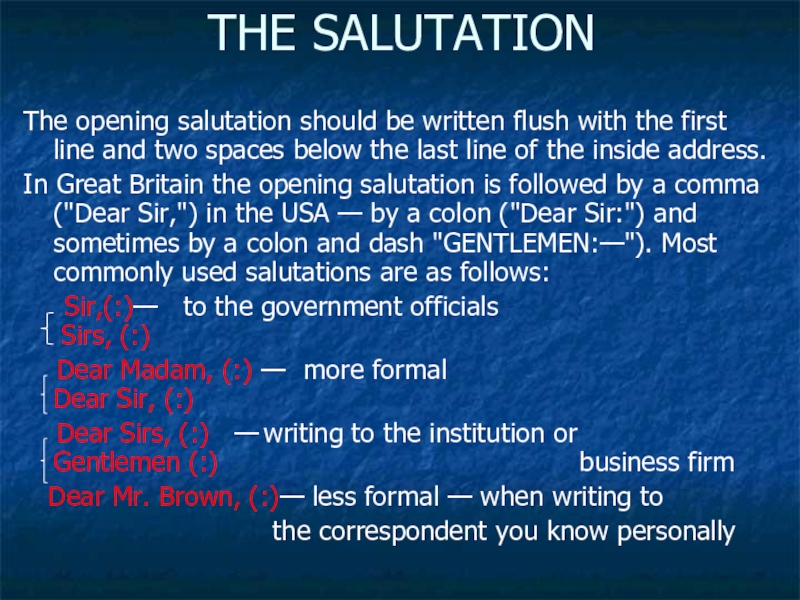
The opening salutation should be written flush with the
first line and two spaces below the last line of the inside address.
In Great Britain the opening salutation is followed by a comma ("Dear Sir,") in the USA — by a colon ("Dear Sir:") and sometimes by a colon and dash "GENTLEMEN:—"). Most commonly used salutations are as follows:
Sir,(:)— to the government officials Sirs, (:)
Dear Madam, (:) — more formal Dear Sir, (:)
Dear Sirs, (:) — writing to the institution or Gentlemen (:) business firm
Dear Mr. Brown, (:)— less formal — when writing to
the correspondent you know personally
In Great Britain the opening salutation is followed by a comma ("Dear Sir,") in the USA — by a colon ("Dear Sir:") and sometimes by a colon and dash "GENTLEMEN:—"). Most commonly used salutations are as follows:
Sir,(:)— to the government officials Sirs, (:)
Dear Madam, (:) — more formal Dear Sir, (:)
Dear Sirs, (:) — writing to the institution or Gentlemen (:) business firm
Dear Mr. Brown, (:)— less formal — when writing to
the correspondent you know personally
Слайд 40 THE BODY OF THE LETTER
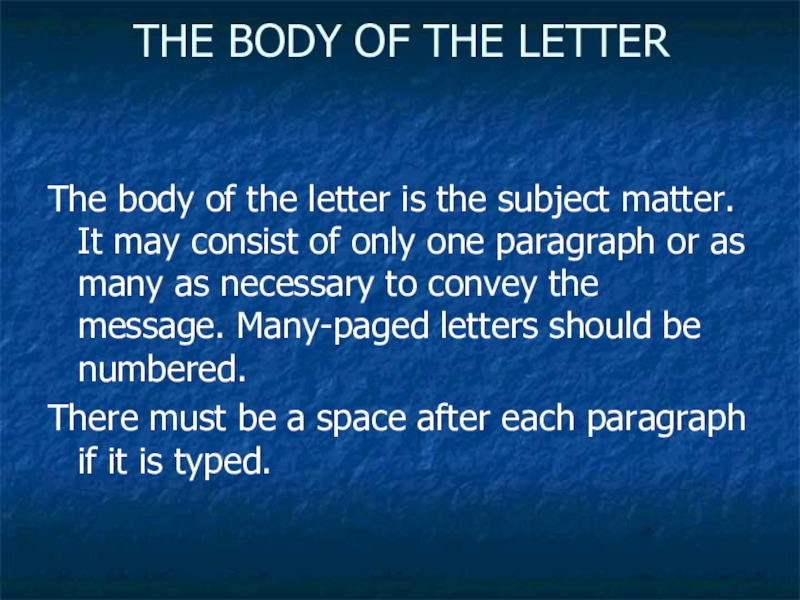
The body of the letter is
the subject matter. It may consist of only one paragraph or as many as necessary to convey the message. Many-paged letters should be numbered.
There must be a space after each paragraph if it is typed.
There must be a space after each paragraph if it is typed.
Слайд 41 THE COMPLIMENTARY CLOSE
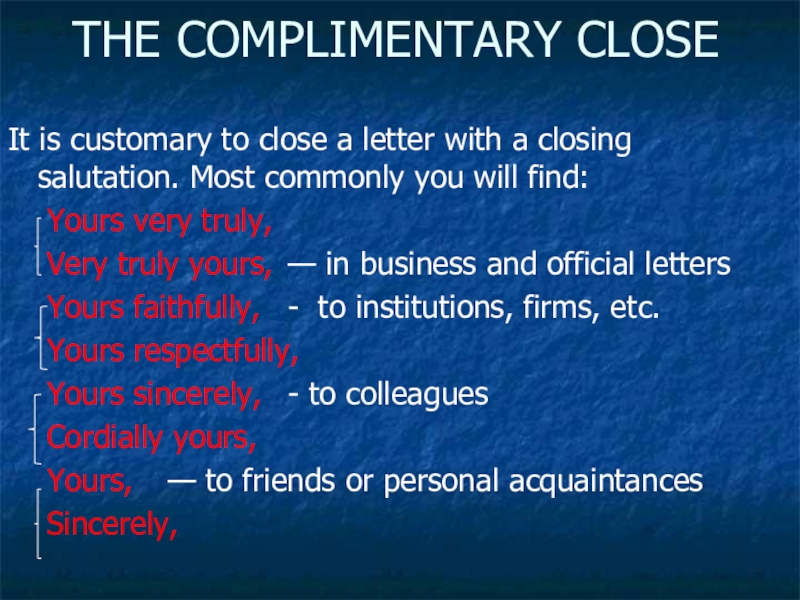
It is customary to close a letter with
a closing salutation. Most commonly you will find:
Yours very truly,
Very truly yours, — in business and official letters
Yours faithfully, - to institutions, firms, etc.
Yours respectfully,
Yours sincerely, - to colleagues
Cordially yours,
Yours, — to friends or personal acquaintances
Sincerely,
Yours very truly,
Very truly yours, — in business and official letters
Yours faithfully, - to institutions, firms, etc.
Yours respectfully,
Yours sincerely, - to colleagues
Cordially yours,
Yours, — to friends or personal acquaintances
Sincerely,
Слайд 42 THE SIGNATURE
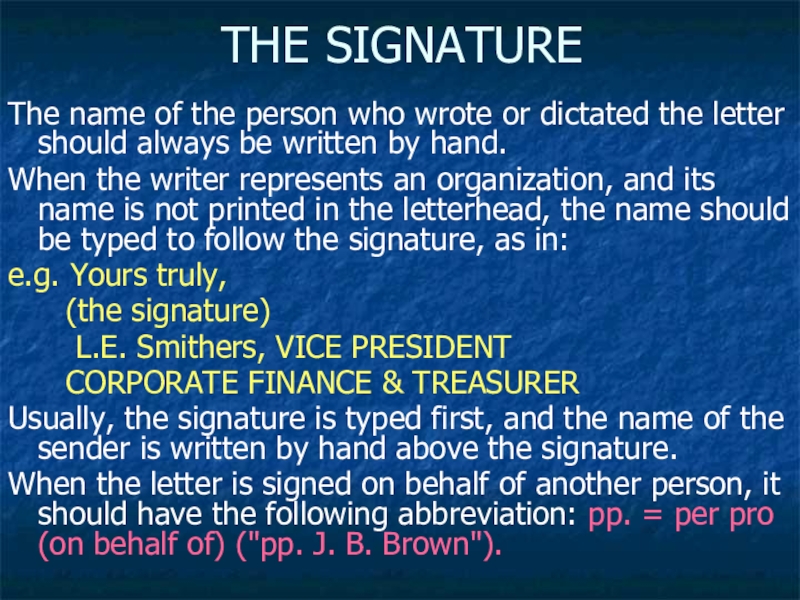
The name of the person who wrote or dictated
the letter should always be written by hand.
When the writer represents an organization, and its name is not printed in the letterhead, the name should be typed to follow the signature, as in:
e.g. Yours truly,
(the signature)
L.E. Smithers, VICE PRESIDENT
CORPORATE FINANCE & TREASURER
Usually, the signature is typed first, and the name of the sender is written by hand above the signature.
When the letter is signed on behalf of another person, it should have the following abbreviation: pp. = per pro (on behalf of) ("pp. J. B. Brown").
When the writer represents an organization, and its name is not printed in the letterhead, the name should be typed to follow the signature, as in:
e.g. Yours truly,
(the signature)
L.E. Smithers, VICE PRESIDENT
CORPORATE FINANCE & TREASURER
Usually, the signature is typed first, and the name of the sender is written by hand above the signature.
When the letter is signed on behalf of another person, it should have the following abbreviation: pp. = per pro (on behalf of) ("pp. J. B. Brown").
Слайд 43SUPPLEMENTS IN OFFICIAL AND BUSINESS LETTERS
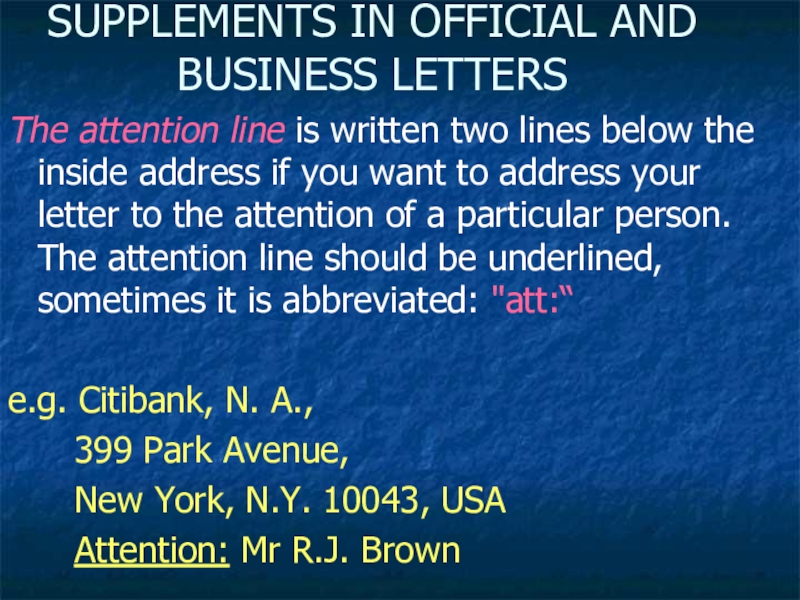
The attention line is written two
lines below the inside address if you want to address your letter to the attention of a particular person. The attention line should be underlined, sometimes it is abbreviated: "att:“
e.g. Citibank, N. A.,
399 Park Avenue,
New York, N.Y. 10043, USA
Attention: Mr R.J. Brown
e.g. Citibank, N. A.,
399 Park Avenue,
New York, N.Y. 10043, USA
Attention: Mr R.J. Brown
Слайд 44SUPPLEMENTS IN OFFICIAL AND BUSINESS LETTERS
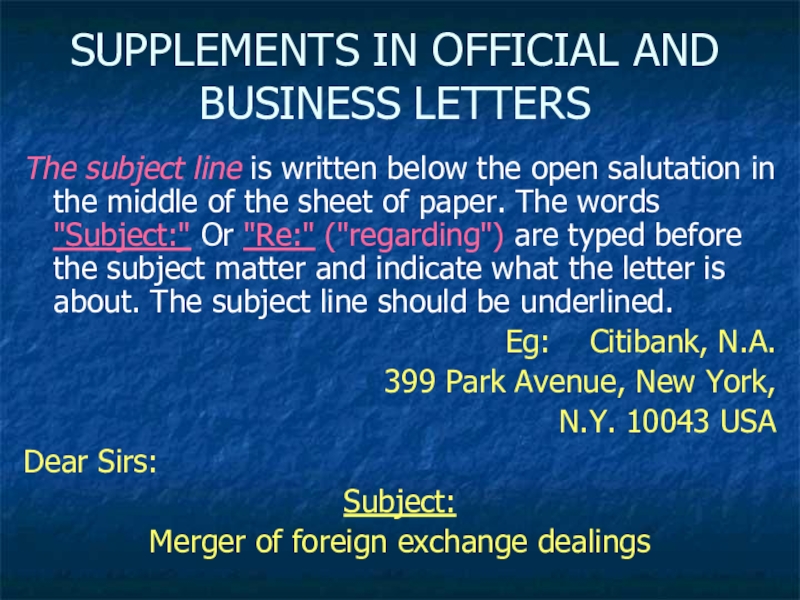
The subject line is written below
the open salutation in the middle of the sheet of paper. The words "Subject:" Or "Re:" ("regarding") are typed before the subject matter and indicate what the letter is about. The subject line should be underlined.
Eg: Citibank, N.A.
399 Park Avenue, New York,
N.Y. 10043 USA
Dear Sirs:
Subject:
Merger of foreign exchange dealings
Eg: Citibank, N.A.
399 Park Avenue, New York,
N.Y. 10043 USA
Dear Sirs:
Subject:
Merger of foreign exchange dealings
Слайд 45SUPPLEMENTS IN OFFICIAL AND BUSINESS LETTERS
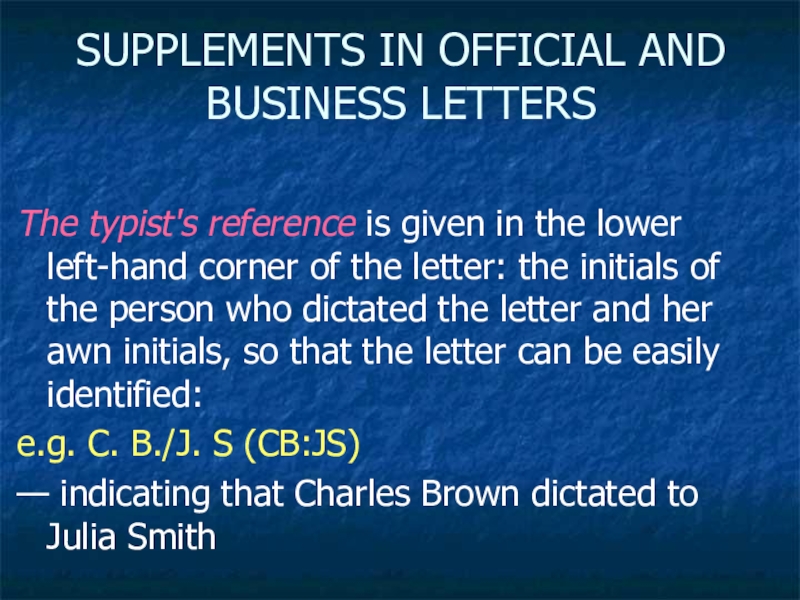
The typist's reference is given in
the lower left-hand corner of the letter: the initials of the person who dictated the letter and her awn initials, so that the letter can be easily identified:
e.g. C. B./J. S (CB:JS)
— indicating that Charles Brown dictated to Julia Smith
e.g. C. B./J. S (CB:JS)
— indicating that Charles Brown dictated to Julia Smith
Слайд 46SUPPLEMENTS IN OFFICIAL AND BUSINESS LETTERS
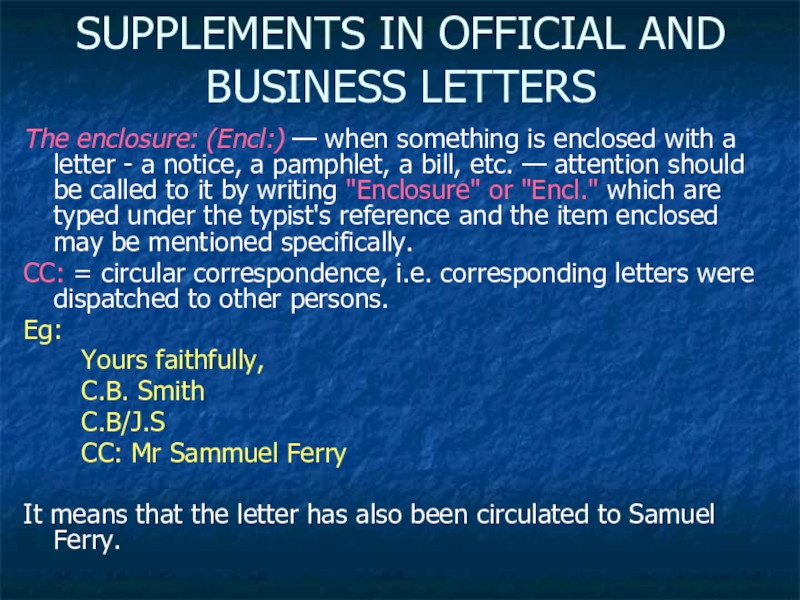
The enclosure: (Encl:) — when something
is enclosed with a letter - a notice, a pamphlet, a bill, etc. — attention should be called to it by writing "Enclosure" or "Encl." which are typed under the typist's reference and the item enclosed may be mentioned specifically.
CC: = circular correspondence, i.e. corresponding letters were dispatched to other persons.
Eg:
Yours faithfully,
C.B. Smith
C.B/J.S
CC: Mr Sammuel Ferry
It means that the letter has also been circulated to Samuel Ferry.
CC: = circular correspondence, i.e. corresponding letters were dispatched to other persons.
Eg:
Yours faithfully,
C.B. Smith
C.B/J.S
CC: Mr Sammuel Ferry
It means that the letter has also been circulated to Samuel Ferry.
Слайд 47Информация об авторе
Кабанова Елена Владимировна МОУ «Гимназия №2» преподаватель высшей категории.