«Интерес»
Г.Люберцы
- Главная
- Разное
- Образование
- Спорт
- Естествознание
- Природоведение
- Религиоведение
- Французский язык
- Черчение
- Английский язык
- Астрономия
- Алгебра
- Биология
- География
- Геометрия
- Детские презентации
- Информатика
- История
- Литература
- Математика
- Музыка
- МХК
- Немецкий язык
- ОБЖ
- Обществознание
- Окружающий мир
- Педагогика
- Русский язык
- Технология
- Физика
- Философия
- Химия
- Шаблоны, фоны, картинки для презентаций
- Экология
- Экономика
Презентация, доклад к уроку. Тема: Праздники и особые дни в Великобритании
Содержание
- 1. Презентация к уроку. Тема: Праздники и особые дни в Великобритании
- 2. Many festivals and holidays in Britain are
- 3. The beginning of the new year and
- 4. New Year’s Day - 1st of JanuaryNew
- 5. Twelfth Night - 5th of JanuaryLong ago
- 6. Twelfth Night - 5th of JanuaryIt was
- 7. February, along with January, was introduced onto
- 8. Candlemas Day (the Christian festival of lights
- 9. Candles were important in those days not
- 10. Valentine's Day (Saint Valentine's Day) is an
- 11. The name of March comes from Latin
- 12. In the UK, Shrove Tuesday is also
- 13. Mothering Sunday in the UK is the
- 14. At Easter time in the UK there
- 15. No one knows for certain how April
- 16. April begins with a day of
- 17. St. George's Day - 23rd April
- 18. St. George's Day - 23rd April By
- 19. May is named after the Greek goddess,
- 20. The first day of the month of
- 21. Although summer does not officially begin until
- 22. June marks the beginning of Summer in
- 23. The Trooping the Colour takes place on
- 24. The Queen's birthday parade is the biggest
- 25. July is one of the hottest months
- 26. Swan Upping on the River ThamesThe census
- 27. Swan Upping on the River ThamesThe swans
- 28. August, the eighth month of the year
- 29. The carnival is held on the Summer
- 30. The name September comes from the old
- 31. Harvest Festival is a celebration of the
- 32. Harvest festivals are traditionally held on or
- 33. In the old Roman calendars, October was
- 34. On October 31st, people celebrate Halloween. It
- 35. The name comes from the Roman word
- 36. In November 1605, the infamous Gunpowder Plot
- 37. It is a special day set aside
- 38. The national day of Scotland - St
- 39. December used to be the tenth month
- 40. Christmas is the time when Christians around
- 41. Christmas is a truly magical season, bringing
- 42. In Britain, Boxing Day is usually celebrated
- 43. Resources:http://projectbritain.com/http://cliparting.com/free-january-clipart-9205/http://www.haverhill-ps.org/wp-content/uploads/sites/14/2015/01/http://biospherehere.org.uk/wp/wp-content/uploads/2015/03/http://www.stbridgetschool.org/wp-content/uploads/2015/08/http://clipartsign.com/image/5864/
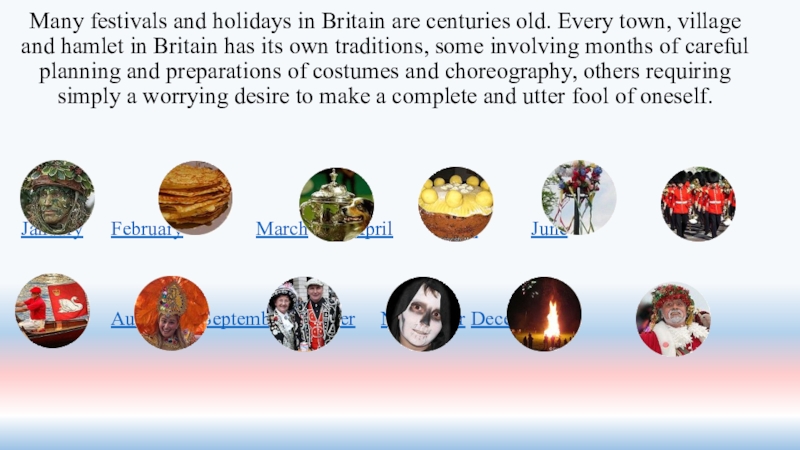
Many festivals and holidays in Britain are centuries old. Every town, village and hamlet in Britain has its own traditions, some involving months of careful planning and preparations of costumes and choreography, others requiring simply a
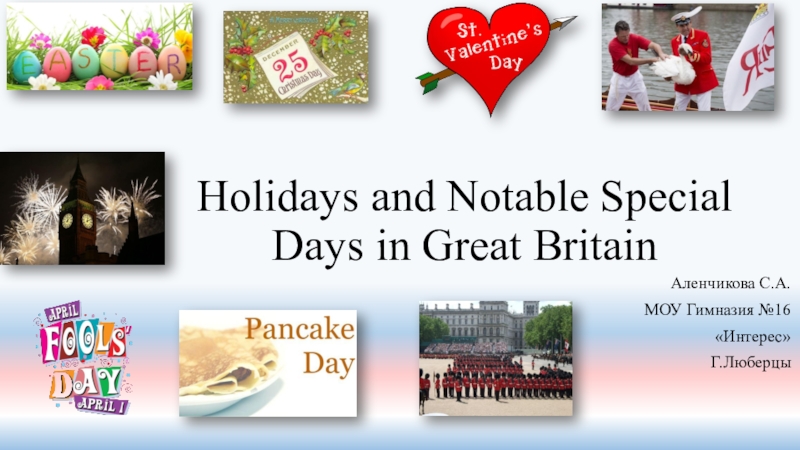
Слайд 2Many festivals and holidays in Britain are centuries old. Every town,
village and hamlet in Britain has its own traditions, some involving months of careful planning and preparations of costumes and choreography, others requiring simply a worrying desire to make a complete and utter fool of oneself.
January February March April May June
July August September October November December
January February March April May June
July August September October November December
Слайд 3The beginning of the new year and the time to make
New Year resolutions.
January was established as the first the first month of the year by the Roman Calendar. It was named after the god Janus (Latin word for door). Janus has two faces which allowed him to look both backwards into the old year and forwards into the new one at the same time. He was the 'spirit of the opening'.
January was established as the first the first month of the year by the Roman Calendar. It was named after the god Janus (Latin word for door). Janus has two faces which allowed him to look both backwards into the old year and forwards into the new one at the same time. He was the 'spirit of the opening'.
Слайд 4New Year’s Day - 1st of January
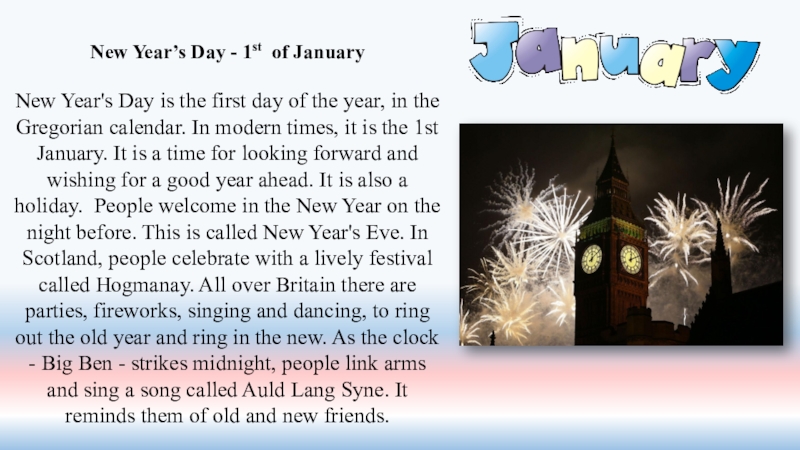
New Year's Day is the
first day of the year, in the Gregorian calendar. In modern times, it is the 1st January. It is a time for looking forward and wishing for a good year ahead. It is also a holiday. People welcome in the New Year on the night before. This is called New Year's Eve. In Scotland, people celebrate with a lively festival called Hogmanay. All over Britain there are parties, fireworks, singing and dancing, to ring out the old year and ring in the new. As the clock - Big Ben - strikes midnight, people link arms and sing a song called Auld Lang Syne. It reminds them of old and new friends.
Слайд 5Twelfth Night - 5th of January
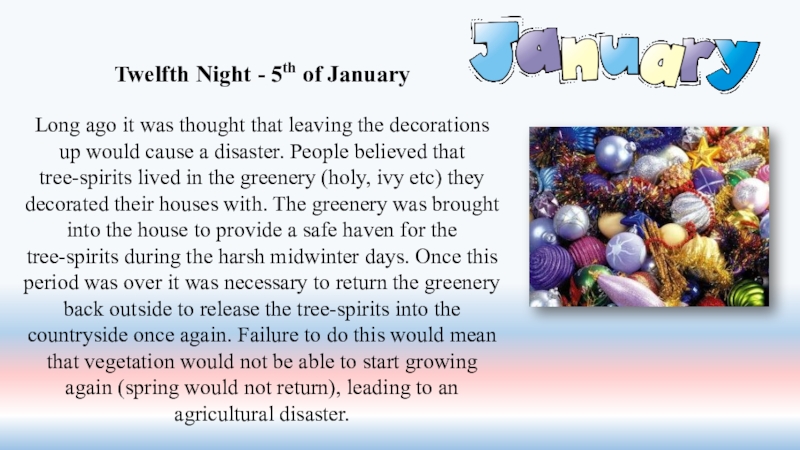
Long ago it was thought that
leaving the decorations up would cause a disaster. People believed that tree-spirits lived in the greenery (holy, ivy etc) they decorated their houses with. The greenery was brought into the house to provide a safe haven for the tree-spirits during the harsh midwinter days. Once this period was over it was necessary to return the greenery back outside to release the tree-spirits into the countryside once again. Failure to do this would mean that vegetation would not be able to start growing again (spring would not return), leading to an agricultural disaster.
Слайд 6Twelfth Night - 5th of January
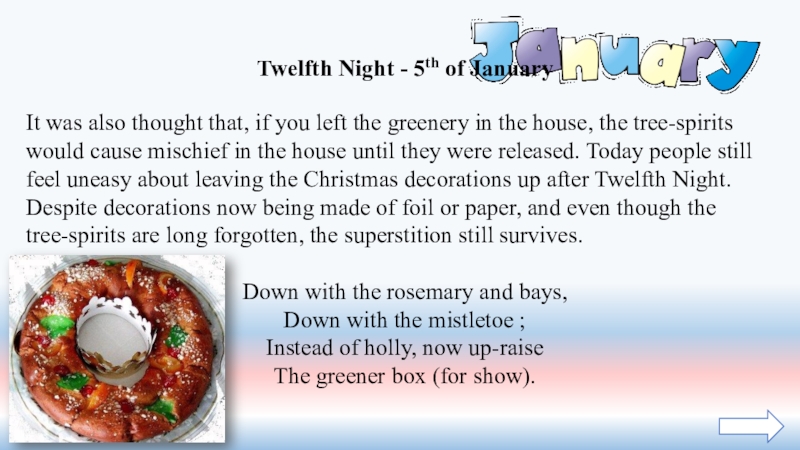
It was also thought that, if
you left the greenery in the house, the tree-spirits would cause mischief in the house until they were released. Today people still feel uneasy about leaving the Christmas decorations up after Twelfth Night. Despite decorations now being made of foil or paper, and even though the tree-spirits are long forgotten, the superstition still survives.
Down with the rosemary and bays, Down with the mistletoe ; Instead of holly, now up-raise The greener box (for show).
Down with the rosemary and bays, Down with the mistletoe ; Instead of holly, now up-raise The greener box (for show).
Слайд 7February, along with January, was introduced onto the Roman calendar by
Numa Pompilous when the calendar was extended from ten to twelve. The word February comes from the word 'februa' - which means cleansing or purification, and reflects the rituals undertaken before Spring.
The Anglo Saxons called February 'Sol-monath' (cake-month), because cakes were offered to the gods during that month. February was also known to the Saxons as 'sprout-kale' from the sprouting of cabbage or kale.
The Anglo Saxons called February 'Sol-monath' (cake-month), because cakes were offered to the gods during that month. February was also known to the Saxons as 'sprout-kale' from the sprouting of cabbage or kale.
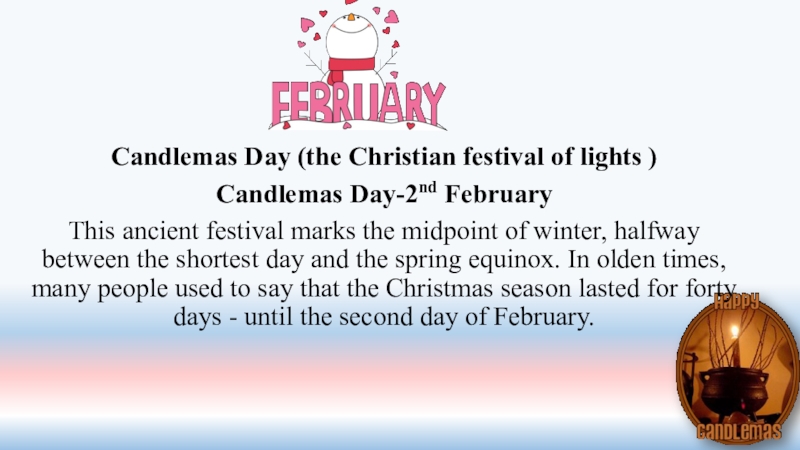
Слайд 8Candlemas Day (the Christian festival of lights )
Candlemas Day-2nd February
This ancient
festival marks the midpoint of winter, halfway between the shortest day and the spring equinox. In olden times, many people used to say that the Christmas season lasted for forty days - until the second day of February.
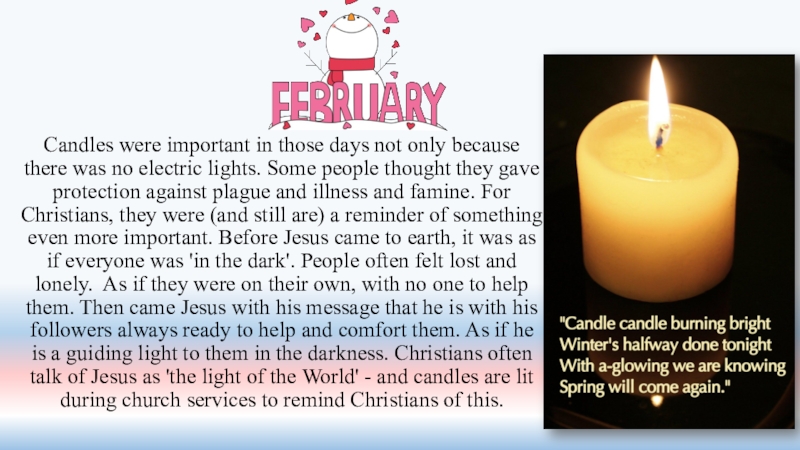
Слайд 9Candles were important in those days not only because there was
no electric lights. Some people thought they gave protection against plague and illness and famine. For Christians, they were (and still are) a reminder of something even more important. Before Jesus came to earth, it was as if everyone was 'in the dark'. People often felt lost and lonely. As if they were on their own, with no one to help them. Then came Jesus with his message that he is with his followers always ready to help and comfort them. As if he is a guiding light to them in the darkness. Christians often talk of Jesus as 'the light of the World' - and candles are lit during church services to remind Christians of this.
Слайд 10Valentine's Day (Saint Valentine's Day) is an occasion celebrated on February
14. It is the traditional day on which people express their love for each other by sending Valentine's cards, presenting flowers, or offering confectionery. There were many Christians names Valentine. According to the Catholic Encyclopaedia, at least three Saint Valentines are mentioned who are associated with 14 February. One is described as a priest at Rome, another as a Bishop of Interamna (now Terni in Italy) and the other lived and died in Africa. The Valentine that most experts believe is the actual one remembered on St. Valentine's Day was a Roman who was martyred for refusing to give up Christianity.
St. Valentine 's Day – 14th February
Слайд 11
The name of March comes from Latin Martius,
the first month
of the earliest Roman calendar.
It was named for Mars, the Roman god of war who was
also regarded as a guardian of agriculture and an ancestor of the
Roman people through his sons Romulus and Remus.
It was named for Mars, the Roman god of war who was
also regarded as a guardian of agriculture and an ancestor of the
Roman people through his sons Romulus and Remus.
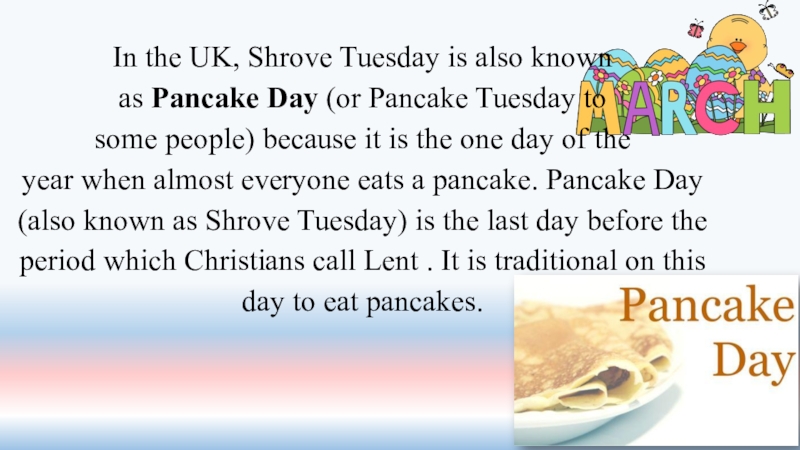
Слайд 12In the UK, Shrove Tuesday is also known
as Pancake Day
(or Pancake Tuesday to
some people) because it is the one day of the
year when almost everyone eats a pancake. Pancake Day
(also known as Shrove Tuesday) is the last day before the
period which Christians call Lent . It is traditional on this
day to eat pancakes.
some people) because it is the one day of the
year when almost everyone eats a pancake. Pancake Day
(also known as Shrove Tuesday) is the last day before the
period which Christians call Lent . It is traditional on this
day to eat pancakes.
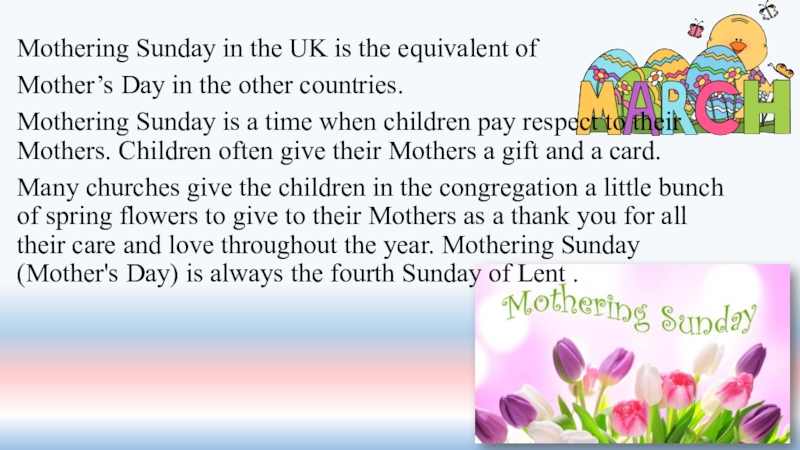
Слайд 13Mothering Sunday in the UK is the equivalent of
Mother’s Day
in the other countries.
Mothering Sunday is a time when children pay respect to their Mothers. Children often give their Mothers a gift and a card.
Many churches give the children in the congregation a little bunch of spring flowers to give to their Mothers as a thank you for all their care and love throughout the year. Mothering Sunday (Mother's Day) is always the fourth Sunday of Lent .
Mothering Sunday is a time when children pay respect to their Mothers. Children often give their Mothers a gift and a card.
Many churches give the children in the congregation a little bunch of spring flowers to give to their Mothers as a thank you for all their care and love throughout the year. Mothering Sunday (Mother's Day) is always the fourth Sunday of Lent .
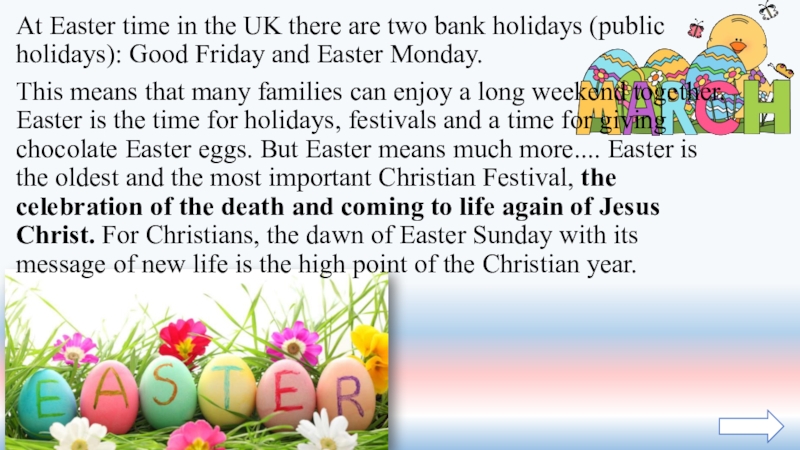
Слайд 14At Easter time in the UK there are two bank holidays
(public holidays): Good Friday and Easter Monday.
This means that many families can enjoy a long weekend together. Easter is the time for holidays, festivals and a time for giving chocolate Easter eggs. But Easter means much more.... Easter is the oldest and the most important Christian Festival, the celebration of the death and coming to life again of Jesus Christ. For Christians, the dawn of Easter Sunday with its message of new life is the high point of the Christian year.
This means that many families can enjoy a long weekend together. Easter is the time for holidays, festivals and a time for giving chocolate Easter eggs. But Easter means much more.... Easter is the oldest and the most important Christian Festival, the celebration of the death and coming to life again of Jesus Christ. For Christians, the dawn of Easter Sunday with its message of new life is the high point of the Christian year.
Слайд 15No one knows for certain how April got its name, but
it may have come from the Latin word 'aperire' which means 'to open'. April is, after all, the month when in the northern hemisphere buds begin to open and things start to grow again after the winter.
Слайд 16
April begins with a day of fun and jokes -
April Fool's Day. No one really knows when this custom began but it has been kept for hundreds of years.
The First of April, some do say
Is set apart for All Fools Day;
But why the people call it so,
Not I, nor they themselves do know.
The First of April, some do say
Is set apart for All Fools Day;
But why the people call it so,
Not I, nor they themselves do know.
April Fool’s day - 1st of April
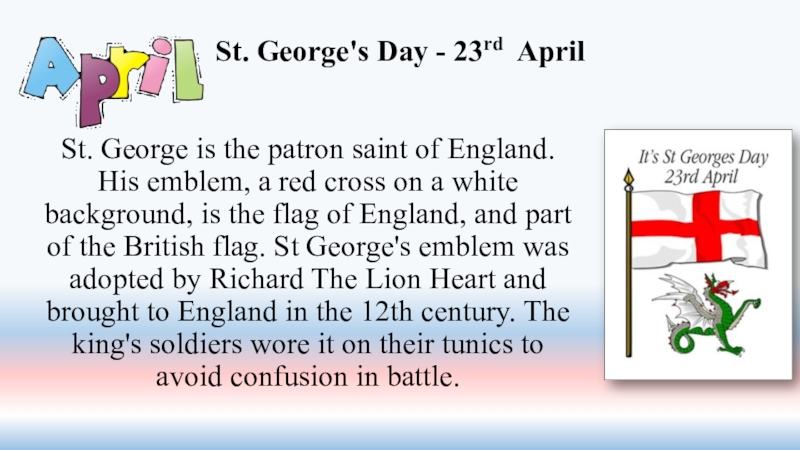
Слайд 17St. George's Day - 23rd April
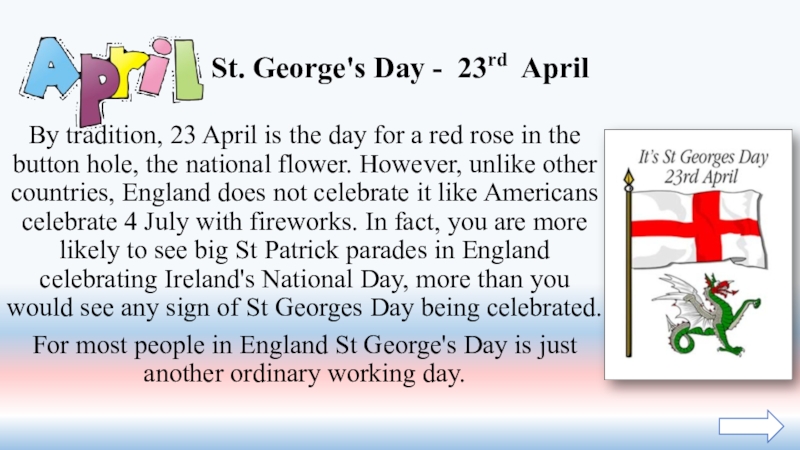
St. George is the patron
saint of England. His emblem, a red cross on a white background, is the flag of England, and part of the British flag. St George's emblem was adopted by Richard The Lion Heart and brought to England in the 12th century. The king's soldiers wore it on their tunics to avoid confusion in battle.
Слайд 18St. George's Day - 23rd April
By tradition, 23 April is
the day for a red rose in the button hole, the national flower. However, unlike other countries, England does not celebrate it like Americans celebrate 4 July with fireworks. In fact, you are more likely to see big St Patrick parades in England celebrating Ireland's National Day, more than you would see any sign of St Georges Day being celebrated.
For most people in England St George's Day is just another ordinary working day.
For most people in England St George's Day is just another ordinary working day.
Слайд 19May is named after the Greek goddess, Maia. The month is
a time of great celebrations in the northern hemisphere. It is the time when flowers emerge and crops begin to sprout.
The Anglo-Saxon name for May was Tri-Milchi, in recognition of the fact that with the lush new grass cows could be milked three times a day. It was first called May in about 1430. Before then it was called Maius, Mayes, or Mai.
The Anglo-Saxon name for May was Tri-Milchi, in recognition of the fact that with the lush new grass cows could be milked three times a day. It was first called May in about 1430. Before then it was called Maius, Mayes, or Mai.
Слайд 20The first day of the month of May is known as
May Day. It is the time of year when warmer weather begins and flowers and trees start to blossom. It is said to be a time of love and romance. It is when people celebrate the coming of summer with lots of different customs that are expressions of joy and hope after a long winter. copyright of protectbritain.com
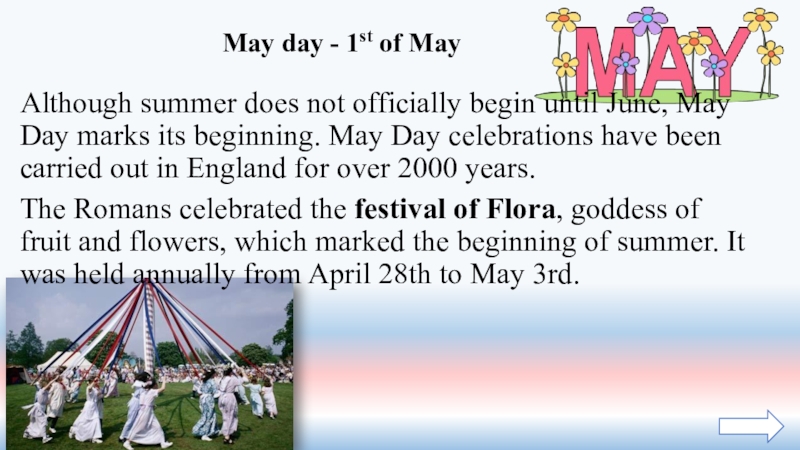
Traditional English May Day celebrations include Morris dancing, crowning a May Queen and dancing around a Maypole.
Traditional English May Day celebrations include Morris dancing, crowning a May Queen and dancing around a Maypole.
May day - 1st of May
Слайд 21Although summer does not officially begin until June, May Day marks
its beginning. May Day celebrations have been carried out in England for over 2000 years.
The Romans celebrated the festival of Flora, goddess of fruit and flowers, which marked the beginning of summer. It was held annually from April 28th to May 3rd.
The Romans celebrated the festival of Flora, goddess of fruit and flowers, which marked the beginning of summer. It was held annually from April 28th to May 3rd.
May day - 1st of May
Слайд 22June marks the beginning of Summer in the northern hemisphere and
the month of the Wimbledon tennis tournament in England.
June is the sixth month of the year and takes its name from the Roman goddess Junno, the goddess of marriage. For this reason, June has always been looked upon as the best month in which to marry:
Married in the month of roses - June Life will be one long homeymoon.
Sera monath (Dry month) was the name the Anglo-Saxons gave to the month.
June is the sixth month of the year and takes its name from the Roman goddess Junno, the goddess of marriage. For this reason, June has always been looked upon as the best month in which to marry:
Married in the month of roses - June Life will be one long homeymoon.
Sera monath (Dry month) was the name the Anglo-Saxons gave to the month.
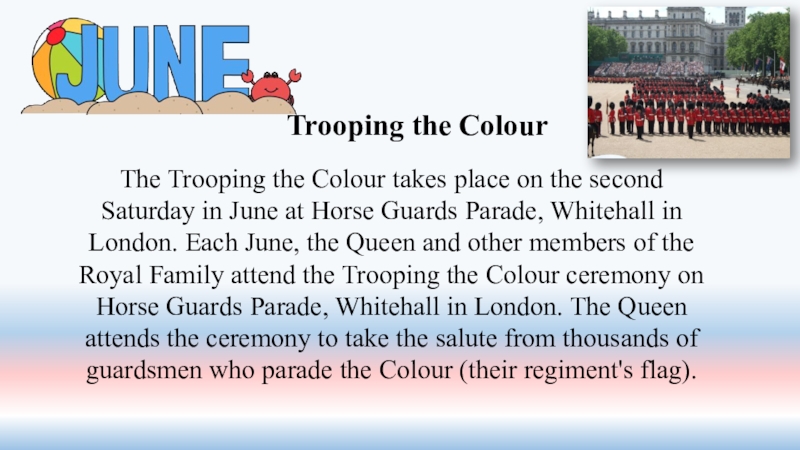
Слайд 23The Trooping the Colour takes place on the second Saturday in
June at Horse Guards Parade, Whitehall in London. Each June, the Queen and other members of the Royal Family attend the Trooping the Colour ceremony on Horse Guards Parade, Whitehall in London. The Queen attends the ceremony to take the salute from thousands of guardsmen who parade the Colour (their regiment's flag).
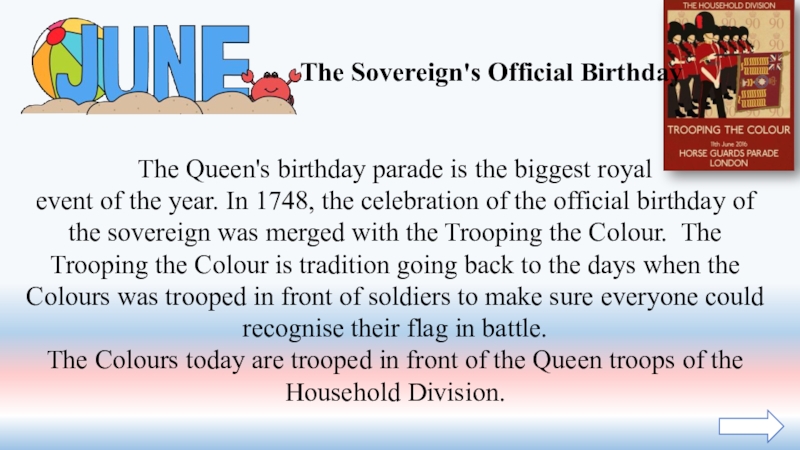
Слайд 24The Queen's birthday parade is the biggest royal
event of the
year. In 1748, the celebration of the official birthday of the sovereign was merged with the Trooping the Colour. The Trooping the Colour is tradition going back to the days when the Colours was trooped in front of soldiers to make sure everyone could recognise their flag in battle.
The Colours today are trooped in front of the Queen troops of the Household Division.
The Colours today are trooped in front of the Queen troops of the Household Division.
The Sovereign's Official Birthday
Слайд 25July is one of the hottest months of the year. It
is nearly the end of the school year and summer holidays are near.
July is the seventh month of the year according to the Gregorian calendar. It was the fifth month in the early calendar of the ancient Romans. The Romans called the month Quintilius, which means fifth. A Roman Senate renamed the month to Julius (July) in honour of Julius Caesar, who was born on 12 July.
The Anglo-Saxon names for the month included Heymonath or Maed monath, referring respectively to haymaking and the flowering of meadows.
July is the seventh month of the year according to the Gregorian calendar. It was the fifth month in the early calendar of the ancient Romans. The Romans called the month Quintilius, which means fifth. A Roman Senate renamed the month to Julius (July) in honour of Julius Caesar, who was born on 12 July.
The Anglo-Saxon names for the month included Heymonath or Maed monath, referring respectively to haymaking and the flowering of meadows.
Слайд 26Swan Upping on the River Thames
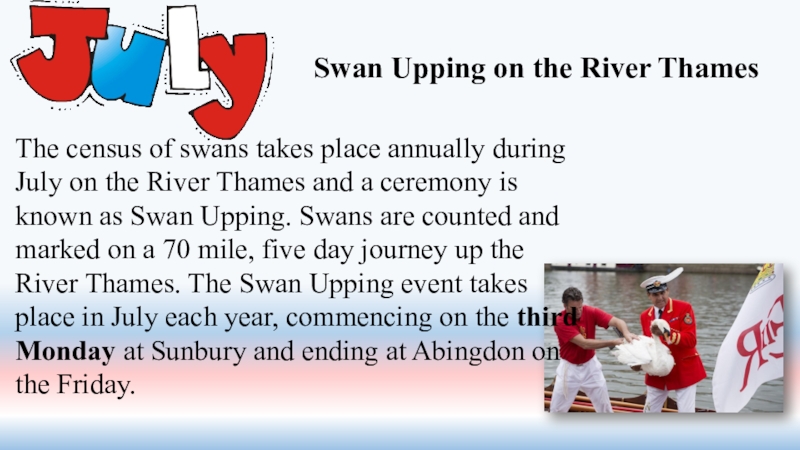
The census of swans takes place
annually during July on the River Thames and a ceremony is known as Swan Upping. Swans are counted and marked on a 70 mile, five day journey up the River Thames. The Swan Upping event takes place in July each year, commencing on the third Monday at Sunbury and ending at Abingdon on the Friday.
Слайд 27Swan Upping on the River Thames
The swans on the River Thames
are Mute Swans .
They are not actually mute, they can honk and hiss alot. Mute
swans are seen in Britain all year round and are distinguished
by a bright orange beak, which has a knob of black tissue on
the top. The Swan Uppers catch and check the health of the
swans and their cygnets through five counties, from
Sunbury-on-Thames, Middlesex, to Abingdon, Oxfordshire.
They are not actually mute, they can honk and hiss alot. Mute
swans are seen in Britain all year round and are distinguished
by a bright orange beak, which has a knob of black tissue on
the top. The Swan Uppers catch and check the health of the
swans and their cygnets through five counties, from
Sunbury-on-Thames, Middlesex, to Abingdon, Oxfordshire.
Слайд 28August, the eighth month of the year and the sixth month
of the Roman calendar. The Romans called the month Sextilis, which means sixth. Eight years before Jesus was born the name of the month was changed to Augustus in honour of the Roman Emperor Augustus Casesar, because many of the important events in his life happened around that time of year.
August is the busiest time for tourism, as it falls in the main school holiday of the year, the summer holidays, which lasts for six weeks for state run schools.
August is the busiest time for tourism, as it falls in the main school holiday of the year, the summer holidays, which lasts for six weeks for state run schools.
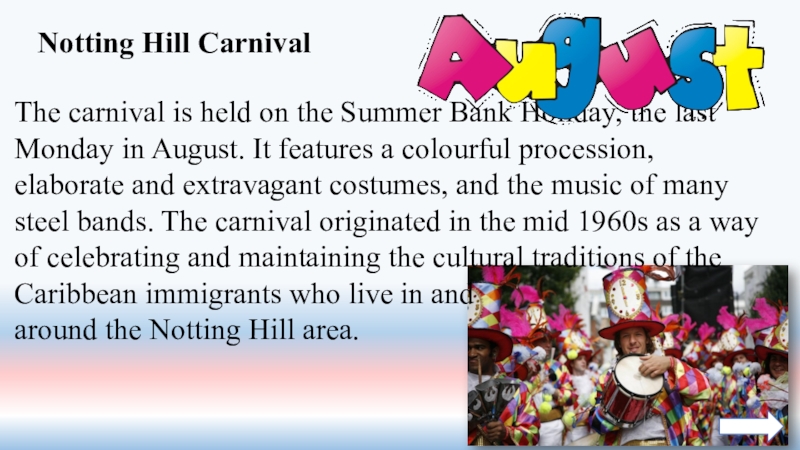
Слайд 29The carnival is held on the Summer Bank Holiday, the last
Monday in August. It features a colourful procession, elaborate and extravagant costumes, and the music of many steel bands. The carnival originated in the mid 1960s as a way of celebrating and maintaining the cultural traditions of the Caribbean immigrants who live in and
around the Notting Hill area.
around the Notting Hill area.
Notting Hill Carnival
Слайд 30The name September comes from the old Roman word 'septem', which
means seven, because in the Roman calendar it was the seventh month. The Anglo-Saxons called it Gerst monath (Barley month), because it was their time when they harvested barley to be made into their favourite drink - barley brew. They also called it Harvest month.
The Romans believed that the month of September was looked after by the god, Vulcan. As the god of the fire and forge they therefore expected September to be associated with fires, volcanic eruptions and earthquakes.
The Romans believed that the month of September was looked after by the god, Vulcan. As the god of the fire and forge they therefore expected September to be associated with fires, volcanic eruptions and earthquakes.
Слайд 31Harvest Festival is a celebration of the food grown on the
land. Thanksgiving ceremonies and celebrations for a successful harvest are both worldwide and very ancient. In Britain, we have given thanks for successful harvests since pagan times. We celebrate this day by singing, praying and decorating our churches with baskets of fruit and food in a festival known as 'Harvest Festival', usually during the month of September.
Harvest Festival
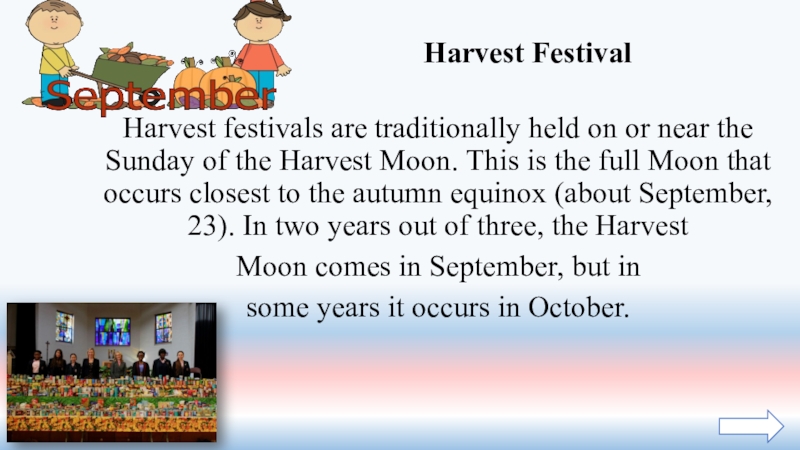
Слайд 32Harvest festivals are traditionally held on or near the Sunday of
the Harvest Moon. This is the full Moon that occurs closest to the autumn equinox (about September, 23). In two years out of three, the Harvest
Moon comes in September, but in
some years it occurs in October.
Moon comes in September, but in
some years it occurs in October.
Harvest Festival
Слайд 33In the old Roman calendars, October was the eighth month of
the year and got its name from the word 'Octo' meaning eight.
The Saxons called it Wyn Monath because it was the season of wine making.
The Saxons called it Wyn Monath because it was the season of wine making.
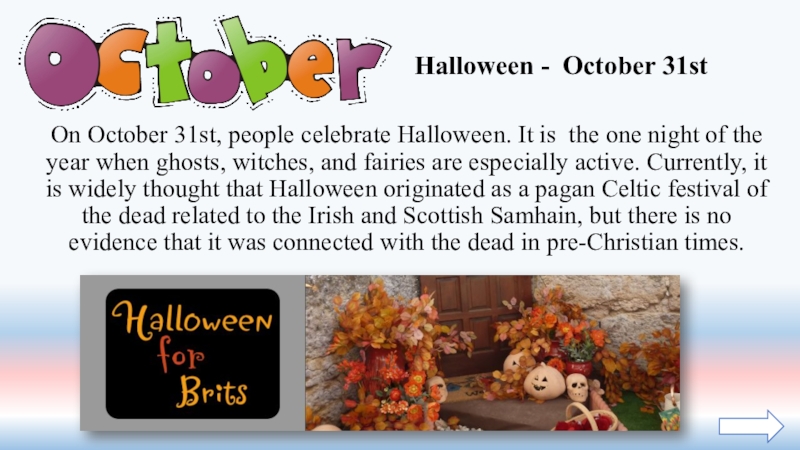
Слайд 34On October 31st, people celebrate Halloween. It is the one night
of the year when ghosts, witches, and fairies are especially active. Currently, it is widely thought that Halloween originated as a pagan Celtic festival of the dead related to the Irish and Scottish Samhain, but there is no evidence that it was connected with the dead in pre-Christian times.
Halloween - October 31st
Слайд 35The name comes from the Roman word 'novem' meaning nine, because
it was the ninth month in their Roman calendar.
Few people find November pleasant. The Anglo-Saxons called November 'Wind monath', because it was the time when the cold winds began to blow.
The first week of November has always been a time of festivals and celebrations marking the end of the harvest and beginning of Winter.
Few people find November pleasant. The Anglo-Saxons called November 'Wind monath', because it was the time when the cold winds began to blow.
The first week of November has always been a time of festivals and celebrations marking the end of the harvest and beginning of Winter.
Слайд 36In November 1605, the infamous Gunpowder Plot took place in which
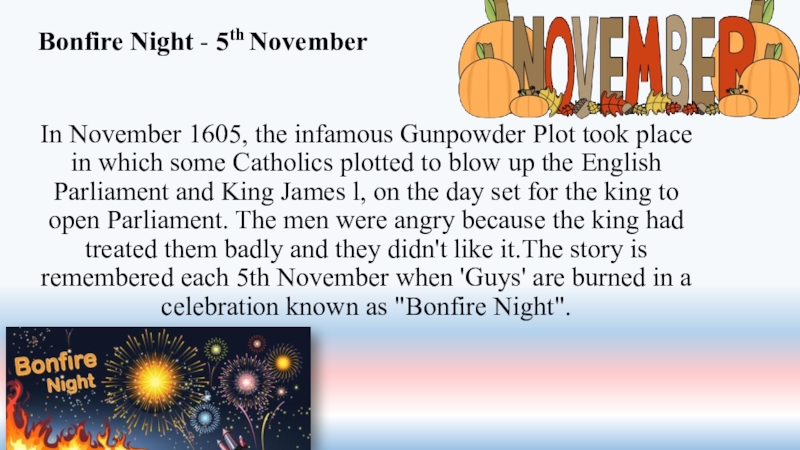
some Catholics plotted to blow up the English Parliament and King James l, on the day set for the king to open Parliament. The men were angry because the king had treated them badly and they didn't like it.The story is remembered each 5th November when 'Guys' are burned in a celebration known as "Bonfire Night".
Bonfire Night - 5th November
Слайд 37It is a special day set aside to remember all those
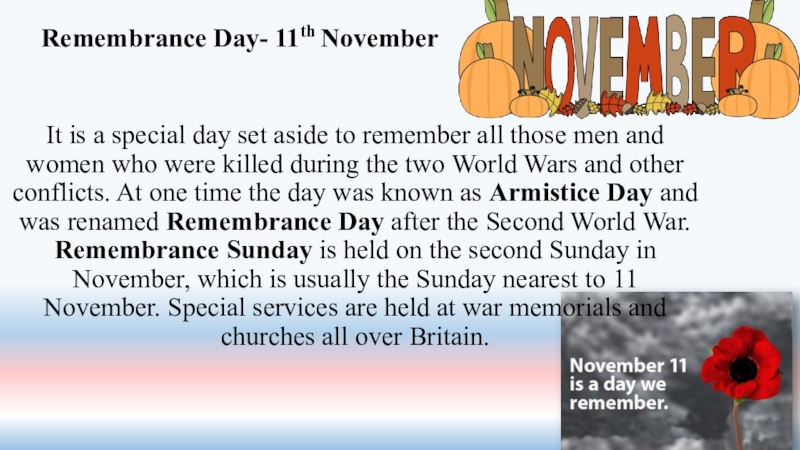
men and women who were killed during the two World Wars and other conflicts. At one time the day was known as Armistice Day and was renamed Remembrance Day after the Second World War. Remembrance Sunday is held on the second Sunday in November, which is usually the Sunday nearest to 11 November. Special services are held at war memorials and churches all over Britain.
Remembrance Day- 11th November
Слайд 38
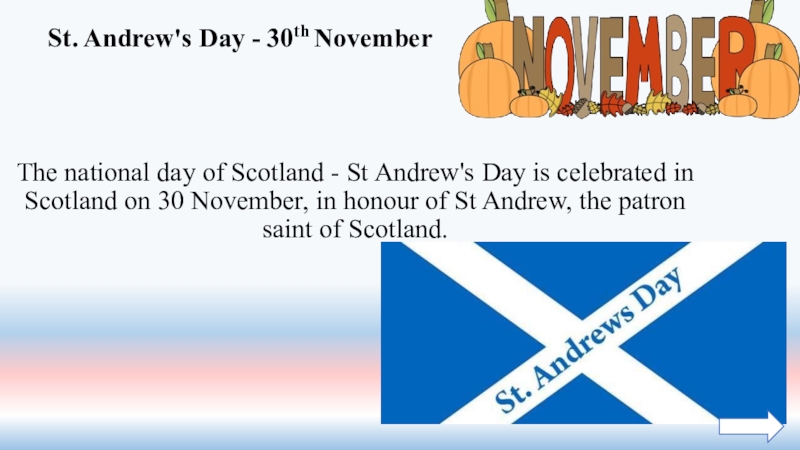
The national day of Scotland - St Andrew's Day is celebrated
in Scotland on 30 November, in honour of St Andrew, the patron saint of Scotland.
St. Andrew's Day - 30th November
Слайд 39December used to be the tenth month of the Roman year,
and it gets its name from the word 'decem', which means ten.
The Anglo-Saxons called it 'Winter monath', or 'Yule monath' because of the custom of burning the yule log around this time. After many Anglo-Saxons became Christians they called it 'Heligh monath' or holy month, because Christmas, the birth of Jesus, is celebrated in December.
In the northern hemisphere December marks the beginning of winter, and it is the time of rain, wind and snow.
The Anglo-Saxons called it 'Winter monath', or 'Yule monath' because of the custom of burning the yule log around this time. After many Anglo-Saxons became Christians they called it 'Heligh monath' or holy month, because Christmas, the birth of Jesus, is celebrated in December.
In the northern hemisphere December marks the beginning of winter, and it is the time of rain, wind and snow.
Слайд 40Christmas is the time when Christians around the world celebrate the
birth of Jesus. The word Christmas (or Christ's Mass) comes from the Old English name 'Cristes Maesse' - Christ's Mass - and is the celebration of the birth of Jesus. The first recorded observance occurred in Rome in AD360, but it wasn't until AD440 that the Christian Church fixed a celebration date of 25 December.
Christmas - 25th December
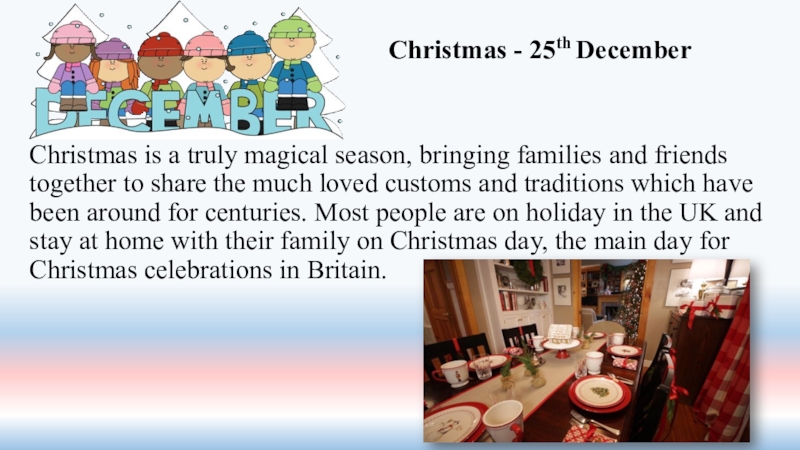
Слайд 41Christmas is a truly magical season, bringing families and friends together
to share the much loved customs and traditions which have been around for centuries. Most people are on holiday in the UK and stay at home with their family on Christmas day, the main day for Christmas celebrations in Britain.
Christmas - 25th December
Слайд 42In Britain, Boxing Day is usually celebrated on the following day
after Christmas Day, which is 26 December. However, strictly speaking, Boxing Day is the first weekday after Christmas. Like Christmas Day, Boxing Day is a public holiday. This means it is typically a non working day in the whole of Britain. When Boxing Day falls on a Saturday or Sunday the following Monday is the public holiday.
Boxing Day - 26th December
Слайд 43Resources:
http://projectbritain.com/
http://cliparting.com/free-january-clipart-9205/
http://www.haverhill-ps.org/wp-content/uploads/sites/14/2015/01/
http://biospherehere.org.uk/wp/wp-content/uploads/2015/03/
http://www.stbridgetschool.org/wp-content/uploads/2015/08/
http://clipartsign.com/image/5864/