Amazing
Scotland"
- Главная
- Разное
- Образование
- Спорт
- Естествознание
- Природоведение
- Религиоведение
- Французский язык
- Черчение
- Английский язык
- Астрономия
- Алгебра
- Биология
- География
- Геометрия
- Детские презентации
- Информатика
- История
- Литература
- Математика
- Музыка
- МХК
- Немецкий язык
- ОБЖ
- Обществознание
- Окружающий мир
- Педагогика
- Русский язык
- Технология
- Физика
- Философия
- Химия
- Шаблоны, фоны, картинки для презентаций
- Экология
- Экономика
Презентация, доклад к уроку английского языка по теме: Шотландия
Содержание
- 1. Презентация к уроку английского языка по теме: Шотландия
- 2. Oh Scotia! My dear, my native soil!
- 3. Welcome to Scotland!
- 4. Our journey begins!
- 5. Some facts about
- 6. Scotland is …Administrative division of the kingdom
- 7. The Land and Resources.Scotland
- 8. Physiographic Regions.The terrain of Scotland may be
- 9. Rivers and lakes.Scotland is characterized by an
- 10. Climate.Like the climate of the rest of
- 11. Plants and animals.Plants:OakFirPineLarchAnimals:The red deer, the roe
- 12. Natural resources. Coal Soil Zinc Oil
- 13. Population:Picts, Celts,Scandinavians, Romans,Scots:Highlanders,Lowlands.
- 14. Population Characteristics.The population of Scotland is 5,2
- 15. Principal cities.The most populous city in Scotland
- 16. Religion and language.The Church of Scotland, a
- 17. Education.Schools in Scotland are administered by the Scottish Education Department and by local education authorities.
- 18. Elementary and secondary schools.In the mid-1980s some
- 19. Universities and colleges.Scotland has about 66 institutions
- 20. Culture.Clans, the traditional keystone of Scottish society,
- 21. Government.Scotland is governed as an integral part
- 22. Central Government.Scottish affairs are administered by a
- 23. Judiciary. The Scottish judiciary is
- 24. Legislature. Before the union of
- 25. Local Government and Political Parties. The
- 26. Вanknotes.
- 27. Economy.Many aspects of the economy of Scotland
- 28. Agriculture.More than three-fourths of the land is
- 29. Forestry and fishing.About 607,000 hectares (about 1.5
- 30. Mining and manufacturing.Coal is the chief mineral
- 31. Transportations and communications.About 48,000 km (about 30,000
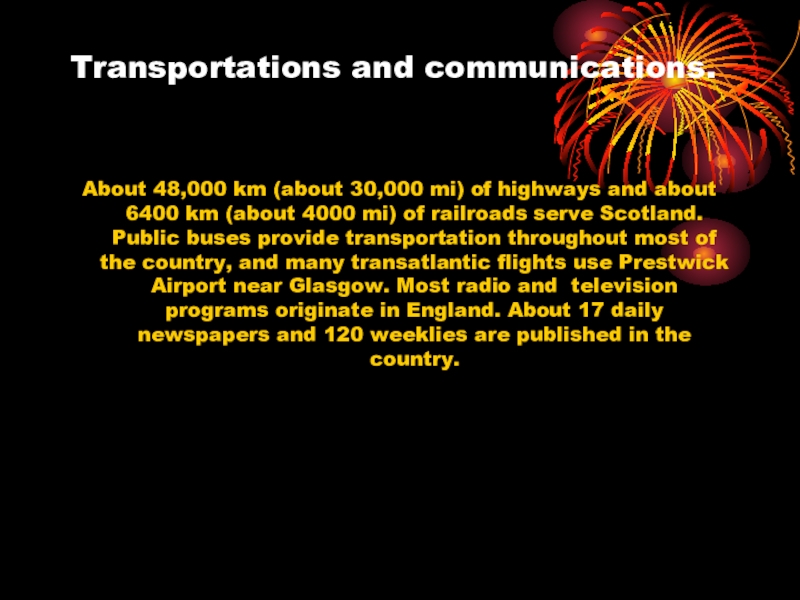
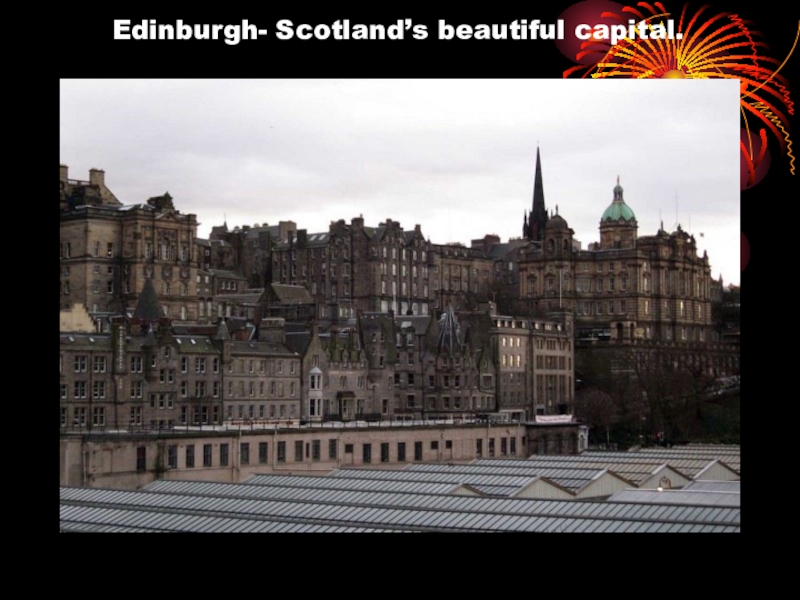
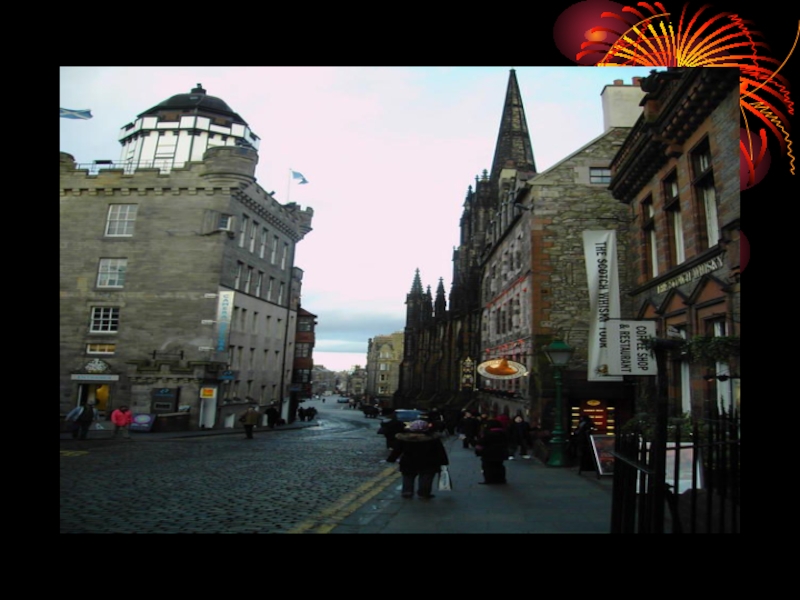
- 32. Edinburgh- Scotland’s beautiful capital.
- 33. Слайд 33
- 34. Слайд 34
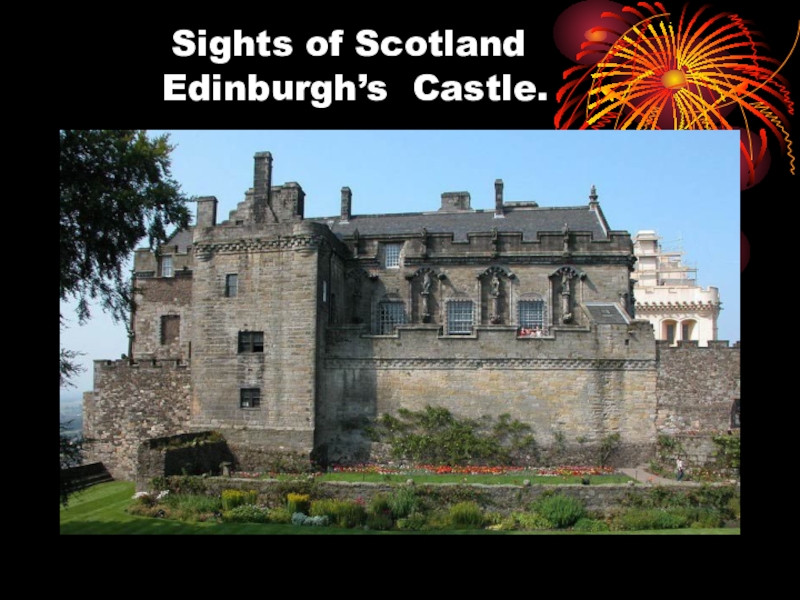
- 35. Sights of Scotland Edinburgh’s Castle.
- 36. Слайд 36
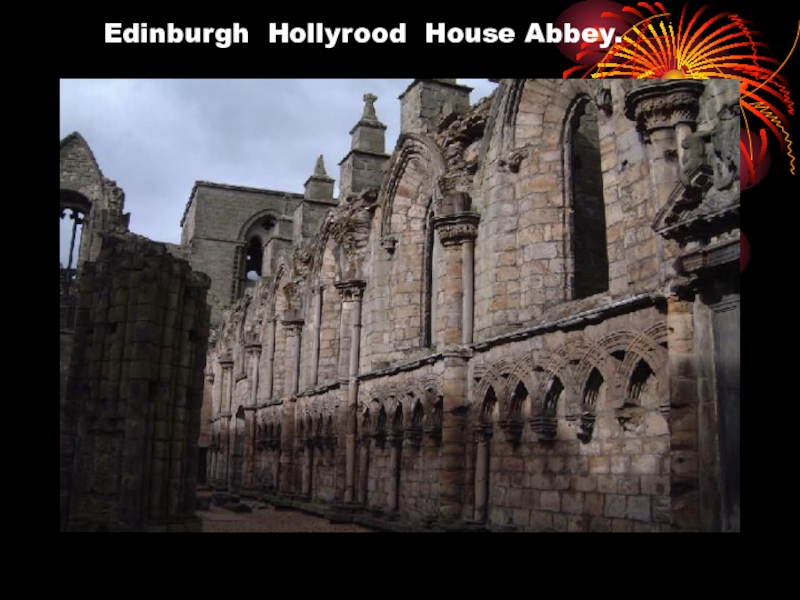
- 37. Edinburgh Hollyrood House Abbey.
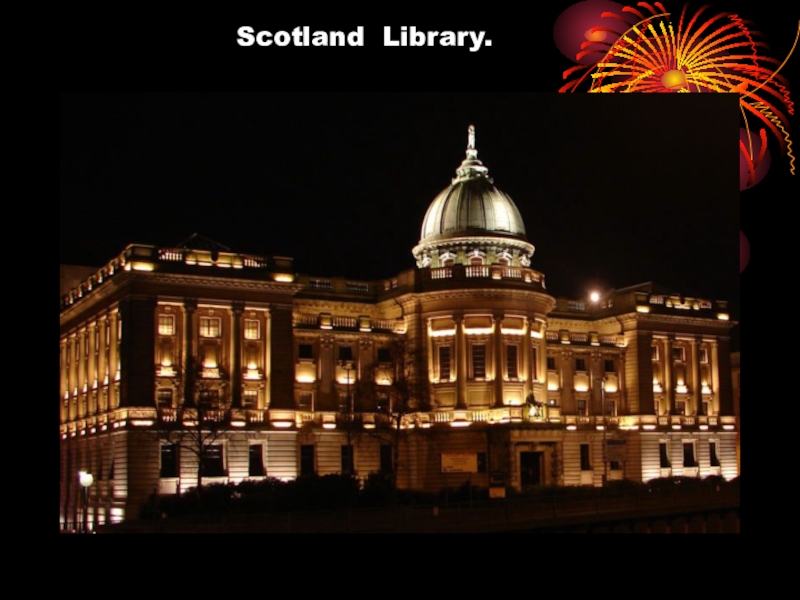
- 38. Scotland Library.
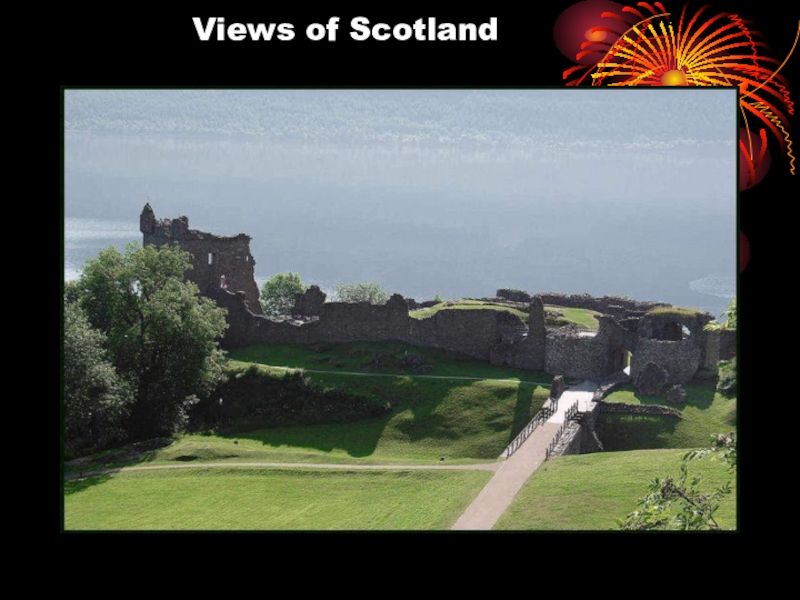
- 39. Views of Scotland
- 40. Слайд 40
- 41. Слайд 41
- 42. Слайд 42
- 43. Слайд 43
- 44. Слайд 44
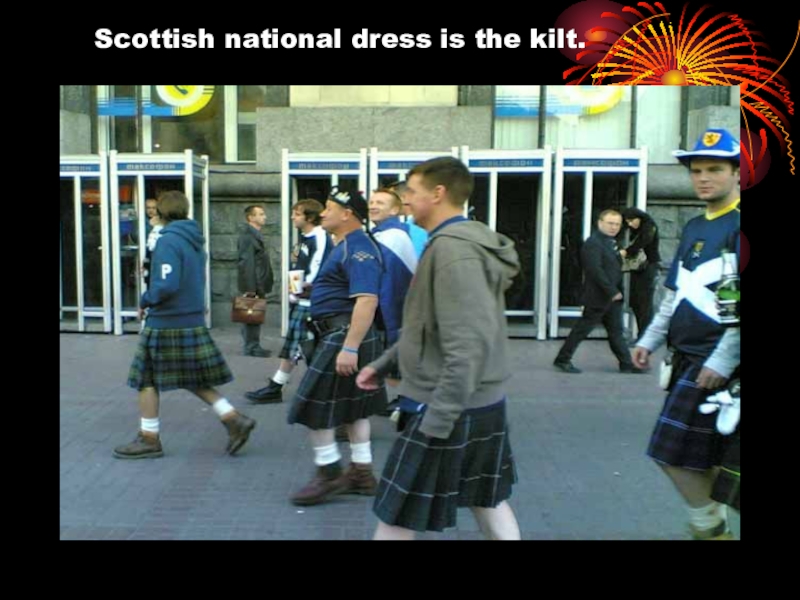
- 45. Scottish national dress is the kilt.
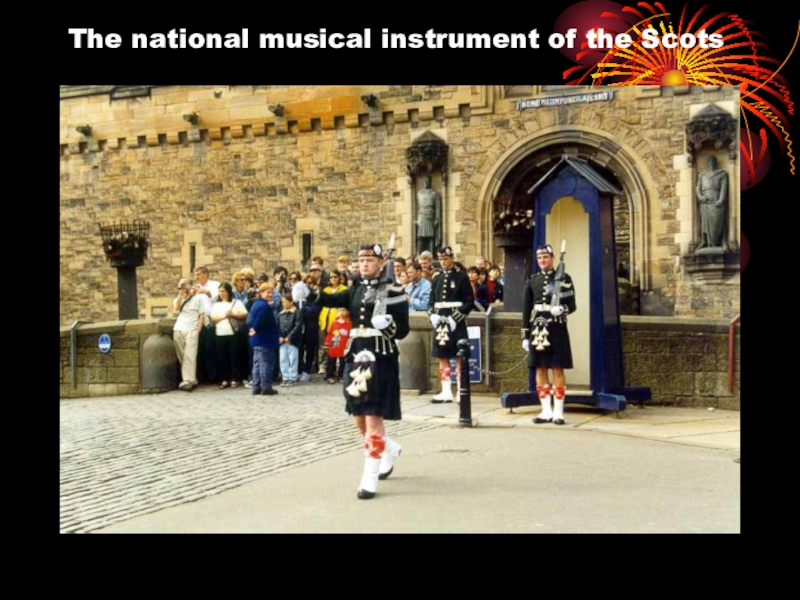
- 46. The national musical instrument of the Scots
- 47. SCOTLAND IS A UNIQUE COUNTRYBECAUSE OF
Oh Scotia! My dear, my native soil! Robert Burns.
Слайд 5 Some facts about
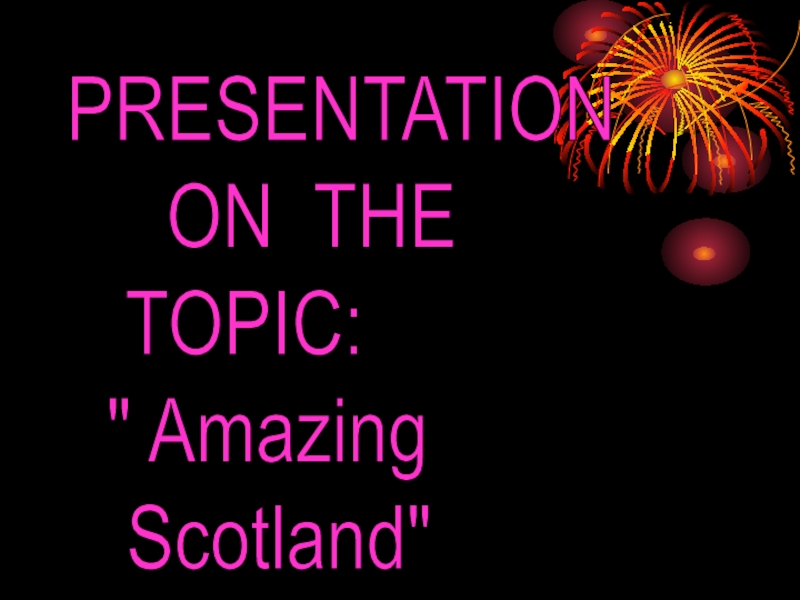
Scotland:
Capital - Edinburgh.
Population – 5,2 millions.
The total area – 78,772 sq km.
Big cities – Glasgow, Clydebank, Dundee, Aberdeen.
Language – English.
Слайд 6Scotland is …
Administrative division of the kingdom of Great Britain, occupying
the northern third of the island of Great Britain. Scotland is bounded on the north by the Atlantic ocean; on the east by the North Sea; on the southeast it from England, and by the
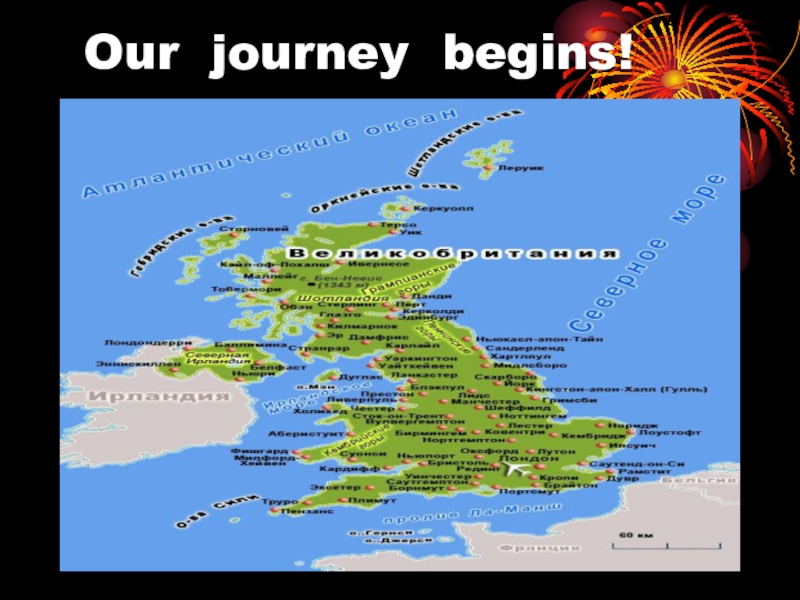
Irish Sea, and on the west by North Channel, which separates it from Ireland, and by the Atlantic Ocean. As a geopolitical entity Scotland includes 186 nearby islands, a majority of which are contained in the three groups – namely, the Hebrides, also known as the Western Islands, situated off the western coast; the Orkney Islands, situated northeast coast; and the Shetland Islands, situated northeast of the Orkney Islands. The largest of the other islands is the Island of Arran. The area, including the islands, is 78,772 sq km. Edinburgh is the capital of Scotland as well as a major industrial area and seaport.
Irish Sea, and on the west by North Channel, which separates it from Ireland, and by the Atlantic Ocean. As a geopolitical entity Scotland includes 186 nearby islands, a majority of which are contained in the three groups – namely, the Hebrides, also known as the Western Islands, situated off the western coast; the Orkney Islands, situated northeast coast; and the Shetland Islands, situated northeast of the Orkney Islands. The largest of the other islands is the Island of Arran. The area, including the islands, is 78,772 sq km. Edinburgh is the capital of Scotland as well as a major industrial area and seaport.
Слайд 7 The Land and Resources.
Scotland has a very irregular
coastline. The western coast in particular is deeply penetrated by numerous arms of the sea, most of which are narrow submerged valleys, known locally as sea lochs, and by a number of broad indentations, generally called firths. The principal firths are the Firth of Lorne, the Firth of Clyde, and Solway Firth. The major indentations on the eastern coast are Dornoch Firth, the Firth of Tay, and the Firth of Forth. Measured around the various firths and lochs, the coastline of Scotland is about 3700 km long.
Слайд 8Physiographic Regions.
The terrain of Scotland may be divided into three distinct
regions, from north to south: the Highlands, the Central Lowlands, and the Southern Uplands. More than one-half of the surface of Scotland is occupied by the Highlands, the most rugged region on the island of Great Britain.
To the south of the Highlands lies the Central Lowlands, a narrow belt comprising only about one-tenth of the area of Scotland, but containing the majority of the country’s population. The Central Lowlands are traversed by several chains of hills, including the Ochil and Sidlaw hills, and by several important rivers, notably the Clyde, Forth and Tay.
The terrain of the Southern Uplands, a region much less elevated and rugged than the Highlands, consist largely of a moorland plateau traversed by rolling valleys and broken by mountainous outcroppings. Only a few summits un the Southern Uplands exceed 762 m (2500 ft) in elevation, the highest being Merrick (843m/2765 ft) in the southwest. Adjoining the Southern Uplands region along the boundary with England are the Cheviot hills.
To the south of the Highlands lies the Central Lowlands, a narrow belt comprising only about one-tenth of the area of Scotland, but containing the majority of the country’s population. The Central Lowlands are traversed by several chains of hills, including the Ochil and Sidlaw hills, and by several important rivers, notably the Clyde, Forth and Tay.
The terrain of the Southern Uplands, a region much less elevated and rugged than the Highlands, consist largely of a moorland plateau traversed by rolling valleys and broken by mountainous outcroppings. Only a few summits un the Southern Uplands exceed 762 m (2500 ft) in elevation, the highest being Merrick (843m/2765 ft) in the southwest. Adjoining the Southern Uplands region along the boundary with England are the Cheviot hills.
Слайд 9Rivers and lakes.
Scotland is characterized by an abundance of streams and
lakes (lochs). Notable among the lakes, which are especially numerous in the central and northern regions, are Loch Lomond (the largest), Loch Ness, Loch Tay, and Lock Katrine. Many of the rivers of Scotland, in particular the rivers in the west, are short, torrential streams, generally of little commercial importance. The longest river of Scotland is the Tay, the Clyde, however, is the principal navigational stream, site of the port of Glasgow. Other chief rivers include the Forth, Tweed, Dee and Spey.
Слайд 10Climate.
Like the climate of the rest of Great Britain, that of
Scotland is subject to the moderating influences of the surrounding seas. As a result of these influences, extreme seasonal variations are rare, and temperature winters and cool summers are the outstanding climatic features. Low temperatures, however, are common during the winter season in the mountainous districts of the interior. In the western coastal region, which is subjects to the moderating effects of the Gulf Stream, conditions are somewhat milder in the east.
Слайд 11Plants and animals.
Plants:
Oak
Fir
Pine
Larch
Animals:
The red deer, the roe deer, the hare, rabbit,
ermine, wildcat.
Birds:
grouse, blackcock, ptarmigan, waterfowl, golden eagle, osprey.
Fish:
cod, haddock, herring, shellfish.
Слайд 14Population Characteristics.
The population of Scotland is 5,2 millions. The population density
was about 64 persons per sq km. The highest density is in the Central Lowlands, where nearly three-quarters of the Scots live, and the lowest is in the Highlands. About two-thirds of the population are urban dwellers.
Слайд 15Principal cities.
The most populous city in Scotland is Glasgow(654,542). The conurbation
of Clydeside, which includes the cities of Glasgow and Clydebank, is the largest shipbuilding and marine engineering center in Great Britain. Other important industrial cities are Dundee and Aberdeen.
Слайд 16Religion and language.
The Church of Scotland, a Presbyterian denomination, is the
official state church. The Roman Catholic church is second in importance. Other leading denominations are the Episcopal Church in Scotland, Congregationalist, Baptist, Methodist, and Unitarian. Jews are a small minority.
English is generally spoken; fewer than 100,000 Scots also speak the Scottish form a Gaelic.
English is generally spoken; fewer than 100,000 Scots also speak the Scottish form a Gaelic.
Слайд 17Education.
Schools in Scotland are administered by the Scottish Education Department and
by local education authorities.
Слайд 18Elementary and secondary schools.
In the mid-1980s some 879,000 pupils were attending
publicly maintained schools and about 31,900 were in private schools.The transfer from elementary to secondary schools generally takes place at the age of 12. For a discussion on specialized schools.
Слайд 19Universities and colleges.
Scotland has about 66 institutions providing programs of study
beyond the secondary level for those do not go on to the universities. These include colleges of agriculture, art, commerce, and science, and in the mid-1980 the total enrollment was more than 81,000. Teacher-training colleges numbered seven, with approximately 3000 students. Of the eight universities in Scotland, the oldest were founded in the 15-16th centuries.Four universities have received their charters since 1960. Total university enrollment was about 43,100 in the early 1980s.
Слайд 20Culture.
Clans, the traditional keystone of Scottish society, are no longer powerful.
Originally, the clan, a grouping of an entire family with one head, or laird, was also important as a fighting unit. The solidarity associated with clan membership has been expanded into a strong national pride. The Puritan zeal of Scottish Presbyterianism, which is traceable to John Knox, the 16th century religious reformer and statesman, is also strong. Popular sports of Scottish origin include curling and golf. Bagpipes, usually associated with Scottish music, were probably introduced by the Romans, who acquired them in the Middle East. Scottish music is noted for the wide use of a five-tone, or pentatonic, scale. Folk tunes are not standardized, and a single song may have hundreds of variations in lyric and music.
Слайд 21Government.
Scotland is governed as an integral part of Great Britain. It
is represented by 72 members in the House of Commons and by 16 Scottish peers in the House of Lords.
Слайд 22Central Government.
Scottish affairs are administered by a British cabinet ministry, headed
by the secretary of state for Scotland. The statutory functions of the secretary of state are discharged by five main departments of equal status: the Department of Agriculture and Fisheries for Scotland, the Scottish Development Department, the Scottish Education Department, the Scottish Home and Health Department, and the Industry Department for Scotland. Each is administered by a secretary of state. The routine administration of the departments proceeds from Edinburgh, but each department has representatives in London, where they perform liaison and parliamentary duties.
Слайд 23Judiciary.
The Scottish judiciary is organized separately from
that of the rest of Great Britain. The two higher courts of Scotland are the High Court of Justiciary (criminal) and the Court of Session (civil). A panel of 21 judges is provided for both courts together. Major criminal trials are held before 1 or 2 judges of the High Court of Justiciary and 15- member jury; criminal appeals may be heard by a bench of at least 3 judges. The Court of Session is divided into an Outer House, which holds all divorce trials and the more important civil trails, and an Inner House, which functions chiefly as an appellate court in civil cases. Appeals to the British House of Lords may be made from the Court of Session; appellate judgments of the High Court Justiciary are final. Each of the six sheriffdoms, into which Scotland is divided, has a sheriff court for less important civil and criminal cases. Petty cases are tired by police courts and justices of the place.
Слайд 24Legislature.
Before the union of Scotland and England in
1707, Scotland has developed its own system of law, which continued after the union. The Scottish law system is based on civil law, which is derived from ancient Roman law, whereas the other parts of Great Britain follow the common law, which originated in England with the evolution case law and precedents. Because of different law system, separate statutes or statutory provisions often are enacted by Parliament for application in Scotland. Any statute must state expressly or imply that it is applicable to Scotland in order to become enforceable.
Слайд 25Local Government and Political Parties.
The Scottish development department responsible
for general policy in regard to local government. A reorganization of local government of Scotland was made effective in 1975, when the counties and burghs were abolished and replaced by nine regions and three islands areas. The regions are divided into districts (but not the islands areas). Each of these units is administered by a council, whose members are elected to 4-years terms. The island areas, numbering some 700 islands and islets to the north and west, the regions, and the former counties, all of which are described in separate articles, are listed in the accompanying table. Two leading British parties, the Conservative Party and the Labour Party, have shared Scottish seats in Parliament about equally since the 1920s. The Scottish Nationalist Party, which was founded in 1927 in order to press for complete self-government, has played a monor role in the politics in thee country.
Слайд 27Economy.
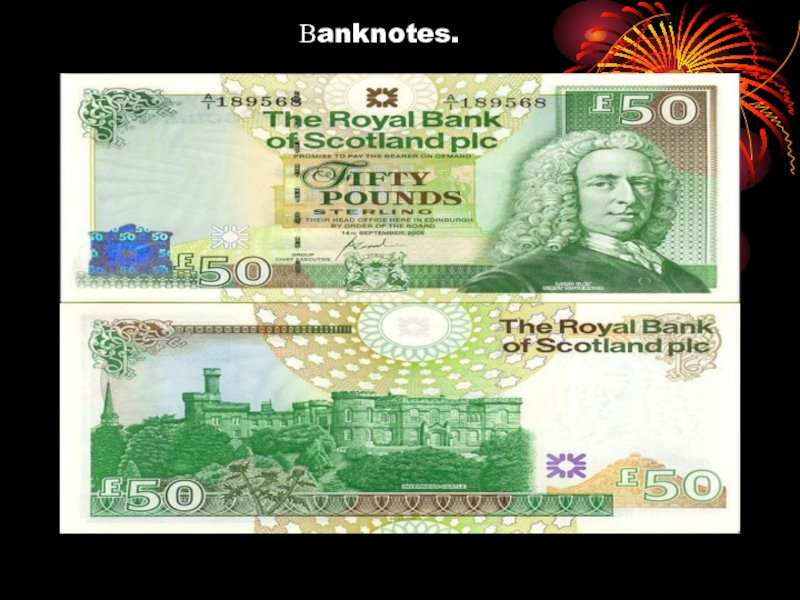
Many aspects of the economy of Scotland are covered in the
article on Great Britain. The currency of GB is the legal tender of Scotland. Both agriculture and industry are important in the economy of Scotland. The chief exports are petroleum and natural gas and manufactured goods, especially burlap, clothing, machinery, textiles, and whiskey. The chief imports are food and iron. The center of Scottish trade unionism is the Scottish trade Union Congress, with an affiliated membership of more than 980,000 .
Слайд 28Agriculture.
More than three-fourths of the land is used for agriculture; approximately
equal areas are devoted to farming and grazing. The most important crops are wheat, oats, and potatoes. Other crops include barley, turnips, and fruit. Livestock products are also of major importance. Sheep are raised in both the Highlands and islands groups and the Southern Uplands. Scotland is also known for its beef and dairy cattle and for its dairy products.
Слайд 29Forestry and fishing.
About 607,000 hectares (about 1.5 million acres) of Scotland
is forested, 60 percent of which is publicly owned. In Scotland fishing is more important than forestry. The principal fishing ports are Aberdeen, Peterhead, Fraseburgh, and Lerwick. The catch consists mainly of whitefish, herring, crabs, and lobsters.
Слайд 30Mining and manufacturing.
Coal is the chief mineral wealth, and the industry
is nationalized. Nearly all the major coal deposits are found in the Central Lowlands. Limestone, clay, and silica are also mined. Iron ores and other metals have been virtually exhausted. North Sea petroleum and natural gas are sent by pipeline to points in the Orkney and Shetland islands and to the mainland. Major oil refineries are located at Grangemouth and Dundee. About 36 percent of the labor force is employed in manufacturing. Shipbuilding, steelmaking, and the manufacture of the electronic items are major industries and are concentrated in the region surrounding Glasgow. Other important manufactures include woolen textiles and yarn, chemicals, machinery of many varieties, vehicles, and whiskey.
Слайд 31Transportations and communications.
About 48,000 km (about 30,000 mi) of highways and
about 6400 km (about 4000 mi) of railroads serve Scotland. Public buses provide transportation throughout most of the country, and many transatlantic flights use Prestwick Airport near Glasgow. Most radio and television programs originate in England. About 17 daily newspapers and 120 weeklies are published in the country.
Слайд 47SCOTLAND IS A
UNIQUE COUNTRY
BECAUSE OF ITS GEOGRAPHICAL POSITION AND CLIMATE;
ITS
HISTORY;
ITS FLORA AND FAUNA,
ITS TRADITIONS,CUSTOMS,
ITS CULTURE
AND THE WAY OF LIFE.
ITS FLORA AND FAUNA,
ITS TRADITIONS,CUSTOMS,
ITS CULTURE
AND THE WAY OF LIFE.