- Главная
- Разное
- Образование
- Спорт
- Естествознание
- Природоведение
- Религиоведение
- Французский язык
- Черчение
- Английский язык
- Астрономия
- Алгебра
- Биология
- География
- Геометрия
- Детские презентации
- Информатика
- История
- Литература
- Математика
- Музыка
- МХК
- Немецкий язык
- ОБЖ
- Обществознание
- Окружающий мир
- Педагогика
- Русский язык
- Технология
- Физика
- Философия
- Химия
- Шаблоны, фоны, картинки для презентаций
- Экология
- Экономика
Презентация, доклад к уроку английского языка на тему Ten famous English personalities
Содержание
- 1. Презентация к уроку английского языка на тему Ten famous English personalities
- 2. Samuel Johnson: “Tired of
- 3. Michael faradayWhat we know today about electricity
- 4. Ken Livingstone – The First Mayor of
- 5. cHarles dickensOne of the greatest British novelists,
- 6. ADA
- 7. Giles Gilbert Scott- Designer of the Red
- 8. Sir Robert Peel – The Founder of
- 9. Samuel pepyPerhaps one of the most famous
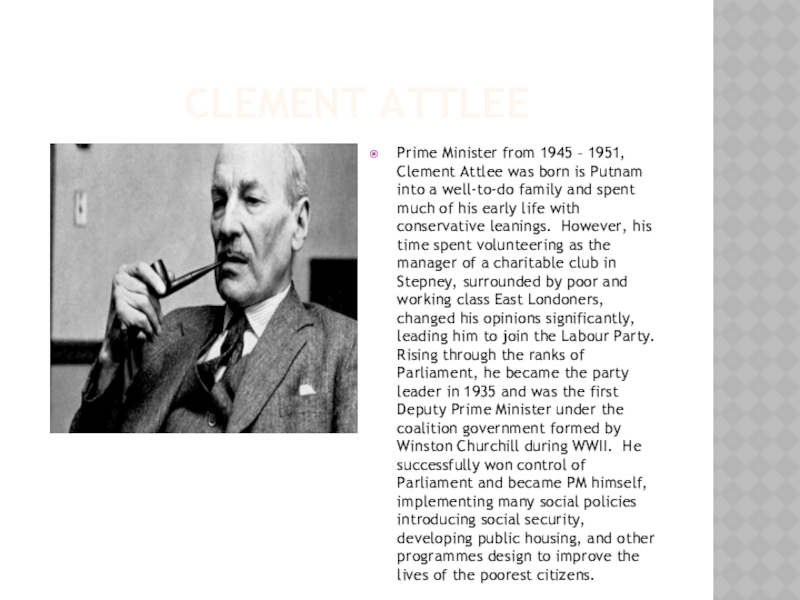
- 10. Clement AttleePrime Minister from 1945 – 1951,
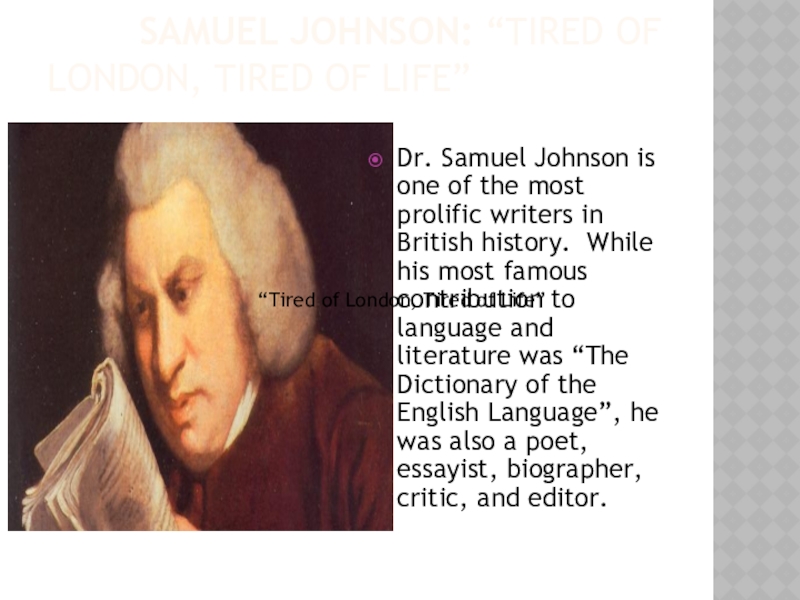
Samuel Johnson: “Tired of London, Tired of Life”Dr. Samuel Johnson is one of the most prolific writers in British history. While his most famous contribution to language and literature was “The Dictionary of

Слайд 2 Samuel Johnson: “Tired of London, Tired of Life”
Dr.
Samuel Johnson is one of the most prolific writers in British history. While his most famous contribution to language and literature was “The Dictionary of the English Language”, he was also a poet, essayist, biographer, critic, and editor.
“Tired of London, Tired of Life”
Слайд 3Michael faraday
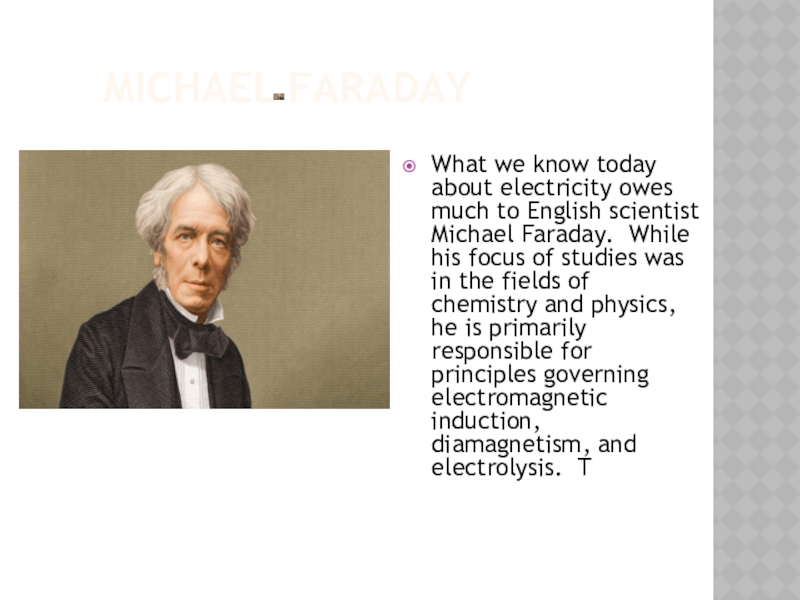
What we know today about electricity owes much to English
scientist Michael Faraday. While his focus of studies was in the fields of chemistry and physics, he is primarily responsible for principles governing electromagnetic induction, diamagnetism, and electrolysis. T
Слайд 4 Ken Livingstone – The First Mayor of London
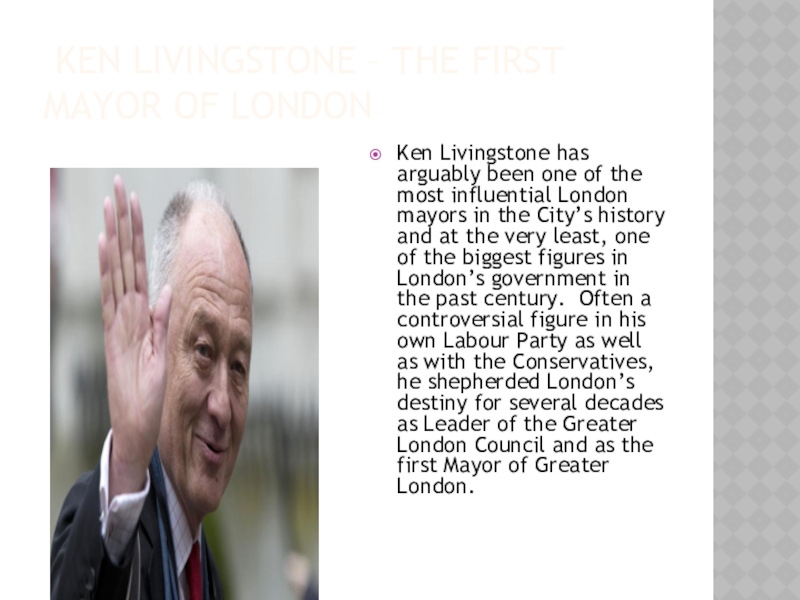
Ken Livingstone has arguably
been one of the most influential London mayors in the City’s history and at the very least, one of the biggest figures in London’s government in the past century. Often a controversial figure in his own Labour Party as well as with the Conservatives, he shepherded London’s destiny for several decades as Leader of the Greater London Council and as the first Mayor of Greater London.
Слайд 5cHarles dickens
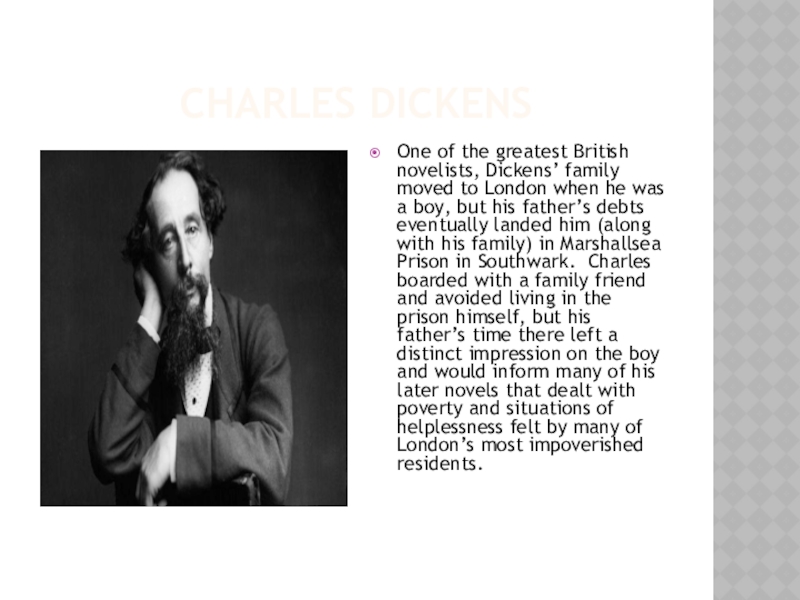
One of the greatest British novelists, Dickens’ family moved to
London when he was a boy, but his father’s debts eventually landed him (along with his family) in Marshallsea Prison in Southwark. Charles boarded with a family friend and avoided living in the prison himself, but his father’s time there left a distinct impression on the boy and would inform many of his later novels that dealt with poverty and situations of helplessness felt by many of London’s most impoverished residents.
Слайд 6 ADA lOVELACE
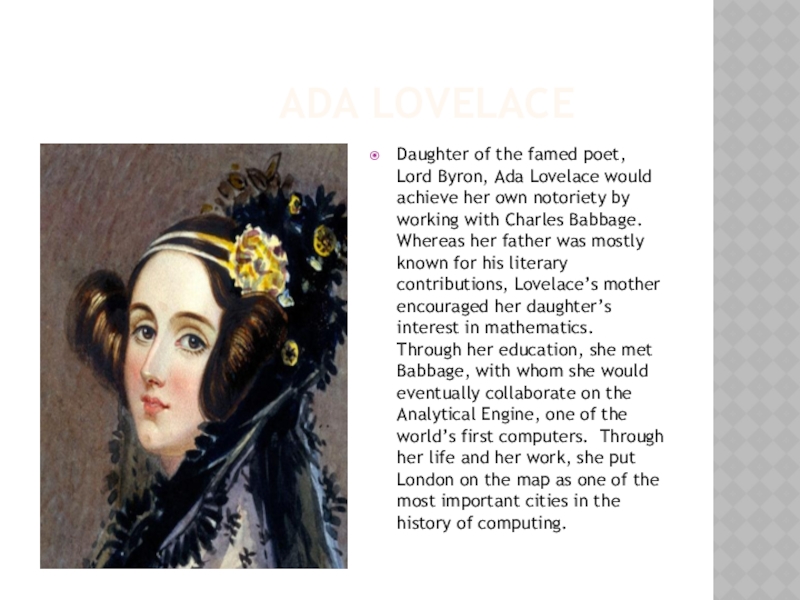
Daughter of the famed
poet, Lord Byron, Ada Lovelace would achieve her own notoriety by working with Charles Babbage. Whereas her father was mostly known for his literary contributions, Lovelace’s mother encouraged her daughter’s interest in mathematics. Through her education, she met Babbage, with whom she would eventually collaborate on the Analytical Engine, one of the world’s first computers. Through her life and her work, she put London on the map as one of the most important cities in the history of computing.
Слайд 7Giles Gilbert Scott- Designer of the Red Phone Box
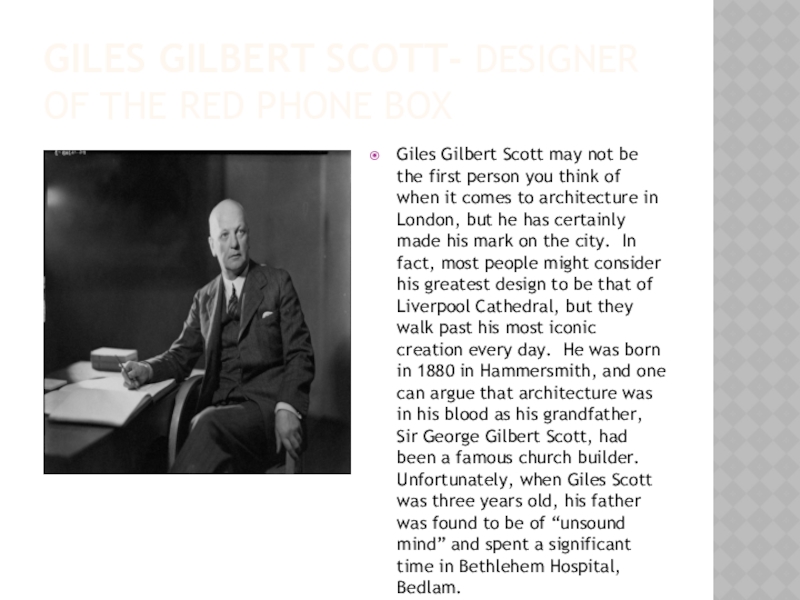
Giles Gilbert Scott
may not be the first person you think of when it comes to architecture in London, but he has certainly made his mark on the city. In fact, most people might consider his greatest design to be that of Liverpool Cathedral, but they walk past his most iconic creation every day. He was born in 1880 in Hammersmith, and one can argue that architecture was in his blood as his grandfather, Sir George Gilbert Scott, had been a famous church builder. Unfortunately, when Giles Scott was three years old, his father was found to be of “unsound mind” and spent a significant time in Bethlehem Hospital, Bedlam.
Слайд 8 Sir Robert Peel – The Founder of the Metropolitan Police
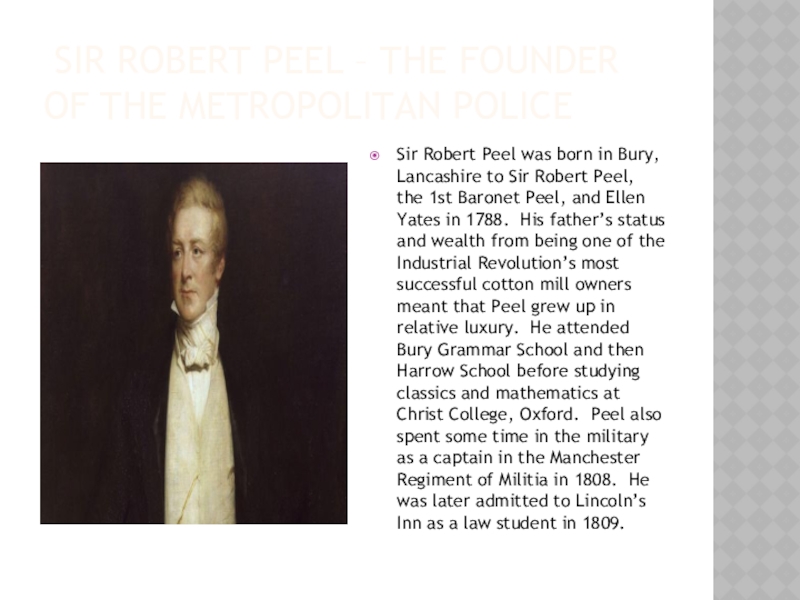
Sir Robert
Peel was born in Bury, Lancashire to Sir Robert Peel, the 1st Baronet Peel, and Ellen Yates in 1788. His father’s status and wealth from being one of the Industrial Revolution’s most successful cotton mill owners meant that Peel grew up in relative luxury. He attended Bury Grammar School and then Harrow School before studying classics and mathematics at Christ College, Oxford. Peel also spent some time in the military as a captain in the Manchester Regiment of Militia in 1808. He was later admitted to Lincoln’s Inn as a law student in 1809.
Слайд 9Samuel pepy
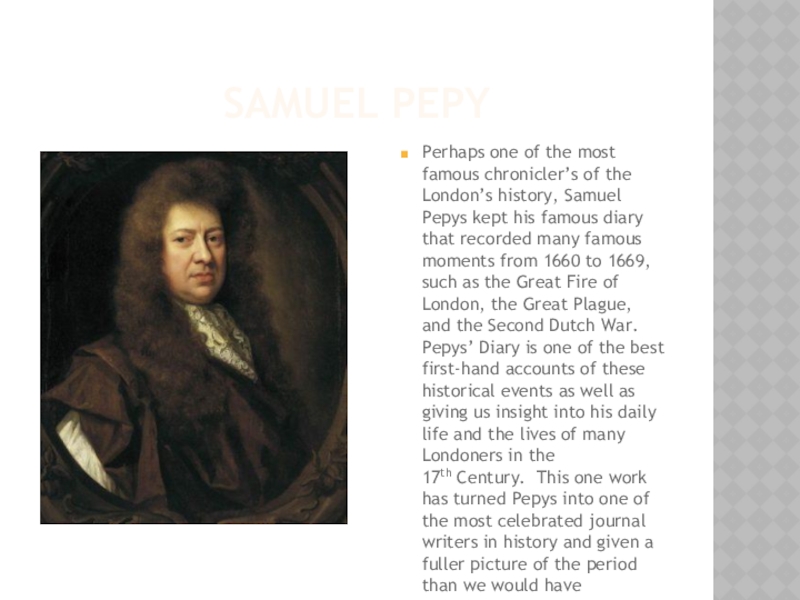
Perhaps one of the most famous chronicler’s of the London’s
history, Samuel Pepys kept his famous diary that recorded many famous moments from 1660 to 1669, such as the Great Fire of London, the Great Plague, and the Second Dutch War. Pepys’ Diary is one of the best first-hand accounts of these historical events as well as giving us insight into his daily life and the lives of many Londoners in the 17th Century. This one work has turned Pepys into one of the most celebrated journal writers in history and given a fuller picture of the period than we would have otherwise.
Слайд 10Clement Attlee
Prime Minister from 1945 – 1951, Clement Attlee was born
is Putnam into a well-to-do family and spent much of his early life with conservative leanings. However, his time spent volunteering as the manager of a charitable club in Stepney, surrounded by poor and working class East Londoners, changed his opinions significantly, leading him to join the Labour Party. Rising through the ranks of Parliament, he became the party leader in 1935 and was the first Deputy Prime Minister under the coalition government formed by Winston Churchill during WWII. He successfully won control of Parliament and became PM himself, implementing many social policies introducing social security, developing public housing, and other programmes design to improve the lives of the poorest citizens.