- Главная
- Разное
- Образование
- Спорт
- Естествознание
- Природоведение
- Религиоведение
- Французский язык
- Черчение
- Английский язык
- Астрономия
- Алгебра
- Биология
- География
- Геометрия
- Детские презентации
- Информатика
- История
- Литература
- Математика
- Музыка
- МХК
- Немецкий язык
- ОБЖ
- Обществознание
- Окружающий мир
- Педагогика
- Русский язык
- Технология
- Физика
- Философия
- Химия
- Шаблоны, фоны, картинки для презентаций
- Экология
- Экономика
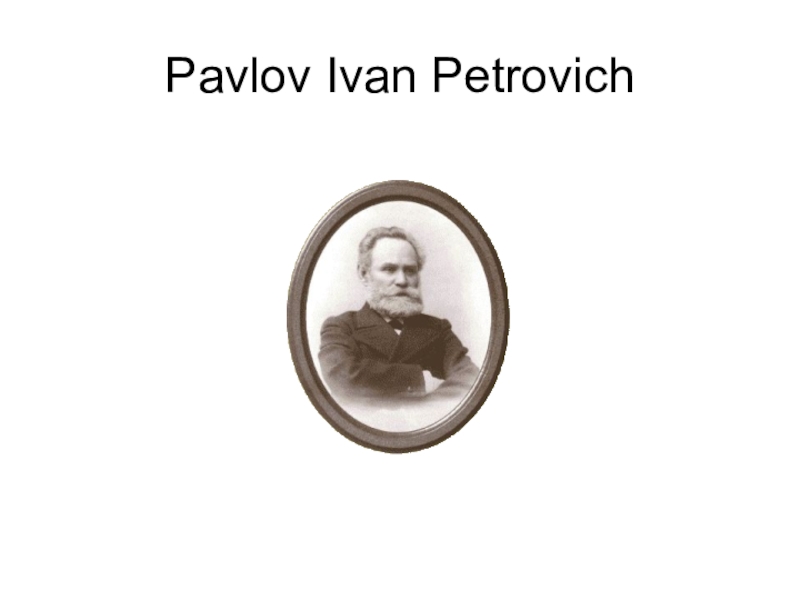
Презентация, доклад к уроку английского языка Борьба за человеческую жизнь.Академик Павлови И.П.
Содержание
- 1. Презентация к уроку английского языка Борьба за человеческую жизнь.Академик Павлови И.П.
- 2. Date of birth: 26 September 1849 Place
- 3. Ivan Petrovich was born
- 4. In 1870 he entered the
- 5. Pavlov, Sechenov as a follower, doing a
- 6. Conducted experiments with sham feeding
- 7. In 1903, 54-year-old Pavlov made
- 8. In the
- 9. In 1919-1920, during the period
- 10. The stages of life 1875
- 11. 1890 — elected Professor and head of
- 12. 1904 — Pavlov is awarded the Nobel
- 13. "The memorial Museum-estate of academician I. P.
- 14. Слайд 14
- 15. Слайд 15
- 16. Слайд 16
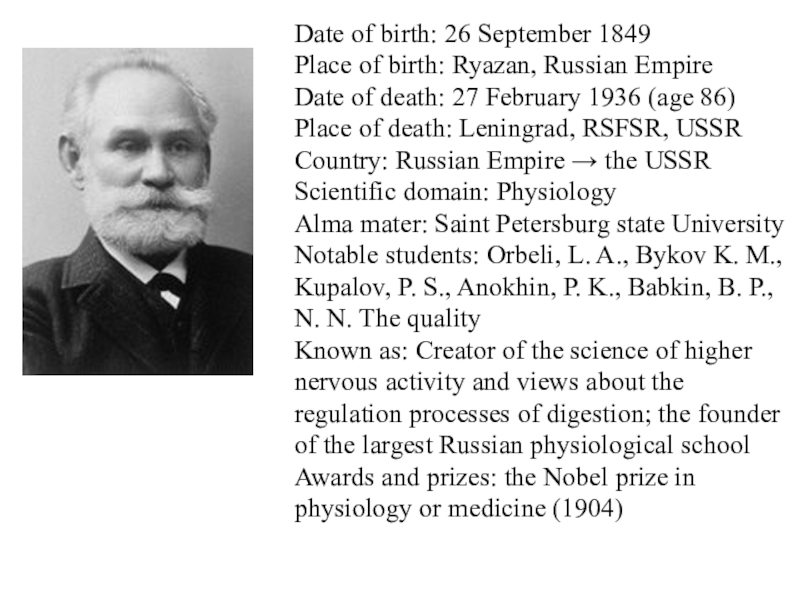
Date of birth: 26 September 1849 Place of birth: Ryazan, Russian Empire Date of death: 27 February 1936 (age 86) Place of death: Leningrad, RSFSR, USSR Country: Russian Empire → the USSR Scientific domain: Physiology Alma
Слайд 2Date of birth: 26 September 1849 Place of birth: Ryazan, Russian Empire Date
of death: 27 February 1936 (age 86)
Place of death: Leningrad, RSFSR, USSR
Country: Russian Empire → the USSR
Scientific domain: Physiology
Alma mater: Saint Petersburg state University
Notable students: Orbeli, L. A., Bykov K. M., Kupalov, P. S., Anokhin, P. K., Babkin, B. P., N. N. The quality
Known as: Creator of the science of higher nervous activity and views about the regulation processes of digestion; the founder of the largest Russian physiological school
Awards and prizes: the Nobel prize in physiology or medicine (1904)
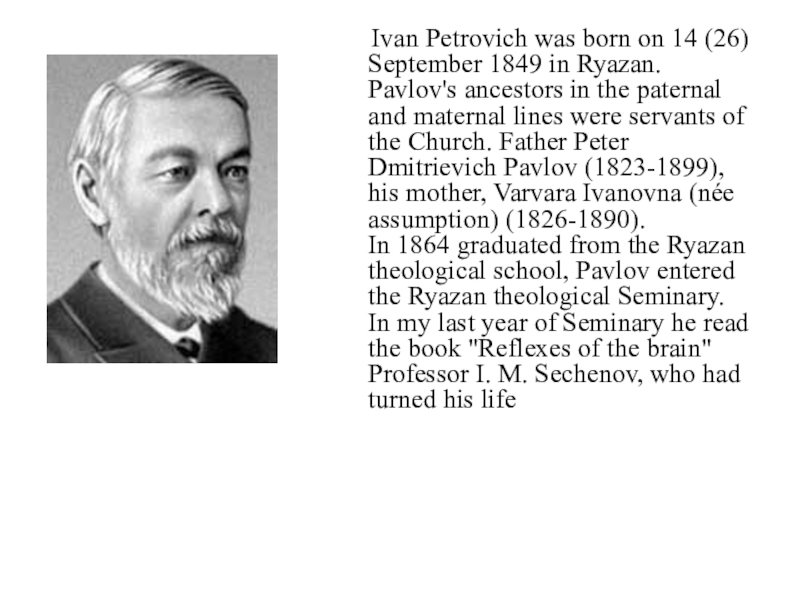
Слайд 3 Ivan Petrovich was born on 14 (26) September
1849 in Ryazan. Pavlov's ancestors in the paternal and maternal lines were servants of the Church. Father Peter Dmitrievich Pavlov (1823-1899), his mother, Varvara Ivanovna (née assumption) (1826-1890).
In 1864 graduated from the Ryazan theological school, Pavlov entered the Ryazan theological Seminary. In my last year of Seminary he read the book "Reflexes of the brain" Professor I. M. Sechenov, who had turned his life
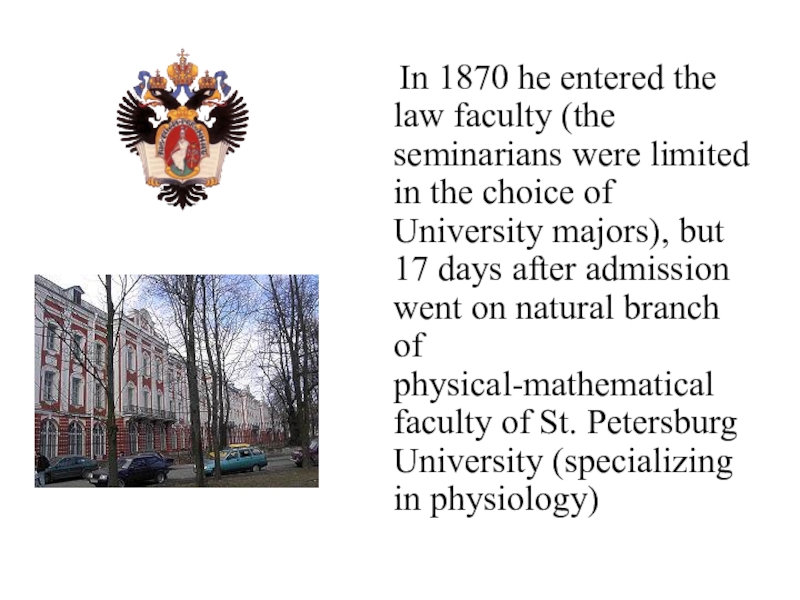
Слайд 4 In 1870 he entered the law faculty (the seminarians
were limited in the choice of University majors), but 17 days after admission went on natural branch of physical-mathematical faculty of St. Petersburg University (specializing in physiology)
Слайд 5
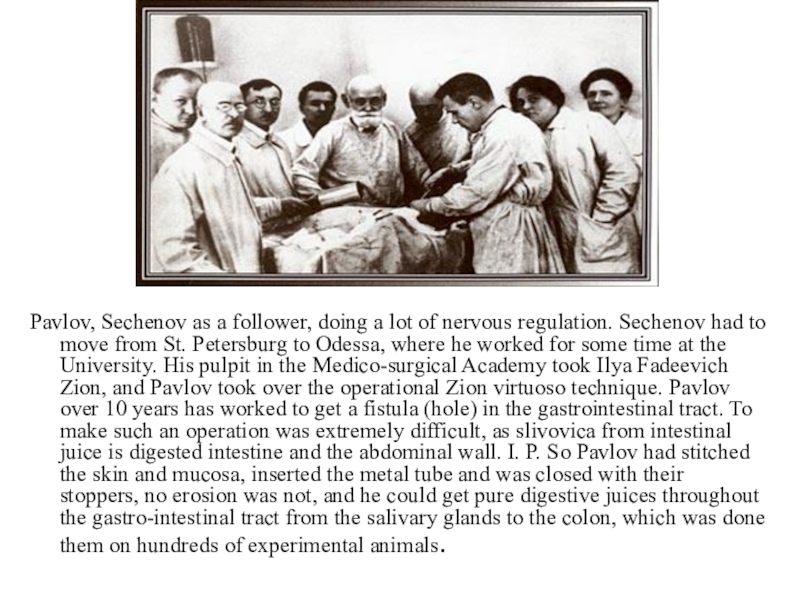
Pavlov, Sechenov as a follower, doing a lot of nervous regulation.
Sechenov had to move from St. Petersburg to Odessa, where he worked for some time at the University. His pulpit in the Medico-surgical Academy took Ilya Fadeevich Zion, and Pavlov took over the operational Zion virtuoso technique. Pavlov over 10 years has worked to get a fistula (hole) in the gastrointestinal tract. To make such an operation was extremely difficult, as slivovica from intestinal juice is digested intestine and the abdominal wall. I. P. So Pavlov had stitched the skin and mucosa, inserted the metal tube and was closed with their stoppers, no erosion was not, and he could get pure digestive juices throughout the gastro-intestinal tract from the salivary glands to the colon, which was done them on hundreds of experimental animals.
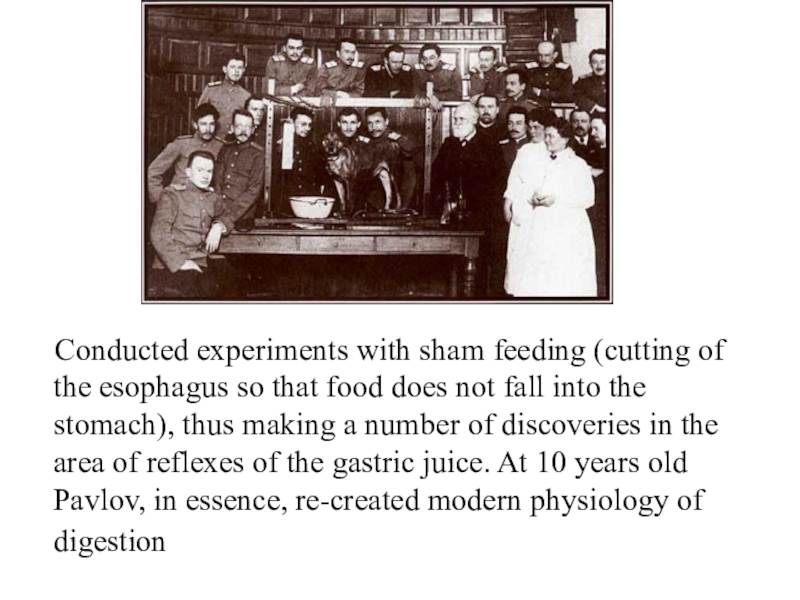
Слайд 6 Conducted experiments with sham feeding (cutting of the esophagus
so that food does not fall into the stomach), thus making a number of discoveries in the area of reflexes of the gastric juice. At 10 years old Pavlov, in essence, re-created modern physiology of digestion
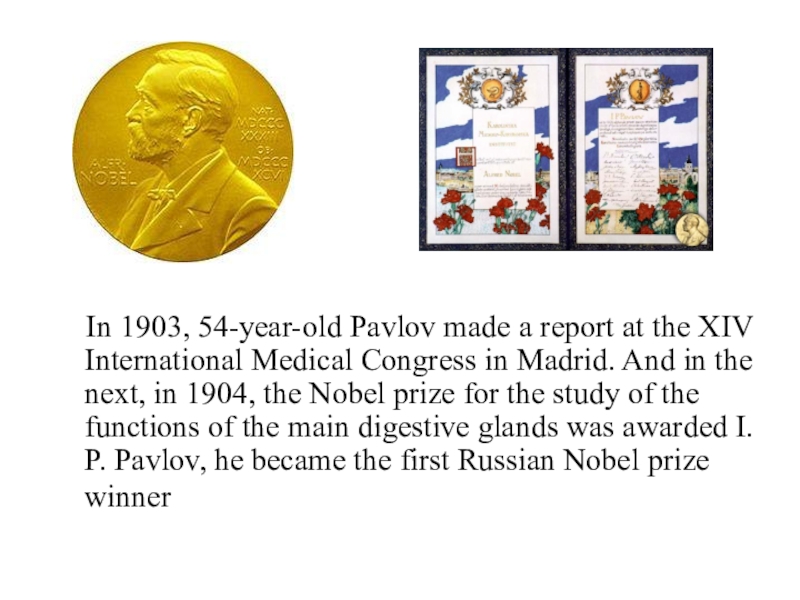
Слайд 7 In 1903, 54-year-old Pavlov made a report at the
XIV International Medical Congress in Madrid. And in the next, in 1904, the Nobel prize for the study of the functions of the main digestive glands was awarded I. P. Pavlov, he became the first Russian Nobel prize winner
Слайд 8
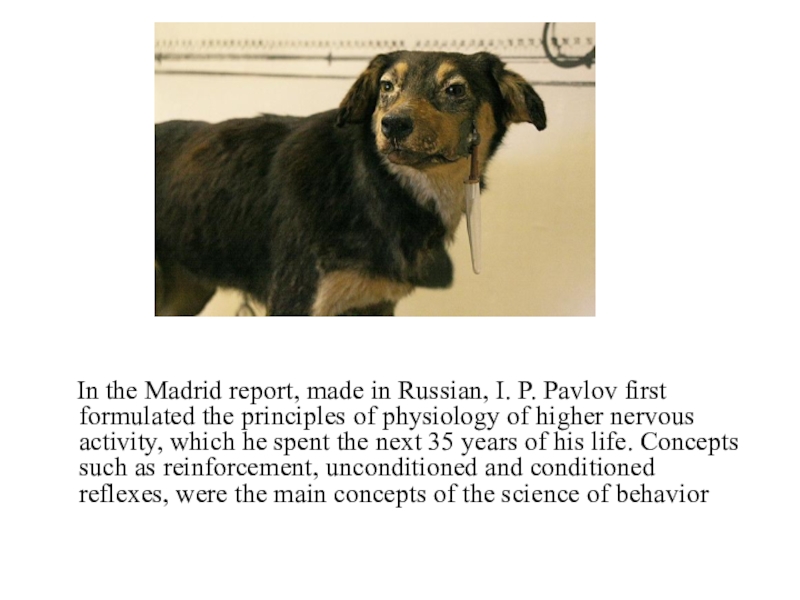
In the Madrid report, made
in Russian, I. P. Pavlov first formulated the principles of physiology of higher nervous activity, which he spent the next 35 years of his life. Concepts such as reinforcement, unconditioned and conditioned reflexes, were the main concepts of the science of behavior
Слайд 9
In 1919-1920, during the period of devastation, Pavlov,
suffering poverty, lack of research funding, refused the invitation of the Swedish Academy of Sciences to move to Sweden, where he promised to create the most favorable conditions for life and scientific research, and in the vicinity of Stockholm was planned to build at the request of Pavlov the Institute, what he wants. Pavlov said that he's not going anywhere. Then followed by the corresponding decree of the Soviet government, and built a magnificent Pavlov Institute in Koltushi, near Leningrad, where he worked until 1936
Слайд 10
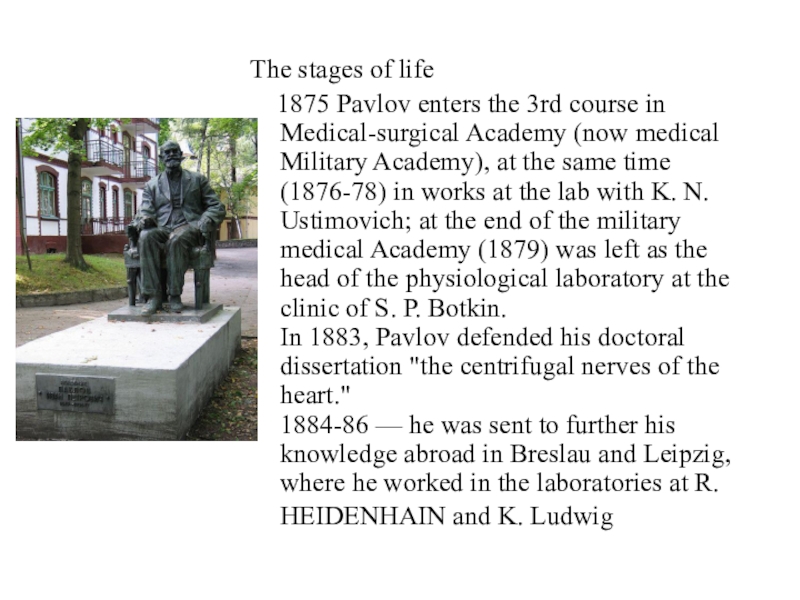
The stages of life
1875 Pavlov enters the 3rd
course in Medical-surgical Academy (now medical Military Academy), at the same time (1876-78) in works at the lab with K. N. Ustimovich; at the end of the military medical Academy (1879) was left as the head of the physiological laboratory at the clinic of S. P. Botkin.
In 1883, Pavlov defended his doctoral dissertation "the centrifugal nerves of the heart."
1884-86 — he was sent to further his knowledge abroad in Breslau and Leipzig, where he worked in the laboratories at R. HEIDENHAIN and K. Ludwig
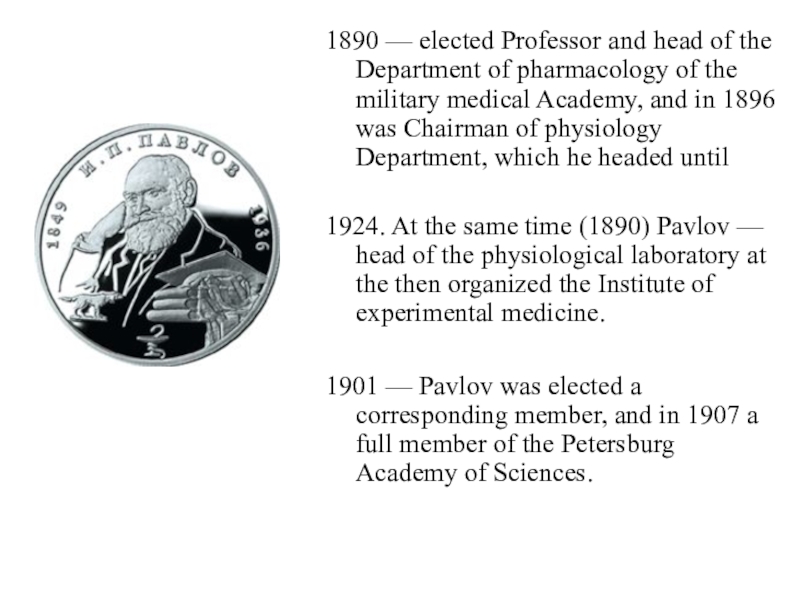
Слайд 111890 — elected Professor and head of the Department of pharmacology
of the military medical Academy, and in 1896 was Chairman of physiology Department, which he headed until
1924. At the same time (1890) Pavlov — head of the physiological laboratory at the then organized the Institute of experimental medicine.
1901 — Pavlov was elected a corresponding member, and in 1907 a full member of the Petersburg Academy of Sciences.
1924. At the same time (1890) Pavlov — head of the physiological laboratory at the then organized the Institute of experimental medicine.
1901 — Pavlov was elected a corresponding member, and in 1907 a full member of the Petersburg Academy of Sciences.
Слайд 121904 — Pavlov is awarded the Nobel prize for many years
of studies of mechanisms of digestion
1925 — to the end of his life Pavlov directed the Institute of physiology, Academy of Sciences of the USSR
1936 — on February 27, Pavlov died of pneumonia. He was buried at the "Literatorskie Mostki" Volkov cemetery in St. Petersburg
1925 — to the end of his life Pavlov directed the Institute of physiology, Academy of Sciences of the USSR
1936 — on February 27, Pavlov died of pneumonia. He was buried at the "Literatorskie Mostki" Volkov cemetery in St. Petersburg
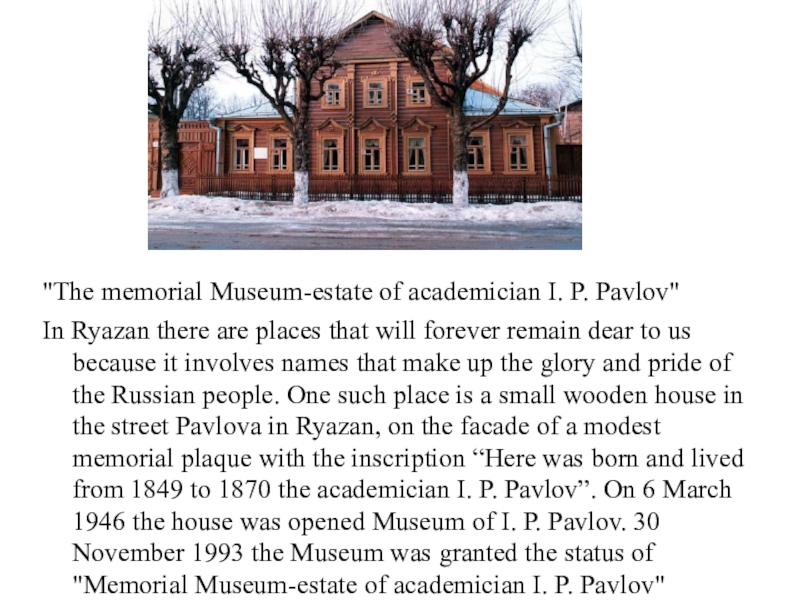
Слайд 13"The memorial Museum-estate of academician I. P. Pavlov"
In Ryazan there
are places that will forever remain dear to us because it involves names that make up the glory and pride of the Russian people. One such place is a small wooden house in the street Pavlova in Ryazan, on the facade of a modest memorial plaque with the inscription “Here was born and lived from 1849 to 1870 the academician I. P. Pavlov”. On 6 March 1946 the house was opened Museum of I. P. Pavlov. 30 November 1993 the Museum was granted the status of "Memorial Museum-estate of academician I. P. Pavlov"