- Главная
- Разное
- Образование
- Спорт
- Естествознание
- Природоведение
- Религиоведение
- Французский язык
- Черчение
- Английский язык
- Астрономия
- Алгебра
- Биология
- География
- Геометрия
- Детские презентации
- Информатика
- История
- Литература
- Математика
- Музыка
- МХК
- Немецкий язык
- ОБЖ
- Обществознание
- Окружающий мир
- Педагогика
- Русский язык
- Технология
- Физика
- Философия
- Химия
- Шаблоны, фоны, картинки для презентаций
- Экология
- Экономика
Презентация, доклад История животных в космосе
Содержание
- 1. Презентация История животных в космосе
- 2. A Brief introduction in History of Animals
- 3. MonkeysIn 1948 a rhesus monkey named Albert
- 4. MonkeysIn May 1952 two Phillipine macaque monkeys
- 5. MonkeysAfter Gordo two monkeys were selected for
- 6. MonkeysAble died 4 days after the mission
- 7. MonkeysIn January 1961 Ham the chimpanzee was
- 8. DogsWhile the US were using monkeys in
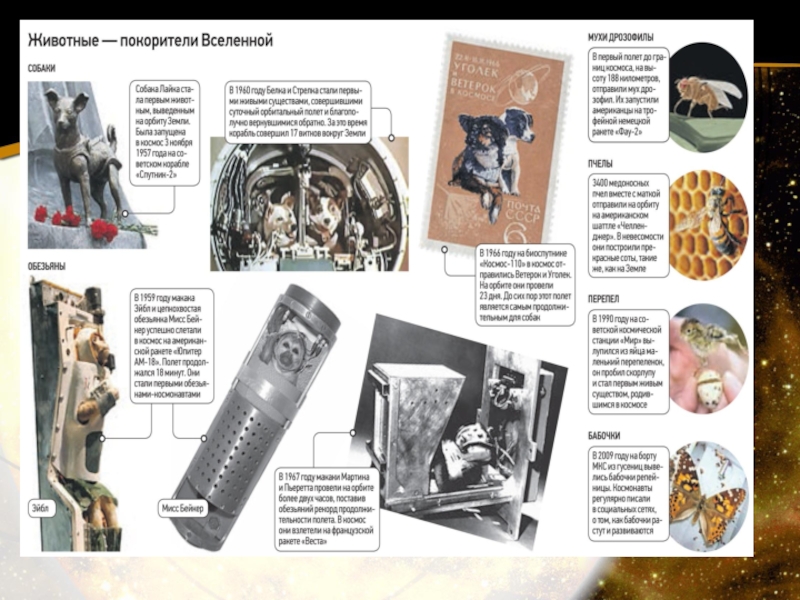
- 9. DogsOn November 3, 1957 the Soviets launched
- 10. DogsLaika died just a few hours after
- 11. Dogs Собаки 4 стр Белка и стрелка19
- 12. DogsRussia continued sending dogs into space.Belka and
- 13. DogsIn the Soviet Union the dogs Veterok
- 14. Félicette (cat)1963 launch yearThe state of weightlessness
- 15. Turtles черепахаAs it does not require a
- 16. Quails перепелаQuail is considered a bird of
- 17. Rats крысаThe first flight of the rat
- 18. Others другиеThroughout the 1990s during the various
- 19. AfterwordAfter the Moon landing in July 1969
- 20. Слайд 20
Слайд 2A Brief introduction in History of Animals in Space
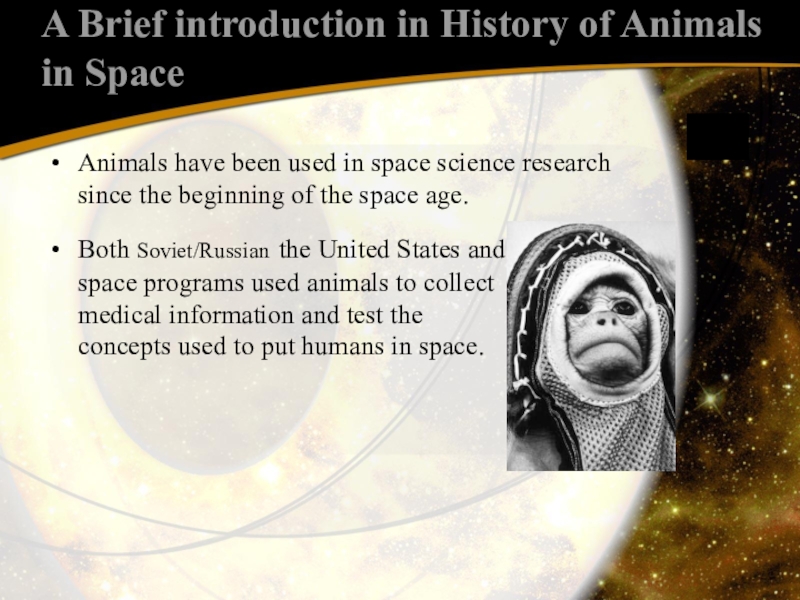
Animals have been
Both Soviet/Russian the United States and space programs used animals to collect medical information and test the concepts used to put humans in space.
Слайд 3Monkeys
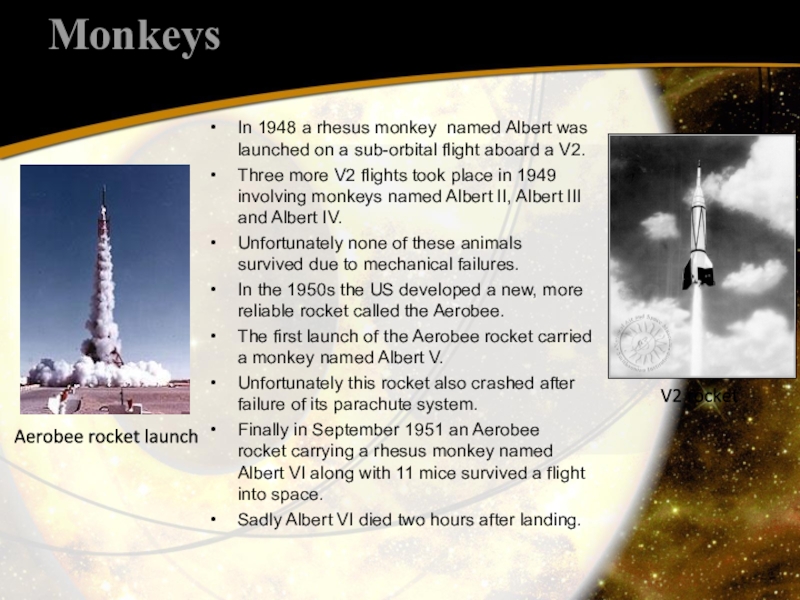
In 1948 a rhesus monkey named Albert was launched on a
Three more V2 flights took place in 1949 involving monkeys named Albert II, Albert III and Albert IV.
Unfortunately none of these animals survived due to mechanical failures.
In the 1950s the US developed a new, more reliable rocket called the Aerobee.
The first launch of the Aerobee rocket carried a monkey named Albert V.
Unfortunately this rocket also crashed after failure of its parachute system.
Finally in September 1951 an Aerobee rocket carrying a rhesus monkey named Albert VI along with 11 mice survived a flight into space.
Sadly Albert VI died two hours after landing.
V2 rocket
Aerobee rocket launch
Слайд 4Monkeys
In May 1952 two Phillipine macaque monkeys named Patricia and Michael
The flight was a resounding success and both were recovered in good health - a big step forward for American space flight.
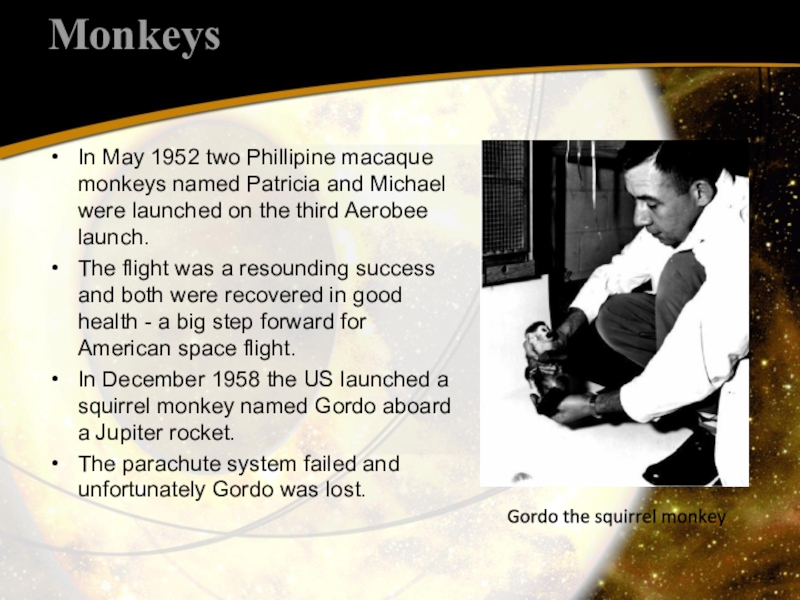
In December 1958 the US launched a squirrel monkey named Gordo aboard a Jupiter rocket.
The parachute system failed and unfortunately Gordo was lost.
Gordo the squirrel monkey
Слайд 5Monkeys
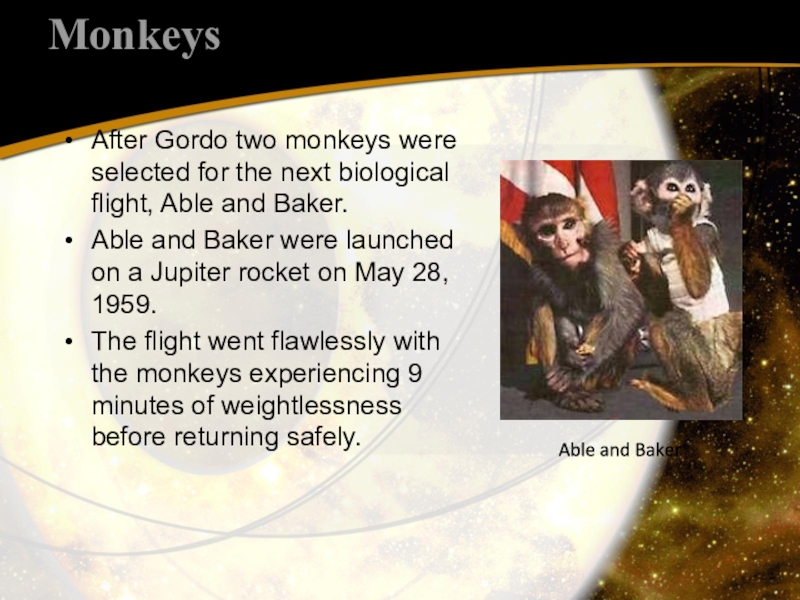
After Gordo two monkeys were selected for the next biological flight,
Able and Baker were launched on a Jupiter rocket on May 28, 1959.
The flight went flawlessly with the monkeys experiencing 9 minutes of weightlessness before returning safely.
Able and Baker
Слайд 6Monkeys
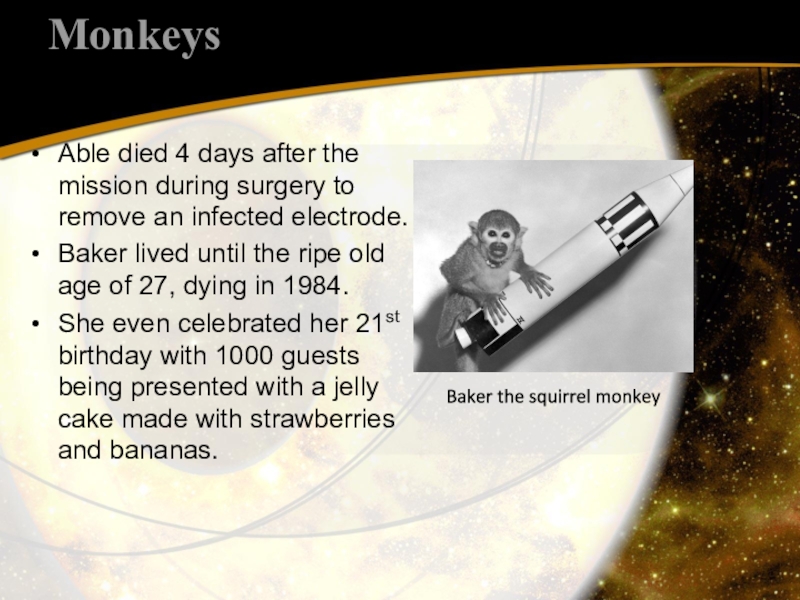
Able died 4 days after the mission during surgery to remove
Baker lived until the ripe old age of 27, dying in 1984.
She even celebrated her 21st birthday with 1000 guests being presented with a jelly cake made with strawberries and bananas.
Baker the squirrel monkey
Слайд 7Monkeys
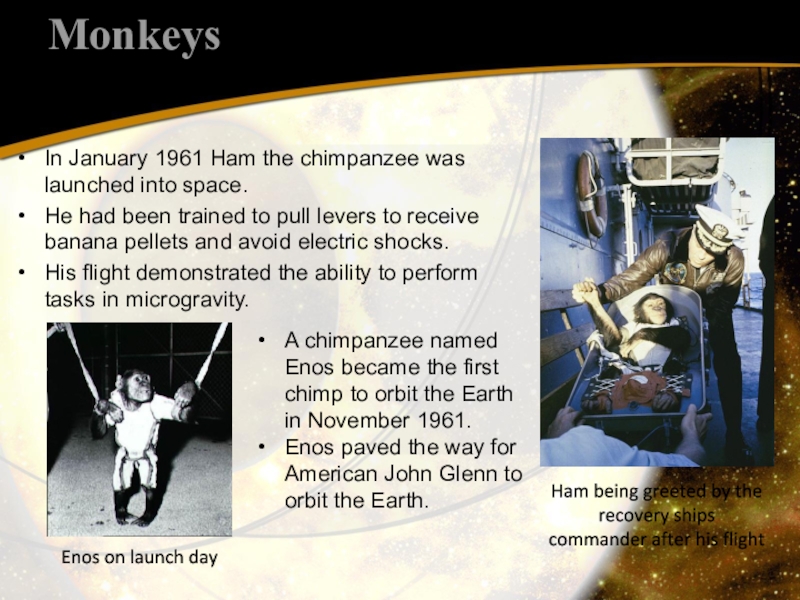
In January 1961 Ham the chimpanzee was launched into space.
He had
His flight demonstrated the ability to perform tasks in microgravity.
Ham being greeted by the recovery ships commander after his flight
A chimpanzee named Enos became the first chimp to orbit the Earth in November 1961.
Enos paved the way for American John Glenn to orbit the Earth.
Enos on launch day
Слайд 8Dogs
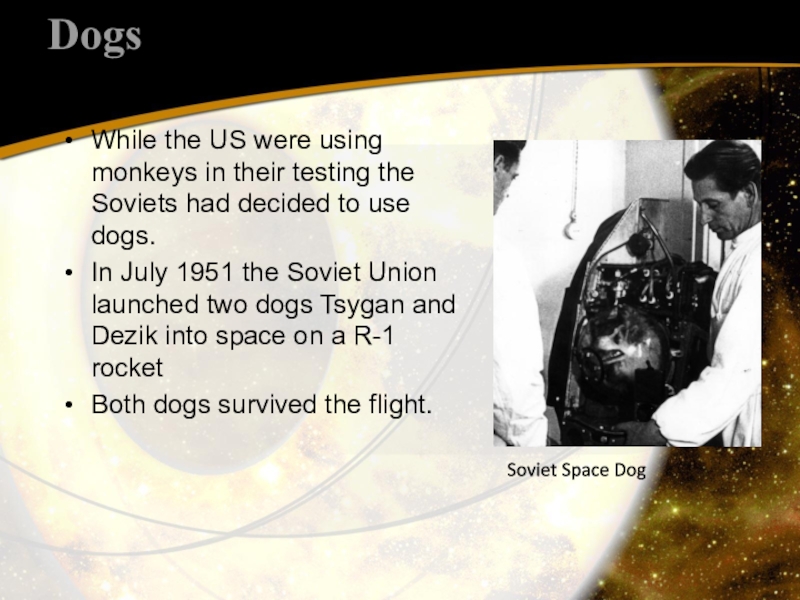
While the US were using monkeys in their testing the Soviets
In July 1951 the Soviet Union launched two dogs Tsygan and Dezik into space on a R-1 rocket
Both dogs survived the flight.
Soviet Space Dog
Слайд 9Dogs
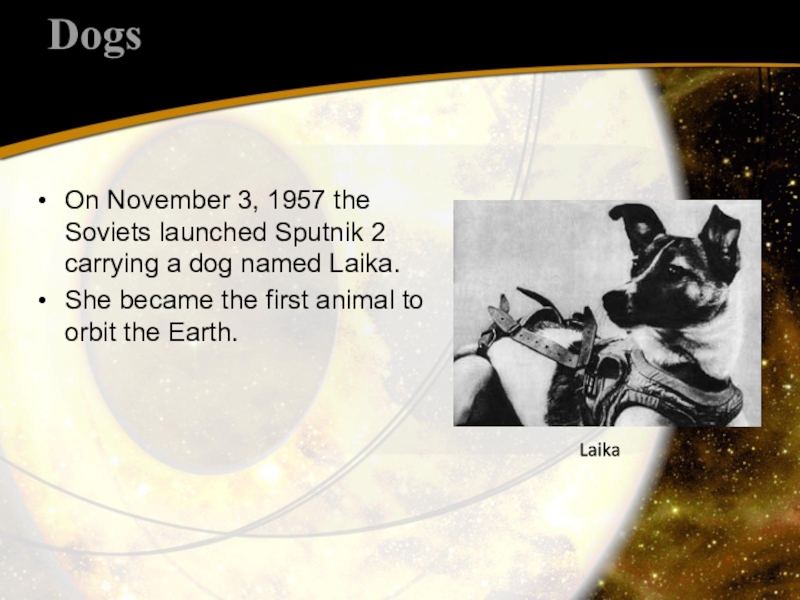
On November 3, 1957 the Soviets launched Sputnik 2 carrying a
She became the first animal to orbit the Earth.
Laika
Слайд 10Dogs
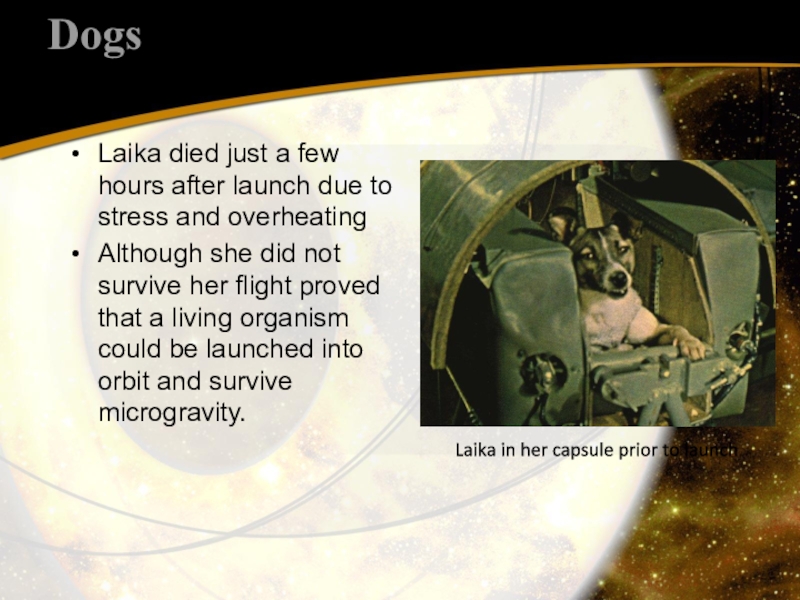
Laika died just a few hours after launch due to stress
Although she did not survive her flight proved that a living organism could be launched into orbit and survive microgravity.
Laika in her capsule prior to launch
Слайд 11Dogs Собаки 4 стр Белка и стрелка
19 августа 1960 года полет
облетели вокруг Земного шара семнадцать раз.
цель полета изучение невесомости, для возможности полета человека. Белка и Стрелка пролетела 700 тысяч километров. После возвращения на Землю собак поселили в институт авиационной медицины. Они принесли ещё много полезного для авиации. У них появилось потомство. И они прожили долго и счастливо.
Слайд 12Dogs
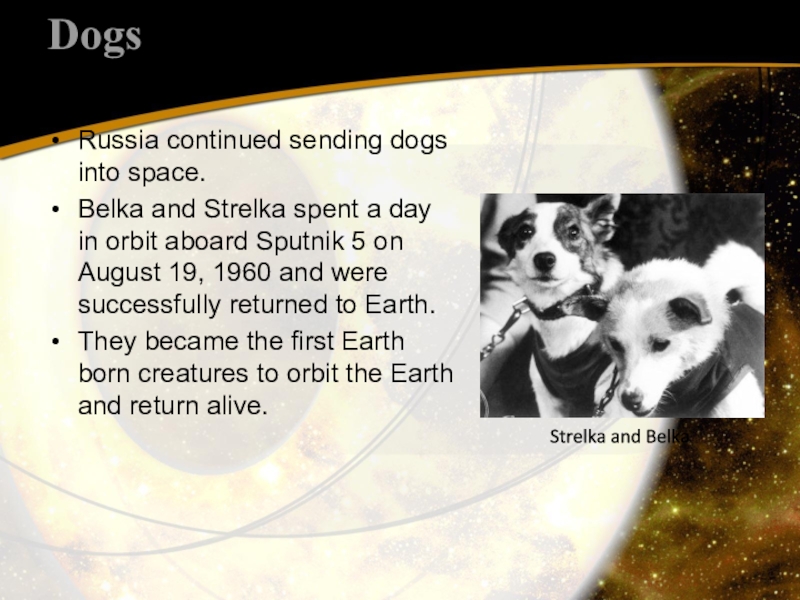
Russia continued sending dogs into space.
Belka and Strelka spent a day
They became the first Earth born creatures to orbit the Earth and return alive.
Strelka and Belka
Слайд 13Dogs
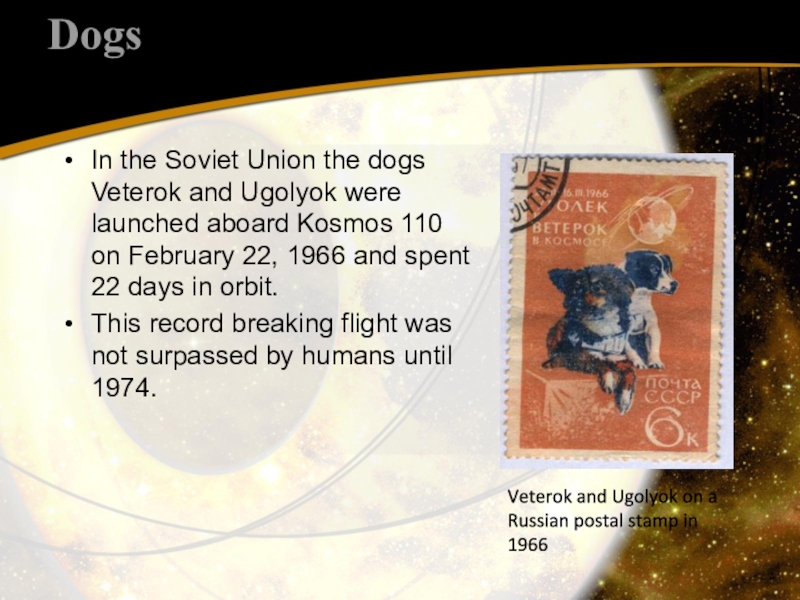
In the Soviet Union the dogs Veterok and Ugolyok were launched
This record breaking flight was not surpassed by humans until 1974.
Veterok and Ugolyok on a Russian postal stamp in 1966
Слайд 14Félicette (cat)
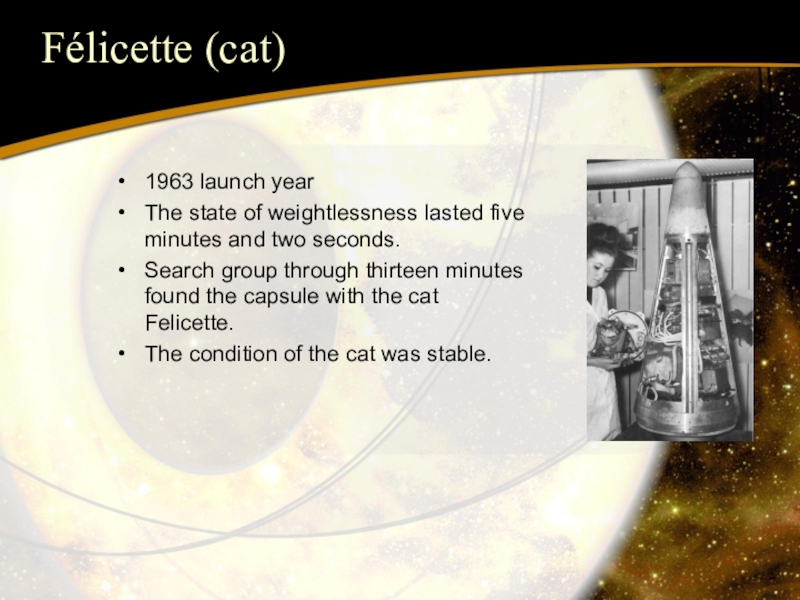
1963 launch year
The state of weightlessness lasted five minutes and
Search group through thirteen minutes found the capsule with the cat Felicette.
The condition of the cat was stable.
Слайд 15Turtles черепаха
As it does not require a large amount of oxygen
They were immersed in a special natural lethargy.
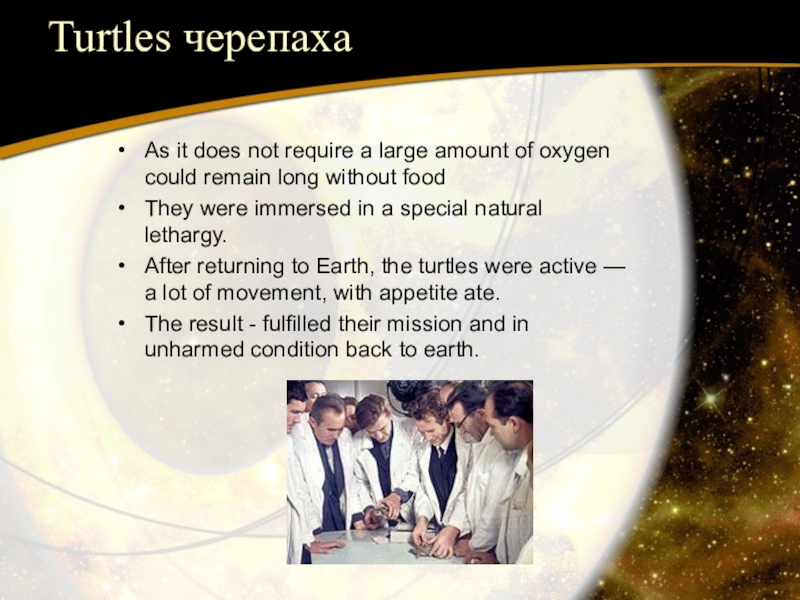
After returning to Earth, the turtles were active — a lot of movement, with appetite ate.
The result - fulfilled their mission and in unharmed condition back to earth.
Слайд 16Quails перепела
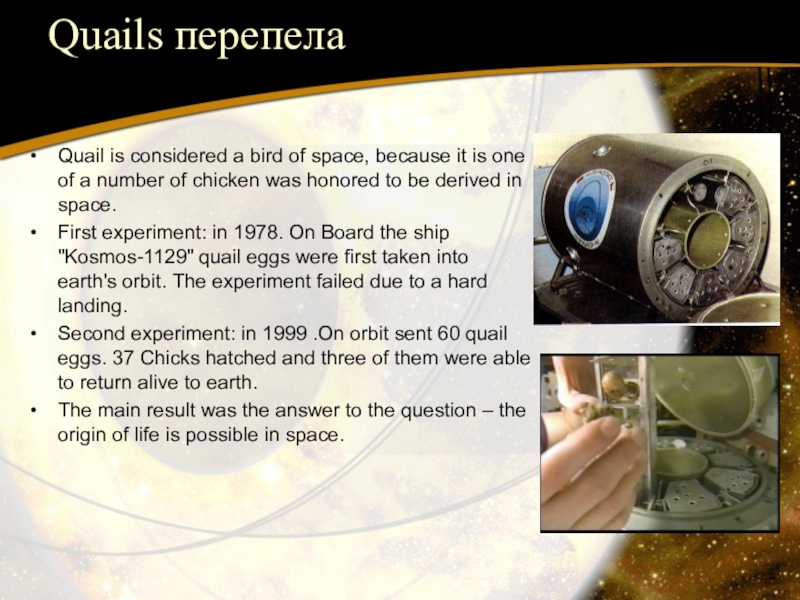
Quail is considered a bird of space, because it is
First experiment: in 1978. On Board the ship "Kosmos-1129" quail eggs were first taken into earth's orbit. The experiment failed due to a hard landing.
Second experiment: in 1999 .On orbit sent 60 quail eggs. 37 Chicks hatched and three of them were able to return alive to earth.
The main result was the answer to the question – the origin of life is possible in space.
Слайд 17Rats крыса
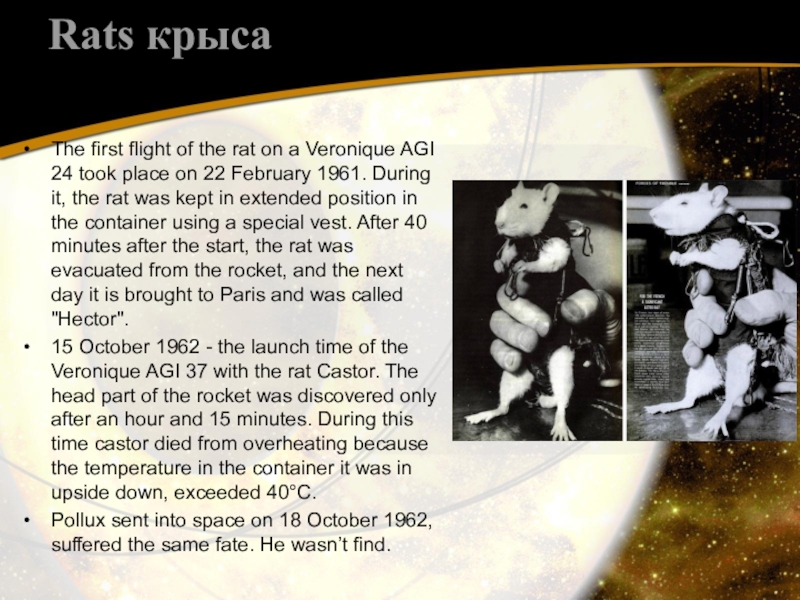
The first flight of the rat on a Veronique AGI
15 October 1962 - the launch time of the Veronique AGI 37 with the rat Castor. The head part of the rocket was discovered only after an hour and 15 minutes. During this time castor died from overheating because the temperature in the container it was in upside down, exceeded 40°C.
Pollux sent into space on 18 October 1962, suffered the same fate. He wasn’t find.
Слайд 18Others другие
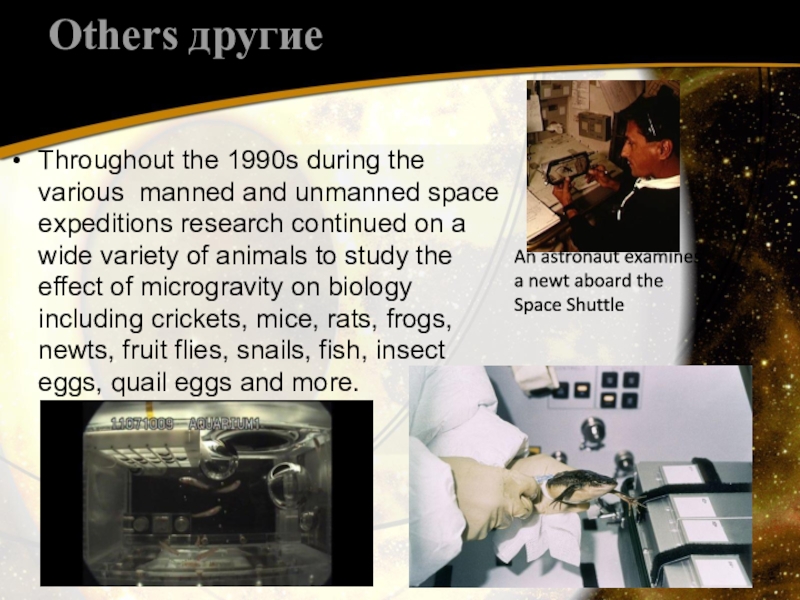
Throughout the 1990s during the various manned and unmanned space
An astronaut examines a newt aboard the Space Shuttle
Слайд 19Afterword
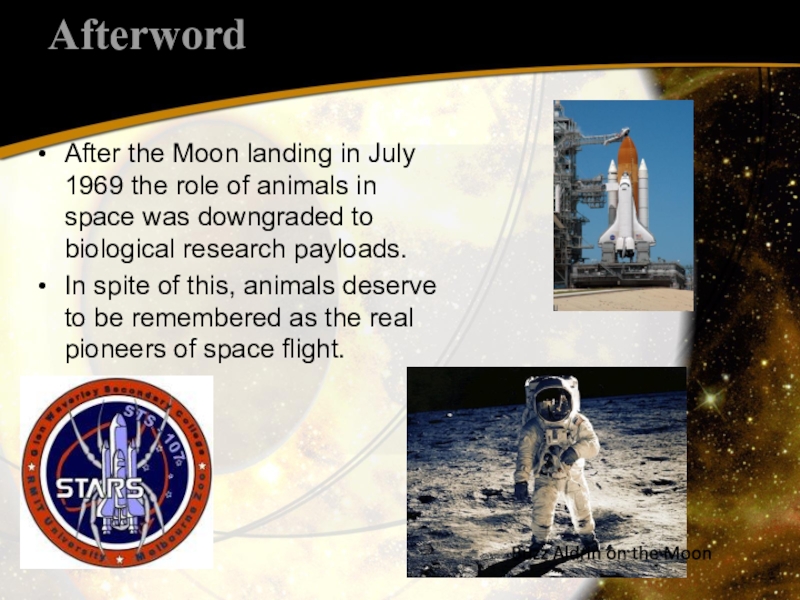
After the Moon landing in July 1969 the role of animals
In spite of this, animals deserve to be remembered as the real pioneers of space flight.
Buzz Aldrin on the Moon