review
3. cohesion
- Главная
- Разное
- Образование
- Спорт
- Естествознание
- Природоведение
- Религиоведение
- Французский язык
- Черчение
- Английский язык
- Астрономия
- Алгебра
- Биология
- География
- Геометрия
- Детские презентации
- Информатика
- История
- Литература
- Математика
- Музыка
- МХК
- Немецкий язык
- ОБЖ
- Обществознание
- Окружающий мир
- Педагогика
- Русский язык
- Технология
- Физика
- Философия
- Химия
- Шаблоны, фоны, картинки для презентаций
- Экология
- Экономика
Презентация, доклад Developing writing skills
Содержание
- 1. Презентация Developing writing skills
- 2. What is a paragraph? “A paragraph is
- 3. The Basic Rule: Keep One Idea to
- 4. Elements of a Paragraph 1)Unity2) Coherence3) Topic Sentence and 4) Adequate Development
- 5. “Consider the postage stamp," advised humorist Josh
- 6. 1)Unity The entire paragraph should concern itself
- 7. 2) Coherence Coherence is the trait that
- 8. Logical bridgesThe same idea of a topic
- 9. 3) Topic SentenceIt is a sentence that
- 10. 4) Adequate Development The topic (which is
- 11. A typical expository paragraph starts with a
- 12. Irrelevant Details When I was growing up,
- 13. Some methods to make sure your paragraph
- 14. Some methods to make sure your paragraph
- 15. You should start a new paragraph when:
- 16. You should start a new paragraph when:When
- 17. Transitions and Signposts Two very important elements
- 18. Transitional words and phrases guide readers from
- 19. 1. Addition Transitions ExampleIn the first place,
- 20. 2. Cause-Effect Transitions accordingly and so as
- 21. 3. Comparison Transitions by the same token
- 22. 4. Contrast Transitions but however in contrast
- 23. 5. Conclusion and Summary Transitions and so
- 24. 6. Example Transitions as an example for
- 25. 7. Insistence Transitions
- 26. 8. Place Transitions above alongside beneath beyond
- 27. 9. Restatement Transitions in other words in
- 28. 10. Time Transitions afterward at the same
What is a paragraph? “A paragraph is a collection of related sentences dealing with a single topic.” Why should we learn to write good paragraphs?1) will help you as a writer stay on track during your
Слайд 2What is a paragraph?
“A paragraph is a collection of related sentences
dealing with a single topic.”
Why should we learn to write good paragraphs?
1) will help you as a writer stay on track during your drafting and revision stages;
2) will greatly assist readers in following a piece of writing
3) you can have fantastic ideas, but if those ideas aren't presented in an organized fashion, you will lose your readers
Why should we learn to write good paragraphs?
1) will help you as a writer stay on track during your drafting and revision stages;
2) will greatly assist readers in following a piece of writing
3) you can have fantastic ideas, but if those ideas aren't presented in an organized fashion, you will lose your readers
Слайд 3The Basic Rule: Keep One Idea to One Paragraph
If you begin
to transition into a new idea, it belongs in a new paragraph. There are some simple ways to tell if you are on the same topic or a new one. You can have one idea and several bits of supporting evidence within a single paragraph. You can also have several points in a single paragraph as long as they relate to the overall topic of the paragraph. If the single points start to get long, then perhaps elaborating on each of them and placing them in their own paragraphs is the route to go.
Слайд 5“Consider the postage stamp," advised humorist Josh Billings. "Its usefulness consists
in the ability to stick to one thing until it gets there.”
The same might be said about an effective paragraph. Unity is the quality of sticking to one idea from start to finish, with every sentence contributing to the central purpose and main idea of that paragraph.
The same might be said about an effective paragraph. Unity is the quality of sticking to one idea from start to finish, with every sentence contributing to the central purpose and main idea of that paragraph.
Слайд 61)Unity
The entire paragraph should concern itself with a single focus. If
it begins with a one focus or major point of discussion, it should not end with another or wander within different ideas.
Слайд 72) Coherence
Coherence is the trait that makes the paragraph easily understandable
to a reader. You can help create coherence in your paragraphs by creating logical bridges and verbal bridges.
Слайд 8Logical bridges
The same idea of a topic is carried over from
sentence to sentence. Successive sentences can be constructed in parallel form.
Verbal bridges
Key words can be repeated in several sentences. Synonymous words can be repeated in several sentences. Pronouns can refer to nouns in previous sentences. Transition words can be used to link ideas from different sentences
Verbal bridges
Key words can be repeated in several sentences. Synonymous words can be repeated in several sentences. Pronouns can refer to nouns in previous sentences. Transition words can be used to link ideas from different sentences
Слайд 93) Topic Sentence
It is a sentence that indicates in a general
way what idea or thesis the paragraph is going to deal with. Although not all paragraphs have clear-cut topic sentences, and despite the fact that topic sentences can occur anywhere in the paragraph (as the first sentence, the last sentence, or somewhere in the middle), an easy way to make sure your reader understands the topic of the paragraph is to put your topic sentence near the beginning of the paragraph. (This is a good general rule for less experienced writers, although it is not the only way to do it). Regardless of whether you include an explicit topic sentence or not, you should be able to easily summarize what the paragraph is about.
Слайд 104) Adequate Development
The topic (which is introduced by the topic sentence)
should be discussed fully and adequately. Again, this varies from paragraph to paragraph, depending on the author's purpose, but writers should beware of paragraphs that only have two or three sentences. It's a pretty good bet that the paragraph is not fully developed if it is that short.
Слайд 11
A typical expository paragraph starts with a controlling idea or claim,
which it then explains, develops, or supports with evidence. Paragraph sprawl occurs when digressions are introduced into an otherwise focused and unified discussion. Digressions and deviations often come in the form of irrelevant details or shifts in focus.
Слайд 12Irrelevant Details
When I was growing up, one of the places I
enjoyed most was the cherry tree in the back yard. Behind the yard was an alley and then more houses. Every summer when the cherries began to ripen, I used to spend hours high in the tree, picking and eating the sweet, sun-warmed cherries. My mother always worried about my falling out of the tree, but I never did. But I had some competition for the cherries — flocks of birds that enjoyed them as much as I did and would perch all over the tree, devouring the fruit whenever I wasn't there. I used to wonder why the grown-ups never ate any of the cherries; but actually when the birds and I had finished, there weren't many left.
No sentence is completely irrelevant to the general topic of this paragraph (the cherry tree), but the sentences Behind the yard was an alley and then more houses and My mother always worried about my falling out of the tree, but I never did do not develop the specific idea in the first sentence: enjoyment of the cherry tree.
Слайд 13Some methods to make sure your paragraph is well-developed:
Use examples and
illustrations
Cite data (facts, statistics, evidence, details, and others)
Examine testimony (what other people say such as quotes and paraphrases)
Use an anecdote or story
Define terms in the paragraph
Compare and contrast
Cite data (facts, statistics, evidence, details, and others)
Examine testimony (what other people say such as quotes and paraphrases)
Use an anecdote or story
Define terms in the paragraph
Compare and contrast
Слайд 14Some methods to make sure your paragraph is well-developed:
Evaluate causes and
reasons
Examine effects and consequences
Analyze the topic
Describe the topic
Offer a chronology of an event (time segments)
How do I know when to start a new paragraph?
Examine effects and consequences
Analyze the topic
Describe the topic
Offer a chronology of an event (time segments)
How do I know when to start a new paragraph?
Слайд 15You should start a new paragraph when:
When you begin a new
idea or point. New ideas should always start in new paragraphs. If you have an extended idea that spans multiple paragraphs, each new point within that idea should have its own paragraph.
To contrast information or ideas. Separate paragraphs can serve to contrast sides in a debate, different points in an argument, or any other difference.
To contrast information or ideas. Separate paragraphs can serve to contrast sides in a debate, different points in an argument, or any other difference.
Слайд 16You should start a new paragraph when:
When your readers need a
pause. Breaks in paragraphs function as a short "break" for your readers—adding these in will help your writing more readable. You would create a break if the paragraph becomes too long or the material is complex.
When you are ending your introduction or starting your conclusion. Your introductory and concluding material should always be in a new paragraph. Many introductions and conclusions have multiple paragraphs depending on their content, length, and the writer's purpose.
When you are ending your introduction or starting your conclusion. Your introductory and concluding material should always be in a new paragraph. Many introductions and conclusions have multiple paragraphs depending on their content, length, and the writer's purpose.
Слайд 17Transitions and Signposts
Two very important elements of paragraphing are signposts and
transitions. Signposts are internal aids to assist readers; they usually consist of several sentences or a paragraph outlining what the article has covered and where the article will be going.
Transitions are usually one or several sentences that "transition" from one idea to the next. Transitions can be used at the end of most paragraphs to help the paragraphs flow one into the next.
Transitions are usually one or several sentences that "transition" from one idea to the next. Transitions can be used at the end of most paragraphs to help the paragraphs flow one into the next.
Слайд 18
Transitional words and phrases guide readers from one sentence to the
next. Although they most often appear at the beginning of a sentence, they may also show up after the subject. Here are the common transitional expressions, grouped according to the type of relationship shown by each.
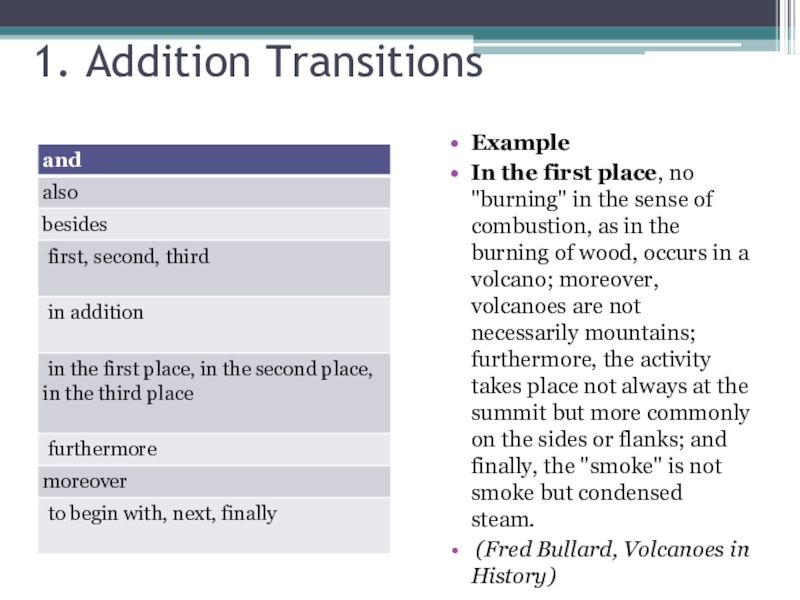
Слайд 191. Addition Transitions
Example
In the first place, no "burning" in the sense
of combustion, as in the burning of wood, occurs in a volcano; moreover, volcanoes are not necessarily mountains; furthermore, the activity takes place not always at the summit but more commonly on the sides or flanks; and finally, the "smoke" is not smoke but condensed steam.
(Fred Bullard, Volcanoes in History)
(Fred Bullard, Volcanoes in History)
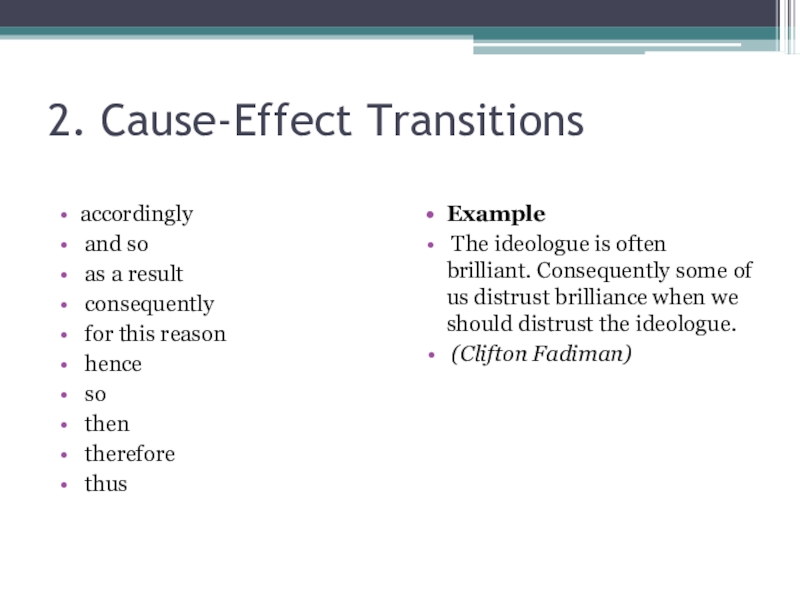
Слайд 202. Cause-Effect Transitions
accordingly
and so
as a result
consequently
for this
reason
hence
so
then
therefore
thus
hence
so
then
therefore
thus
Example
The ideologue is often brilliant. Consequently some of us distrust brilliance when we should distrust the ideologue.
(Clifton Fadiman)
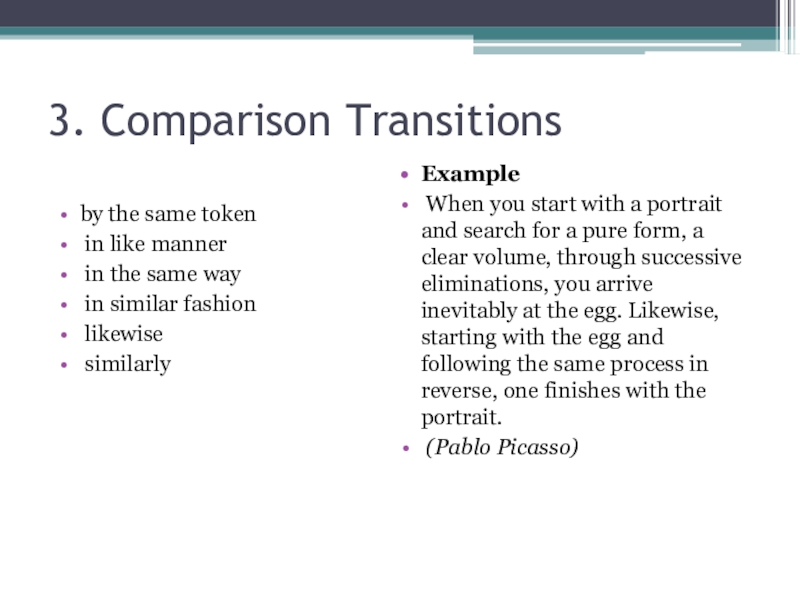
Слайд 213. Comparison Transitions
by the same token
in like manner
in the
same way
in similar fashion
likewise
similarly
in similar fashion
likewise
similarly
Example
When you start with a portrait and search for a pure form, a clear volume, through successive eliminations, you arrive inevitably at the egg. Likewise, starting with the egg and following the same process in reverse, one finishes with the portrait.
(Pablo Picasso)
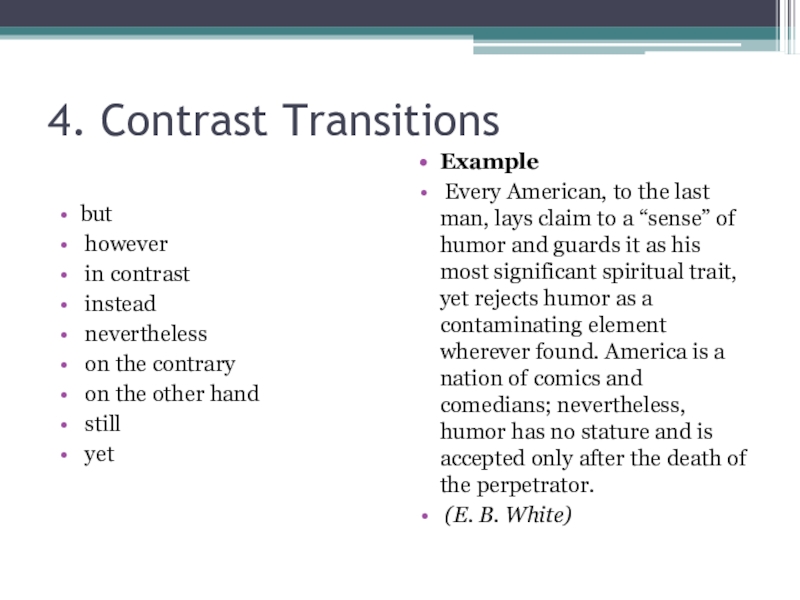
Слайд 224. Contrast Transitions
but
however
in contrast
instead
nevertheless
on the contrary
on the other hand
still
yet
still
yet
Example
Every American, to the last man, lays claim to a “sense” of humor and guards it as his most significant spiritual trait, yet rejects humor as a contaminating element wherever found. America is a nation of comics and comedians; nevertheless, humor has no stature and is accepted only after the death of the perpetrator.
(E. B. White)
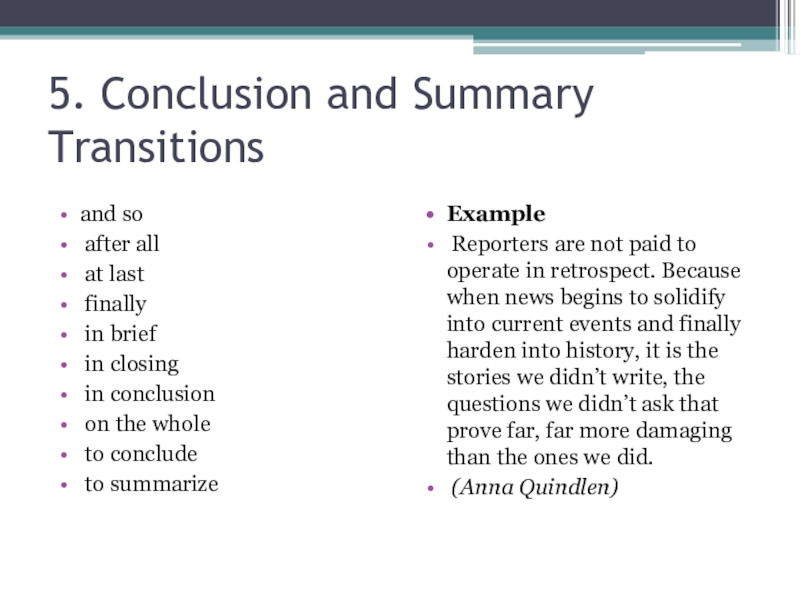
Слайд 235. Conclusion and Summary Transitions
and so
after all
at last
finally
in brief
in closing
in conclusion
on the whole
to conclude
to summarize
in closing
in conclusion
on the whole
to conclude
to summarize
Example
Reporters are not paid to operate in retrospect. Because when news begins to solidify into current events and finally harden into history, it is the stories we didn’t write, the questions we didn’t ask that prove far, far more damaging than the ones we did.
(Anna Quindlen)
Слайд 246. Example Transitions
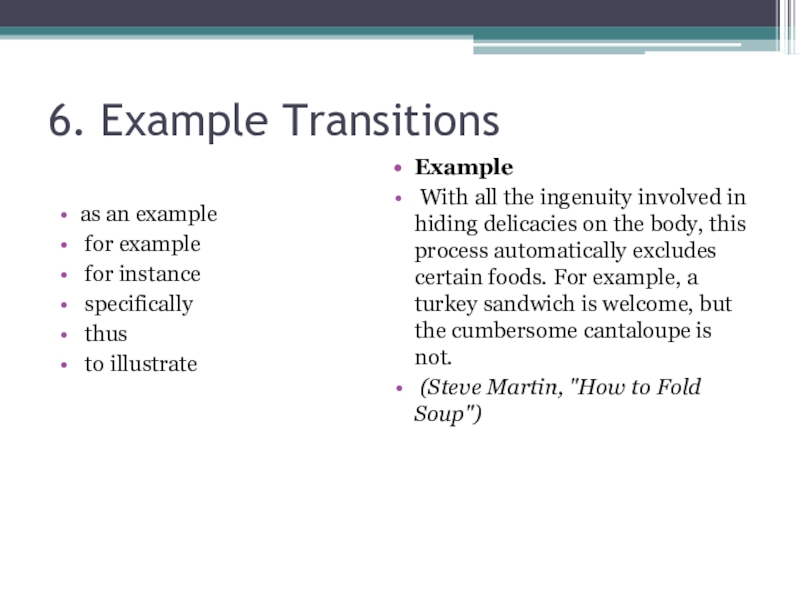
as an example
for example
for instance
specifically
thus
to illustrate
Example
With all the ingenuity involved in hiding delicacies on the body, this process automatically excludes certain foods. For example, a turkey sandwich is welcome, but the cumbersome cantaloupe is not.
(Steve Martin, "How to Fold Soup")
Слайд 25
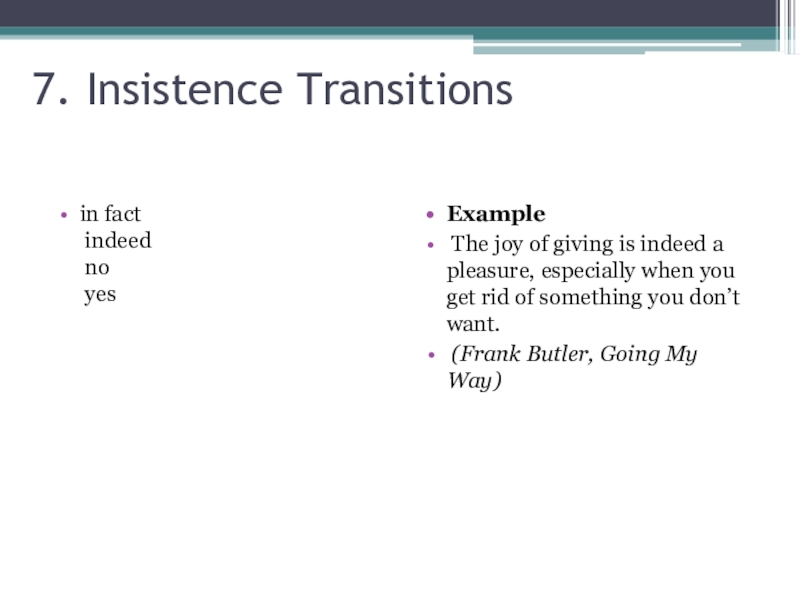
7. Insistence Transitions
in fact
indeed
no
yes
Example
The joy of giving
is indeed a pleasure, especially when you get rid of something you don’t want.
(Frank Butler, Going My Way)
(Frank Butler, Going My Way)
Слайд 268. Place Transitions
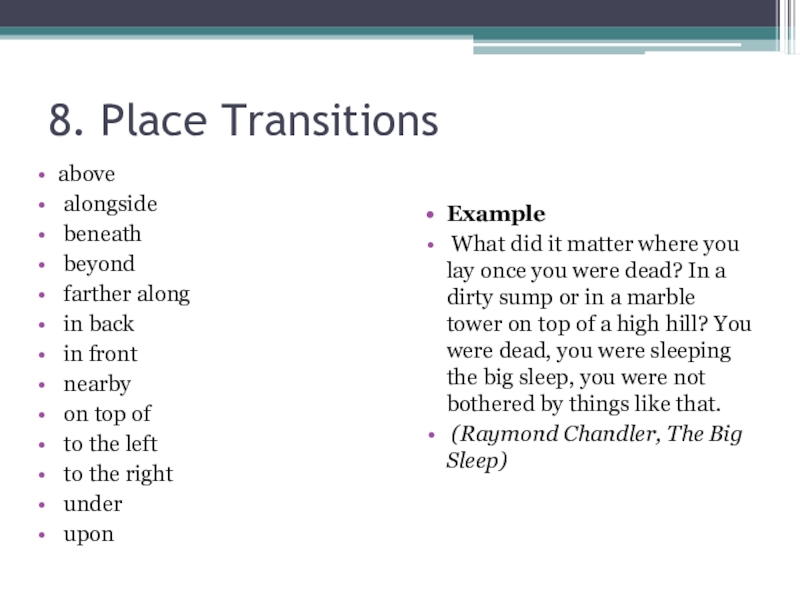
above
alongside
beneath
beyond
farther along
in back
in
front
nearby
on top of
to the left
to the right
under
upon
nearby
on top of
to the left
to the right
under
upon
Example
What did it matter where you lay once you were dead? In a dirty sump or in a marble tower on top of a high hill? You were dead, you were sleeping the big sleep, you were not bothered by things like that.
(Raymond Chandler, The Big Sleep)
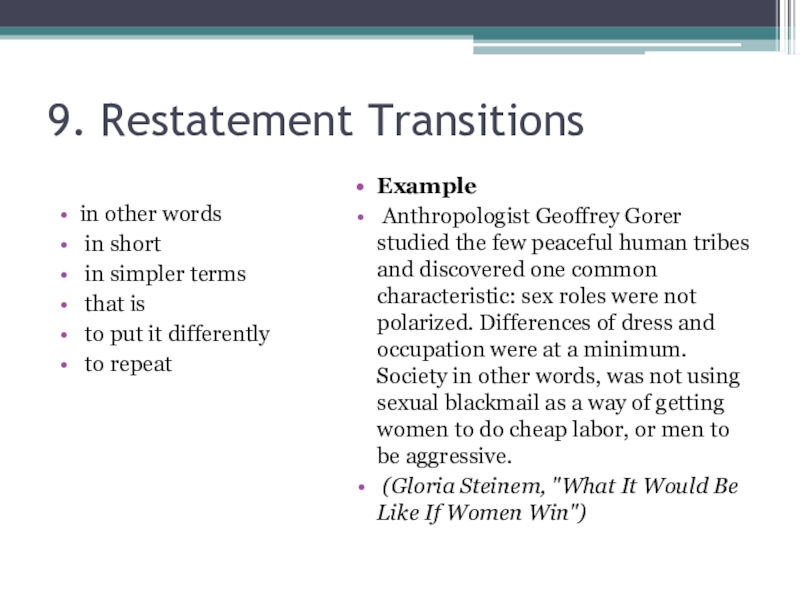
Слайд 279. Restatement Transitions
in other words
in short
in simpler terms
that
is
to put it differently
to repeat
to put it differently
to repeat
Example
Anthropologist Geoffrey Gorer studied the few peaceful human tribes and discovered one common characteristic: sex roles were not polarized. Differences of dress and occupation were at a minimum. Society in other words, was not using sexual blackmail as a way of getting women to do cheap labor, or men to be aggressive.
(Gloria Steinem, "What It Would Be Like If Women Win")
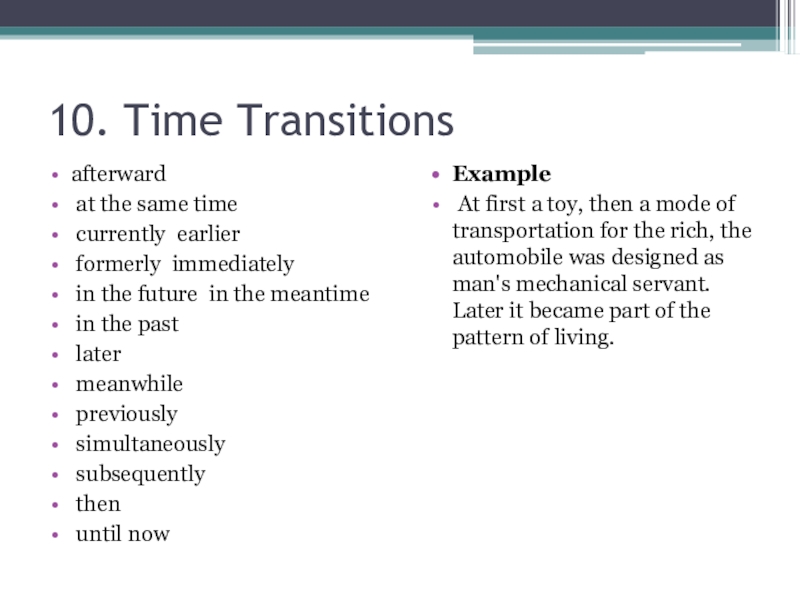
Слайд 2810. Time Transitions
afterward
at the same time
currently earlier
formerly immediately
in the future in the meantime
in the past
later
meanwhile
previously
simultaneously
subsequently
then
until now
in the past
later
meanwhile
previously
simultaneously
subsequently
then
until now
Example
At first a toy, then a mode of transportation for the rich, the automobile was designed as man's mechanical servant. Later it became part of the pattern of living.