- Главная
- Разное
- Образование
- Спорт
- Естествознание
- Природоведение
- Религиоведение
- Французский язык
- Черчение
- Английский язык
- Астрономия
- Алгебра
- Биология
- География
- Геометрия
- Детские презентации
- Информатика
- История
- Литература
- Математика
- Музыка
- МХК
- Немецкий язык
- ОБЖ
- Обществознание
- Окружающий мир
- Педагогика
- Русский язык
- Технология
- Физика
- Философия
- Химия
- Шаблоны, фоны, картинки для презентаций
- Экология
- Экономика
Презентация, доклад на тему Presentation in english - specific warm-up activities
Содержание
- 1. Presentation in english - specific warm-up activities
- 2. SPECIFIC WARM-UP ACTIVITIES IN TEFL
- 3. Слайд 3
- 4. Слайд 4
- 5. We want learners to move in class.
- 6. 1. THE TRAIN CONNECTIONThis activity works because
- 7. Слайд 7
- 8. How does it work?A. Use a ribbon
- 9. 2. FIND IT IN A FLASH
- 10. How does it work? The materials needed
- 11. Слайд 11
- 12. When space is limited in your classroom,
- 13. 3. DR. TAPEThis activity helps students identify
- 14. How does it work? Begin by
- 15. You can use this breakbrain activity while learning: colors, numbers, vocabulary, irregular verbs etc.
- 16. 4. A SPECIAL PERSON A CONFIDENCE BUILDING
- 17. Слайд 17
- 18. How does it work? Divide the
- 19. Have the class help develop “feel good”
- 20. 5. VOCABULARY HOT POTATO Quick thinking, memory,
- 21. How does it work? You will
- 22. A. Learners in the upper grades could
- 23. 6. LIGHTS! CAMERA! ACTION! This activity
- 24. How does it work? You will need
- 25. 7. OLD MCDONALDThis activity works to help
- 26. How does it work?No materials are needed
- 27. 8. WHERE IS IT? The purpose
- 28. Слайд 28
- 29. How does it work? You will
- 30. 9. DOODLE TIMEThe purpose of this activity
- 31. How does it work? Give learners some
- 32. 10. MINUTE TO WIN ITThis activity works to help learners concentrate on specific classroom activities.
- 33. How does it work? Each learner has
- 34. Слайд 34
SPECIFIC WARM-UP ACTIVITIES IN TEFL
Слайд 5We want learners to move in class. Energizing Brain Breaks help
learners to be active in class and get refocused and refreshed. They are 1-2 minute brain and body breaks that are simple to implement in your classroom. They are perfect for your learners as a transition exercise. The learners love them and they are good for students of any age.
Слайд 61. THE TRAIN CONNECTION
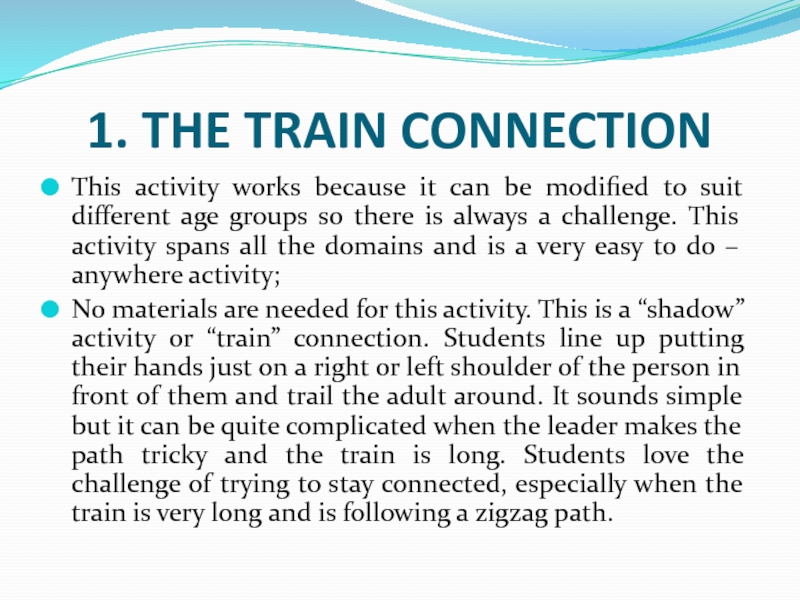
This activity works because it can be modified
to suit different age groups so there is always a challenge. This activity spans all the domains and is a very easy to do – anywhere activity;
No materials are needed for this activity. This is a “shadow” activity or “train” connection. Students line up putting their hands just on a right or left shoulder of the person in front of them and trail the adult around. It sounds simple but it can be quite complicated when the leader makes the path tricky and the train is long. Students love the challenge of trying to stay connected, especially when the train is very long and is following a zigzag path.
No materials are needed for this activity. This is a “shadow” activity or “train” connection. Students line up putting their hands just on a right or left shoulder of the person in front of them and trail the adult around. It sounds simple but it can be quite complicated when the leader makes the path tricky and the train is long. Students love the challenge of trying to stay connected, especially when the train is very long and is following a zigzag path.
Слайд 8How does it work?
A. Use a ribbon string trying to drape
it over left or right shoulder, add more learners to the train to make it more difficult, etc.
B. Add spelling words to rotate the students in the train. E.g. spell a sight word correctly and the person who is the caboose moves up one space until he/she gets to be the conductor and so on.
B. Add spelling words to rotate the students in the train. E.g. spell a sight word correctly and the person who is the caboose moves up one space until he/she gets to be the conductor and so on.
Слайд 92. FIND IT IN A FLASH
This activity helps learners
to make associations so that they can continue to develop their vocabulary, the way they perceive things, and their minds.
Слайд 10How does it work?
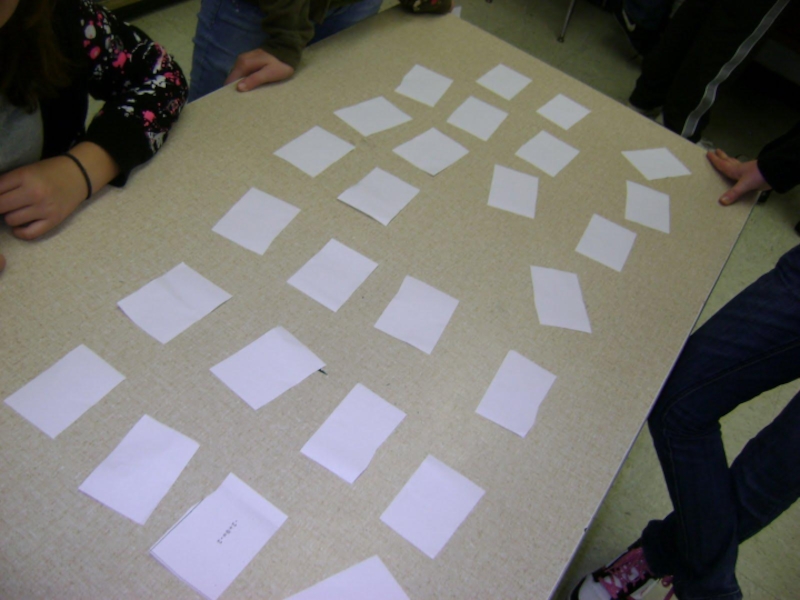
The materials needed for this activity include
a variety of flashcards, which depict colors, shapes, letters, etc. The teacher has a set of flash cards. He/she shows the learners the card and one of the learners must find five things in
the classroom that correspond to the flash card. You can use any type of flash cards as long as the learners will be able to find enough of the objects in the class.
the classroom that correspond to the flash card. You can use any type of flash cards as long as the learners will be able to find enough of the objects in the class.
Слайд 12When space is limited in your classroom, rather then finding 5
items about the classroom, learners could identify 5 items, more like an I spy game.
Other variations include make the game a “Treasure Hunt” where learners pair up and find objects about the classroom that correspond to the chosen card.
At the end, have pairs present their items and tell why it goes with their card.
Other variations include make the game a “Treasure Hunt” where learners pair up and find objects about the classroom that correspond to the chosen card.
At the end, have pairs present their items and tell why it goes with their card.
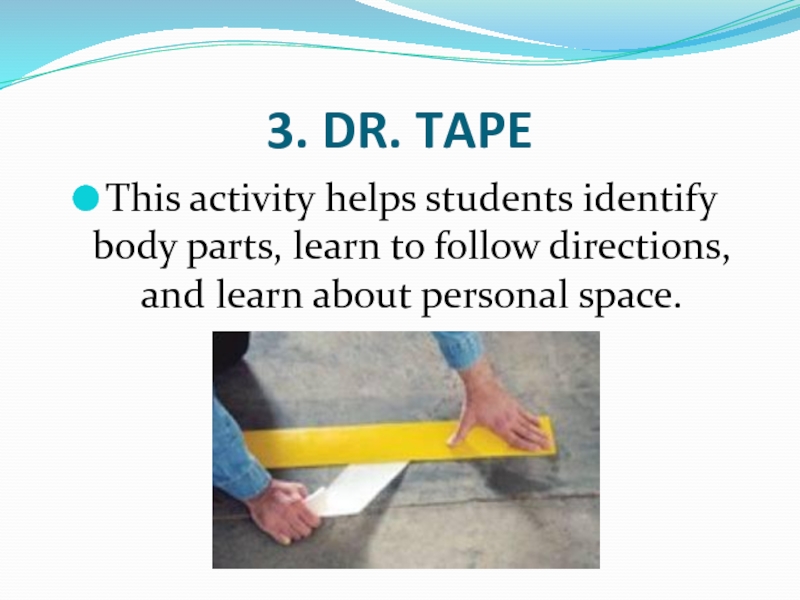
Слайд 133. DR. TAPE
This activity helps students identify body parts, learn to
follow directions, and learn about personal space.
Слайд 14How does it work?
Begin by making an “x” on
the floor for each student using masking, duct, or other durable tape. Make sure there is enough room around each piece so a student standing on the tape will not be able to touch others. As the students come into the playing area, have them find a piece of tape. Quickly call out body parts for them to place on the tape (for example, “Put your wrist on Dr. Tape.” “Put your back on Dr. Tape” etc.) Also, include some movements such as: “Jump up and down on Dr. Tape.” “Jog in place on Dr. Tape.” “Do sit-ups on Dr. Tape.”
Слайд 15 You can use this breakbrain activity while learning:
colors,
numbers,
vocabulary,
irregular verbs etc.
irregular verbs etc.
Слайд 164. A SPECIAL PERSON
A CONFIDENCE BUILDING ACTIVITY
Everyone needs a pat on
the back once in a while and this tactile experience promotes good self-esteem.
Слайд 18How does it work?
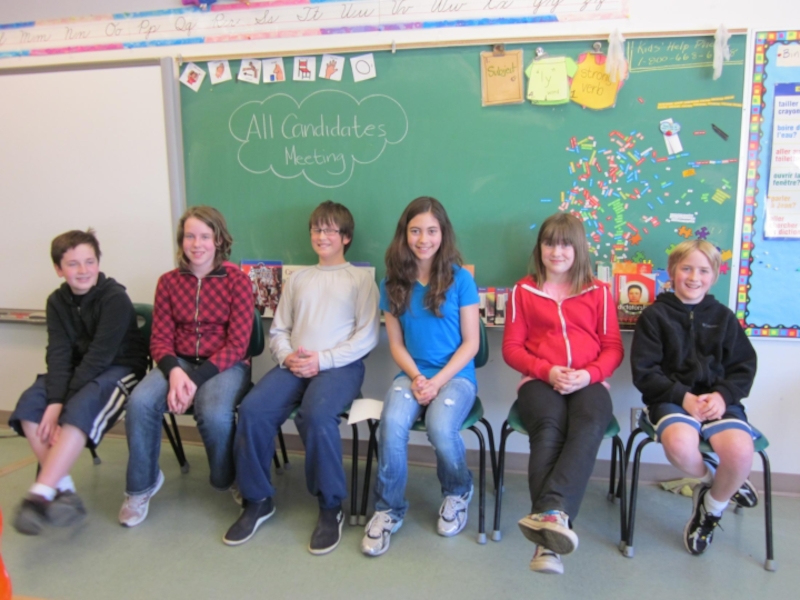
Divide the learners into two groups;
one group sitting at their desks, and the others standing in the back of the classroom. Read the “feel good” phrases listed below, giving the learners enough time to touch as many people as they want to on the shoulder or back. (Make sure everyone is touched: if not, make sure you station yourself near the children who might not be touched so that you can sneak a touch.) After a given number of phrases, switch the groups and repeat. There should be no talking and the learners should be shown the proper way to touch someone else so that no one feels uncomfortable. Soft music could be played during this exercise. The learners can remain in their seats, but must have their heads down so that no one can see who is doing the touching.
Слайд 19Have the class help develop “feel good” phrases. You could also
do educational sayings such as “A special person who has blue on their t-shirt.”
Examples of “feel good” phrases include:
A person who makes me smile.
A person who makes me laugh.
A person upon whom I can depend on.
A person who likes me for who I am.
A person I like to talk with.
A person I can depend on.
A person who I would like to get to know better.
A person who makes me feel comfortable.
A person who has great ideas.
Examples of “feel good” phrases include:
A person who makes me smile.
A person who makes me laugh.
A person upon whom I can depend on.
A person who likes me for who I am.
A person I like to talk with.
A person I can depend on.
A person who I would like to get to know better.
A person who makes me feel comfortable.
A person who has great ideas.
Слайд 205. VOCABULARY HOT POTATO
Quick thinking, memory, and vocabulary will all
be aided with this fast-action game.
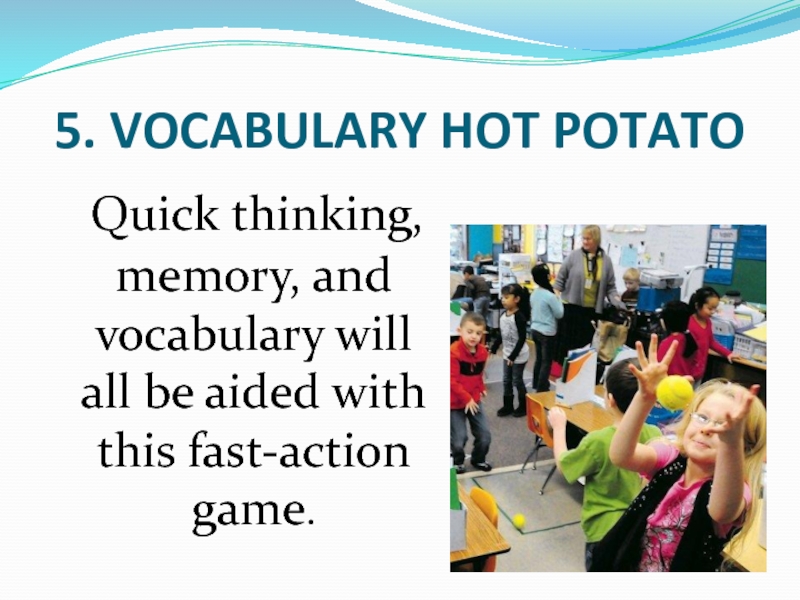
Слайд 21How does it work?
You will need one ball, no
smaller than a tennis ball and no larger than a basketball. The teacher will gather up the learners in an open area of the room. They will then be instructed to sit in a circle facing the center. The ball will be randomly given to one of the learners. That student will then be given one word form the spelling list. The learner with the ball will state the first letter of the word. Then that child will gently pass the ball to another child who will add the next letter to the preceding one. This will continue until the word is spelled correctly.
Слайд 22A. Learners in the upper grades could have to think of
a word from the spelling or vocabulary list and begin spelling the word. The other learners would then have to figure out which word to spell and add the correct sequence of letters in order to spell it correctly.
B. The learners could spell the word and the last person would pass the ball to the final learner who would define the word or use it in a sentence.
C. The first learner would spell a complete word. The next learner would define the word. The next learner would tell what part of speech the word is. The next person would use the word in a sentence. Etc.
B. The learners could spell the word and the last person would pass the ball to the final learner who would define the word or use it in a sentence.
C. The first learner would spell a complete word. The next learner would define the word. The next learner would tell what part of speech the word is. The next person would use the word in a sentence. Etc.
Слайд 236. LIGHTS! CAMERA! ACTION!
This activity reinforces the relationship between
action verbs and adverbs in a physical way.
Слайд 24How does it work?
You will need index cards (half with
verbs, half with adverbs) for this activity. Introduce action verbs as words that indicate some form of action. Then introduce “adverb” as a modifier that tells how the action is performed. Pass out index cards or spread them on the ground. Have the students each pick one card. They must then decide if the word that is written on the card is an action verb or an adverb. The children will each partner up with someone who has the other type of word and the two of them will act out the phase (ex: hop quickly). The words must make sense together.
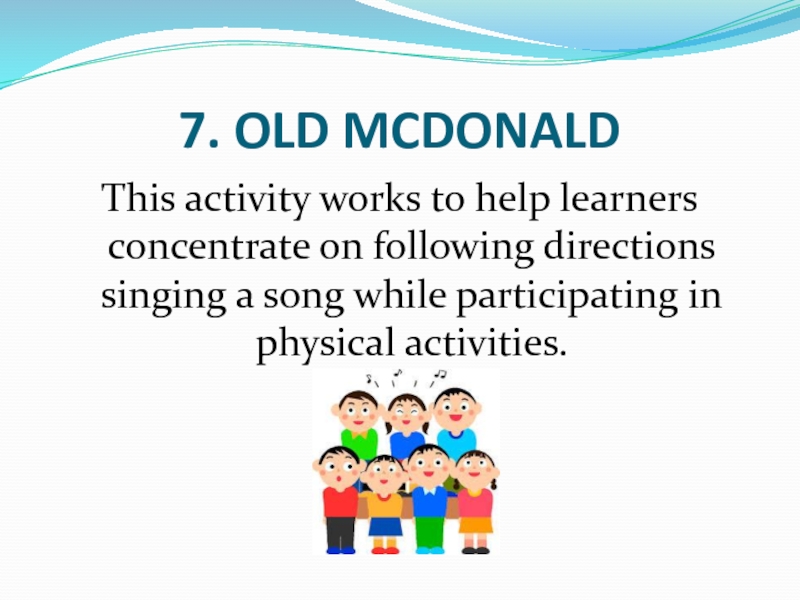
Слайд 257. OLD MCDONALD
This activity works to help learners concentrate on following
directions singing a song while participating in physical activities.
Слайд 26How does it work?
No materials are needed for this activity beyond
personal space for the activities and a working knowledge of the
words and melody to Ol’ McDonald. The activity is a replica of the song Ol’ McDonald. The words are changed
and are listed below. The children will need to listen and be capable of following the new directions.
Song (example of first verse)
- Ol’ Miss Brown had a class, E-I-E-I-O
- And in that class they did some jumping E-I-E-I-O
- With a jumping here and a jumping there, here a jumping,
there a jumping, Everywhere a jumping
- Ol’ Miss Brown had a class, E-I-E-I-O (Repeat with a different activity)
ADAPTATIONS
Students with a hearing impairments can read the words to the song, or if the activities are in the same order, they will/can remember the order of the activities. They can stand close to the teacher and the teacher will sing toward them so they can hear the song better.
Ideas for activities
Jumping jacks Sit-ups Jump
Hop Skip Leap
Slide Squat Twist
Hand-shake “Hi” Stomp
words and melody to Ol’ McDonald. The activity is a replica of the song Ol’ McDonald. The words are changed
and are listed below. The children will need to listen and be capable of following the new directions.
Song (example of first verse)
- Ol’ Miss Brown had a class, E-I-E-I-O
- And in that class they did some jumping E-I-E-I-O
- With a jumping here and a jumping there, here a jumping,
there a jumping, Everywhere a jumping
- Ol’ Miss Brown had a class, E-I-E-I-O (Repeat with a different activity)
ADAPTATIONS
Students with a hearing impairments can read the words to the song, or if the activities are in the same order, they will/can remember the order of the activities. They can stand close to the teacher and the teacher will sing toward them so they can hear the song better.
Ideas for activities
Jumping jacks Sit-ups Jump
Hop Skip Leap
Slide Squat Twist
Hand-shake “Hi” Stomp
Слайд 278. WHERE IS IT?
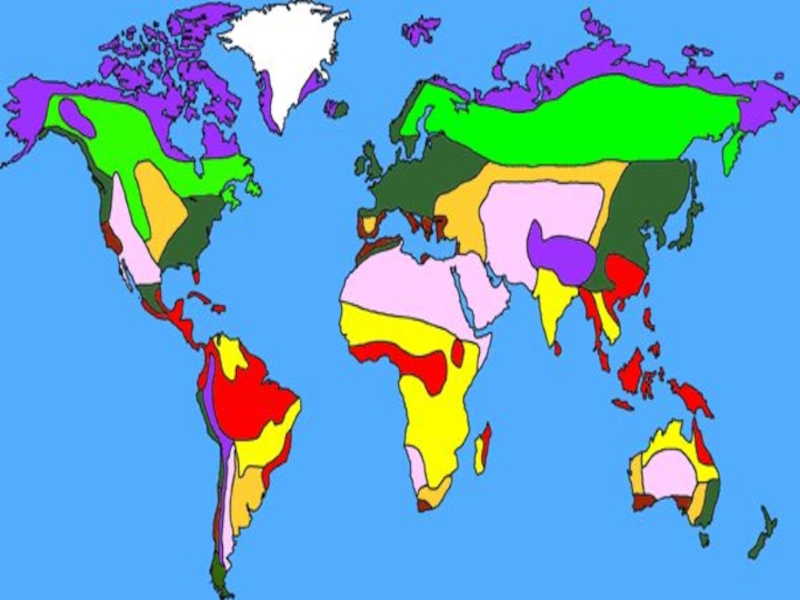
The purpose of this activity is
twofold: to teach the children geographical names and to encourage cooperation through working with a partner.
Слайд 29How does it work?
You will need pairs of large
cards each with the name of a different geographical location on it (two cards per location). Have the learners get with a partner. Place the names of the different countries in a pile (upside down so that the learners can’t see the name) on a table or desk. Place cards for the same states on the floor according to their geographical location (north, south, east, or west). One of the partners picks out a card from the pile and looks at the map on the desk.
That learner must determine the match location, but not say it or indicate it in any way. The person holding the clue must direct the other partner to the matching state.
That learner must determine the match location, but not say it or indicate it in any way. The person holding the clue must direct the other partner to the matching state.
Слайд 309. DOODLE TIME
The purpose of this activity is to give learners
a chance to express their feelings with the help of drawing.
Слайд 31How does it work?
Give learners some blank paper and markers
and let them DOODLE and talk for five minutes. It sounds simple but learners love to draw and doodle.
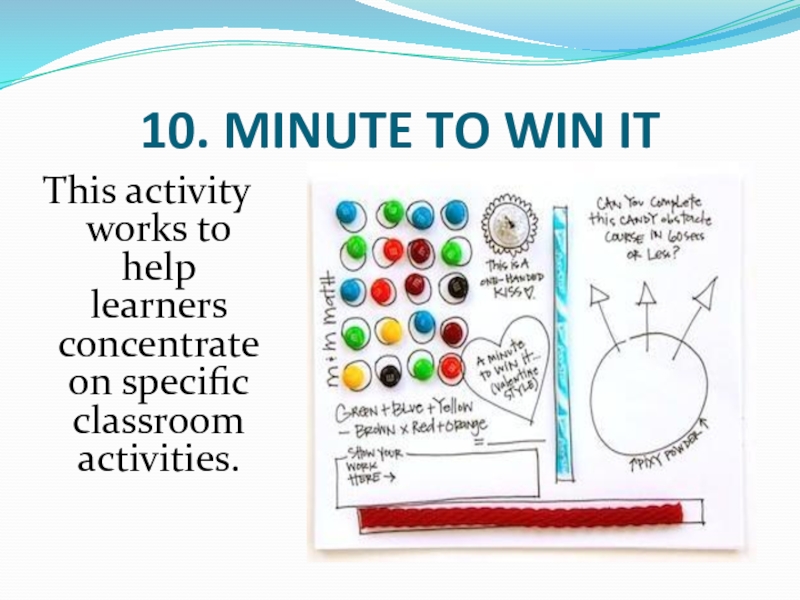
Слайд 3210. MINUTE TO WIN IT
This activity works to help learners concentrate
on specific classroom activities.
Слайд 33How does it work?
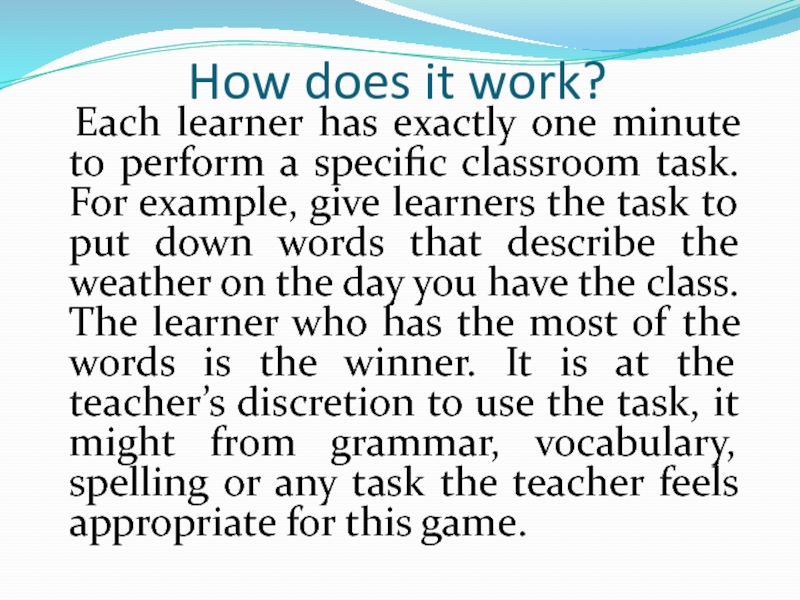
Each learner has exactly one minute to
perform a specific classroom task. For example, give learners the task to put down words that describe the weather on the day you have the class. The learner who has the most of the words is the winner. It is at the teacher’s discretion to use the task, it might from grammar, vocabulary, spelling or any task the teacher feels appropriate for this game.