- Главная
- Разное
- Образование
- Спорт
- Естествознание
- Природоведение
- Религиоведение
- Французский язык
- Черчение
- Английский язык
- Астрономия
- Алгебра
- Биология
- География
- Геометрия
- Детские презентации
- Информатика
- История
- Литература
- Математика
- Музыка
- МХК
- Немецкий язык
- ОБЖ
- Обществознание
- Окружающий мир
- Педагогика
- Русский язык
- Технология
- Физика
- Философия
- Химия
- Шаблоны, фоны, картинки для презентаций
- Экология
- Экономика
Презентация, доклад на тему Present Continuous and Present Simple Tenses
Содержание
- 1. Present Continuous and Present Simple Tenses
- 2. Present Simple Tense выражает1. Действие, происходящее регулярно,
- 3. Present Continuous Tense выражает1. незаконченное действие, происходящее
- 4. Очень важно сразу же разобраться, когда следует
- 5. Слайд 5
- 6. Во временах Continuous (любых) преимущественно употребляются глаголы,
- 7. *have (в значении "иметь" употребляется в Simple):
- 8. *think (в значении "считать, выражать мнение" употребляется
- 9. Упражнения 1. Раскройте скобки, употребляя глаголы в
- 10. Упражнения 2. Раскройте скобки, употребляя глаголы в
- 11. Упражнения 3. Раскройте скобки, употребляя глаголы в
- 12. Упражнения 4. Раскройте скобки, употребляя глаголы в
- 13. Упражнения 5. Раскройте скобки, употребляя глаголы в
- 14. Упражнения по английскому языку 6. Раскройте скобки,
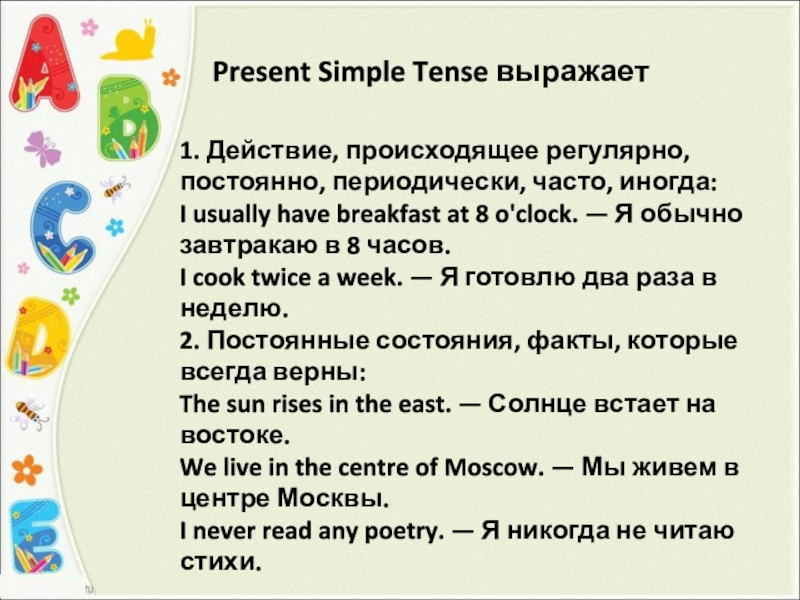
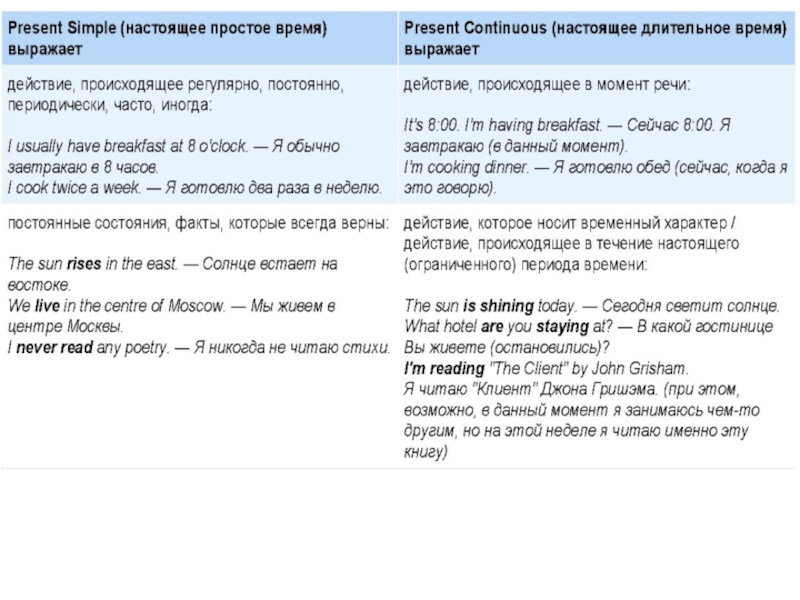
Present Simple Tense выражает1. Действие, происходящее регулярно, постоянно, периодически, часто, иногда: I usually have breakfast at 8 o'clock. — Я обычно завтракаю в 8 часов. I cook twice a week. — Я готовлю два раза в
Слайд 2Present Simple Tense выражает
1. Действие, происходящее регулярно, постоянно, периодически, часто, иногда:
I
usually have breakfast at 8 o'clock. — Я обычно завтракаю в 8 часов.
I cook twice a week. — Я готовлю два раза в неделю.
2. Постоянные состояния, факты, которые всегда верны: The sun rises in the east. — Солнце встает на востоке. We live in the centre of Moscow. — Мы живем в центре Москвы. I never read any poetry. — Я никогда не читаю стихи.
2. Постоянные состояния, факты, которые всегда верны: The sun rises in the east. — Солнце встает на востоке. We live in the centre of Moscow. — Мы живем в центре Москвы. I never read any poetry. — Я никогда не читаю стихи.
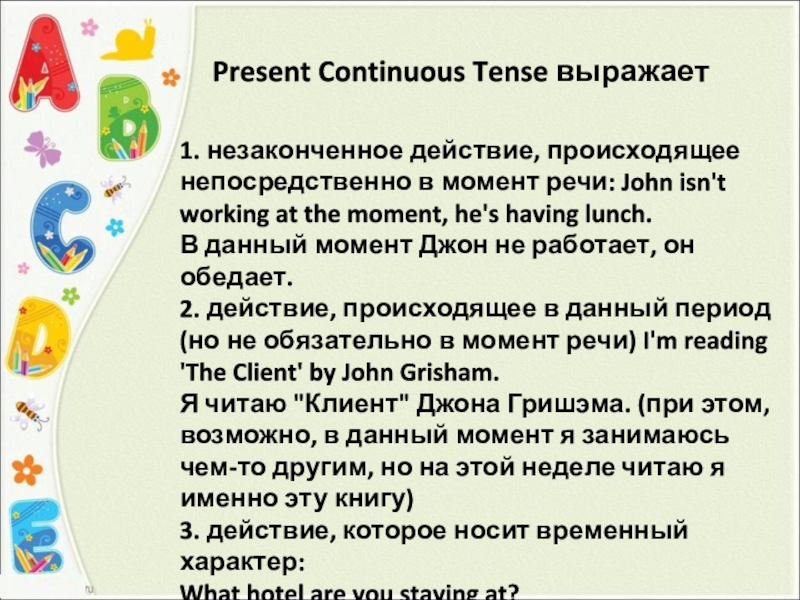
Слайд 3Present Continuous Tense выражает
1. незаконченное действие, происходящее непосредственно в момент речи:
John isn't working at the moment, he's having lunch.
В данный момент Джон не работает, он обедает.
2. действие, происходящее в данный период (но не обязательно в момент речи) I'm reading 'The Client' by John Grisham.
Я читаю "Клиент" Джона Гришэма. (при этом, возможно, в данный момент я занимаюсь чем-то другим, но на этой неделе читаю я именно эту книгу)
3. действие, которое носит временный характер:
What hotel are you staying at?
В какой гостинице Вы живете (остановились)?
В данный момент Джон не работает, он обедает.
2. действие, происходящее в данный период (но не обязательно в момент речи) I'm reading 'The Client' by John Grisham.
Я читаю "Клиент" Джона Гришэма. (при этом, возможно, в данный момент я занимаюсь чем-то другим, но на этой неделе читаю я именно эту книгу)
3. действие, которое носит временный характер:
What hotel are you staying at?
В какой гостинице Вы живете (остановились)?
Слайд 4Очень важно сразу же разобраться, когда следует употреблять Present Simple, а
когда — Present Continuous:
Сравнение употребления Present Simple и Present Continuous
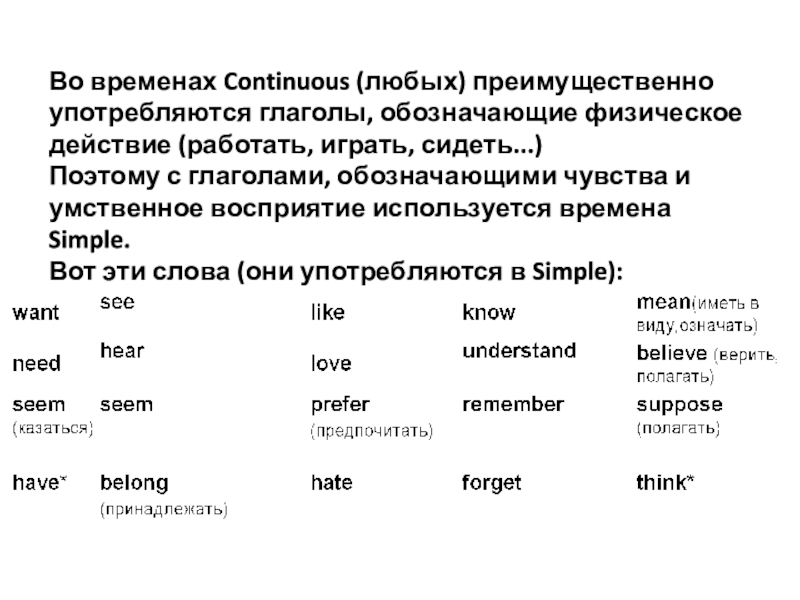
Слайд 6Во временах Continuous (любых) преимущественно употребляются глаголы, обозначающие физическое действие (работать,
играть, сидеть...)
Поэтому с глаголами, обозначающими чувства и умственное восприятие используется времена Simple.
Вот эти слова (они употребляются в Simple):
Вот эти слова (они употребляются в Simple):
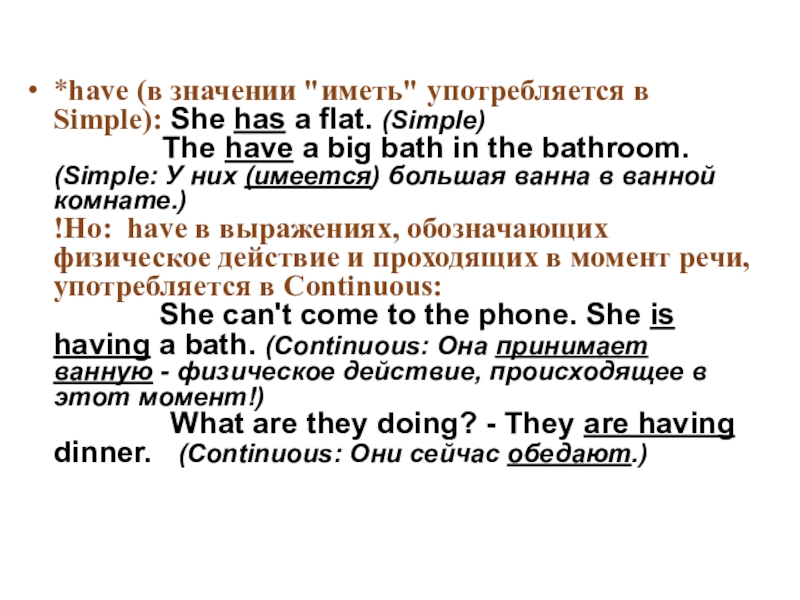
Слайд 7*have (в значении "иметь" употребляется в Simple): She has a flat.
(Simple)
The have a big bath in the bathroom. (Simple: У них (имеется) большая ванна в ванной комнате.)
!Но: have в выражениях, обозначающих физическое действие и проходящих в момент речи, употребляется в Continuous:
She can't come to the phone. She is having a bath. (Continuous: Она принимает ванную - физическое действие, происходящее в этот момент!)
What are they doing? - They are having dinner. (Continuous: Они сейчас обедают.)
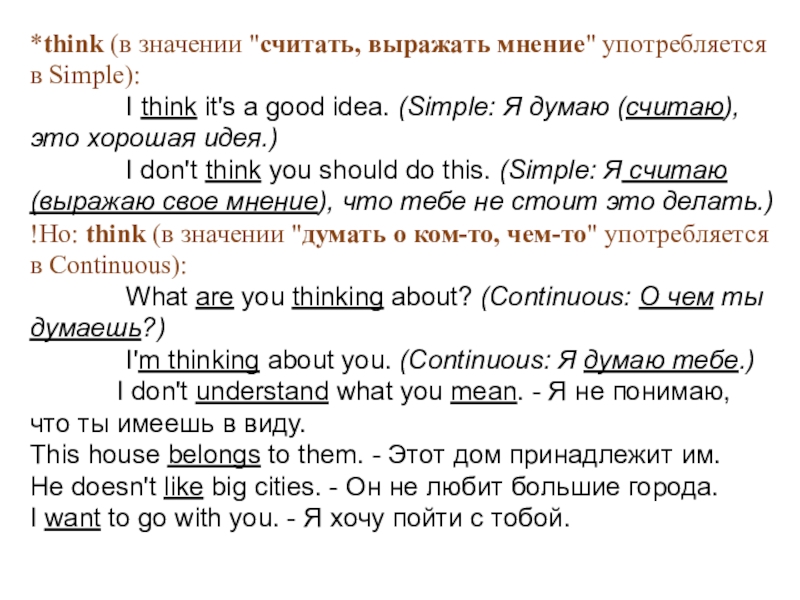
Слайд 8*think (в значении "считать, выражать мнение" употребляется в Simple): I
think it's a good idea. (Simple: Я думаю (считаю), это хорошая идея.)
I don't think you should do this. (Simple: Я считаю (выражаю свое мнение), что тебе не стоит это делать.)
!Но: think (в значении "думать о ком-то, чем-то" употребляется в Continuous):
What are you thinking about? (Continuous: О чем ты думаешь?)
I'm thinking about you. (Continuous: Я думаю тебе.)
I don't understand what you mean. - Я не понимаю, что ты имеешь в виду.
This house belongs to them. - Этот дом принадлежит им.
He doesn't like big cities. - Он не любит большие города.
I want to go with you. - Я хочу пойти с тобой.
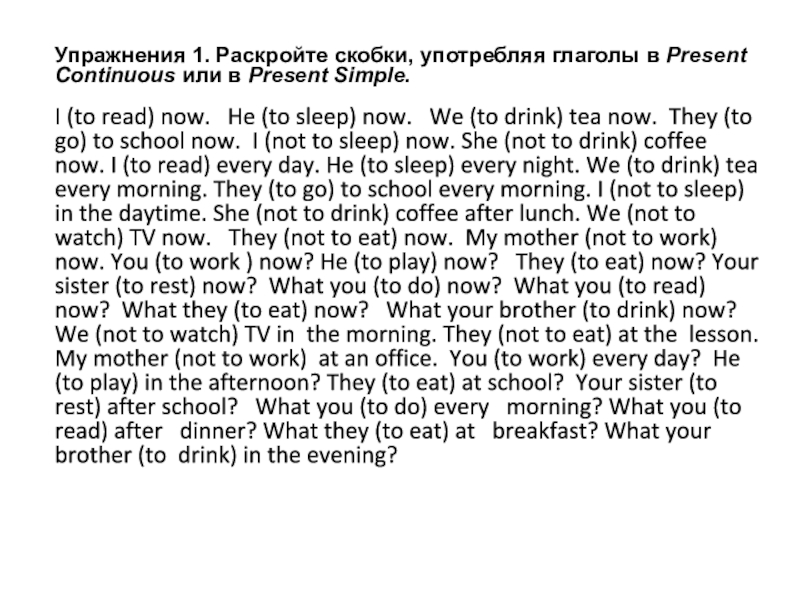
Слайд 9Упражнения 1. Раскройте скобки, употребляя глаголы в Present Continuous или в
Present Simple.
I (to read) now. He (to sleep) now. We (to drink) tea now. They (to go) to school now. I (not to sleep) now. She (not to drink) coffee now. I (to read) every day. He (to sleep) every night. We (to drink) tea every morning. They (to go) to school every morning. I (not to sleep) in the daytime. She (not to drink) coffee after lunch. We (not to watch) TV now. They (not to eat) now. My mother (not to work) now. You (to work ) now? He (to play) now? They (to eat) now? Your sister (to rest) now? What you (to do) now? What you (to read) now? What they (to eat) now? What your brother (to drink) now? We (not to watch) TV in the morning. They (not to eat) at the lesson. My mother (not to work) at an office. You (to work) every day? He (to play) in the afternoon? They (to eat) at school? Your sister (to rest) after school? What you (to do) every morning? What you (to read) after dinner? What they (to eat) at breakfast? What your brother (to drink) in the evening?
I (to read) now. He (to sleep) now. We (to drink) tea now. They (to go) to school now. I (not to sleep) now. She (not to drink) coffee now. I (to read) every day. He (to sleep) every night. We (to drink) tea every morning. They (to go) to school every morning. I (not to sleep) in the daytime. She (not to drink) coffee after lunch. We (not to watch) TV now. They (not to eat) now. My mother (not to work) now. You (to work ) now? He (to play) now? They (to eat) now? Your sister (to rest) now? What you (to do) now? What you (to read) now? What they (to eat) now? What your brother (to drink) now? We (not to watch) TV in the morning. They (not to eat) at the lesson. My mother (not to work) at an office. You (to work) every day? He (to play) in the afternoon? They (to eat) at school? Your sister (to rest) after school? What you (to do) every morning? What you (to read) after dinner? What they (to eat) at breakfast? What your brother (to drink) in the evening?
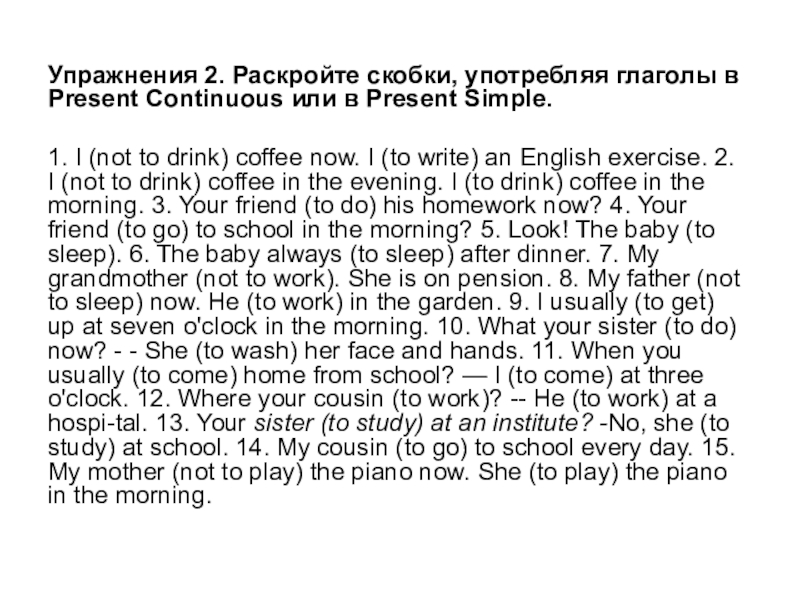
Слайд 10Упражнения 2. Раскройте скобки, употребляя глаголы в Present Continuous или в
Present Simple.
1. I (not to drink) coffee now. I (to write) an English exercise. 2. I (not to drink) coffee in the evening. I (to drink) coffee in the morning. 3. Your friend (to do) his homework now? 4. Your friend (to go) to school in the morning? 5. Look! The baby (to sleep). 6. The baby always (to sleep) after dinner. 7. My grandmother (not to work). She is on pension. 8. My father (not to sleep) now. He (to work) in the garden. 9. I usually (to get) up at seven o'clock in the morning. 10. What your sister (to do) now? - - She (to wash) her face and hands. 11. When you usually (to come) home from school? — I (to come) at three o'clock. 12. Where your cousin (to work)? -- He (to work) at a hospi-tal. 13. Your sister (to study) at an institute? -No, she (to study) at school. 14. My cousin (to go) to school every day. 15. My mother (not to play) the piano now. She (to play) the piano in the morning.
1. I (not to drink) coffee now. I (to write) an English exercise. 2. I (not to drink) coffee in the evening. I (to drink) coffee in the morning. 3. Your friend (to do) his homework now? 4. Your friend (to go) to school in the morning? 5. Look! The baby (to sleep). 6. The baby always (to sleep) after dinner. 7. My grandmother (not to work). She is on pension. 8. My father (not to sleep) now. He (to work) in the garden. 9. I usually (to get) up at seven o'clock in the morning. 10. What your sister (to do) now? - - She (to wash) her face and hands. 11. When you usually (to come) home from school? — I (to come) at three o'clock. 12. Where your cousin (to work)? -- He (to work) at a hospi-tal. 13. Your sister (to study) at an institute? -No, she (to study) at school. 14. My cousin (to go) to school every day. 15. My mother (not to play) the piano now. She (to play) the piano in the morning.
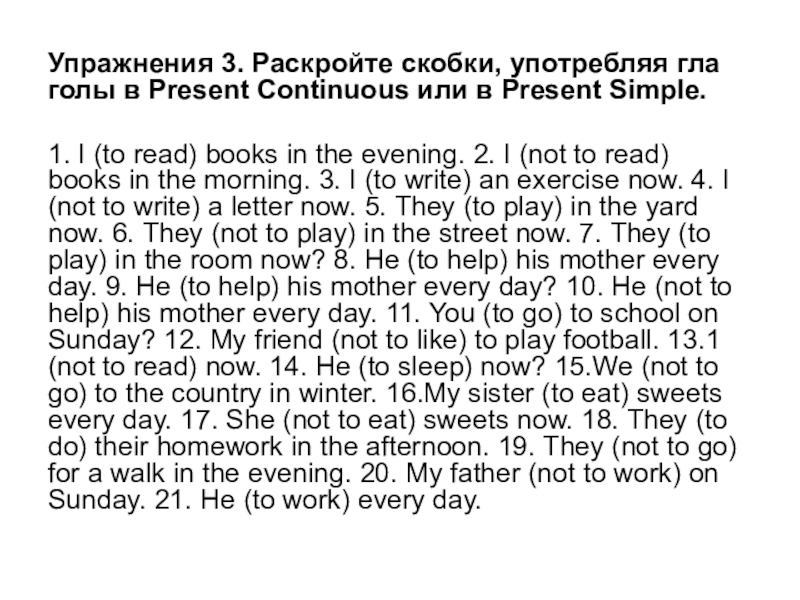
Слайд 11Упражнения 3. Раскройте скобки, употребляя глаголы в Present Continuous или в
Present Simple.
1. I (to read) books in the evening. 2. I (not to read) books in the morning. 3. I (to write) an exercise now. 4. I (not to write) a letter now. 5. They (to play) in the yard now. 6. They (not to play) in the street now. 7. They (to play) in the room now? 8. He (to help) his mother every day. 9. He (to help) his mother every day? 10. He (not to help) his mother every day. 11. You (to go) to school on Sunday? 12. My friend (not to like) to play football. 13.1 (not to read) now. 14. He (to sleep) now? 15.We (not to go) to the country in winter. 16.My sister (to eat) sweets every day. 17. She (not to eat) sweets now. 18. They (to do) their homework in the afternoon. 19. They (not to go) for a walk in the evening. 20. My father (not to work) on Sunday. 21. He (to work) every day.
1. I (to read) books in the evening. 2. I (not to read) books in the morning. 3. I (to write) an exercise now. 4. I (not to write) a letter now. 5. They (to play) in the yard now. 6. They (not to play) in the street now. 7. They (to play) in the room now? 8. He (to help) his mother every day. 9. He (to help) his mother every day? 10. He (not to help) his mother every day. 11. You (to go) to school on Sunday? 12. My friend (not to like) to play football. 13.1 (not to read) now. 14. He (to sleep) now? 15.We (not to go) to the country in winter. 16.My sister (to eat) sweets every day. 17. She (not to eat) sweets now. 18. They (to do) their homework in the afternoon. 19. They (not to go) for a walk in the evening. 20. My father (not to work) on Sunday. 21. He (to work) every day.
Слайд 12Упражнения 4. Раскройте скобки, употребляя глаголы в Present Continuous или в
Present Simple.
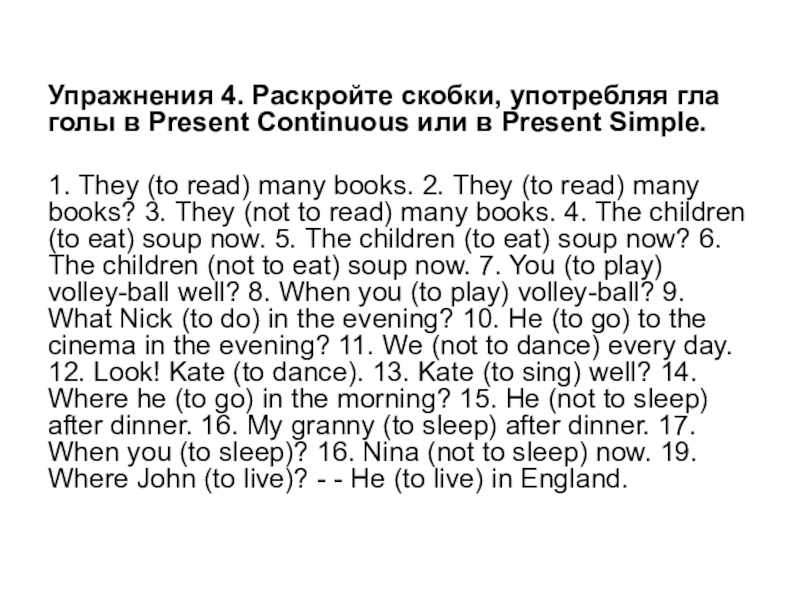
1. They (to read) many books. 2. They (to read) many books? 3. They (not to read) many books. 4. The children (to eat) soup now. 5. The children (to eat) soup now? 6. The children (not to eat) soup now. 7. You (to play) volley-ball well? 8. When you (to play) volley-ball? 9. What Nick (to do) in the evening? 10. He (to go) to the cinema in the evening? 11. We (not to dance) every day. 12. Look! Kate (to dance). 13. Kate (to sing) well? 14. Where he (to go) in the morning? 15. He (not to sleep) after dinner. 16. My granny (to sleep) after dinner. 17. When you (to sleep)? 16. Nina (not to sleep) now. 19. Where John (to live)? - - He (to live) in England.
1. They (to read) many books. 2. They (to read) many books? 3. They (not to read) many books. 4. The children (to eat) soup now. 5. The children (to eat) soup now? 6. The children (not to eat) soup now. 7. You (to play) volley-ball well? 8. When you (to play) volley-ball? 9. What Nick (to do) in the evening? 10. He (to go) to the cinema in the evening? 11. We (not to dance) every day. 12. Look! Kate (to dance). 13. Kate (to sing) well? 14. Where he (to go) in the morning? 15. He (not to sleep) after dinner. 16. My granny (to sleep) after dinner. 17. When you (to sleep)? 16. Nina (not to sleep) now. 19. Where John (to live)? - - He (to live) in England.
Слайд 13Упражнения 5. Раскройте скобки, употребляя глаголы в Present Continuous или в
Present Simple.
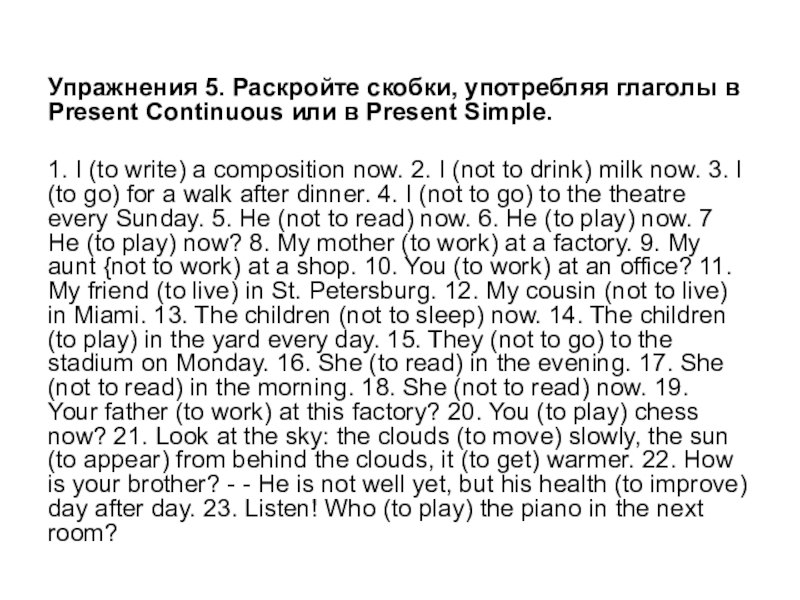
1. I (to write) a composition now. 2. I (not to drink) milk now. 3. I (to go) for a walk after dinner. 4. I (not to go) to the theatre every Sunday. 5. He (not to read) now. 6. He (to play) now. 7 He (to play) now? 8. My mother (to work) at a factory. 9. My aunt {not to work) at a shop. 10. You (to work) at an office? 11. My friend (to live) in St. Petersburg. 12. My cousin (not to live) in Miami. 13. The children (not to sleep) now. 14. The children (to play) in the yard every day. 15. They (not to go) to the stadium on Monday. 16. She (to read) in the evening. 17. She (not to read) in the morning. 18. She (not to read) now. 19. Your father (to work) at this factory? 20. You (to play) chess now? 21. Look at the sky: the clouds (to move) slowly, the sun (to appear) from behind the clouds, it (to get) warmer. 22. How is your brother? - - He is not well yet, but his health (to improve) day after day. 23. Listen! Who (to play) the piano in the next room?
1. I (to write) a composition now. 2. I (not to drink) milk now. 3. I (to go) for a walk after dinner. 4. I (not to go) to the theatre every Sunday. 5. He (not to read) now. 6. He (to play) now. 7 He (to play) now? 8. My mother (to work) at a factory. 9. My aunt {not to work) at a shop. 10. You (to work) at an office? 11. My friend (to live) in St. Petersburg. 12. My cousin (not to live) in Miami. 13. The children (not to sleep) now. 14. The children (to play) in the yard every day. 15. They (not to go) to the stadium on Monday. 16. She (to read) in the evening. 17. She (not to read) in the morning. 18. She (not to read) now. 19. Your father (to work) at this factory? 20. You (to play) chess now? 21. Look at the sky: the clouds (to move) slowly, the sun (to appear) from behind the clouds, it (to get) warmer. 22. How is your brother? - - He is not well yet, but his health (to improve) day after day. 23. Listen! Who (to play) the piano in the next room?
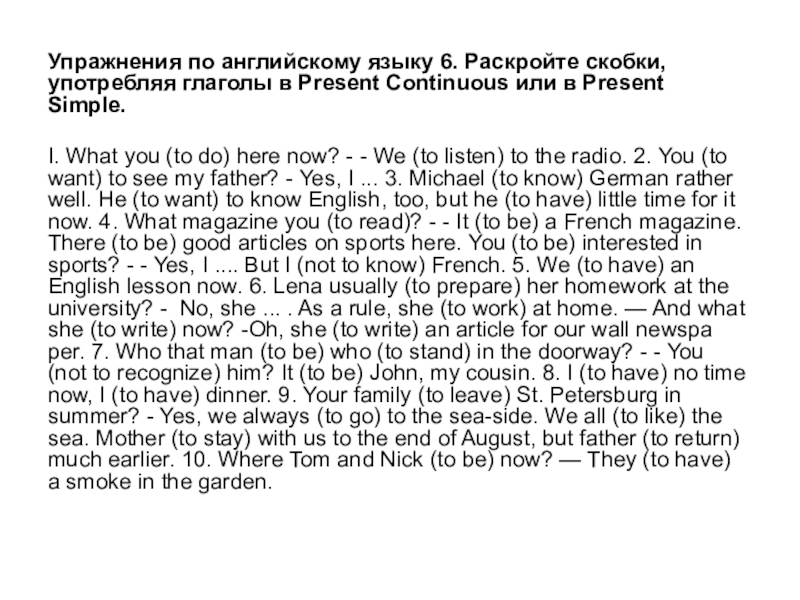
Слайд 14Упражнения по английскому языку 6. Раскройте скобки, употребляя глаголы в Present
Continuous или в Present Simple.
I. What you (to do) here now? - - We (to listen) to the radio. 2. You (to want) to see my father? - Yes, I ... 3. Michael (to know) German rather well. He (to want) to know English, too, but he (to have) little time for it now. 4. What magazine you (to read)? - - It (to be) a French magazine. There (to be) good articles on sports here. You (to be) interested in sports? - - Yes, I .... But I (not to know) French. 5. We (to have) an English lesson now. 6. Lena usually (to prepare) her homework at the university? - No, she ... . As a rule, she (to work) at home. — And what she (to write) now? -Oh, she (to write) an article for our wall newspaper. 7. Who that man (to be) who (to stand) in the doorway? - - You (not to recognize) him? It (to be) John, my cousin. 8. I (to have) no time now, I (to have) dinner. 9. Your family (to leave) St. Petersburg in summer? - Yes, we always (to go) to the sea-side. We all (to like) the sea. Mother (to stay) with us to the end of August, but father (to return) much earlier. 10. Where Tom and Nick (to be) now? — They (to have) a smoke in the garden.
I. What you (to do) here now? - - We (to listen) to the radio. 2. You (to want) to see my father? - Yes, I ... 3. Michael (to know) German rather well. He (to want) to know English, too, but he (to have) little time for it now. 4. What magazine you (to read)? - - It (to be) a French magazine. There (to be) good articles on sports here. You (to be) interested in sports? - - Yes, I .... But I (not to know) French. 5. We (to have) an English lesson now. 6. Lena usually (to prepare) her homework at the university? - No, she ... . As a rule, she (to work) at home. — And what she (to write) now? -Oh, she (to write) an article for our wall newspaper. 7. Who that man (to be) who (to stand) in the doorway? - - You (not to recognize) him? It (to be) John, my cousin. 8. I (to have) no time now, I (to have) dinner. 9. Your family (to leave) St. Petersburg in summer? - Yes, we always (to go) to the sea-side. We all (to like) the sea. Mother (to stay) with us to the end of August, but father (to return) much earlier. 10. Where Tom and Nick (to be) now? — They (to have) a smoke in the garden.