области,
Яковлева Надежда Александровна
- Главная
- Разное
- Образование
- Спорт
- Естествознание
- Природоведение
- Религиоведение
- Французский язык
- Черчение
- Английский язык
- Астрономия
- Алгебра
- Биология
- География
- Геометрия
- Детские презентации
- Информатика
- История
- Литература
- Математика
- Музыка
- МХК
- Немецкий язык
- ОБЖ
- Обществознание
- Окружающий мир
- Педагогика
- Русский язык
- Технология
- Физика
- Философия
- Химия
- Шаблоны, фоны, картинки для презентаций
- Экология
- Экономика
Презентация, доклад на тему Обзорная презентация университета Гарвард
Содержание
- 1. Обзорная презентация университета Гарвард
- 2. Motto
- 3. School color
- 4. SOME FACTS FROM THE HISTORYHarvard
- 5. Administration and organization A faculty: 2,110
- 6. Governing bodies Harvard is governed by two
- 7. Faculties and schools The Faculty of Arts
- 8. Campus 1938
- 9. Harvard's 210-acre main
- 10. The Harvard Business
- 11. Each residential house
- 12. Research centers Broad Institute of MIT
- 13. Libraries The Harvard University Library
- 14. Museums• The Harvard Art Museums, including:
- 15. Some of Harvard student groups • The Harvard
- 16. Students Harvard enrolled 6,655 students in undergraduate
- 17. Слайд 17
- 18. Academic dress of Harvard University
- 19. Sports
Motto VeritasMotto in English TruthEstablished September 18, 1636 (NS)Type
Слайд 2Motto
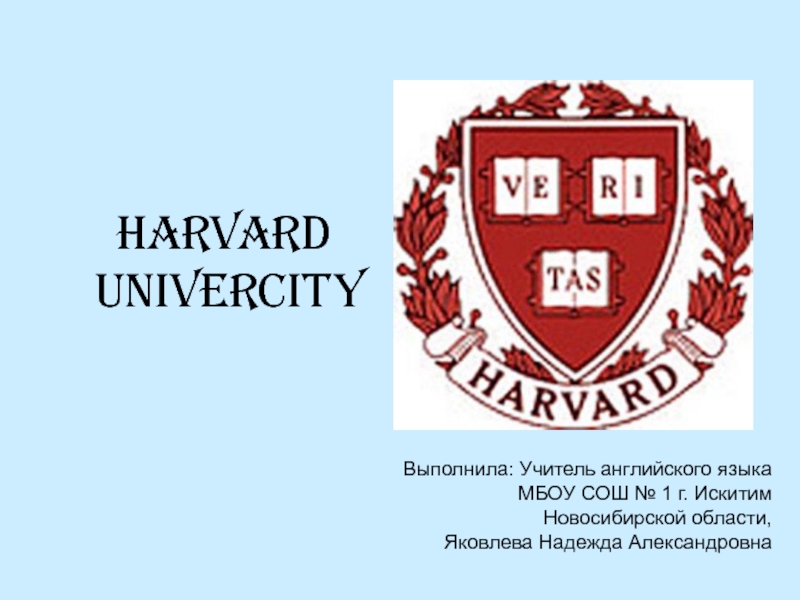
Veritas
Motto in English Truth
Established September 18, 1636 (NS)
Type Private
Endowment USD $25.62 billion
President Drew Gilpin Faust
Faculty 2,107
Staff 2,497 non-medical
10,674 medical
Students 21,125
Undergraduates 7,181 total
6,655 College
526 Extension
Postgraduates 14,044
Location Cambridge, Massachusetts, U.S.
Campus Urban
210 acres (Main campus)
22 acres (Medical campus)
359 acres (Allston campus)
Motto in English Truth
Established September 18, 1636 (NS)
Type Private
Endowment USD $25.62 billion
President Drew Gilpin Faust
Faculty 2,107
Staff 2,497 non-medical
10,674 medical
Students 21,125
Undergraduates 7,181 total
6,655 College
526 Extension
Postgraduates 14,044
Location Cambridge, Massachusetts, U.S.
Campus Urban
210 acres (Main campus)
22 acres (Medical campus)
359 acres (Allston campus)
Слайд 3School color
Crimson
Living alumni More than 320,000
Nobel laureates 43 current and former faculty members
Library collection About 16.2 million volumes
Undergraduate Cost
(2009-10 academic year) Tuition — $33,696
Total including room, board, student service fees —
$48,868
Financial aid
(2009-10 academic year) Nearly $41,000 average total aid package
University income
(Fiscal Year 2008) $3,482,317,000
Newspaper The Harvard Crimson
Colors Crimson
Mascot Crimson
Athletics 41 Varsity Teams
Ivy League
NCAA Division I
Harvard Crimson
Website www.harvard.edu
Living alumni More than 320,000
Nobel laureates 43 current and former faculty members
Library collection About 16.2 million volumes
Undergraduate Cost
(2009-10 academic year) Tuition — $33,696
Total including room, board, student service fees —
$48,868
Financial aid
(2009-10 academic year) Nearly $41,000 average total aid package
University income
(Fiscal Year 2008) $3,482,317,000
Newspaper The Harvard Crimson
Colors Crimson
Mascot Crimson
Athletics 41 Varsity Teams
Ivy League
NCAA Division I
Harvard Crimson
Website www.harvard.edu

Слайд 4SOME FACTS
FROM
THE HISTORY
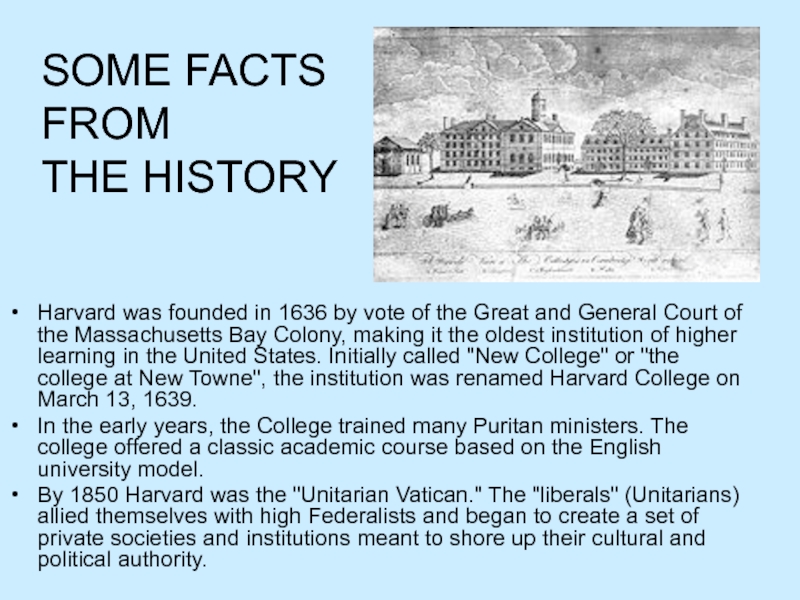
Harvard was founded in 1636 by vote
of the Great and General Court of the Massachusetts Bay Colony, making it the oldest institution of higher learning in the United States. Initially called "New College" or "the college at New Towne", the institution was renamed Harvard College on March 13, 1639.
In the early years, the College trained many Puritan ministers. The college offered a classic academic course based on the English university model.
By 1850 Harvard was the "Unitarian Vatican." The "liberals" (Unitarians) allied themselves with high Federalists and began to create a set of private societies and institutions meant to shore up their cultural and political authority.
In the early years, the College trained many Puritan ministers. The college offered a classic academic course based on the English university model.
By 1850 Harvard was the "Unitarian Vatican." The "liberals" (Unitarians) allied themselves with high Federalists and began to create a set of private societies and institutions meant to shore up their cultural and political authority.
Слайд 5Administration
and organization
A faculty: 2,110 professors, lecturers, and instructors
6,715 undergraduate and 12,424 graduate students.
The school color is crimson, which is also the name of the Harvard sports teams and the daily newspaper, The Harvard Crimson.
The John Harvard statue in Harvard Yard is occasionally a target of humorous decorations.
Harvard has a friendly rivalry with the Massachusetts Institute of Technology.
Today, they compete, with many joint conferences and programs,
- the Harvard-MIT Division of Health Sciences and Technology,
- the Broad Institute,
- the Harvard-MIT Data Center and the Dibner Institute for the
History of Science and Technology.
The school color is crimson, which is also the name of the Harvard sports teams and the daily newspaper, The Harvard Crimson.
The John Harvard statue in Harvard Yard is occasionally a target of humorous decorations.
Harvard has a friendly rivalry with the Massachusetts Institute of Technology.
Today, they compete, with many joint conferences and programs,
- the Harvard-MIT Division of Health Sciences and Technology,
- the Broad Institute,
- the Harvard-MIT Data Center and the Dibner Institute for the
History of Science and Technology.

Слайд 6Governing bodies
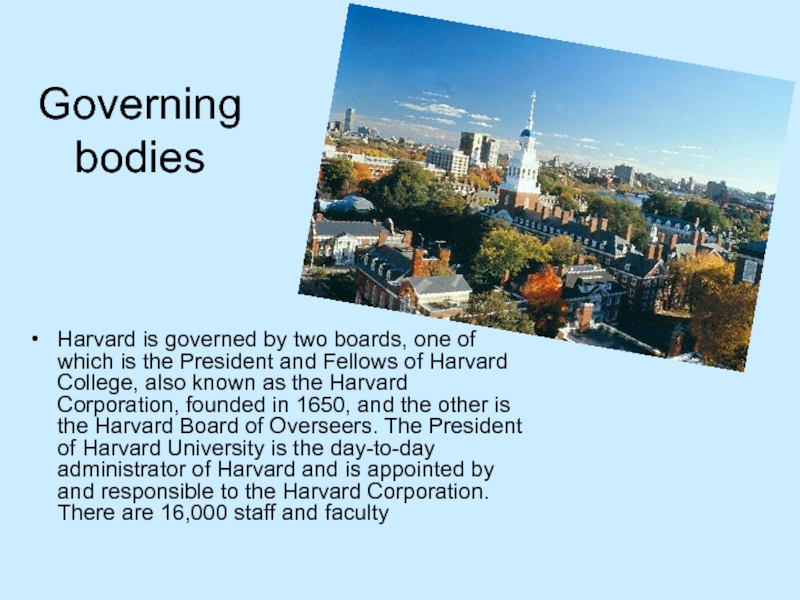
Harvard is governed by two boards, one of which
is the President and Fellows of Harvard College, also known as the Harvard Corporation, founded in 1650, and the other is the Harvard Board of Overseers. The President of Harvard University is the day-to-day administrator of Harvard and is appointed by and responsible to the Harvard Corporation. There are 16,000 staff and faculty
Слайд 7Faculties and schools
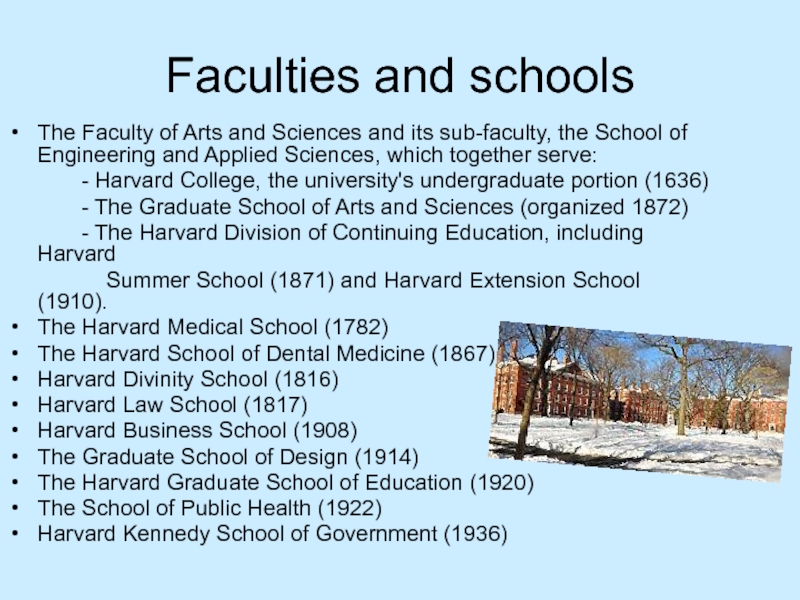
The Faculty of Arts and Sciences and its
sub-faculty, the School of Engineering and Applied Sciences, which together serve:
- Harvard College, the university's undergraduate portion (1636)
- The Graduate School of Arts and Sciences (organized 1872)
- The Harvard Division of Continuing Education, including Harvard
Summer School (1871) and Harvard Extension School (1910).
The Harvard Medical School (1782)
The Harvard School of Dental Medicine (1867).
Harvard Divinity School (1816)
Harvard Law School (1817)
Harvard Business School (1908)
The Graduate School of Design (1914)
The Harvard Graduate School of Education (1920)
The School of Public Health (1922)
Harvard Kennedy School of Government (1936)
- Harvard College, the university's undergraduate portion (1636)
- The Graduate School of Arts and Sciences (organized 1872)
- The Harvard Division of Continuing Education, including Harvard
Summer School (1871) and Harvard Extension School (1910).
The Harvard Medical School (1782)
The Harvard School of Dental Medicine (1867).
Harvard Divinity School (1816)
Harvard Law School (1817)
Harvard Business School (1908)
The Graduate School of Design (1914)
The Harvard Graduate School of Education (1920)
The School of Public Health (1922)
Harvard Kennedy School of Government (1936)
Слайд 9 Harvard's 210-acre main campus is centered on
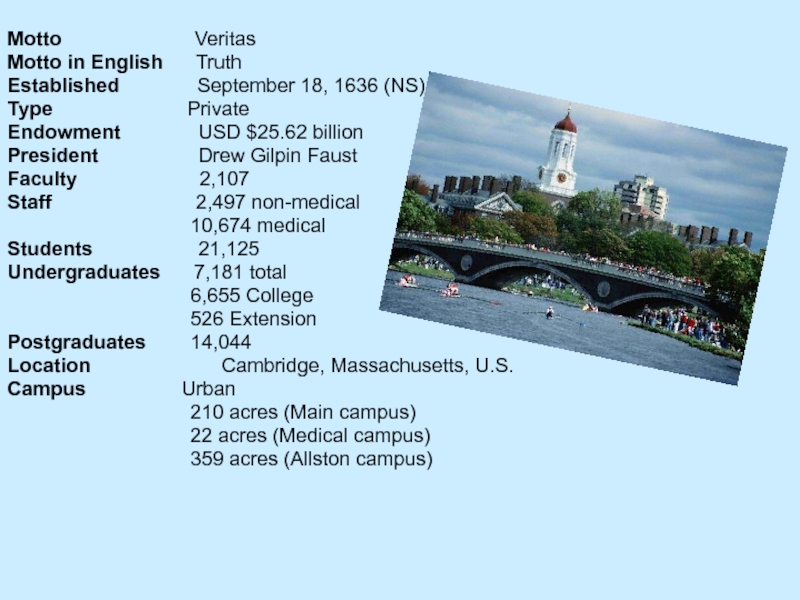
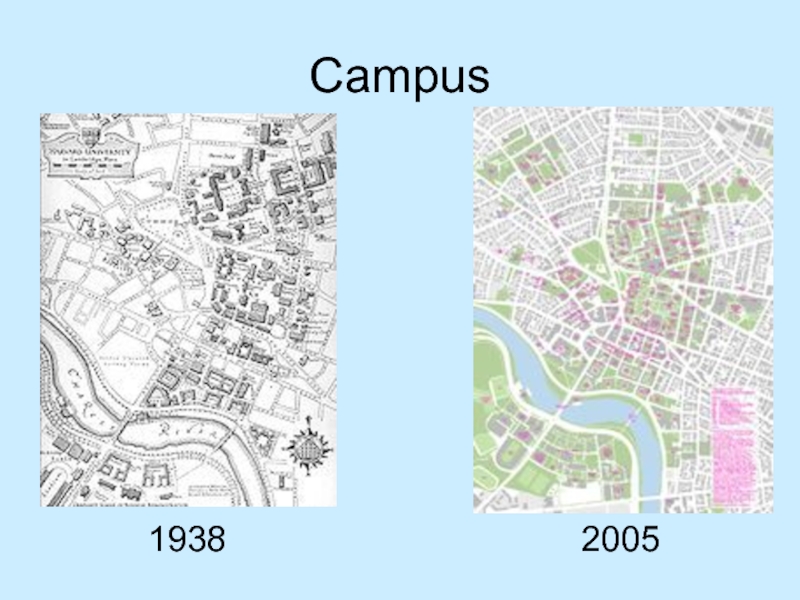
Harvard Yard in Cambridge, approximately 3.4 miles northwest of downtown Boston and extends into the surrounding Harvard Square neighborhood. Harvard Yard itself contains the central administrative offices and main libraries of the university, academic buildings including Sever Hall and University Hall, Memorial Church, and the majority of the freshman dormitories. Sophomore, junior, and senior undergraduates live in twelve residential Houses, nine of which are south of Harvard Yard along or near the Charles River. The other three are located in a residential neighborhood half a mile northwest of the Yard at the Quadrangle (commonly referred to as the Quad), which formerly housed Radcliffe College students until Radcliffe merged its residential system with Harvard. The Harvard MBTA station provides public transportation via bus service and the Red Line subway.

Слайд 10 The Harvard Business School and many of
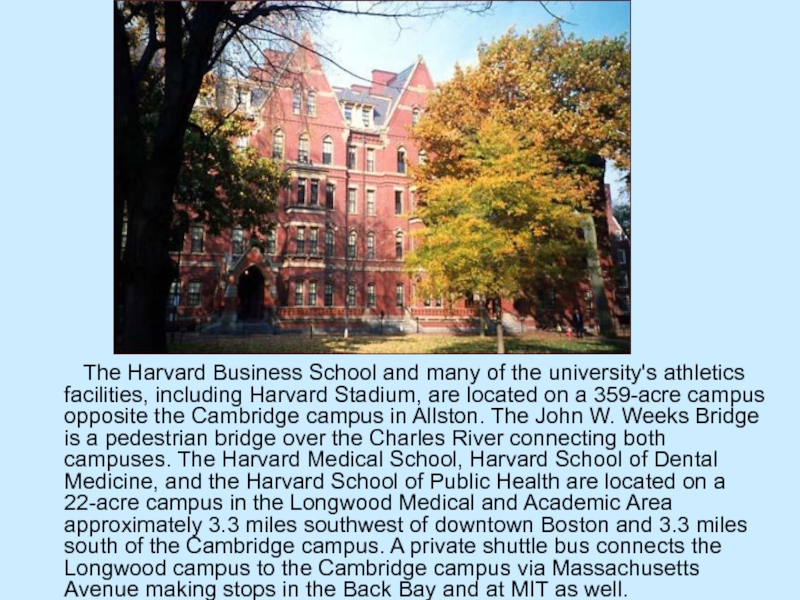
the university's athletics facilities, including Harvard Stadium, are located on a 359-acre campus opposite the Cambridge campus in Allston. The John W. Weeks Bridge is a pedestrian bridge over the Charles River connecting both campuses. The Harvard Medical School, Harvard School of Dental Medicine, and the Harvard School of Public Health are located on a 22-acre campus in the Longwood Medical and Academic Area approximately 3.3 miles southwest of downtown Boston and 3.3 miles south of the Cambridge campus. A private shuttle bus connects the Longwood campus to the Cambridge campus via Massachusetts Avenue making stops in the Back Bay and at MIT as well.
Слайд 11 Each residential house contains rooms for undergraduates,
House masters, and resident tutors, as well as a dining hall, library, and various other student facilities. The facilities were made possible by a gift from Yale University alumnus Edward Harkness.
Radcliffe Yard, formerly the center of the campus of Radcliffe College (and now home of the Radcliffe Institute), is adjacent to the Graduate School of Education and the Cambridge Common.
From 2006 - 2008, Harvard University reported on-campus crime statistics that included 48 forcible sex offenses, 10 robberies, 15 aggravated assaults, 750 burglaries, and 12 cases of motor vehicle theft.
Radcliffe Yard, formerly the center of the campus of Radcliffe College (and now home of the Radcliffe Institute), is adjacent to the Graduate School of Education and the Cambridge Common.
From 2006 - 2008, Harvard University reported on-campus crime statistics that included 48 forcible sex offenses, 10 robberies, 15 aggravated assaults, 750 burglaries, and 12 cases of motor vehicle theft.

Слайд 12Research
centers
Broad Institute of MIT and Harvard
Harvard Clinical Research Institute
Harvard
Institute of Economic Research
Harvard Ukrainian Research Institute
Institute for Quantitative Social Science[104]
Radcliffe Institute for Advanced Studies (one of Harvard's 14 schools)
Laboratory for Nanomedicine (at the Harvard Medical School-affiliated Brigham and Women's Hospital)
Sheens Eye Research Institute
W. E. B. Du Bois Institute for African and African-American Research
Wyss Institute for Biologically Inspired Engineering
Harvard Ukrainian Research Institute
Institute for Quantitative Social Science[104]
Radcliffe Institute for Advanced Studies (one of Harvard's 14 schools)
Laboratory for Nanomedicine (at the Harvard Medical School-affiliated Brigham and Women's Hospital)
Sheens Eye Research Institute
W. E. B. Du Bois Institute for African and African-American Research
Wyss Institute for Biologically Inspired Engineering

Слайд 13Libraries
The Harvard University Library System is centered in
Widener Library in Harvard Yard and comprises over 80 individual libraries and over 15 million volumes. Harvard describes its library as the "largest academic library in the world".
Cabot Science Library, Lamont Library, and Widener Library are three of the most popular libraries for undergraduates to use, with easy access and central locations. There are rare books, manuscripts and other special collections throughout Harvard's libraries.
The Harvard University Archives consist principally of rare and unique materials.
Cabot Science Library, Lamont Library, and Widener Library are three of the most popular libraries for undergraduates to use, with easy access and central locations. There are rare books, manuscripts and other special collections throughout Harvard's libraries.
The Harvard University Archives consist principally of rare and unique materials.

Слайд 14Museums
• The Harvard Art Museums, including:
- The Fogg
Museum of Art, with galleries featuring history of Western art from the Middle Ages to the present.
- The Busch-Reisinger Museum.
- The Arthur M. Sackler Museum
• The Peabody Museum of Archaeology and Ethnology, specializing in the cultural history and civilizations of the Western Hemisphere
• The Semitic Museum.
• The Harvard Museum of Natural History complex, including:
- The Harvard University Herbaria
- The Museum of Comparative Zoology
- The Harvard Mineralogical Museum
• The Carpenter Center for the Visual Arts, designed by Le Corbusier, is home to the University's film archive and the department of Visual and Environmental Studies.
- The Busch-Reisinger Museum.
- The Arthur M. Sackler Museum
• The Peabody Museum of Archaeology and Ethnology, specializing in the cultural history and civilizations of the Western Hemisphere
• The Semitic Museum.
• The Harvard Museum of Natural History complex, including:
- The Harvard University Herbaria
- The Museum of Comparative Zoology
- The Harvard Mineralogical Museum
• The Carpenter Center for the Visual Arts, designed by Le Corbusier, is home to the University's film archive and the department of Visual and Environmental Studies.

Слайд 15Some of Harvard student groups
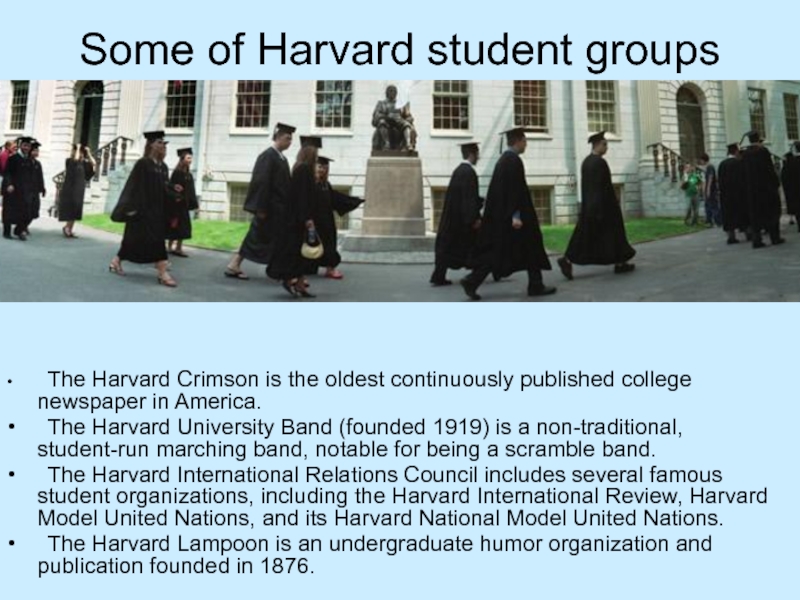
• The Harvard Crimson is the oldest
continuously published college newspaper in America.
• The Harvard University Band (founded 1919) is a non-traditional, student-run marching band, notable for being a scramble band.
• The Harvard International Relations Council includes several famous student organizations, including the Harvard International Review, Harvard Model United Nations, and its Harvard National Model United Nations.
• The Harvard Lampoon is an undergraduate humor organization and publication founded in 1876.
• The Harvard University Band (founded 1919) is a non-traditional, student-run marching band, notable for being a scramble band.
• The Harvard International Relations Council includes several famous student organizations, including the Harvard International Review, Harvard Model United Nations, and its Harvard National Model United Nations.
• The Harvard Lampoon is an undergraduate humor organization and publication founded in 1876.
Слайд 16Students
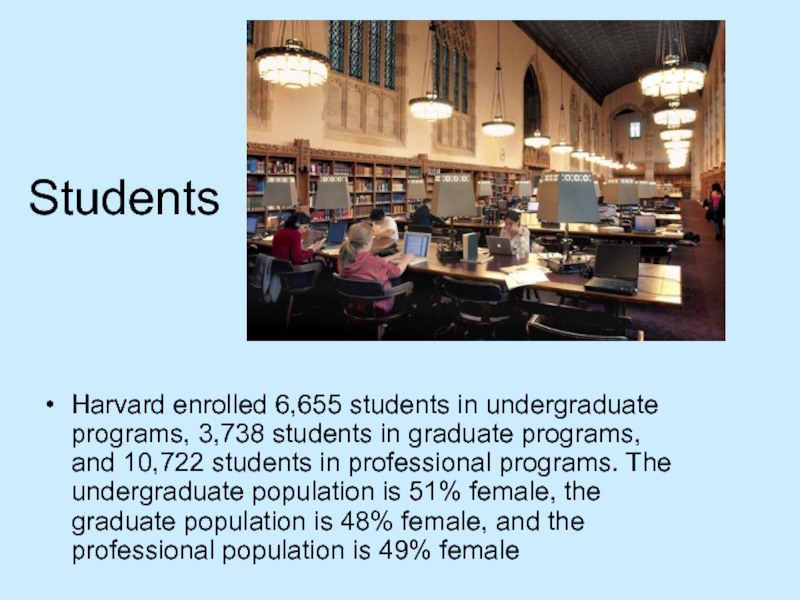
Harvard enrolled 6,655 students in undergraduate programs, 3,738 students in
graduate programs, and 10,722 students in professional programs. The undergraduate population is 51% female, the graduate population is 48% female, and the professional population is 49% female

Слайд 18Academic dress of Harvard University
As the oldest
university in the United States, Harvard University has a long tradition of academic dress. Harvard gown facings bear crow's-feet emblems near the yoke, a symbol unique to Harvard, made from flat braid in colours distinctive of the wearer's qualification or degree. Crow's-feet are double for earned degrees, and triple for honorary degrees.