- Главная
- Разное
- Образование
- Спорт
- Естествознание
- Природоведение
- Религиоведение
- Французский язык
- Черчение
- Английский язык
- Астрономия
- Алгебра
- Биология
- География
- Геометрия
- Детские презентации
- Информатика
- История
- Литература
- Математика
- Музыка
- МХК
- Немецкий язык
- ОБЖ
- Обществознание
- Окружающий мир
- Педагогика
- Русский язык
- Технология
- Физика
- Философия
- Химия
- Шаблоны, фоны, картинки для презентаций
- Экология
- Экономика
Презентация, доклад на тему Мультимедийный урок 7 чудес света (11 класс)
Содержание
- 1. Мультимедийный урок 7 чудес света (11 класс)
- 2. The Great Pyramid of Giza,
- 3. It is believed the pyramid
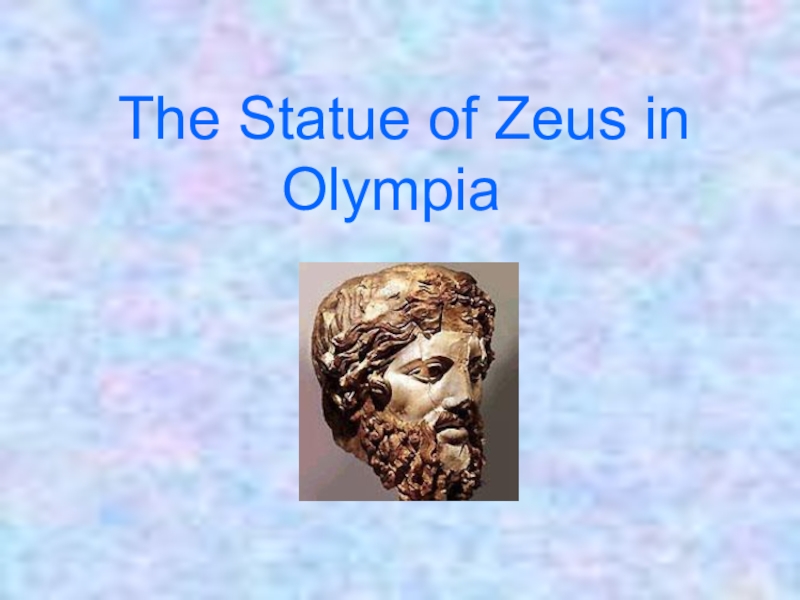
- 4. The Statue of Zeus in Оlympia
- 5. Слайд 5
- 6. According to accounts, the statue was located
- 7. In its right hand the statue held
- 8. The Temple of Artemis
- 9. Artemis was a Greek goddess of forests
- 10. The breadth of the temple of Artemis
- 11. When the huge building opened for looks
- 12. Mausoleum at Halicarnassus
- 13. The Mausoleum was built between 353
- 14. The famous sculptors, Leochares, Bryaxis,
- 15. Nowadays Mausoleum of Halicarnassus is in ruins……
- 16. The Colossus of Rhodes.
- 17. The Colossus of Rhodes was the statue
- 18. The statue stood for only 56 years
- 19. The Hanging Gardens of Babylon
- 20. Gardens of Semiramis, 20th century interpretation
- 21. The Hanging Gardens of Babylon, also
- 22. The ALEXANDRIA lighthouse was a huge tower
- 23. The Pharos
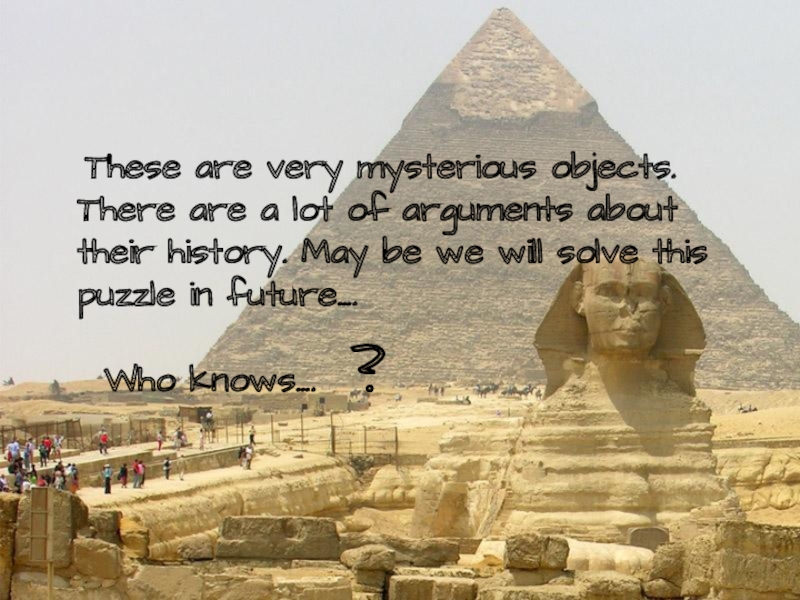
- 24. These are very mysterious objects.
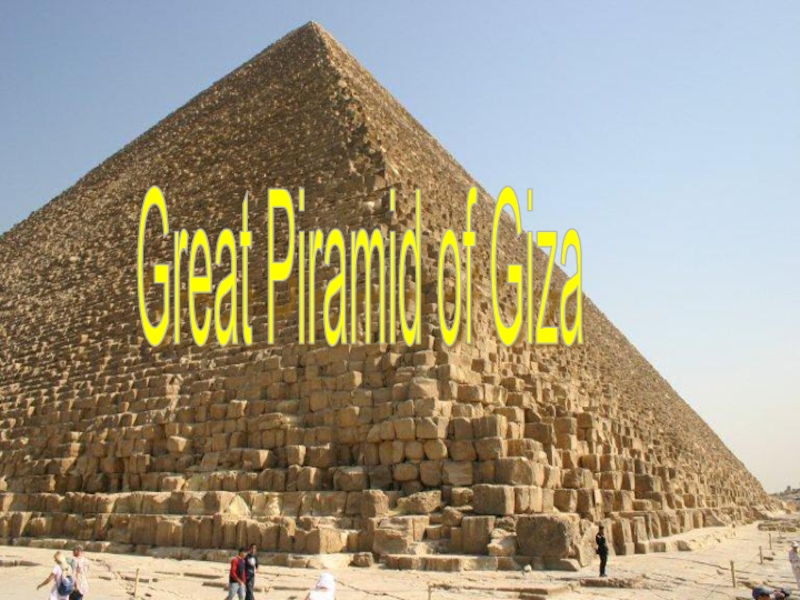
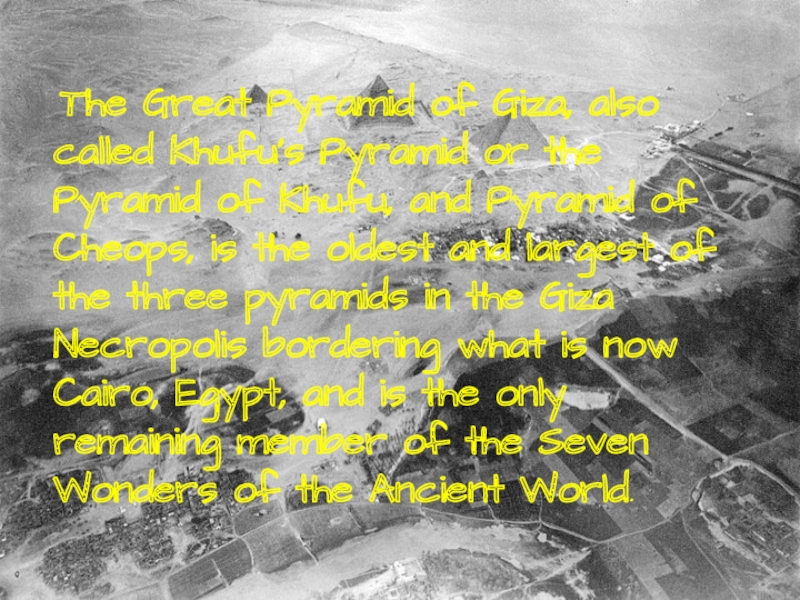
The Great Pyramid of Giza, also called Khufu's Pyramid or the Pyramid of Khufu, and Pyramid of Cheops, is the oldest and largest of the three pyramids in the Giza Necropolis bordering what is
Слайд 2 The Great Pyramid of Giza, also called Khufu's Pyramid
or the Pyramid of Khufu, and Pyramid of Cheops, is the oldest and largest of the three pyramids in the Giza Necropolis bordering what is now Cairo, Egypt, and is the only remaining member of the Seven Wonders of the Ancient World.
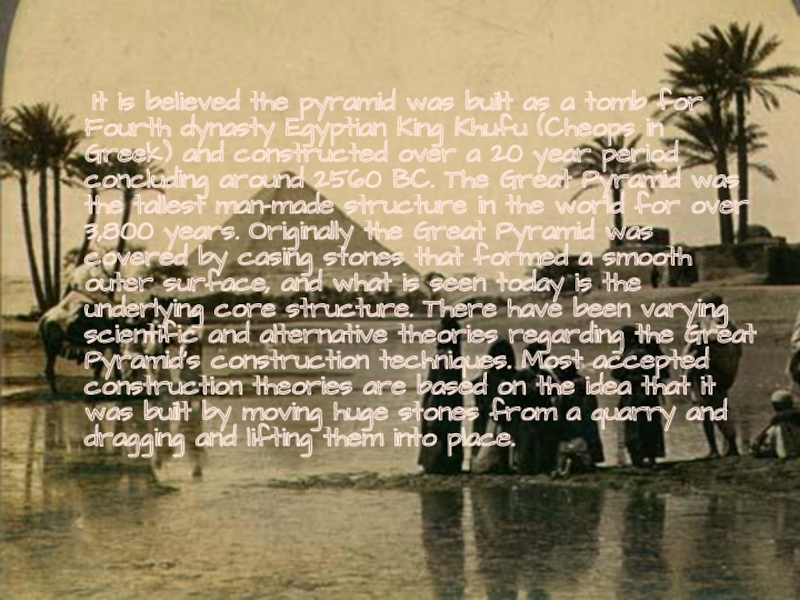
Слайд 3 It is believed the pyramid was built as a
tomb for Fourth dynasty Egyptian King Khufu (Cheops in Greek) and constructed over a 20 year period concluding around 2560 BC. The Great Pyramid was the tallest man-made structure in the world for over 3,800 years. Originally the Great Pyramid was covered by casing stones that formed a smooth outer surface, and what is seen today is the underlying core structure. There have been varying scientific and alternative theories regarding the Great Pyramid's construction techniques. Most accepted construction theories are based on the idea that it was built by moving huge stones from a quarry and dragging and lifting them into place.
Слайд 6According to accounts, the statue was located at the western end
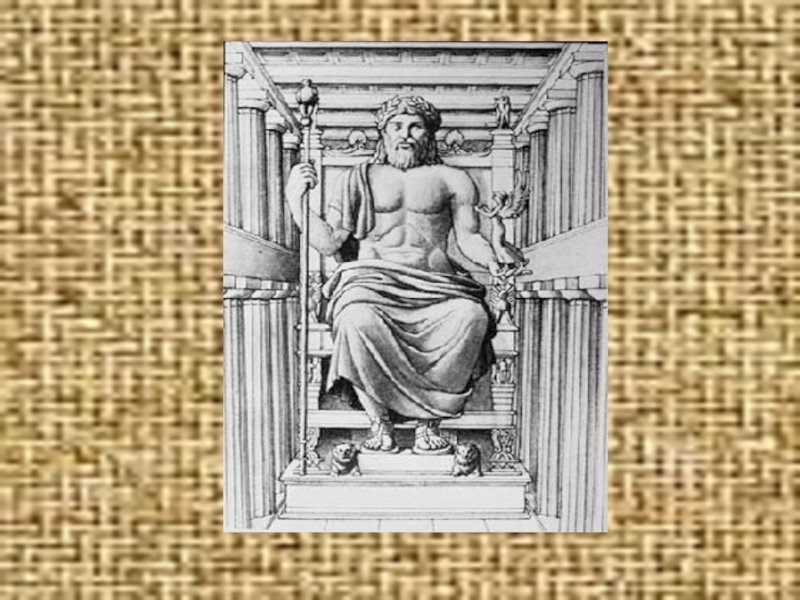
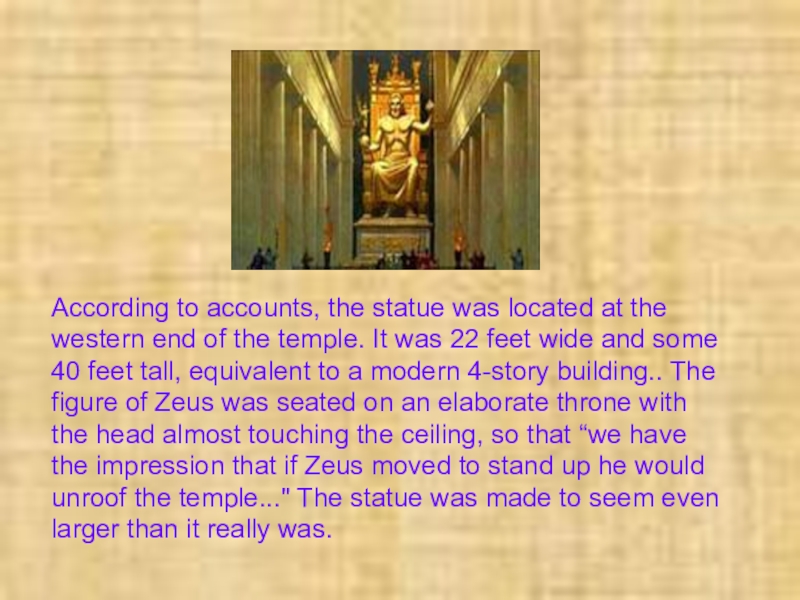
of the temple. It was 22 feet wide and some 40 feet tall, equivalent to a modern 4-story building.. The figure of Zeus was seated on an elaborate throne with the head almost touching the ceiling, so that “we have the impression that if Zeus moved to stand up he would unroof the temple..." The statue was made to seem even larger than it really was.
Слайд 7In its right hand the statue held the figure of Nike
(the goddess of victory) and in its left was a sceptre which was topped with an eagle. Perhaps even more impressive than the statue itself was the throne made out of gold, ebony, ivory and inlaid with precious stones. Carved into the chair were figures of Greek gods and mystical animals, like the sphinx.
The figure's skin was composed of ivory and the beard, hair and robe of gold. Construction was by the use of gold and ivory plates attached to a wooden frame.
The figure's skin was composed of ivory and the beard, hair and robe of gold. Construction was by the use of gold and ivory plates attached to a wooden frame.
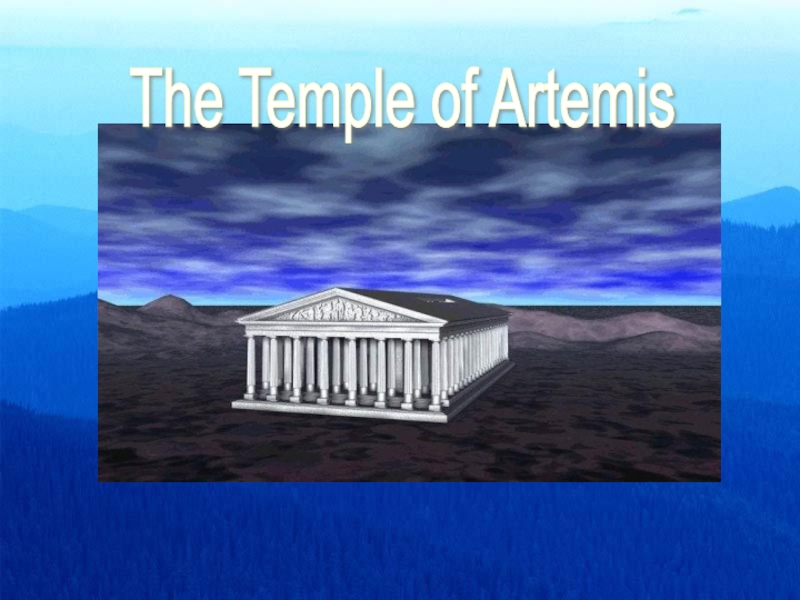
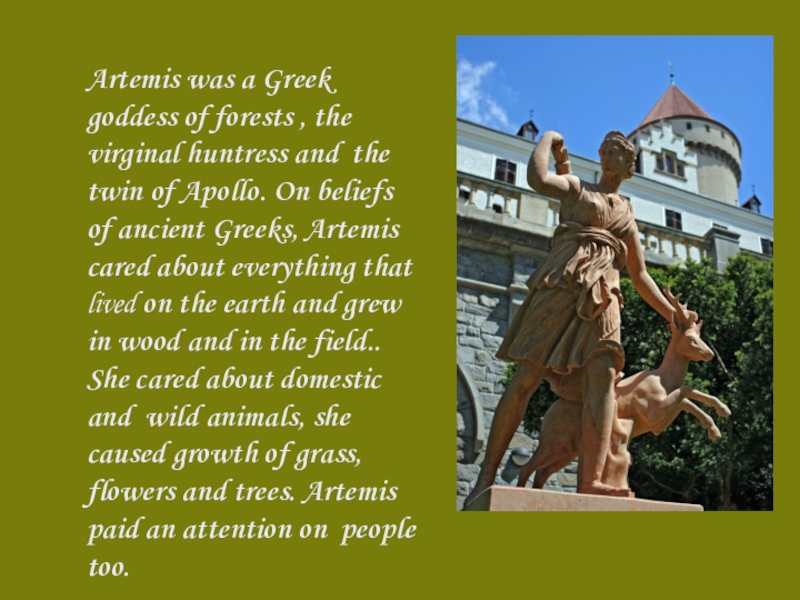
Слайд 9Artemis was a Greek goddess of forests , the virginal huntress
and the twin of Apollo. On beliefs of ancient Greeks, Artemis cared about everything that lived on the earth and grew in wood and in the field.. She cared about domestic and wild animals, she caused growth of grass, flowers and trees. Artemis paid an attention on people too.
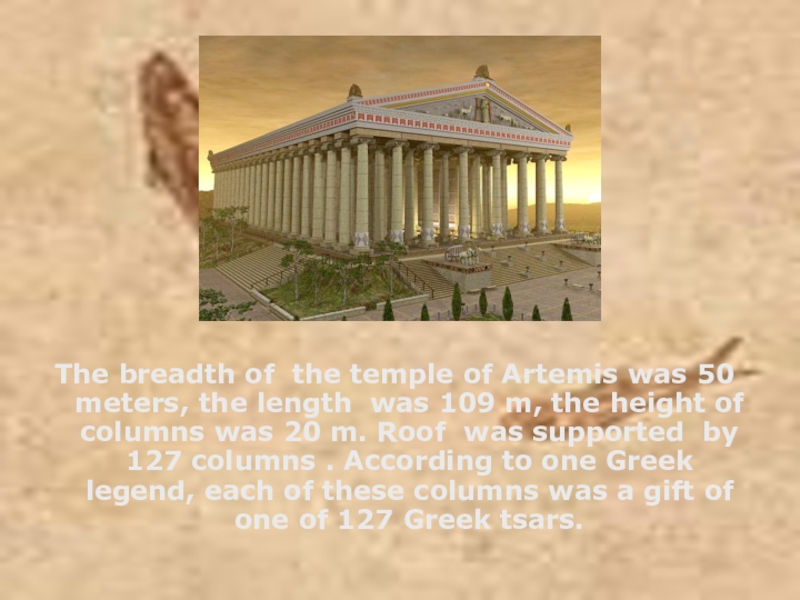
Слайд 10The breadth of the temple of Artemis was 50 meters, the
length was 109 m, the height of columns was 20 m. Roof was supported by 127 columns . According to one Greek legend, each of these columns was a gift of one of 127 Greek tsars.
Слайд 11When the huge building opened for looks of citizens, it was
really amazing.
Unfortunately, we don't know, by whom the temple was desighed. It’s known that the best masters of Greece took part in creation of sculptural furniture of the temple, and the statue of Artemis was made from gold and silver.
Unfortunately, we don't know, by whom the temple was desighed. It’s known that the best masters of Greece took part in creation of sculptural furniture of the temple, and the statue of Artemis was made from gold and silver.
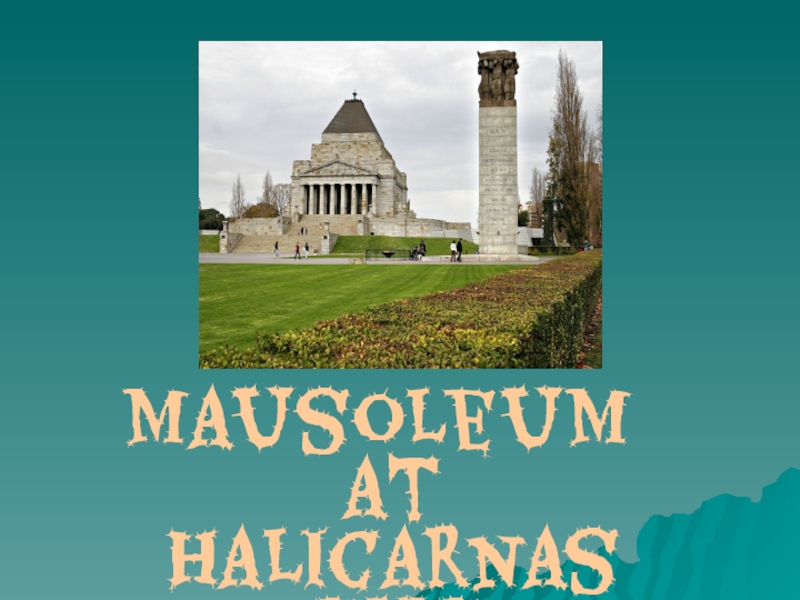
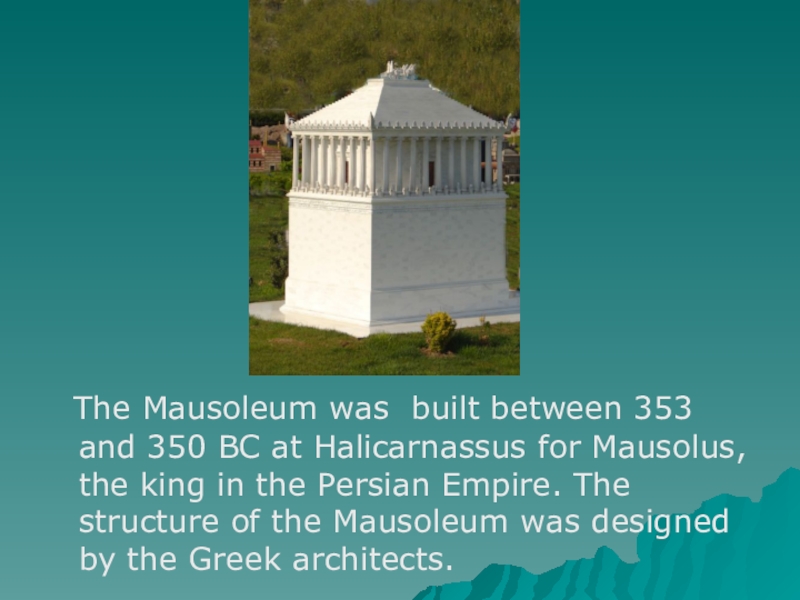
Слайд 13 The Mausoleum was built between 353 and 350 BC at
Halicarnassus for Mausolus, the king in the Persian Empire. The structure of the Mausoleum was designed by the Greek architects.
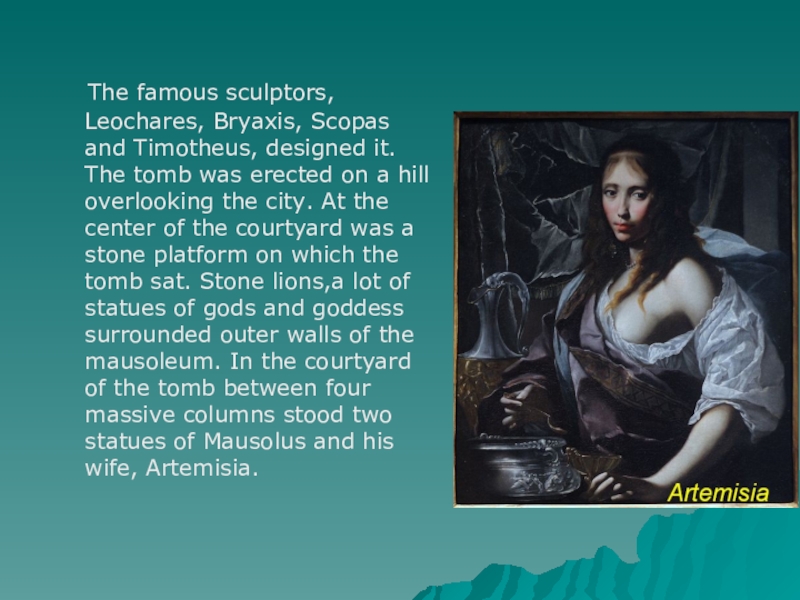
Слайд 14 The famous sculptors, Leochares, Bryaxis, Scopas and Timotheus, designed
it. The tomb was erected on a hill overlooking the city. At the center of the courtyard was a stone platform on which the tomb sat. Stone lions,a lot of statues of gods and goddess surrounded outer walls of the mausoleum. In the courtyard of the tomb between four massive columns stood two statues of Mausolus and his wife, Artemisia.
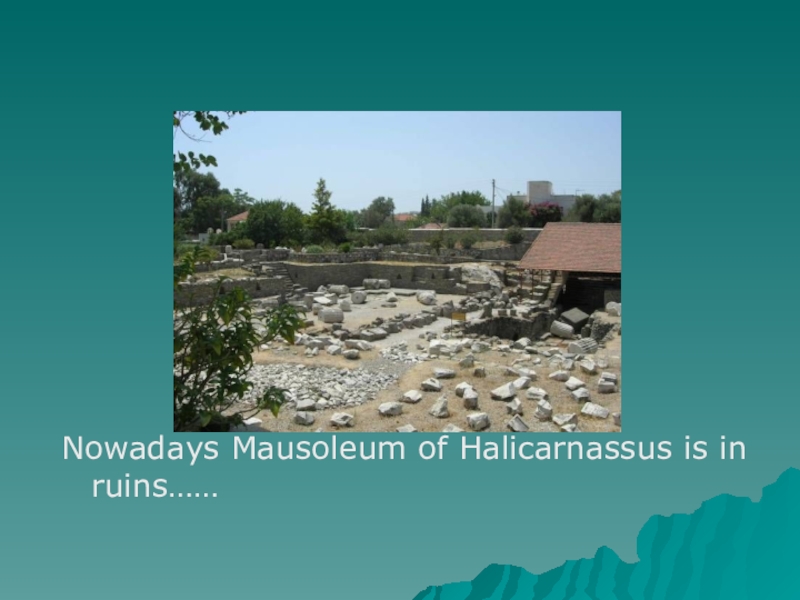
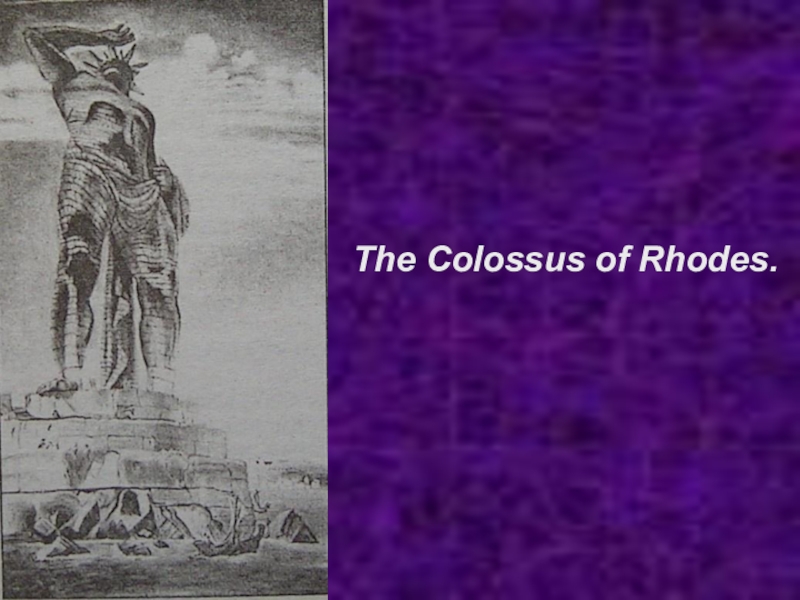
Слайд 17The Colossus of Rhodes was the statue of the Greek god
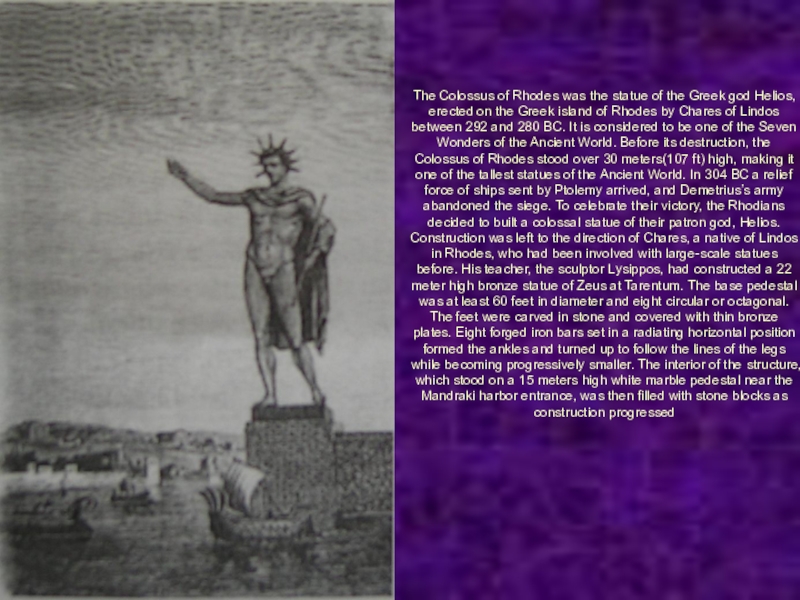
Helios, erected on the Greek island of Rhodes by Chares of Lindos between 292 and 280 BC. It is considered to be one of the Seven Wonders of the Ancient World. Before its destruction, the Colossus of Rhodes stood over 30 meters(107 ft) high, making it one of the tallest statues of the Ancient World. In 304 BC a relief force of ships sent by Ptolemy arrived, and Demetrius’s army abandoned the siege. To celebrate their victory, the Rhodians decided to built a colossal statue of their patron god, Helios. Construction was left to the direction of Chares, a native of Lindos in Rhodes, who had been involved with large-scale statues before. His teacher, the sculptor Lysippos, had constructed a 22 meter high bronze statue of Zeus at Tarentum. The base pedestal was at least 60 feet in diameter and eight circular or octagonal. The feet were carved in stone and covered with thin bronze plates. Eight forged iron bars set in a radiating horizontal position formed the ankles and turned up to follow the lines of the legs while becoming progressively smaller. The interior of the structure, which stood on a 15 meters high white marble pedestal near the Mandraki harbor entrance, was then filled with stone blocks as construction progressed
Слайд 18
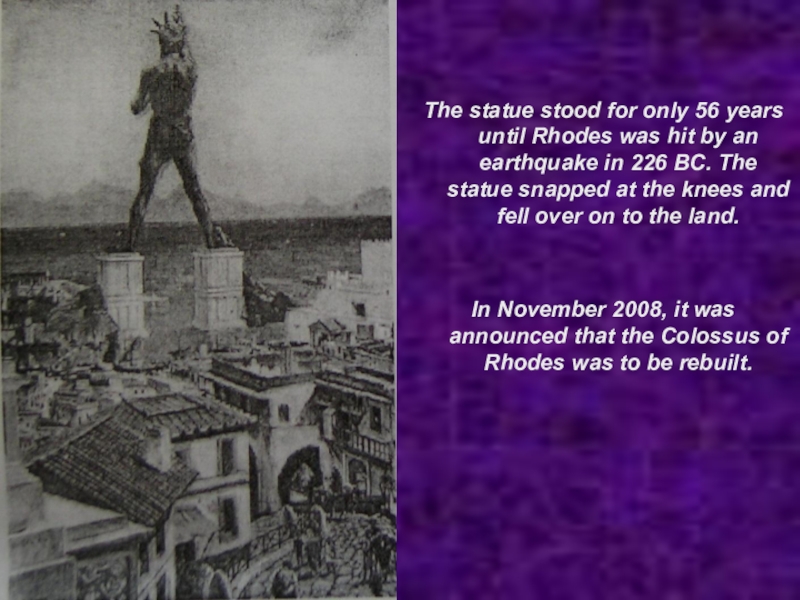
The statue stood for only 56 years until Rhodes was hit
by an earthquake in 226 BC. The statue snapped at the knees and fell over on to the land.
In November 2008, it was announced that the Colossus of Rhodes was to be rebuilt.
In November 2008, it was announced that the Colossus of Rhodes was to be rebuilt.
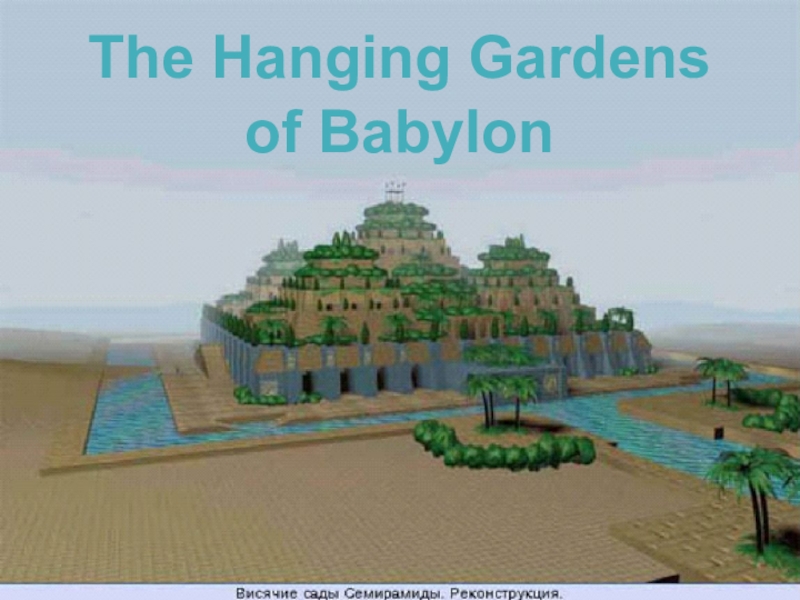
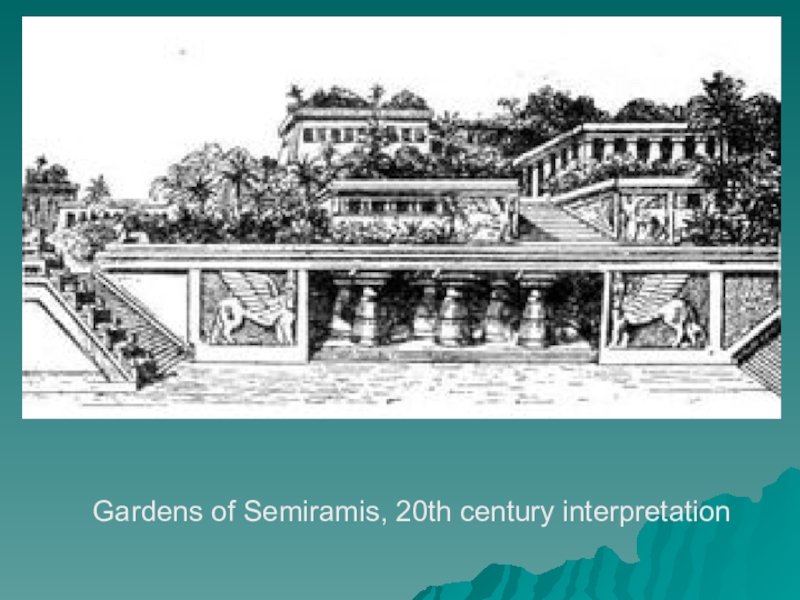
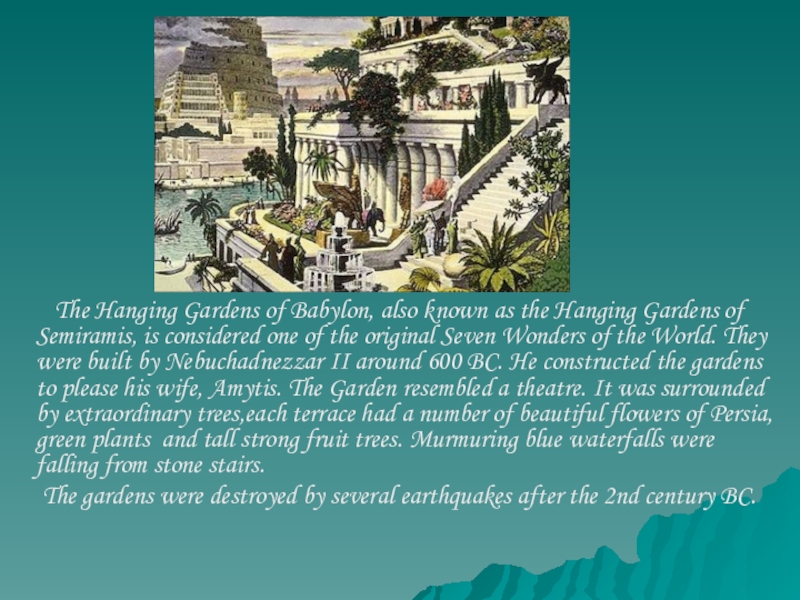
Слайд 21 The Hanging Gardens of Babylon, also known as the Hanging
Gardens of Semiramis, is considered one of the original Seven Wonders of the World. They were built by Nebuchadnezzar II around 600 BC. He constructed the gardens to please his wife, Amytis. The Garden resembled a theatre. It was surrounded by extraordinary trees,each terrace had a number of beautiful flowers of Persia, green plants and tall strong fruit trees. Murmuring blue waterfalls were falling from stone stairs.
The gardens were destroyed by several earthquakes after the 2nd century BC.
The gardens were destroyed by several earthquakes after the 2nd century BC.
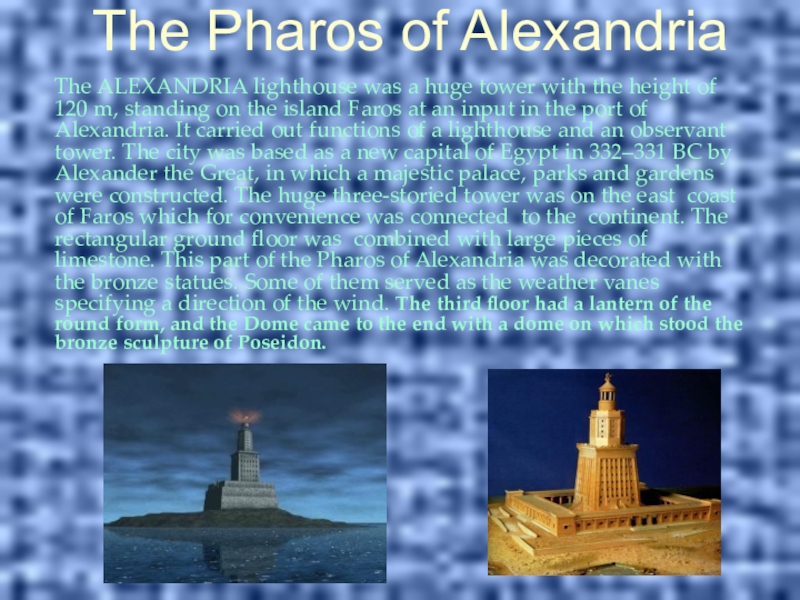
Слайд 22The ALEXANDRIA lighthouse was a huge tower with the height of
120 m, standing on the island Faros at an input in the port of Alexandria. It carried out functions of a lighthouse and an observant tower. The city was based as a new capital of Egypt in 332–331 BC by Alexander the Great, in which a majestic palace, parks and gardens were constructed. The huge three-storied tower was on the east coast of Faros which for convenience was connected to the continent. The rectangular ground floor was combined with large pieces of limestone. This part of the Pharos of Alexandria was decorated with the bronze statues. Some of them served as the weather vanes specifying a direction of the wind. The third floor had a lantern of the round form, and the Dome came to the end with a dome on which stood the bronze sculpture of Poseidon.
The Pharos of Alexandria
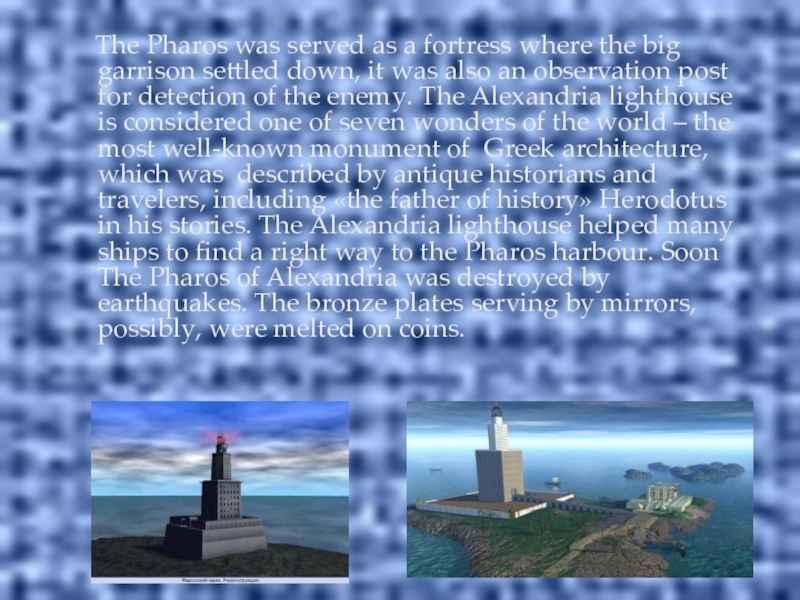
Слайд 23 The Pharos was served as a
fortress where the big garrison settled down, it was also an observation post for detection of the enemy. The Alexandria lighthouse is considered one of seven wonders of the world – the most well-known monument of Greek architecture, which was described by antique historians and travelers, including «the father of history» Herodotus in his stories. The Alexandria lighthouse helped many ships to find a right way to the Pharos harbour. Soon The Pharos of Alexandria was destroyed by earthquakes. The bronze plates serving by mirrors, possibly, were melted on coins.
Слайд 24 These are very mysterious objects. There are a lot
of arguments about their history. May be we will solve this puzzle in future….
Who knows…. ?
Who knows…. ?