– географический центр Республики Алтай
Из истории Онгудая
Чике – Таман
Место слияния рек Чуи и Катунь
Калбак – Таш
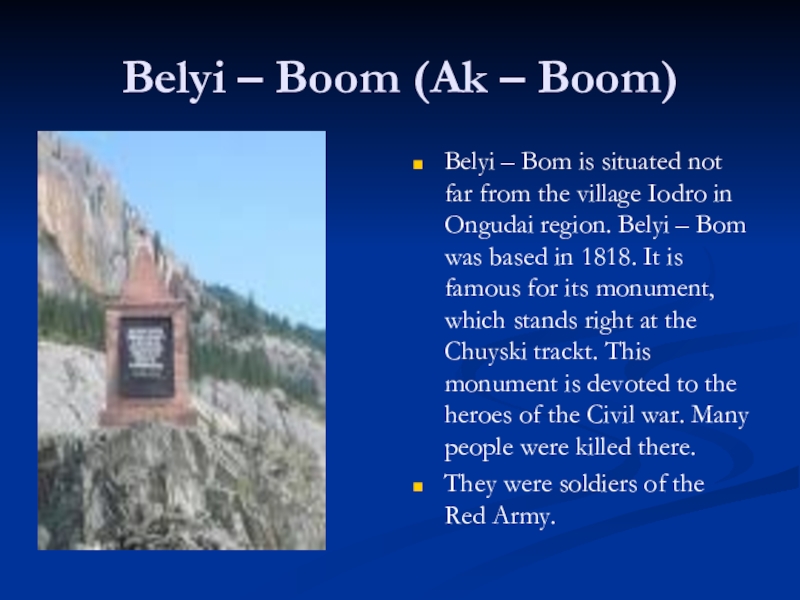
Белый - Боом
- Главная
- Разное
- Образование
- Спорт
- Естествознание
- Природоведение
- Религиоведение
- Французский язык
- Черчение
- Английский язык
- Астрономия
- Алгебра
- Биология
- География
- Геометрия
- Детские презентации
- Информатика
- История
- Литература
- Математика
- Музыка
- МХК
- Немецкий язык
- ОБЖ
- Обществознание
- Окружающий мир
- Педагогика
- Русский язык
- Технология
- Физика
- Философия
- Химия
- Шаблоны, фоны, картинки для презентаций
- Экология
- Экономика
Презентация, доклад на тему Компьютерная презентация по теме:Advertising presentation of some natural sights of Ongudaiskaya district
Содержание
- 1. Компьютерная презентация по теме:Advertising presentation of some natural sights of Ongudaiskaya district
- 2. Welcome to the Ongudaiska-ya districtThe central
- 3. Let’s start To our district you can
- 4. The Seminskii passThe Seminskii pass is the
- 5. The Seminskii pass Seminskii pass
- 6. The Karakol Valley If Altai is the
- 7. ‘Ooch Enmek’ ‘Ooch Enmek’s area is
- 8. ‘Skazitel’‘Skazitel’ translates as “folk-tale narrator’ or ‘Story
- 9. TopshurTopshur is two-stringed instrument carved from a
- 10. Entering an “ail”If you want to try
- 11. Ongudai – geographical centre of the Republic
- 12. History of OngudaiThere are no written references
- 13. Сhike-Tamanskaya passIt is a natural monument. Its
- 14. Confluence of the rivers Chuya and Katun.It
- 15. Rock artRock art can be found the
- 16. Kalbak - TashActually petrogliphs were found in
- 17. Belyi – Boom (Ak – Boom)Belyi –
Welcome to the Ongudaiska-ya districtThe central location of the area and an abundance of archaeological, historical, ethnographic monuments is a natural interest of tourists. There are numerous stone statues, burial mounds, settlements parking, cave paintings.
Слайд 2
Welcome to the
Ongudaiska-ya district
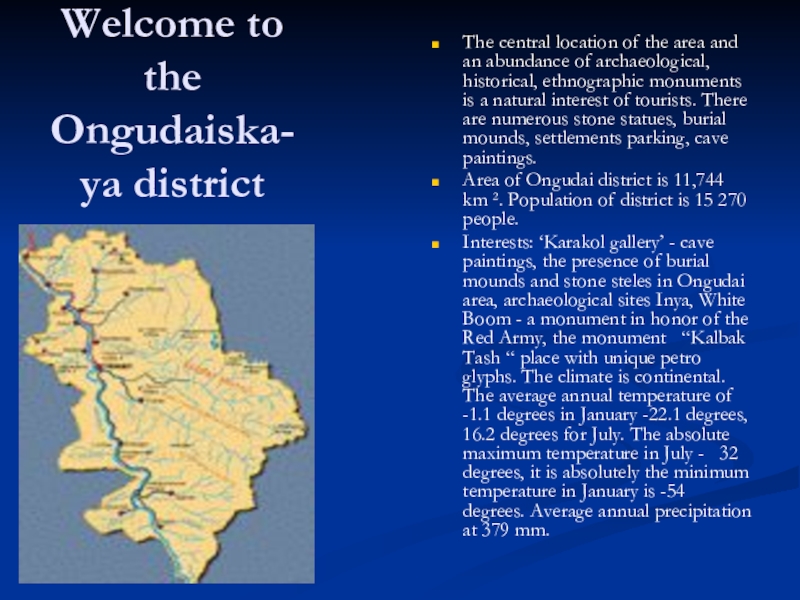
The central location of the area and an
abundance of archaeological, historical, ethnographic monuments is a natural interest of tourists. There are numerous stone statues, burial mounds, settlements parking, cave paintings.
Area of Ongudai district is 11,744 km ². Population of district is 15 270 people.
Interests: ‘Karakol gallery’ - cave paintings, the presence of burial mounds and stone steles in Ongudai area, archaeological sites Inya, White Boom - a monument in honor of the Red Army, the monument “Kalbak Tash “ place with unique petro glyphs. The climate is continental. The average annual temperature of -1.1 degrees in January -22.1 degrees, 16.2 degrees for July. The absolute maximum temperature in July - 32 degrees, it is absolutely the minimum temperature in January is -54 degrees. Average annual precipitation at 379 mm.
Area of Ongudai district is 11,744 km ². Population of district is 15 270 people.
Interests: ‘Karakol gallery’ - cave paintings, the presence of burial mounds and stone steles in Ongudai area, archaeological sites Inya, White Boom - a monument in honor of the Red Army, the monument “Kalbak Tash “ place with unique petro glyphs. The climate is continental. The average annual temperature of -1.1 degrees in January -22.1 degrees, 16.2 degrees for July. The absolute maximum temperature in July - 32 degrees, it is absolutely the minimum temperature in January is -54 degrees. Average annual precipitation at 379 mm.
Слайд 3Let’s start
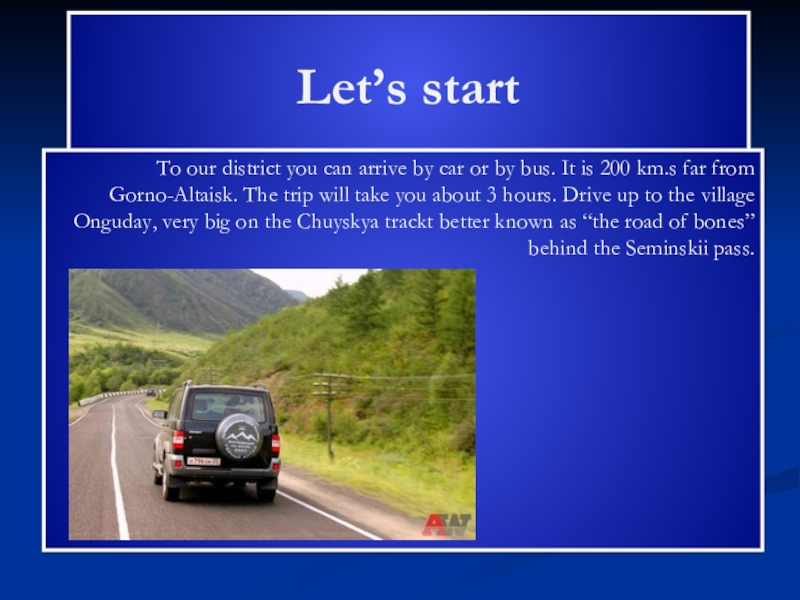
To our district you can arrive by car or
by bus. It is 200 km.s far from Gorno-Altaisk. The trip will take you about 3 hours. Drive up to the village Onguday, very big on the Chuyskya trackt better known as “the road of bones” behind the Seminskii pass.
Слайд 4The Seminskii pass
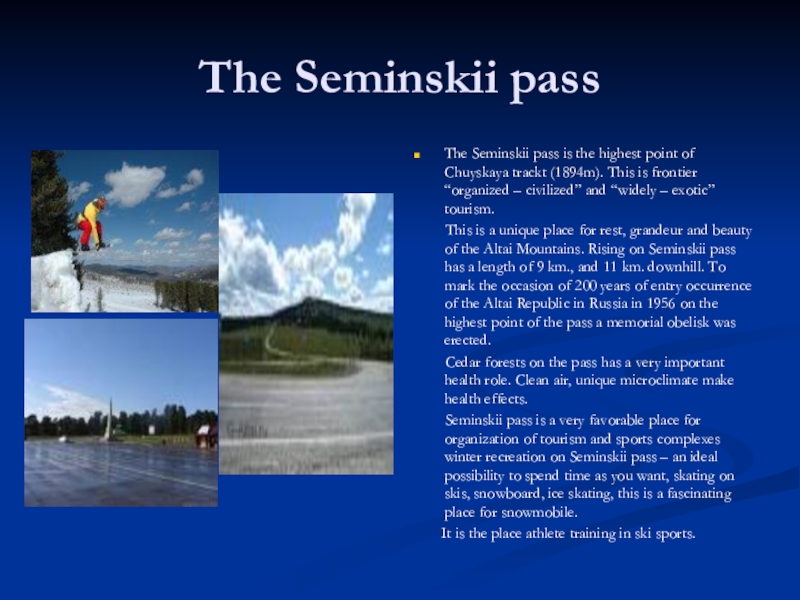
The Seminskii pass is the highest point of Chuyskaya
trackt (1894m). This is frontier “organized – civilized” and “widely – exotic” tourism.
This is a unique place for rest, grandeur and beauty of the Altai Mountains. Rising on Seminskii pass has a length of 9 km., and 11 km. downhill. To mark the occasion of 200 years of entry occurrence of the Altai Republic in Russia in 1956 on the highest point of the pass a memorial obelisk was erected.
Cedar forests on the pass has a very important health role. Clean air, unique microclimate make health effects.
Seminskii pass is a very favorable place for organization of tourism and sports complexes winter recreation on Seminskii pass – an ideal possibility to spend time as you want, skating on skis, snowboard, ice skating, this is a fascinating place for snowmobile.
It is the place athlete training in ski sports.
This is a unique place for rest, grandeur and beauty of the Altai Mountains. Rising on Seminskii pass has a length of 9 km., and 11 km. downhill. To mark the occasion of 200 years of entry occurrence of the Altai Republic in Russia in 1956 on the highest point of the pass a memorial obelisk was erected.
Cedar forests on the pass has a very important health role. Clean air, unique microclimate make health effects.
Seminskii pass is a very favorable place for organization of tourism and sports complexes winter recreation on Seminskii pass – an ideal possibility to spend time as you want, skating on skis, snowboard, ice skating, this is a fascinating place for snowmobile.
It is the place athlete training in ski sports.
Слайд 5The Seminskii pass
Seminskii pass is «bailu dyer». The
Altai word «bailu» means sacred or taboo in the sense of a restricted area or taboo subject.
One observes certain behavioural codes such as keeping quiet, making no unnecessary noise, contemplating the quality of the place and generally behaving with the dignity fitting to the purity of the place.
It is custom to stop ones car at the pass, get out and acknowledge the place before moving on. Even taxi drivers who run passengers from Ongudai to the capital and back twice a day turn the radio off and pass the place in silence as a sign of respect.
At the Seminskii pass the guests from other countries or regions which come officially can be met by representatives of the ethno – cultural park or by the administration of the district.
You will be given «chegen», a sour milk drink from a small bowl and small pieces of «sirchik», «kurut» to eat.
You will stand in a circle and voice your reasons for going to Altai.
After the greeting quests travel on to the Karakol valley.
One observes certain behavioural codes such as keeping quiet, making no unnecessary noise, contemplating the quality of the place and generally behaving with the dignity fitting to the purity of the place.
It is custom to stop ones car at the pass, get out and acknowledge the place before moving on. Even taxi drivers who run passengers from Ongudai to the capital and back twice a day turn the radio off and pass the place in silence as a sign of respect.
At the Seminskii pass the guests from other countries or regions which come officially can be met by representatives of the ethno – cultural park or by the administration of the district.
You will be given «chegen», a sour milk drink from a small bowl and small pieces of «sirchik», «kurut» to eat.
You will stand in a circle and voice your reasons for going to Altai.
After the greeting quests travel on to the Karakol valley.
The Seminskii pass
Слайд 6The Karakol Valley
If Altai is the heart of Asia, so
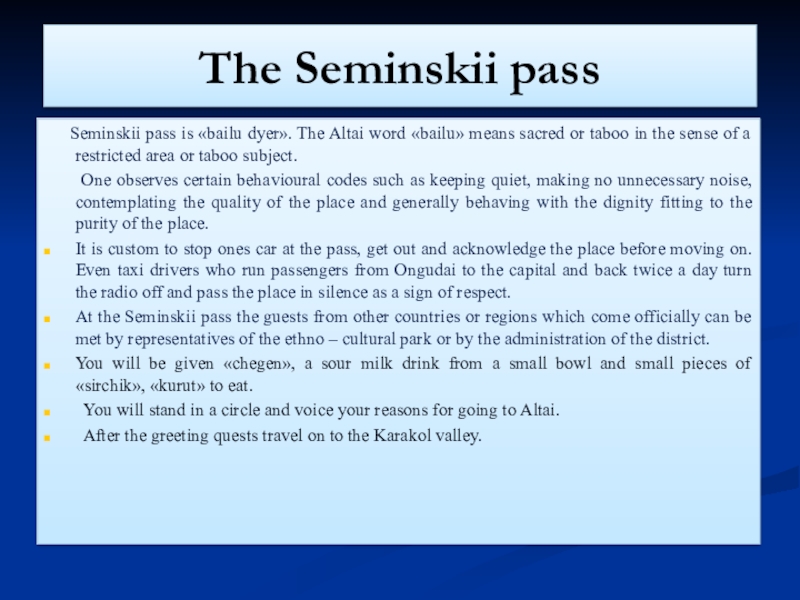
Ongudai is the Centre of the Altai Republic, then the Karakol Valley is the spiritual Center of Ongudai. The Karakol Valley is sacred land and has been considered so by the indigenous population for centuries.
The inhabitants of the valley are endowed with a unique understanding of this place and maintain a spiritual, almost blood relationship with the valley’s natural environment. The valley is home to whole groups of ancient kurgans (burial mounds) which together with the impressive rock carvings that decorate the foot of many of the valley’s sacred mountains represent Altai’s most tantalizing mysteries.
The park was set up to protect the indigenous people and their heritage and to work towards the return of ancient monuments previously removed from the valley in order to return it to its original form.
‘Karakol’ means ‘black hand’. No one can get explain why the valley is called ‘Karakol’. It is possible that ‘Kol’ refers to ‘lake’ and so ‘Karakol’ also means ‘black lake’.
Слайд 7‘Ooch Enmek’
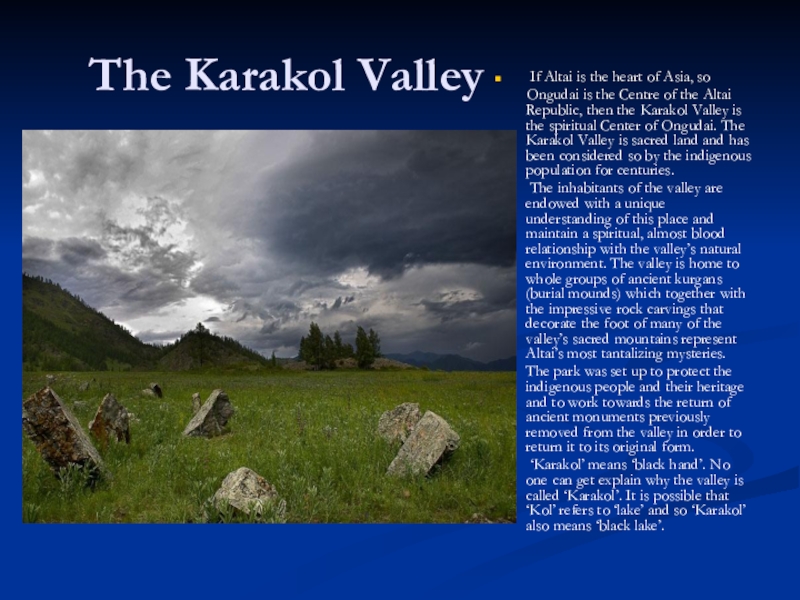
‘Ooch Enmek’s area is 60 thousand 551 hectares.
This is the first sacred place which attracts a lot of tourists. The Park is relatively young and was created only with much anxiety and discord among the indigenous community and village elders. The guests are informed that as many people were against the formation of the park and did not wish to allow tourists into some parts of the region at all. Don’t be surprised if some of the local people will look at you strangely or ignore you. Guests will be met by “skazitel”
Слайд 8‘Skazitel’
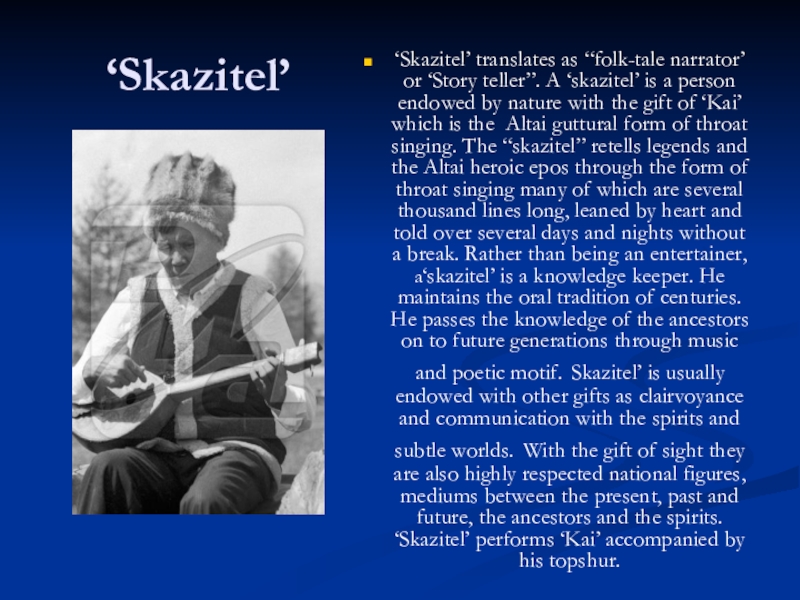
‘Skazitel’ translates as “folk-tale narrator’ or ‘Story teller”. A ‘skazitel’ is
a person endowed by nature with the gift of ‘Kai’ which is the Altai guttural form of throat singing. The “skazitel” retells legends and the Altai heroic epos through the form of throat singing many of which are several thousand lines long, leaned by heart and told over several days and nights without a break. Rather than being an entertainer, a‘skazitel’ is a knowledge keeper. He maintains the oral tradition of centuries. He passes the knowledge of the ancestors on to future generations through music and poetic motif. Skazitel’ is usually endowed with other gifts as clairvoyance and communication with the spirits and subtle worlds. With the gift of sight they are also highly respected national figures, mediums between the present, past and future, the ancestors and the spirits. ‘Skazitel’ performs ‘Kai’ accompanied by his topshur.
Слайд 9Topshur
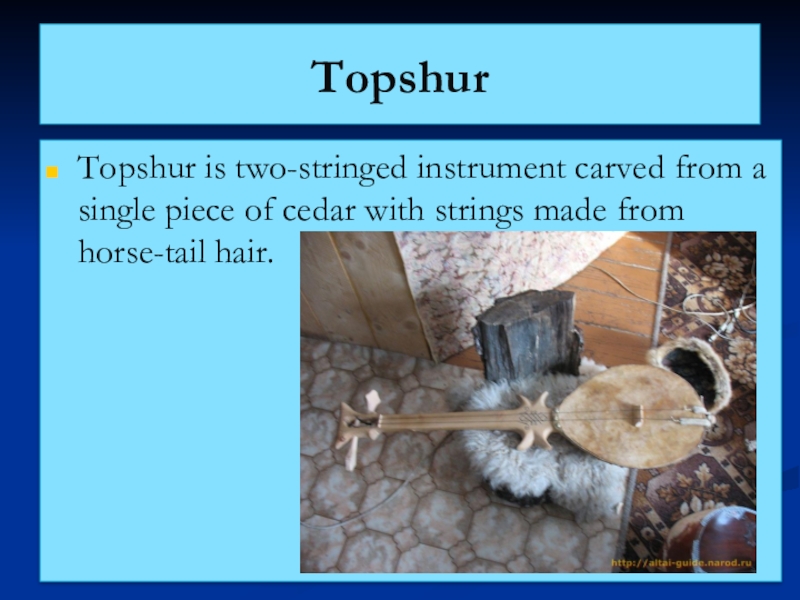
Topshur is two-stringed instrument carved from a single piece of cedar
with strings made from horse-tail hair.
Слайд 10Entering an “ail”
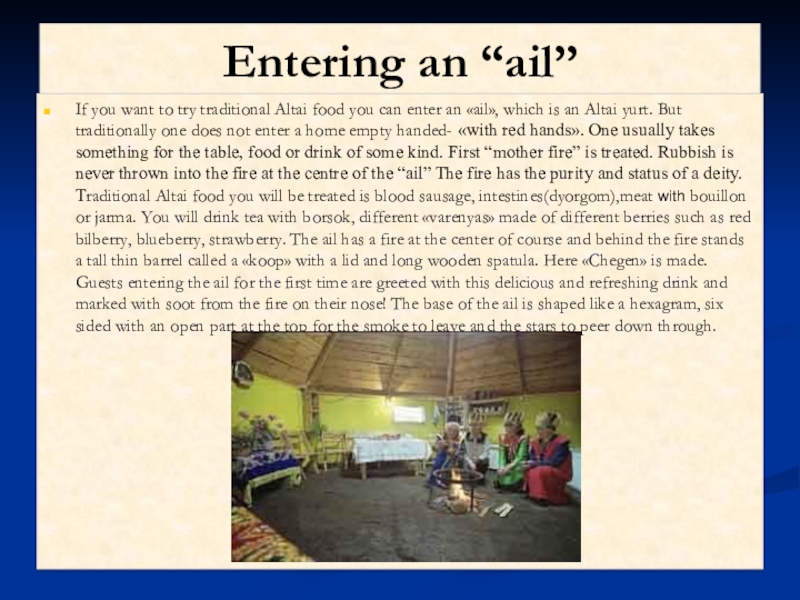
If you want to try traditional Altai food you
can enter an «ail», which is an Altai yurt. But traditionally one does not enter a home empty handed- «with red hands». One usually takes something for the table, food or drink of some kind. First “mother fire” is treated. Rubbish is never thrown into the fire at the centre of the “ail” The fire has the purity and status of a deity. Traditional Altai food you will be treated is blood sausage, intestines(dyorgom),meat with bouillon or jarma. You will drink tea with borsok, different «varenyas» made of different berries such as red bilberry, blueberry, strawberry. The ail has a fire at the center of course and behind the fire stands a tall thin barrel called a «koop» with a lid and long wooden spatula. Here «Chegen» is made. Guests entering the ail for the first time are greeted with this delicious and refreshing drink and marked with soot from the fire on their nose! The base of the ail is shaped like a hexagram, six sided with an open part at the top for the smoke to leave and the stars to peer down through.
Слайд 11Ongudai – geographical centre of the Republic Altai.
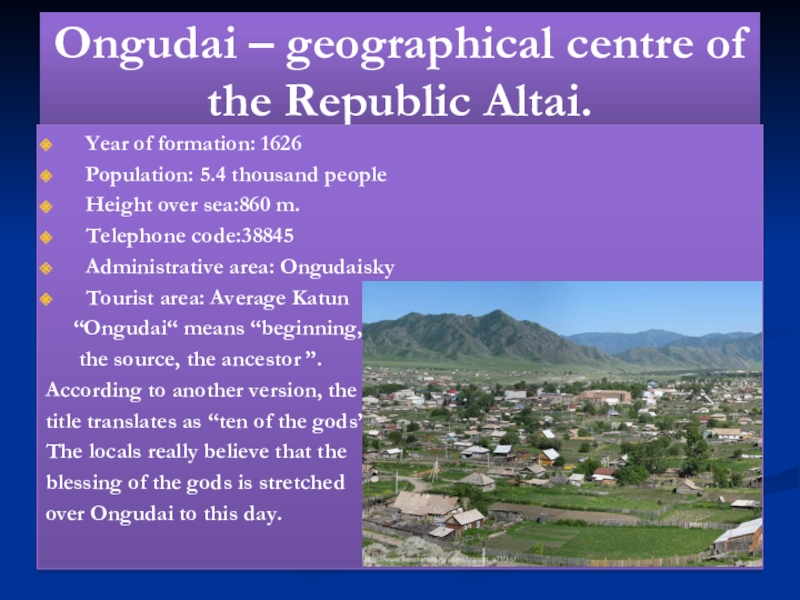
Year of formation: 1626
Population:
5.4 thousand people
Height over sea:860 m.
Telephone code:38845
Administrative area: Ongudaisky
Tourist area: Average Katun
“Ongudai“ means “beginning,
the source, the ancestor ”.
According to another version, the
title translates as “ten of the gods”.
The locals really believe that the
blessing of the gods is stretched
over Ongudai to this day.
Height over sea:860 m.
Telephone code:38845
Administrative area: Ongudaisky
Tourist area: Average Katun
“Ongudai“ means “beginning,
the source, the ancestor ”.
According to another version, the
title translates as “ten of the gods”.
The locals really believe that the
blessing of the gods is stretched
over Ongudai to this day.
Слайд 12History of Ongudai
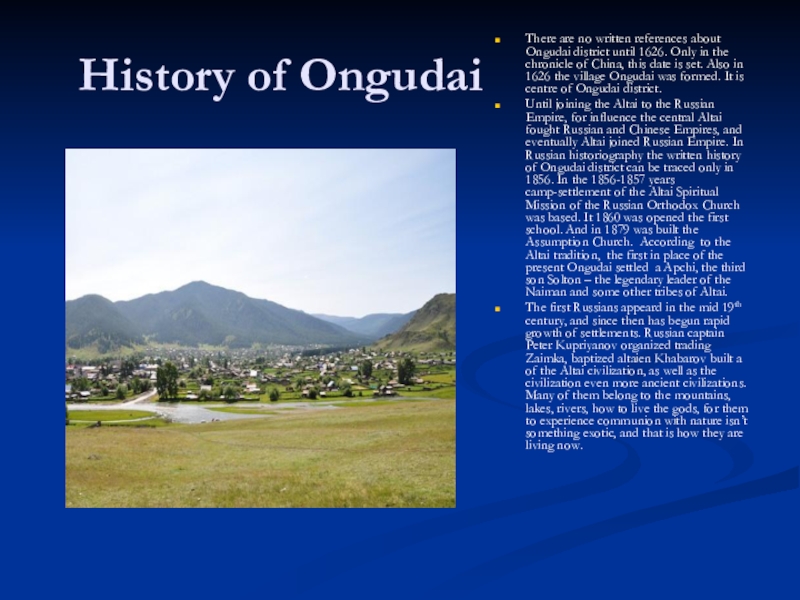
There are no written references about Ongudai district until
1626. Only in the chronicle of China, this date is set. Also in 1626 the village Ongudai was formed. It is centre of Ongudai district.
Until joining the Altai to the Russian Empire, for influence the central Altai fought Russian and Chinese Empires, and eventually Altai joined Russian Empire. In Russian historiography the written history of Ongudai district can be traced only in 1856. In the 1856-1857 years camp-settlement of the Altai Spiritual Mission of the Russian Orthodox Church was based. It 1860 was opened the first school. And in 1879 was built the Assumption Church. According to the Altai tradition, the first in place of the present Ongudai settled a Apchi, the third son Solton – the legendary leader of the Naiman and some other tribes of Altai.
The first Russians appeard in the mid 19th century, and since then has begun rapid growth of settlements. Russian captain Peter Kupriyanov organized trading Zaimka, baptized altaien Khabarov built a of the Altai civilization, as well as the civilization even more ancient civilizations. Many of them belong to the mountains, lakes, rivers, how to live the gods, for them to experience communion with nature isn’t something exotic, and that is how they are living now.
Until joining the Altai to the Russian Empire, for influence the central Altai fought Russian and Chinese Empires, and eventually Altai joined Russian Empire. In Russian historiography the written history of Ongudai district can be traced only in 1856. In the 1856-1857 years camp-settlement of the Altai Spiritual Mission of the Russian Orthodox Church was based. It 1860 was opened the first school. And in 1879 was built the Assumption Church. According to the Altai tradition, the first in place of the present Ongudai settled a Apchi, the third son Solton – the legendary leader of the Naiman and some other tribes of Altai.
The first Russians appeard in the mid 19th century, and since then has begun rapid growth of settlements. Russian captain Peter Kupriyanov organized trading Zaimka, baptized altaien Khabarov built a of the Altai civilization, as well as the civilization even more ancient civilizations. Many of them belong to the mountains, lakes, rivers, how to live the gods, for them to experience communion with nature isn’t something exotic, and that is how they are living now.
Слайд 13Сhike-Tamanskaya pass
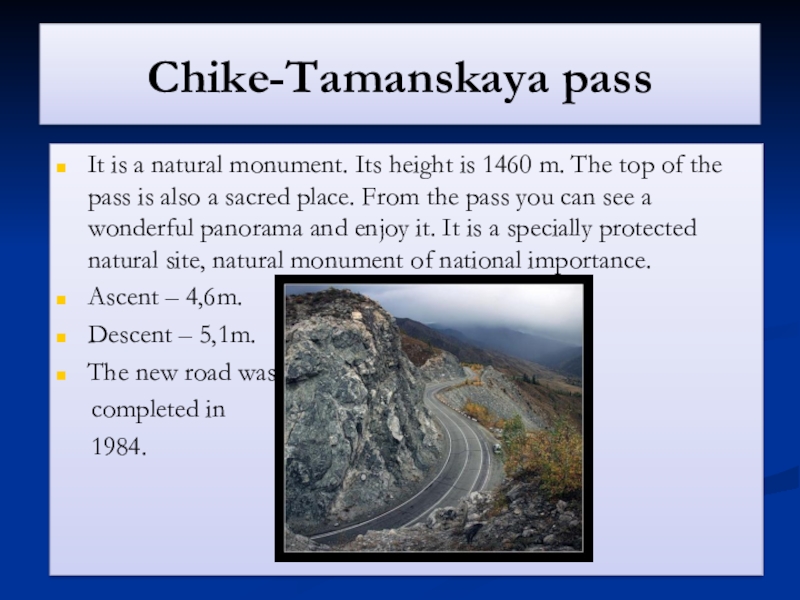
It is a natural monument. Its height is 1460 m.
The top of the pass is also a sacred place. From the pass you can see a wonderful panorama and enjoy it. It is a specially protected natural site, natural monument of national importance.
Ascent – 4,6m.
Descent – 5,1m.
The new road was
completed in
1984.
Ascent – 4,6m.
Descent – 5,1m.
The new road was
completed in
1984.
Слайд 14Confluence of the rivers Chuya and Katun.
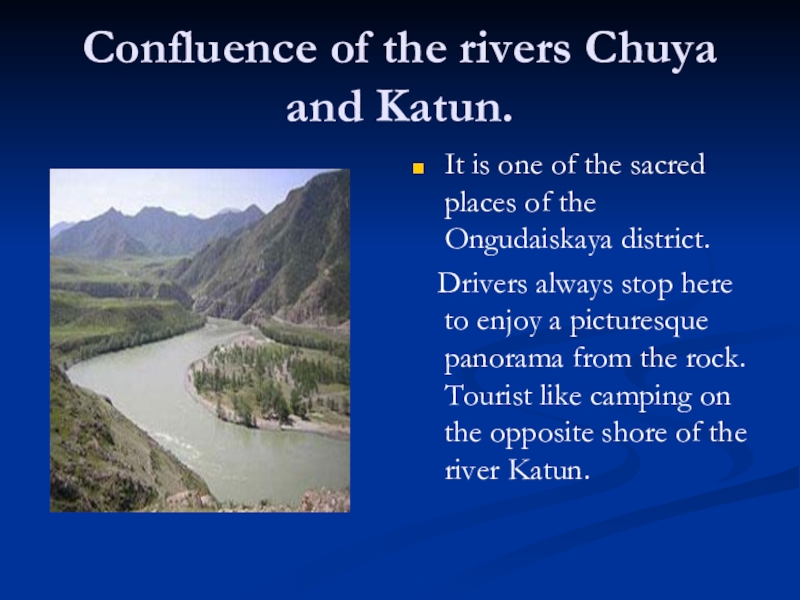
It is one of the
sacred places of the Ongudaiskaya district.
Drivers always stop here to enjoy a picturesque panorama from the rock. Tourist like camping on the opposite shore of the river Katun.
Drivers always stop here to enjoy a picturesque panorama from the rock. Tourist like camping on the opposite shore of the river Katun.
Слайд 15Rock art
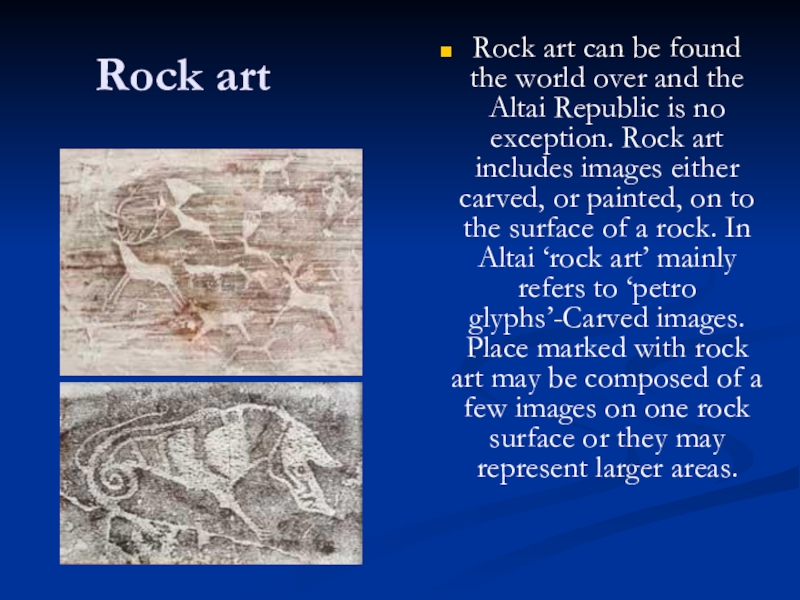
Rock art can be found the world over and the
Altai Republic is no exception. Rock art includes images either carved, or painted, on to the surface of a rock. In Altai ‘rock art’ mainly refers to ‘petro glyphs’-Carved images. Place marked with rock art may be composed of a few images on one rock surface or they may represent larger areas.
Слайд 16Kalbak - Tash
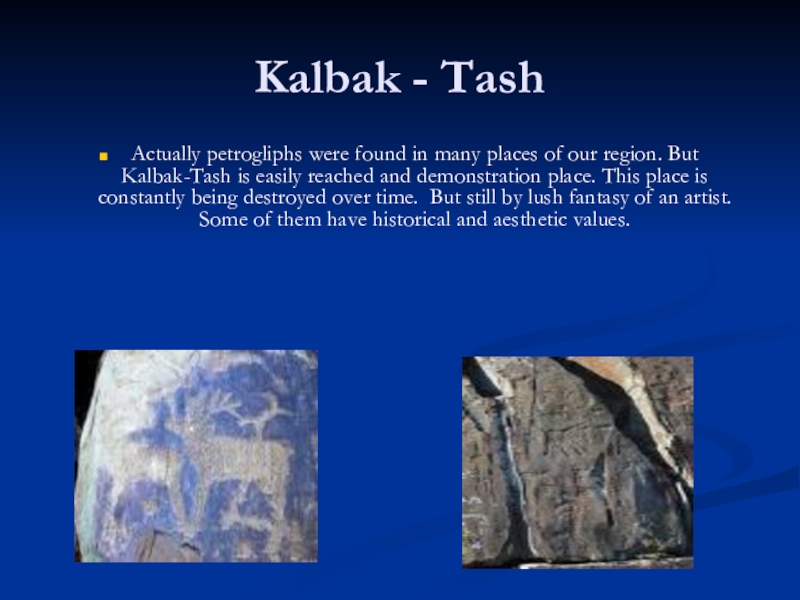
Actually petrogliphs were found in many places of our
region. But Kalbak-Tash is easily reached and demonstration place. This place is constantly being destroyed over time. But still by lush fantasy of an artist. Some of them have historical and aesthetic values.
Слайд 17Belyi – Boom (Ak – Boom)
Belyi – Bom is situated not
far from the village Iodro in Ongudai region. Belyi – Bom was based in 1818. It is famous for its monument, which stands right at the Chuyski trackt. This monument is devoted to the heroes of the Civil war. Many people were killed there.
They were soldiers of the Red Army.
They were soldiers of the Red Army.