Food in Russia and Britain
Finished: 9th grade student Alina Tukhvatullina
They say that in Britain there is no restaurant culture. In the middle of the day, when the British have an hour-long lunch break, people want to eat quickly and do not think about the quality of the food. Young people and families with children who eat at fast food restaurants are simply not interested in quality. As for coffee, it is terrible in Britain and people drink it not for pleasure, but in order to get their dose of caffeine.
Holidays and parties are held without special feasts, in contrast to how this happens in Russia. If a Briton expresses a desire to cook a barbecue, this does not mean that he wants to do it, it means that he just likes the atmosphere of barbecue.
The British people are mostly urban and have little idea of what can grow on earth. Therefore, the variety of plants that they eat is narrow. For most people, the idea of collecting wild plants for cooking is exotic. When the British want to hurt people from another country, they turn to them in accordance with their eating habits. For how strange the Germans are cooking cabbage, they are called ‘krauts’. Because the French eat frog legs, they are called ‘frogs’.
“If you are cold, tea will warm you. If you are hot - it will cool you. Tea will cheer you up if you are in a depressed mood, and if you are excited, it will calm you down. ” Herbert D. Gladstone, Prime Minister of Great Britain (1854-1930)
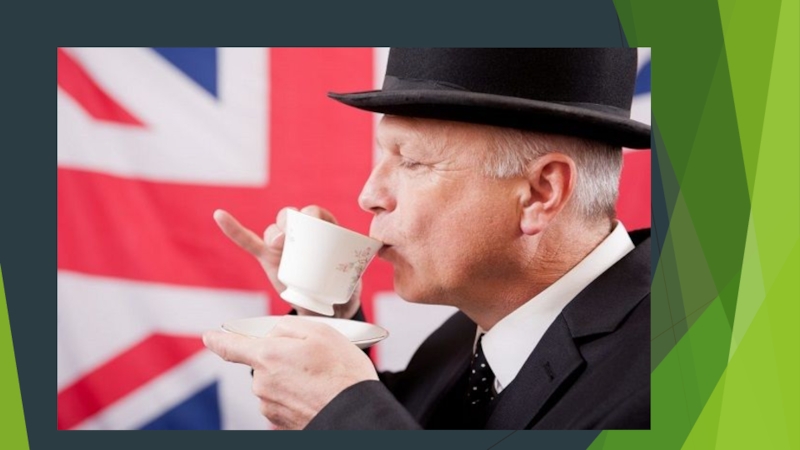
Of course, one cannot help but remember the English love for tea. The British drink almost 2 billion cups of tea per day. This is approximately 1040 cups of tea per year for one Briton.
For an Englishman, tea is not just a tradition, but a way of life. The English tradition of tea drinking originated in the 17th century, since then it has constantly evolved and improved.
Etiquette provides the following order of tea preparation: the water should be just boiled, the teapot should be warmed up, the tea leaf should be infused for 5-7 minutes, and the fragrant drink should be poured into elegant porcelain cups. Usually tea is brewed in porcelain teapots per one teaspoon of tea per person. Drink tea should only be fresh to feel pleasant astringency and catch the fragrant aroma of tea. Usually tea is drunk around 4-5 pm. There is a wide variety of teas in England, but the most popular variety is the English Breakfast. As a rule, milk and sugar are added to tea (optional).
Dishes from yeast dough - pies and pies, pastries, cakes
Sweets - delicious chocolate, ice cream (sold even in winter on the street), sweets (weighted), cookies (also sold from bags by weight).
Dairy products - fresh milk is also sold on the street from tanks, fermented baked milk is made from sour milk, curd products are common - curd mass (with dried apricots, prunes, raisins), cheese.
Other typical Russian dishes are pancakes (round with different fillings), pelmenib, and drying.
Festive and ceremonial dishes
Christmas - Coming
Shrovetide - pancakes with butter
Easter - Easter cake, eggs, Easter, do not eat hot dishes
wake - pancakes, kutya, white jelly
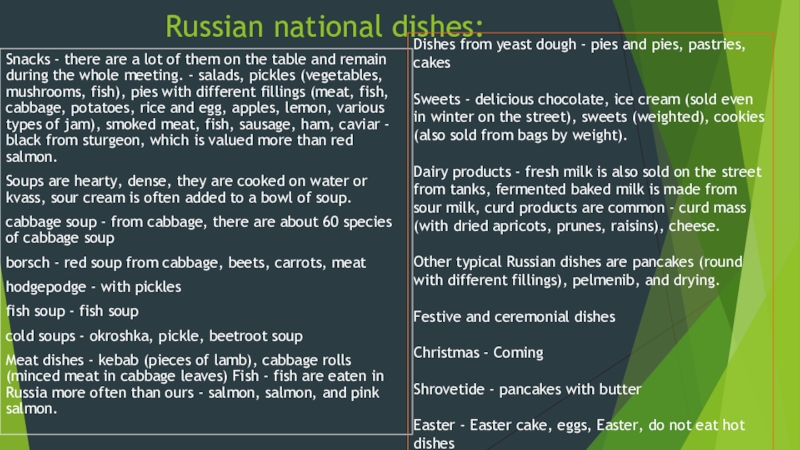
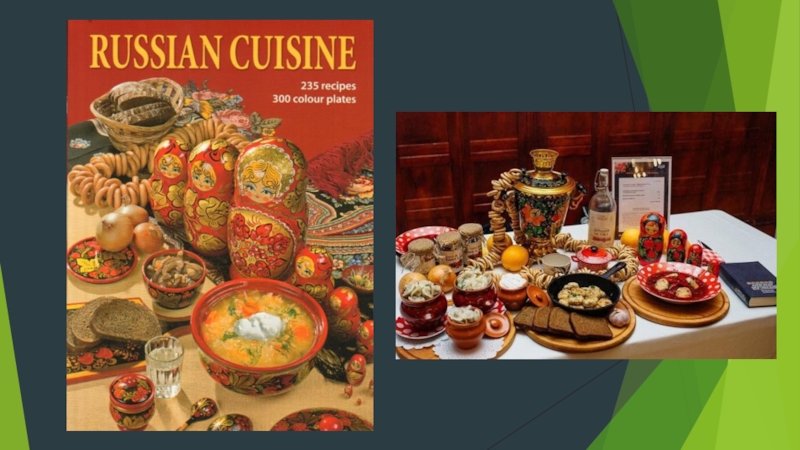
Tea is brewed in a special teapot, allowed to stand, and then the tea leaves are poured into cups and added with boiling water or tea is prepared in a samovar. Sweet tea is served for tea: jam (cherry is most appreciated), sweets, cakes, buns, cookies. Tea parties usually end the day, exchange news, talk about the events of the day, the whole family gathers for tea.
A samovar is a “self-heating appliance”. It consists of a “vase” (in it a brazier for coal with a pipe), handles, a hotplate of a teapot, a spout with a wrench. In each house, the samovar occupied an important place in the interior of the living room or dining room - during tea drinking it was put on the table or on a special table, the hostess or the eldest daughter poured tea. Samovars gradually began to look not like teapots, but like decorative vases, then they became simpler and stricter, and finally became electric. Today, the samovar has ceased to be a thing of prime necessity.
he attitude of Russians and British towards food is different, but there are common feature.Both Russians and British like fast food restaurants because it saves time and effort.
Both Russian and British cuisine have a wide variety of dishes, but in everyday life both Russians and British prefer not to cook complex dishes.
Both Russian and British are big sweet tooth. However, according to statistics, the British lead in the amount of sugar consumed per year.
Both Russians and British rarely go to restaurants, and if they do, it’s more likely to “go to a restaurant” rather than to eat. As mentioned earlier, they both eat more often in fast food restaurants.
Both there are also differences between Russian and British cuisine
For Russians, any holiday is a compulsory feast, usually with a lot of food and alcohol. The British prefer to celebrate holidays without a feast. It should also be noted that “feast’ is a reality related to Russian cuisine.
Bread is an integral part of the Russian table, any meal is necessary with bread. The British, as a rule, do not eat their dishes with bread; they use it to make sandwiches.
Tea is a British tradition, the first association that arises with English cuisine. The British approach with great responsibility to the preparation of this drink. Russians also love tea, but not as much as the British. The British do not really like coffee, and few of them know what real coffee tastes like. Russians, on the contrary, love coffee, in any large city you can find many small cozy coffee houses.
Это сайт презентаций, где можно хранить и обмениваться своими презентациями, докладами, проектами, шаблонами в формате PowerPoint с другими пользователями. Мы помогаем школьникам, студентам, учителям, преподавателям хранить и обмениваться учебными материалами.
Email: Нажмите что бы посмотреть