DISERTATIE
Îndrumător ştiinţific:
LECT.DR. DANIELA ŞORCARU
Absolvent:
Selemet Elena
Comrat
2016
- Главная
- Разное
- Образование
- Спорт
- Естествознание
- Природоведение
- Религиоведение
- Французский язык
- Черчение
- Английский язык
- Астрономия
- Алгебра
- Биология
- География
- Геометрия
- Детские презентации
- Информатика
- История
- Литература
- Математика
- Музыка
- МХК
- Немецкий язык
- ОБЖ
- Обществознание
- Окружающий мир
- Педагогика
- Русский язык
- Технология
- Физика
- Философия
- Химия
- Шаблоны, фоны, картинки для презентаций
- Экология
- Экономика
Презентация, доклад на тему An approach to media discourse:”Newspaper language”
Содержание
- 1. An approach to media discourse:”Newspaper language”
- 2. An approach to media discourse: ”Newspaper language”Comrat 2016
- 3. Contents FOREWORD CHAPTER 1. The elements of a news1.1.
- 4. Welcome!Three chapters Theoretical backgroundPractical aspects from linguistic
- 5. Foreword This dissertation studies newspaper discourse from
- 6. reasons why discourse analysis might interest youit
- 7. News lovers read newspapers84%8.1 million readers
- 8. Chapter 1The explanation of ‘’news" is the
- 9. Слайд 9
- 10. Headlines and leads Morley (1998:34) states that
- 11. Слайд 11
- 12. This guide (based on Dorothy Bowles’ and
- 13. SOME EXAMPLES In news reporting, however, this
- 14. Chapter 2The discourse topic of the text
- 15. Analyses of news textsA shooting incident in
- 16. Linguistic tools for the analysis of
- 17. Example: The Headline, “Mendis flown out as
- 18. The most obvious way in which they
- 19. Слайд 19
- 20. Table 1: vocabulary explaining the culling of
- 21. Chapter 3The articles originating from two popular
- 22. Слайд 22
- 23. Comparative analysis‘He died just 14 months after
- 24. ConclusionsOne of the major findings of this
- 25. Bell, Allan. 1991. The Language of News
An approach to media discourse: ”Newspaper language”Comrat 2016
Слайд 1UNIVERSITATEA “DUNĂREA DE JOS” GALAŢI FACULTATEA TRANSFRONTALIERĂ DE ŞTIINŢE UMANISTE, ECONOMICE ŞI
INGINEREŞTI

Слайд 3Contents
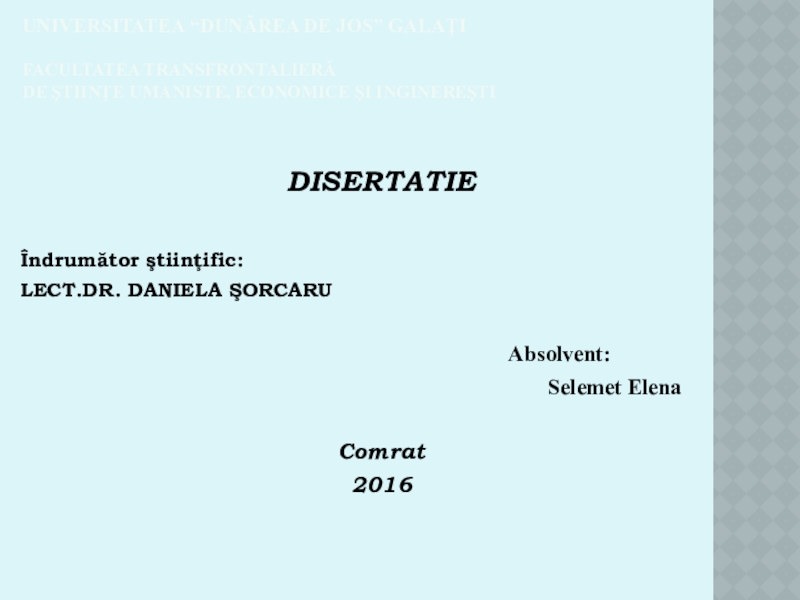
FOREWORD
CHAPTER 1. The elements of a news
1.1. Writing news stories
1.2. The
structure of newspaper articles
1.3. Newspaper language
1.4. The influence of newspaper
1.5. Headlines and leads
1.6. Quotations and reported speech
CHAPTER 2. Linguistic tools for the analysis of news
1.1.Themes and topics
2.2. Discourse topics
2. 3. Critical discourse analysis
2.4. Macrostructures
2. 5. Grammar and syntax
2.6. Objectivity
2.7. Analyses of news texts
1.3. Newspaper language
1.4. The influence of newspaper
1.5. Headlines and leads
1.6. Quotations and reported speech
CHAPTER 2. Linguistic tools for the analysis of news
1.1.Themes and topics
2.2. Discourse topics
2. 3. Critical discourse analysis
2.4. Macrostructures
2. 5. Grammar and syntax
2.6. Objectivity
2.7. Analyses of news texts
CHAPTER 3 Analysis of the articles
3.1.General remarks on the articles
3.2. Experimental meaning analysis
3.3. Experiential comparative analysis
3.4. Interpersonal meaning analysis
3.5. Grammar opinion
3.6. Textual meaning analysis
3.7. Lexico-grammatical analysis
3.8. Stylistic variation and context
CONCLUSIONS
REFERENCES
Слайд 4Welcome!
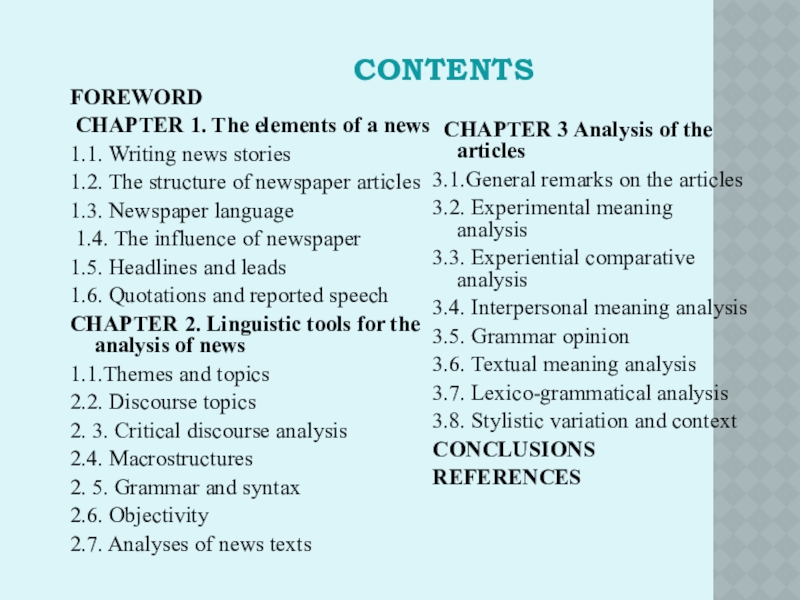
Three chapters
Theoretical background
Practical aspects from linguistic tools for the analysis
of news
Analysis of the articles
Examples and comparative analysis
Analysis of the articles
Examples and comparative analysis
Слайд 5Foreword
This dissertation studies newspaper discourse from a linguistic point of view.
Among
the key authors in the discipline, I will highlight, Fairclough, Bell, Allan, Van Dijk and Caldas –Coulthard , who represent the major approaches I refer to here. These scholars share interest areas such as control, literacy and advertising.
The theoretical part of this thesis consists of the characteristics of newspaper language, including sentence length and complexity, looks into the role and importance of headlines and leads. Chapter 2 analyzed texts through a Discourse Analysis and the nature of paragraphs in news stories will be analysis.
The last part of the work compares two newspaper articles and aims at identifying the main similarities and differences of the three systemic principal types of meanings.
The theoretical part of this thesis consists of the characteristics of newspaper language, including sentence length and complexity, looks into the role and importance of headlines and leads. Chapter 2 analyzed texts through a Discourse Analysis and the nature of paragraphs in news stories will be analysis.
The last part of the work compares two newspaper articles and aims at identifying the main similarities and differences of the three systemic principal types of meanings.
Слайд 6reasons why discourse analysis might interest you
it might be connected to
your life (job, family, friends and so on)
it can go on your CV
if you get interested in the subject you might want to take it further
so it’s worth starting to think about what you are interested in (linguistically)
it can go on your CV
if you get interested in the subject you might want to take it further
so it’s worth starting to think about what you are interested in (linguistically)

Слайд 8Chapter 1
The explanation of ‘’news" is the idea of chosen facts
on case which is presented by print, broadcast, Internet. What builds news?
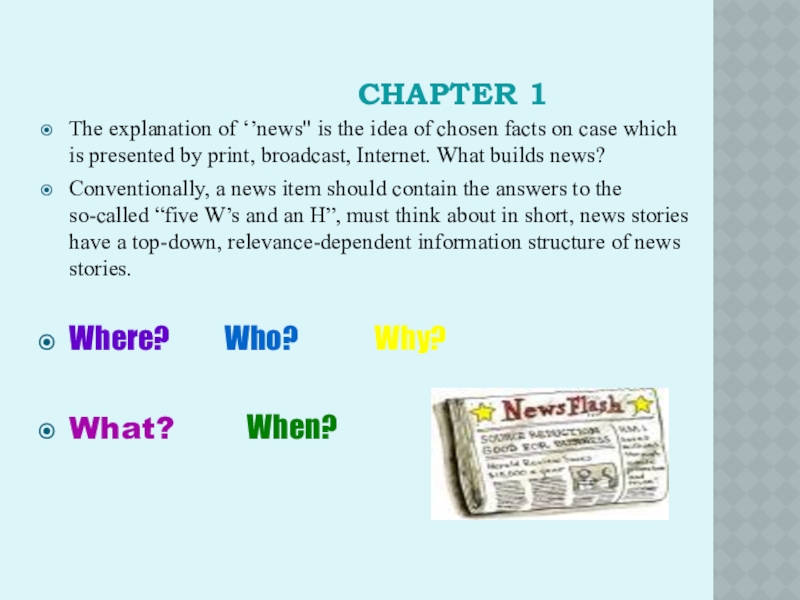
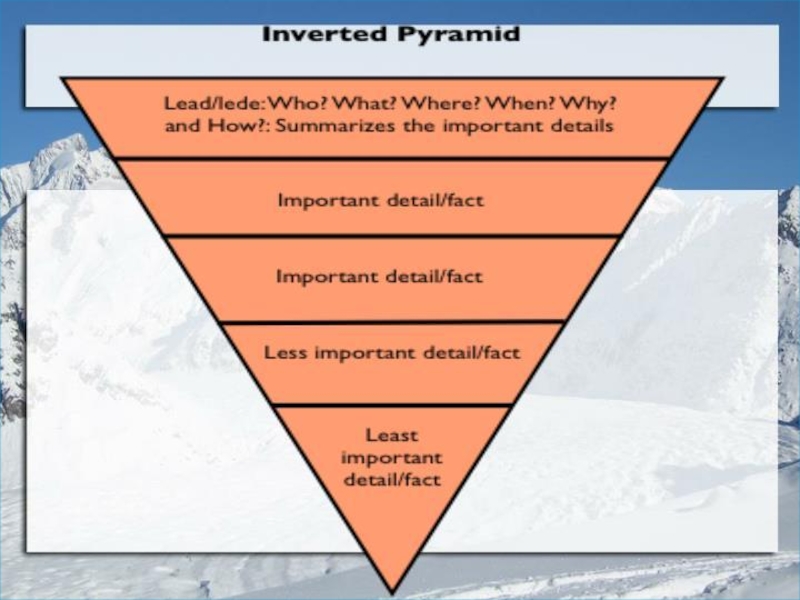
Conventionally, a news item should contain the answers to the so-called “five W’s and an H”, must think about in short, news stories have a top-down, relevance-dependent information structure of news stories.
Where? Who? Why?
What? When?
Conventionally, a news item should contain the answers to the so-called “five W’s and an H”, must think about in short, news stories have a top-down, relevance-dependent information structure of news stories.
Where? Who? Why?
What? When?
Слайд 10Headlines and leads
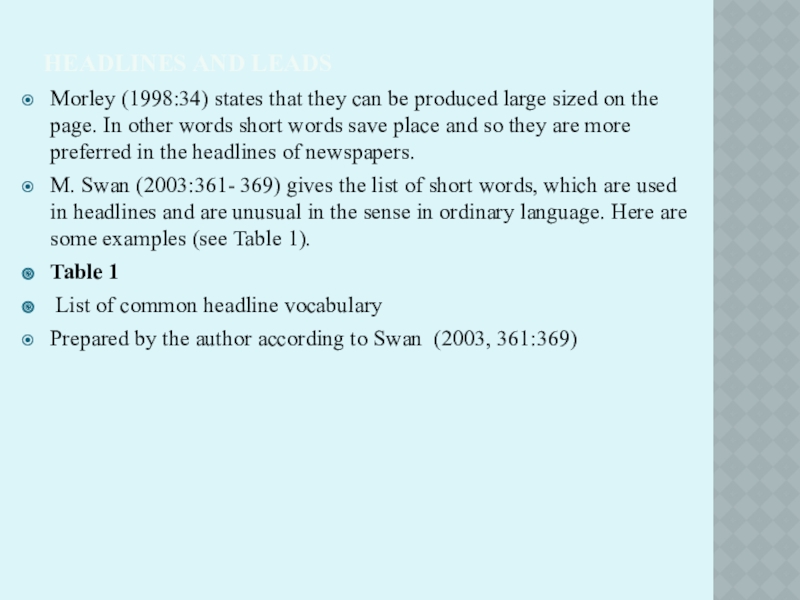
Morley (1998:34) states that they can be produced large
sized on the page. In other words short words save place and so they are more preferred in the headlines of newspapers.
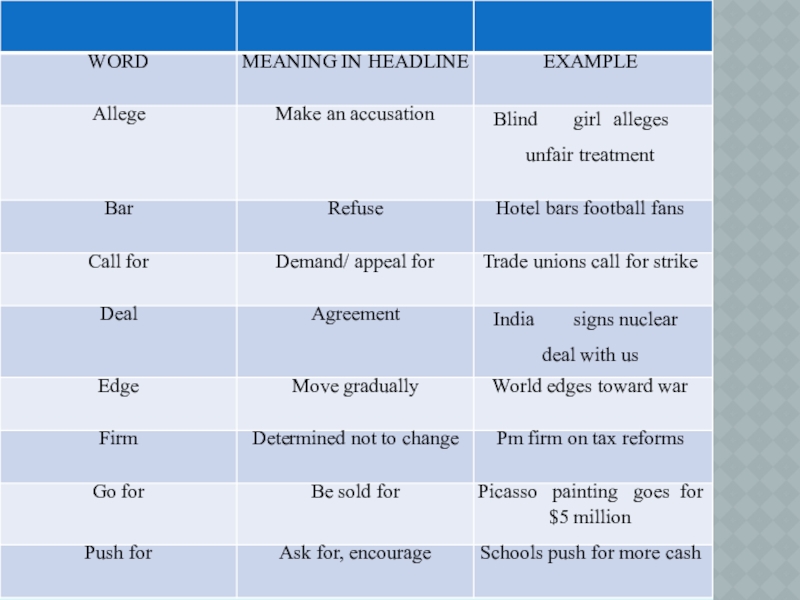
M. Swan (2003:361- 369) gives the list of short words, which are used in headlines and are unusual in the sense in ordinary language. Here are some examples (see Table 1).
Table 1
List of common headline vocabulary
Prepared by the author according to Swan (2003, 361:369)
M. Swan (2003:361- 369) gives the list of short words, which are used in headlines and are unusual in the sense in ordinary language. Here are some examples (see Table 1).
Table 1
List of common headline vocabulary
Prepared by the author according to Swan (2003, 361:369)
Слайд 12This guide (based on Dorothy Bowles’ and Diane Borden’s Creative Editing,
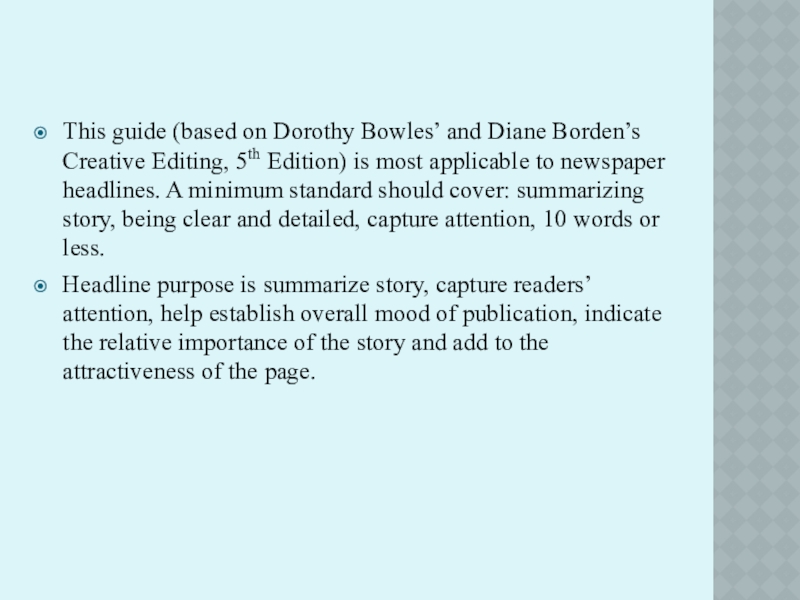
5th Edition) is most applicable to newspaper headlines. A minimum standard should cover: summarizing story, being clear and detailed, capture attention, 10 words or less.
Headline purpose is summarize story, capture readers’ attention, help establish overall mood of publication, indicate the relative importance of the story and add to the attractiveness of the page.
Headline purpose is summarize story, capture readers’ attention, help establish overall mood of publication, indicate the relative importance of the story and add to the attractiveness of the page.
Слайд 13SOME EXAMPLES
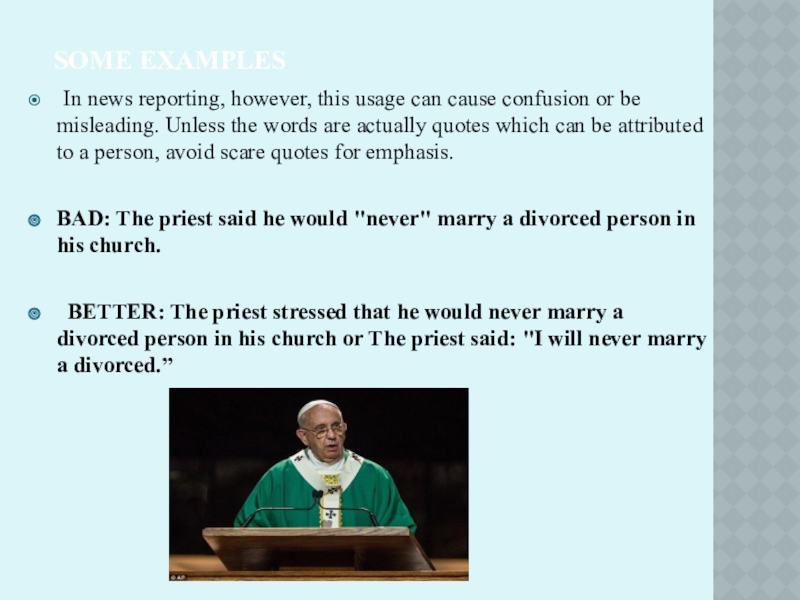
In news reporting, however, this usage can cause confusion
or be misleading. Unless the words are actually quotes which can be attributed to a person, avoid scare quotes for emphasis.
BAD: The priest said he would "never" marry a divorced person in his church.
BETTER: The priest stressed that he would never marry a divorced person in his church or The priest said: "I will never marry a divorced.’’
BAD: The priest said he would "never" marry a divorced person in his church.
BETTER: The priest stressed that he would never marry a divorced person in his church or The priest said: "I will never marry a divorced.’’
Слайд 14Chapter 2
The discourse topic of the text may be expressed in
the headline .This study is based on examining the articles in the six different newspapers by evaluating, for instance, the transitivity of the sentences, and the active and passive voice used in the articles.
Fowler “identifies a variety of grammatical means for conveying modal commitments, amongst which are contained modal auxiliaries, modal adverbs, evaluative adjectives, generic sentences and verbs of knowledge.
Nominalization, according to Fowler, regularly permits “habits of concealment, particularly in the areas of power relations and writers' attitudes” . Permutation, initialization and utterance context are analyzed in the articles as well as metaphors and lexico -semantic manipulation.
Fowler “identifies a variety of grammatical means for conveying modal commitments, amongst which are contained modal auxiliaries, modal adverbs, evaluative adjectives, generic sentences and verbs of knowledge.
Nominalization, according to Fowler, regularly permits “habits of concealment, particularly in the areas of power relations and writers' attitudes” . Permutation, initialization and utterance context are analyzed in the articles as well as metaphors and lexico -semantic manipulation.
Слайд 15Analyses of news texts
A shooting incident in Mosul, Iraq, April 15
2003
The Daily Telegraph April
When reading article the conclusion could be drawn that the text will be show signs of being negative towards US troops. Hence give the headline the interpretation ‘US fired on demonstrators’.
This was perhaps not the purpose, after all the rest of the article principally can be read as favorable to the American version of the action.The newspaper avoids accusing US troops of the killing of people by the use of syntactic meaning such as the passive voice and deletion of the actor: “At least 10 people were shot dead when American troops opened fire on killer.”
The Daily Telegraph April
When reading article the conclusion could be drawn that the text will be show signs of being negative towards US troops. Hence give the headline the interpretation ‘US fired on demonstrators’.
This was perhaps not the purpose, after all the rest of the article principally can be read as favorable to the American version of the action.The newspaper avoids accusing US troops of the killing of people by the use of syntactic meaning such as the passive voice and deletion of the actor: “At least 10 people were shot dead when American troops opened fire on killer.”
Слайд 16
Linguistic tools for the analysis of news.
The theme is what the
sentence is ‘about’ It occupies an informational hefty position in the sentence. The theme is usually the first element in the sentence. The rest of the sentence is called “the rhyme”.
John gave flowers to Mary.
Mary got flowers from John.
In the first sentence above, John is the theme and the sentence can be said to be ‘’about” John. The remaining part of the sentences,’ ’gave flowers to Mary”, is the rheme .In the second sentence, Mary is the theme and ‘’got flowers from John «the rheme.
Fries write:” Theme is the orienteer to the message conveyed by the clause. It tells the reader how to understand the news conveyed by the clause’’ (1994, 234)
John gave flowers to Mary.
Mary got flowers from John.
In the first sentence above, John is the theme and the sentence can be said to be ‘’about” John. The remaining part of the sentences,’ ’gave flowers to Mary”, is the rheme .In the second sentence, Mary is the theme and ‘’got flowers from John «the rheme.
Fries write:” Theme is the orienteer to the message conveyed by the clause. It tells the reader how to understand the news conveyed by the clause’’ (1994, 234)
Слайд 17Example: The Headline, “Mendis flown out as police face ‘rentamob’ fury,”
expresses two macro-propositions (topics):
1-Mendis is deported (by plane) and (at the same time) the police are confronted with the angry reactions of protesters.
These two propositions summarize the main information of the text. Thereby signal that for the Mail both events are important. Other newspapers may only highlight the event of the expulsion. It is characteristic of a right-wing tabloid like the Mail that little attention is paid to the social or political background of the events, whereas relatively many details are given about the demonstrators and their Labor supporters. Information in the Verbal Reactions category is limited to the negative opinions of a policeman about the “great unwashed.”
This also shows that news gathering and quotation in news are often biased through the choice of sources. Here, Demonstrators and Mendis are not allowed to speak the Comment category is additional descriptions expressed discontinuously throughout the text here, by the various negative descriptions of the demonstrators and their Labour supporters.
Слайд 18The most obvious way in which they differ is the way
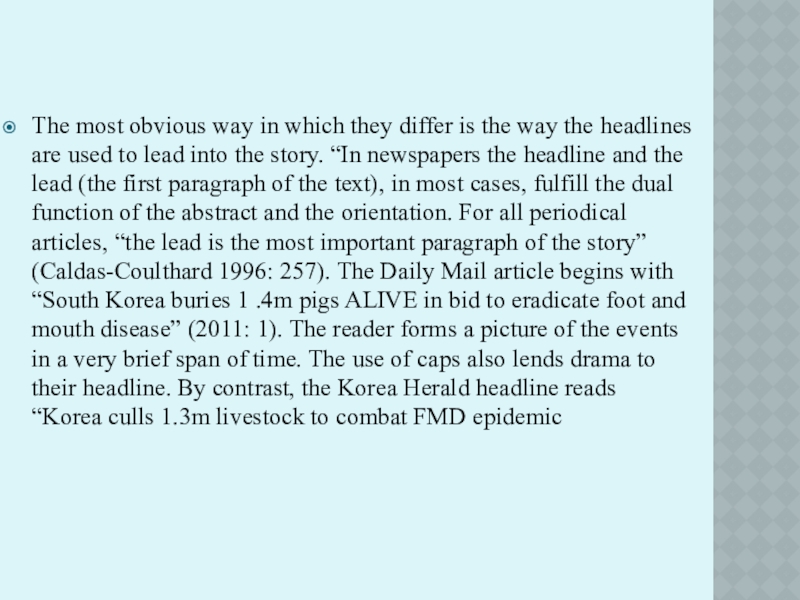
the headlines are used to lead into the story. “In newspapers the headline and the lead (the first paragraph of the text), in most cases, fulfill the dual function of the abstract and the orientation. For all periodical articles, “the lead is the most important paragraph of the story” (Caldas-Coulthard 1996: 257). The Daily Mail article begins with “South Korea buries 1 .4m pigs ALIVE in bid to eradicate foot and mouth disease” (2011: 1). The reader forms a picture of the events in a very brief span of time. The use of caps also lends drama to their headline. By contrast, the Korea Herald headline reads “Korea culls 1.3m livestock to combat FMD epidemic
Слайд 20Table 1: vocabulary explaining the culling of animals
In contrast, to the
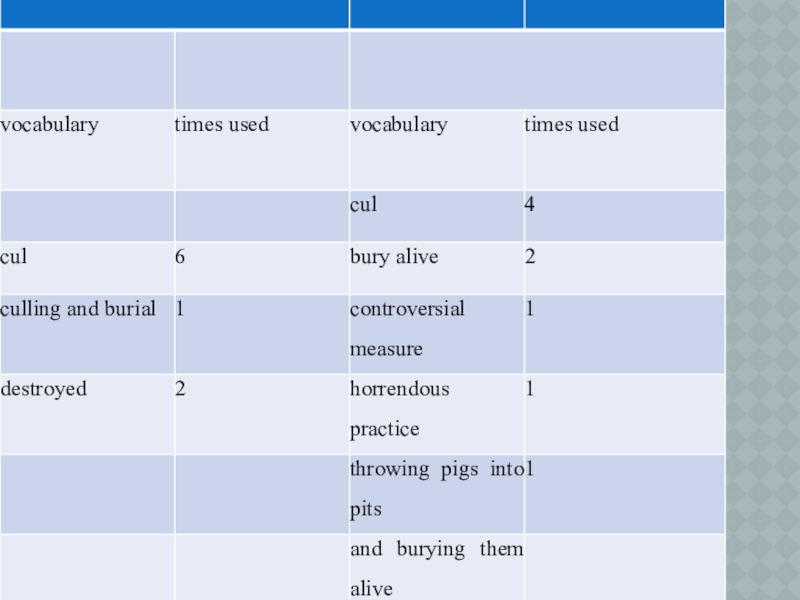
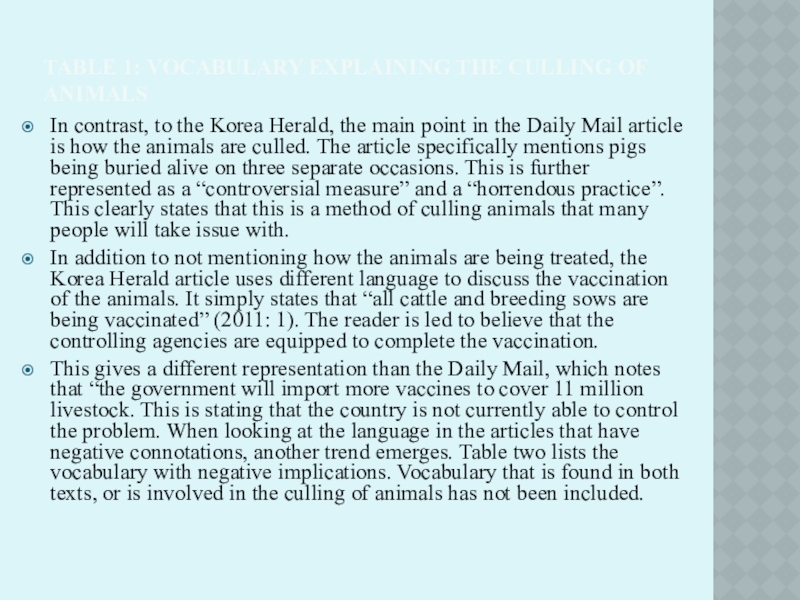
Korea Herald, the main point in the Daily Mail article is how the animals are culled. The article specifically mentions pigs being buried alive on three separate occasions. This is further represented as a “controversial measure” and a “horrendous practice”. This clearly states that this is a method of culling animals that many people will take issue with.
In addition to not mentioning how the animals are being treated, the Korea Herald article uses different language to discuss the vaccination of the animals. It simply states that “all cattle and breeding sows are being vaccinated” (2011: 1). The reader is led to believe that the controlling agencies are equipped to complete the vaccination.
This gives a different representation than the Daily Mail, which notes that “the government will import more vaccines to cover 11 million livestock. This is stating that the country is not currently able to control the problem. When looking at the language in the articles that have negative connotations, another trend emerges. Table two lists the vocabulary with negative implications. Vocabulary that is found in both texts, or is involved in the culling of animals has not been included.
In addition to not mentioning how the animals are being treated, the Korea Herald article uses different language to discuss the vaccination of the animals. It simply states that “all cattle and breeding sows are being vaccinated” (2011: 1). The reader is led to believe that the controlling agencies are equipped to complete the vaccination.
This gives a different representation than the Daily Mail, which notes that “the government will import more vaccines to cover 11 million livestock. This is stating that the country is not currently able to control the problem. When looking at the language in the articles that have negative connotations, another trend emerges. Table two lists the vocabulary with negative implications. Vocabulary that is found in both texts, or is involved in the culling of animals has not been included.
Слайд 21Chapter 3
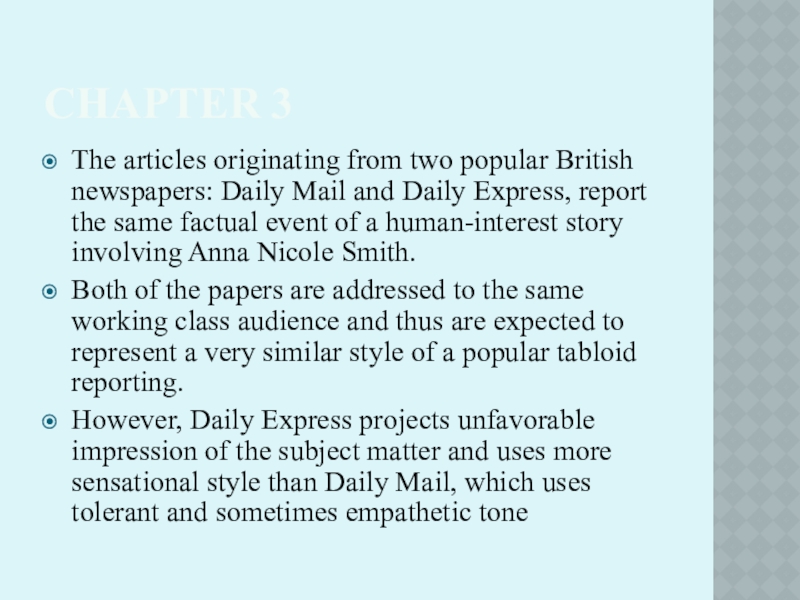
The articles originating from two popular British newspapers: Daily Mail
and Daily Express, report the same factual event of a human-interest story involving Anna Nicole Smith.
Both of the papers are addressed to the same working class audience and thus are expected to represent a very similar style of a popular tabloid reporting.
However, Daily Express projects unfavorable impression of the subject matter and uses more sensational style than Daily Mail, which uses tolerant and sometimes empathetic tone
Both of the papers are addressed to the same working class audience and thus are expected to represent a very similar style of a popular tabloid reporting.
However, Daily Express projects unfavorable impression of the subject matter and uses more sensational style than Daily Mail, which uses tolerant and sometimes empathetic tone
Слайд 23Comparative analysis
‘He died just 14 months after they married and she
then faced a ten-year battle for a share of his £800 million fortune.’ (DM) she (Participant / Actor) then (Circumstance of location in time / adverb) faced (Material Process) a ten-year battle (Participant / Range)
‘She remained in the headlines after his death the following year when she began acrimonious legal battle over his $1.6 billion estate with his family, who painted her as gold digger.’ (DE) when (subordinating conjunction) she (Participant / Actor) began (Material Process) acrimonious legal battle (Participant / Range)
Although both of the analyzed clause complexes are factual, they cultivate a very different impression of Ms Smith who is an actor in both cases.
The essential difference between the sentences is the choice of lexis to describe the material processes. Daily Mail uses verb ‘faced’, while Daily Express ‘began’.
‘She remained in the headlines after his death the following year when she began acrimonious legal battle over his $1.6 billion estate with his family, who painted her as gold digger.’ (DE) when (subordinating conjunction) she (Participant / Actor) began (Material Process) acrimonious legal battle (Participant / Range)
Although both of the analyzed clause complexes are factual, they cultivate a very different impression of Ms Smith who is an actor in both cases.
The essential difference between the sentences is the choice of lexis to describe the material processes. Daily Mail uses verb ‘faced’, while Daily Express ‘began’.
Слайд 24Conclusions
One of the major findings of this study is that the
discourse topic is a very practical tool in the determination of possible bias residing in headlines and leads. By comparing the discourse topic with the contents of the headline and lead, it is possible to discover if they are neutral or focus the story in a «biased” direction.
The role of scare quotes in the realization of bias is, perhaps, more significant than what might have been expected. Grammatical and syntactic means, in contrast, are not in a prominent position in the representation of things in the articles analyzed.
Final chapter provides conclusions on how the texts are similar and how they are different in terms of their general stylistic properties and their communicative functionality based on analysis carried out in the essay. The referencing used throughout assignment is as follows: DM: Daily Mail, DE: Daily Express
The most important results of the analysis of the articles will now be summarized, beginning with a discussion of the overall attitude of the articles and followed by comments on each presentational feature.
The role of scare quotes in the realization of bias is, perhaps, more significant than what might have been expected. Grammatical and syntactic means, in contrast, are not in a prominent position in the representation of things in the articles analyzed.
Final chapter provides conclusions on how the texts are similar and how they are different in terms of their general stylistic properties and their communicative functionality based on analysis carried out in the essay. The referencing used throughout assignment is as follows: DM: Daily Mail, DE: Daily Express
The most important results of the analysis of the articles will now be summarized, beginning with a discussion of the overall attitude of the articles and followed by comments on each presentational feature.
Слайд 25
Bell, Allan. 1991. The Language of News Media. Oxford: Blackwell. Bolinger,
Dwight. 1980. Language – The Loaded Weapon. London: Longman. Morley (1998:33)
Brown, Gillian & George Yule. 1983. Discourse Analysis. Cambridge: Cambridge University Press.
Bülow-Møller, Anne-Marie. 1989. The Textlinguistic Omnibus: A Survey of Methods for Analysis. København: Nyt Nordisk Forlag Arnold Busck.
This powerpoint was kindly donated to
https://www.google.com/#q=powerpoint
Brown, Gillian & George Yule. 1983. Discourse Analysis. Cambridge: Cambridge University Press.
Bülow-Møller, Anne-Marie. 1989. The Textlinguistic Omnibus: A Survey of Methods for Analysis. København: Nyt Nordisk Forlag Arnold Busck.
This powerpoint was kindly donated to
https://www.google.com/#q=powerpoint
References