can be:
∙noun clauses:
I know that he'll be a little late.
∙relative clauses:
Show me the pictures which you took.
∙adverbial clauses (clauses of time, place, manner, reason, concession, purpose, result, comparison, condition)
He left early so as not to miss the bus.
- Главная
- Разное
- Образование
- Спорт
- Естествознание
- Природоведение
- Религиоведение
- Французский язык
- Черчение
- Английский язык
- Астрономия
- Алгебра
- Биология
- География
- Геометрия
- Детские презентации
- Информатика
- История
- Литература
- Математика
- Музыка
- МХК
- Немецкий язык
- ОБЖ
- Обществознание
- Окружающий мир
- Педагогика
- Русский язык
- Технология
- Физика
- Философия
- Химия
- Шаблоны, фоны, картинки для презентаций
- Экология
- Экономика
Презентация, доклад на тему Adjective ( 7 form)
Содержание
- 1. Adjective ( 7 form)
- 2. 08/15/2020Relative ClausesRelative clauses are introduced by:a) relative
- 3. 08/15/2020✷Object of the verb of the relative
- 4. 08/15/2020Possession ( WHOSE )( cannot be omitted
- 5. 08/15/2020Whom, which, whose can be used in
- 6. 08/15/2020Relative AdverbsTime → when (=
- 7. 08/15/2020Prepositions in Relative Clauses We do not
- 8. 08/15/2020Fill in: where, whose, who, which, why
- 9. 08/15/2020A travel companion 7) ............ likes the
- 10. 08/15/2020The place where you went is my
- 11. 08/15/2020Defining / Non-defining Relative ClausesA defining relative
- 12. 08/15/2020The employees who get a salary have
- 13. 08/15/2020WHICH Which can refer not only
- 14. 08/15/2020What is the difference between these sentences?▶
- 15. 08/15/2020▶ I had a cocktail, which was
- 16. 08/15/2020 In Other WordsThat's the town I
- 17. 08/15/2020⇨ Complete the sentences using the words
- 18. 08/15/20203. That woman complained to the manager.
- 19. 08/15/20206. Clare Spender is the author; her book
- 20. 08/15/2020She has a class of twenty students;
08/15/2020Relative ClausesRelative clauses are introduced by:a) relative pronouns, i.e. who, whom, whose, which or that or b) relative adverbs i.e. when, where or why.Relative Pronouns ✷Subject of the verb of the relative clause (can not
Слайд 208/15/2020
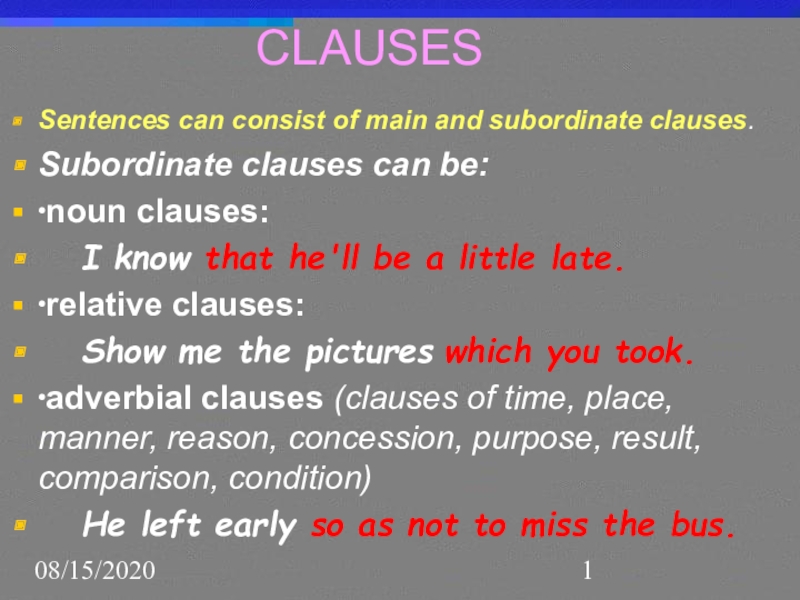
Relative Clauses
Relative clauses are introduced by:
a) relative pronouns, i.e. who, whom,
whose, which or that or
b) relative adverbs i.e. when, where or why.
Relative Pronouns
✷Subject of the verb of the relative clause
(can not be omitted)
Used for people who / that
That's the man who / that stole the money.
Used for things / animals which / that
I read a book which / that was written by Samuel Johnson.
b) relative adverbs i.e. when, where or why.
Relative Pronouns
✷Subject of the verb of the relative clause
(can not be omitted)
Used for people who / that
That's the man who / that stole the money.
Used for things / animals which / that
I read a book which / that was written by Samuel Johnson.
Слайд 308/15/2020
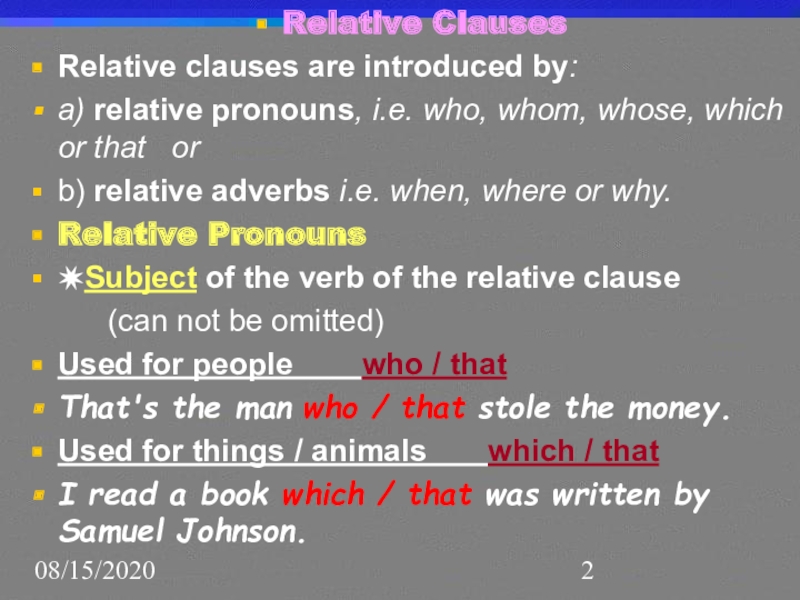
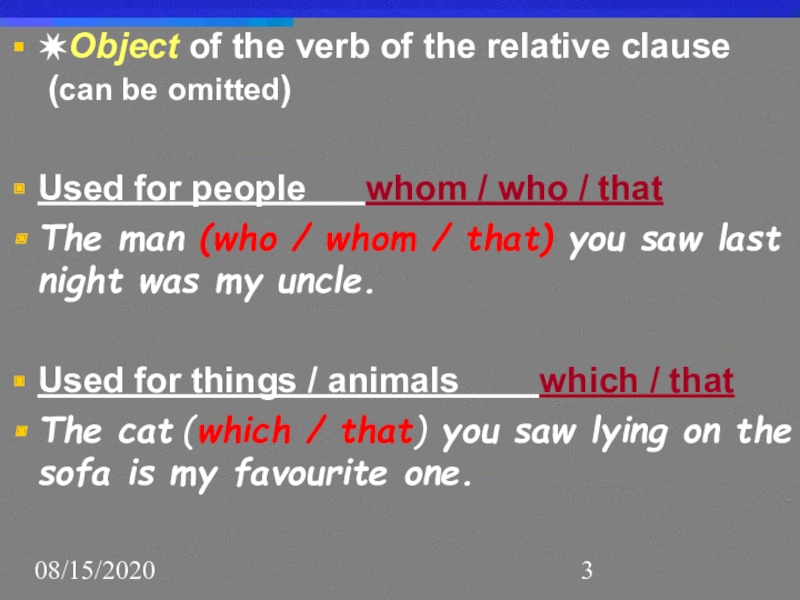
✷Object of the verb of the relative clause (can be omitted)
Used
for people whom / who / that
The man (who / whom / that) you saw last night was my uncle.
Used for things / animals which / that
The cat (which / that) you saw lying on the sofa is my favourite one.
The man (who / whom / that) you saw last night was my uncle.
Used for things / animals which / that
The cat (which / that) you saw lying on the sofa is my favourite one.
Слайд 408/15/2020
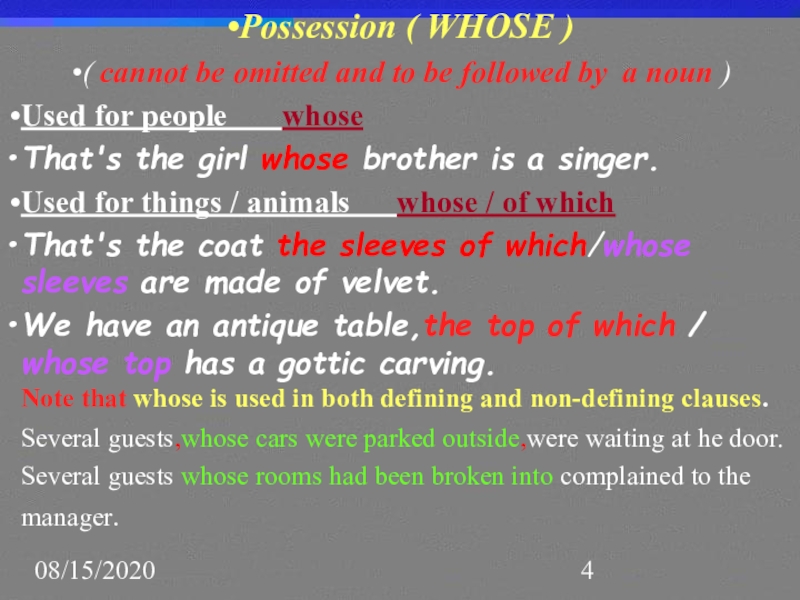
Possession ( WHOSE )
( cannot be omitted and to be followed
by a noun )
Used for people whose
That's the girl whose brother is a singer.
Used for things / animals whose / of which
That's the coat the sleeves of which/whose sleeves are made of velvet.
We have an antique table,the top of which / whose top has a gottic carving.
Note that whose is used in both defining and non-defining clauses.
Several guests,whose cars were parked outside,were waiting at he door.
Several guests whose rooms had been broken into complained to the manager.
Used for people whose
That's the girl whose brother is a singer.
Used for things / animals whose / of which
That's the coat the sleeves of which/whose sleeves are made of velvet.
We have an antique table,the top of which / whose top has a gottic carving.
Note that whose is used in both defining and non-defining clauses.
Several guests,whose cars were parked outside,were waiting at he door.
Several guests whose rooms had been broken into complained to the manager.
Слайд 508/15/2020
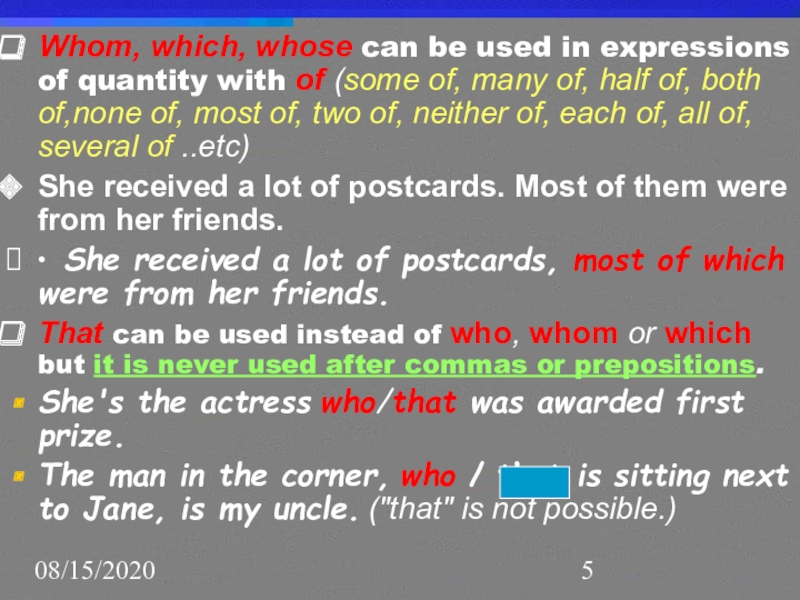
Whom, which, whose can be used in expressions of quantity with
of (some of, many of, half of, both of,none of, most of, two of, neither of, each of, all of, several of ..etc)
She received a lot of postcards. Most of them were from her friends.
∙ She received a lot of postcards, most of which were from her friends.
That can be used instead of who, whom or which but it is never used after commas or prepositions.
She's the actress who/that was awarded first prize.
The man in the corner, who / that is sitting next to Jane, is my uncle. ("that" is not possible.)
She received a lot of postcards. Most of them were from her friends.
∙ She received a lot of postcards, most of which were from her friends.
That can be used instead of who, whom or which but it is never used after commas or prepositions.
She's the actress who/that was awarded first prize.
The man in the corner, who / that is sitting next to Jane, is my uncle. ("that" is not possible.)
Слайд 608/15/2020
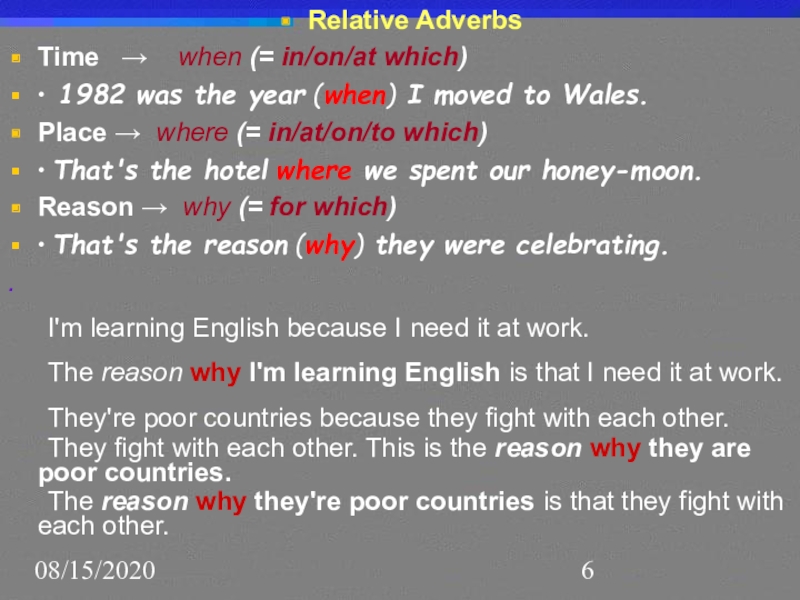
Relative Adverbs
Time → when (= in/on/at which)
∙ 1982 was the year (when) I moved to Wales.
Place → where (= in/at/on/to which)
∙ That's the hotel where we spent our honey-moon.
Reason → why (= for which)
∙ That's the reason (why) they were celebrating.
.
I'm learning English because I need it at work.
The reason why I'm learning English is that I need it at work.
They're poor countries because they fight with each other.
They fight with each other. This is the reason why they are poor countries.
The reason why they're poor countries is that they fight with each other.
Слайд 708/15/2020
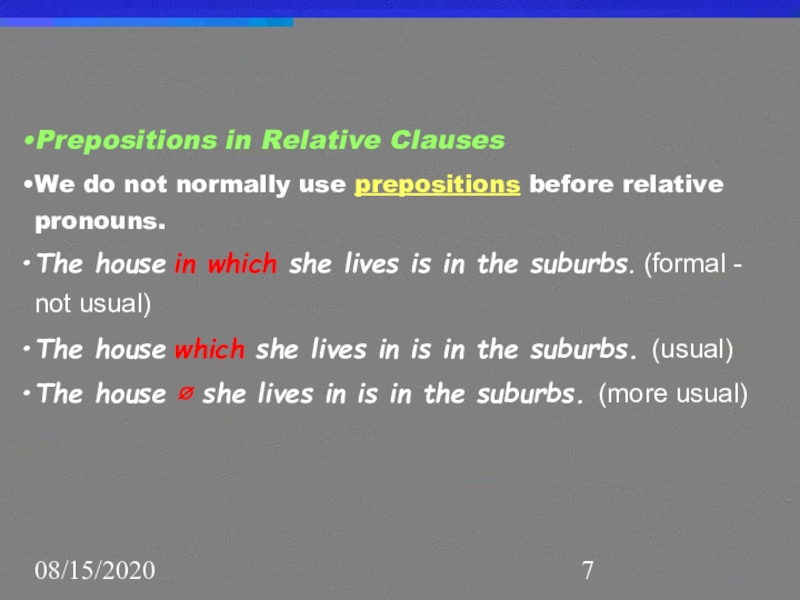
Prepositions in Relative Clauses
We do not normally use prepositions before
relative pronouns.
The house in which she lives is in the suburbs. (formal - not usual)
The house which she lives in is in the suburbs. (usual)
The house ∅ she lives in is in the suburbs. (more usual)
The house in which she lives is in the suburbs. (formal - not usual)
The house which she lives in is in the suburbs. (usual)
The house ∅ she lives in is in the suburbs. (more usual)
Слайд 808/15/2020
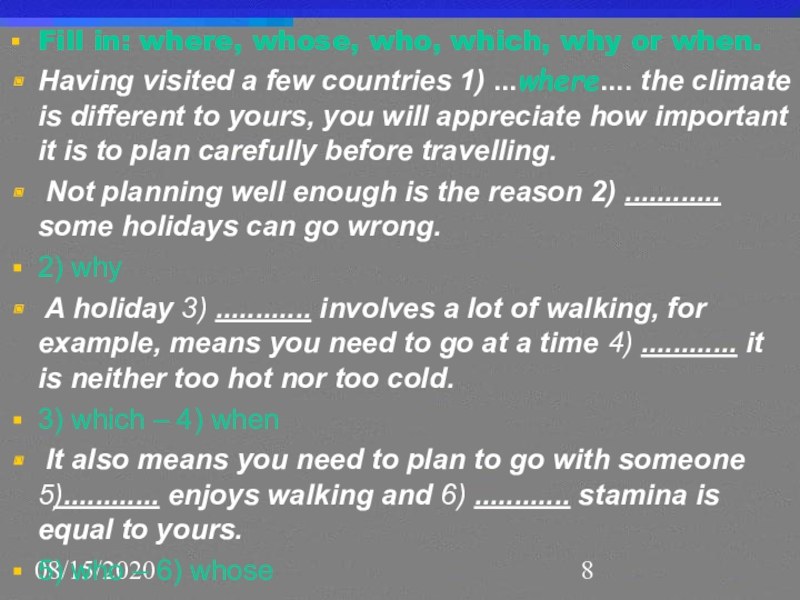
Fill in: where, whose, who, which, why or when.
Having visited a
few countries 1) ...where.... the climate is different to yours, you will appreciate how important it is to plan carefully before travelling.
Not planning well enough is the reason 2) ............ some holidays can go wrong.
2) why
A holiday 3) ............ involves a lot of walking, for example, means you need to go at a time 4) ............ it is neither too hot nor too cold.
3) which – 4) when
It also means you need to plan to go with someone 5)............ enjoys walking and 6) ............ stamina is equal to yours.
5) who – 6) whose
Not planning well enough is the reason 2) ............ some holidays can go wrong.
2) why
A holiday 3) ............ involves a lot of walking, for example, means you need to go at a time 4) ............ it is neither too hot nor too cold.
3) which – 4) when
It also means you need to plan to go with someone 5)............ enjoys walking and 6) ............ stamina is equal to yours.
5) who – 6) whose
Слайд 908/15/2020
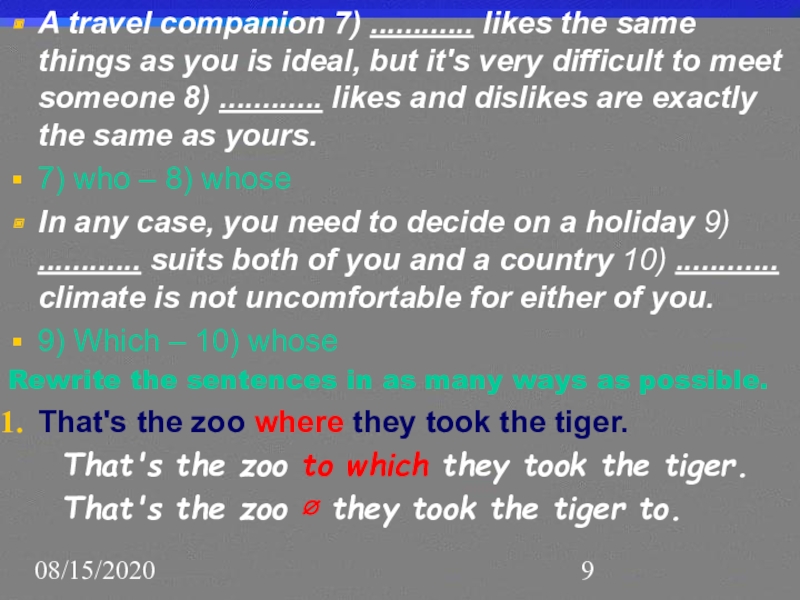
A travel companion 7) ............ likes the same things as you
is ideal, but it's very difficult to meet someone 8) ............ likes and dislikes are exactly the same as yours.
7) who – 8) whose
In any case, you need to decide on a holiday 9) ............ suits both of you and a country 10) ............ climate is not uncomfortable for either of you.
9) Which – 10) whose
Rewrite the sentences in as many ways as possible.
That's the zoo where they took the tiger.
That's the zoo to which they took the tiger.
That's the zoo ∅ they took the tiger to.
7) who – 8) whose
In any case, you need to decide on a holiday 9) ............ suits both of you and a country 10) ............ climate is not uncomfortable for either of you.
9) Which – 10) whose
Rewrite the sentences in as many ways as possible.
That's the zoo where they took the tiger.
That's the zoo to which they took the tiger.
That's the zoo ∅ they took the tiger to.
Слайд 1008/15/2020
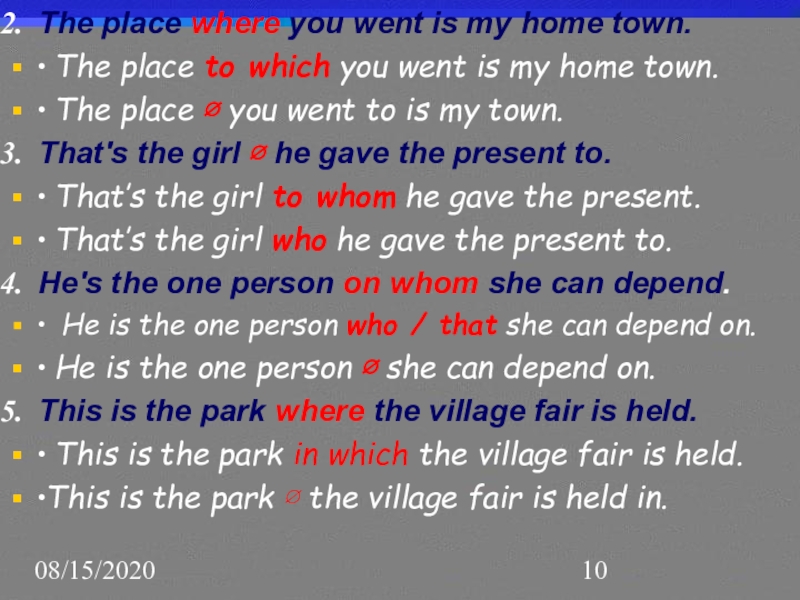
The place where you went is my home town.
∙ The place to
which you went is my home town.
∙ The place ∅ you went to is my town.
That's the girl ∅ he gave the present to.
∙ That’s the girl to whom he gave the present.
∙ That’s the girl who he gave the present to.
He's the one person on whom she can depend.
∙ He is the one person who / that she can depend on.
∙ He is the one person ∅ she can depend on.
This is the park where the village fair is held.
∙ This is the park in which the village fair is held.
∙This is the park ∅ the village fair is held in.
∙ The place ∅ you went to is my town.
That's the girl ∅ he gave the present to.
∙ That’s the girl to whom he gave the present.
∙ That’s the girl who he gave the present to.
He's the one person on whom she can depend.
∙ He is the one person who / that she can depend on.
∙ He is the one person ∅ she can depend on.
This is the park where the village fair is held.
∙ This is the park in which the village fair is held.
∙This is the park ∅ the village fair is held in.
Слайд 1108/15/2020
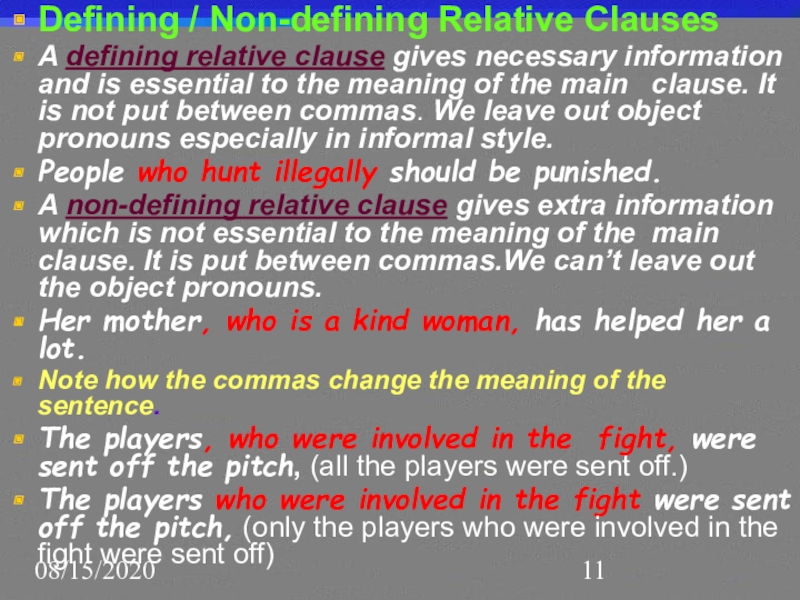
Defining / Non-defining Relative Clauses
A defining relative clause gives necessary information
and is essential to the meaning of the main clause. It is not put between commas. We leave out object pronouns especially in informal style.
People who hunt illegally should be punished.
A non-defining relative clause gives extra information which is not essential to the meaning of the main clause. It is put between commas.We can’t leave out the object pronouns.
Her mother, who is a kind woman, has helped her a lot.
Note how the commas change the meaning of the sentence.
The players, who were involved in the fight, were sent off the pitch, (all the players were sent off.)
The players who were involved in the fight were sent off the pitch, (only the players who were involved in the fight were sent off)
People who hunt illegally should be punished.
A non-defining relative clause gives extra information which is not essential to the meaning of the main clause. It is put between commas.We can’t leave out the object pronouns.
Her mother, who is a kind woman, has helped her a lot.
Note how the commas change the meaning of the sentence.
The players, who were involved in the fight, were sent off the pitch, (all the players were sent off.)
The players who were involved in the fight were sent off the pitch, (only the players who were involved in the fight were sent off)
Слайд 1208/15/2020
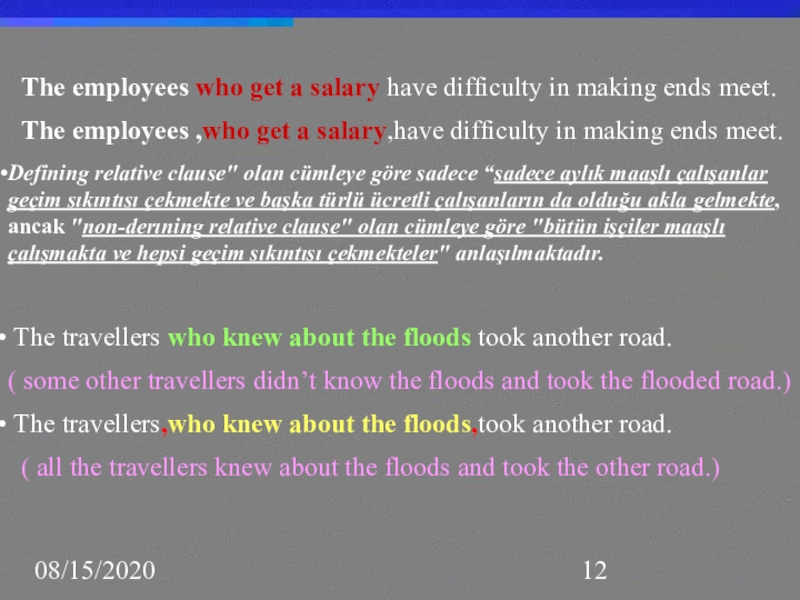
The employees who get a salary have difficulty in making ends
meet.
The employees ,who get a salary,have difficulty in making ends meet.
The employees ,who get a salary,have difficulty in making ends meet.
Defining relative clause" olan cümleye göre sadece “sadece aylık maaşlı çalışanlar geçim sıkıntısı çekmekte ve başka türlü ücretli çalışanların da olduğu akla gelmekte, ancak "non-derıning relative clause" olan cümleye göre "bütün işçiler maaşlı çalışmakta ve hepsi geçim sıkıntısı çekmekteler" anlaşılmaktadır.
The travellers who knew about the floods took another road.
( some other travellers didn’t know the floods and took the flooded road.)
The travellers,who knew about the floods,took another road.
( all the travellers knew about the floods and took the other road.)
Слайд 1308/15/2020
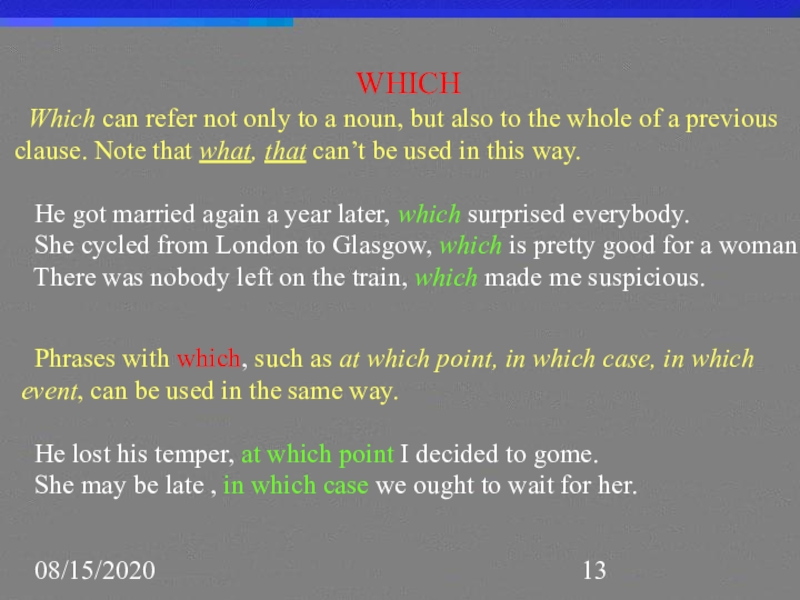
WHICH
Which can refer not only to a noun, but
also to the whole of a previous
clause. Note that what, that can’t be used in this way.
He got married again a year later, which surprised everybody.
She cycled from London to Glasgow, which is pretty good for a woman.
There was nobody left on the train, which made me suspicious.
clause. Note that what, that can’t be used in this way.
He got married again a year later, which surprised everybody.
She cycled from London to Glasgow, which is pretty good for a woman.
There was nobody left on the train, which made me suspicious.
Phrases with which, such as at which point, in which case, in which
event, can be used in the same way.
He lost his temper, at which point I decided to gome.
She may be late , in which case we ought to wait for her.
Слайд 1408/15/2020
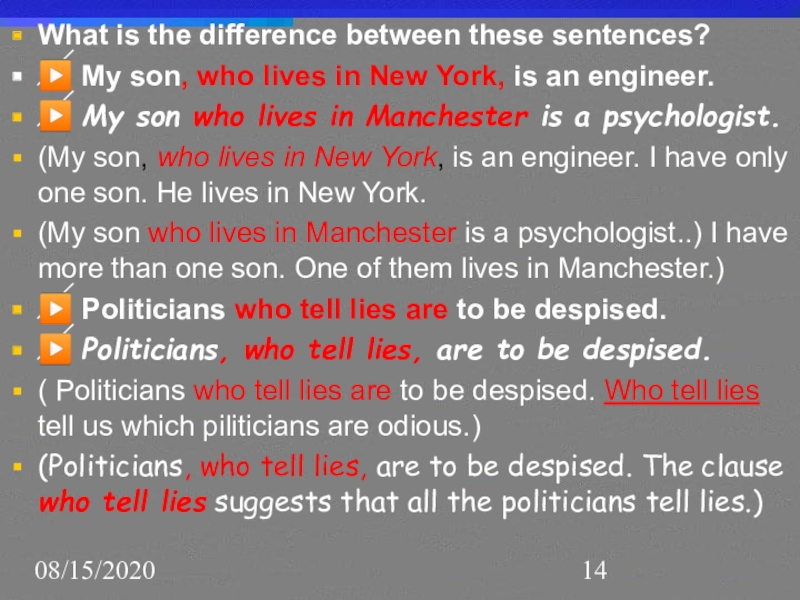
What is the difference between these sentences?
▶ My son, who lives
in New York, is an engineer.
▶ My son who lives in Manchester is a psychologist.
(My son, who lives in New York, is an engineer. I have only one son. He lives in New York.
(My son who lives in Manchester is a psychologist..) I have more than one son. One of them lives in Manchester.)
▶ Politicians who tell lies are to be despised.
▶ Politicians, who tell lies, are to be despised.
( Politicians who tell lies are to be despised. Who tell lies tell us which piliticians are odious.)
(Politicians, who tell lies, are to be despised. The clause who tell lies suggests that all the politicians tell lies.)
▶ My son who lives in Manchester is a psychologist.
(My son, who lives in New York, is an engineer. I have only one son. He lives in New York.
(My son who lives in Manchester is a psychologist..) I have more than one son. One of them lives in Manchester.)
▶ Politicians who tell lies are to be despised.
▶ Politicians, who tell lies, are to be despised.
( Politicians who tell lies are to be despised. Who tell lies tell us which piliticians are odious.)
(Politicians, who tell lies, are to be despised. The clause who tell lies suggests that all the politicians tell lies.)
Слайд 1508/15/2020
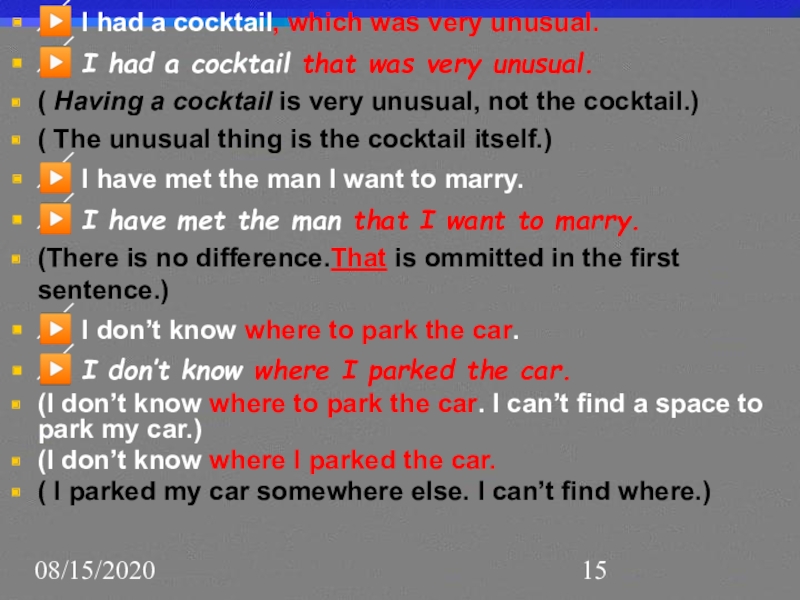
▶ I had a cocktail, which was very unusual.
▶ I had
a cocktail that was very unusual.
( Having a cocktail is very unusual, not the cocktail.)
( The unusual thing is the cocktail itself.)
▶ I have met the man I want to marry.
▶ I have met the man that I want to marry.
(There is no difference.That is ommitted in the first sentence.)
▶ I don’t know where to park the car.
▶ I don’t know where I parked the car.
(I don’t know where to park the car. I can’t find a space to park my car.)
(I don’t know where I parked the car.
( I parked my car somewhere else. I can’t find where.)
( Having a cocktail is very unusual, not the cocktail.)
( The unusual thing is the cocktail itself.)
▶ I have met the man I want to marry.
▶ I have met the man that I want to marry.
(There is no difference.That is ommitted in the first sentence.)
▶ I don’t know where to park the car.
▶ I don’t know where I parked the car.
(I don’t know where to park the car. I can’t find a space to park my car.)
(I don’t know where I parked the car.
( I parked my car somewhere else. I can’t find where.)
Слайд 1608/15/2020
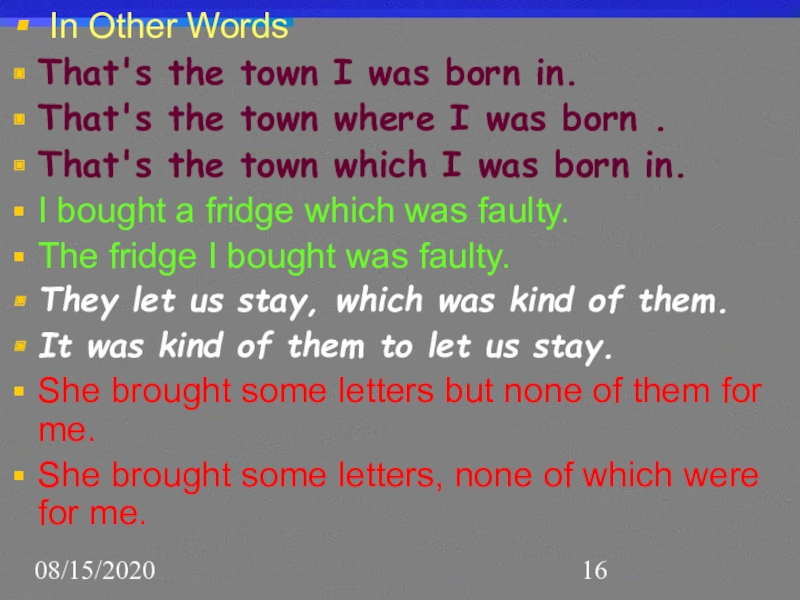
In Other Words
That's the town I was born in.
That's
the town where I was born .
That's the town which I was born in.
I bought a fridge which was faulty.
The fridge I bought was faulty.
They let us stay, which was kind of them.
It was kind of them to let us stay.
She brought some letters but none of them for me.
She brought some letters, none of which were for me.
That's the town which I was born in.
I bought a fridge which was faulty.
The fridge I bought was faulty.
They let us stay, which was kind of them.
It was kind of them to let us stay.
She brought some letters but none of them for me.
She brought some letters, none of which were for me.
Слайд 1708/15/2020
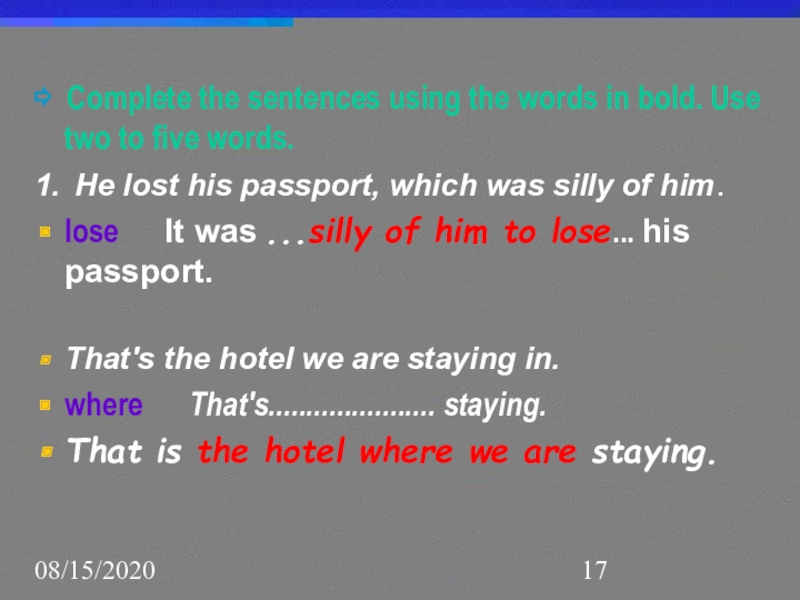
⇨ Complete the sentences using the words in bold. Use two
to five words.
1. He lost his passport, which was silly of him.
lose It was ...silly of him to lose... his passport.
That's the hotel we are staying in.
where That's...................... staying.
That is the hotel where we are staying.
1. He lost his passport, which was silly of him.
lose It was ...silly of him to lose... his passport.
That's the hotel we are staying in.
where That's...................... staying.
That is the hotel where we are staying.
Слайд 1808/15/2020
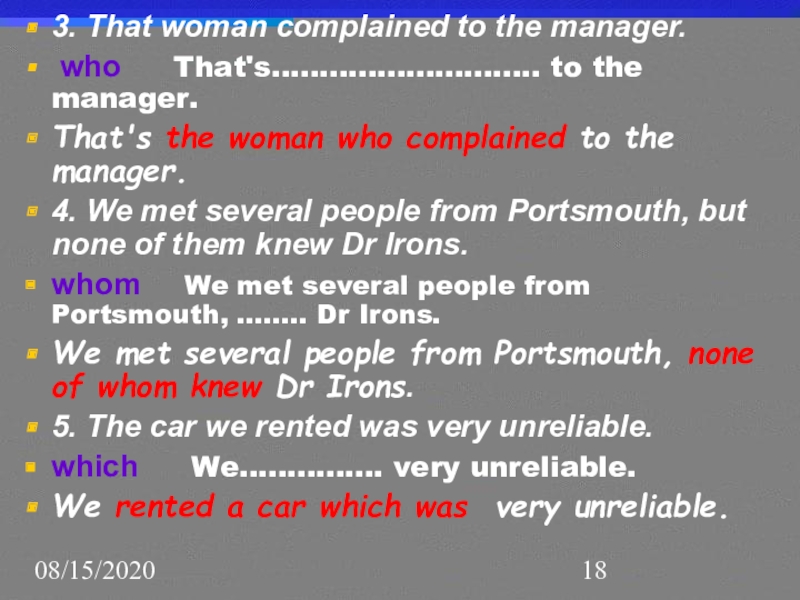
3. That woman complained to the manager.
who That's............................
to the manager.
That's the woman who complained to the manager.
4. We met several people from Portsmouth, but none of them knew Dr Irons.
whom We met several people from Portsmouth, ........ Dr Irons.
We met several people from Portsmouth, none of whom knew Dr Irons.
5. The car we rented was very unreliable.
which We............... very unreliable.
We rented a car which was very unreliable.
That's the woman who complained to the manager.
4. We met several people from Portsmouth, but none of them knew Dr Irons.
whom We met several people from Portsmouth, ........ Dr Irons.
We met several people from Portsmouth, none of whom knew Dr Irons.
5. The car we rented was very unreliable.
which We............... very unreliable.
We rented a car which was very unreliable.
Слайд 1908/15/2020
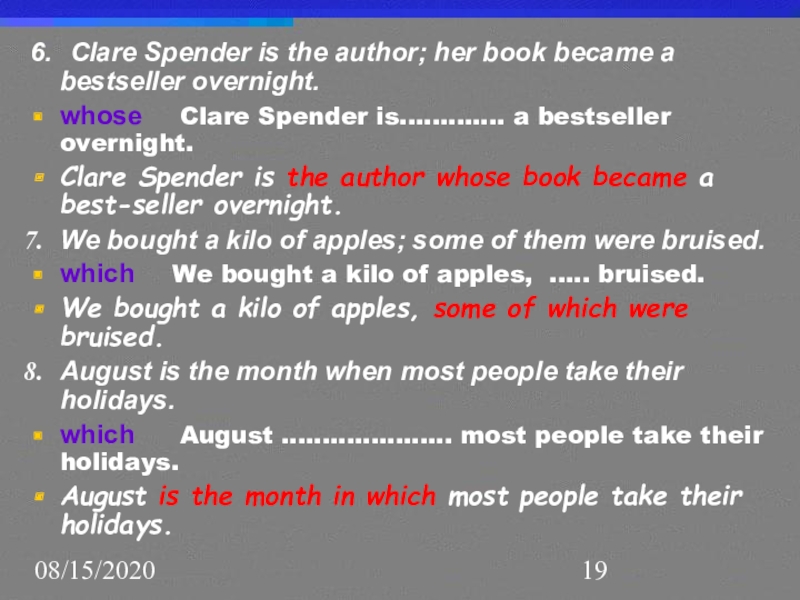
6. Clare Spender is the author; her book became a bestseller overnight.
whose
Clare Spender is............. a bestseller overnight.
Clare Spender is the author whose book became a best-seller overnight.
We bought a kilo of apples; some of them were bruised.
which We bought a kilo of apples, ..... bruised.
We bought a kilo of apples, some of which were bruised.
August is the month when most people take their holidays.
which August ..................... most people take their holidays.
August is the month in which most people take their holidays.
Clare Spender is the author whose book became a best-seller overnight.
We bought a kilo of apples; some of them were bruised.
which We bought a kilo of apples, ..... bruised.
We bought a kilo of apples, some of which were bruised.
August is the month when most people take their holidays.
which August ..................... most people take their holidays.
August is the month in which most people take their holidays.
Слайд 2008/15/2020
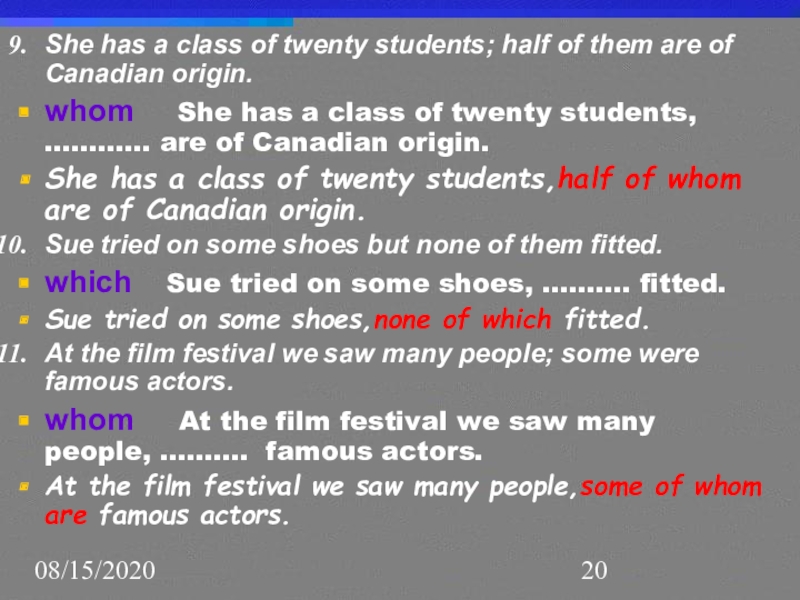
She has a class of twenty students; half of them are
of Canadian origin.
whom She has a class of twenty students, ............ are of Canadian origin.
She has a class of twenty students,half of whom are of Canadian origin.
Sue tried on some shoes but none of them fitted.
which Sue tried on some shoes, .......... fitted.
Sue tried on some shoes,none of which fitted.
At the film festival we saw many people; some were famous actors.
whom At the film festival we saw many people, .......... famous actors.
At the film festival we saw many people,some of whom are famous actors.
whom She has a class of twenty students, ............ are of Canadian origin.
She has a class of twenty students,half of whom are of Canadian origin.
Sue tried on some shoes but none of them fitted.
which Sue tried on some shoes, .......... fitted.
Sue tried on some shoes,none of which fitted.
At the film festival we saw many people; some were famous actors.
whom At the film festival we saw many people, .......... famous actors.
At the film festival we saw many people,some of whom are famous actors.